Agriculture

Cereal solution

Context: The United Nations has declared 2023 as the International Year of Millets, and Finance Minister Nirmala Sitharaman has singled them out as the "best among grains." With rising demand for sustainable agriculture, India is looking to market millet as a global panacea.

Prime Minister of India has recently inaugurated a global conference on millets, Millets have been recognized by the government as a potential ally against climate change and malnutrition, and the United Nations has declared 2023 as the International Year of Millets. Promoting millets as a superior crop to rice and wheat ignores the economics of production and could have negative consequences for marginal farmers. 

Millets:

Millets, a group of small-grained cereal crops, are highly resilient to extreme weather conditions and can be grown with minimal chemical inputs such as fertilizers and pesticides. Millets are a versatile and healthy grain alternative, as they are both gluten-free and non-allergenic. They are nutri-cereals which are highly nutritious and are known to have high nutrient content which includes protein, essential fatty acids, dietary fibre, B-Vitamins, minerals such as calcium, iron, zinc, potassium, and magnesium. 

Significance & Benefits of Millets:

  1. Nutritionally rich: Millet grains are an excellent choice for meeting your nutritional needs due to their abundance of nutrients such as carbohydrates, protein, dietary fibre, and good-quality fat. They also possess a variety of phytochemicals, known for their therapeutic properties, which can offer anti-inflammatory and anti-oxidative benefits. 
  2. Health benefits: They contain high amounts of antioxidants which are known to effectively reduce both LDL (low-density lipoprotein) and total cholesterol levels while promoting healthy blood vessels, ultimately lowering the risk of heart disease and stroke. Furthermore, millets are beneficial in managing health concerns such as obesity, diabetes, etc.
  3. Climate Resilient: Millets are an essential component of dry land agriculture, serving as hardy and resilient crops with minimal carbon and water footprint. These "miracle grains" or "crops of the future" possess the ability to endure high temperatures and grow in poor soil conditions, requiring minimal external inputs. 
  4. Ecologically Sustainable: Millet production is not dependent on the use of chemical fertilizers. These crops do not attract pests, and a majority of the millets are not affected by storage pests. 

Millets are categorized as Major or Minor Millets based on grain size.

Major Millets:

  1. Sorghum (Jowar)
  • Rich in potassium, phosphorous, calcium with sufficient amount of iron, zinc, and sodium.
  1. Pearl Millet (Bajra)
  • Contains considerably high proportion of proteins as well as lipids.
  • It is also rich in calcium and unsaturated fats.
  1. Finger Millet (Ragi)
  • Richest source of calcium & it has highest mineral content.
  • It has high antioxidant activity.

Minor Millets:

  1. Foxtail Millet (Kakum)
  • Rich in carbohydrates and has double quantity of protein content compared to rice.
  • It contains minerals such as copper and iron.
  1. Kodo Millet (Kodon)
  • It has high protein content, low fat, and very high fibre content.
  • It contains high amount of lecithin and is an excellent for strengthening the nervous system.
  1. Barnyard Millet (Sanwa)
  • It is the richest source of crude fibre and iron.
  1. Little Millet (Kutki/Shavan)
  • It is high in iron content.
  • It has high antioxidant properties.
  1. Proso Millet (Chenna/Barri)
  • It contains highest amount of protein.
  • It is cheaper source of manganese as compared to other conventional source like spices and nuts.

Pseudo Millets: 

Two prominent pseudo-millets are: 

  1. Amaranth (Ramdana/Rajgira)
  • High protein & fibre content
  • A rich dietary source of phytosterols, with cholesterol lowering properties.
  1. Buckwheat (Kuttu) Amaranth (Ramdana/Rajgira) 
  • It is rich in carbohydrates (mainly starch).
  • Contains Vitamin B1, C and E.

Efforts to promote Millets by India:

  1. India celebrated 2018 as “The National Year of Millets” to promote the production and consumption of millets in the country. 
  2. Recognizing the importance of millets, and creating a domestic and global demand along with providing nutritious food to the people, the Government of India, spearheaded the United Nations General Assembly (UNGA) resolution for declaring the year 2023 as International Year of Millets.
  3. The Government, under the Sub Mission on National Food Security Mission (NFSM) -Nutri-cereals, is creating awareness among farmers for Nutri Cereals (Millets) such as ragi, sorghum, bajra and small millets through demonstration and training.
  4. Indian Institute of Millets Research in Hyderabad will be promoted as centre of excellence for millets.
  5. The Agricultural and Processed Food Products Export Development Authority (APEDA) and Agriculture Ministry participated in a trade show in Belgium (in January 2023) wherein a multi-stakeholder delegation showcased the diversity of Indian millets.

Status of Millets Production in India:
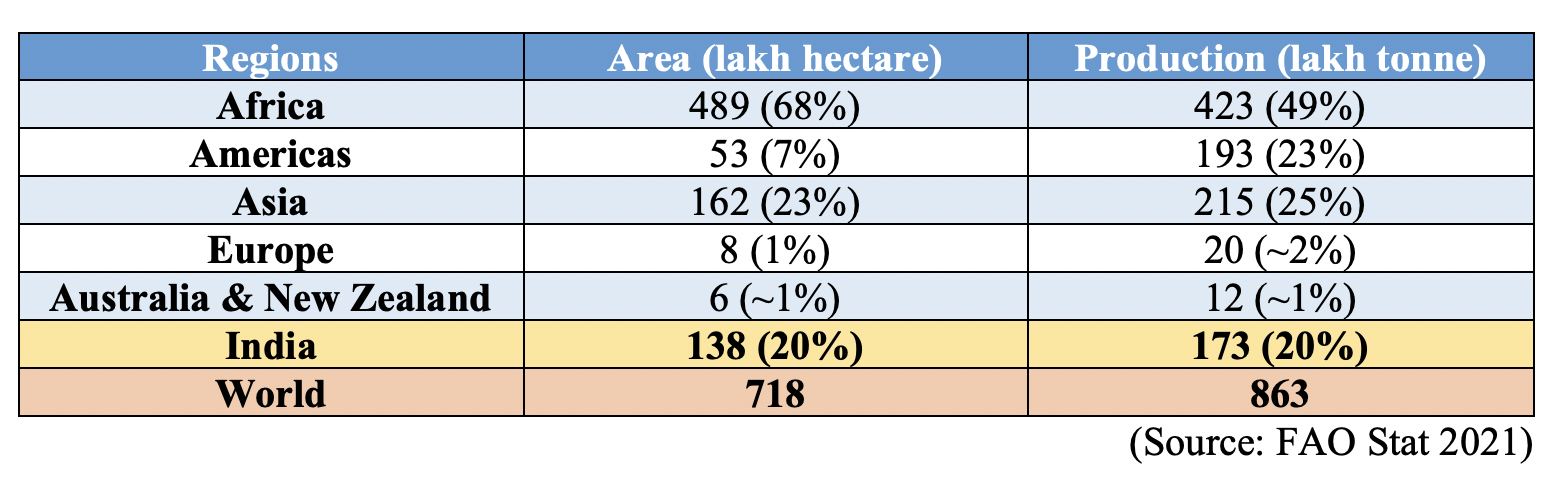
OspFu04uFLE9E205lmBcgDdITzz DZemtydMw9JqrASnUAEzyThvwYCYQZdVjjxGXjypykTi0luRVsbWwW5j6 T99YVkLgn8Cw epoiwSg4usEzC1qd5Em2XjXWMB9LsqiuFSoPkt3Kwcz8ab Qg
  1. India produces more than 170 lakh tonnes of millet, which is 80 per cent of Asia’s and 20 per cent of global production.
  2. India produces all the nine commonly known millets and is the largest producer and fifth-largest exporter of millets in the world.
  3. India recorded 27 per cent growth in millet production in 2021-22 as compared to millet production in the previous year was 15.92 MMT.
  4. Pearl millet (60%) followed by Sorghum (27%), and Finger millet (11%) are the major millets produced in India (as per the 4th Advance estimate 2021- 22).
  5. The major millets producing states in India are Rajasthan, Uttar Pradesh, Haryana, Gujarat, Madhya Pradesh, Maharashtra, Karnataka, Tamil Nadu, Andhra Pradesh, and Telangana.
  6. India exported millets products worth of USD 34.32 million during 2021-22. In 2020- 21, India exported millets worth USD 26.97 million against USD 28.5 million in 2019-20.

The UN General Assembly's declaration of 2023 as 'The International Year of Millets' has paved the way for a global increase in the cultivation of millet. India, being the world's largest producer of millet, is taking comprehensive measures to capitalize on this opportunity.

However, the success of this movement depends on striking a balance between promoting the advantages of millets, supporting the livelihoods of all farmers, and ensuring food security for all.

Electronic-Negotiable Warehouse Receipts

About Warehousing Development & Regulatory Authority (WDRA)

  • WDRA is a statutory body created under the Warehousing (Development & Regulation) Act, 2007 and shall have the duty to regulate and ensure implementation of WDRA, 2007 and promote orderly growth of warehousing business.
  • It is headed by a Chairman and two full-time members.
  • WDRA aims to ensure that interests of farmers are protected through
    • Growth and development in warehousing sector.
    • Improve fiduciary trust of depositors and banks.
    • Increase in liquidity in rural areas.
    • Encourage scientific warehousing of goods.
    • Lower cost of financing.
    • Promote shorter and efficient supply chains.
    • Enhance reward for grading and quality.
    • Ensure better price risk management.
  • Only Warehouses registered with the WDRA can issue negotiable warehouse receipts.
  • Requirements for warehouses for registration with WDRA:
    • Warehouse should be constructed as per BIS/CWC/FCI standards and is storage worthy.
    • Has all safety and security arrangements for stock and premises.
    • Has got requisite manpower with adequate experience in warehousing.
    • Availability of requisite infrastructure in weighing, grading and preservation.
    • Warehouse should have its own Standard Operating Procedures (SOPs) or adopts model SOP of WDRA.
    • Adequate insurance is taken for stock against fire, theft, burglary, misappropriation, riots, strikes or terrorism.
    • Financial network and security deposit for securing negotiable warehouse receipts issued.
  • Commodities covered against which NWRs can be issued by WDRA: Currently, 136 agricultural commodities including cereals, pulses, oilseeds, spices, rubber, tobacco, coffee etc. are notified under the WDRA Act for issuing negotiable warehouse receipts. Also, 24 horticultural commodities for cold storage and 9 non-agricultural commodities have been notified. 

About Negotiable Warehouse Receipts (NWRs):

  • NWRs issued by WDRA will help farmers to seek loans from banks against the NWRs to avoid distress sales of agricultural produce during the peak marketing season and to avoid the post-harvest storage loss. WDRA Act allows issue of NWRs in writing form or electronic form.
  • Benefits of NWRs
    • Increased liquidity in rural areas.
    • Encouragement of scientific storage of goods and thereby reducing post-harvest losses.
    • Lower cost of financing
    • Shorter and more efficient supply chains
    • Enhanced rewards for standard section, grading and quality.
    • Better price risk management
    • Better returns to farmers and better services (Quality of Goods) to consumers.

About Electronic Negotiable Warehouse Receipt (e-NWRs):

  • According to Amendment to Warehousing (Development & Regulation) Registration of Warehouses Rules, 2017, no registered warehouses under the WDRA act will issue NWRs in physical form and shall register with one or more repositories registered with WDRA for issuing negotiable warehouse receipts has migrated to system of launching electronic Negotiable Warehouse Receipt in 2018 which is a IT based eNWR ecosystem.
  • Repositories for eNWRs: Two repositories have been notified for issuing eNWRs: National E-Repository and CDSL Commodity Repository.
  • Benefits of eNWR
    • Avoidance of forgery/loss/tamper/mutilation of a physical NWR.
    • Avoidance of multiple financing against the same NWR.
    • Reduction of monitoring costs and building credibility amongst market participants.
    • Market participants to have secured accessible to view and manage their warehouse receipts via online portal.
    • Easy access to finance by enabling multiple transfers without physical movement of goods.
    • Splitting of NWRs for partial sale/pledge/withdrawal.

Steps for Mainstreaming of eNWRs

  • RBI’s Priority Sector Lending Guidelines prescribes for loan against pledge/hypothecation of agricultural produce. Thus, loans up to Rs 75 lakhs can be given against eNWRs.
  • Integration of e-NWRs with e-NAM Platforms: farmers/holders of an e-NWR issued by a registered warehouse can sell their underlying stocks on e-NAM platform and have better price discovery. The registered warehouse is required to be declared as a market sub-yard by the state authority for trade on e-NAM APMC market.

Challenges restricting expansion of NWR ecosystem:

  • Warehousing sector has been mostly un-organised and highly fragmented.
  • Registration of warehouses is voluntary and hence scope for increase in the number of registered warehouses is limited.
  • There is inadequate regulatory framework under the Act.
  • Registration system and issuance of NWRs had been paper based.
  • Monitoring & surveillance system of registered warehouses had been inadequate.

Way Forward

  • Easier registration of warehouses with WDRA.
  • Making it mandatory for newer warehouses getting assistance under government schemes to register with WDRA.
  • Training and capacity building of warehousemen.
  • Awareness among farmers about benefits and access of Negotiable Warehouse Receipts.

International Grains Council

About International Grains Council

  • International Wheat Council as established by the International Wheat Agreement, 1949 was renamed as International Grains Council by the Grains Trade Convention, in 1995. It is located in London.
  • International Grains Council is an inter-governmental organisation that administers the Grains Trade Convention.
  • Scope: Food Items Covered under the definition of Grains are Rice (added later), Pulses (added later), barley, maize, oats, rye, sorghum,  triticale and wheat and their products.
  • Functions of International Grains Council:
    • Further international cooperation in grain trade.
    • Promote expansion, openness and fairness in grains sector.
    • Contribute to grain market stability and enhance world food security.
    • Forum for exchange of information and discussion of members regarding trade in grains
  • International Grains Council has been formed under the Grains Trade Convention, 1995 and also administers the GTC.
  • Membership: Membership of IGC consists of all parties to the Grain Trade Convention, 1995 with 30 countries as members. Each member is designated as an importer or exporter based on its average trade in grains, rice and oilseeds. India is a member of this organisation. Department of Food & Public Distribution under Ministry of Consumer Affairs, Food & Public Distribution Acts as the nodal agency on behalf of government of India in International Grains Council. 
  • Chairperson and Vice-Chairperson of this council are elected annually by the council.
  • IGC holds two regular Council Sessions each year, either in London or by invitation in member countries.
  • IGC also acts as the secretariat of Food Assistance Convention, 2013. (Food Assistance Convention aims to reduce hunger, improve food security and improve nutritional status of the most vulnerable populations. India is not a party to this convention).

Initiatives of the International Grains Council

  • Grains & Oilseeds Index: An index developed by International Grains Council which provides daily updates on variation of prices of commodities covered by International Grains Council.
  • Grain Market Report: It is a monthly publication that reviews the situation and outlook for wheat (including durum), maize (corn), barley, sorghum, oats, rye, rice, soybeans, soy meal and rapeseed/canola markets.
  • Agricultural Market Information System (AMIS): International Grains Council joined the Secretariat of Agricultural Market Information System (AMIS) in 2012. AMIS was established at the request of Agriculture Ministers of G20. It covers four crops (Wheat, Maize, Rice and Soyabeans). AMIS aims to promote food market transparency and coordination of policy action in response to market uncertainty.

Grains Trade Convention, 1995 (GTC)

  • GTC is the only international treaty covering trade in grains, rice and oilseeds trade.
  • Scope: Food Items Covered under the definition of Grains are Rice (added later), Pulses (added later), barley, maize, oats, rye, sorghum,  triticale and wheat and their products.
  • Recently, Egypt which is one of the largest importers of Wheat in the world, withdrew from the Grains Trade Convention, 1995.

Bio & Organic Fertilisers

NITI Aayog has released a report on the promotion of Bio and Organic Fertilisers.

Organic Fertilisers

  • Organic fertilisers are substances made up of one or more unprocessed materials of a biological nature (plant/animal) and may include unprocessed mineral materials that have been altered through the microbiological decomposition process.
  • Organic fertilisers are composted/fermented products made from organic wastes (city waste, agro-waste, crop residue, livestock waste, food processing industry waste etc.)
  • Organic fertilisers specified under FCO, 1985 are classified into the following categories:
  • City compost
  • Vermicompost
  • Phosphate-rich organic manure
  • Organic manure
  • Bio-enriched organic manure
  • Bone meal (raw/steamed)
  • Potash derived from rhodophytes
  • Fermented organic manure
  • Liquid-fermented organic manure

Biofertilisers

  • Biofertilisers are different from organic fertilisers. Biofertilisers are defined as a product containing carrier-based (solid or liquid) living microorganisms which are agriculturally useful in terms of nitrogen fixation, phosphorus solubilisation or nutrient mobilisation, to increase the productivity of soil and/or crop (FCO 1985).
  • Upon application to seed or soil, these microbial preparations multiply rapidly around emerging crop roots and fix/mobilise nutrients from air and soil, from unavailable form to available form.
  • Nutrient solubilisers (P, K or Zn solubilizers) transform insoluble nutrients present in the soil to soluble form for easy uptake by crop plants.
  • Average dose of mixed bio fertilisers application is 6 litre/hectare for liquid formulations and 12 kg/hectare for solid carrier-based for solid carrier-based, for fixation/solubilisation of 20-25 kg nutrients/hectare.
  • Biofertilisers are available in four different forms:
    • Nitrogen fixers (Rhizobium, Azotobacter, Azospirillum, Gluconacetobacter)
    • Phosphorus solubilisers (Wide range of bacteria, fungi and Mycorrhiza)
    • Potassium solubilisers (Bacillus mucilaginous, Bacillus edaphicus, Bacillus circulanscan, Frateuriaaurentia)
    • Zinc and other micronutrient solubilisers.

Regulation of Organic & Biofertilisers

  • Organic & Biofertilisers are regulated by the Fertiliser (Inorganic, Organic or Mixed) (Control) Order (FCO, 1985) under the Union Ministry of Agriculture & Farmers' Welfare.
  • Currently, 11 bio fertilisers & 10 organic fertilisers are approved under FCO for use in India as of now.

Need for promoting organic and biofertilisers

  • Sustainable Agriculture: Organic and chemical-free agriculture can reverse environmental ill effects like groundwater depletion and loss of biodiversity etc primarily caused due to overuse of chemical fertilisers and pesticides after the green revolution.
    • Nutrient run-off from farms laced with chemical fertilisers adversely affects land ecosystems.
    • Ammonia emissions from agricultural activities can combine with vehicle exhausts to create dangerous particulates in the air and exacerbate respiratory diseases.
    • Chemical fertiliser production and use also lead to significant greenhouse gas emissions.
  • Promoting Soil Health: India's soil is getting depleted of organic matter. Nutritional quality of food produced from soil poor in organic matter is also poor. Organic and bio fertilisers conserve the micro-fauna of soil and act as a natural surface purifier. Dung manure contains basic elements critical to plant health i.e., nitrogen (N), phosphorus (P), potassium (K) and several micronutrients. Also, humus in dung manure act as a soil amender and preserves moisture in the soil. Application of organic and bio fertilisers will lead to the sustainability of agriculture.
  • Incomes for farmers and gaushalas: Promoting the use of cow dung manure will improve economy of gaushalas, support natural farming and improve sustainability of agriculture.
  • Address the problem of stray cattle: Promoting use of cow and animal waste-based organic and bio-fertilisers will address the issue of stray cattle which has led to a big menace in rural areas.
  • Waste management: Production of bio and organic fertilisers from animal waste, cow dung etc. will help to sustainably address the issue of waste management in rural areas.
  • Less input cost of agriculture: Increasing the use of bio and organic fertilisers will reduce the input cost of farming and is expected to increase the incomes of farmers over the long term.
  • Reduced expenditure on fertiliser subsidy: Fertilisers subsidy alone accounts for more than Rs 1,50,000 lakh crores per year. This increases the fiscal deficit of the government. This can be reduced if we promote the use of bio and organic fertilisers.
  • Fertiliser security: Most chemical fertilisers have to be imported into India as India lacks domestic sources of phosphorous, potassium and urea. This dependence on imports exposes Indian agriculture to supply chain constraints. Thus, promoting bio and organic fertilisers will come to the fertiliser supply more assured.

Government Initiatives for Promoting Organic and Biofertilisers

  • Paramparagat Krishi Vikas Yojana
  • Mission Organic Value Chain Development for North Eastern Region
  • Namami Ganga Program
  • National Program for Organic Production
  • Capital Investment Subsidy Scheme (CISS)
  • Soil Health Management Scheme
  • Policy on Promotion of City Compost
  • New National Biogas and Organic Manure Programme (NNBOMP)
  • Government has set a target to bring additional 10 lakh hectares under organic farming in the next 3 years.

Challenges

  • Heavy subsidies on chemical fertilisers especially urea discourage the use and uptake of organic fertilisers and biofertilisers, which do not get any subsidy.
  • Limited R&D in the field of organic & bio fertilisers.
  • Lack of regional resource centres for the supply of authentic and efficient microbial strains; Lack of awareness of biofertilisers for proper preservation, sub-culturing, storage, and procurement of authentic strains suitable for local environmental conditions.
  • Lack of availability of options for enriched organic fertilisers with essential nutrients for agricultural use.
  • Absence of economically viable mass production systems could lower the selling cost of biofertilisers.
  • Inadequate funds are spent on the promotion of bio and organic fertilisers despite various schemes for their promotion of them.
  • Lack of suitable infrastructure: Infrastructure support funds provided under schemes like the Capital Investment Subsidy Scheme and Soil Health Management have not seen much uptake in states and remain underutilised. Gaushalas and farmers cannot market compost and other organic fertiliser produced by them and there is no organised market and buyer for their produce.
  • Lack of extension and awareness on the use and benefits of organic and bio fertilisers amongst farming communities.
  • Issues of regulation: (i) FCO does not list some bio & organic fertilisers prepared from livestock waste such as Panchagavya, Dasagavya, Sheep & Goat Manure, Poultry Manure, Sanjivak, Gokripa Amrut, Amrit Pani, Fermented curd water, Ghanjivamrut, Crystallised cow urine. (ii) Lack of testing facilities and personnel and certification for organic and bio fertilisers in states which have slowed market prospects for manufacturers of organic fertilisers, especially PROM. (iii) Currently, the regulatory process for Bio and Organic fertilisers differs between states.

Way Forward

  • Digitisation of the whole process of manufacturing, license to sale authorisation to a dealer, stock records and maintenance, timely sampling by an inspector as per FCO with time-bound consultation with States.
  • Parity between inorganic and bio and organic fertilisers: There is a need for some parity in support for organic & bio fertilisers vis-a-vis organic, bio fertilisers and other animal waste-based compost, manures, jivamrit etc. This will also help cow farmers and cow shed owners earn extra income.
  • Marketing of bio & organic fertiliser: (i) Public sector fertiliser distribution agencies like IFFCO, KRIBHCO and such state-level agencies should be mandated to market standardised bio and organic fertilisers. (ii) A mechanism should be established to mandate fertiliser selling and manufacturing agencies to sell inorganic and organic fertiliser. (iii) Policy support to encourage commercial production, packaging, marketing & distribution of cow dung-based organic fertilisers including brand development. (iv) Gram panchayats should be involved in the production of organic and bio fertilisers at cow sheds.
  • Expanding the scope of FCO, 1985: (i) FCO, 1985 should be amended to include livestock waste fertilisers such as Panchagavya etc. (ii) Adequate testing facility should be created for manufacturers of organic and bio fertilisers. (iii) Quality certification of bio and organic fertilisers should be undertaken which would help farmers to identify safe and certified products. (iv) There is a need for uniformity in the regulatory process accommodating state specificities across India for registration and marketing of bio and organic fertilisers.
  • Incentives to encourage production and consumption of bio & organic fertilisers: (i) Extension of subsidy/market development assistance for bio fertiliser in line with city compost Rs 1500/ton. (ii) Mandatory 10-20% off-take of bio and organic fertiliser by fertiliser companies. (iii) Via gap funding to be provided to capital assistance and marketing of cow dung and cow-urine-based formulations for application in agriculture. (iv) Attracting the private sector to invest in mass-scale production of organic and bio fertilisers, bio pesticides, soil-enriching products and stimulants for use in agriculture.
  • Research & Development: (i) Improvement of efficiency of different formulations of organic and bio fertiliser. (ii) ICAR and other institutions should be encouraged to research organic & biofertilisers. (iii) These institutions should be encouraged to carry extension among farmers to take over bio and organic fertilisers.

National Horticulture Board

About National Horticulture Board (NHB):

  • The NHB was set up by the Government of India in 1984 as an Autonomous organisation under the administrative control of the Ministry of Agriculture and Farmers Welfare.
  • It is registered as a society under Societies Registration Act with its headquarters at Gurugram.
  • Presently, NHB has 29 field offices located all over the country.

Aims & Objectives of NHB Schemes:

The main objectives of the NHB are to improve integrated development of the Horticulture industry and to help in coordinating, sustaining the production and processing of fruits and vegetables. Detailed objectives of the Board are as under:-

  • Development of hi-tech commercial horticulture in identified belts and make such areas vibrant with horticultural activity, which in turn will act as hubs for development of horticulture.
  • Development of modern post-harvest management infrastructure as an integral part of area expansion projects or as a common facility for clusters of projects.
  • Development of integrated, energy efficient cold chain infrastructure for fresh horticulture produce.
  • Popularisation of identified new technologies / tools / techniques for commercialization / adoption, after carrying out technology and need assessment.
  • Assistance in securing availability of quality planting material by promoting setting up of scion and rootstock banks / mother plant nurseries and carrying out accreditation / rating of horticulture nurseries and need based imports of planting material.
  • Promotion and market development of fresh horticultural produce.
  • Promotion of field trials of newly developed/imported planting materials and other farm inputs; production technology; PHM protocols, INM and IPM protocols and promotion of applied R&D programmes for commercialization of proven technology.
  • Promotion of Farm Mechanization in Horticulture through demonstration and its uses at farmers field level to reduce labour cost and increase the productivity of Horticulture crops.
  • Promotion of applied R & D for standardising PHM protocols, prescribing critical storage conditions for fresh horticulture produce, benchmarking of technical standards for cold chain infrastructure etc.
  • Transfer of technology to producers/farmers and service providers such as gardeners, nurserymen, farm level skilled workers, operators in cold storages, work force carrying out post harvest management including processing of fresh horticulture produce and to the master trainers.
  • Promotion of consumption of horticulture produce and products.
  • Promoting long distance transport solutions for bulk movement of horticulture produce through rail etc.
  • Carrying out studies and surveys to identify constraints and develop short and long term strategies for systematic development of horticulture and providing technical services including advisory and consultancy services.

Wheat output and food inflation

Wheat production will not drive food inflation in India. The reason is the world has overcome, if not shrugged off, the effects of the Ukraine war. The supply situation has changed from deficit to, perhaps, surplus in most agri-commodities.

Reasons to support the contention that ‘wheat production will not drive food inflation in India:

  • Grain filling in wheat crop occurs at temperatures up to 35 degrees Celsius. The maximum shouldn’t cross 37 degrees before March-end. Last year, maximum temperatures breached the 35-degrees mark in the northern plains by mid-March and 40 degrees before the month-end. Last year the mercury spiked, leading to a marginal dip in India’s wheat output. This year, record February temperatures raised concerns about the current crop, but so far, the crop looks fine, with maximum temperatures hovering at 30-33 degrees in March.
  • Global prices  of urea and di-ammonium phosphate has fallen from recent peaks is quite steep.
  • The UN Food and Agriculture Organization’s (FAO) food price index hit a historic high of 159.7 points in March 2022, the month that followed Russia’s invasion of Ukraine. But since then, the FAO index has fallen every month to touch 129.8 points in February 2023.
  • Wheat prices at the Chicago Board of Trade futures exchange have more than halved since March 2022, and the US Department of Agriculture has projected all-time-high exports of wheat by Russia, Australia, and Kazakhstan.
  • Palm oil prices in Malaysia have also retreated from an unprecedented high in March 2022, and record production and exports are expected of palm oil from Indonesia, soybean from Brazil and sunflower from Russia, alongside increased rapeseed supplies from Canada and the European Union.
  • The decline in international food prices will help ease food inflation pressures in India caused by weather shocks and supply disruptions last year.
  • The world has overcome the effects of the Ukraine war, with the supply situation changing from deficit to surplus.
  • The falling international prices will also enable the Indian government to import wheat and other food items to meet domestic demand, if needed.

Prelims Pointer: Condition for wheat production

Wheat is a staple crop that is grown in many parts of the world. The conditions required for wheat production include:

  • Climate: Wheat requires a temperate climate with moderate rainfall. It grows best in areas with an average temperature of 15-20°C during the growing season and a rainfall of 500-600 mm.
  • Soil: Wheat can grow in a wide range of soils, but it prefers well-drained loamy soils with a pH range of 6.0-7.5. The soil should be rich in organic matter and have adequate nitrogen, phosphorus, and potassium.
  • Sunlight: Wheat requires plenty of sunlight for photosynthesis and growth. It grows best in areas with at least 6 hours of direct sunlight per day.
  • Water: Wheat requires adequate moisture throughout its growing season. Irrigation may be necessary in areas with low rainfall or prolonged dry spells.
  • Pests and diseases: Wheat is susceptible to various pests and diseases, including aphids, armyworms, rusts, and smuts. Appropriate measures should be taken to prevent and control these pests and diseases.

Overall, the conditions required for wheat production vary depending on the variety of wheat being grown, the location, and the agricultural practices used. However, the above-mentioned factors are the key requirements for successful wheat production.

Purple Revolution

Lavender farmers in Jammu and Kashmir are bringing ‘Purple Revolution’

About ‘Purple Revolution’:

  • Doda in Jammu and Kashmir is the birthplace of India’s Purple Revolution. 
  • The Purple Revolution or Lavender Revolution, launched by the Ministry of Science & Technology, aims to promote the indigenous aromatic crop-based agro-economy through the ‘aroma mission’ of the Council of Scientific and Industrial Research (CSIR).
  • The mission aims to increase the income of the farmers and promote lavender cultivation on commercial scale. Lavender oil, which sells for, at least, Rs. 10,000 per litre, is the main commodity.
  • Other popular products include medicines, incense sticks, soaps, and air fresheners.
  • Lavender has been designated by the central government as a "Doda brand product" to promote the rare aromatic plant and boost the morale of farmers, entrepreneurs, and agribusinesses involved in its cultivation as part of this Aroma Mission.
  • Jammu and Kashmir’s climatic conditions are conducive to lavender cultivation since the aromatic plant can withstand both chilly winters and pleasant summers.

Benefits of Purple Revolution:

  • The market for lavender oil in India will expand at a CAGR (Compound Annual Growth Rate) of 5.5 percent, while trade is expected to touch $1 billion per year. 
  • The cultivation of lavender is very cost-effective as it yields revenue immediately. It is a low maintenance crop, which can be used from its second year of plantation and blossoms for fifteen years.
  • In its entirety, lavender production gives better returns when compared to other traditional crops. 
  • Modernised farming: value addition to lavender, Oil from lavender flowers and manufacturing of aromatic products thereby givens an opportunity for starting a startup and sparking entrepreneurship. This will help in creating additional employment.
  • The “purple revolution” has also helped women's empowerment in a big way- For example (Jammu and Kashmir): After harvesting season of traditional crops, they used to remain without work for five months during winters, but lavender farming has given them a new lease of life and they get round the year work in lavender fields.

About Aroma Mission:

About Aroma Mission
  • The CSIR Aroma Mission is envisaged to bring transformative change in the aroma sector through desired interventions in the areas of agriculture, processing and product development for fuelling the growth of the aroma industry and rural employment.
  • Aroma Mission is drawing entrepreneurs and farmers from all across the country. CSIR assisted in the cultivation of 6000 hectares of land in 46 Aspirational districts across the country during Phase I. In addition, almost 44,000 employees were trained.
  • The CSIR has started Phase-II of the Aroma Mission, which will include over 45,000 skilled human resources and help over 75,000 farming families.
  • An additional 700 tonnes of essential oil is expected to be produced annually for perfumery, cosmetics and pharmaceutical industries, and use of these oils in value addition and herbal products would generate a business of at least 200 crores.
  • The activities of the Mission will improve the availability of quality material on a sustainable basis for a boom in the herbal industry based on essential oils.
  • The income of the farmers through such cultivation is expected to increase by Rs. 30,000 to 60,000/ha/year. About 45,000 skilled human resources capable of multiplying quality planting material, distillation, fractionation and value addition will be developed.
  • More than 25,000 farming families would be directly benefitted and employment of more than 10-15 lakh mandays will be generated in rural areas.
  • The scientific interventions made under the mission project would provide assured benefits to the growers of Vidarbha, Bundelkhand, Gujarat, Marathwada, Rajasthan, Andhra Pradesh, Odisha and other states where farmers are exposed to frequent episodes of weather extremes and account for maximum suicides.
  • The mission will put a mechanism in place for timely agro-advisory, ensuring optimal productivity and fair price of the produce to the farmers and reducing the import of essential oils and enabling India to become a leading exporter of at least some essential oils.