Context:In the book 'Delhi': Unknown Tales of a City’ by Ronald Vivian Smith, the description has been of Khooni Darwaja, which was built by Sher Shah Sur.
Khooni Darwaja
Khooni Darwaza, located near the Delhi Gate, was constructed during Sher Shah Suri's reign in the 16th century (1540-45).
Initially known as Lal Darwaza, it was later renamed Khooni Darwaza due to a tragic event that took place in 1857. Lieutenant Hodson shot and killed Bahadur Shah Zafar's sons and grandson there, after the British forces recaptured Delhi and the last Emperor sought shelter in Humayun's Tomb.
Architectural features
The architectural design of Khooni Darwaza showcases a combination of Mughal and Afghan influences. Constructed using quartzite stone, the gate stands tall with three stories.
It features three arched entrances, with the central one being the largest.
The upper floors of the gate boast balconies known as jharokhas, offering panoramic views of the surrounding area.
In the past, the gate's expansive courtyard served as a gathering space for the public, as believed by historians. Enclosed by a tall wall, the courtyard encompasses various chambers and rooms.
Additionally, on either side of the gate, there are rectangular windows with decorative overhanging edges known as chajjas, supported by intricately carved brackets.
Kangura structure:
The Kangura or Kungura battlement is an important aspect of Indian monuments which serves both military and aesthetic purposes.
While the petal shaped roof boundary looks regal, it also served as a place for soldiers to guard and defend the building.
Damaaga:
Below the Kangura battlement, there are three hole-like openings. These are called damaaga.
The damaagas were also structure built for defence, and could be used to pour boiling oil on enemies scaling the gate.
Pishtaq:
The main entrance have two wonderfully carved pishtaq, or niches.
These niches could be used to keep lamps to light up the entrance in the dark.
The frames of the window are made from red sandstone.
It is a protected monument under the Archaeological Survey in India.
Establishment of Sur Dynasty
Battle of Chausa (1539): In this battle Sher Khan defeated Humayun due to his superior political and military skills.
Humayun arrived at Agra after the defeat and assembled his army with the support of his brothers Askari and Hindal to counter Sher Khan. The final encounter took place at Kanauj.
Battle of Kanauj (1540): Humayun’s army was completely routed by Sher Shah.
Sur Dynasty (1540-1555)
Founded by Sher Shah.
Through his ability and efficiency, he emerged as the chief of Afghans in India. His military capability and diplomacy made him victorious over Humayun and many other Rajput rulers.
Malwa fell without a fight and Rana Uday Singh of Mewar surrendered without resistance.
End of the dynasty:
Sher Shah’s next venture to capture Kalinjar failed as a gunshot caused his death in 1545.
Sher Shah was succeeded by his second son Islam Shah who ruled till 1553. His death at a young age led to a state of confusion about succession. Humayun used this opportunity to regain Delhi and Agra from the Sur rulers.
Architecture during Sher Shah
Indian Architecture during the reign of Sher Shah Suri can be divided into two separate time periods. The first phase which runs from 1530 to 1540, a group of tombs were constructed taking the Lodi style to its ultimate expression. During the second phase from 1540 to 1545, when Sher Shah Suri wrested control from Humayun, he patronized a list of architectural innovations which represent an important development in the gestation of the subsequent Mughal Architecture.
1. First phase (1530-1540):
The initial phase of constructing tombs in Sasaram, Bihar, clearly demonstrated Sher Shah Suri's ambition to create a monument grander than anything found in Delhi.
To bring his vision to life, he enlisted the expertise of Aliwal Khan, a master builder trained in the Imperial tradition.
The construction began in 1525 with the tomb of Hasan Sur Khan, Sher Shah Suri's father, following a fairly conventional Lodi design.
However, Khan's subsequent masterpiece, the tomb of Sher Shah Suri, is a breath-taking architectural marvel.
It is an immense and majestic structure situated in a picturesque tank.
Crafted from the finest Chunar sandstone, this remarkable monument left a significant impact on the evolution of Indo-Islamicfunerary architecture.
2. Second Phase (1540-1545):
Sher Shah Suri gained control from Humayun and supported a range of innovative architectural endeavours that played a crucial role in the development of subsequent Mughal architecture.
Purana Qila or old fort is one of the oldest forts in Delhi India. The construction began in the time of Humayun and continued under Sher Shah Suri.
Purana Qila, served as a defensive citadel and the focal point of his sixth city in Delhi, called Shergarh. He added several more structures in the fort during his reign.
The fort also includes overhanging balconies or jharokhas, topped with pillar pavilions or chhatris which is a feature of Rajasthani architecture.
Sher Mandal, an interior structure in the Old Fort is credited to Sher Shah.
The Qila-i-Kuhna Masjid, the royal chapel of Sher Shah Suri, constructed around 1542, had a far greater influence on the subsequent Mughal architecture.
It exhibits four-centred arches within definite rectangular frames, adorned with delicate spearhead fringes and merlons.
The composition is harmoniously completed by the horizontal line of the projecting chajja, resulting in a cohesive and integrated structure.
Context: A Memorandum of Agreement (MoA) was signed between the Indian Council of Medical Research (ICMR) and the Ministry of AYUSH for collaboration and cooperation in health research in the field of Integrated Medicine.
Integrated Medicine:
Integrated medicine in India refers to the practice of combining traditional Indian medicine systems, such as Ayurveda, Yoga, Unani, Siddha, and Homeopathy (AYUSH), with modern medicine.
The aim is to provide patients with a holistic approach to healthcare that takes into account physical, mental, emotional, and spiritual aspects of health. By combining different therapies, healthcare providers can tailor treatment plans to individual patients and provide more effective care.
In India, the government has established the Department of Ayurveda, Yoga and Naturopathy, Unani, Siddha, and Homoeopathy (AYUSH) to promote the integration of traditional Indian medicine with modern medicine.
Major Highlights:
Ministry of AYUSH and ICMR have joined hands to undertake quality human clinical trials to generate evidence on the benefits of using ayurveda along with modern medicine (evidence-based medicine) in treating certain disease conditions of national importance.
ICMR will design and conduct these trials as it holds decades of experience in conducting human clinical trials.
In the initial phase, the collaboration will be restricted to Ayurveda. The other systems of AYUSH — Yoga, Unani, Siddha and Homoeopathy — may be included in future, and each system will be tested together with modern medicine when the central councils of the respective AYUSH systems are ready to work with the ICMR.
An expert committee will soon decide the area/disease conditions to be included for detailed clinical testing using both Ayurveda and modern medicine.
Significance:
Scientific validation of superior outcomes of combined therapy using Ayurveda and modern medicine and aid the development of integrated medicine.
The initiative may right away not provide scientific validation of Ayurveda interventions in treating disease conditions, but it is the first major step in an evidence-based approach to validate medical interventions.
Encouraging trial outcomes might probably serve as a starting point to undertake further trials using Ayurveda interventions alone to evaluate their effectiveness and understand the mechanism of action.
Strengthen the country's health infrastructure by integrating and mainstreaming AYUSH.
Reasons for non-development of alternate medicine in India:
Lack of scientific validation: Alternative medicine is often not based on scientific evidence or rigorous testing. Without proper scientific validation, it can be difficult for alternative medicine to gain acceptance in the medical community and among the general public.
Limited government support: While India has a rich tradition of alternative medicine, government support for research and development in this field, in the past has been limited, which has hindered the growth of alternative medicine.
E.g., Lack of dedicated funding mechanism for research and development of alternative medicine.
Competition from conventional medicine: Conventional medicine, including modern pharmaceuticals, is highly developed and widely accepted in India. This has made it difficult for alternative medicine to gain a foothold and compete in the marketplace.
Lack of standardization: Unlike conventional medicine, which is highly standardized and regulated, alternative medicine often lacks standardization. This can lead to inconsistencies in the quality and efficacy of alternative treatments, which can undermine public confidence in these therapies.
Skepticism among medical professionals: Some medical professionals remain skeptical about the efficacy of alternative medicine, particularly when it comes to treating serious or life-threatening conditions.
Significance of revival and fusion of traditional Indian medicine system with modern medicine:
The collaboration with the ICMR is, therefore, a step in the right direction. The recent COVID-19 Pandemic has underscored the importance of AYUSH thus calling for its revival and fusion with modern medicine for building a holistic health system, which can:
Holistic approach: Traditional Indian medicine, such as Ayurveda, focuses on a holistic approach to health and wellness. This means that it considers the individual as a whole, including physical, mental, and emotional factors. By combining this approach with modern medicine, patients can receive more comprehensive and personalized care.
Accessibility: Traditional Indian medicine is often more accessible and affordable than modern medicine. By incorporating these therapies into modern healthcare systems, it reduces out-of-pocket expenditure.
Innovation: By combining traditional Indian medicine with modern medicine, new and innovative treatments can be developed, which can lead to better healthcare outcomes for patients and advances in medical research.
Overcome the challenge of doctors’ shortage: The existing doctor-patient ratio in India is 1:1700 and the ratio improves to around 1:800 (below the WHO’s mandate of 1:1000) with the integration of the AYUSH practitioners.
Help tackle multidrug-resistant diseases such as tuberculosis, lifestyle disordersand long-term diseases. It can reduce the growing burden of non-communicable diseasessuch as cardiovascular diseases- WHO Report highlights that non-communicable diseases account for 63% of deaths in India.
Reduces the pollution in the manufacturing and waste management of allopathic medicine.
Steps to build a holistic health system:
Co-locate AYUSH facilities in hospitals and primary health centres.
Introduce bridge courses for AYUSH practitioners and health professionals for interdisciplinary learning.
Invest in research and development of AYUSH for integration with modern medicine.
Update curriculum in medical courses to integrate traditional Indian medicine system with modern medicine.
Build awareness in the Public about the benefits and limitations of integrated medicine through public health campaigns, community outreach programs, and partnerships with traditional healers and practitioners.
Context: The World Health Organisation (WHO), after the recommendation of the organisation’s emergency committee, has announced that Mpox is no longer a global health emergency.
About Monkeypox:
Mpox (monkeypox) is a viral zoonotic disease caused by the mpox virus, a member of the Orthopoxvirus genus.
Mpox is characterized by rash or skin lesions that are usually concentrated on the face, palms of the hands, and soles of the feet.
It is mainly spread to people from animals, primarily rodents and monkeys, and human-to-human transmission can occur through contact with bodily fluids, respiratory droplets, or contaminated objects.
There is currently no specific treatment for mpox, it may be treated with some antiviral drugs used to treat smallpox. Also, monkeypox is self-limiting, which means it can get better without treatment.
Context: Indigenous development of supercomputers touches new highs in India but the country still greatly lags behind global peers.
Development of supercomputers in India:
The indigenous development of supercomputers in India began in 1980 with the involvement of organisations such as BARC, C-DAC and C-DOT, among others.
The launch of the National Supercomputing Mission (NSM) in 2015 has accelerated the efforts.
Under the NSM scheme, C-DAC is aiming to install 70 supercomputers pan India.
Presently, India has 23 supercomputers — powerful computers that are primarily used for scientific and engineering work that demands ultra-high-speed computations.
The Indian government has initiated efforts to develop indigenous exascale computing capabilities through NSM by 2024.
Param-Shankh, India’s new indigenous exascale supercomputing monster from C-DAC, is set to launch in 2024.
India has developed an indigenous server, Rudra, which can meet the high-performance computing needs of government bodies and public sector undertakings.
Challenges:
In terms of supercomputing capacity, India has made commendable progress, though it still lags behind other leading nations.
As of June 2022, China boasted a staggering 173 of the world’s 500 most powerful supercomputers, while the US had 128. From India, only three systems — Param Siddhi AI (ranked 111), Pratyush (132), and Mihir (249) — made it to the list.
While exascale computing is evolving rapidly, India has no exascale supercomputers yet. India is still looking at petaflops, while India should be looking at exaflops.
Petaflops is a unit of measurement used to quantify the computational speed of a computer system. It represents the number of floating-point operations (flop) a computer can perform in one second.
One petaflop is equal to one quadrillion (10^15) floating-point operations per second.
One exaflop represents one quintillion (10^18) floating-point operations per second.
The use of supercomputers in India is currently limited to research institutions. Beyond research and academia, supercomputers have found limited adoption in the industry.
India currently lacks the infrastructure to produce the semiconductor devices required for the development of supercomputers.
Context: The United Kingdom will provide long-range Storm Shadow cruise missiles to Ukraine which could bolster the country’s counter-offensive capabilities.
Storm Shadow Cruise missile:
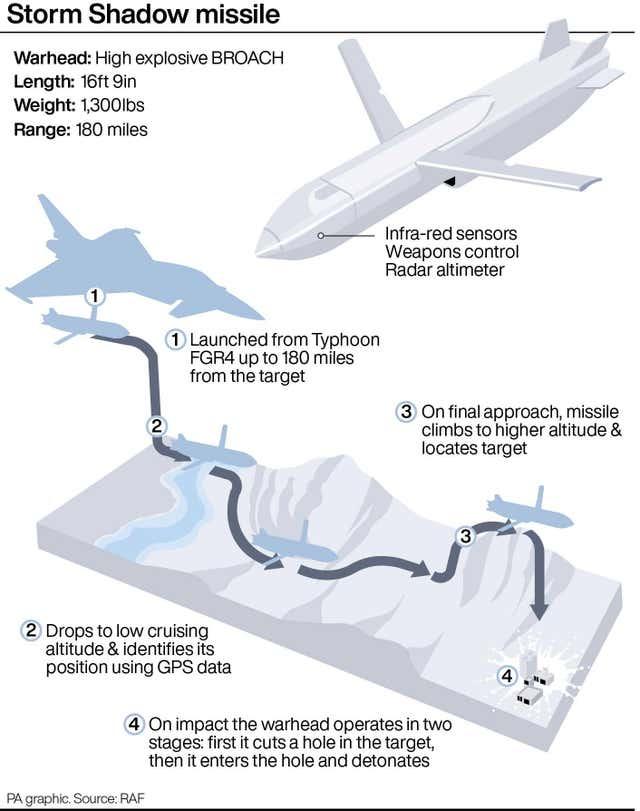
Storm Shadow is a long-ranged, air-launched, conventionally armed, deep-strike supersonic missile, which is manufactured by the France-based MBDA Missile Systems.
Range: More than 250 km
It is capable of being operated day and night in all weathers and is designed to destroy high-valued stationary targets such as airbases, radar installations, communications hubs and port facilities.
It is equipped with fire-and-forget technology and offers high-precision deep strike capability as it features a sophisticated navigation system that includes inertial navigation (INS), a global positioning system (GPS) and terrain reference navigation for better control over the path.
The missile features the BROACH (Bomb Royal Ordnance Augmented CHarge) warhead — a high-technology warhead, which first cuts the surface of the target, penetrates into it and then explodes.
Context: The Central Equipment Identity Register (CEIR) system is scheduled for a pan-India launch on May 17. The Centre for Department of Telematics (CDoT) has been running the pilot project of the CEIR system in some of the telecom circles, including Delhi, Maharashtra, Karnataka, and the Northeast region.
Central Equipment Identity Register system:
CEIR is the citizen-centric portal of the Department of Telecommunications for tracing lost/stolen mobile devices.
This also facilitates for blocking of lost/stolen mobile devices in the network of all telecom operators so that lost/stolen devices can not be used in India. If anyone tries to use the blocked mobile phone, its traceability is generated. Once a mobile phone is found it may be unblocked on the portal for its normal use by the citizens.
Significance: Mobile users will be able to block and track their lost or stolen cell phones across India with the rollout of the tracking system.
Context: A baby was born in the U.K. using three persons’ DNA through a process called Mitochondrial donation treatment.
The baby, technically, has three parents- genetic material (DNA) from two biological parents and mitochondria from one donor parent (female donor). The technology was used to prevent the child from inheriting the mother’s mitochondrial disease.
What is Mitochondria?
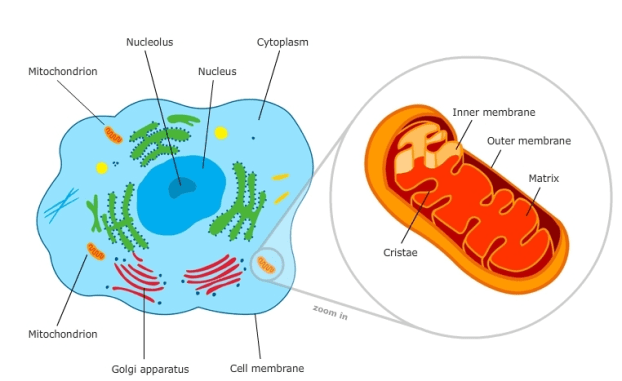
Mitochondria are tiny organelles inside cells that are often referred to as the powerhouses of the cell.
Mitochondria occur in large numbers in most of our cells, except for red blood cells.
It converts the energy molecules which we get from food to usable energy molecules called ATP (Adenosine triphosphate) through a process known as cellular respiration.
Mitochondrial disease:
Mitochondria generate energy and thus are responsible for cell function in the human body. However, when the mitochondria are impaired they do not produce sufficient energy which affects how organs function.
Faulty mitochondria can cause inherited conditions such as fatal heart problems, liver failure, brain disorders, blindness and muscular dystrophy. The diseases that arise out of such mitochondrial mutations are called mitochondrial diseases.
Mitochondrial diseases are only passed on by the mother.
The symptoms get more pronounced as a child grows, and there is no cure for mitochondrial DNA disease at present.
Some estimates put the incidence of mitochondrial diseases as one in 5,000 people.
Mitochondrial Donation Treatment:
Mitochondrial donation involves replacing unhealthy mitochondria in the mother with healthy mitochondria from a donor during the in vitro fertilisation (IVF) process.
Mitochondria have their own DNA, distinct from that in a cell's nucleus. It does not influence appearance, personality or other human characteristics.
The process:
Through the IVF technique, the baby’s biological father’s sperm was used to fertilise the eggs from the biological mother, who has mitochondrial disease, and a third, female donor with clear mitochondria, separately.
Then, the nuclear genetic material from the donor’s egg was removed and replaced with the genetic material from the biological parents.
The final product — the egg — which has the genetic material (DNA) from the parents, and the mitochondria from the female donor, is implanted in the uterus and carried to full term to yield a baby who will be free from the mother’s mitochondrial disease. This process is termed Mitochondrial Donation Treatment (MDT).
With this process, the final cytoplasm (which holds the genetic material and mitochondria) has healthy mitochondria while the genetic material belongs to the biological parents.
Side effects: While largely helpful, the procedure has some minimal risks that sometimes a small amount of the maternal mitochondria with errors may get passed on during the procedure.
Context: Ministry of Ports, Shipping & Waterways has secured 2nd position among 66 ministries in the Data Governance Quality Index.
Data Governance Quality Index 2023
Data Governance Quality Index (DGQI) survey aims to measure the maturity level of administrative data systems and their use in decision-making of various Ministries & Departments on the implementation of Central Sector Schemes and Centrally Sponsored Schemes.
Also identifies reforms to reach the frontier of seamless data exchange and its synergistic use within the ministry, while defining clear pathways to achieve these goals.
This index is published by Development Monitoring & Evaluation Office (DMEO) under Niti Aayog.
Methodology of Data Governance Quality Index
Data Generation: Measures ability of respective ministries/departments to efficiently generate data for program implementation.
Data Quality: Covers processes of scientifically and statistically evaluating data to determine whether they meet quality benchmarks.
Use of Technology: Assesses if emerging technologies are being utilised to improve data robustness.
Data Analysis, Use & Dissemination: Covers if collected data is being analysed and used for evidence creation and decision making.
Data Security & Human Resource Capacity: Assesses if antivirus updates and internal audit systems are in place to ensure data is not corrupted or prone to areas.
Case Studies: Focuses on any intervention at Ministry/Department level or any innovative approach can be highlighted as case studies.
Significance of Data driven governance
Enables policymakers to identify trends, opportunities and areas for improvement accurately.
Enables policymakers to make informed decisions that lead to better outcomes for citizens.
Data driven decision making leads to economies and cost-effective solutions.
Enhances transparency and makes it easier to track the progress of schemes and policies.
Context:Parveen Sood, a 1986 batch officer, has been appointed director of CBI for a period of two years.
About CBI:
It was setup in 1963 by resolution of the Ministry of Home Affairs.
The establishment of the CBI was recommended by Santhanam Committee.
It is a non-constitutional and non-statutory body.
It derives its powers from the Delhi Police Establishment Act, 1946.
It is the main investigating agency of the Central Government.
It acts as the “National Central Bureau” of Interpol in India.
Director of CBI:
The CBI is headed by a Director.
The director of CBI has been provided security of two-year tenure in office by CVC Act, 2003.
Lokpal and Lokayuktas Act 2013 amended the Delhi Special Police Establishment Act 1946 and made following changes: The Central Government shall appoint the Director of CBI on the recommendations of a three-member committee consisting of Prime Minister, Leader of Opposition and the Chief Justice of India or Judge of Supreme Court nominated by him.
Functions of CBI:
Investigating cases of corruption, bribery and misconduct of Central government employees.
Investigating cases relating to infringement of fiscal and economic laws.
Investigating serious crimes, having national and international ramifications, committed by organized gangs of professional criminals.
Coordinating the activities of anticorruption agencies and various state police forces.
It takes up investigation of conventional crimes like murder, kidnapping, rape etc. on the reference from the state governments or when directed by the Supreme Court/High Courts.
The Central Bureau of Investigation (CBI) is India's premier investigative agency, responsible for conducting probes into a wide range of crimes and offences. However, the agency has faced several issues and controversies in recent years.
Limited jurisdiction: Its jurisdiction is limited to certain types of cases, such as those related to corruption or economic offences. This has led to questions about the agency's ability to investigate other types of crimes, such as terrorism or organized crime.
Withdrawal of Consent: The work of the agency has been further constrained by the increasingly hostile relations between the Centre and the state governments. As many as nine states have withdrawn general consent to the CBI. Most of these are Opposition-ruled states, which have alleged that the CBI is being used by the Centre to target the Opposition.
Political interference: CBI is often accused of being used as a tool by the ruling government to target political opponents and shield their own leaders from corruption charges. E.g., CBI's investigation into the alleged corruption in the Rafale deal was seen as politically motivated by the opposition parties.
Lack of autonomy: CBI is supposed to be an independent investigating agency, but it often faces interference from the government and its officials. In 2018, the CBI director Alok Verma was removed from his post and sent on leave by the government, which led to a controversy over the agency's autonomy.
Delay in investigations: It is known for its slow pace of investigations, which often leads to delays in justice and allows the accused to go scot-free. For example, the investigation into the 2G spectrum scam took several years to complete, which led to criticism from the public and the media.
Lack of transparency: It is often criticized for its lack of transparency in its functioning and investigations. The agency's refusal to disclose information under the Right to Information Act has been challenged in courts by activists and journalists. E.g., In the 2017 Ryan International School murder case, the CBI was criticized for not disclosing key information about the investigation.
Corruption within the agency: CBI itself has been rocked by corruption scandals in the past, which have raised questions about its credibility and impartiality. In 2018, the CBI arrested its own DSP Devender Kumar for allegedly falsifying records in a case against the meat exporter Moin Qureshi.
Inefficient use of resources: Its resources are often stretched thin due to its heavy workload, which leads to inefficiencies in its functioning. The agency has a backlog of several thousand cases, which has led to the demand for more resources and manpower.
Lack of expertise: Its investigators are often accused of lacking the necessary expertise and skills to handle complex cases. For instance, the agency's investigation into the murder of journalist Gauri Lankesh was criticized for being shoddy and inadequate.
Internal Conflicts: The issue between former Director Alok Verma and his deputy Rakesh Asthana, who accused each other of corruption and interference in ongoing investigations, led to two factions within the CBI. The conflict affected the CBI's credibility and raised concerns about independence.
Way Forward:
Greater Autonomy: The 2nd ARC have recommended enactment of a comprehensive central legislation to remove the deficiencies of not having a central investigative agency having its own laws and charter of duties and functions.
Increase Jurisdiction: 24th Parliamentary Standing Committee even suggested CBI to take Suo moto cognizance of crimes and to give CBI pan Indian jurisdiction including jurisdiction to investigate corruption charges against officers of All India Service.
Enhanced Accountability: To ensure greater accountability, the CBI should be made answerable to a parliamentary committee rather than the executive. This would help to prevent interference in the agency's functioning and improve transparency.
Strengthening Coordination: The CBI should strengthen coordination with state police forces and other law enforcement agencies to enhance its investigative capabilities. This would help to avoid duplication of effort and ensure that cases are investigated thoroughly and efficiently.
Context:In November 2019, India walked out from the trade pact called the Regional Comprehensive Economic Partnership (RCEP) involving China, Japan, South Korea, Australia, New Zealand and the 10-state Association of Southeast Asian Nations (ASEAN) grouping. Fast forward to 2023, and now India along with many of the same countries, but with China replaced by the United States, is getting into the U.S.-driven Indo-Pacific Economic Framework for Prosperity (IPEF).
Moving Away from China
The one clear difference is of China versus the U.S. Developing a strategic partnership with the U.S. is India’s top foreign policy priority. Its relationship with China has, meanwhile, further deteriorated. But a strategic partnership with the U.S. need not come at the cost of economic dependency on it. With China, the big economic fear was any trade deal’s impact on India’s manufacturing sector; of cheap Chinese goods flooding Indian markets.
Traditionally, trade deals used to be mostly about tariffs. Increasingly though, issues related to intellectual property, services, investment, domestic regulation, digital, and labour and environmental standards, are becoming more important. The U.S.’s IPEF proposal completely removes the tariff element of typical trade deals, and is entirely about all these other areas.
Potential Negative Impact
Early assessment by many experts shows that the IPEF would result in a complete stranglehold over the economic systems of the participating countries, in a manner that is to the complete advantage of the U.S. The systemic integration caused by the IPEF’s actual long-term impact will leave little leeway for domestic policies to help a country’s own industrialisation (for example through tight supply chain integration that many elements of the IPEF contribute to).
The IPEF has four pillars: trade, supply chains, clean economy, and fair economy. Fearful of a possible trap, India has joined the other three pillars but not trade. But there is great pressure on it to join trade too, and India could relent. Joining the trade pillar is the worst, but the other pillars too contribute to developing hard new economic architectures and structures that are not tariff-based.
The IPEF can already be seen to have deep implications in agriculture, in terms of genetically modified seeds and food, surrendering policy space for regulating Big Tech, and compromising a comparative advantage in manufacturing because of unfair labour and environment standards. It will also seriously affect India’s ability to create a vibrant domestic ecosystem in emerging areas such as a digital economy and green products.
Context:The weekend meeting in Riyadh between Saudi Crown Prince Mohammed bin Salman and the national security advisers of the US, UAE, and India underlines the growing strategic convergence between Delhi and Washington in the Gulf. It also highlights India’s new possibilities in the Arabian Peninsula.
New Development in the Middle East
The new India-US warmth on the Gulf is a major departure from the traditional approaches to the Middle East in both India and the US.
In India, one of the entrenched principles of the Nehruvian foreign policy was the proposition that Delhi must either oppose Washington or keep its distance from it in the Middle East. This self-imposed ideological taboo was broken with the formation of a four-nation grouping unveiled in October 2021 called I2U2 that brought the US, India, Israel, and the UAE together.
It is too understand that joining hands with the US was not the only taboo that current foreign policy dispensation discarded. It also rejected the notion that India can’t be visibly friendly to Israel.
The move has also transformed India’s uneasy relations with the two Arabian kingdoms, Saudi Arabia and the UAE, into solid strategic partnerships. As India is now doubling down with a new quadrilateral with the US, UAE, and Saudi Arabia.
Emerging Arabia opens enormous new possibilities for India’s economic growth and Delhi’s productive involvement in promoting connectivity and security within Arabia and between it and the abutting regions including Africa, the Middle East, Eastern Mediterranean and the Subcontinent.
The engagement would also help India overcome the dangerous forces of violent religious extremism within the Subcontinent. The new opportunities in Arabia and the emerging possibilities for partnership with the US and the West position India to rapidly elevate its own standing in the region.
Further the US is not the only Western power that India is beginning to work with in the Gulf. France has emerged as an important partner in the Gulf and the Western Indian Ocean. India now has a trilateral dialogue with Abu Dhabi and Paris
It is also to understand that it is not only India that is shedding its “anti-Western” lens in the Middle East, the US is leading the West to discard its pro-Pakistan bias in thinking about the relationship between the Subcontinent and the Gulf. Under Nehruvian foreign policy India withdrew from its historic geopolitical role in the Middle East, Pakistan became the lynchpin of the Anglo-American strategy to secure the “wells of (oil) power” in the Gulf.
However Pakistan’s continuing strategic decline makes it a lot less relevant to the changing geopolitics of the Gulf. Once viewed as a moderate Muslim nation with prospects for economic growth, it has now locked itself into a self-made trap of violent religious extremism and its political elite is utterly unprepared to lift the nation economically.
The US is not about to abandon the Middle East. But it certainly is recalibrating its regional strategy.
US National Security Adviser Jake Sullivan highlighted several elements of the new US approach. Viewed from Delhi, two of them stand out.
One was about building new partnerships, including with Delhi
Second was about the integration of the Arabian Peninsula into India and the world.
It is also about the rising power of the Arabian Peninsula, especially Saudi Arabia and the UAE. The Gulf kingdoms have accumulated massive financial capital and embarked on an ambitious economic transformation that will reduce their dependence on oil over the long term.
They have also begun to diversify their strategic partnerships, develop nationalism rather than religion as the political foundation for their states, promote religious tolerance at home, and initiate social reform.
Conclusion
The momentous change in intra-regional and international relations of the Arabian Peninsula, India has inevitably become part of the new regional calculus. Seizing the new strategic opportunities for India in the Gulf would, however, involve the long overdue modernisation of Delhi’s strategic discourse on the Gulf and a conscious effort to change the outdated popular narratives on the Arabian Peninsula.
Context: India’s goods exports for 2022-23 scaled up significantly from earlier estimates to almost $451 billion, indicating a 6.9% year-on-year growth. Similarly, the import bill as per the May 1 statement was pegged at $711.85 billion.
Experts have flagged petroleum shipments as the main driver for the high revisions of recent export data.
Source: PIB
Major exports from India:
Export trends in India show that the episodes of export growth accelerations are not new. India’s exports are characterized by a high rate of volatility making the growth path episodic with discrete shifts from periods of low growth to periods of high growth and vice versa. The switch between highs and lows is accompanied by dramatic changes in growth rates
India’s exports benefited majorly from the surge in global growth after two years of repressed demand owing to the pandemic. Several PLI schemes in diverse sectors, such as mobile manufacturing, electronic and textile products, automobile, and auto components have boosted domestic manufacturing and exports by helping India gain competitiveness in the global markets. Though these incentives take a few years to show their full effect, early signs of their positive impact are already visible.
Source: Ministry of Commerce and Industry
Major sector-wise exports of India include:
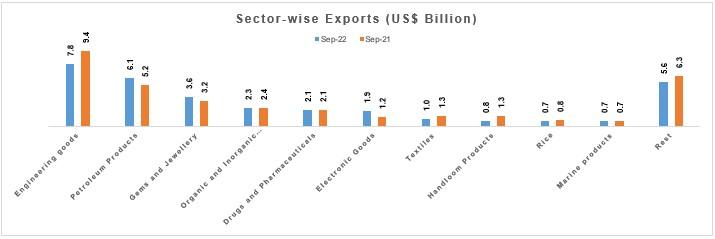
Engineering Goods: It registered exports at US$ 7.8 billion. This is primarily due to the benefits that the sector enjoys owing to the various trade agreements India has with other countries. Currently, all pumps, tools, carbides, air compressors, engines, and generators manufacturing MNC companies in India are trading at all-time highs with increased prospects of shifting production to India. It is expected to continue its upward trajectory in steel, auto components, and medical devices and India's push for Make in India.
Petroleum Products: Petroleum products have contributed in a major way to Indian export growth. They registered a growth of US$ 6.1 billion. Factors leading to the growth are rising crude oil prices which got aggravated by the post-pandemic world, demand spiking for oil, and the recent geopolitical tension.
Gems and Jewellery: Gems and jewellery made up US$ 3.6 billion of India's exports. This sector was one of the key focus areas of Indian exports and is expected to flourish more with the reduction of import duty on cut and polished diamonds and the Extension of the Emergency Credit Line Guarantee Scheme (ECLGS) for MSMEs, which make up 90% of the sector. The largest exports of gems and jewellery from India are to the United States of America (USA), United Arab Emirates (UAE) followed by the United Kingdom (UK), Germany, Singapore, the Netherlands, and many more.
Agriculture Exports:Agricultural exports were elated by the government’s push to meet the global demand for food amid the pandemic. India exported rice worth US$ 0.7 billion, the highest among agricultural commodities. The rise in the export of agricultural and processed food products has been largely due to the various initiatives taken by the government through the Agricultural and Processed Food Products Export Development Authority (APEDA) such as organizing B2B exhibitions in different countries, exploring new potential markets through product specific and general marketing campaigns by the active involvement of Indian Embassies.
Organic and Inorganic Chemicals:With strong demand from developed markets, organic and inorganic chemicals registered exports worth US$ 2.3 billion further contributing to the rise in Indian exports. The export growth of organic and inorganic chemicals has been achieved because of a surge in shipments of organic, and inorganic chemicals, agrochemicals, dyes, dye intermediates, and specialty chemicals. China is a major importer of dyes, dye intermediates, and organic chemicals from India. The USA remained the largest importer of essential oils, and inorganic chemicals while Brazil was the top importer of agrochemicals from India.
Electronic Goods: Electronic goods have also contributed massively to the export surge from India. The exports of electronic goods amounted to US$ 1.9 billion. The segment benefitted from several PLI schemes, such as the Scheme for Large Scale Electronics Manufacturing and the Scheme for the Promotion of Manufacturing of Electronic Components and Semiconductors (SPECS). As per the Union Budget economy survey of 2019-20 the integration of ‘Assemble in India for the World’ into ‘Make in India’, India can raise its export market share to about 3.5% by 2025 and 6% by 2030.
Textile and Apparel:India is among the top garment manufacturing countries in the world. India’s textile exports amounted to US$ 1 billion in September 2022. The government introduced various schemes such as the Scheme for Integrated Textile Parks (SITP), Technology Upgradation Fund Scheme (TUFS), and Mega Integrated Textile Region and Apparel (MITRA) Park scheme. In addition, Amazon India signed an MoU with the Manipur Handloom & Handicrafts Development Corporation Limited (MHHDCL). The sustainable Textiles for Sustainable Development (SusTex) project by the United Nations Climate Change will increase artisans’ engagement from Asia and especially India in the coming decade.
Drugs and Pharmaceuticals: India’s drugs and pharmaceuticals export amounted to US$ 2.1 billion, and it is the largest provider of generic medicines globally. Currently, the country has a share of 20% in the global supply volume and contributes to around 60% of the global vaccines. The USA, the UK, and Russia are among the largest importers from India with a share of 29%, 3%, and 2.4%, respectively during 2021-22. The Strengthening of Pharmaceutical Industry (SPI) scheme focuses on bolstering the existing infrastructure facility, with a total financial outlay of US$ 60 million (Rs. 500 crores).
Marine Products: India’s exports for marine products in September 2022 amounted to US$ 0.7 billion whereinIndia shipped 1,369,264 MT of seafood. Frozen shrimp remained the major export item in terms of quantity and value. The overall export of frozen shrimps during 2021-22 totalled up to 728,123 MT. The USA was the largest market for imported frozen shrimp, followed by China, European Union, South East Asia, Japan, and the Middle East.
Export Promotion Scheme
Foreign Trade Policy 2015-20 and other schemes provide promotional measures to boost India’s exports with the objective to offset infrastructural inefficiencies and associated costs involved to provide exporters a level playing field. Brief of these measures are as under:
1.1 Exports from India Scheme
i. Merchandise Exports from India Scheme (MEIS)
Under this scheme, exports of notified goods/ products to notified markets as listed in Appendix 3B of Handbook of Procedures, are granted freely transferable duty credit scrips on realized FOB value of exports in free foreign exchange at specified rate. Such duty credit scrips can be used for payment of basic custom duties for import of inputs or goods.
Exports of notified goods of FOB value upto Rs 5,00,000 per consignment, through courier or foreign post office using e-commerce shall be entitled for MEIS benefit. List of eligible category under MEIS if exported through using e-commerce platform is available in Appendix 3C.
MEIS has since been withdrawn w.e.f. 1st January, 2021. A new Scheme called Remission of Duties and Taxes on Exported Products (RoDTEP) has been introduced which shall refund the embedded duties suffered in export goods.
ii. Service Exports from India Scheme (SEIS)
Service providers of notified services as per Appendix 3D are eligible for freely transferable duty credit scrip @ 5% of net foreign exchange earned.
2. Duty Exemption & Remission Schemes
These schemes enable duty free import of inputs for export production with export obligation. These scheme consists of:-
2.1 Advance Authorization Scheme
Under this scheme, duty free import of inputs are allowed, that are physically incorporated in the export product (after making normal allowance for wastage) with minimum 15% value addition. Advance Authorization (AA) is issued for inputs in relation to resultant products as per SION or on the basis of self declaration, as per procedures of FTP. AA normally have a validity period of 12 months for the purpose of making imports and a period of 18 months for fulfillment of Export Obligation (EO) from the date of issue. AA is issued either to a manufacturer exporter or merchant exporter tied to a supporting manufacturer(s).
2.2 Advance Authorization for annual requirement
Exporters having past export performance (in at least preceding two financial years) shall be entitled for Advance Authorization for Annual requirement. This shall only be issued for items having SION.
2.3 Duty Free Import Authorization (DFIA) Scheme
DFIA is issued to allow duty free import of inputs, with a minimum value addition requirement of 20%. DFIA shall be exempted only from the payment of basic customs duty. DFIA shall be issued on post export basis for products for which SION has been notified. Separate schemes exist for gems and jewellery sector for which FTP may be referred.
2.4 Duty Drawback of Customs
The scheme is administered by Department of Revenue. Under this scheme products made out of duty paid inputs are first exported and thereafter refund of duty is claimed in two ways:
i) All Industry Rates : As per Schedule
ii) Brand Rate : As per application on the basis of data/documents
2.5 Interest Equalisation Scheme (IES)
The Government announced the Interest Equalisation Scheme @ 3% per annum for Pre and Post Shipment Rupee Export Credit with effect from 1st April, 2015 for 5 years available to all exports under 416 tariff lines [at ITC (HS) code of 4 digit] and exports made by Micro, Small & Medium Enterprises (MSMEs) across all ITC(HS) codes. With effect from November 2, 2018, the rate of Interest Equalisation for MSME has been increased to 5%. The Scheme has also been extended to Merchant Exporters who will now avail the benefit @ 3% for all exports under 416 tariff lines w.e.f. January 2, 2019.
3. EPCG SCHEME
3.1 Zero duty EPCG scheme
Under this scheme import of capital goods at zero custom duty is allowed for producing quality goods and services to enhance India’s export competitiveness. Import under EPCG shall be subject to export obligation equivalent to six times of duty saved in six years. Scheme also allows indigenous sourcing of capital goods with 25% less export obligation.
3.2 Post Export EPCG Duty Credit Scrip Scheme
A Post Export EPCG Duty Credit Scrip Scheme shall be available for exporters who intend to import capital goods on full payment of applicable duty in cash.
4. EOU/EHTP/STP & BTP SCHEMES
Units undertaking to export their entire production of goods and services may be set up under this scheme for import/ procurement domestically without payment of duties. For details of the scheme and benefits available therein FTP may be required.
5. OTHER SCHEMES
5.1 Towns of Export Excellence (TEE)
Selected towns producing goods of Rs. 750 crores or more are notified as TEE on potential for growth in exports and provide financial assistance under MAI Scheme to recognized Associations.
5.2 Market Access Initiative (MAI) Scheme
Under the Scheme, financial assistance is provided for export promotion activities on focus country, focus product basis to EPCs, Industry & Trade Associations, etc. The activities are like market studies/surveys, setting up showroom/warehouse, participation in international trade fairs, publicity campaigns, brand promotion, reimbursement of registration charges for pharmaceuticals, testing charges for engineering products abroad, etc.
5.3 Status Holder Scheme
Upon achieving prescribed export performance, status recognition as one star Export House, two Star Export House, three star export house, four star export house and five star export house is accorded to the eligible applicants as per their export performance. Such Status Holders are eligible for various non-fiscal privileges as prescribed in the Foreign Trade Policy.
In addition to the above schemes, facilities like 24X7 customs clearance, single window in customs, self-assessment of customs duty, prior filing facility of shipping bills etc are available to facilitate exports.
5.4 Gold Card Scheme
The Gold Card Scheme was introduced by the RBI in the year 2004. The Scheme provides for a credit limit for three years, automatic renewal of credit limit, additional 20% limit to meet sudden need of exports on account of additional orders, priority in PCFC, lower charge schedule and fee structure in respect of services provided by Banks, relaxed norms for security and collateral etc,. A Gold Card under the Scheme may be issued to all eligible exporters including those in the small and medium sectors who satisfy the pre-requisite conditions laid by individual Banks.
Apart from the above points, Government has recently unveiled new Trade Policy, link to which has been provided below: