Post-facto analyses of deadly disasters — like the landslides in Wayanad, Kerala, reminds us of the fact that broad warnings of risks can hardly be translated to specific actions.
For example, declaring whole of the western ghats to be landslide vulnerable won’t get rid of extreme events induced by climate change anytime soon.
Some landslides will occur anyway even if the Ghats enjoy the fullest protections from human perturbations because the risk is never zero.
Therefore predictions of disaster management and mitigation becomes important.
Need for long-term climate risk outlooks: extending up to a decade or more.
Improving accuracy of predictive models by understanding local factors that exacerbate climate effects. The relationship between local events and global warming complicates predictions. Local amplifiers often intensify the effects of distant climate drivers.
Case Study - Coastal Influence on heavy rain in Wayanad: Coastal sea surface temperatures significantly influence heavy rain along India’s west coast. As monsoon winds approach the Western Ghats, coastal waters warm up, leading to increased rainfall.
Importance of Location-Specific Measures: such as preserving biodiversity, can help mitigate disaster risks.
Role of Governments and Monitoring: National and local governments must collaborate to monitor, report, and verify risks, and these efforts must be reflected in budgetary provisions.
Weather-Proofing the Country: Disaster mitigation is essential to making the country more resilient to climate change. Establishing a robust data network to map local extreme event amplifiers is urgently needed.
Context: The Indian Himalayan Range (IHR), comprising 11 States and two Union Territories, had a decadal urban growth rate of more than 40% from 2011 to 2021. Towns have expanded, and more urban settlements are developing. However, Himalayan towns require a different definition of urbanisation.
Why Himalayan ecosystem is unique?
These systems, with their steep slopes and sharp gradients, are heterogeneous and exhibit sharp and most often systemic changes in climatic variables over very short distances.
These features consequently result into enhanced changes in hydrological processes, with accelerated direct runoff and erosion.
Major rivers of the region have their origin from these mountains and are the source of water for a large proportion of the human population within and outside the mountain region.
Many of the world’s crops originate in mountains, a crucial resource that should be conserved for sustaining modern agriculture.
Natural wealth in the region, including geological assets, forms an important part of the Himalayan eco-system.
All this has contributed to a whole range of diversity in indigenous human habitations, cultures and knowledge systems. The region is largely inhabited by indigenous societies.
What is happening to the Himalayan towns?
Huge civic issues - For example, cities like Srinagar, Guwahati, Shillong, and Shimla, as well as smaller towns, face significant challenges in managing sanitation, solid and liquid waste, and water.
Lack of institutional strength - Planning institutions in these States often fail because they use models copied from the plains and have only limited capacities to implement these plans. City governments are short of human resources by almost 75%.
Unchecked expansion and consequent land use change - Cities continue to expand into the peripheries, encroaching on the commons of villages. Srinagar and Guwahati are examples of such expansion, leading to the plundering of open spaces, forest land, and watersheds. In Srinagar, land use changes between 2000 and 2020 showed a 75.58% increase. Water bodies have eroded by almost 25%.
Complex mix of other factors - The IHR faces increasing pressure from urbanization and development, compounded by high-intensity tourism, unsustainable infrastructure, and resource use (land and water), further aggravated by climatic variations like changing precipitation patterns and rising temperatures. This has led to water scarcity, deforestation, land degradation, biodiversity loss, and increased pollution, including plastics. These pressures have the potential to disrupt lives and livelihoods, impacting the socio-ecological fabric of the Himalayas.
How Infrastructure is affecting the Himalayan region?
Infrastructure like dams, roads, hotels, industries etc are increasing the vulnerability of the Himalayan ecosystem in multiple ways. Joshimath crisis is one such example.
Following are the various impacts:
Slope destabilization - Large scale construction of roads, hotels, powerhouses etc. involves blasting, quarrying, deforestation and muck disposal which loosens slopes and destabilizes them.
Landslides - By disrupting underground streams and aquifers, tunnels can weaken slope stability leading to landslides (Kinnaur, Himachal Pradesh 2022)
Earthquakes – Huge pressure is exerted by the large structures of the dams which in turn create fractures and faults in the rocks below generating earthquakes. For e.g – Koyna dam.
Erosion and desertification - Siltation in dams devoid the rivers of natural sediments. Soil downstream does not get enough nutrients and thus issues of soil erosion, desertification etc rises.
Forced displacement - This destroys livelihood sources of indigenous communities further increasing their vulnerabilities.
What needs to be done?
Continuous Monitoring of the Eco-system and Data Generation - Every town needs to be mapped, with layers identifying vulnerabilities from geological and hydrological perspectives.
Ecological modelling and predicting climate change scenarios - Climate-induced disasters annually erode infrastructures built without such mapping and hence requires vulnerability assessment.
Financial strengthening- none of the cities in the IHR can generate capital for their infrastructure needs. The Finance Commission must include a separate chapter on urban financing for the IHR.
Promoting sustainable forestry, sustainable agriculture and food security.
Promoting regional cooperation involving domestic states as well as neighbouring countries.
Sustainable urbanization by waste management, traffic control, town planning and regulating tourism.
Building environmental awareness among the citizens.
Context: The intense wildfires raging in the United States and Canada have spiked the occurrence of pyrocumulonimbus clouds. The development of these clouds has become more frequent in recent years.
About Pyrocumulonimbus clouds
Pyrocumulonimbus clouds are thunder clouds created by intense heat from the Earth’s surface, either from large wildfires or volcanic eruptions. That is the reason why the prefix ‘pyro’ is used – meaning fire in Greek.
For instance, these clouds were formed during the Australian bushfires of 2019-2020 when temperatures crossed 800 degrees Celsius.
Mechanism of formation of the clouds:
The intense heat from the wildfire/ volcanic eruption warms the surrounding air which moves upward into the atmosphere.
As this hot and very buoyant air (carrying water vapour, smoke, and ash) rises, it expands and cools down.
Once it is cool enough, water vapour condenses on ash, forming a grey or brown cloud. At this stage, the cloud is known as a pyrocumulus cloud, also known as ‘fire cloud’.
But if there is sufficient water vapour available and the upward movement of hot air intensifies, pyrocumulus clouds can evolve into a pyrocumulonimbus cloud.
Characteristics:
These clouds can reach heights of 50,000 feet and generate their own systems of thunderstorms.
Although pyrocumulonimbus clouds can produce lighting, they do not generate much rain. As a result, they can spark new wildfires many kilometres away from the main blaze.
These clouds can also trigger strong winds that can make the spread of the wildfire faster and unpredictable.
Frequent occurrence of pyrocumulonimbus clouds:
Before 2023, 102 pyrocumulonimbus were recorded globally in a single year on average — 50 of them were seen in Canada. However, during last year’s extreme wildfire season, 140 pyrocumulonimbus clouds were recorded in Canada alone.
The exact reason for their frequent occurrence remains unclear. However, scientists believe that climate change and temperatures soaring across the world, leads to frequent wildfires, which may spike the occurrence of pyrocumulonimbus clouds.
Context: Recently, the Disaster Management (Amendment) Bill 2024 was introduced in the Lok Sabha. The bill aims to amend the Disaster Management Act, 2005.
About Disaster Management Act, 2005 (DM Act, 2005)
DM provides for effective management of disasters in India
The DM Act puts in place necessary institutional mechanisms for
(i) Drawing up and monitoring the implementation of disaster management plans.
(ii) Ensuring measures by various wings of government for preventing and mitigating the effects of disasters.
(iii) For under-taking a holistic, coordinated and prompt response to any disaster or threatening disaster situation.
Salient features of Disaster Management (Amendment) Bill
Inclusion of new definitions of disaster risk, evacuation, exposure, recovery, rehabilitation, resilience etc. in line with the Sendai principles on Disaster Risk Reduction.
Clarification on man-made disasters: The bill proposes to clarify that man-made disasters does not include any law-and-order issues. Thus, loss of lives, displacement, or property damage due to riots, violence etc. would not invoke the DM Act.
Bring more clarity and convergence in the roles of Authorities and Committees working towards disaster management.
Provide statutory status to centain pre-DM Act organisations like National Crisis Management Committee (NCMC) and High Level Committee (HLC). (Note. NCMC is a nodal body to deal with major disasters & High Level Committee is the nodal body for the approval of financial assistance for recovery and rehabilitation from disasters).
Strengthen and efficient working of National Disaster Management Authority (NDMA) and State Disaster Management Authorities (SDMA).
Empower the NDMA and the SDMAs to prepare the disaster plans at national level and state level instead of the National Executive Committee (NEC) and State Executive Committee (SEC), presently.
Provide for creation of a disaster database at national and state level. The database will collect information on assessment of disaster, fund allocation, expenditure, preparation and mitigation plans.
Provision for constitution of 'Urban Disaster Management Authority' (UDMA) for State Capital and large cities having municipal corporations. Currently, the DM Act only provides for District level District Disaster Management Authority. However, considering the economic importance of cities, large capacity and need for quick & decentralized response in the face of disasters. The bill proposes to create Urban Disaster Management Authority for large cities for unified and coordinated approach towards city level disasters such as urban flooding.
Provisions for constitution of 'State Disaster Response Force' by State Governments. Currently, many states have raised disaster response forces on the lines of NDRF. However, the state level disaster response forces have not been mandated under the DM Act, which this amendment aims to provide for.
Need for Empowerment of National Disaster Management Authority (NDMA)
Disaster Management to be separate department or ministry:
Given the growing role and importance, NDMA should be elevated to the status of a full-fledged government department or a separate ministry.
Currently, the NDMA functions as an agency under Ministry of Home Affairs. Therefore, all its communication and coordination is done through Union Home Ministry, which is the nodal ministry for NDMA.
Climate change has increased the frequency of extreme climate events and resultant disasters in large parts of country. This means NDMA is active throughout the year and regularly coordinates with central and state governments and their agencies.
Lack of financial or administrative powers: Currently, NDMA does not any administrative or financial powers. This makes it dependent on the Union Home Ministry for even small decisions leading to slow decision making and inefficiencies.
Vacancy in office of Vice-Chairperson of NDMA: Though the PM is the chairperson of NDMA, the day-to-day functioning of NDMA is the responsibility of vice-chairperson, who has a rank of cabinet minister. However, the post of vice-chairperson of NDMA has remained vacant for more than decade, this deprives NDMA of necessary leadership and political heft to deal with states and other central government agencies.
Shortage of staff: NDMA is severely short-staffed at the top with only three members overlooking the entire gamut of disasters in the country. Earlier, NDMA used to have 6-7 members, each in charge of a specific type of disaster.
Context: In response to a calling attention motion on Wayanad landslides in Parliament, Home Minister makes several claims on early warning systems in India and how they are utilized to alert the Kerala government ahead of the tragedy.
What is Early Warning system?
An early warning system is a set of tools and processes designed to provide advance notice of potential hazards or threats, allowing individuals, communities, and governments to take proactive measures to mitigate damage and ensure safety.
These systems are crucial for managing and responding to a variety of risks, including natural disasters, technological accidents, and public health emergencies.
What are components of Early warning system?
Early warning system need four components:
Disaster risk knowledge based on the systematic collection of data and disaster risk assessments.
Detection, monitoring, analysis and forecasting of the hazards and possible consequences.
Dissemination and communication, by an official source, of authoritative, timely, accurate and actionable warnings and associated information on likelihood and impact.
Preparedness at all levels to respond to the warnings received.
What is the status of Early warning system (EWS) In India?
According to Council on energy, environment and water (CEEW), the status of early warning system are as follows:
Approximately 66 per cent of individuals in India are exposed to extreme flood events; however, only 33 per cent of the exposed individuals are covered by flood EWS. Meanwhile, 25 per cent of individuals in India are exposed to cyclones and their impacts, but cyclone warnings are available to 100 per cent of the exposed population.
More than 88 per cent of Indian states exposed to floods and 100 per cent of the states exposed to extreme cyclone events have a high teledensity ratio (means to access early warnings through telecommunications).
9 states with high exposure to extreme flood events have highly effective flood EWS. 10 states with high exposure to extreme cyclone events also have high to moderately effective cyclone EWS.
14 out of 32 flood-exposed states, and 9 out of 17 cyclone-exposed states, are highly resilient owing to the availability, accessibility, and effectiveness of EWS.
What are the different types of Early warning systems?
Purpose: To inform people of severe weather conditions that could lead to dangerous situations.
Seismic:
Examples: Earthquake early warning systems.
Purpose: To provide immediate alerts before the shaking from an earthquake reaches a location.
Tsunami:
Examples: Tsunami warning systems.
Purpose: To detect underwater earthquakes and send alerts about potential tsunami waves.
Public Health:
Examples: Epidemic or pandemic alerts.
Purpose: To notify the public of emerging health threats or disease outbreaks.
Technological:
Examples: Industrial accident warnings, chemical spill alerts.
Purpose: To provide advance notice of potential technological hazards.
What are the benefits of having early warning system?
Saving Lives: By providing advanced notice of potential hazards, early warning systems enable timely evacuations and other protective measures, significantly reducing the risk of injury and death.
Economic Protection: These systems help minimize economic losses by allowing businesses and individuals to take preventive actions, such as securing property and assets.
Enhanced Preparedness: Early warning systems improve community preparedness by increasing awareness and understanding of potential risks, leading to better response strategies.
Resilience Building: They contribute to building more resilient communities by promoting proactive risk management and fostering a culture of preparedness.
Environmental Protection: By predicting and mitigating the impacts of natural hazards, early warning systems help protect ecosystems and biodiversity.
Case study Of Kerala Early warning system
In Kerala, early warning systems are crucial for managing natural hazards such as floods and landslides.
Early Warning System Framework
Monitoring and Data Collection:
IMD Forecasts: The IMD provides forecasts and warnings based on weather models and real-time data from meteorological instruments.
Regional Forecasts: Regional centers, such as the IMD’s Meteorological Centre in Thiruvananthapuram, issue localized forecasts.
Alerts and Warnings:
Types of Alerts: IMD issues alerts categorized as yellow (watch), orange (warning), and red (alert) based on the severity of weather conditions.
Communication Channels: Alerts are disseminated through media, official websites, and direct messages to local authorities.
Response and Action:
Preparedness Plans: Local authorities and emergency services develop and implement preparedness plans based on forecasts and alerts.
Public Awareness: Education and drills are conducted to ensure the public knows how to respond to warnings.
In July 2024, Kerala faced significant landslides in Wayanad. The India Meteorological Department (IMD) issued several warnings: an initial flash flood risk alert on July 18, updates on July 23 and 25 forecasting heavy to very heavy rainfall, and an orange alert for July 29. However, the landslides occurred early on July 30. IMD’s forecasts for July 26 predicted light to moderate rainfall, and an experimental landslide forecast from July 29 indicated a low chance of landslides.
Home Minister claimed an early warning for 20 cm of rainfall and landslides was issued on July 26, but no such warning appeared in official IMD releases. Kerala Chief Minister criticized the accuracy of these forecasts and highlighted funding cuts to early warning systems. This case underscores the need for accurate forecasting, timely alerts, and adequate resources for effective disaster management.
Context: Environment Performance Index-2024 was released recently. The EPI highlighted that while many countries have made progress in declaring protected areas (both terrestrial and marine) abiding by the 30X30 target under the Kunming Montreal Global Biodiversity Framework. However, many of these protected areas are ‘paper parks.’ Many of the terrestrial protected areas have large parts where commercial activities such as mining, agriculture, building and construction activity are found and not natural ecosystems. The marine protected areas are affected by trawling and extensive fishing. Thus, the protected areas have failed to halt ecosystem loss, reduce environmentally destructive practices and suffer from shortages of funding and personnel, making enforcement difficult.
About Environmental Performance Index
EPI is a data driven summary of the state of sustainability around the world. EPI offers a scorecard to help countries assess how close they are to established environmental policy targets.
EPI ranks points to the leaders and laggards in different aspects of environmental performance and provides practical guidance for countries that aspire to move towards a sustainable future.
EPI indicators help spot problems, set targets, track trends, understand outcomes and identify best policy practices.
EPI helps government officials refine policy agenda, facilitates communication and maximize return on environmental investments.
Published by: Yale Centre for Environment Law & Policy (Yale University), Centre for International Earth Science Information Network (Columbia University).
Countries covered: 180 countries are scored.
Methodology of EPI 2024:
Ranks countries on their progress at (i) mitigating climate change, (ii) safeguarding ecosystem vitality and (iii) promoting environmental health. Three policy objectives for the objectives are – Ecosystem Vitality (45%), Climate Change (30%) & Environmental Health (25%) focusing on sub-components like:
Ecosystem Vitality: Biodiversity & Habitat, Forests, Fisheries, Air Pollution, Agriculture & Water Resources.
Climate Change: Climate change mitigation.
Environmental Health: Air Quality, Sanitation & Drinking Water, Heavy Metal pollution and Waste Management.
It is a composite indicator that synthesizes data on 58 sustainability indicators across 11 environmental issues into one single metric of country level performance.
The indicators measure their growth rate or change in the last decade. Leading to challenges poor correlation between rank and absolute performance of the indicator and quality or productivity of ecosystem services has not been accounted.
Rankings in EPI 2024
Global Rankings: Estonia, Luxembourg and Germany are the three highest ranked countries.
India is one of the lowest rank countries in the world in EPI-2024. India has rank of 176 among 180 countries in the world. Only Myanmar, Laos, Pakistan and Vietnam are ranked below India.
Reasons for India’s poor rankings: Restricted public access to over 95% of the protected area data submitted to the World Database on Protected Areas.
Context: As India moves ahead with increasing shift towards renewable energy sources like solar and wind. There has been a greater focus on developing battery storage systems, which can store electricity. In this respect, there has been an increased focus on developing Pumped Storage Hydropower projects, which are giant batteries.
Pumped Storage Project
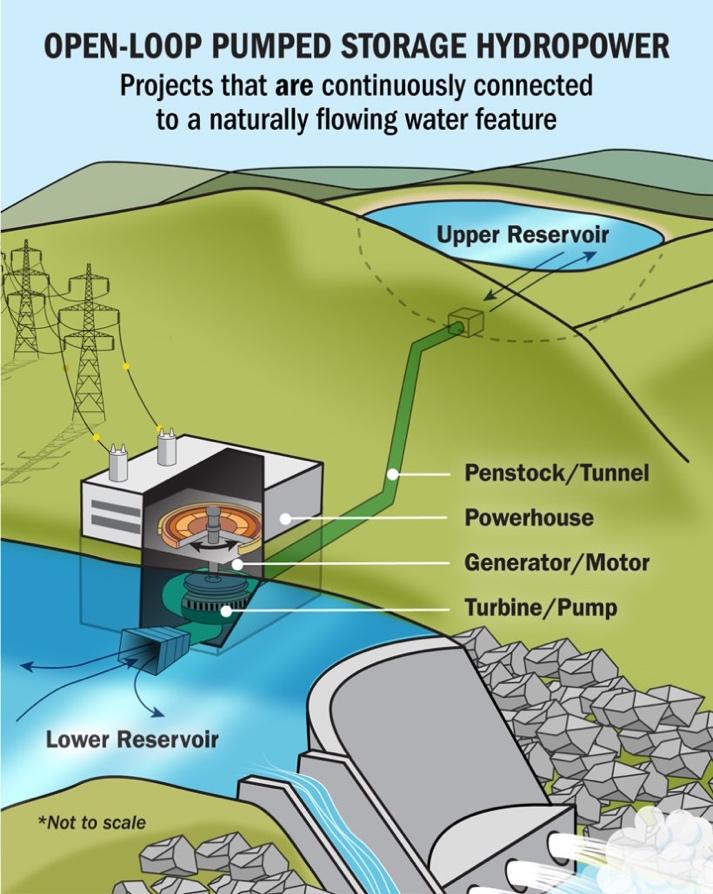
Pumped storage plants use the principle of gravity to generate electricity using water that has been previously pumped from a lower source to an upper reservoir.
Operation of pumped storage power plants requires two reservoirs viz. upper and lower reservoir. Water in upper reservoir is used for generating power during peak demand hours. The water in the lower reservoir is pumped back to the upper reservoir during the off-peak hours and the cycle continues.
Pumped storage plants are of two types: ‘open loop’, which has an associated natural-water source (like a river) for one or both the reservoirs; and ‘closed loop’ (or off-river PSH), which does not have a connected natural-water source and the same water is cycled between the two reservoirs for pumping and generation.
Energy storage capacity of a pumped hydro facility depends on size of its two reservoirs and the head between reservoirs, while the amount of power generated is linked to the size of turbine.
Need for Pumped Storage Hydropower Project
Renewable energy sources like solar & wind energy are intermittent and variable in nature. This leads to challenges of grid-stability and temporal considerations in power availability. This requires immediate ramp-up & back down of generation for grid balancing & stability of grid frequency.
Pump Storage Technology is the only long term technically proven, cost-effective, highly efficient & operationally flexible way of energy storage on a large scale & available at short notice.
Currently, it is the largest energy storage system making it most effective for Renewable Energy Integration.
It offers following benefits:
Peak shaving: PSPs absorb off peak energy in the system.
Energy conversion rates for pump-storage projects often exceeds 80%
Only PSP can meet most of the grid scale energy storage needs and no other storage system can and therefore almost 95% of the storage projects are Pump hydro
Status of Pumped Storage Hydropower:
Current potential of 'on-river pumped storage' in India is 103 GW. Out of 4.76 GW of installed capacity, 3.36 GW capacity is working in pumping mode. About 44.5 GW including 34 GW off-river pumped storage hydro plants are under various stages of development.
Currently, operational Pumped Storage Plants:
Pumped Storage Project
Location
States
Capacity
Nagarjunasagar
On Krishna River
Telangana
705 MW
Srisailam
On Krishna River on a deep gorge on Nallamala hills.
Telangana
900 MW
Kadamparai
Tamil Nadu
400 MW
Bhira
Near Mulshi Dam on Mula River.
Maharashtra
150 MW
Ghatghar
On Pravara River, a tributary of Godavari River in Ahmedanagar district
Maharashtra
250 MW
Purulia (Panchet)
West Bengal
900 MW
Total
3300 MW
Other Pumped Storage Projects
Kadana, Sardar Sarovar Project (
Tehri, Kundah, Koyna (Under Construction)
Turga, Upper Sileru
Pumped storage projects being planned:
Upper Indravati PSP (600 MW) in Odisha
Sharavathy PSP (2000 MW) in Karnataka
Around 60 GW of pumped storage power projects are under survey and investigation.
Advantages of Pumped Storage Projects
Ecologically friendly: PSPs would have minimal impact on environment in their vicinity as they are envisaged on existing hydroelectric projects, or as off the river projects. All components of PSPs would be connected, operated and maintained in an environmentally friendly manner with no residual environmental impacts.
Atmanirbhar Bharat: PSPs employ indigenous technologies and domestically produced materials. Most electrical & mechanical parts of PSPs are also made in India. Other alternate solutions to storage such as batteries are heavily import dependent.
Tested technology: PSPs operate on time-tested technology thereby infusing confidence in lending institutions for a longer duration of loans. Cost of technologies involved in construction has reduced rendering PSPs a viable proposition. Technological surety associated with PSPs has opened possibility for developers to claim a higher debt-equity ratio in projects.
Local development: Development of PSPs is highly capital intensive and involves development of local transport infrastructure for mobilisation of men and materials. Local industries such as cement & steel get impetus and drive domestic creation in the economy giving salutary effect on local area development, regional development, infrastructure upgradation and employment generation.
Longer and reliable duration of discharge: PSPs are designed for a longer duration of discharge of more than 6 hours to meet peak demand or for compensating variability in the grid due to VREs. However, Battery Energy Storage Systems are designed for up to 4 hours of discharge generally. Firm capacity of PSPs during peak hours is guaranteed and relatively immune to grid conditions.
Challenges in the development of Pumped Storage Projects
Environmental clearances: Currently, environmental and forest clearance process of PSPs is very cumbersome, since these projects are treated at par with conventional hydro projects for granting EC and FC. However, environment impact of PSPs constructed on existing reservoirs is generally less and does not lead to displacement of people.
Free power: PSPs are energy storage projects designed to cater to the need for grid stability during peak hours. PSPs do not produce any electricity and are net consumers of electricity.
Cost of pumping power: Cost of power from PSPs has three components - cost of storage, cost of conversion losses and cost of input power. For the commercial viability of a PSP unit input power should be available at affordable tariff. However, availability of solar power at relatively cheaper rates allows affordable input power for PSP units.
Value of peak power: Importance of PSP lies in its capability to offer peaking power. Other services offered by PSPs like spinning reserves, reactive support, black start ability etc. which are essential for grid stability are not adequately monetized.
Taxation:
Measures taken by Government of India for promoting PSPs
Utilisation of financial & project execution capabilities of CPSUs: Government of India has identified probable PSP sites with CPSUs to facilitate their development.
Energy Storage Obligation: Government has notified Energy Storage Obligation for distribution companies to ensure capacities regarding storage as a grid element.
Waiver of Inter-state transmission and other transmission charges for PSPs.
Budgetary support by Central Government for enabling infrastructure of hydropower & PSP projects as infrastructure create for hydropower/PSP enables further development of the area and the same is available for reuse for other purposes.
Ease of doing business and simplification of process: For ex. Central Electricity Authority has issued revised guidelines for the preparation and approval of DPRs for Pumped Storage Hydropower projects.
Guidelines for promotion of PSPs
Allotment of project sites: State Governments may allot project sites to developers in following manner.
On-nomination basis to CPSUs and State PSUs: States may award projects directly to hydro CPSUs or State PSUs or to JVs between Central & State PSUs on a nomination basis. CPSU/State PSUs shall ensure that award of contracts for supply of equipment and construction is done through competitive bidding.
Allotment through competitive bidding: PSP project may be awarded to private developers by following a two-stage competitive bidding process. PSUs can also participate in the bidding process. Home State shall have right of first refusal up to 80% of the project capacity and tariff shall be fixed by State Government. The developer will be free to sell the balance storage space under short/medium/long-term PPA, on in power markets or through bilateral contract.
Allotment through Tariff Based Competitive Bidding (TBCB): PSPs may be awarded on a TBCB basis to developers based on competitive bidding based on:
Composite tariff (including cost of input power) in case input power is arranged by developer.
Tariff for storage on a per megawatt hour basis if input power is arranged by procurer of the storage capacity.
Self-identified off-stream PSPs: Developers may also self-identify potential off-stream sites where PSPs can be constructed. This will help in harnessing off-stream potential in the country at a faster pace. Since, these sites are away from riverine system and do not utilise natural resources like river streams, allotment from State Governments would not be required for PSP projects on such sites. However, all statutory clearances need to be obtained from State & Central agencies before starting construction.
Incentives for Pump Storage Projects
States shall not charge any upfront premium for PSP project allocation.
Exemption from free power obligation as PSPs are energy storage schemes i.e., net consumers of energy and do not produce any energy.
No requirement for creation of a Local Area Development Fund as these projects have minimal environmental impact and have no R&R issues.
Utilisation of discarded mines including coal mines to develop PSPs.
Developers should start construction work within a period of 2 years from project allotment, otherwise the project allocation will be cancelled.
Market reforms for PSPs by Appropriate Commission
shall ensure that services which help in supporting grid stability are suitable monetized.
Notify Peak and Off-Peak tariffs for generation to provide appropriate pricing signal to Peak and Base Load Generating plants.
PSPs and other storage projects shall be allowed to participate in all market segments of power exchange.
80% power generated when PSPs operate as conventional hydropower stations during monsoon period would be offered to Home State at the rate of secondary energy fixed by CERC.
If capacity contracted for energy storage in PSP is not fully utilised by contracting agency, the developer would be free to transfer the usage of the capacity to other interested entities so that resources do not remain idle.
Financial Viability:
Central Government may notify a benchmark tariff of storage for investment decisions of developers considering 6-8 hours of operation of PSP based on prevailing and anticipated difference between peaking and non-peaking rates.
Financial institutions like PFC, REC and IREDA shall treat PSPs at par with other renewable energy projects while extending long-term loans of 20-25 years tenure.
The debt-to-equity ratio of PSP projects can be up to 80:20, in consultation with financial institutions.
Taxes & Duties:
State Government shall consider reimbursement of SGST on PSP project components. States may exempt land to be acquired by off-the-river PSPs from payment towards stamp duty and registration fees.
Government land may be provided at a concessional rate to the developers on annual lease rent basis.
Electricity Duty and Cross Subsidy Surcharge not applicable on pumping power for charging of PSPs as PSPs are merely facilitating conversion of energy.
No water cess will be leviable on PSPs (like conventional hydro) as there is no consumptive use of water.
Rationalisation of Environmental Clearances for PSPs: According to draft notification issued by MOEFCC would evaluate under B2 for grant of Environmental Clearance irrespective of power generation.
Projects which do not attract Forest Clearance (FC) and Wildlife Clearance (WC).
Projects where no new reservoir is/are created.
Projects where existing reservoir is not expanded or structurally modified.
Green Finance: Since PSPs will be utilised for avoiding greenhouse gas emissions. Hence, PSPs will be supported through concessional climate finance. Sovereign green bonds issued for mobilizing resources for green infrastructure as a part of Government’s overall market borrowings for development of PSPs which utilise renewable energy for charging.
Context - On July 13, three workers died of asphyxiation inside an illegal coal mine in Gujarat’s Surendranagar district.
What is the present status?
The installed generation capacity of coal and other fossil based resources is as follow:
India is 5th when it comes to total coal reserves in the world.
In the last 10 years, domestic coal production has increased over 55 per cent and much of it has come over the last 5 years.
Annual coal production almost doubled from 565.77 million tonnes (mt) in FY14 to 997.4 mt in FY24,production surpassing a billion tonnes (bt) being the key achievement.
India aims to achieve a production of 1.5 bt by FY30 as the country’s power demand is likely to double by the end of the current decade.
Why is coal relevant for India?
Around 50% of the installed generation capacity comes from coal.
Huge demand - Due to the rising population, coal consumption has nearly doubled in the last decade.
Employment - Coal industry employs as many as four million people.
Sectors like steel, aluminium and cement are highly dependent on coal.
Large-scale sourcing of non-fossil fuels is quite challenging.
Coal is cheaper than all other sources of energy.
High cost of manufacturing & installation of solar energy.
Unstable nature of Tidal, Solar energy.
Lack of renewable energy infrastructure in rural areas.
What are the challenges associated with India’s coal sector?
Poor quality - High ash content, lack of high grade anthracite and bituminous coal.
Virtual monopoly: Coal India ltd commands the maximum share of coal production discouraging private investment and competition.
Environmental concern - India's coal-based power sector accounts for approximately 2.4% of global greenhouse gas (GHG) emissions, 33% of India's GHG emissions, and around 50% of the country's fuel related emissions.
Quality of captive mines: Poor quality of captive mines being awarded to private players decreases their presence as well as production.
Illegal mining which not only is detrimental for the environment but also causes death of workers due to inhalation of toxic gasses and lack of protective gears. Also because it is considered as law and order issue, centre generally leaves it for the state government.
Other issues like issues land acquisition, green movements, strict rules & regulations.
International pressure by developed countries to phase out the coal based plants.
What steps can India take?
Attract private players by promoting transparency and ease of doing business.
Promote alternate uses of coal in sectors like coal gasification to use the surplus production of coal which is expected by 2026.
Upgrading existing coal based plants by retrofitting of thermal plants to ensure minimal Sulphur emissions, investing in supercritical technology and adopting CCUS methods.
Coal trading exchange can be set up by an exchange operator so that the g government only provides a platform to the sellers and the buyers of the fuel. The coal trading exchange could be similar to such platforms in the power and natural gas.
Leveraging technology to curb illegal mining especially in North East.
Investing in renewable energy by creating solar, wind parks, providing financial incentives and grid integration for renewable energy projects.
Enhancing energy efficiency by Enforcing energy-efficient building codes and promoting standards and labelling programs.
Policy reforms like carbon pricing can create economic incentives to reduce emissions and Renewable Purchase Obligations (RPOs) can mandate utilities to purchase a certain percentage of power from renewable sources.
International cooperation for climate finance to support renewable energy projects and technology transfer to bring advanced clean energy technologies to India, accelerating the transition to a low-carbon economy.
Context: A constitution bench of the Supreme Court held that the power of State Legislatures to tax mining lands and quarries is not limited by the Parliament’s Mines and Minerals (Development and Regulation) Act of 1957.
AboutMines and Minerals (Development and Regulation) Act, 1957
The Mines and Minerals (Development and Regulation) Act, 1957 (MMDR Act) is the primary legislation governing the mining sector in India.
Major minerals(Coal, Lignite, Atomic Minerals, Metallic and Non-metallic minerals such as Iron-ore, bauxite, gold, precious stones, Copper, Lead, Zinc etc.)
Minor minerals(Building stones, gravel, ordinary clay, ordinary sand and any other mineral which the Central Government can notify.)
Regulation
Central govt make rules for regulating the grant of lease for mining.
State govt make rules for regulating the grant of lease for mining.
Approval
· State govt grants mining lease for Coal and Lignite to those selected by the central govt based on the competitive bidding.· For other major minerals, the State govts provide grant.
· State govts directly grant mining lease to the applicants as per the rules prescribed by them.
Payment of Royalty
Fixed by the central govt and collected by the respective state governments.
Fixed and collected by the respective state governments.
Key Changes made through amendment in 2021:
Removal of restriction on end-use of minerals:The original act empowers the central government to reserve any mine (other than coal, lignite, and atomic minerals) to be leased through an auction for a particular end-use (such as iron ore mine for a steel plant). Such mines are known as captive mines. The amendment provides that no mine will be reserved for particular end-use.
Issue of composite licensing: Earlier, the private sector was required to separately apply for Prospecting Licence, Reconnaissance permit (RP) and Mining Lease (ML). The amendment empowered the government to provide a common composite licensing.
Transfer of statutory clearances: Earlier the statutory clearances (including Environmental clearances) do not get transferred to new lessee. The amendment Provides for transfer of statutory clearances from existing lessee to new lessee upon expiry of lease period.
Context: While the Gandhi Sagar sanctuary in Madhya Pradesh is the preferred location for the next lot of imports, Banni in Gujarat is also getting readied to house some of the big cats to land in India.
Key Facts about reintroduction in Banni grassland
Considered a potential habitat for cheetahs for over a decade.
Basic infrastructure being set up in Banni to accommodate cheetahs.
Gujarat government preparing suitable enclosures for breeding and conservation.
Current prey species include chinkara and blackbuck, insufficient to sustain cheetah population.
Plans to introduce chital to support cheetahs in Banni's ecosystem.
Comparison with Other Locations
Gandhi Sagar sanctuary in Madhya Pradesh preferred for next cheetah imports.
Banni offers more space than Kuno and Gandhi Sagar but faces prey availability challenges.
Long-Term Viability
Absence of leopards in Banni considered advantageous for sustaining cheetah population.
Long-term plan includes gradual increase in cheetah population with adequate prey availability.
Current Status
13 adult cheetahs and 13 cubs currently housed in Kuno reserve.
All cheetahs expected to be released into the wild by October.
Challenges and Considerations
Previous challenges include infections and acclimatization issues leading to fatalities.
Continuous monitoring and management crucial for successful reintroduction and breeding.
Key facts related to Banni grassland reserve:
Location and Area
Located on the outer southern edge of the Rann of Kutch in Kutch District, Gujarat, India.
Formed from sediment deposits by the Indus and other rivers over millennia.
Protected Status and Management
Declared a protected forest in May 1955 under the Indian Forest Act, 1927.
Currently managed by Gujarat State’s Forest department.
Recent proposals for a special management plan to restore and conserve the ecosystem.
Vegetation
Sparse vegetation dependent on annual variations in rainfall.
Dominated by low-growing forbs, graminoids, and halophiles (salt-tolerant plants).
Tree cover includes Salvadora spp. and invasive Prosopis juliflora.
Wildlife
Diverse mammalian species such as nilgai, chinkara, blackbuck, wild boar, golden jackal, Indian hare, Indian wolf, caracal, Asiatic wildcat, and desert fox.
Home to the increasing population of Indian wild ass (Equus hemionus khur).
Rich avifauna with over 150 species of migratory and resident birds during good rainfall years.
Human Settlements and Tribes
Inhabited by Sindhi-speaking Maldhari (cattle breeders) tribes including Halaypotra, Hingora, Hingorja, Jat, and Mutwa.
Villages within the grasslands contribute to the cultural landscape.
Key facts related to Gandhi Sagar Wildlife Sanctuary
The sanctuary is spread across an area of 368.62 sq km, in the districts of Mandsaur (187.12 sq km) and Neemuch (181.5 sq km) in western MP.
It sits atop a flat rocky plateau, with the Chambal river cutting the sanctuary into two almost equal halves.
It has Savanna ecosystem (comprising open grasslands interspersed with dry deciduous trees and shrubs.) due to shallow top soil.
It has trees like Salai, Kardhai, Dhawda, Tendu, Palash etc.
It is part of World famous Chaturbhuj Nala rock shelters.
It is knowns for some rare wildlife species like Wild Dogs (Dholes), Chinkara, Leopard, Otter, Mugger crocodile.
Context: Indigenous rights NGO Survival International has released rare pictures of the Mashco Piro tribespeople, one of the world’s 100-odd uncontacted tribes.
Mashco Piro
The Mashco Piro tribe are indigenous people living in the Amazon rainforest in Peru (precisely in the Madre de Dios Region, close to Peru’s border with Brazil and Bolivia), South America.
Uncontacted tribe:
They are one of the last remaining uncontacted tribes in the world, choosing to live in voluntary isolation from mainstream society.
The tribe, possibly numbering more than 750, is believed to be the largest of uncontacted tribes.
Nomadic Lifestyle: The Mashco Piro are traditionally nomadic, moving through the rainforest based on seasonal availability of resources.
Hunter-Gatherers: They rely on hunting, fishing, and gathering for sustenance, utilising traditional tools and knowledge passed down through generations.
Use of Natural Resources: The tribe makes use of various plants and animals in the forest for food, shelter, and medicine.
Challenges:
Disease transmission: Peru’s government has forbidden all contact with the Mashco Piro, fearing that the contact with outsiders can pose significant health risks to the Mashco Piro, as they lack immunity to common diseases.
Deforestation: The expansion of logging, agriculture, and infrastructure projects in the Amazon threatens Mashco Piro's territory and way of life.
Legal Protection: While the Peruvian government has established protected areas & reserves to protect the territory of these tribes, enforcement of these protections is often weak, and illegal activities continue to encroach on their land and resources.
PBW pests have severely damaged cotton crops over the past 3-4 years.
Example: Farmer in Fazilka district destroyed his cotton crop due to PBW infestation.
Pink Bollworm
Pink Bollworm is considered possibly the most destructive peston cotton worldwide.
It is native to India but is now found in nearly all the cotton-growing countries of the globe.
Description: The larvae have distinctive pink bands, and the larval stage, is the most destructive and identifiable stage. The adults are small moths about 3/8 inch long.
Threat:
Adults lay eggs on cotton bolls; once hatched, the larvaeburrow into the developing fruits (bolls) of cotton plants, eat the seeds and damage the fibres of the cotton.
The damage affects both the weight and quality of the harvested bolls containing the lint fibre and seeds inside, thus, reducing both the yield and quality.
When the larvae mature, they cut out the boll and drop to the ground and cocoon near the soil surface.
The larvae can also survive in the seed after the ginning process and if the seed is not fumigated, they will emerge from the stored seed the next spring.
Apart from cotton, they can also attack hibiscus and okra.
What are the measures taken in this regard?
CREMIT Technology
Deployment: (Haryana) and Fazilka/Bhatinda (Punjab).
Objective: Eco-friendly population control through "Insect Family Planning" by disrupting mating of PBW.
Mechanism: Uses synthetic sex pheromones to confuse male moths during mating season, reducing PBW incidence.
Collaborative Initiatives
Project San-Vardhan (Cotton You Can Trust)
Purpose: Promote CREMIT technology in Punjab and Haryana.
Focus: Ensure sustainable cotton farming by reducing dependence on insecticides.
San Vardhan is a holistic approach to tackle the PBW issue, including package of practices of agronomy, nutrients, etc. It will also enable traceability of the produce. This is currently being implemented across 2,000 acres in three districts of Punjab and Haryana with about 500+ cotton farmers being trained on Integrated Nutrient Management (INM).
Policy Advocacy
Demand for BG-III Cotton Seeds
Request: Punjab Agriculture Minister seeks approval of next generation Bollgard-III cotton seeds.
Reason: Current BG-II seeds vulnerable to pests; BG-III seeds expected to offer better pest resistance.
Advocacy: Urges Union Agriculture Minister to expedite approval to combat ongoing pest attacks effectively.
Challenges Faced by Farmers
Example: Farmer shift from cotton to moong due to PBW damage and lack of irrigation machinery.
Need: Access to resilient seeds and sustainable pest management technologies to safeguard crops.
Way Forward
Emphasize adoption of innovative technologies like CREMIT.
Accelerate approval and adoption of BG-III cotton seeds to enhance crop resilience against pests.
Promote sustainable agricultural practices to ensure long-term viability of cotton farming in the region.