Economy

Navigating Uncertainty

Context: In its World Economic Outlook report, International Monetary Fund (IMF) lowered India’s economic growth projection for the current fiscal to 5.9 per cent from 6.1 per cent earlier. 

More on news

IMF has forecast India's economic growth to be 5.9% for the fiscal year 2023-24, lower than the Reserve Bank of India's projection of 7%. Despite the drop in growth rate projections, India remains the fastest-growing economy in the world, according to the IMF's World Economic Outlook figures. Meanwhile, China's growth rate is projected to be 5.2% in 2023 and 4.5% in 2024, against a growth rate of 3% in 2022. The global economy is expected to recover gradually from the pandemic, with global growth projected to bottom out at 2.8% this year before rising modestly to 3% in 2024.

About International Monetary Fund (IMF)

  • The IMF was established in 1944 in the aftermath of the Great Depression of the 1930s. 
  • Today, its membership embraces 190 countries, with staff drawn from 150 nations. 
  • The IMF is governed by and accountable to those 190 countries that make up its near-global membership.
  • It works to achieve sustainable growth and prosperity for all of its 190 member countries. It does so by supporting economic policies that promote financial stability and monetary cooperation, which are essential to increase productivity, job creation, and economic well-being. 
  • The IMF has three critical missions furthering international monetary cooperation, encouraging the expansion of trade and economic growth, and discouraging policies that would harm prosperity.
  • The IMF's resources mainly come from the money that countries pay as their capital subscription (quotas) when they become members. Each member of the IMF is assigned a quota, based broadly on its relative position in the world economy. Countries can then borrow from this pool when they fall into financial difficulty.

Publications of IMF

  • World Economic Outlook
  • Global Financial Stability Report
  • Fiscal Monitor

The rapid rail between Delhi and Meerut will be called RapidX

Context: India's first semi high-speed regional rapid transit system (RRTS), which will connect Delhi with NCR, including Meerut, Alwar and Panipat, will now be called RAPIDX

About name RAPIDX

  • India’s National Capital Region Transport Corporation (NCRTC) has named its first semi-high-speed regional rail services as ‘RAPIDX’.
  • The X in the name denotes next generation technology and new-age mobility solution.
  • The leaf symbol is the “highlight of the brand’s commitment towards decarbonization” by not only decongesting NCR and reducing the number of vehicles on road but also by the use of green energy.
About name RAPIDX

About Rapid Rail Transit Services (RRTS) corridor

  • The NCRTC which works under the administrative control of Ministry of Housing & Urban Affairs (MoHUA) and is executing the RRTS project is a joint venture of the Government of India (50 per cent) and state governments of Haryana (12.5 per cent), NCT Delhi (12.5 per cent), Uttar Pradesh (12.5 per cent) and Rajasthan (12.5 per cent).
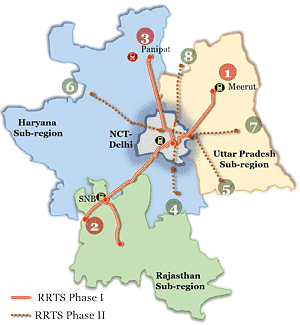
  • In the first phase of the project, three corridors, namely, Delhi-Ghaziabad-Meerut, Delhi-SNB (Shahjahanpur-Neemrana-Behror Urban Complex)-Alwar and Delhi-Panipat are under implementation.
  • The 82-km long Delhi-Meerut corridor is one of the three priority corridors of Phase-1 planned in the NCR and is expected to be operational by 2025.
  • NCRTC is targeting to commission a 17km priority section between Sahibabad and Duhai of the 84km Delhi-Ghaziabad-Meerut corridor, in 2023, before the scheduled time, and the entire first RAPIDX corridor by 2025.
  • In the next phase(s), five additional RAPIDX lines will be developed. These are Delhi–Faridabad–Ballabgarh-Palwal, Ghaziabad–Khurja, Delhi- Bahadurgarh-Rohtak, Ghaziabad-Hapur and Delhi-Shahdara-Baraut.

4hl8 eFri8k52PEnoB1uPFkBBEdpmRdUA8ufu8cXIHvdhF2ySdJPrw1RFp3tg5WJ6g4O6HtiDvwXWzufQ jyTNC7 8LCflg8DoG9O95i4v90zPpTXWipyn5G S

What is Rapid Rail Transit Services (RRTS)?

  • It  is a dedicated, high speed and high-capacity rail-based commuter service that will connect different regions in the national capital region (NCR).
  •  It will offer high-frequency, point-to-point travel at an average speed of 160 kmph.
  • It will provide a "multi-modal integration" connecting the Railway Stations, Bus Depots, airports, and Metro stations.

How is it different from Delhi Metro?

  • The distance travelled on Delhi Metro is usually short and has several stops in between. The RRTS, on the other hand, will be used for relatively longer transits and will have fewer stops.
  • RRTS will also be faster as compared to the DMRC's train. The operational speed of RRTS will be 160 kmph, but for Delhi Metro, it is usually around 80 kmph.

About RRTS- The Journey

  • In 2005, Niti Aayog, then known as the Planning Commission, formed a task force in 2005 under the chairmanship of the secretary of the Ministry of Urban Development (MoUD) to develop a multi-modal transit system for Delhi NCR.
  • The main objective was to reduce the dependence of commuters on road-based transportation and this was included in NCRPB's Integrated Transport Plan (ITP) for NCR 2032.
  • The Task Force also identified 8 corridors and prioritised three corridors, Delhi-Meerut, Delhi-Panipat and Delhi-Alwar, for implementation.
  • NCRTC was made the project's nodal agency, and it was formed as a joint venture of the Centre and the states of Delhi, Haryana, Rajasthan and Uttar Pradesh.

Benefits of Rapid Rail Transit Systems (RRTS)

  • Reduced travel time due to high speeds, easing congestion and increasing productivity.
  • Improved connectivity with seamless integration with other modes of transportation.
  • Environmentally friendly with reduced carbon emissions and air pollution.
  • Economic benefits through job creation and regional development.
  • Enhanced safety and comfort with modern technologies and amenities.
  • Promotes sustainable urban development with transit-oriented development (TOD) principles.
  • Reduces dependence on private vehicles, contributing to a more sustainable transportation system.

National Career Service Portal

About National Career Service Portal

  • This portal is launched by the Labour Ministry to provide placement for diploma & degree holders.
  • This portal facilitates the registration of job seekers, job providers, skill providers, career counsellors, etc.
  • The portal provides job-matching services in a highly transparent and user-friendly manner.
  • These facilities along with career counselling content will be delivered by the portal through multiple channels like career centres, mobile devices, CSCs, etc.
  • The project would be capable of meeting the varied demands and requirements of the youth for information on education, employment and training and will be supported by a multi-lingual call centre.
  • The portal will also make available information on local service providers available to house hold and other consumers for services like driving, plumbing, carpentry, etc.

Subsidy burden of states

Context: Comptroller and Auditor General urged states to make a proper accounting of subsidies, remove revenue deficits, reduce fiscal deficits and keep outstanding debt at an acceptable level. In this context, let us discuss the problems with the subsidy regime.

Subsidies & freebies

As per CAG, the state government’s expenditure on subsidies has grown at 12.9 per cent and 11.2 per cent during 2020-21 and 2021-22. 

 In the recent period, state governments have started delivering a portion of their subsidies in the form of freebies.  Though there is no precise definition of freebies, they are different from subsidies provided by the government on public/merit goods, such as the public distribution system, employment guarantee schemes, states’ support for education and health, and expenditure which brings economic benefits.

On the other hand, freebies like the provision of free electricity, free water, free public transportation, waiver of pending utility bills and farm loan waivers often undermine credit culture, and disincentivise work at the current wage rate leading to a drop in labour force participation.

Issues with Subsidies & freebies

  • Regressive: Some of the subsidies such as Electricity, Fertilisers, MSP etc. are universal in nature and are given to all households irrespective of their socio-economic status. Being universal in nature, such subsidies benefit the richer households more than the poor households and hence are considered to be regressive in nature.
  • Leakages & Corruption: Inclusion and Exclusion errors; Duplicate and Ghost Beneficiaries; Presence of Middlemen, Poor administrative efficiency etc. E.g., 46% leakage in PDS.
  • Subsidies create distortions and ultimately affect poor people: Farm subsidies like MSP encouraged the production of water-intensive crops like rice & wheat and prevented crop diversification. This ultimately resulted in the low-income growth of the farmers. 
  • Cross-subsidization: Subsidies/Freebies like low/free passenger fares or free electricity for the public result in cross-subsidization through commercial usage. This increases the cost of doing business and hence hinders the growth of a private investment.
  • Distorts credit culture: Freebies like Agricultural loan waivers hampers the credit culture among the public and may result in the accumulation of bad assets in the banking sector. 
  • Revenue deficit: Increasing investments on subsidies & freebies increase the Revenue expenditure and hence the Revenue deficit. This leaves little headroom for the governments to invest in capital expenditure. 

Hence, rationalising subsidies is important for state governments to reduce their debt burden in the long term. 

Depositor Education and Awareness (DEA) Fund

Context: Development of a Centralised Web portal for the Public to Search Unclaimed Deposits

Need of DEA

  • The deposits remaining unclaimed for 10 years in a bank are transferred to the “Depositor Education and Awareness” (DEA) Fund maintained by the Reserve Bank of India. 
  • Depositors’ protection being an overarching objective, RBI has been taking various measures to ensure that newer deposits do not turn unclaimed and existing unclaimed deposits are returned to the rightful owners or beneficiaries after following due procedure. On the second aspect, banks display the list of unclaimed deposits on their website. 
  • In order to improve and widen the access of depositors / beneficiaries to such data, RBI has decided to develop a web portal to enable search across multiple banks for possible unclaimed deposits based on user inputs. The search results will be enhanced by use of certain AI tools.

The Depositor Education and Awareness Fund Scheme

  • The fund was created by RBI as per Section 26A of the Banking Regulation Act, 1949.
  • The amounts to be credited to the Fund by banks shall be deposited in the specified account maintained with the RBI.
  • The amounts to be credited to the Fund shall be the credit balance in any deposit account maintained with banks which have not been operated upon for ten years or more, or any amount remaining unclaimed for ten years or more, which include:-
    • Savings bank deposit accounts
    • Fixed or term deposit accounts
    • Cumulative/recurring deposit accounts
    • Current deposit accounts
    • Other deposit accounts in any form or with any name
    • Cash credit accounts
    • Loan accounts after due appropriation by the banks
    • Margin money against issue of Letter of Credit/Guarantee etc., or any security deposit
    • Outstanding telegraphic transfers, mail transfers, demand drafts, pay orders, bankers cheques, sundry deposit accounts, vostro accounts, inter-bank clearing adjustments, unadjusted National Electronic Funds Transfer (NEFT) credit balances and other such transitory accounts, unreconciled credit balances on account of Automated Teller Machine (ATM) transactions, etc.
    • Undrawn balance amounts remaining in any prepaid card issued by banks but not amounts outstanding against travellers cheques or other similar instruments, which have no maturity period
    • Rupee proceeds of foreign currency deposits held by banks after conversion of foreign currency to rupees in accordance with extant foreign exchange regulations and
    • Such other amounts as may be specified by the Reserve Bank from time to time.
  • Any amount payable in foreign currency under an instrument or a transaction, that has remained unclaimed for ten years or more, shall at the time of transfer to the Fund be converted into Indian Rupees at the exchange rate prevailing on that date and in the event of a claim, the Fund shall be liable to refund only the Indian Rupees received by the Fund with respect to such instrument or transaction.
  • The Fund shall be utilised for promotion of depositors’ interests and for such other purposes which may be necessary for promotion of depositors’ interest as may be specified by the RBI. All expenditure incurred for the promotion of depositors’ education, awareness, interests and other purposes that may be specified by the RBI under Section 26A (4) of the Act, shall be charged to the Fund.

Committee to Administer the Fund

  • There shall be a Committee to administer and manage the Fund in accordance with the Scheme which shall consist of an ex-officio Chairperson (a Deputy Governor of RBI, nominated by Governor) and not more than six members as decided by the RBI.
  • The Committee may from time to time lay down a list of activities, the criteria and procedure, etc. for incurring expenditure and achieving the objectives of the Fund.
  • The Committee shall administer the Fund and shall exercise all powers on behalf of the Fund, including incurring of all expenditure that may be charged to the Fund, and keeping the corpus of the Fund invested.
  • The expenses of the Committee and other expenses for administration of the Fund shall be charged to the Fund as decided by the Committee.
  • For facilitating the RBI for determination of the rate of interest payable by the Fund to the depositors, the Committee shall provide to the Reserve Bank such information on the income and expenditure of the Fund as may be required.
  • For the promotion of depositors’ interests, the Committee may register/recognise from time to time various institutions, organisations or associations, engaged in activities relating to depositor awareness and education, including those proposing to conduct programmes for depositors of banks, organising seminars and symposia for depositors and undertaking projects and research activities relating to these areas.
  • Institutions, organisations or associations registered/recognized by the Committee may be considered for grant of funds as a grant-in-aid either as one time measure or in stages or by way of reimbursement, depending upon the nature of the activity proposed.

Refunds and Interest

  • In case of demand from a customer/ depositor whose unclaimed amount/deposit had been transferred to the Fund, banks shall repay the customer/depositor, along with interest if applicable, and lodge a claim for refund from the Fund for an equivalent amount paid to the customer/depositor.
  • The interest payable, if any, from the Fund on a claim shall accrue only from the date on which the balance in an account was transferred to the Fund to the date of payment to the customer/depositor. No interest shall be payable in respect of amounts refunded from the Fund, in respect of which no interest was payable by the bank to its customer/depositor.
  • Rate of interest, if any, payable on the principal amount transferred to the Fund shall be specified by the RBI from time to time.

‘PRAVAAH’ (Platform for Regulatory Application, Validation And Authorisation)

Need of PRAVAAH Portal

  • Various entities are required to obtain licence / authorization to carry out activities regulated by RBI. Further, regulated entities are required to seek certain regulatory approvals from RBI under various statutes / regulations periodically. 
  • Currently, the application and approval processes for the same take place in varied on-line and off-line modes. 
  • The Union Budget for 2023-24 has announced the need to simplify, ease and reduce cost of compliance by financial sector regulators within laid down time limits to decide the applications under various regulations. 
  • It has been decided to develop a secured web based centralised portal named as ‘PRAVAAH’ which will gradually extend to all types of applications made to RBI across all functions.

What is Monetary Policy?

About Monetary Policy

  • Monetary policy is a set of tools used by a nation's central bank to control the overall money supply and promote economic growth and employ strategies such as revising interest rates and changing bank reserve requirements.
  • Under the Reserve Bank of India, Act,1934 (RBI Act,1934) (as amended in 2016), RBI is entrusted with the responsibility of conducting monetary policy in India with the primary objective of maintaining price stability while keeping in mind the objective of growth.

The Monetary Policy Framework

  • In May 2016, the RBI Act, 1934 was amended to provide a statutory basis for the implementation of the flexible inflation targeting framework.
  • Inflation Target: Under Section 45ZA, the Central Government, in consultation with the RBI, determines the inflation target in terms of the Consumer Price Index (CPI), once in five years and notifies it in the Official Gazette. 
  • Accordingly, the Central Government notified in the Official Gazette 4 per cent Consumer Price Index (CPI) inflation as the target for the period from August 5, 2016 to March 31, 2021 with the upper tolerance limit of 6 per cent and the lower tolerance limit of 2 per cent. On March 31, 2021, the Central Government retained the inflation target and the tolerance band for the next 5-year period – April 1, 2021 to March 31, 2026.
  • Section 45ZB of the RBI Act provides for the constitution of a six-member Monetary Policy Committee (MPC) to determine the policy rate required to achieve the inflation target.

Failure to Maintain Inflation Target

Maintain Inflation Target
  • The Central Government has notified the following as the factors that constitute a failure to achieve the inflation target:
    • The average inflation is more than the upper tolerance level of the inflation target for any three consecutive quarters; or 
    • The average inflation is less than the lower tolerance level for any three consecutive quarters.
  • Where the Bank fails to meet the inflation target, it shall set out in a report to the Central Government:
    • The reasons for the failure to achieve the inflation target;
    • Remedial actions proposed to be taken by the Bank; and
    • An estimate of the time period within which the inflation target shall be achieved pursuant to the timely implementation of proposed remedial actions.
  • The operating framework of monetary policy aims at aligning the operating target – the weighted average call rate (WACR) – with the policy repo rate through proactive liquidity management to facilitate the transmission of repo rate changes through the entire financial system, which, in turn, influences aggregate demand – a key determinant of inflation and growth.

Monetary Policy Committee

  • Section 45ZB of the amended RBI Act, 1934 provides for an empowered six-member monetary policy committee (MPC) to be constituted by the Central Government by notification in the Official Gazette. The first such MPC was constituted in September 2016. The present MPC members, as notified by the Central Government in the Official Gazette of October, 2020, are as under:
    • Governor of the Reserve Bank of India—Chairperson, ex officio
    • Deputy Governor of the Reserve Bank of India, in charge of Monetary Policy—Member, ex officio
    • One officer of the Reserve Bank of India to be nominated by the Central Board—Member, ex officio
    • Prof. Ashima Goyal, Professor, Indira Gandhi Institute of Development Research —Member
    • Prof. Jayanth R. Varma, Professor, Indian Institute of Management, Ahmedabad—Member
    • Dr. Shashanka Bhide, Senior Advisor, National Council of Applied Economic Research, Delhi—Member
  • Last three persons are to be appointed by the central government. This category of appointments must be from “persons of ability, integrity and standing, having knowledge and experience in the field of economics or banking or finance or monetary policy”. (Section 45ZC)
  • The MPC determines the policy repo rate required to achieve the inflation target.
  • The MPC is required to meet at least four times in a year. The quorum for the meeting of the MPC is four members.
  • Each member of the MPC has one vote, and in the event of an equality of votes, the Governor has a second or casting vote.
  • Each Member of the Monetary Policy Committee writes a statement specifying the reasons for voting in favour of, or against the proposed resolution.

Instruments of Monetary Policy

There are several direct and indirect instruments that are used for implementing monetary policy.

  • Repo Rate: The interest rate at which the Reserve Bank provides liquidity under the liquidity adjustment facility (LAF) to all LAF participants against the collateral of government and other approved securities.
  • Standing Deposit Facility (SDF) Rate: The rate at which the Reserve Bank accepts non collateralized deposits, on an overnight basis, from all LAF participants. The SDF is also a financial stability tool in addition to its role in liquidity management. The SDF rate is placed at 25 basis points below the policy repo rate. With introduction of SDF in April 2022, the SDF rate replaced the fixed reverse repo rate as the floor of the LAF corridor.
  • Marginal Standing Facility (MSF) Rate: The penal rate at which banks can borrow, on an overnight basis, from the Reserve Bank by dipping into their Statutory Liquidity Ratio (SLR) portfolio up to a predefined limit (2 percent). This provides a safety valve against unanticipated liquidity shocks to the banking system. The MSF rate is placed at 25 basis points above the policy repo rate.
  • Liquidity Adjustment Facility (LAF): The LAF refers to the Reserve Bank’s operations through which it injects/absorbs liquidity into/from the banking system. It consists of overnight as well as term repo/reverse repos (fixed as well as variable rates), SDF and MSF. Apart from LAF, instruments of liquidity management include outright open market operations (OMOs), forex swaps and market stabilisation scheme (MSS).
  • LAF Corridor: The LAF corridor has the marginal standing facility (MSF) rate as its upper bound (ceiling) and the standing deposit facility (SDF) rate as the lower bound (floor), with the policy repo rate in the middle of the corridor.
  • Main Liquidity Management Tool: A 14-day term repo/reverse repo auction operation at a variable rate conducted to coincide with the cash reserve ratio (CRR) maintenance cycle is the main liquidity management tool for managing frictional liquidity requirements.
  • Fine Tuning Operations: The main liquidity operation is supported by fine-tuning operations, overnight and/or longer tenor, to tide over any unanticipated liquidity changes during the reserve maintenance period. In addition, the Reserve Bank conducts, if needed, longer-term variable rate repo/reverse repo auctions of more than 14 days.
  • Reverse Repo Rate: The interest rate at which the Reserve Bank absorbs liquidity from banks against the collateral of eligible government securities under the LAF. Following the introduction of SDF, the fixed rate reverse repo operations will be at the discretion of the RBI for purposes specified from time to time.
  • Bank Rate: The rate at which the Reserve Bank is ready to buy or rediscount bills of exchange or other commercial papers. The Bank Rate acts as the penal rate charged on banks for shortfalls in meeting their reserve requirements (cash reserve ratio and statutory liquidity ratio). The Bank Rate is published under Section 49 of the RBI Act, 1934. This rate has been aligned with the MSF rate and changes automatically as and when the MSF rate changes alongside policy repo rate changes.
  • Cash Reserve Ratio (CRR): The average daily balance that a bank is required to maintain with the Reserve Bank as a percent of its net demand and time liabilities (NDTL) as on the last Friday of the second preceding fortnight that the Reserve Bank may notify from time to time in the Official Gazette.
  • Statutory Liquidity Ratio (SLR): Every bank shall maintain in India assets, the value of which shall not be less than such percentage of the total of its demand and time liabilities in India as on the last Friday of the second preceding fortnight, as the Reserve Bank may, by notification in the Official Gazette, specify from time to time and such assets shall be maintained as may be specified in such notification (typically in unencumbered government securities, cash and gold).
  • Open Market Operations (OMOs): These include outright purchase/sale of government securities by the Reserve Bank for injection/absorption of durable liquidity in the banking system.

Monetary Policy Process

The Reserve Bank has notified the Reserve Bank of India Monetary Policy Committee and Monetary Policy Process Regulations, 2016 which consists of the following:

  • Meeting schedule: The schedule of monetary policy voting/decision meetings for the entire fiscal year is announced in advance.
  • Meeting notice: Ordinarily, not less than fifteen days’ notice is given to members for meetings of the Committee. Should it be found necessary to convene an emergency meeting, 24 hours’ notice is given to every member to enable him/her to attend, with technology enabled arrangements for even shorter notice period for meetings.
  • Meeting duration: The duration of monetary policy meetings is as decided by the Committee. The policy resolution is publicly released after the conclusion of the MPC meeting keeping in view the functioning and timing of financial markets.
    • The MPC in its meetings reviews the surveys conducted by the Reserve Bank to gauge consumer confidence, households’ inflation expectations, corporate sector performance, credit conditions, the outlook for the industrial, services and infrastructure sectors, and the projections of professional forecasters. 
    • The MPC also reviews in detail the staff’s macroeconomic projections, and alternative scenarios around various risks to the outlook. Drawing on the above and after extensive discussions on the stance of monetary policy, the MPC adopts a resolution.
  • The MPC Resolution: The Bank publishes, after the conclusion of every meeting of the MPC, the resolution adopted by the said Committee. The resolution includes the MPC’s decision on the policy repo rate.
  • Minutes of the MPC meeting: On the 14th day after every meeting of the MPC, the minutes of the proceedings of the MPC are published which include: (a) the resolution adopted by the MPC; (b) the voting of each member on the resolution; and (c) short written statements of individual members justifying the vote, consistent with the provisions of Section 45ZL of the RBI Act. Minutes shall be released at 5 pm on the 14th day from the date of the policy day (or next earliest working day, if a holiday in Mumbai).
  • The Monetary Policy Report: Once in every six months, the Reserve Bank publishes the Monetary Policy Report containing the following elements:
    • Explanation of inflation dynamics in the last six months and the near term inflation outlook.
    • Projections of inflation and growth and the balance of risks.
    • An assessment of the state of the economy, covering the real economy, financial markets and stability, fiscal situation, and the external sector, which may entail a bearing on monetary policy decisions.
    • An updated review of the operating procedure of monetary policy.
    • An assessment of projection performance.

Monetary Policy Stance

The MPC indicates its broader policy approach by guiding the markets with policy stances.

  • Accommodative: means the central bank is prepared to expand the money supply to boost economic growth. The central bank, during an accommodative policy period, is willing to cut the interest rates. A rate hike is ruled out. The central bank typically adopts an accommodative policy when growth needs policy support and inflation is not the immediate concern.
  • Neutral: suggests that the central bank can either cut rate or increase rate. This stance is typically adopted when the policy priority is equal to both inflation and growth. During neutral policy, the central bank doesn’t commit to hiking rates or cuts. The interest rate can move to either side depending on incoming data. The guidance indicates that the market can expect a rate action on either way at any point.
  • Hawkish: indicates that the central bank’s top priority is to keep the inflation low. During such a phase, the central bank is willing to hike interest rates to curb money supply and thus reduce the demand. A hawkish policy also indicates tight monetary policy. A rate cut is nearly certain during such a period. When the central bank increases rates or 'tightens' the monetary policy, banks too increase their rate of interest on loans to end borrowers which, in turn, curbs demand in the financial system.
  • Calibrated tightening: means during the current rate cycle, a cut in the repo rate is off the table. But, the rate hike will happen in a calibrated manner. This means the central bank may not go for a rate increase in every policy meeting but the overall policy stance is tilted towards a rate hike. This can happen outside the policy meetings as well if the situation warrants it.

PM-DeVINE (Prime Minister’s Development Initiative for North East)

Context: Recently, the Ministry of Development of the North Eastern Region (MDoNER) provided the details of developmental projects in the North East region under the PM DevINE scheme to the Rajya Sabha.

About PM-DeVINE Scheme

  • Launched in Union Budget 2022-23  
  • It is a central sector scheme means fully funded by Union Government
  • It is to be implemented for 4 years between 2022-23 to 2025-26
  • PM-DevINE will enable livelihood activities for youth and women by filling the gaps in various sectors, but it will not be a substitute for existing Central or State schemes.

The objectives of PM-DevINE

  • Fund infrastructure convergently, in the spirit of PM Gati Shakti;
  • Support social development projects based on the felt needs of the NER;
  • Enable livelihood activities for youth and women; and
  • Fill the development gaps in various sectors.

 Initiatives under the scheme

  • Establishment of Dedicated Services for the Management of Paediatric and Adult Haematolymphoid Cancers in North East India, at Dr B. Borooah Cancer Institute (BBCI), Guwahati
  • NECTAR Livelihood Improvement Project (Multi-State): Value Chain on Utilization of Banana Pseudo Stem for Value-Added Products.
  • Promoting Scientific Organic Agriculture in North East India, using Improved Farming Techniques & Digital Data Management through Capacity Building of Farmers and Facilitating Certification. (Multi-State)
  • Construction of Aizawl By-pass on the Western Side of Mizoram
  • Construction and upgradation of Bamboo Link Roads- from Tuirial Airfield to North Chaltlang (18 km) and from Lengpui to Saiphal Bamboo Plantation (41 km) in Mizoram
  • Gap funding for Passenger Ropeway System from Pelling to Sanga-Choeling in West Sikkim
  • Gap funding for Passenger Ropeway from Dhapper to Bhaleydunga in South Sikkim
  • Transformation of 20 schools as Centre of Excellence in the Kamrup District of Assam by Public Works Department, Government of Assam
  • Construction of a new four-lane road and conversion of an existing two-lane road into a four-lane with cycling tracks, utility ducts, footpaths, etc. at New Shillong Township by Directorate of Urban Affairs, Government of Meghalaya
  • Livelihood projects relating to Special Development of Eastern Nagaland by the Department of Under Developed Areas (DUDA), Government of Nagaland
  • Establishment of Solar Micro Grid for the supply of reliable power to Remote Habitations in Tripura by the Department of Power, Government of Tripura

Chidambaram says 83% of MUDRA loans too small for business

Context: Recently Prime Minister MUDRA (Micro Units Development Refinance Agency) Yojana completed 8 years.  Reports say that 83% of loans given under the scheme were under Rs. 50000.

About PM MUDRA Yojana

  • The scheme aimed to provide loans up to 10 lacks to non-corporate, non-farm small/micro enterprises.
  • Under the aegis of PMMY, MUDRA has created three products namely '

1. ‘Shishu' covers loans upto Rs. 50000

2. 'Kishore' covers loans above Rs. 50000 and upto Rs. 5 lakhs

3. 'Tarun’ Covers loans Above 5 lakhs and upto 10 lakhs

  • These loans are given by Commercial Banks, RRBs, Small Finance Banks, MFIs and NBFCs.
  • MUDRA Bank is nodal agency to implement the scheme

What is MUDRA Bank? 

  • It is a refinancing institution and regulator  for micro-finance institutions.
  • It would be in charge of developing and refinancing the micro-enterprise sector by assisting finance institutions that lend to micro/small business entities engaged in manufacturing, trading, and service activities. 
  • It would collaborate with banks, microfinance institutions, and other lending institutions at the state and regional levels to provide microfinance support to the country's microenterprise sector. 

Achievements under PM MUDRA Yojana

  • A total of 60827414 beneficiaries have taken the loan up to the financial year 2022-23
  • A total of Rs. 442296.46 Crore have been disbursed upto the financial house 2022-23

Limitations of MUDRA Yojana

  • There are a number of already existing refinancing agencies
  • There is a potential conflict of interest due to the nature of the roles and responsibilities of Mudra Bank.
  • Mudra Bank seems to promote shadow banking.
  • There is a better solution to finance micro and small businesses in the form of Microfinance institutions
  • It will lead to an increase in the number of regulators for MFIs

How ASBA-like facility for secondary market trading benefits customers

Context: The capital markets regulator, Securities and Exchange Board of India (SEBI), last week approved a framework for Application Supported by Blocked Amount (ASBA)-like facility for trading in the secondary market.

The facility will be optional for investors and stock brokers. To facilitate smooth transition in the market, the framework will be implemented in a phased manner.

About Application Supported by Blocked Amount

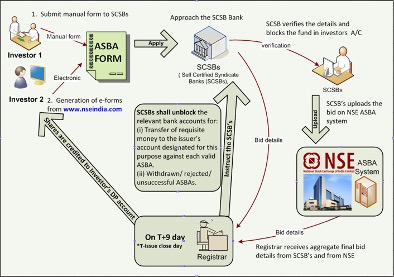
  • ASBA, which was first introduced by SEBI in 2008, is an application by an investor that contains an authorisation to a Self-Certified Syndicate Bank (SCSB) to block in the bank account the application money for subscribing to an issue.
  • Simply put, ASBA provides an alternative mode of payment in issues whereby the application money remains in the investor's account till finalization of basis of allotment in the issue (shares).
  • An SCSB is a recognised bank (e.g. HDFC or ICICI) capable of providing ASBA services to its customers.
  • The application money of an investor applying through ASBA shall be debited from the bank account only if her application is selected for allotment after the basis of allotment has been finalised. In public issues and rights issues, all investors have to mandatorily apply through ASBA.
1olMsbczIQofRqukbJd3ixFJT hDR22aBTWCo0a8K2ziocstr8nmWFmcHF8qNN8SRL8QCHdQUb0ytEbdA5okUWIPfXYVyUMrsZD6ovbkbFWikZBAeGOHYscq fm46MC8nglMZeNEkLieHOXINhM5AsM

What SEBI has done?

  • It gave its nod for an ASBA-like facility for secondary market trading. The facility is based on the blocking of funds for trading in the secondary market through UPI (Unified Payments Interface).
  • At present, ASBA is available for the primary market, wherein the initial public offering (IPO) funds only are blocked on application, and are debited only on allotment.
  • Extension of ASBA to secondary markets means brokers will no longer collect margins from clients; only a block will be placed on the bank account.

How will the ASBA facility benefit retail investors in the secondary market?

  • ASBA in secondary market trading will ensure that clients will continue to earn interest on the blocked funds in their savings account till the debit takes place.
  • There will be direct settlement with Clearing Corporation (CC), without passing through the pool accounts of the intermediaries. Hence, it will provide client-level settlement visibility to CC, and help avoid the risk of co-mingling of clients’ funds and securities.
  • It will eliminate the custody risk of client collateral, which is currently retained by the members, and is not transferred to the CC. There will be hassle-free and immediate unblocking of client’s funds and/ or return of securities in case of member default.
  • The markets regulator said the facility will bring efficiency in the secondary market ecosystem by allowing usage of the same blocked amount towards margin and settlement obligations. It will result in lower working capital requirements for members.
  • Under the proposed framework, stock brokers will be allowed to either directly settle the brokerage with the UPI clients or opt for CC’s facility to deduct standard rate of brokerage from the UPI block of the clients.

Will this impact the markets?

  • Market participants feel that the ASBA-like system for the secondary market would impact volumes. While client volumes may not be impacted, the proprietary volumes can be negatively impacted.
  • Much of these funds are client funds and that could take a hit. This is also likely to reduce the leverage provided by brokers to the clients.
  • So, there will certainly be a short-term volume impact, although it is expected to be value accretive in the long run.

Goods & Service Tax Appellate Tribunal

Context: Finance Act amended the Central Goods & Services Tax Act, 2017 and provided the framework for the functioning of GST Appellate Tribunal for hearing appeals against the orders passed by Appellate Authority or Revisional Authority.

Need for GST Appellate Tribunal

  • GST Appellate Tribunal is the forum of second appeal in GST laws and first common forum of dispute resolution between Centre & States. 
  • Appeals against the orders in first appeals issued by Appellate Authorities under Central & State GST Acts lie before the GST Appellate Tribunal, which is common under the Central & State GST Acts. Currently, due to want to GST Appellate Tribunal appeals from Appellate Authorities lie in various High Courts and Supreme Court which renders the process of dispute resolution slow.
  • Being a common forum, GST Appellate Tribunal will ensure that there is uniformity in redressal of disputes arising under GST and in implementation of GST across the country. 
  • Earlier GST Council had formed a group of ministers committee under the Chairmanship of Dushyant Chautala of Haryana. GST Council in its 49th meetings accepted the committee reports and recommended the constitution of GST Appellate Tribunal. 

GST Appellate Tribunal formed by Finance Act, 2023

  • Central Government shall establish an Appellate Tribunal known as Goods and Services Tax Appellate Tribunal for hearing appeals against the orders passed by the Appellate Authority or the Revisional Authority.
  • Jurisdiction, powers & authority conferred on the Appellate Tribunal shall be exercised by Principal Bench and State Benches of GSTAT. 
  • Principal Bench & State Benches shall hear appeals against orders passed by Appellate Authority or Revisional Authority. However, if a case involves dispute over the place of supply, the Principal Bench shall only hear it. 
  • Principal Bench of GSTAT will be established at New Delhi and will consist of President, a Judicial Member, a Technical (Centre) and a Technical Member (State). President shall distribute the business of the GST Appellate Tribunal among the Benches and may transfer cases from one bench to another.
  • State Benches of GSTAT
  • Central Government to establish State Benches on the request of the State Governments. 
  • Number of Benches, their locations and their jurisdictions to be recommended by GST Council to the Central Government. 
  • State Benches of GSTAT will consist of two Judicial Members, a Technical Member (Centre) and a Technical Member (State) i.e., total four members. 
  • Senior-most Judicial Member in State Bench shall act as Vice-President for such State benches and will exercise similar functions as played by President in relation of Principal Bench of GSTAT. 
  • Administration of Benches of GSTAT for both State Benches and Principal Bench of GSTAT: 
  • For disputes in which the amount of fine, fee or penalty, tax or input tax credit is less than Rs 50 lakhs and not involving any question of law, may with the approval of President, can be heard by a single member.
  • All other cases will be heard by two-member bench comprising of one judicial member and one technical member. 
  • In case of difference of opinion among members: If after hearing the cases, members differ in their opinion on any point or points, such members shall state the points on which they differ and the President shall refer such case for hearing:
  • For a State Bench: To another member of a State Bench within the State or where no such other State Bench is available in the State, to a Member of a State Bench in another State.
  • For a Principal Bench: To another member of Principal Bench, or, where no such other Member is available, to a Member of any State Bench. 

And such points shall be decided according to the majority opinion including the opinion of the Members who first heard the case.

Qualifications for members of Principal Bench

A person shall not be qualified for appointment as:

  • President should have been a Judge of the Supreme Court or is or has been the Chief Justice of a High Court.
  • Judicial Member should have been a Judge of High Court or District Judge or Additional District Judge for a combined period of 10 years.
  • Technical Member (Centre) should be or been a member of Indian Revenue (Customs & Indirect Taxes) Service, Group A or All India Service with at least three years of experience in administration of an existing law or goods & service tax in the Central Government, and has completed 25 years of service in Group A.
  • Technical Member (State) should have been an officer of State Government or an officer of All India Services, not below the rank of Additional Commissioner of Value Added Tax or State goods and services tax or such rank not lower than First Appellate Authority to be notified by concerned State Government, on the recommendations for GST Council and has completed 25 years in Group A service
  • President, Judicial Member, Technical Member (Centre) & Technical Member (State) shall be appointed or re-appointed by the Central Government on the recommendations of a Search-cum-Selection Committee.

Search-cum-Selection Committee for all members apart from Technical Member (State)

  • Chief Justice of India or a Judge of Supreme Court nominated by him, to be Chairperson of Search-cum-Selection Committee. 
  • Secretary of Department of Revenue in Ministry of Finance of Central Government, to be Member Secretary of Search-cum-Selection Committee. (Does not have right to vote)
  • Secretary of Central Government nominated by Cabinet Secretary.
  • Chief Secretary of a State to be nominated by GST Council.
  • One member, who
    • For appointment of a President of a Tribunal, this member will be the outgoing President of the GSTAT.  
    • For appointment of a member of a Tribunal, this member will be the sitting President of Tribunal. 
    • For considering reappointment of President of GSTAT or when outgoing President is not available or when removal of incumbent President is being considered, this member will a retired judge of Supreme Court or a retired Chief Justice of a High Court to be nominated by CJI.
  • Search-cum-Selection Committee shall recommend a panel of two names for appointment or re-appointment to the post of President or a Member. 

Search-cum-Selection Committee for Technical Member (State)

  • While making selection for Technical Member (State) of a State Bench, first preference to be given to officers who have worked in the State Government of the State to which jurisdiction of the Bench extends.
  • Search-cum-Selection for Technical Member (State) of a State Bench consists of the following members:
  • Chairperson: Chief Justice of High Court in whose jurisdiction the State Bench is located.
  • Senior-most Judicial Member in the State and where no Judicial Member is available, a retired Judge of High Court in whose 
  • Chief Secretary of the State in which State Bench is located.
  • One Additional Chief Secretary or Principal Secretary or Secretary of the State in which the State Bench is located 

Conditions of Service of members of GSTAT

  • Tenure of service for members: All the members of GSTAT including the President will hold office for a term of four years from the date on which they enter office. The President can stay in office until he reaches 67 years of age and shall be eligible for re-appointment for a period not exceeding two years. Other members can stay in office until they reach 65 years of age and shall be eligible for re-appointment for a period not exceeding two years.
  • Resignation of Members: President or any member resign from his office by notice addressed to Central Government. 
  • Removal of Members: Government may on the recommendations of Search-cum-Selection Committee remove from office a member including President, who:
    • Has been adjudged an insolvent.
    • Has been convicted of an offence which involves moral turpitude
    • Has become physically or mentally incapable of acting as President or Member.
    • Has acquired such financial or other interest
    • Has abused his position to render his continuance in office prejudicial to public interest.
  • Suspension of Members: Central government may suspend from office the President and other members on the recommendations of Search-cum-Selection Committee against whom proceedings for removal have been initiated.
  • Transfer of Members: Central Government may in consultation with the President for administrative efficiency transfer Members from one Bench to another Bench. However, a Technical Member (State) of a State Bench may be transferred to a State Bench only of the same State in which he was originally appointed, in consultation with State Government. 
  • President or other Members, on ceasing to hold their office, shall not be eligible to appear, act or plead before the Principal Bench or State Bench
  • Salary of President & Members of GSTAT: 
  • Salary of the President and Members of GSTAT shall be such as may be prescribed and their allowances and other terms and condition of service shall be same as applicable to Central Government officers carrying same pay. 
  • Salary and allowances and other terms of service will not be varied to their disadvantage after their appointment. 

NPCI’s circular on levy charges

About NPCI

  • National Payments Corporation of India (NPCI), an umbrella organisation for operating retail payments and settlement systems in India, is an initiative of Reserve Bank of India (RBI) and Indian Banks’ Association (IBA) under the provisions of the Payment and Settlement Systems Act, 2007, for creating a robust Payment & Settlement Infrastructure in India.
  • Considering the utility nature of the objects of NPCI, it has been incorporated as a “Not for Profit” Company under the provisions of Section 25 of Companies Act 1956 (now Section 8 of Companies Act 2013), with an intention to provide infrastructure to the entire Banking system in India for physical as well as electronic payment and settlement systems.
  • NPCI is focused on bringing innovations in the retail payment systems through the use of technology for achieving greater efficiency in operations & widening the reach of payment systems.
  • The ten core promoter banks are State Bank of India, Punjab National Bank, Canara Bank, Bank of Baroda, Union Bank of India, Bank of India, ICICI Bank Limited, HDFC Bank Limited, Citibank N. A. and HSBC.
  • In 2016 the shareholding was broad-based to 56 member banks to include more banks representing all sectors.
  • In 2020, new entities regulated by RBI were inducted, consisting of Payment Service Operators, payment banks, Small Finance Banks, etc.
  • The shares were allotted pursuant to issuance of equity shares on private placement basis in compliance to the applicable provisions of the Companies Act, 2013.

What is UPI?

  • UPI is an instant real-time payment system developed by National Payments Corporation of India (NPCI)
  • The mobile-based fast payment system is built over the IMPS infrastructure.
  • Features:
    • The payments can be made round-the-clock and in real time.
    • It eliminates the risk of sharing bank account details by the remitter as customers are not required to enter the details such as Card no, account number, IFSC etc.
    • UPI supports both Person-to-Person (P2P) and Person-to-Merchant (P2M) payments and it also enables a user to send or receive money.
    • It enables the use of a single mobile application for accessing different bank accounts.
    • Transactions are carried out through mobile devices with two factor authentication using device binding and a UPI PIN as security.
    • Registration of Beneficiary is not required for transferring funds through UPI as the fund would be transferred based on using a Virtual Payment Address (VPA) created by the customer.

The Circular on Levy Charges

  • National Payments Corporation of India (NPCI), which governs UPI - intimated banks and payment service providers that they can now levy charges on merchant transactions made through Prepaid Instrument wallets using UPI.
    • For using prepaid payment instruments (PPIs) such as gift cards, wallets etc for transactions on UPI, an interchange fee of up to 1.1% has been levied from April 1, 2023.
  • It also issued a clarification stating that normal bank-to-bank UPI transactions will not be charged and that customers will not have to pay for transactions made via PPI on UPI.
  • New interchange charges are only applicable for Prepaid Payment Instruments’ (PPI) merchant transactions.
  • The interchange fee, generally associated with card payments to cover the transaction cost, has now brought PPI wallets also under its fold.

What are PPIs?

  • Prepaid Payment Instruments (PPIs) are payment methods that can be used to purchase goods and services and send/receive money by using the stored value in the wallet.
  • Users have to pre-load the wallet with a desired amount.
  • The amount can be loaded/reloaded against cash or through debit to bank account, or by using credit/debit cards, UPI, or any other approved payment method in India. PPIs can only be used in Indian rupees.
  • PPIs can be in the form of mobile wallets, physical smart cards, secure tokens, vouchers, or any other method that allows access to prepaid funds.

What is PPI interoperability?

  • Previously, to use PPI at any merchant, it was necessary that the concerned merchant was engaged directly by the specific PPI issuer (specific network). All PPIs with which the merchant did not have a direct tie-up would get rejected.
  • The most prevalent form of PPI used in the country is the mobile wallet, and this restriction meant that customers of one specific mobile wallet could spend the money in the wallet only at specific merchant locations which were directly tied up with the same PPI wallet provider.
  • For example, if you had a Paytm or Mobikwik wallet, you could only use it at merchants that accepted Paytm or Mobikwik QR codes.
  • To overcome this limitation of PPIs, the RBI has mandated interoperability among different PPI issuers.
  • Subsequently, PPI issuers tied-up with NPCI for issuing
    • interoperable RuPay PPI cards
    • creating interoperable wallets on UPI rails.
  • Prepaid instruments in the form of wallets can now be linked to UPI, thus creating interoperable wallets on UPI rails.

How does PPI interoperability through UPI work?

  • After linking one’s PPI wallet to UPI, customers can transact using Scan and Pay on all UPI interoperable QR codes. This will enable the use of PPI wallets at all merchant locations.
  • The user can also send/receive money to any other wallet user.
  • Similarly, a merchant with any UPI QR code can now accept payments from any PPI issuer or mobile wallet.
  • PPI on UPI will speed up the growth of merchant transactions in rural areas and further deepen digital financial inclusion by catering to use cases such as healthcare, transit, education, utility bills, etc.

Do merchants have to pay for accepting wallet transactions on UPI?

  • The PPI enabled merchants were already paying charges to the PPI issuer for acceptance of mobile wallets or prepaid cards. Now the charges are aligned at a network level with some standardisation. However, each merchant can work with their preferred acquiring entity.
  • Now, for using prepaid payment instruments (PPIs) such as gift cards, wallets etc for transactions on UPI, an interchange fee of up to 1.1% has been levied from April 1, 2023.
    • The charges are applicable if the transaction is more than ₹2,000.
    • If you are a merchant and accepting UPI payments from a customer’s bank account, then there are no charges applicable.
    • Charges are applicable only if you have accepted or consented for the transactions made using PPI Wallet.

Are there any charges to be paid by consumers holding wallets for PPI on UPI transactions?

  • Officially there are no charges to be paid by the customer. However, merchants may pass on the additional burden to customers by way of price increase or some other means.