Context: The intense wildfires raging in the United States and Canada have spiked the occurrence of pyrocumulonimbus clouds. The development of these clouds has become more frequent in recent years.
About Pyrocumulonimbus clouds
Pyrocumulonimbus clouds are thunder clouds created by intense heat from the Earth’s surface, either from large wildfires or volcanic eruptions. That is the reason why the prefix ‘pyro’ is used – meaning fire in Greek.
For instance, these clouds were formed during the Australian bushfires of 2019-2020 when temperatures crossed 800 degrees Celsius.
Mechanism of formation of the clouds:
The intense heat from the wildfire/ volcanic eruption warms the surrounding air which moves upward into the atmosphere.
As this hot and very buoyant air (carrying water vapour, smoke, and ash) rises, it expands and cools down.
Once it is cool enough, water vapour condenses on ash, forming a grey or brown cloud. At this stage, the cloud is known as a pyrocumulus cloud, also known as ‘fire cloud’.
But if there is sufficient water vapour available and the upward movement of hot air intensifies, pyrocumulus clouds can evolve into a pyrocumulonimbus cloud.
Characteristics:
These clouds can reach heights of 50,000 feet and generate their own systems of thunderstorms.
Although pyrocumulonimbus clouds can produce lighting, they do not generate much rain. As a result, they can spark new wildfires many kilometres away from the main blaze.
These clouds can also trigger strong winds that can make the spread of the wildfire faster and unpredictable.
Frequent occurrence of pyrocumulonimbus clouds:
Before 2023, 102 pyrocumulonimbus were recorded globally in a single year on average — 50 of them were seen in Canada. However, during last year’s extreme wildfire season, 140 pyrocumulonimbus clouds were recorded in Canada alone.
The exact reason for their frequent occurrence remains unclear. However, scientists believe that climate change and temperatures soaring across the world, leads to frequent wildfires, which may spike the occurrence of pyrocumulonimbus clouds.
Context: Opposition leaders demanding the withdrawal of 18% Goods and Services Tax (GST) on life insurance and health insurance premiums.
GST on health and life insurance premiums
GST replaced all indirect taxes like service tax and cess and is currently set at 18% for health and life insurance policies.
Prior to GST, life insurance premiums were subject to a 15% service tax, including Basic Service Tax, Swachh Bharat cess, and Krishi Kalyan cess. The increase to 18% has raised premium costs for policyholders.
Markets for life and health insurance in India:
General insurance industry: Collected Rs 1,09,000 crore in premiums under the health portfolio for fiscal 2023-24.
Life Insurance Companies: Mobilized Rs 3,77,960 crore in premiums in FY2024, with LIC accounting for a significant portion.
Regional contributions: Five states (Maharashtra, Karnataka, Tamil Nadu, Gujarat, and Delhi) contributed 64% of the total health insurance premiums.
Insurance penetration: Life insurance penetration decreased from 3.2% in 2021-22 to 3% in 2022-23, with non-life insurance remaining at 1%. Overall insurance penetration dropped to 4% from 4.2% during the same period.
Arguments for GST on health insurance:
Revenue generation: GST applies to all insurance policies as a service tax, generating significant revenue for the government, which can be used for public welfare and infrastructure development.
As government collected around Rs 21,000 crore in GST over the last 3 FYs, with an additional around Rs 3,000 crore from the reissuance of health policies.
Tax exemption: Insurance policies allow certain deductions while computing income tax under Sections 80C and 80D of the Income Tax Act, 1961.
Section 80C allows deductions of up to Rs 1.5 lakh on the total premium, including GST, while Section 80D provides additional deductions for medical riders with life insurance policies.
Simplification and uniformity: GST replaces multiple indirect taxes, simplifying the tax structure and providing uniformity across states, making it easier for insurers to comply with tax regulations.
Transparency:GST compliance often encourages digital record-keeping and transactions, lead to more transparency and efficiency in the insurance industry.
Constitutional framework: GST rates and exemptions are determined by the GST Council, which includes both central and state representatives. This ensures that decisions are made based on comprehensive inputs from various stakeholders.
Arguments against GST on health insurance:
Increasing out-of-pocket expenses for healthcare: High GST rates on insurance, acts as a deterrent to buying policies, making it less affordable for individuals and families, especially for those already facing high medical costs and increasing out-of-pocket expenses for healthcare.
Premium increases: Significant increases in health insurance premiums have led to a decline in policy renewals and unable to achieve the goal of "Insurance for All by 2047."
Impact on vulnerable populations: Low-income groups and senior citizens may find it particularly challenging to afford insurance with the added GST, potentially leaving them without financial protection in medical emergencies.
Contradiction to public health goals: May contradict government efforts such as Swasth Bharat Viksit Bharat to promote healthcare access and financial protection for all citizens.
Potential for reduced coverage: Individuals may opt for lower coverage or higher deductibles to offset the increased costs due to GST, may undermine the effectiveness of their insurance in covering medical expenses.
Way forward:
Parliamentary Standing Committee Recommendations:
GST rates applicable to health insurance products, particularly retail policies for senior citizens and microinsurance policies (up to limits prescribed under PMJAY, presently Rs 5 lakh), and term policies may be reduced.
It recommended that the Ayushman Bharat scheme can be expanded by allowing people who are not covered by the scheme to opt for it on a paid basis to achieve public health goal.
Sector-specific adjustments: Consideration of lower GST rates for specific categories such as retail policies for senior citizens, microinsurance policies, and health insurance could help in addressing affordability concerns.
Global scenario
In countries like Singapore and Hong Kong, there is no GST or VAT on insurance, making it more accessible to consumers.
Context: Recently Infosys had received a tax notice of ₹32,403 crore for unpaid IGST under the reverse charge mechanism for services from its overseas branches from 2017-22.
What is Reverse charge mechanism under GST?
Generally, the supplier of goods or services is liable to pay GST. However, in specified cases the liability may be cast on the recipient under the reverse charge mechanism. Reverse charge means the liability to pay tax is on the recipient of supply of goods or services instead of the supplier of such goods or services.
The input tax credit is received is by the receiver of the good/service in this mechanism.
Reverse charge mechanism is applicable in the following cases:
Import of goods/services
Good/Service is supplied by an unregistered (who is not registered under GST) supplier.
Services provided by the e-commerce operators.
Any other category of services notified by the government.
What happened in Infosys case?
The tax authorities had issued notices for remittance sent by the Indian head office to its foreign branches as part of its expenses, even where there is no service between the head office and the foreign branch.
The tax authorities considered them as ‘import of services’ by the head office from the branch.
Carry trade involves borrowing at low interest rate in one country (in one currency) and investing in another country (in another currency) where interest rates are higher to achieve higher returns.
This is possible when central banks of different countries try to keep their interest rates at a level that suits their specific economic conditions. The difference in the interest rates in the respective countries enables the carry trade.
The carry trade also take advantage of the weakening currency of the low interest rate country to offset any conversion expenses.
What is Yen carry trade?
The yen carry trade involves borrowing in low-interest Japanese yen and investing in higher-yielding assets in other countries to profit from the interest rate differential and potential currency movements.
e.g., Japan central bank (the Bank of Japan) had kept interest rates at 0% between 2011 and 2016 and, in fact, pushed them even below zero (-0.10%) since 2016 to stimulate economic activity.
Such low interest rates incentivise investors to borrow cheaply in yen and invest in other countries (such as Brazil, Mexico, India and even the US) in a bid to earn better returns.
How did it impact global markets?
While Bank of Japan kept its interests lower, other central banks kept raising their interest rates in the wake of Russian-Ukraine war which incentivised yen carry trade.
However, Bank of Japan increased its interest rates by around 60 basis points in the last 6 months. it led to investors who had borrowed in yen and invested in Brazilian real or Mexican peso or Indian rupee, selling their assets in international markets (Unwinding of yen carry trade).
This unwinding of yen carry trade also strengthened Yen’s exchange rate against currencies like dollar, real, rupee, peso etc.
Clocks are devices that measure the passage of time and display it. A clock measures the amount of time that has passed by tracking something that happens in repeating fashion, at a fixed frequency.
Sundials in ancient times allowed people to ‘tell’ time by casting shadows of changing lengths against sunlight.
In water clocks/ sand clocks, water/sand would slowly fill a vessel, with its levels at different times indicating how much time had passed.
Important types of clocks:
Some important types of clocks are the quartz clock, atomic clock, optical clock and nuclear clocks.
1. Quartz clocks:
The fundamental setup of both quartz clock and the atomic clock is similar: they have a power source, a resonator, and a counter.
Working:
Quartz clocks use a tiny piece of quartz crystal as the resonator.
The Quartz crystal has a special property- on the application of electricity to it, it vibrates at a very precise and constant speed - 32,768 times per second. The power source in the clock sends electrical signals to a quartz crystal, whose crystal structure oscillates due to the piezoelectric effect.
The Electronic circuit (counter) in the clock counts these vibrations and uses them to create regular electric pulses, one per second. These pulses power a tiny motor. The motor turns gears that move the hands of the clock.
Hence, quartz clocks are much more accurate than older mechanical clocks. These clocks are inexpensive to make and easy to operate, and their invention led to watches and wall-clocks becoming very common from the mid-20th century.
An atomic clock is a highly accurate timekeeping device that uses the properties of atoms to measure time. In these clocks, a laser serves as the power source, and a group of atoms of the same isotope acts as the resonator.
Atoms Used: Caesium-133 (most commonly used and is the basis for the definition of the second in the International System of Units (SI)), Rubidium-87 (less accurate than caesium clocks but are more compact and cost-effective), Hydrogen and Strontium.
Working:
The laser provides enough energy for the atom to jump from its low energy state to a specific higher energy state.
When the atom returns to its lower energy state, it emits radiation with a very precise frequency. For example, in a caesium atomic clock, caesium-133 atoms emit radiation at a frequency of 9,192,631,770 Hz. The counter in the clock counts these waves, and when it detects exactly 9,192,631,770 waves, it records that one second has passed.
Significance:
Atomic clocks are extremely precise and stable,losing or gaining only a second every 20 million years.
Because of their accuracy, they serve as time standards. For instance, India’s official time is maintained by a caesium atomic clock at the National Physical Laboratory in New Delhi.
The frequency of the radiation emitted by caesium clocks is in the microwave range, making them essential for applications where precise timing is crucial.
Applications of Atomic Clocks:
Global Positioning System (GPS) and other satellite navigation systems to provide precise location data.
Telecommunications to help synchronise communication networks and Internet synchronisation.
Scientific Research and timekeeping standards.
Financial Systems for timestamping transactions in financial markets.
3. Optical clocks:
An optical clock is an advanced timekeeping device that uses the properties of atoms or ions, but at optical frequencies rather than microwave frequencies (as in atomic clocks). These clocks offer even greater accuracy and stability than traditional atomic clocks.
Atoms/Ions Used: Strontium, Ytterbium and Aluminium Ion.
Working:
Laser Excitation: A laser excites electrons in the atom or ion to a higher energy state.
Optical Frequency: When the electron returns to a lower energy state, it emits radiation at an optical frequency (much higher than the microwave frequencies in atomic clocks).
Counting Oscillations: The clock measures these oscillations, with the optical frequency allowing for more precise time measurement due to the higher number of cycles per second.
Significance:
High Precision: Optical clocks are even more precise than atomic clocks, with potential accuracies that would lose or gain only a second in more than 10 billion years.
Future Time Standards: These clocks are being researched as potential successors to atomic clocks for defining the second.
Applications of Optical Clocks:
Scientific Research: Used in testing fundamental physics theories, such as relativity and quantum mechanics.
Redefining Time Standards: May lead to a new definition of the second in the International System of Units (SI).
Navigation Systems: Potentially used in next-generation satellite navigation and communication systems for even greater precision.
4. Nuclear Clocks
A nuclear clock is an experimental timekeeping device that uses the energy levels within an atomic nucleus, rather than electron transitions, to measure time. These clocks are still in the research phase but promise unprecedented precision.
Atomic clocks need to make sure the resonator atoms are not affected by energy from other sources, like a stray electromagnetic field.
An atom’s nucleus is located well within each atom, surrounded by electrons, and thus could be a more stable resonator.
The nucleus’s de-excitation emission has a frequency of 2,020 terahertz, which indicates an ultra-high precision.
Nucleus Used: Scientists are experimenting with Thorium-229 nuclei.
Working:
Nuclear Transitions: The clock relies on a transition between energy levels within the atomic nucleus itself, which occurs at a much higher frequency than electron transitions.
Laser Excitation: A laser tuned to the nuclear transition frequency excites the nucleus. The frequency of this transition is counted to measure time.
Significance:
Unprecedented Precision: Nuclear clocks could be far more precise than even optical clocks, with theoretical accuracies that would lose or gain only a second over the entire age of the universe.
Resistant to Environmental Interference: Nuclear transitions are less affected by external electromagnetic fields, making these clocks potentially more stable.
Applications of Nuclear Clocks:
Fundamental Physics: Potential to explore new areas of fundamental physics, such as the study of time variation in fundamental constants.
Ultra-Precise Timekeeping: Could redefine precision timekeeping, impacting scientific research, telecommunications, and global positioning systems.
Testing Gravitational Effects: Useful in experiments testing the effects of gravity on time, contributing to our understanding of general relativity.
Context: Ministry of Ayush is implementing operationalisation of Ayushman Arogya Mandir in the country to provide holistic health coverage based on Ayush to citizens of India.
About Ayushman Arogya Mandirs
Ayushman Arogya Mandirs will be created by transforming existing sub-health centres/Ayush dispensaries to Ayush Health & Wellness Centres to ensure universal access to expanded range of Primary Health Care services as appropriate to people's needs.
Implemented by: Ministry of Ayush as a sub-component of the centrally sponsored scheme, National Ayush Mission (NAM) which provides for operationalization of Ayush Heath & Wellness Centres (AHWC).
Under the National Ayush Mission, proposals are sent by State/UT Governments according to their State Annual Action Plans (SAAPs).
In total, 12,500 units of existing Ayush dispensaries and sub-health centres have been approved to be upgraded as Ayushman Arogya Mandir (Ayush) in the States/UTs.
According to reports from States/UTs, 12121 Ayushman Arogya Mandirs have been functional till date.
Context: Recently, the Disaster Management (Amendment) Bill 2024 was introduced in the Lok Sabha. The bill aims to amend the Disaster Management Act, 2005.
About Disaster Management Act, 2005 (DM Act, 2005)
DM provides for effective management of disasters in India
The DM Act puts in place necessary institutional mechanisms for
(i) Drawing up and monitoring the implementation of disaster management plans.
(ii) Ensuring measures by various wings of government for preventing and mitigating the effects of disasters.
(iii) For under-taking a holistic, coordinated and prompt response to any disaster or threatening disaster situation.
Salient features of Disaster Management (Amendment) Bill
Inclusion of new definitions of disaster risk, evacuation, exposure, recovery, rehabilitation, resilience etc. in line with the Sendai principles on Disaster Risk Reduction.
Clarification on man-made disasters: The bill proposes to clarify that man-made disasters does not include any law-and-order issues. Thus, loss of lives, displacement, or property damage due to riots, violence etc. would not invoke the DM Act.
Bring more clarity and convergence in the roles of Authorities and Committees working towards disaster management.
Provide statutory status to centain pre-DM Act organisations like National Crisis Management Committee (NCMC) and High Level Committee (HLC). (Note. NCMC is a nodal body to deal with major disasters & High Level Committee is the nodal body for the approval of financial assistance for recovery and rehabilitation from disasters).
Strengthen and efficient working of National Disaster Management Authority (NDMA) and State Disaster Management Authorities (SDMA).
Empower the NDMA and the SDMAs to prepare the disaster plans at national level and state level instead of the National Executive Committee (NEC) and State Executive Committee (SEC), presently.
Provide for creation of a disaster database at national and state level. The database will collect information on assessment of disaster, fund allocation, expenditure, preparation and mitigation plans.
Provision for constitution of 'Urban Disaster Management Authority' (UDMA) for State Capital and large cities having municipal corporations. Currently, the DM Act only provides for District level District Disaster Management Authority. However, considering the economic importance of cities, large capacity and need for quick & decentralized response in the face of disasters. The bill proposes to create Urban Disaster Management Authority for large cities for unified and coordinated approach towards city level disasters such as urban flooding.
Provisions for constitution of 'State Disaster Response Force' by State Governments. Currently, many states have raised disaster response forces on the lines of NDRF. However, the state level disaster response forces have not been mandated under the DM Act, which this amendment aims to provide for.
Need for Empowerment of National Disaster Management Authority (NDMA)
Disaster Management to be separate department or ministry:
Given the growing role and importance, NDMA should be elevated to the status of a full-fledged government department or a separate ministry.
Currently, the NDMA functions as an agency under Ministry of Home Affairs. Therefore, all its communication and coordination is done through Union Home Ministry, which is the nodal ministry for NDMA.
Climate change has increased the frequency of extreme climate events and resultant disasters in large parts of country. This means NDMA is active throughout the year and regularly coordinates with central and state governments and their agencies.
Lack of financial or administrative powers: Currently, NDMA does not any administrative or financial powers. This makes it dependent on the Union Home Ministry for even small decisions leading to slow decision making and inefficiencies.
Vacancy in office of Vice-Chairperson of NDMA: Though the PM is the chairperson of NDMA, the day-to-day functioning of NDMA is the responsibility of vice-chairperson, who has a rank of cabinet minister. However, the post of vice-chairperson of NDMA has remained vacant for more than decade, this deprives NDMA of necessary leadership and political heft to deal with states and other central government agencies.
Shortage of staff: NDMA is severely short-staffed at the top with only three members overlooking the entire gamut of disasters in the country. Earlier, NDMA used to have 6-7 members, each in charge of a specific type of disaster.
Context: In response to a calling attention motion on Wayanad landslides in Parliament, Home Minister makes several claims on early warning systems in India and how they are utilized to alert the Kerala government ahead of the tragedy.
What is Early Warning system?
An early warning system is a set of tools and processes designed to provide advance notice of potential hazards or threats, allowing individuals, communities, and governments to take proactive measures to mitigate damage and ensure safety.
These systems are crucial for managing and responding to a variety of risks, including natural disasters, technological accidents, and public health emergencies.
What are components of Early warning system?
Early warning system need four components:
Disaster risk knowledge based on the systematic collection of data and disaster risk assessments.
Detection, monitoring, analysis and forecasting of the hazards and possible consequences.
Dissemination and communication, by an official source, of authoritative, timely, accurate and actionable warnings and associated information on likelihood and impact.
Preparedness at all levels to respond to the warnings received.
What is the status of Early warning system (EWS) In India?
According to Council on energy, environment and water (CEEW), the status of early warning system are as follows:
Approximately 66 per cent of individuals in India are exposed to extreme flood events; however, only 33 per cent of the exposed individuals are covered by flood EWS. Meanwhile, 25 per cent of individuals in India are exposed to cyclones and their impacts, but cyclone warnings are available to 100 per cent of the exposed population.
More than 88 per cent of Indian states exposed to floods and 100 per cent of the states exposed to extreme cyclone events have a high teledensity ratio (means to access early warnings through telecommunications).
9 states with high exposure to extreme flood events have highly effective flood EWS. 10 states with high exposure to extreme cyclone events also have high to moderately effective cyclone EWS.
14 out of 32 flood-exposed states, and 9 out of 17 cyclone-exposed states, are highly resilient owing to the availability, accessibility, and effectiveness of EWS.
What are the different types of Early warning systems?
Purpose: To inform people of severe weather conditions that could lead to dangerous situations.
Seismic:
Examples: Earthquake early warning systems.
Purpose: To provide immediate alerts before the shaking from an earthquake reaches a location.
Tsunami:
Examples: Tsunami warning systems.
Purpose: To detect underwater earthquakes and send alerts about potential tsunami waves.
Public Health:
Examples: Epidemic or pandemic alerts.
Purpose: To notify the public of emerging health threats or disease outbreaks.
Technological:
Examples: Industrial accident warnings, chemical spill alerts.
Purpose: To provide advance notice of potential technological hazards.
What are the benefits of having early warning system?
Saving Lives: By providing advanced notice of potential hazards, early warning systems enable timely evacuations and other protective measures, significantly reducing the risk of injury and death.
Economic Protection: These systems help minimize economic losses by allowing businesses and individuals to take preventive actions, such as securing property and assets.
Enhanced Preparedness: Early warning systems improve community preparedness by increasing awareness and understanding of potential risks, leading to better response strategies.
Resilience Building: They contribute to building more resilient communities by promoting proactive risk management and fostering a culture of preparedness.
Environmental Protection: By predicting and mitigating the impacts of natural hazards, early warning systems help protect ecosystems and biodiversity.
Case study Of Kerala Early warning system
In Kerala, early warning systems are crucial for managing natural hazards such as floods and landslides.
Early Warning System Framework
Monitoring and Data Collection:
IMD Forecasts: The IMD provides forecasts and warnings based on weather models and real-time data from meteorological instruments.
Regional Forecasts: Regional centers, such as the IMD’s Meteorological Centre in Thiruvananthapuram, issue localized forecasts.
Alerts and Warnings:
Types of Alerts: IMD issues alerts categorized as yellow (watch), orange (warning), and red (alert) based on the severity of weather conditions.
Communication Channels: Alerts are disseminated through media, official websites, and direct messages to local authorities.
Response and Action:
Preparedness Plans: Local authorities and emergency services develop and implement preparedness plans based on forecasts and alerts.
Public Awareness: Education and drills are conducted to ensure the public knows how to respond to warnings.
In July 2024, Kerala faced significant landslides in Wayanad. The India Meteorological Department (IMD) issued several warnings: an initial flash flood risk alert on July 18, updates on July 23 and 25 forecasting heavy to very heavy rainfall, and an orange alert for July 29. However, the landslides occurred early on July 30. IMD’s forecasts for July 26 predicted light to moderate rainfall, and an experimental landslide forecast from July 29 indicated a low chance of landslides.
Home Minister claimed an early warning for 20 cm of rainfall and landslides was issued on July 26, but no such warning appeared in official IMD releases. Kerala Chief Minister criticized the accuracy of these forecasts and highlighted funding cuts to early warning systems. This case underscores the need for accurate forecasting, timely alerts, and adequate resources for effective disaster management.
Context: Environment Performance Index-2024 was released recently. The EPI highlighted that while many countries have made progress in declaring protected areas (both terrestrial and marine) abiding by the 30X30 target under the Kunming Montreal Global Biodiversity Framework. However, many of these protected areas are ‘paper parks.’ Many of the terrestrial protected areas have large parts where commercial activities such as mining, agriculture, building and construction activity are found and not natural ecosystems. The marine protected areas are affected by trawling and extensive fishing. Thus, the protected areas have failed to halt ecosystem loss, reduce environmentally destructive practices and suffer from shortages of funding and personnel, making enforcement difficult.
About Environmental Performance Index
EPI is a data driven summary of the state of sustainability around the world. EPI offers a scorecard to help countries assess how close they are to established environmental policy targets.
EPI ranks points to the leaders and laggards in different aspects of environmental performance and provides practical guidance for countries that aspire to move towards a sustainable future.
EPI indicators help spot problems, set targets, track trends, understand outcomes and identify best policy practices.
EPI helps government officials refine policy agenda, facilitates communication and maximize return on environmental investments.
Published by: Yale Centre for Environment Law & Policy (Yale University), Centre for International Earth Science Information Network (Columbia University).
Countries covered: 180 countries are scored.
Methodology of EPI 2024:
Ranks countries on their progress at (i) mitigating climate change, (ii) safeguarding ecosystem vitality and (iii) promoting environmental health. Three policy objectives for the objectives are – Ecosystem Vitality (45%), Climate Change (30%) & Environmental Health (25%) focusing on sub-components like:
Ecosystem Vitality: Biodiversity & Habitat, Forests, Fisheries, Air Pollution, Agriculture & Water Resources.
Climate Change: Climate change mitigation.
Environmental Health: Air Quality, Sanitation & Drinking Water, Heavy Metal pollution and Waste Management.
It is a composite indicator that synthesizes data on 58 sustainability indicators across 11 environmental issues into one single metric of country level performance.
The indicators measure their growth rate or change in the last decade. Leading to challenges poor correlation between rank and absolute performance of the indicator and quality or productivity of ecosystem services has not been accounted.
Rankings in EPI 2024
Global Rankings: Estonia, Luxembourg and Germany are the three highest ranked countries.
India is one of the lowest rank countries in the world in EPI-2024. India has rank of 176 among 180 countries in the world. Only Myanmar, Laos, Pakistan and Vietnam are ranked below India.
Reasons for India’s poor rankings: Restricted public access to over 95% of the protected area data submitted to the World Database on Protected Areas.
Context: As India moves ahead with increasing shift towards renewable energy sources like solar and wind. There has been a greater focus on developing battery storage systems, which can store electricity. In this respect, there has been an increased focus on developing Pumped Storage Hydropower projects, which are giant batteries.
Pumped Storage Project
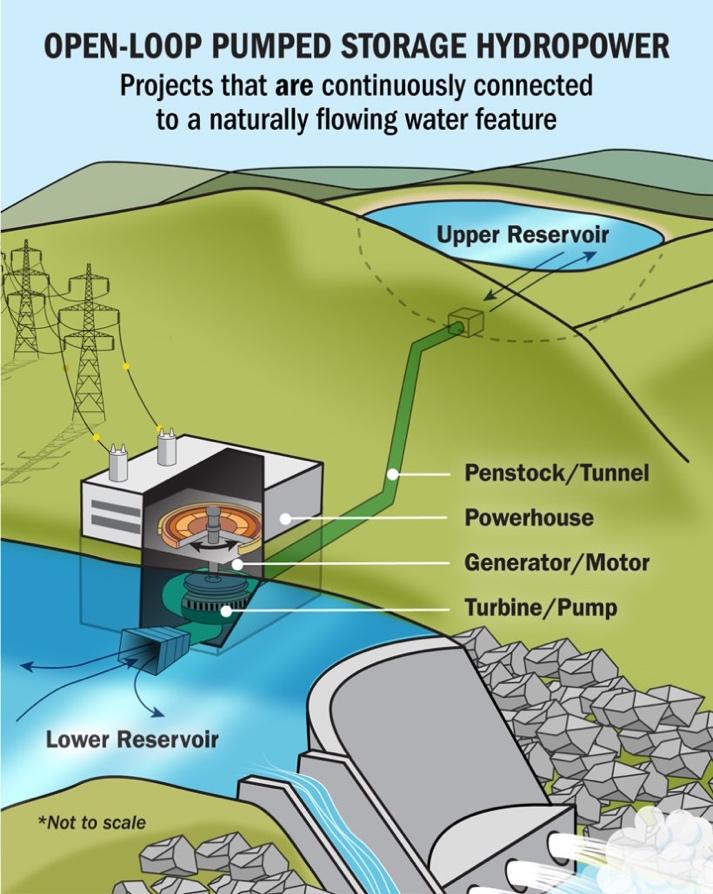
Pumped storage plants use the principle of gravity to generate electricity using water that has been previously pumped from a lower source to an upper reservoir.
Operation of pumped storage power plants requires two reservoirs viz. upper and lower reservoir. Water in upper reservoir is used for generating power during peak demand hours. The water in the lower reservoir is pumped back to the upper reservoir during the off-peak hours and the cycle continues.
Pumped storage plants are of two types: ‘open loop’, which has an associated natural-water source (like a river) for one or both the reservoirs; and ‘closed loop’ (or off-river PSH), which does not have a connected natural-water source and the same water is cycled between the two reservoirs for pumping and generation.
Energy storage capacity of a pumped hydro facility depends on size of its two reservoirs and the head between reservoirs, while the amount of power generated is linked to the size of turbine.
Need for Pumped Storage Hydropower Project
Renewable energy sources like solar & wind energy are intermittent and variable in nature. This leads to challenges of grid-stability and temporal considerations in power availability. This requires immediate ramp-up & back down of generation for grid balancing & stability of grid frequency.
Pump Storage Technology is the only long term technically proven, cost-effective, highly efficient & operationally flexible way of energy storage on a large scale & available at short notice.
Currently, it is the largest energy storage system making it most effective for Renewable Energy Integration.
It offers following benefits:
Peak shaving: PSPs absorb off peak energy in the system.
Energy conversion rates for pump-storage projects often exceeds 80%
Only PSP can meet most of the grid scale energy storage needs and no other storage system can and therefore almost 95% of the storage projects are Pump hydro
Status of Pumped Storage Hydropower:
Current potential of 'on-river pumped storage' in India is 103 GW. Out of 4.76 GW of installed capacity, 3.36 GW capacity is working in pumping mode. About 44.5 GW including 34 GW off-river pumped storage hydro plants are under various stages of development.
Currently, operational Pumped Storage Plants:
Pumped Storage Project
Location
States
Capacity
Nagarjunasagar
On Krishna River
Telangana
705 MW
Srisailam
On Krishna River on a deep gorge on Nallamala hills.
Telangana
900 MW
Kadamparai
Tamil Nadu
400 MW
Bhira
Near Mulshi Dam on Mula River.
Maharashtra
150 MW
Ghatghar
On Pravara River, a tributary of Godavari River in Ahmedanagar district
Maharashtra
250 MW
Purulia (Panchet)
West Bengal
900 MW
Total
3300 MW
Other Pumped Storage Projects
Kadana, Sardar Sarovar Project (
Tehri, Kundah, Koyna (Under Construction)
Turga, Upper Sileru
Pumped storage projects being planned:
Upper Indravati PSP (600 MW) in Odisha
Sharavathy PSP (2000 MW) in Karnataka
Around 60 GW of pumped storage power projects are under survey and investigation.
Advantages of Pumped Storage Projects
Ecologically friendly: PSPs would have minimal impact on environment in their vicinity as they are envisaged on existing hydroelectric projects, or as off the river projects. All components of PSPs would be connected, operated and maintained in an environmentally friendly manner with no residual environmental impacts.
Atmanirbhar Bharat: PSPs employ indigenous technologies and domestically produced materials. Most electrical & mechanical parts of PSPs are also made in India. Other alternate solutions to storage such as batteries are heavily import dependent.
Tested technology: PSPs operate on time-tested technology thereby infusing confidence in lending institutions for a longer duration of loans. Cost of technologies involved in construction has reduced rendering PSPs a viable proposition. Technological surety associated with PSPs has opened possibility for developers to claim a higher debt-equity ratio in projects.
Local development: Development of PSPs is highly capital intensive and involves development of local transport infrastructure for mobilisation of men and materials. Local industries such as cement & steel get impetus and drive domestic creation in the economy giving salutary effect on local area development, regional development, infrastructure upgradation and employment generation.
Longer and reliable duration of discharge: PSPs are designed for a longer duration of discharge of more than 6 hours to meet peak demand or for compensating variability in the grid due to VREs. However, Battery Energy Storage Systems are designed for up to 4 hours of discharge generally. Firm capacity of PSPs during peak hours is guaranteed and relatively immune to grid conditions.
Challenges in the development of Pumped Storage Projects
Environmental clearances: Currently, environmental and forest clearance process of PSPs is very cumbersome, since these projects are treated at par with conventional hydro projects for granting EC and FC. However, environment impact of PSPs constructed on existing reservoirs is generally less and does not lead to displacement of people.
Free power: PSPs are energy storage projects designed to cater to the need for grid stability during peak hours. PSPs do not produce any electricity and are net consumers of electricity.
Cost of pumping power: Cost of power from PSPs has three components - cost of storage, cost of conversion losses and cost of input power. For the commercial viability of a PSP unit input power should be available at affordable tariff. However, availability of solar power at relatively cheaper rates allows affordable input power for PSP units.
Value of peak power: Importance of PSP lies in its capability to offer peaking power. Other services offered by PSPs like spinning reserves, reactive support, black start ability etc. which are essential for grid stability are not adequately monetized.
Taxation:
Measures taken by Government of India for promoting PSPs
Utilisation of financial & project execution capabilities of CPSUs: Government of India has identified probable PSP sites with CPSUs to facilitate their development.
Energy Storage Obligation: Government has notified Energy Storage Obligation for distribution companies to ensure capacities regarding storage as a grid element.
Waiver of Inter-state transmission and other transmission charges for PSPs.
Budgetary support by Central Government for enabling infrastructure of hydropower & PSP projects as infrastructure create for hydropower/PSP enables further development of the area and the same is available for reuse for other purposes.
Ease of doing business and simplification of process: For ex. Central Electricity Authority has issued revised guidelines for the preparation and approval of DPRs for Pumped Storage Hydropower projects.
Guidelines for promotion of PSPs
Allotment of project sites: State Governments may allot project sites to developers in following manner.
On-nomination basis to CPSUs and State PSUs: States may award projects directly to hydro CPSUs or State PSUs or to JVs between Central & State PSUs on a nomination basis. CPSU/State PSUs shall ensure that award of contracts for supply of equipment and construction is done through competitive bidding.
Allotment through competitive bidding: PSP project may be awarded to private developers by following a two-stage competitive bidding process. PSUs can also participate in the bidding process. Home State shall have right of first refusal up to 80% of the project capacity and tariff shall be fixed by State Government. The developer will be free to sell the balance storage space under short/medium/long-term PPA, on in power markets or through bilateral contract.
Allotment through Tariff Based Competitive Bidding (TBCB): PSPs may be awarded on a TBCB basis to developers based on competitive bidding based on:
Composite tariff (including cost of input power) in case input power is arranged by developer.
Tariff for storage on a per megawatt hour basis if input power is arranged by procurer of the storage capacity.
Self-identified off-stream PSPs: Developers may also self-identify potential off-stream sites where PSPs can be constructed. This will help in harnessing off-stream potential in the country at a faster pace. Since, these sites are away from riverine system and do not utilise natural resources like river streams, allotment from State Governments would not be required for PSP projects on such sites. However, all statutory clearances need to be obtained from State & Central agencies before starting construction.
Incentives for Pump Storage Projects
States shall not charge any upfront premium for PSP project allocation.
Exemption from free power obligation as PSPs are energy storage schemes i.e., net consumers of energy and do not produce any energy.
No requirement for creation of a Local Area Development Fund as these projects have minimal environmental impact and have no R&R issues.
Utilisation of discarded mines including coal mines to develop PSPs.
Developers should start construction work within a period of 2 years from project allotment, otherwise the project allocation will be cancelled.
Market reforms for PSPs by Appropriate Commission
shall ensure that services which help in supporting grid stability are suitable monetized.
Notify Peak and Off-Peak tariffs for generation to provide appropriate pricing signal to Peak and Base Load Generating plants.
PSPs and other storage projects shall be allowed to participate in all market segments of power exchange.
80% power generated when PSPs operate as conventional hydropower stations during monsoon period would be offered to Home State at the rate of secondary energy fixed by CERC.
If capacity contracted for energy storage in PSP is not fully utilised by contracting agency, the developer would be free to transfer the usage of the capacity to other interested entities so that resources do not remain idle.
Financial Viability:
Central Government may notify a benchmark tariff of storage for investment decisions of developers considering 6-8 hours of operation of PSP based on prevailing and anticipated difference between peaking and non-peaking rates.
Financial institutions like PFC, REC and IREDA shall treat PSPs at par with other renewable energy projects while extending long-term loans of 20-25 years tenure.
The debt-to-equity ratio of PSP projects can be up to 80:20, in consultation with financial institutions.
Taxes & Duties:
State Government shall consider reimbursement of SGST on PSP project components. States may exempt land to be acquired by off-the-river PSPs from payment towards stamp duty and registration fees.
Government land may be provided at a concessional rate to the developers on annual lease rent basis.
Electricity Duty and Cross Subsidy Surcharge not applicable on pumping power for charging of PSPs as PSPs are merely facilitating conversion of energy.
No water cess will be leviable on PSPs (like conventional hydro) as there is no consumptive use of water.
Rationalisation of Environmental Clearances for PSPs: According to draft notification issued by MOEFCC would evaluate under B2 for grant of Environmental Clearance irrespective of power generation.
Projects which do not attract Forest Clearance (FC) and Wildlife Clearance (WC).
Projects where no new reservoir is/are created.
Projects where existing reservoir is not expanded or structurally modified.
Green Finance: Since PSPs will be utilised for avoiding greenhouse gas emissions. Hence, PSPs will be supported through concessional climate finance. Sovereign green bonds issued for mobilizing resources for green infrastructure as a part of Government’s overall market borrowings for development of PSPs which utilise renewable energy for charging.
Context:Recently, a study was published in RBI’s July Bulletin which showed that India’s natural rate of interest has seen an upward shift, driven by growth in potential output. The estimate of natural rate of interest for India for Q4 FY24 is at 1.4-1.9 percent as compared to 0.8-1.0 percent for Q3 FY 22.
Natural Rate of Interest
Natural Rate of Interest is associated with an economy operating at full capacity without generating inflationary pressures.
It is also referred to as r-star or r*.
Significance of Natural Rate of Interest
Rate of interest at which savings equals to investment, consistent with stable prices.
Gauging stance of monetary policy: Difference between real policy interest rate and natural rate measures the monetary policy stance. When the policy rate is set below the natural rate, the stance is regarded as accommodative, and the converse signifies a restrictive stance. The policy stance in neutral when the real policy rate is at the level of the natural rate.
Factors determining natural rate of interest
Natural rate of interest is determined by factors that impact long run saving investment behaviour.
Long run saving investment behaviour: Factors that reduce saving or increase investment raise the natural rate of interest.
Longer life expectancy raises savings to support a longer retirement.
Lower dependency ratio reflects a higher share of working age people in the population and increases savings as those in the workforce typically save more than the elderly and young dependents.
Higher inequality raises savings as richer households save a larger share of income relative to less affluent families.
Higher productivity growth associated with new investment opportunities raises demand for capital which increases real interest rates and therefore, the natural rate of interest.
Risk Aversion: Higher risk aversion induces higher savings in safe assets as a buffer against future economic downturns and lowers investment. Investment in risky assets is found to increase with advancement in digital technologies.
Fiscal deficits: Persistent fiscal deficits reduce gross saving and crowd out private investment.
Economic stagnation: An economy can experience rise in saving and fall in investment due to lack of demand for new investment and this could keep interest rates low for longer.
Monetary policy: Prolonged monetary expansion could fuel debt accumulation and financial imbalances by impacting debt and asset price dynamics, leading to lowering of natural rate of interest over long horizons.
Reasons for India’s rising natural rate of interest
Demographic factors:
India’s demographic structure is characterized by large proportion of youth population and a growing working age cohort which tends increase the natural rate of interest.
Falling dependency ratio which enhances savings and investment potential. However, the COVID-19 pandemic has resulted in decline in life expectancy.
Other factors propelling rising investment demand:
Higher Investments for supply chain resilience for diversifying sourcing strategies due to increasing protectionism and geopolitical tensions.
India’s export thrust through initiatives such as PLI schemes, District as Export Hubs, and promoting export potential of MSMEs could further increase investment demand.
AI & Digitalisation: Rapid advances in AI & digitalisation will require large public and private sector investments in physical and human capital for acquiring and implementing new technologies and reshaping business processes.
Enhanced defence spending: The growing geopolitical conflict across the world necessitates significantly stepping up defence spending.
Investments to address climate change and resilience against extreme weather events: Extensive public and private investments will be needed for both rebuilding and adaptation.
Context: The committee constituted by the Government on minimum support price (MSP) to examine the feasibility of granting greater autonomy to the Commission for Agricultural Costs and Prices (CACP), and to explore ways to make it more scientific, as well as to provide suggestions for offering a legal guarantee to MSP, held six meetings in the two years since July 2022.
Minimum Support Price (MSP)
It is a form of market intervention by the Government of India to ensure agricultural producers against any sharp fall in farm prices.
Announced by Cabinet Committee on Economic Affairs at the beginning of the sowing season for 22 mandated crops and fair and remunerative price (FRP) for sugarcane based on the recommendations of the Commission for Agricultural Costs and Prices (CACP).
Price fixed by Government of India to protect the producer farmers against excessive fall in price during bumper production years. They are a guaranteed price for farmer’s produce from the Government.
3 Commercial Crops: Copra, Cotton, Raw Jute (Sugarcane covered under FRP)
Present Status of MSP:
Presently, MSP does not enjoy statutory recognition. This means that,
No obligation on the Government to purchase all the commodities for which MSP is declared.
No obligation on the Government to pay MSP to the farmers.
No obligation on the private sector to purchase commodities at MSP. Private sector can purchase below MSP.
Need For Legalisation of MSP
Promote crop diversification: Only three to four crops (mainly wheat, paddy and cotton and at times some pulses), were being procured at MSP while the remaining crops were being procured at much below the MSP. Hence, absence of any dependable or assured market mechanism of procurement-purchase for crops on the MSP in most parts of the country discourages efforts towards crop diversification.
Income security for farmers: Legalising MSP would guarantee farmers a minimum income, helping them cover costs and reduce financial distress that reduces the farmer suicides.
Stability in agriculture: A legal MSP can provide stability and predictability in agricultural income, encouraging farmers to invest more in agriculture.
Modernise agriculture: It aligns with the national interest by formalizing and digitizing commodity transactions, supporting the government's goal to modernize agriculture.
Challenges and concerns:
Adverse impact on economy: Higher costs of procurement due to a statutory MSP will increase the food prices, leading to inflation in the economy. Higher prices of commodities would adversely affect exports of agricultural commodities.
Financing needs: According to some estimates, if the Government were to procure all the 23 crops at MSP, it would amount to half of the Government's Budget.
Unsustainable food grain management policy: The Food subsidy bill has already become quite unsustainable at around Rs 2 lakh crores. The excess procurement of food grains by the FCI has led to surplus buffer stocks leading to higher storage costs and wastages. Legalisation of MSP would further worsen the scenario.
Administrative challenge: Lack of government machinery to procure all crops that are under the MSP system.
Violation of WTO Agreement on Agriculture (AoA): Legalisation of MSP would further violate the limit on the subsidies under AoA and it can be challenged by other countries. India's quest for Permanent solution on public stockholding could be in jeopardy.
Promote inequality: Only 6 percent of farmers are able to benefit from the MSP. Similarly, most of the Rice and Wheat are sourced from states such as Punjab, Haryana, MP etc. Hence, legalisation of MSP could worsen socio-economic inequality and promote regional disparity.
Environmental cost: Encourage farmers to grow more rice and wheat leading to further environmental problems.
Adverse impact of Government's intervention: In any free-market economy, the price of any goods and services produced in the country must be decided by market forces and not by the state. As highlighted by Eco Survey 2019-20, Government's intervention, sometimes though well intended, often ends up adversely affecting the market. For example, the regulation of prices of drugs through the DPCO 2013, has led to an increase in the price of a regulated pharmaceutical drug vis-à-vis that of a similar drug whose price is not regulated.
Conclusion:
Better marketing infrastructure: Improving agricultural marketing infrastructure, including e-NAM, to ensure better prices for farmers.
Insurance schemes: Strengthening crop insurance schemes to protect farmers against price volatility and natural calamities.
Progressively increase the number of crops eligible for MSP: To encourage crop diversification and lessen the dominance of rice and wheat. This will offer farmers more choices and promote the cultivation of crops that align with market demand.
Price deficiency payment schemes: Government compensates farmers for the difference between average prices in major mandis and the MSPs. (NITI Aayog).
Case study: Haryana's Bhavantar Bharapai Yojana government pays a fixed compensation against the produce sold below minimum support price (MSP)