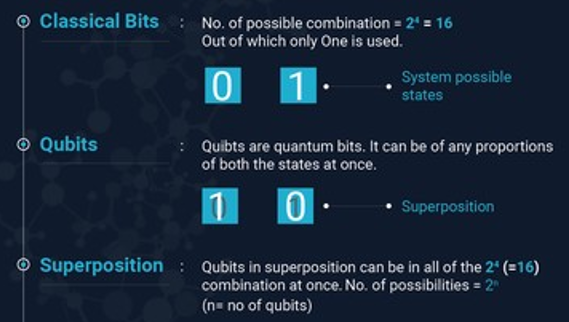
Context: Quantum computers use qubits that can exist in superposed states, combining these two states uniquely, enhancing computational possibilities. However, qubits are sensitive to interactions causing decoherence.
Developing quantum devices requires addressing challenges like qubit uniformity, integration, and operating conditions, typically at low temperatures making quantum computers very expensive.
To address these concerns, a group of scientists in Japan have realised qubits at room temperature in metal-organic framework (MOF). This development gives hope to lower the costs of qubits and make quantum computer accessible.
However, the superpositions between qubits are fragile. This fragility arises out of the interaction between qubit and other systems. The more the number of interaction channels, the faster the superposition ‘decoheres’ and the qubit ends up in one of the two states.
Quantum computer, qubits, and superposition
- A quantum computer is a device that processes information using quantum bits, or x are the fundamental physical component of quantum computers.
- A qubit is a physical system that can exist in one of two quantum states, denoted as |0> or |1> and a superposed state with contribution from both states. The superposed states are also known as coherent superpositions which play an important role quantum information processing protocols.
- For example, a qubit can be represented by an electron that is either spin up or spin down, or a photon that is either horizontally or vertically polarized. The superimposition of both states is denoted as |0> + b|1>, where a and b are complex numbers that determine the probability of measuring the qubit in either state. Thus, a qubit can be in a state where it has a 50% chance of being |0> and a 50% chance of being |1>.
- A quantum computer performs computations by manipulating the states of qubits using quantum operations, such as rotations, swaps, and controlled gates.
- A quantum computer can encode and process information in a more efficient and powerful way than a classical computer, by exploiting quantum phenomena, such as superposition and entanglement.
Characteristics of an ideal qubit for Quantum Computing
To create a quantum device, such as a quantum computer, a collection of qubits is required. However, not all qubits are suitable for quantum computing, as they need to satisfy some basic requirements, such as:
- Identicality: Qubits should be identical in their physical properties and behavior, so that they can be manipulated and controlled in a consistent and predictable way. However, qubits are often subject to manufacturing imperfections and variations, which can affect their performance and reliability.
- Scalability: Qubits should be scalable in number and size, so that they can be integrated into larger and more complex quantum devices. However, qubits are often difficult to fabricate and assemble, and their quality and coherence tend to degrade as the number of qubits increases.
- Addressability: The qubits should be individually addressable, so that they can be accessed and manipulated by external signals and devices. However, qubits are often sensitive to interference and crosstalk, and their addressability can be limited by the physical constraints and limitations of the quantum device.
- Interactability: The qubits should be interactable with each other, so that they can form entangled states and perform quantum operations. However, qubits are often isolated and weakly coupled, and their interaction can be affected by noise and decoherence.
- Room temperature capability: The qubit system should be robust enough to function at room temperature without losing quantum features for reasonably long durations.
Current Physical systems being used as Qubits
Many different physical systems can be used to realize qubits, each with its own advantages and disadvantages. Some of the well-studied and practical options include:
- Superconducting junctions:
- These are circuits made of superconducting materials, which can conduct electricity without resistance at very low temperatures. Superconducting junctions can act as qubits by using the current or the magnetic flux as the quantum state.
- Superconducting qubits have high coherence, scalability, and interactability, but they require very low temperatures and sophisticated fabrication techniques.
- Trapped ions:
- These are atoms that have lost or gained one or more electrons, and are confined in a vacuum by electric or magnetic fields.
- Trapped ions can act as qubits by using the electronic or the vibrational state as the quantum state.
- Trapped ion qubits have high coherence, addressability, and interactability, but they require high vacuum and complex laser systems.
- Quantum dots:
- These are nanoscale structures that can confine electrons in a small space. Quantum dots can act as qubits by using the spin or the charge of the electron as the quantum state.
- Quantum dot qubits have high scalability, addressability, and potential for room-temperature operation, but they have low coherence and interactability.
Challenges with realising Qubits
- Fragility of Quantum Superimposition
- Coherence is essential for quantum computing, as it allows qubits to exhibit quantum behaviour and perform quantum operations.
- Decoherence is the process of losing coherence due to the interaction of quantum systems with their environment.
- Decoherence is a major challenge for quantum computing, as it causes qubits to collapse into one of the two states and lose quantum information.
- Decoherence can be caused by various factors, such as noise, heat, and measurement. Decoherence can be minimized by isolating qubits from external influences, using error correction techniques, and designing robust quantum algorithms.
- Challenges with the present models being developed as qubits: Present technologies to realise qubits are based on superconducting junctions, trapped ions and quantum dots. All these systems operate as qubits only at very low temperatures or in a high vacuum or both. As a result, quantum computers based on such technologies are expensive and out of reach for most.
Thus, there is a need to develop economically viable alternatives for qubits. In this direction, a group of scientists have realised qubits at room temperatures in a metal-organic framework (MOF).
Metal-organic framework (MOF) and its application in quantum computing
- Japanese scientists used Zirconium as the metal component and an organic molecule containing chromophore pentacene bridges the metal atoms to develop room temperature qubit.
Metal Organic Framework
- A metal-organic framework (MOF) is a type of porous material that consists of a network of repeated molecular arrangements where the repeating structure has a metal atom or ion with organic molecules attached to its like tentacles. Each tentacle attaches to another metal atom and the structure repeats itself to make up the MOF.
- MOFs have various applications in fields such as gas storage, catalysis, and sensing, due to their high surface area, tunable structure, and functional properties.
- MOFs can also be used for quantum computing, as they can host qubits within their pores or on their surfaces.
- MOFs can offer some advantages for quantum computing, such as:
1. Room-temperature operation:
- MOFs can support qubits that can operate at room temperature, such as nitrogen-vacancy centers in diamond or organic molecules.
- This can overcome the challenge of cooling down qubits to very low temperatures, which is costly and complex.
2. Chemical versatility:
- MOFs can be synthesized and modified with various metals and ligands, which can tailor their physical and chemical properties, such as size, shape, porosity, and functionality.
- This can enable the creation of diverse and customized qubits with different characteristics and behaviors.
3. Self-assembly:
- MOFs can be self-assembled from simple and readily available components, such as metal salts and organic precursors.
- This can simplify the fabrication and integration of qubits, which is often difficult and sophisticated.
Chromophores, singlet and triplet state and singlet fission
- A chromophore is a organic molecule or a part of a molecule that can absorb or emit light of a specific wavelength. An object containing such molecules thus appears to have some specific colour.
- The presence of chromophores is responsible for the colouration, they are also called ‘colour molecules’.
- Excited state: When a chromosphore absorbs light, the chromosphore molecule jumps to a higher energy level.
- Ground state: In its lowest energy state (ground state), a chromophore molecule has a pair of electrons in a special configuration called singlet.
- Chromophores can also be used as qubits, as they can store and manipulate quantum information using their electronic states.
- Chromophores have two types of electronic states, called singlet and triplet states, which differ in the spin configuration of their electrons.
- A singlet state has paired spins, while a triplet state has unpaired spins.
- A singlet state can be converted to a triplet state by absorbing a photon of a specific energy, and vice versa by emitting a photon.
- This process is called intersystem crossing, and it can be used to control the quantum state of the chromophore.
- Singlet fission is a phenomenon that occurs in some chromophores, where a singlet state splits into two triplet states, each on a different molecule.
- This process can effectively double the number of qubits, as each triplet state can act as a qubit.
- Singlet fission can also increase the efficiency of solar cells, as it can generate two electrons from one photon.
Innovations in Quantum Computing
Quantum computing is a rapidly evolving and advancing technology that witnesses many innovations and breakthroughs in its research and development. Some of the recent and significant innovations are:
- Room-temperature qubits: Researchers have demonstrated qubits that can operate at room temperature, such as nitrogen-vacancy centers in diamond, organic molecules in MOFs, and silicon carbide defects. This can overcome the challenge of cooling down qubits to very low temperatures, which is costly and complex.
- Quantum supremacy: Researchers have claimed quantum supremacy, which is the demonstration of a quantum device that can perform a task that is impossible or impractical for a classical device. For example, Google’s Sycamore processor performed a random circuit sampling task in 200 seconds, which would take a classical supercomputer 10,000 years.
- Quantum internet: Researchers have proposed and prototyped a quantum internet, which is a network of quantum devices that can communicate and exchange quantum information securely and reliably. For example, China’s Micius satellite achieved quantum key distribution between two ground stations 1,200 km apart.
Commercial viability of quantum computing
Quantum computing is a promising technology that has the potential to solve problems that are intractable or inefficient for classical computers, such as:
- Cryptography: Quantum computing can break some of the existing encryption schemes, such as RSA and ECC, by using algorithms such as Shor’s and Grover’s. Quantum computing can also create new encryption schemes, such as quantum key distribution and quantum digital signatures, that are secure against quantum attacks.
- Artificial intelligence:
- Quantum computing can enhance some of the existing machine learning and optimization methods, such as neural networks and genetic algorithms, by using quantum variants such as quantum neural networks and quantum annealing.
- Quantum computing can also enable new forms of artificial intelligence, such as quantum machine learning and quantum reinforcement learning, that can learn from quantum data and environments.
- Simulation:
- Quantum computing can simulate complex physical systems, such as molecules, materials, and quantum systems, by using algorithms such as quantum chemistry and quantum Monte Carlo.
- Quantum computing can also simulate classical systems, such as games, networks, and cellular automata, by using quantum algorithms such as quantum walks and quantum cellular automata.
Challenges and limitations of Quantum Computing
- Technical:
- Quantum computing requires advanced and expensive hardware and software, such as quantum devices, quantum error correction, quantum algorithms, and quantum programming languages.
- Quantum computing also suffers from noise, decoherence, and scalability issues, which affect the performance and reliability of quantum devices and algorithms.
- Theoretical:
- Quantum computing is based on quantum mechanics, which is a complex and counterintuitive theory that is not fully understood or agreed upon.
- Quantum computing also lacks some of the established and standard concepts and tools of classical computing, such as complexity classes, benchmarks, and metrics.
- Ethical:
- Quantum computing poses some ethical and social risks and challenges, such as privacy, security, fairness, and accountability.
- Quantum computing can also have disruptive and transformative impacts on various sectors and domains, such as economy, education, and society.