Context: The Balasore accident was an exception in recent years, but it also reflects the declining focus on safety measures by the Indian Railways.
What happened in Balasore
At least 288 people have been killed and over 1000 were injured in a horrific three-train collision. The crash involved the Bengaluru-Howrah Superfast Express, the Shalimar-Chennai Central Coromandel Express, and a goods train.
The accident saw one train ram so hard into the other that carriages were lifted high into the air, twisting and then smashing off the tracks. Another carriage had been tossed entirely onto its roof, crushing the passenger section.
Why the train accident happened
Railway officials indicated that possible “sabotage” and tampering with the electronic interlocking system, which detects the presence of trains.
Trends in rail accidents
Chart 1 shows that year-wise number of accidents have decreased sharply between 1990 to 2021. The main contributor in this regard was in the case of derailment. Similarly there was decline in the collisions and level crossing. However, number of fires in the trains (despite being the least in numbers) has remained consistent.
Chart 2 shows the number of killed passenger over last three decades. Numbers have been very fluctuating all these years. But it has reached the minimum in last two years (except current Balasore accident).
Chart 3 clearly proves that majority of the accidents have been due to failure on part of railway staff followed by non-railway persons. Equipment failure, sabotage and other incidents have remained the least.
Chart 4 shows the budgetary allocation over modernisation and ensuring safer railway travel. There was a sudden jump in the allocation in the 2020-21, however it came down in later years. It is visible that higher priority has been given the renewal of track rather than the signalling and telecommunication system. Signalling is as important as the safety of the tracks as many collision have taken place due to misleading signalling.
Chart 5 shows the performaces of the government with regards to the achievements on the track renewal. Through this chart we can easily deduce that achievements have been repeated in majority of the cases. In last three financial years, success of the railway in the achievement on track renewal outnumbered the targets.
Initiative taken towards safe railway travel
1. Rashtriya Rail Sanraksha Kosh (RRSK) was created in the year 2017-18 with a corpus of Rs 1 lakh crore for a period of 5 years (i.e. 2017-2022) for critical safety related works. It is for Safety related works like track renewal, bridge rehabilitation, vehicular ultrasound testing for rail/welds, weld quality improvements, elimination of level crossings with ROB/RUB, electronic interlocking system, block proving through axle counter, interlocking of LC gates etc.
2. Elimination of unmanned level crossing: decision was taken to eliminate all unmanned level crossings either by way of closure, merger etc. or by manning these level crossings along with provision of lifting barrier. All Unmanned level crossings have been eliminated on Broad Gauge.
3. Provision of LBH coaches: to switch over completely to LHB (Linke Hofmann Busch) type coaches into the IR system which are of a superior design that have superior body-bogie and wheel bogie connections, anti-climbing features, tight lock coupling, provision of bump stop, superior braking, provision of yaw dampers to ensure smooth transfer of forces between body and bogie, etc.
4. Track renewal and modernisation of track: track renewal has been doubled from 2,424 Kms in 2014-15 to 4,500 Kms in 2019-20.
5. Automatic train protection (ATP) systems: Indian Railway has developed its own Indigenous Automatic Train Protection (ATP) Systems for enhancing safety of running trains. The System is known as Train Collision Avoidance System (TCAS). TCAS will not only aid Loco Pilot to avoid Signal Passing At Danger (SPAD) and over speeding but also help in train running during inclement weather such as dense fog. TCAS is adopted as our National Automatic Train Protection (ATP) System.
Context: Recently, Union Cabinet at a meeting chaired by Prime Minister Narendra Modi, approved the City Investments to Innovate, Integrate and Sustain (CITIIS) 2.0, a programme under the ambit of the Smart Cities Mission, which aims to promote integrated waste management and climate-oriented reform actions.
About City Investments to Innovate, Integrate and Sustain 2.0 (CITIIS 2.0)
It aims to leverage and scale up the learnings and successes of CITIIS 1.0 which was launched in 2018.
Vision
The programme envisages to support competitively selected projects promoting a circular economy with focus on
Integrated waste management at the city level
Climate-oriented reform actions at the state level
Institutional strengthening and knowledgedissemination at the national level.
Duration and Participants
Programme will run for four years from 2023 till 2027, in partnership with the French Development Agency (AFD),Kreditanstalt für Wiederaufbau (KfW), the European Union (EU), and the National Institute of Urban Affairs (NIUA).
Components
The programme has three components
firstly,financial and technical support for developing projectsfocused on building climate resilience, adaptation and mitigation in up to 18 smart cities.
Secondly, all states and Union Territories will be eligible for support on-demandbasis. The states will be provided support to
(a) set up/strengthen their existing state climate centres/ climate cells/ equivalents
(b) create state and city-level climate data observatories
(c) facilitate climate-data-driven planning, develop climate action plans and (d) build capacities of municipal functionaries. To achieve these objectives, the Program Management Unit (PMU) at NIUA will coordinate the provision of technical assistance and strategic support to state governments.
And thirdly, interventions at all three levels– Centre, State and City– to further climate governance in urban India through institutional strengthening, knowledge dissemination, partnerships, building capacity, research and development to support scale-up across all States and Cities.
CITIIS 2.0 will supplement the climate actions of Government of India through its ongoing National programs (National Mission on Sustainable Habitat, AMRUT 2.0, Swachh Bharat Mission 2.0 and Smart Cities Mission), as well as contributing positively to India’s Intended Nationally Determined Contributions (INDCs) and Conference of the Parties (COP26) commitments.
The first phase of CITIIS was launched in July 2018 with projects in 12 cities namely Agartala, Amaravati, Amritsar, Bhubaneshwar, Chennai, Dehradun, Hubbali-Dharwad, Kochi, Puducherry, Surat, Ujjain and Visakhapatnam.
Context: The finance ministry has tasked a high-level committee under Bibek Debroy, chairman of the Economic Advisory Council to PM, to undertake a comprehensive assessment of the characteristics or parameters defining infrastructure and its financing framework.
Infrastructure refers to basic physical and structural facilities, which are essential for an economy to function. There is no universally accepted definition of infrastructure. National Statistical Commission headed by C. Rangarajan identified six characteristics of infrastructure sector.
Characteristics of Infrastructure:
Natural Monopoly: A natural monopoly typically has high fixed costs meaning that it is impractical to have more than one firm competing to provide same good or services.
E.g., Electricity transmission lines, Gas pipelines.
High Sunk Costs: Sunk cost refers to the money that has already been spent and cannot be recovered even when the firm goes out of business. Typically, infrastructure projects incur high sunk costs.
Non-tradability of output: Non tradable outputs are those which are produced and sold at the same location and cannot be transported to other location. Generally, the infrastructure outputs are consumed at the place they are produced and are non-tradeable. E.g., Fly over.
Non-rivalness in consumption: non-rivalness implies that the cost of providing a good or service to an additional individual is zero. That means consumption of an individual does not affect the consumption of others.
Price exclusion: Price exclusion means that the enjoyment of benefits is contingent on payment of user charges.
Externalities: The benefits of Infrastructure projects go beyond the immediate provision of services for which they are built, which are not directly measured.
E.g., A gas pipeline contributes not only provides access to energy but also results in environmental and social benefits.
Based on the above features, Harmonized Master List of Infrastructure sub-sectors is updated from time to time. The latest updated list is as follows.
Harmonized master list of Infrastructure sub-sectors:
Category
Infrastructure sub-sectors
Transport and Logistics
Roads and bridgesPortsShipyardsInland WaterwaysAirportRailway track including electrical & signalling system, tunnels, viaducts, bridgesRailway rolling stock along with workshop and associated maintenance facilitiesRailway terminal infrastructure including stations and adjoining commercial infrastructureUrban Public Transport (except rolling stock in case of urban road transport)Logistics InfrastructureBulk Material Transportation Pipelines
Energy
Electricity GenerationElectricity TransmissionElectricity DistributionOil/Gas/Liquefied Natural Gas (LNG) storage facility
Water & Sanitation
Solid Waste ManagementWater treatment plantsSewage collection, treatment and disposal systemIrrigation (dams, channels, embankments, etc.)Storm Water Drainage System
Context: Go first passenger airline has filed for bankruptcy protection recently.
Why Airlines are facing problems?
Ever-increasing number of failing engines supplied by Pratt & Whitney, which it claimed had resulted in half its Airbus fleet being grounded.
Given the high capital and operational costs, the commercial air transport industry operates with wafer thin margins. This has impacted the overall profits of the company.
Since last one-and-half decade, rival airliners have adopted an aggressive pricing strategies to gain market share that stretched balance sheets and made companies more vulnerable to shocks.
External shocks such as COVID crisis and long drawn lockdowns had impacted the operations of many airlines. Similarly, last year’s Ukraine-Russia was has shocked the global prices of oil.
Prolonged rupee’s depreciation against the dollar has sent aviation turbine fuel (ATF) costs soaring for domestic carriers.
Challenges faced by Aviation sector in India
Aviation Industry scenario
Industry trend
Airport Authority of India to spend $ 3 bn on non-metro projects over 2016-2020
$ 3 bn investments in green-field airports – Navi Mumbai and Goa
Authority of India (AAI) has taken up a development programme to spend around INR 25,000 crore in next five years for expansion and modification. Furthermore, Three Public Private Partnership (PPP) airports at Delhi, Hyderabad and Bengaluru have undertaken major expansion plan to the tune of INR 30,000 Crores by 2025. Additionally, INR 36,000 Crores have been planned for investment in the development of new Greenfield airports across the country under PPP mode.
The civil aviation industry in India has emerged as one of the fastest growing industries in the country during the last three years and can be broadly classified into scheduled air transport service which includes domestic and international airlines, non-scheduled air transport service which consists of charter operators and air taxi operators, air cargo service, which includes air transportation of cargo and mail.
In 2010, 79 Mn people travelled to/from/or within India. By 2017 that doubled to 158 mn, and this number is expected to treble to 520 mn by 2037. The nation’s airplane fleet is projected to quadruple in size to approximately 2500 airplanes by 2038.
Currently, the country has 131 operational airports including 29 international, 92 domestic, and 10 custom airports. To meet the growing demand for air travel in India, it has become imperative to increase the capacity of airport infrastructure.
To augment the airport infrastructure the government aims to develop 100 airports by 2024 (under the UDAN Scheme) and expects to invest $1.83 bn in the development of airport infrastructure by 2026.Till date 74 airports have been developed. More than 2.15 lakh UDAN flights have operated and over 1.1 crore passengers have availed the benefits in UDAN flights so far.
The projected upsurge in air travel in India would require more aircraft usage, further igniting the demand for Maintenance, Repair & Overhaul (MRO) services. The Indian Civil Aviation MRO market, at present, stands at around $900 mn and is anticipated to grow to $4.33 bn by 2025 increasing at a CAGR of about 14-15%. Unmanned aerial vehicles, also known as drones have been welcomed across industries. Indian drone industry is expected to have a total turnover of up to US$ 1.8 billion by 2026.
Up to 100% FDI is permitted in Non-scheduled air transport services, Helicopter services and seaplanes under the automatic route.
Up to 100% FDI is permitted in MRO for maintenance and repair organizations; flying training institutes; and technical training institutes under the automatic route.
Government Initiatives
Through the National Civil Aviation Policy 2016 (NCAP) the government plans to take flying to the masses by enhancing affordability and connectivity. It promotes ease of doing business, deregulation, simplified procedures, and e-governance.
In April 2020, the Goods and Services Tax for MRO services rendered locally was reduced from 18% to 5%. The ‘place of supply’ for B2B MRO services was changed to the ‘location of recipient’, enabling Indian MRO facilities to claim zero-rating (i.e., export status) under GST laws on MRO services rendered to prime contractor/OEM located outside India. This has been an extremely crucial policy amendment as it will encourage global participation in the Indian aviation sector by allowing foreign MRO operators to subcontract MRO work to Indian entities without any extra tax liability.
The Regional Connectivity Scheme or UDAN (‘Ude Desh ka Aam Nagrik’) is a vital component of NCAP 2016. The scheme plans to enhance connectivity to India's unserved and under-served airports and envisages to make air travel affordable and widespread. More than 2.15 lakh UDAN flights have operated and over 1.1 Cr passengers have availed the benefits in UDAN flights as on 30th November 2022. The Government has set a target to operationalize 1,000 UDAN routes and to revive/develop 100 unserved & underserved airports/heliports/water aerodromes (including 68 aerodromes) by 2024.
The aircraft leasing and financing businesses are operated from the International Financial Services Centre (IFSC) and GIFT City provides the off-shore status for financial services.
Ministry of Civil Aviation released Krishi UDAN 2.0. The Scheme lays out the vision of improving value realization through better integration and optimization of Agri-harvesting and air transportation and contributing to Agri-value chain sustainability and resilience under different and dynamic conditions. After a 6-month successful pilot of Krishi Udan 2.0 it was decided to add 5 new airports namely Belagavi, Jharsuguda, Jabalpur, Darbhanga and Bhopal to the existing list of 53 airports, taking the number of airports actively participating in Krishi Udan to 58.
Monetising Assets: AAI has formed joint ventures in seven airports. Recently, it awarded six airports — Ahmedabad, Jaipur, Lucknow, Guwahati, Thiruvananthapuram, Mangaluru — for operations, management and development under PPP for a period of 50 years. As per National Monetisation Pipeline (NMP), 25 AAI airports have been earmarked for asset monetisation between 2022 and 2025.
NASP 2022 lays out the vision of making India as one of the top sports nations by 2030, by providing a safe, affordable, accessible, enjoyable, and sustainable air sports ecosystem in India. Air sports, as the names suggests, encompasses various sports activities involving the medium of air. These include sports like air-racing, aerobatics, aero modelling, hang gliding, paragliding, para motoring and skydiving etc.
The Central Government has approved the Production Linked Incentive scheme for drones and drone components. The PLI scheme comes as a follow-through of the liberalized Drone Rules, 2021 released by the Central Government on 25 August 2021. The PLI scheme and new drone rules are intended to catalyze super-normal growth in the upcoming drone sector. The total incentive of INR 120 crores and the total PLI per manufacturer is capped at INR 30 crores.
NABH (NextGen Airports for Bharat): Nirman is a government initiative to expand airport capacity more than five times to handle bn trips a year, in the next 10-15 years.
AAI Startup Policy: Delivering a framework & mechanism for the interaction of AAI with internal and external stakeholders that catalyze innovation at airports and leveraging technology for addressing challenges and enhancing the delivery of services to passengers.
Way forward
Here are some proposals that the government could look at closely to achieve our long-term vision of becoming the biggest aviation market in the world.
1. Tightening the PPP (Public Private Partnership) procurement and concession framework With more private airport concessions on the anvil, there are three things that the government should look at prioritising as part of its reform agenda to enhance competition, attract more foreign investments and deliver better commercial and economic outcomes.
(i) Implement the recommendations of the Kelkar Committee report on revitalizing PPPs (2015), of which two key elements stand out (a) defining triggers and commercial principles for renegotiation of contracts – a necessity in long-tenure concessions with volatile and uncertain market variables (b) disallowing public-sector entities from participating in PPP projects – a good and effective approach to not vitiate the fundamental rationale of private sector procurement
(ii) Providing tariff certainty – an essential tenet in any private sector contract to give comfort to both investors and users.
(iii) Ensure tight procurement timelines – process from tender invitation to award of contracts not exceeding 9 months.
In addition, making airport connectivity or other mobility solutions an integral part of the concession and project agreements. They also need to be co-terminus with airport commencement timelines, with clearly defined obligations and penalty provisions for delays or defaults by contracting parties – the economic costs of non-compliance can be significantly minimized or avoided if properly structured.
2. Redefining our regulatory philosophy With tariff setting and commercial renegotiation mechanisms internalised in PPP contracts, regulators can focus more on monitoring and enforcing the efficient preferred outcomes on service quality, including security, safety and sustainability KPIs that are essential elements of the airport and aviation businesses.
3. Making Air Cargo Infrastructure a national priority Building capacity at Tier-2 and newer airports is now important as well. The UDAN and Krishi UDAN schemes offer great opportunity to build a logistics backbone linking nodal production and distribution centres in the country to serve both domestic and export markets seamlessly and lucratively. The scope for use of unmanned aerial systems (drones) and new mobility solutions (use of urban rail transit for last mile distribution and hyperloop) adds a completely new dimension to the planning, design, implementation and economics of cargo logistics with far reaching implications on utility, safety, security, reliability and viability of services.
4. Rationalizing taxes across the board Below are a few examples of discrepancies and value eroders in our industry that may need a fix:
Withholding taxes (WHT) on aircraft lease rentals –Foreign lessors pass on domestic taxes, including WHT on aircraft lease payments to the Indian carriers, increasing the cost burden. WHT can range from 0-11% of lease rentals subject to availability of double-tax avoidance treaties. Waiver of WHT on lease payments with a sunset clause, would leave more cash in the pockets of carriers and help expedite recovery in a situation where the government is unable to provide direct financial relief.
Rationalising GST on Aviation Turbine Fuel (ATF) – ATF in India costs 30-35% more than neighbouring markets killing airline margins. VAT on ATF varies from 0% to 29% across states in India. This is over and above excise duties, marketing and logistics costs on production and distribution of fuel. Carriers would benefit immensely if ATF is brought under GST with a flat rate of say 5% or lower.
Relief for MRO (Maintenance, Repair, Overhaul) services - Indian carriers spend an estimated USD 1.2 billion every year for MRO services performed abroad because of high tax rates on such services in India. Government recently reduced the GST on aircraft MRO services from 18% to 5% , allowing full input tax credit. But this may not be enough to make Indian carriers change their preferences. Service centres should be stationed in India itself. Other solutions could be: (i) A full waiver of royalty payments for the next five years (NCAP, 2016) (ii) Rationalization of lease rentals charged by airport operators. (iii) A tax incentive for Indian and foreign carriers to procure services in India.
5. Roll-out GAGAN with firm timelines The advantages of GAGAN are many. For example, it would obviate the need to have instrument landing systems (ILS) at smaller airports with limited air-traffic movement, avoid flight diversions, save fuel for airlines and bring down air navigation charges by allowing ground infrastructure and manpower to be optimized. The biggest beneficiaries of this initiative will be general aviation and helicopter operators who depend on visual flight rules (VFR) and are constrained to perform safe and effective night operations.
6. Unlocking value from Open Skies and Liberalized ASAs
Current bilateral air service agreements with some of these countries continue to be restrictive to protect Indian carriers, but it is time for us to take a more pragmatic view of the economic losses associated with this artificial stifling of demand, that is costing us investments, jobs and other multiplier benefits of traffic growth to Tier-2 and Tier-3 cities and towns, especially on routes where domestic carriers may be constrained to deploy reciprocal capacity.
7. Revamping the UDAN scheme The challenge is not demand but the operational and financial sustainability of the program. The solution lies in revamping the scheme to allow newer operators and carriers to come into the system and provide the fleet and flexibility required to deepen regional air travel markets.
1) providing adequate long-term low-cost capital to support new ventures;
2) creating a strong local leasing market;
3) incentivizing use of the NSOP (non-scheduled operators) fleet through code shares; and
4) opening up the industry for air transport aggregators that can significantly multiply the number and frequency of users, much like the ride-hailing market in the urban transport ecosystem, which has transformed intra city travel globally.
8. Making India an aviation manufacturing hub Our challenge has been in moving up and across the manufacturing value chain in the civil aviation industry. For example, the helicopter and small-aircraft market in India is still nascent and can grow exponentially in the next ten years triggered by demands for regional connectivity, medical and emergency services, disaster management and pilot training requirements. The increasing adoption of unmanned aerial systems for commercial and defence purposes presents another unprecedented opportunity for localizing production and globalizing the value chain.
9. Revitalizing India as a global tourist destination
We need to revamp our tourism infrastructure and global marketing initiatives with razor-sharp focus and urgency, especially in a post-COVID world which is likely to trigger a distinct preference for leisure travel and medical tourism. India has plenty to offer on both fronts.
We can triple our foreign tourist arrivals if we get our act together on three strategic elements that have proven to be critical success factors for other tourism economies
(i) High-quality tourism destinations with consistent best in-class infrastructure and state-of-the art mobility solutions (ii) Unrestrained and reliable connectivity options by air and surface transport. (iv) Business friendly fiscal and regulatory environment including friendly visa and immigration policies.
Context: Recently, the Logistics Performance Index 2023 was released by the World Bank. India's ranking on the LPI improved by 6 places to reach 38th place in 2023 edition of LPI as compared to 2018 edition of LPI.
About Logistics Performance Index
It is an index compiled by World Bank to help countries identify challenges and opportunities they face in their performance on trade logistics and what they can do to improve their performance.
139 countries are ranked in the 2023 edition of LPI.
2023 edition of LPI only conducted survey on international component of LPI. Earlier editions of LPI, focused on both domestic & international surveys.
Components of Logistics Performance Index (LPI)
Efficiency of customs & border management clearance
Quality of trade and transport related infrastructure
Ease of arranging competitively priced international shipments
Competence and quality of logistics services
Ability to track & trace consignments
Frequency with which shipments reach consignees within the scheduled or expected delivery time
Methodology of Logistics Performance Index
For Logistics Performance Index: Worldwide survey of international logistics operators on the ground (global freight forwarders & express carriers), providing feedback on logistics 'friendliness' of countries with which they trade.
For Key Performance Indicators measuring actual speed of trade: Granular high frequency information on maritime shipping and container tracking, postal & air freight activities, collected & made available to LPI by several data partners. These KPIs are not yet included in the construction of main LPI indicators.
Rankings in Logistics Performance Index 2023:
India's ranking improved by 6 places to reach 38th place on the Logistics Performance Index 2023 as compared to the last edition in 2018.
Singapore was the best ranked country on the LPI 2023.
Definition of Logistics
Logistics is understood as a network of services that support physical movement of goods, trade across borders and commerce within borders.
It comprises transportation, warehousing, brokerage, express delivery, terminal operations and related data & information management.
Reasons for India's improvement in Logistics Performance Index
Since 2015, Government of India has invested in trade related soft and hard infrastructure connecting port gateways on both coasts to the economic poles in the hinterland.
Enhancing port productivity: Port productivity can be improved by increasing private sector participation in terminal operations, implementing electronic port community systems
Tracking & Tracing solutions: NICDC Logistics Data Services limited applied radio frequency identification tags to containers and offers consignees end-to-end tracking of their supply chain. With the introduction of cargo tracking, dwell-time in eastern Visakhapatnam port fell from 32.4 days to 5.3 days in 2019. On an average dwell time for containers came down to 2.6 days for India.
Union Budget 2022-23 first announced Parvatmala Pariyojana - National Ropeways Development Program. In Budget 2022-23 the focus was on developing 8 ropeways in India. However, Union Ministry for Road Transport & Highways has expanded the scope of the project to 1,200 km of ropeway length in next 5 years.
About PARVATMALA PARIYOJANA
Government of India plans to develop 250+ Ropeway Projects with length of over 1,200 km in 5 years.
The projects under the scheme will be taken under PPP under Hybrid Annuity Model with 60% contribution support by Government of India.
This is a program of Ministry of Road Transport & Highways. (Note: Amendment in Government of India (Allocation of Business) Rules, 1961 empowers Ministry of Road Transport & Highways to look after development of Ropeways and Alternate Mobility Solutions.
Importance of Ropeways
Ropeways are cable propelled transit systems which are an alternative mobility transport solution as compared to roads in difficult hilly areas.
Ropeways will enable mobility to people living in difficult areas and help them become part of mainstream. Villagers/farmers living in such areas will be able to sell their produces in other areas, which in turn help them grow their income.
They are a modern and sustainable system of transportation and connectivity on the mountains, can promote tourism and may also ease access to congested urban areas, where conventional mass transit system is not feasible.
Ideal for difficult/challenging/sensitive terrain: Ropeways are built with long rope spans which helps it cross obstacles like rivers, buildings, ravines or roads without a problem. Also, in ropeways ropes are guided over towers which results in low space requirements on ground and creates no barriers for humans or animals.
Low land acquisition cost: Since ropeways are built in a straight line over a hilly terrain, they can be constructed with lower land acquisition costs. Hence, despite having a higher cost of construction per km than roadways, ropeway projects construction cost may happen to be economical than roadways.
Economical operations: Ropeways have multiple cars propelled by a single power-plant and drive mechanism. This reduces both construction and maintenance costs. The use of a single operator for an entire ropeway is a further saving. On level ground, the cost of ropeways is competitive with narrow-gauge railroads; in the mountains the ropeway is far superior.
Faster mode: Since ropeways are an aerial mode of transportation and built in straight line, transportation over ropeways takes less time in difficult terrain.
Environmentally friendly: Ropeways result in low dust emissions. Material containers can be designed to rule out any soiling of environment.
Last-Mile connectivity: Ropeway projects adopting 3S (a kind of cable car system) or equivalent technologies can transport 6000-8000 passengers per hour.
Ability to handle large slopes: Ropeways and cableways (cable cranes) can handle large slopes and large differences in elevation. While a road or rail needs switchbacks or tunnels, a ropeway travels straight up & down the fall line.
Low footprint: For ropeways only narrow-based vertical supports are needed at intervals, leaving the rest of the ground free. This makes it possible for ropeways to be constructed in built-up areas and in places where there is intense competition for land use.
Way forward
Need to promote manufacturing of ropeway components under Make in India Initiative.
Create standards for safety, auditing and regulatory environment of ropeways.
Partnership with state governments for identifying locations and accelerating development of ropeways.
Development of new technologies and global best practices.
Context: Recently NHAI data reveals that in 2022-23 10,993 kilometres of national highways have been constructed. It is 13.7% less than the goal of 12500 Km. While the pace of the construction of national highways touched a record high of 37 km a day in 2020-21, it slowed to 30.11 km a day in 2022-23.
About NHAI
The National Highways Authority of India was set up by an act of the Parliament, the NHAI Act, 1988.
It is aimed at the development, maintenance and management of national highways and for matters connected therewith or incidental thereto.
It has been entrusted with the National Highways Development Project, which along with other minor projects, has vested in it 50329 km of National Highways for development, maintenance and management.
Its objective is to ensure that all contract awards and procurements conform to the best industry practices regarding transparency of the process, adoption of bid criteria to ensure healthy competition in the award of contracts, implementation of projects conform to best quality requirements and the highway system is maintained to ensure best user comfort and convenience.
To meet the Nation’s need for the provision and maintenance of the National Highways network to global standards.
To meet the user’s expectations in the most time-bound and cost-effective manner, within the strategic policy framework set by the Government of India.
To promote economic well-being and quality of life of the people.
Mission
To develop, maintain and manage National Highways vested in it by the Government.
To collect fees on National Highways, regulate and control the plying of vehicles on National Highways for its proper management.
To develop and provide consultancy and construction services in India and abroad and carry on research activities about the development, maintenance and management of highways or any other facilities there.
To advise the Central Government on matters relating to highways.
To assist on such terms and conditions as may be mutually agreed upon, any State Government in the formulation and implementation of schemes for highway development.
Importance of NHs
National Highways are the arterial roads of the country for the inter-state movement of passengers and goods.
They traverse the length and width of the country connecting the National and State capitals, major ports and rail junctions and link up with border roads and foreign highways.
The total length of NH (including expressways) in the country at present is 1,32,499 km.
While Highways/Expressways constitute only about 1.7% of the length of all roads, they carry about 40% of the road traffic.
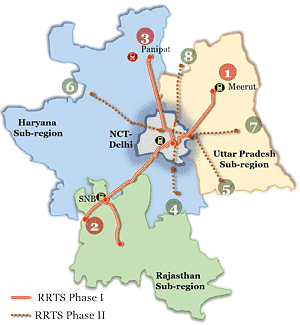
Context: India's first semi high-speed regional rapid transit system (RRTS), which will connect Delhi with NCR, including Meerut, Alwarand Panipat, will now be called RAPIDX.
About name RAPIDX
India’s National Capital Region Transport Corporation (NCRTC) has named its first semi-high-speed regional rail services as ‘RAPIDX’.
The X in the name denotes next generation technology and new-age mobility solution.
The leaf symbol is the “highlight of the brand’s commitment towards decarbonization” by not only decongesting NCR and reducing the number of vehicles on road but also by the use of green energy.
About Rapid Rail Transit Services (RRTS) corridor
The NCRTC which works under the administrative control of Ministry of Housing & Urban Affairs (MoHUA) and is executing the RRTS project is a joint venture of the Government ofIndia (50 per cent) and state governments of Haryana (12.5 per cent), NCT Delhi (12.5 per cent), Uttar Pradesh (12.5 per cent) and Rajasthan (12.5 per cent).
In the first phase of the project, three corridors, namely, Delhi-Ghaziabad-Meerut, Delhi-SNB (Shahjahanpur-Neemrana-Behror Urban Complex)-Alwar and Delhi-Panipat are under implementation.
The 82-km long Delhi-Meerut corridor is one of the three priority corridors of Phase-1 planned in the NCR and is expected to be operational by 2025.
NCRTC is targeting to commission a 17km priority section between Sahibabad and Duhai of the 84km Delhi-Ghaziabad-Meerut corridor, in 2023, before the scheduled time, and the entire first RAPIDX corridor by 2025.
In the next phase(s), five additional RAPIDX lines will be developed. These are Delhi–Faridabad–Ballabgarh-Palwal, Ghaziabad–Khurja, Delhi- Bahadurgarh-Rohtak, Ghaziabad-Hapur and Delhi-Shahdara-Baraut.
What is Rapid Rail Transit Services (RRTS)?
It is a dedicated, high speed and high-capacity rail-based commuter service that will connect different regions in the national capital region (NCR).
It will offer high-frequency, point-to-point travel at an average speed of 160 kmph.
It will provide a "multi-modal integration" connecting the Railway Stations, Bus Depots, airports, and Metro stations.
How is it different from Delhi Metro?
The distance travelled on Delhi Metro is usually short and has several stops in between. The RRTS, on the other hand, will be used for relatively longer transits and will have fewer stops.
RRTS will also be faster as compared to the DMRC's train. The operational speed of RRTS will be 160 kmph, but for Delhi Metro, it is usually around 80 kmph.
About RRTS- The Journey
In 2005, Niti Aayog, then known as the Planning Commission, formed a task force in 2005 under the chairmanship of the secretary of the Ministry of Urban Development (MoUD) to develop a multi-modal transit system for Delhi NCR.
The main objective was to reduce the dependence of commuters on road-based transportation and this was included in NCRPB's Integrated Transport Plan (ITP) for NCR 2032.
The Task Force also identified 8 corridors and prioritised three corridors, Delhi-Meerut, Delhi-Panipat and Delhi-Alwar, for implementation.
NCRTC was made the project's nodal agency, and it was formed as a joint venture of the Centre and the states of Delhi, Haryana, Rajasthan and Uttar Pradesh.
Benefits of Rapid Rail Transit Systems (RRTS)
Reduced travel time due to high speeds, easing congestion and increasing productivity.
Improved connectivity with seamless integration with other modes of transportation.
Environmentally friendly with reduced carbon emissions and air pollution.
Economic benefits through job creation and regional development.
Enhanced safety and comfort with modern technologies and amenities.
Promotes sustainable urban development with transit-oriented development (TOD) principles.
Reduces dependence on private vehicles, contributing to a more sustainable transportation system.
Context: Recently Chennai Port and its subsidiary Kamarajar Port have set a target to handle 100 million tonnes (MT) of cargo for FY24, against 92.45 million tonnes handled in the just-ended fiscal year.
About Chennai port
It is the second-largest container port in India
It is the largest port in the Bay of Bengal
It is an artificial and all-weather port with wet docks
Chennai became known as the gateway of south India due to Chennai port
Context: The International Finance Corporation will stop supporting investments in new coal projects as part of its alignment with the Paris Agreement. The decision comes after a 13-year campaign against IFC's support for a financial intermediary client backing coal in India, which affected communities' livelihoods.
About International Finance Corporation (IFC)
IFC was founded in 1956 on an idea that the private sector has the potential to transform developing countries.
It is the largest global development institution focused on the private sector in developing countries.
It is a member of World Bank Group.
It focuses on economic development and improving the lives of people by encouraging the growth of the private sector in developing countries.
It helps private sector in variety of ways:
Investing in companies through loans, equity investments, debt securities and guarantees.
Mobilizing capital from other lenders and investors through loan participations, parallel loans and other means.
Advising businesses and governments to encourage private investment and improve the investment climate.
World Bank
Background: The Bretton Woods Conference of July 1944 established the framework for post – World War II international economic cooperation and reconstruction. It resulted in the formation of the International Monetary Fund (IMF) and the International Bank for Reconstruction and Development (World Bank). The World Bank provides loans and grants to low and middle-income countries for capital projects. World Bank comprises of the International Bank for Reconstruction and Development (IBRD) and International Development Association (IDA), two of five organizations in the World Bank Group.
Mission of World Bank
The World Bank has two goals:end extreme poverty and promote shared prosperity in a sustainable way.
World Bank Group
The World Bank Group consists of five organizations:
The International Bank for Reconstruction and Development (IBRD): is a global development cooperative owned by 189 member countries. It supports the World Bank Group’s mission by providing loans, guarantees, risk management products, and advisory services to middle-income and creditworthy low-income countries.
The International Development Association (IDA): It was established in 1960 with an aim to reduce poverty by providing zero to low-interest loans (called “credits”) and grants for programs that boost economic growth, reduce inequalities, and improve people’s living conditions. It is the part of the World Bank that helps the world’s poorest countries.
The International Finance Corporation(IFC): is the largest global development institution focused exclusively on the private sector. It helps the developing countries to achieve sustainable growth by financing investment, mobilizing capital in international financial markets, and providing advisory services to businesses and governments.
The Multilateral Investment Guarantee Agency (MIGA): it was created in 1988 to promote foreign direct investment into developing countries to support economic growth, reduce poverty, and improve people’s lives. MIGA fulfils this mandate by offering political risk insurance (guarantees) to investors and lenders.
The International Centre for Settlement of Investment Disputes (ICSID): provides international facilities for conciliation and arbitration of investment disputes.
Note: India is a member of all the organizations of World Bank Group except The International Centre for Settlement of Investment Disputes (ICSID).
Context: Petroleum & Natural Gas Regulatory Board has amended PNGRB (Determination of Natural Gas Pipeline Tariff) Regulations to incorporate regulations pertaining to Unified Tariff for natural gas pipelines with a mission of 'One Nation, One Grid & One Tariff). National Gas Grid System means network of all such natural gas pipelines within India which are fully interconnected with each other (including those which are partly commissioned and so interconnected)
Salient Features of Unified Tariff Regime for Natural Gas Pipelines
Levelised Unified Tariff: PNGRB has notified a levelized Unified Tariff of Rs 73.93 per MMBTU additional GST tax will be Rs. 0.19/MMBTU. All entities part of National Gas Grid will get the tariff as per their entitlement while customers would pay Unified Tariff applicable for different zones. Difference between the entitlement tariffs to be earned by pipeline companies and unified tariffs paid by customers will be settled between pipeline entities by a settlement mechanism.
Tariff zones for unified tariff:
First Tariff zone for unified tariff: Length of 300 km from the entry point on either side of national gas grid system.
Second Tariff zone for unified tariff: length between 300 to 1200 km on either side of the first tariff zone on national gas grid
Third Tariff zone for unified tariff: Remaining length of national gas grid system on either side of second tariff zone.
UNIFIED ZONE
TARIFF (Rs./MMBTU on GCV basis)
Zone 1
39.45
Zone 2
74.97
Zone 3
99.90
Companies covered: National Gas Grid covers all interconnected pipeline networks owned and operated by following entities: Indian Oil Corporation, Oil & Natural Gas Corporation (ONGC), GAIL (India), Pipeline Infrastructure ltd., Gujarat State Petronet Ltd, Gujarat Gas, Reliance Gas Pipelines, GSPL India Gasnet & GSPL India Transco. All these entities will be members of Industry Committee.
Settlement mechanism: The settlement mechanism will be applicable to all the entities including shippers availing transportation services through natural gas pipelines forming part of National Gas Grid System. Out of the members of the Industry Committee 5 members will be selected to form a part of Settlement Committee will decide the ratio of settlement among different entities part of National Gas Grid System.
Significance of Unified Price for National Gas Grid System
Expansion of National Gas Grid: With commissioning of newer interconnected gas pipelines, the national gas grid will keep expanding for Union tariff.
Affordable access to natural gas in far-flung areas: This reform will specially benefit consumers located in far-flung areas by making natural gas available at competitive and affordable rates. In the current regime, additive rates are applicable for gas consumers in these areas.
Transition to gas economy: India plans to raise the share of gas in the economy to about 15% by 2030 from 6.4% in 2022. The uniform price mechanism for transportation will aid in this regard.
About Petroleum & Natural Gas Regulatory Board (PNGRB)
PNGRB is a statutory body formed under the Petroleum & Natural Gas Regulatory Board Act, 2006.
The Board is headed by a Chairperson, a Member (legal) and three other members to be appointed by Central Government.
Functions of PNGRB are:
Protect interests of consumers by fostering fair trade and competition among entities.
Maintain a data bank of information on activities related to petroleum, petroleum products & natural gas.
Lay down technical standards, specifications & safety standards related to petroleum, petroleum products, natural gas, pipeline construction, operation & maintenance related to downstream petroleum and natural gas.
Adjudicate and decide disputes arising amongst entities and receive complaints.
Context: Ministry of Ports, Shipping & Waterways has launched the Green Tug Transition Program which will help in India’s aim of becoming Global Hub for Green Ship by 2030.
Ministry of Ports, Shipping & Waterways has launched the Green Tug Transition Program which will help in India’s aim of becoming Global Hub for Green Ship by 2030.
SALIENT FEATURES OF GREEN TUG TRANSITION PROGRAM
Launched by Ministry of Ports, Shipping & Waterways (MoPSW).
The program will start with Green Hybrid Tugs which will be powered by Green Hybrid Propulsion systems and subsequently adopting non-fossil fuel solutions like Methanol, Ammonia and Hydrogen. Initial Green Tugs will start working in all major ports by 2025.
At least, 50% of all Tugs are likely to be converted into Green Tugs by 2030, considerably reducing emissions at India.
Tugboat or Tugs
A tugboat or tugs are marine vessels that manoeuvre ships by pushing or pulling them, mostly using tow lines.
These boats are known to tug ships in circumstances where the latter cannot or does not move using its own power. For ex in narrow harbours, canals etc.
NATIONAL CENTRE of EXCELLENCE in GREEN PORTS & SHIPPING (NCoEGPS)
Ministry of Ports, Shipping & Waterways (MoPSW) in partnership with The Energy & Resources Institute (TERI) are establishing will help India’s transition towards green shipping & green ports in Gurgaon, Haryana in TERI Complex.
Functions of National Centre of Excellence in Green Ports & Shipping
Act as a nodal agency for the industry for India’s Global hub for building Green Ships by 2030 program.
Acts as a technological arm of MoPSW for providing the needed support on policy, research and cooperation in Green Shipping areas for Ports, Directorate General of Shipping,
Host several technological arms to support port & shipping sector and provide solutions to a variety of problems being faced in shipping industry through scientific research.
Carry out valuable education, applied research and technology transfer in maritime transportation at local, regional, national & international levels.
Focus areas: Energy management, Emission management, Sustainable Maritime Operations etc. and enable fast-track innovations to provide solutions to challenges in these sectors.
Create a pool of manpower for green shipping industry.
Ten Initial Projects of NCoEGPS
Developing a regulatory framework for use of wind energy for marine applications.
Identifying a suitable biofuel for blending with conventional marine fuels.
Identifying a fuel cell technology for long haul shipping
Developing a regulatory framework for transportation of hydrogen up to 700 bar pressure
Detailed project report on low energy consumption port
Detailed project report on offshore platform for tapping solar energy.
Detailed project report on production, storage and usage of Green Hydrogen
Other Major Projects for India’s Transition to Green Shipping
Transition towards renewables: India intends to increase share of renewable energy to 60% of total power demand at each of India’s major ports through solar and wind generated power. At present, about 99% of energy demand for coastal shipping sector is met by fossil fuels with fuel and marine gas oil (MGO).
Shore to ship power (electrification of ports): 50% of port equipments will be electrified by 2030 and all ports shall supply shore power to all visiting ships in a three-phased manner. Currently, India is already supplying shore power to ships with power demand less than 150 kW.
Ports to reduce Carbon emissions per ton of cargo handled by 30% by 2030.
Maritime Vision Document 2050 released by MoPSW is a 10-year blueprint on India’s vision of a sustainable maritime sector and vibrant blue economy.
India has been selected as the first country under IMO Green Voyage 2050 Project of a pilot project related to Green Shipping.
India will be implementing IMO energy efficiency requirements for existing ships and carbon intensity requirements on all its vessels whether coastal or international to help achieve IMO GHG reduction targets.
India is working with Marine Environmental Protection Committee of IMO to help devise acceptable requirements for GHG emission in line with IMO GHG initial strategy.
Adoption of mechanised mode of dry bulk handling, increasing green belt coverage, conversion of diesel RTGCs to electric or hybrids to reduce pollution in ports.
Storage & bunkering facilities for environment friendly fuels like LNG, CNG, Green Hydrogen, Green Ammonia etc. Under the National Hydrogen Mission, MoPSW has identified Paradip Port, Deendayal Port (Kandla), V. O. Chidambarar Port in (Thoothukudi, Tamil Nadu) to be developed as Hydrogen Hubs i.e., capable of handling, storing and generation of green hydrogen by 2030.
GREEN VOYAGE 2050 PROJECT
It is a joint project of International Maritime Organisation (IMO) and Norway to support developing countries in their efforts to reduce GHG emissions from ships and implementing IMO Strategy ON Reduction of GHG Emissions from Ships and Ports.
IMO Strategy on Reduction of GHG Emissions from Ships aims to reduce total annual GHG emissions by at least 50% by 2050 compared to 2008. Carbon intensity of international shipping to decline to reduce CO2 emissions per transport work by at least 40% by 2030 and 70% by 2050 compared to 2008. Use of Energy Efficiency Design Index (EEDI) for new ships to strengthen energy efficiency design requirements.
IMO resolution on ports encourages shipping and port sectors to cooperate for reducing GHG emissions from ships. This will be done by Onshore Power Supply, Safe & Efficient bunkering.
Green Voyage Project will strengthen MARPOL Annex VI compliance, facilitate sharing of operational best practices, catalyse uptake of energy efficient technologies and explore opportunities for low and zero-carbon fuels.
IMO is the executing authority and Norway will provide funding for the project.
India has been selected as the first country under IMO Green Voyage 2050 Project of a pilot project related to Green Shipping.
Components of Green Voyage 2050 Project
Undertake an assessment of maritime emissions in national context.
Develop policy frameworks & national action plans (NAPs) to address GHG emissions from ships.
Draft legislation to implement MARPOL Annex VI into national law.
Assess emissions and develop port-specific emission reduction strategies.
Identify opportunities and deliver port projects, through the establishment of public private partnership & mobilisation of financial resources.
Establish partnerships with industry to develop new & innovative solutions to support low carbon shipping.
Partner Countries: Green Voyage 2050 Project is working with 12 countries: Azerbaijan, Belize, China, Cook Islands, Ecuador, Georgia, India, Kenya, Malaysia, Solomon Islands, South Africa, Sri Lanka.
GLOBAL INDUSTRY ALLIANCE TO SUPPORT LOW CARBON SHIPPING (LOW CARBON GIA)
It is a public private partnership under the framework of IMO-Norway Green Voyage 2050 Project that aims to bring together maritime industry leaders to support an energy efficient and low carbon maritime transport system.
Leading shipowners & operators, classification societies, engine and technology builders and suppliers, big data providers, oil companies and ports have joined hand under Low Carbon GIA to collectively identify and implement solutions for uptake and implementation of energy efficiency technologies, operational best practices and alternative low and zero carbon fuels.
Workstreams of Low Carbon GIA are:
Energy efficiency technologies (EETS) & operational best practices.
Alternative low and zero-carbon fuels.
Addressing emissions at ship-port interface.
INTERNATIONAL MARITIME ORGANISATION (IMO)
It is a specialised agency of the United Nations responsible for measures to improve the safety & security of international shipping and prevent pollution from ships.
It is also involved in legal matters, including liability and compensation issues and facilitation of international maritime traffic.
It came into existence in 1959.
The IMO Assembly consists of all Member States and is the highest governing body of the Organization. It is responsible for approving the work programme, voting the budget and determining the IMO’s financial arrangements.
IMO Council is elected by the Assembly for terms of two years. It acts as the Executive Organ of IMO and is responsible, under the Assembly, for supervising the work of the Organization.
IMO has five main Committees:
Maritime Safety Committee (MSC)
Marine Environment Protection Committee (MEPC)
Legal Committee
Technical Cooperation Committee
Facilitation Committee
Currently, IMO has 175 member states and 66 intergovernmental organisations (observer status).
Organisation is led by the Secretary General supported by Secretariat.
Headquartered at London.
INITIATIVE FOR SUSTAINABLE SHIPPING UNDER INTERNATIONAL MARITIME ORGANISATION
ANNEX VI OF MARPOL CONVENTION: IMO adopted a Annex VI to it MARPOL Convention to address air pollution from ships. It addresses:
Main air pollutants contained in ships exhaust gas such as sulphur oxides (SOX) and nitrous oxides (NOX) and prohibited deliberate emissions of ozone depleting substances.
Regulates shipboard incineration and emissions of volatile organic compounds (VOC) from tankers.
Promotion of energy efficiency of ships – intended to limit emissions of greenhouse gases. (Added in 2011). This introduced compulsory energy efficiency components to ship design and management, promoting use of less polluting equipment and engines. From 2023, it is mandatory for all ships to calculate their attained Energy Efficiency Existing Ship Index (EEXI) to measure their energy efficiency and calculate their carbon intensity indicator (CII) and CII rating.
Lower limit on sulphur content in fuel oil (Added in 2020). This measure was introduced because most ships were using fuel oil with a much higher sulphur content compared to other fuel sources. Implementation of this new limit would result in 77% reduction in sulphur oxide emissions from ships.
IMO Strategy on Reduction of GHG Emissions from Ships (2018) aims to reduce total annual GHG emissions by at least 50% by 2050 compared to 2008. Carbon intensity of international shipping to decline to reduce CO2 emissions per transport work by at least 40% by 2030 and 70% by 2050 compared to 2008. Use of Energy Efficiency Design Index (EEDI) for new ships to strengthen energy efficiency design requirements.
IMO resolution on ports encourages shipping and port sectors to cooperate for reducing GHG emissions from ships. This will be done by Onshore Power Supply, Safe & Efficient bunkering.
Green Voyage Project will strengthen MARPOL Annex VI compliance, facilitate sharing of operational best practices, catalyse uptake of energy efficient technologies and explore opportunities for low and zero-carbon fuels.
Particularly Sensitive Sea Areas (PSSA): Oceans areas of ecological, socio-economic or scientific significance can be granted special protection status of a Particularly Sensitive Sea Area (PSSA). PSSA status recognises that the area may be vulnerable to damage by international maritime activities and protection measures such as compulsory routeing of ship to avoid these areas may be enacted.
Addressing Biofouling: Biofouling is the process of accumulation of various aquatic organisms in ships’ hulls. Through the process of biofouling, invasive aquatic organisms can be introduced to new marine environments affecting marine biodiversity, coastal properties & infrastructure, fisheries and ocean renewable energy.
IMO has found GloFouling Partnership to raise awareness, foster R&D, share best practices and help promote technical solutions for biofouling.
Ballast Water Management Convention, 2004 is international maritime treaty ensures that flag states to ensure that ships flagged by them comply with standards and procedures for management & control of ships ballast water and sediments.