Infrastructure

World’s largest Hydropower Dam in Tibet

Context: China has approved the construction of what will be the world’s largest hydropower dam on the Brahmaputra River in Tibet, close to the Indian Border. This announcement has raised concerns in lower riparian states of India and Bangladesh. 

Relevance of the Topic: Prelims: Key locations in the article; Facts about Brahmaputra river. 

Salient Features: 

  • Location:
    • It will be built at the lower reaches of Yarlung Zangbo river (Tibetan name of the Brahmaputra).
    • The dam is to be built at a huge gorge in the Himalayan reaches where the Brahmaputra river makes a huge ‘U turn’ to flow into Arunachal Pradesh and then to Bangladesh.

Cost & Scale:

  • Total investment in the dam could exceed one trillion yuan (roughly equal to 137 billion U.S. Dollars), which is largest in terms of investment for any other single infrastructure project in the world.
  • The project could produce 300 billion kilowatt-hours of electricity annually. That would be more than triple the 88.2 billion kWh designed capacity of the Three Gorges Dam, currently the world’s largest, in central China.
  • Significance for China:
    • China’s Official statement states that “The project will play a major role in meeting China’s carbon peaking and carbon neutrality goals, stimulate related industries such as engineering, and create jobs in Tibet.”
  • Concerns for India: 
    • The dam empowers China to control the water flow in lower riparian reaches in India. Further, the project has potential in altering not only the local ecology but also the flow and course of the river downstream.
    • The size and scale of it could also enable China to release large amounts of water flooding border areas in times of hostilities.
image 183

Brahmaputra River System:

  • Brahmaputra originates as Tsangpo in the Kailash range near the Mansarovar lake, in Tibet.
  • ​​It traverses more than 1,000 km eastward, before forming a horseshoe bend around the Namcha Barwa peak and enters Arunachal Pradesh as Siang (or Dihang). 
  • ​​Brahmaputra River: Formed by the confluence of Siang, Lohit, and Dibang rivers in Assam.
  • Sub-basin: Arunachal Pradesh (Subansiri, Kameng, and Bhareli rivers), Assam (Manas, Kopili, Sankosh, and Dikhow rivers), Nagaland (Doyang), Meghalaya (Umngot and Kynshi rivers), West Bengal and Sikkim (Teesta). 
  • River Teesta joins Jumna (Brahmaputra in Bangladesh) as a right bank tributary. 
image 184
Left bank Tributaries of BrahmaputraRight bank Tributaries of Brahmaputra
DibangSubansari
LohitKameng
Burhi DihangManas
DhansariSankosh
Kelang

Ken-Betwa Link Project

Context: The Prime Minister of India laid the foundation stone for the Ken-Betwa river linking project in Khajuraho, Madhya Pradesh. 

Relevance of the Topic: Prelims: Key facts about Ken-Betwa link project; Ken river; Betwa river. 

Ken-Betwa link project

  • The Ken-Betwa link project envisages transferring of surplus water from Ken basin to water short areas of Betwa basin by substitution. Both rivers are tributaries of the Yamuna. 
Ken-Betwa link project
  • The Ken-Betwa link project will be implemented in two phases.
    • Phase I: involves construction of 77 m high Daudhan dam across river Ken.
    • Phase II: involves construction of Lower Orr dam, Kotha Barrage and Bina Complex.
  • The estimated cost of the project is around ₹45,000 crore.

Ken River:

  • It is an interstate river between Uttar Pradesh and Madhya Pradesh.
  • It is a tributary of the Yamuna.
  • It originates from the north-west slopes of the Kaimur hills in the Jabalpur district of Madhya Pradesh.
  • The river joins the Yamuna river near village Chilla (Banda district), near Fatehpur in Uttar Pradesh.
  • The river is the last tributary of Yamuna before the Yamuna joins the Ganga.
  • The important tributaries of Ken are - Alona, Bearma, Sonar, Mirhasan, Shyamari, Banne, Kutri, Urmil, Kail and Chandrawal.

Betwa River:

  • The Betwa river originates in the Raisen district of Madhya Pradesh south-west of Bhopal.
  • It is an interstate river between the two states viz. Madhya Pradesh and Uttar Pradesh. 
  • It flows in a northeasterly direction through Madhya Pradesh and enters into Uttar Pradesh near village Bangawan of Jhansi district.
  • The river joins the Yamuna near Hamirpur in Uttar Pradesh.
  • Important tributaries of Betwa are - Bina, Jamini, Dhasan, Birma, Kaliasote, Halali, Bah, Saga, Narain and Kaithan.

Background:

  • Ken-Betwa Link is the first project under the National Perspective Plan for interlinking of rivers, which was prepared in 1980.
  • A major breakthrough came in the year 2005 when a tripartite memorandum of understanding for preparation of a detailed project report (DPR) was signed among the Central government, Uttar Pradesh and Madhya Pradesh.
  • In 2008, the Centre declared the Ken Betwa Link Project (KBLP) a National Project. Later, it was included as part of the Prime Minister’s package for the development of the drought-prone Bundelkhand region.

Significance:

  • The project is expected to provide annual irrigation to 10.62 lakh hectares (8.11 lakh ha in MP and 2.51 lakh ha in UP) of land, and supply drinking water to about 62 lakh people.
    • It is aimed at solving the water woes of the Bundelkhand region, spread across parts of Uttar Pradesh and Madhya Pradesh. 
    • It will benefit the water-starved region, especially the districts of Panna, Tikamgarh, Chhatarpur, Sagar, Damoh, Datia, Vidisha, Shivpuri and Raisen of Madhya Pradesh, and Banda, Mahoba, Jhansi and Lalitpur districts of Uttar Pradesh.
  • It aims to generate more than 100 MW of hydropower and 27 MW of solar energy.

Challenges and Criticism: 

1. Environmental: 

  • The project will involve large-scale deforestation inside the heart of the Panna National Park and Tiger Reserve.
    • Experts have raised serious concerns about submergence of around 98 sq km of Panna national park, and felling of about two to three million trees.
    • The Supreme Court’s Central Empowered Committee (CEC) has pointed out that the project will undo the successful tiger reintroduction that helped the tiger population bounce back from local extinction in 2009.
  • CEC also noted that in its downstream side, Daudhan dam is likely to affect the Gharial population in the Ken Gharial sanctuary along with vulture nesting sites.
  • A study published by IIT Bombay highlighted that moving large quantities of water as part of river linking projects can affect land-atmosphere interplay and feedback and lead to a mean rainfall deficit by up to 12 per cent.

2. Economic: 

  • The Supreme Court’s Central Empowered Committee (CEC) had raised questions on the economic viability of the project. It suggested that the first focus should be on  exhausting other irrigation options in the upper Ken basin before taking up any such large scale project.

3. Social:

  • Since its inception the project has witnessed severe protest over the issue of inadequate compensation and rehabilitation plans. The dam will displace 5,228 families in Chhatarpur district and 1,400 families in Panna district due to submergence and project-related acquisition. 

As per the Ministry of Jal Shakti the project will pave the way for more river interlinking projects to ensure that scarcity of water does not become an inhibitor for development in the country.

New cables to enhance India's Internet Connectivity

Context: Two new optical fiber cables namely India Asia Xpress (IAX) and India Europe Xpress (IEX) are expected to be functional in near future to enhance internet connectivity of India. 

Major Highlights:

  • As of 2024, India is connected to the global internet by 17 international undersea cables: SEA-ME-WE 3, Bay of Bengal Gateway, and Europe India Gateway. 
  • Two new cable systems are set to launch in India in the coming months. The cables-  IAX and IEX are cumulatively over 15,000 Km in length. They are owned by Reliance Jio with a strategic investment from China Mobile.
    • IAX connects- Chennai and Mumbai with Singapore, Thailand and Malaysia in Asia.
    • IEX connects- Chennai and Mumbai with France, Greece, Saudi Arabia, Egypt and Djibouti. 
image 140

About Undersea Cables

  • Submarine or undersea cables are high-capacity optic fibre cables laid on the ocean floor to provide global connectivity for high-speed data exchange.
  • There are about 400 submarine cables worldwide that handle about 99% of international data traffic. Examples: JUNO, Asia-America Gateway, MAREA etc.

Advantages of Undersea Cables:

  • The undersea cables are designed to offer higher bandwidth and low latency.
  • These undersea cables i.e. Optical fiber cables offer low power loss and are immune to EM (Electro-magnetic) interference.
  • Over long distances, these cables are more cost effective compared to satellites.
  • The cables have minimal environmental footprint and are designed to last for around 25 years.

Disadvantages of Undersea Cables:

  • They are vulnerable to physical damage to them from shipping and fishing activities.
  • These cables are not suitable for regions vulnerable to disasters such as mudslides, typhoons etc. Satellites are used for such scenarios.
  • The submarine cable system requires repeaters at regular intervals.
  • The cables are used for espionage by countries. There have been instances where nations have intercepted data for espionage, raising concerns about data security. 
  • The installation of the fiber network is very much expensive which requires huge investment. Undersea cable repair is slow, tedious and expensive. 

International Telecommunication Union (ITU):

  • ITU is a specialised agency of the United Nations that focuses on issues related to information and communication technologies established in 1985. 
  • Headquarters: Geneva, Switzerland
  • India is a member nation. 
  • Report associated: Global Cybersecurity Index. 

Bharat Net Scheme:

  • The scheme, launched by the Government of India, aims to boost the internet connectivity in the nation, especially the remote and rural regions. 
  • It primarily advocates the usage of Optical Fiber Cable to enhance the connectivity to remote regions. 
  • It targets to connect 2.5 Lakh Gram Panchayats with high speed broadband connection. 
  • Universal Service Obligation Fund is used for the funding of the project. Where USOF is a corpus collected by the levies on the telecom operators.

Undersea Cables and India’s Opportunity:

  • Strategic Location of India: India's advantageous position in the Indian Ocean, brings it at the crossroads of major international trade and data transmission routes. Hence, India can serve as a vital node or connectivity hub for global internet traffic. 
  • Enhancing regional connectivity: India has 17 prominent undersea cables and is expanding even further. The infrastructure can be leveraged to provide connectivity solutions to neighbouring countries (Sri Lanka, Bangladesh, Maldives, East Africa etc.) This can increase India’s strategic influence as well as provide economic gains. 
  • Strategic leadership: India can play an active role in the International Telecommunication Union to shape global standards for connectivity and cybersecurity. 

Certain challenges to Internet Connectivity in India:

  • Cost overrun as the delay in the projects due to land acquisition leads to the elevation in the cost of the project. 
  • Coordination issues: In India, there are multiple agencies and coordinating bodies involved in Telecom regulation namely Telecom tribunal and Consumer tribunals; creating a coordination issue due to overlapping jurisdiction. 
  • Security Issue: Submarine cables are susceptible to disruptions (intentional or accidental damage to cables) and espionage risks at strategic chokepoints. E.g., Malacca Strait. This could impact data transmission. 

Way Forward: The new ecosystem of optical fiber will boost the economic development in India, though the challenges can be addressed with a common coordinating agency and inviting Public-Private Partnership funding. Also, new means of connectivity like satellite based internet like Starlink can also be explored. 

Gujarat Port City Project

Context: Drawing inspiration from international port-cities such as Rotterdam, Dubai, and Antwerp, Gujarat government is revisiting a decade-old idea of building India’s first greenfield port-city spread over 500 sq km. It targets completion by 2047 with a cumulative investment of ₹1.5 lakh crores.

What are Port-City Projects? 

  • A port-city project refers to a development initiative that focuses on integration and expansion of ports with the surrounding urban areas, enhancing the relationship between the port infrastructure and the city. 
  • These projects aim to address both the economic and social aspects of port operations while improving the urban environment.

About Gujarat’s Port-City Project:

  • Led by: Gujarat Maritime Board.
  • Aim: Build a massive port, capable of handling 500 million tonnes per annum (MTPA), integrate port-related industries, marine activities, residential complexes, and recreational activities. 
  • The 500 sq. km greenfield venture will have port facilities, industries, residences, and leisure options.
  • Four sites have been shortlisted for the planned port-city based on key factors such as proximity to deepwater access, availability of waterfront space, connectivity to robust road and rail networks, and potential to support sustainable industrial growth. These are Porbandar, Bhavnagar, Surat, and Valsad.

Major Ports In India

  • India has 13 major ports and more than 175 non-major ones. The major ports carry about 70% of the total volume of cargo handled by ports. 
  • Currently, Gujarat accounts for 66% of the cargo handled by non-major ports in India, followed by Andhra Pradesh (14%) and Maharashtra (9%).
Major Ports In India

Benefits associated with development of Port-Cities:

  • Boost to Maritime Trade and Logistics:
    • Port-city projects can enhance port capacities to handle larger vessels and more cargo. This strengthens India’s position in global trade.
    • Improved port infrastructure, coupled with enhanced road, rail, and air connectivity, can streamline supply chains and lower transportation costs.
  • Job Creation and Economic Diversification:
    • Port-city projects create numerous jobs in construction, logistics, port operations, and urban development. 
    • Growth of ancillary sectors like warehousing, packaging, and IT services also contributes to job creation.
  • Attract FDI: 
    • Modernised ports and integrated urban spaces are attractive to foreign investors.
    • They can also boost development of Special Economic Zones (SEZs).
  • Development of Coastal and Hinterland Regions:
    • By transforming underdeveloped coastal zones into thriving economic centers, port-city projects can foster balanced regional development. 
  • Promote Sustainable Urban Development:
    • Green spaces, renewable energy systems, and eco-friendly construction practices can help India meet its environmental goals while simultaneously boosting its economy by positioning the country as a leader in green development.
  • Boost to Tourism and Hospitality Industry: Tap into potential of Cruise & Coastal tourism.
  • Improved Global Competitiveness: Port cities can serve as key regional trade hubs, enhancing India’s standing in global trade. 

Challenges:

Implementing port-city projects in India involves various challenges, ranging from logistical and regulatory issues to social and environmental concerns.

  • Land related Issues: Land scarcity and disputes, high land costs, dense population and India’s complex land acquisition laws can lead to legal battles and delays. 
  • Environmental Concerns: Port-city projects bring with them the risks of coastal degradation and Marine & Coastal pollution. 
  • Congestion and Inefficiency: Many of India’s existing ports have limited capacity to handle large volumes of goods. Upgrading or modernising these facilities and connecting them to the city can be a complex and costly process.
  • Coordination between stakeholders: Including port authorities, urban development agencies, environmental bodies, and local communities can be difficult, especially when different levels of government have conflicting interests or priorities.
  • Public-Private Partnerships (PPP) challenges: PPPs face challenges such as mismatched expectations, delays in decision-making, and difficulty in attracting private sector investment
  • Social and Community Impacts: Displacement of local communities and associated social resistance, inadequate stakeholder engagement can be of concern.

Addressing these issues requires comprehensive planning, strong governance, collaboration between multiple stakeholders, and innovative approaches to ensure the successful integration of port infrastructure with urban development. Overcoming these challenges is critical for realising the full potential of port-city projects and fostering sustainable economic growth in India.

Polavaram Dam Project

Context: The Biju Janata Dal (BJD) has recently intensified its efforts to highlight the potential adverse impacts of the Polavaram Dam project (Andhra Pradesh), on the tribal communities in Odisha’s Malkangiri district (Odisha).

Relevance of the Topic: Prelims: Key facts about Polavaram Dam Project. 

Polavaram Dam Project:

  • The Polavaram Project is an under construction multi-purpose irrigation project on the Godavari River. It is located in the Polavaram mandal of the Eluru district (formerly West Godavari district) in Andhra Pradesh.
AD 4nXd2GCDIN eZLanfkAasqwaFWftKosBdvFPuXilL3lKmd6qT2O2Ei xYXHLOCDQ6OmugvS370BK 5hK5fOGckHqlKYz7qvQgnLBtSArPb6pxYLhtwzFHn4WsEd933DjHXyxm fweWrxdGcDwTa34WQ?key=hBIXVSnzBiL QlDmpJYwcaPV

Purpose:

  • The project is a multi-purpose project on river Godavari for irrigation, developing hydropower and providing drinking water facilities to East Godavari, Visakhapatnam, West Godavari and Krishna districts of Andhra Pradesh.
    • The project will provide irrigation facilities to 2.91 lakh hectares.  
    • The project has an installed capacity of 960 MW and will provide 23.44 TMC (663.7 MCM) of drinking water and industrial water supply to Visakhapatnam city and steel plant. 
  • In this project, Godavari-Krishna inter-linking will be implemented under the inter-linking of rivers project. The project envisages transfer of 80 TMC of surplus water of Godavari river to Krishna river to be shared between Andhra Pradesh, Karnataka and Maharashtra.

Background:

  • The Polavaram Irrigation Project on the river Godavari was conceived as a part of the recommendations of the Godavari Water Disputes Tribunal (GWDT). 
  • Andhra Pradesh, Madhya Pradesh and Odisha had entered into an agreement dated April 2, 1980, where the project was to be executed by Andhra Pradesh.
  • As per Andhra Pradesh State Reorganization Act (APRA), 2014, the Polavaram Irrigation Project was declared as a National Project . As per the Act the Central Government shall execute the project and obtain all requisite clearances including environmental, forests, and rehabilitation and resettlement norms. 
polavaram irrigation project

Objection raised by Odisha: 

  • The Odisha State government in the year 2016 submitted to the National Commission for Scheduled Tribes (NCST) that the project was going to submerge 7,656 hectares of land, including forestland, and displace more than 6,800 people including 5,916 tribals in Malkangiri.

**Though no comprehensive study has been carried out with regards to the likely submergence of the Malkangiri district  due to the Polavaram project.

Steps taken by Ministry of Jal Shakti

  • The Ministry of Jal Shakti said that by providing remedial measures such as constructing protective embankments along Sileru and Sabari River in Odisha, and along Sabari River in Chhattisgarh, the submergence in both Odisha and Chhattisgarh could be avoided completely. 
  • In August 2024 this year, the Ministry had asked the State Pollution Control Boards of Odisha and Chhattisgarh to conduct a public hearing for the construction of protective embankments without further loss of time as the project is in an advanced stage of construction. 

Present status: 

  • The Odisha State Pollution Control Board is yet to hold a public hearing. 
  • The Odisha government had earlier expressed its reservation over the high protective embankment by stating that the construction of an embankment requires the diversion of forestland and creates flooding in Odisha territory.

Jalvahak Scheme

Context: The Union Government has recently launched "Jalvahak" scheme to incentivise movement of cargo along the inland waterways, reduce logistics cost and de-congest roads and railways.

Present Status of Inland Waterways: 

  • India has approximately 14,500 km of navigable waterways which consist of rivers, canals, backwaters, creeks, etc. However, the share of Inland waterway transport (IWT) in India is currently only around 2% in comparison to 35%  in Bangladesh and 20% in Germany.

Benefits of Inland Waterways:

  • Reduce Logistics cost (12-14% of GDP) and bring it on par with the global standards (8-10% of GDP).
  • Lower Investment and maintenance cost in comparison to road and railways.
  • Environment Friendly: 
    • 50% lower carbon dioxide emissions in comparison to Roads.
    • Negligible land requirement.
    • Safe mode for hazardous cargo.
  • Streamline Infrastructure:
    • Reduces pressure on Roads and Railways.
    • Provide for carriage of vehicles in the form of Roll-on-roll-off mode.
    • Easy integration of the IWT with sea transport.
    • Safe and less risky in comparison to other modes.
  • Socio-economic development: IWT provides benefits in terms of trade and access to markets, enhance local community’s economic engagement, promote eco-tourism and boost employment opportunities. For example, Arth Ganga has potential to promote sustainable development with a focus on economic activities along river Ganga.

Constraints and Strategies:

image 91

Details about Jalvahak Scheme:

  • Rationale: Need to provide incentives on the lines of Europe's Marcopolo initiative to encourage modal shift towards Inland waterways from better funded and developed Road and Railways sector.
  • Duration of scheme: 3 years.
  • Implementation agency: Inland and Coastal Shipping Limited (ICSL) 
  • Nodal Ministry: Ministry of Shipping, Ports, and Inland Waterways. 

Design of the scheme:

  • Financial incentives will be provided directly to the cargo owners who shift cargo from road/rail to Inland waterways. 
  • Incentive would be up to 35% of the total actual operating expenditure incurred on waterways.
  • Incentive would be provided only on long haul movement of cargo i.e. distances more than 300 km.

Is the incentive applicable for all the Inland waterways?

  • Presently, the incentives are applicable for movement of cargo along National Waterways 1 (river Ganga), National Waterways 2 (Brahmaputra river) and National Waterways 16 (River Barak). However, based on the success of the Scheme, it may also be extended to other waterways.

Way Forward: The inland waterways are cost-effective, fuel-efficient, safe and  secure  mode  of  transportation  for  goods  and  passengers. Going forward, the Jalvahak scheme should be implemented efficiently to increase the modal share of inland waterways from 2% to 5% as envisioned in Maritime India Vision 2030.

Railways (Amendment) Bill 2024

Context: The Lok Sabha passed the Railways (Amendment) Bill, 2024. The Bill was passed five months after it was introduced on the Floor of the House.

Relevance of the Topic:Prelims: Key aspects of the Railways (Amendment) Bill, 2024. 

Background:

  • The Bill aims to repeal the Indian Railway Board Act, 1905 and incorporates its provisions into the Railways Act, 1989.  
  • The Indian Railway Board Act, 1905 enabled the central government to invest in the Railway Board with powers and functions under Indian Railways Act, 1989.

Key provisions of the Bill:

  • Powers of Union Government: The Central Government will prescribe:
    1. the number of members of the Board
    2. the qualifications, experience, terms and conditions of service, and manner of appointment for the Chairman and members of the Board.
  • Statutory Status: The Bill proposes to amend the Railways Act, 1989, to provide statutory backing to the Railway Board.
  • Independent Regulator: The Bill proposes to establish an independent regulator to oversee tariffs, safety, and the participation of the private sector in the Railways.
  • Autonomy to Zones: The Bill proposes to improve operational efficiencies and decentralise powers, granting greater autonomy to railway zones.
image 61

Key Impact:

  • The current Bill proposes to simplify the legal framework by incorporating the proposals of the Indian Railway Board Act, 1905 in the Railways Act, 1989. This will reduce the need to refer to two laws. Instead reference will be required only to one law.
  • Establishment of an independent regulator would give encouragement to private participation by protecting the interests of stakeholders and promoting competition. This in turn would attract investment, increase efficiency in operations, and improve service standards.
  • Autonomy to zones would grant them flexibility and space to make decisions on project tenders for their zones without approaching the Board.
  • Statutory backing to the board would streamline its functioning with better efficiency and autonomy.
  • The amendment is expected to speed up the approval process for train services that will help meet pending demands from various regions.
  • The Bill will allow the government to fast-track infrastructure and superfast train operations.

Why was the amendment needed?

Indian Railways was envisioned as a commercial undertaking of the government, with an additional social responsibility to make transport services accessible and affordable to the public. Over the years, Railways has faced persistent challenges such as: 

  1. High operating costs due to significant salary and pension expenditure
  2. Continued losses from its passenger business due to underpricing
  3. Under-investment in capacity augmentation (infrastructure development) due to poor surplus generation and limited private participation 
  4. Network congestion and cross-subsidy for passenger services reducing its freight competitiveness.

The opposition alleges that through this bill the government is trying to take away the autonomy and has an aim to privatize the railways. Whereas the government argues that these steps are essential to make railways modernize and financially viable as the proposed amendments are in line with the recommendations made by various committees like The Committee on Restructuring of Railways (2015) and The Sreedharan Committee (2014). 

Merchant Shipping Bill 2024

Context: India unveils new Merchant Shipping Bill 2024 which seeks to repeal Merchant Shipping Act, 1958 to streamline vessel ownership, registration, and environmental regulations.

Background: 

  • The Merchant Shipping Act, 1958, restricts seafarers’ welfare provisions to Indian-flagged ships, despite 85% of the 2,80,000 active Indian seafarers working on foreign-flagged vessels. Additionally, the Act lacks enabling provisions for implementing certain international conventions that India has signed or plans to ratify.
  • The Merchant Shipping Bill introduces significant changes to modernise India’s maritime framework, drawing upon the best practices of leading maritime jurisdictions like the U.K., Norway, and Singapore.
maritime map

Key Provisions of Merchant Shipping Bill 2024:

  • Simplified ownership criteria: 
    • The existing law restricts vessel registration to entities with 100% Indian ownership. The new Bill proposes significant reforms to attract foreign investment. 
    • It also reduces the ownership threshold for Indian citizens/entities from 100% to 51%, enabling more flexibility.
  • Expanded eligibility for vessel ownership.
    • Ownership allowed for Indian citizens, Non-Resident Indians (NRIs), Overseas Citizens of India (OCIs) and companies established under Central Act or State Act having its registered office of business in India.
  • Registration of vessels: 
    • The Bill allows the registration of vessels chartered by Indian entities under the bareboat charter-cum-demise, enabling entrepreneurs to acquire ownership of vessels at the end of the charter period. 
  • Enlarging the scope of vessels:
    • The existing Act regulates only mechanised ships (engine-fitted vessels) above a certain size, leaving smaller mechanised vessels and all non-mechanised vessels outside its ambit. This regulatory gap has allowed many vessels to operate without adequate oversight.
    • The new Bill seeks to address this issue by expanding the definition of ‘vessels’ to uniformly include a wide range of crafts, including submersibles, semi-submersibles, hydrofoils, non-displacement crafts, amphibious crafts, wing-in-ground crafts, pleasure crafts, barges, lighters, Mobile Offshore Drilling Units (MODUs), and Mobile Offshore Units (MOUs), whether mechanised or not. 
  • Regulation on wrecked or abandoned vessels:
    • Vessels that have ceased registration due to wreckage or abandonment must be surveyed and certified seaworthy before re-registration.
  • Mortgage Rights: 
    • Establishes clear rules on mortgaged vessels, enabling debt recovery through vessel sales without court intervention for single mortgages. Multiple mortgages require High Court involvement for debt recovery.
  • Provisions for Recycling:
    • Legislation encourages vessel recycling within India. Abandoned non-Indian vessels in Indian waters can be recycled under temporary registration.
  • Establishment of National Shipping Board: 
    • The central regulatory body will oversee vessel security and port facilities.
  • Stricter regulations on Marine Casualties:
  • Addressing Marine Pollution: 
    • Sulphur content in marine fuel reduced to less than 0.5%.
    • Ban on single-use plastics aboard Indian ships.
    • Launch of 'Swachh Sagar' portal for waste disposal at ports.
    • Incorporates IMO conventions such as MARPOL, CLC (International Convention on Civil Liability for Oil Pollution Damage, 1969), and Bunker Convention.
    • Aligns India’s framework with international standards for sustainable shipping.

Significance of the bill:

  • Boosts maritime trade by expanding ownership and registration options and promoting ease of doing business.
  • Encourages sustainability in the maritime sector through recycling initiatives.
  • Provides clarity on mortgage rights, expediting financial processes for shipowners and creditors.
  • Vessel definition is expected to enhance transparency and ensure comprehensive regulatory oversight in the offshore sector.
  • Registration of vessels will be beneficial for capital-deficient entrepreneurs, facilitating entry into the shipping industry without upfront investment.

By fostering investment, enhancing safety, combating marine pollution, and supporting seafarers’ welfare, the proposed reforms promise to unlock the true potential of India’s maritime sector.

Oilfields (Regulation and Development) Amendment Bill 2024

Context: Rajya Sabha has passed the Oilfields (Regulation and Development) Amendment Bill, 2024. The Bill amends the Oilfields (Regulation and Development) Act, of 1948.

Relevance of the Topic: Prelims- Oil fields (Regulation and Development) [Once it becomes an Act]

About Oilfields (Regulation and Development) Amendment Bill, 2024: 

  • Aim: To ensure policy stability for oil and gas producers and allow international arbitration.
Oilfields

Key Highlights of the Bill:

1. Definition of Mineral Oils expanded:

  • The Oilfields (Regulation and Development) Act, 1948, defined only two mineral oils -  petroleum and natural gas. 
  • The Bill expands the definition to include:
    1. any naturally occurring hydrocarbon
    2. coal bed methane
    3. shale gas/ shale oil and gas hydrates.  
  • It clarifies that mineral oils will not include coal, lignite or helium. 

2. Introduction of petroleum lease: 

  • The Bill alters the previously used mining lease to introduce a ‘petroleum lease’ which allows companies to explore, prospect (assessment of potential petroleum accumulations across large areas), produce, make merchantable, and dispose of mineral oils. Existing mining leases granted under the Act will continue to be valid.
  • The Bill urges oil companies to use oilfields for other purposes like hydrogen production, carbon capture utilisation and storage or coal gasification. 

3. Expands regulatory powers of Central Government:  

  • Under the Act, the Centre is empowered to regulate the grant, terms and conditions, and time period of leases, production, storage and conservation of mineral oils and collecting royalties, fees and taxes for mineral oils. 
  • This Bill expands the Centre’s powers to include framing rules for lessees to reduce emissions, sharing of oil production and processing units, merger of leases and resolving disputes on leases. 

4. Decriminalisation of offences:

  • The Bill decriminalises offences related to the petroleum activities (such as invalid leases and non-payment of royalties etc.); however, it increases the monetary fine for violation of Rules from Rs. 1000 to Rs 25 lakhs. 
  • Adjudication of penalties:
    • The central government will appoint an officer of the rank of Joint Secretary or above for adjudication of penalties.
    • Appeals against the decisions of the Adjudicating Authority will lie before the Appellate Tribunal specified in the Petroleum and Natural Gas Board Regulatory Board Act, 2006. 

5. Opening up no-go areas to oil exploration:

  • The Centre has allowed oil exploration within previously defined no-go areas, such as those near missile testing sites. 

Need for the Amendment: 

  • India needs to increase its domestic production and reduce its import dependence to meet the country’s rapidly growing energy demand.
  • Imports have largely remained unchanged in spite of policy measures aimed at boosting domestic production— such as the Hydrocarbon Exploration and Licensing Policy (HELP), the Discovered Small Fields (DSF) policy, gas pricing reforms, and reduced royalty rates for deepwater, ultra-deepwater, and high-pressure/ high-temperature areas.
  • India is believed to hold yet-to-find potential of 13 billion tons of oil equivalent. Currently, the petroleum industry is burdened by delays in obtaining environmental and forest clearances, complexities in land acquisition, absence of comprehensive standards, procedures, and guidelines for operational and safety compliance.

Significance of Amendment: 

  • The broader definition (of mineral oils) enables the efficient exploration, development, and production of both conventional and unconventional hydrocarbon resources without any policy confusion.
  • The regulatory changes (such as separation of leases) seek to simplify and streamline the regulatory environment, for the petroleum and energy sectors in India, by eliminating redundant or irrelevant approvals.
  • By shifting from criminal penalties to administrative fines for minor infractions, companies can focus on compliance and operational improvements without the fear of severe legal consequences. This will foster a more predictable environment, encourage innovation, and streamline the regulatory process.
  • The ‘zero interference’ promise by the government to the private sector would enhance India’s domestic output and cut down its reliance on oil imports. 

These reforms are designed to enhance exploration and production. Achieving a meaningful reduction in import dependency will require a sustained and significant growth in domestic production, particularly in oil, natural gas, and deployment of renewable energy. 

House Price Index (HPI)

Context: The All-India House Price Index (HPI) of the Reserve Bank of India rose by 4.34% as of September 2024. The rising HPI shows that the house prices are on the rise in India, despite high interest rates in the banking system and inflation. 

Relevance of the Topic: Prelims- House Price Index 

What is the House Price Index?

  • Released by: Reserve Bank of India 
  • Frequency: Published quarterly.
  • Base year: 2010-11
  • Coverage: The Index tracks the price movements of residential property in ten major cities in India. (Ahmedabad, Bengaluru, Chennai, Delhi, Jaipur, Kanpur, Kochi, Kolkata, Lucknow, and Mumbai)
  • Data Source: Official data of property price transactions collected from registration authorities of respective state governments. 
  • Based on these city indices, an average house price index representing all-India house price movement is also compiled. 

Utility of House Price Index:

  • Functions as an analytical tool for estimating:
    • Changes in the rates of Real estate and mortgage defaults
    • Housing affordability  
  • Used by policymakers and banks to assess the impact of monetary policy on the housing sector and assists in framing housing and urban development schemes. 

Pradhan Mantri Gram Sadak Yojana-IV (PMGSY-IV) Scheme Approved by Union Cabinet

Context: Union Cabinet headed by Prime Minister has approved the implementation of Pradhan Mantri Gram Sadak Yojana - IV between FY 2024-25 to 2028-29.

About PMGSY-IV

  • Total length of roads: 62,500 km of all weather roads.
  • Habitations to be covered: 25,000 unconnected habitations
  • Eligibility of habitations to be covered based on population size (as per Census 2011):
    • 500+ in North-East & Hill States/UTs, Special Category Areas (Tribal Schedule V Areas, Aspirational Districts/Blocks, Desert Areas)
    • 100+ in LWE affected districts
    • Financial assistance will also be provided for construction/upgradation of bridges along the alignment of all-weather roads will be provided for new connectivity roads.
  • Financial Assistance: Total outlay will be Rs 70,125 crore (Centre's share Rs 49,087 crores and State's share Rs 21,037 crores).
  • Technological innovation: PMGSY-IV will employ global best practices for road construction such as Cold Mix Technology, Waste Plastic, panelled cement concrete, Cell filled concrete, full depth reclamation, use of construction waste and other wastes such as fly ash, steel slag etc.
  • Integration with PM Gati Shakti Portal: PMGSY-IV road alignment planning and DPR (Detailed project report) preparation will be undertaken through PM Gati Shakti portal.
  • Nodal Ministry: Department of Rural Development under the Ministry of Rural Development.

Pumped Storage Hydropower Projects

Context: As India moves ahead with increasing shift towards renewable energy sources like solar and wind. There has been a greater focus on developing battery storage systems, which can store electricity. In this respect, there has been an increased focus on developing Pumped Storage Hydropower projects, which are giant batteries.

Pumped Storage Project

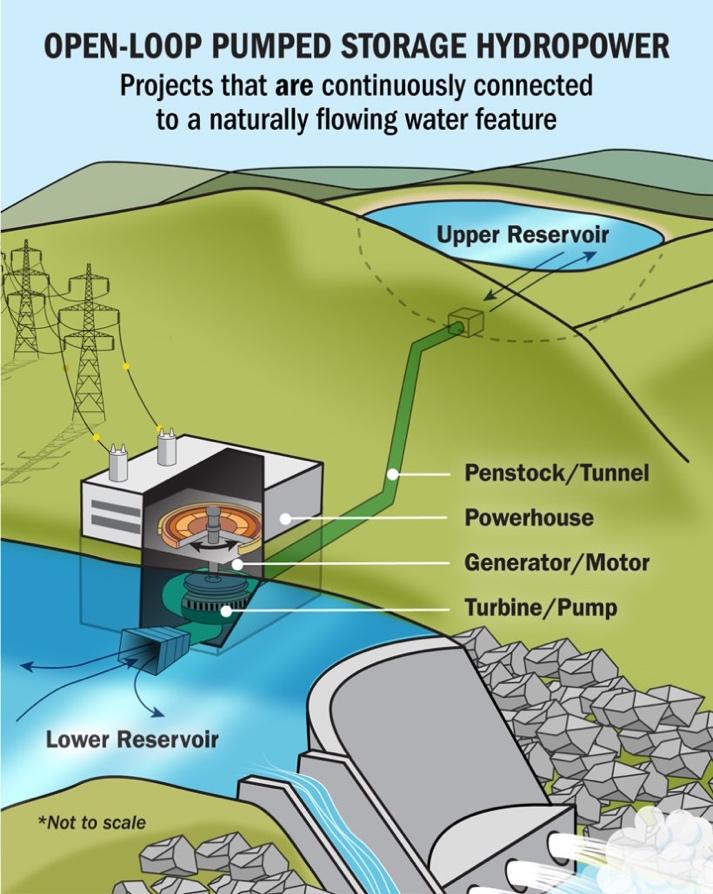
  • Pumped storage plants use the principle of gravity to generate electricity using water that has been previously pumped from a lower source to an upper reservoir. 
  • Operation of pumped storage power plants requires two reservoirs viz. upper and lower reservoir. Water in upper reservoir is used for generating power during peak demand hours. The water in the lower reservoir is pumped back to the upper reservoir during the off-peak hours and the cycle continues. 
  • Pumped storage plants are of two types: ‘open loop’, which has an associated natural-water source (like a river) for one or both the reservoirs; and ‘closed loop’ (or off-river PSH), which does not have a connected natural-water source and the same water is cycled between the two reservoirs for pumping and generation.
  • Energy storage capacity of a pumped hydro facility depends on size of its two reservoirs and the head between reservoirs, while the amount of power generated is linked to the size of turbine.
A chart showing a open-loop pumped storage hydropower system. From top, water sits in an upper reservoir, then travels through a penstock or tunnel into a powerhouse. It passes through a generator/motor, then through a turbine/pump into a lower reservoirA chart showing a closed-loop pumped storage hydropower system. From top, water sits in an upper reservoir, then travels through a penstock or tunnel into a powerhouse. It passes through a generator or motor, then through a turbine or pump into a lower reservoir.

Need for Pumped Storage Hydropower Project

  • Renewable energy sources like solar & wind energy are intermittent and variable in nature. This leads to challenges of grid-stability and temporal considerations in power availability. This requires immediate ramp-up & back down of generation for grid balancing & stability of grid frequency.
  • Pump Storage Technology is the only long term technically proven, cost-effective, highly efficient & operationally flexible way of energy storage on a large scale & available at short notice.
  • Currently, it is the largest energy storage system making it most effective for Renewable Energy Integration. 
  • It offers following benefits:
    • Peak shaving: PSPs absorb off peak energy in the system.
    • Load balancing (Peak/off-peak balancing support): Provides peaking power. 
    • Helps in system stability.
    • Increases capacity utilisation of thermal plants.
    • Spinning reserve at almost no cost to the system
    • Black start capability
    • Fast ramp up & ramp down of generation
    • Large energy storage capacity
    • Long life
    • Energy conversion rates for pump-storage projects often exceeds 80%
    • Only PSP can meet most of the grid scale energy storage needs and no other storage system can and therefore almost 95% of the storage projects are Pump hydro

Status of Pumped Storage Hydropower:

  • Current potential of 'on-river pumped storage' in India is 103 GW. Out of 4.76 GW of installed capacity, 3.36 GW capacity is working in pumping mode. About 44.5 GW including 34 GW off-river pumped storage hydro plants are under various stages of development. 
  • Currently, operational Pumped Storage Plants: 
Pumped Storage ProjectLocationStatesCapacity
Nagarjunasagar  On Krishna RiverTelangana705 MW
SrisailamOn Krishna River on a deep gorge on Nallamala hills.Telangana900 MW
Kadamparai Tamil Nadu400 MW
BhiraNear Mulshi Dam on Mula River.Maharashtra150 MW
GhatgharOn Pravara River, a tributary of Godavari River in Ahmedanagar districtMaharashtra250 MW
Purulia (Panchet) West Bengal900 MW
Total  3300 MW
  • Other Pumped Storage Projects
    • Kadana, Sardar Sarovar Project (
    • Tehri, Kundah, Koyna (Under Construction)
    • Turga, Upper Sileru
  • Pumped storage projects being planned:
    • Upper Indravati PSP (600 MW) in Odisha
    • Sharavathy PSP (2000 MW) in Karnataka
    • Around 60 GW of pumped storage power projects are under survey and investigation.

Advantages of Pumped Storage Projects

  • Ecologically friendly: PSPs would have minimal impact on environment in their vicinity as they are envisaged on existing hydroelectric projects, or as off the river projects. All components of PSPs would be connected, operated and maintained in an environmentally friendly manner with no residual environmental impacts.
  • Atmanirbhar Bharat: PSPs employ indigenous technologies and domestically produced materials. Most electrical & mechanical parts of PSPs are also made in India. Other alternate solutions to storage such as batteries are heavily import dependent.
  • Tested technology: PSPs operate on time-tested technology thereby infusing confidence in lending institutions for a longer duration of loans. Cost of technologies involved in construction has reduced rendering PSPs a viable proposition. Technological surety associated with PSPs has opened possibility for developers to claim a higher debt-equity ratio in projects.
  • Local development: Development of PSPs is highly capital intensive and involves development of local transport infrastructure for mobilisation of men and materials. Local industries such as cement & steel get impetus and drive domestic creation in the economy giving salutary effect on local area development, regional development, infrastructure upgradation and employment generation.
  • Longer and reliable duration of discharge: PSPs are designed for a longer duration of discharge of more than 6 hours to meet peak demand or for compensating variability in the grid due to VREs. However, Battery Energy Storage Systems are designed for up to 4 hours of discharge generally. Firm capacity of PSPs during peak hours is guaranteed and relatively immune to grid conditions.

Challenges in the development of Pumped Storage Projects

  • Environmental clearances: Currently, environmental and forest clearance process of PSPs is very cumbersome, since these projects are treated at par with conventional hydro projects for granting EC and FC. However, environment impact of PSPs constructed on existing reservoirs is generally less and does not lead to displacement of people. 
  • Free power: PSPs are energy storage projects designed to cater to the need for grid stability during peak hours. PSPs do not produce any electricity and are net consumers of electricity. 
  • Cost of pumping power: Cost of power from PSPs has three components - cost of storage, cost of conversion losses and cost of input power. For the commercial viability of a PSP unit input power should be available at affordable tariff. However, availability of solar power at relatively cheaper rates allows affordable input power for PSP units. 
  • Value of peak power: Importance of PSP lies in its capability to offer peaking power. Other services offered by PSPs like spinning reserves, reactive support, black start ability etc. which are essential for grid stability are not adequately monetized.
  • Taxation:

Measures taken by Government of India for promoting PSPs

  • Utilisation of financial & project execution capabilities of CPSUs: Government of India has identified probable PSP sites with CPSUs to facilitate their development.
  • Energy Storage Obligation: Government has notified Energy Storage Obligation for distribution companies to ensure capacities regarding storage as a grid element.  
  • Waiver of Inter-state transmission and other transmission charges for PSPs.
  • Budgetary support by Central Government for enabling infrastructure of hydropower & PSP projects as infrastructure create for hydropower/PSP enables further development of the area and the same is available for reuse for other purposes.
  • Ease of doing business and simplification of process: For ex. Central Electricity Authority has issued revised guidelines for the preparation and approval of DPRs for Pumped Storage Hydropower projects.

Guidelines for promotion of PSPs

Allotment of project sites: State Governments may allot project sites to developers in following manner.

  • On-nomination basis to CPSUs and State PSUs: States may award projects directly to hydro CPSUs or State PSUs or to JVs between Central & State PSUs on a nomination basis. CPSU/State PSUs shall ensure that award of contracts for supply of equipment and construction is done through competitive bidding.
  • Allotment through competitive bidding: PSP project may be awarded to private developers by following a two-stage competitive bidding process. PSUs can also participate in the bidding process. Home State shall have right of first refusal up to 80% of the project capacity and tariff shall be fixed by State Government. The developer will be free to sell the balance storage space under short/medium/long-term PPA, on in power markets or through bilateral contract.
  • Allotment through Tariff Based Competitive Bidding (TBCB): PSPs may be awarded on a TBCB basis to developers based on competitive bidding based on:
    • Composite tariff (including cost of input power) in case input power is arranged by developer.
    • Tariff for storage on a per megawatt hour basis if input power is arranged by procurer of the storage capacity.
  • Self-identified off-stream PSPs: Developers may also self-identify potential off-stream sites where PSPs can be constructed. This will help in harnessing off-stream potential in the country at a faster pace. Since, these sites are away from riverine system and do not utilise natural resources like river streams, allotment from State Governments would not be required for PSP projects on such sites. However, all statutory clearances need to be obtained from State & Central agencies before starting construction. 

Incentives for Pump Storage Projects

  • States shall not charge any upfront premium for PSP project allocation.
  • Exemption from free power obligation as PSPs are energy storage schemes i.e., net consumers of energy and do not produce any energy.
  • No requirement for creation of a Local Area Development Fund as these projects have minimal environmental impact and have no R&R issues.
  • Utilisation of discarded mines including coal mines to develop PSPs. 
  • Developers should start construction work within a period of 2 years from project allotment, otherwise the project allocation will be cancelled. 
  • Market reforms for PSPs by Appropriate Commission
    • shall ensure that services which help in supporting grid stability are suitable monetized.
    • Notify Peak and Off-Peak tariffs for generation to provide appropriate pricing signal to Peak and Base Load Generating plants.
    • PSPs and other storage projects shall be allowed to participate in all market segments of power exchange.
    • 80% power generated when PSPs operate as conventional hydropower stations during monsoon period would be offered to Home State at the rate of secondary energy fixed by CERC.
    • If capacity contracted for energy storage in PSP is not fully utilised by contracting agency, the developer would be free to transfer the usage of the capacity to other interested entities so that resources do not remain idle.
  • Financial Viability: 
    • Central Government may notify a benchmark tariff of storage for investment decisions of developers considering 6-8 hours of operation of PSP based on prevailing and anticipated difference between peaking and non-peaking rates.
    • Financial institutions like PFC, REC and IREDA shall treat PSPs at par with other renewable energy projects while extending long-term loans of 20-25 years tenure. 
    • The debt-to-equity ratio of PSP projects can be up to 80:20, in consultation with financial institutions.
  • Taxes & Duties:
    • State Government shall consider reimbursement of SGST on PSP project components. States may exempt land to be acquired by off-the-river PSPs from payment towards stamp duty and registration fees.
    • Government land may be provided at a concessional rate to the developers on annual lease rent basis.
    • Electricity Duty and Cross Subsidy Surcharge not applicable on pumping power for charging of PSPs as PSPs are merely facilitating conversion of energy.
    • No water cess will be leviable on PSPs (like conventional hydro) as there is no consumptive use of water.
  • Rationalisation of Environmental Clearances for PSPs: According to draft notification issued by MOEFCC would evaluate under B2 for grant of Environmental Clearance irrespective of power generation.
    • Projects which do not attract Forest Clearance (FC) and Wildlife Clearance (WC).
    • Projects where no new reservoir is/are created.
    • Projects where existing reservoir is not expanded or structurally modified.
  • Green Finance: Since PSPs will be utilised for avoiding greenhouse gas emissions. Hence, PSPs will be supported through concessional climate finance. Sovereign green bonds issued for mobilizing resources for green infrastructure as a part of Government’s overall market borrowings for development of PSPs which utilise renewable energy for charging.