GS Paper 3

With 6.9% year-on-year growth, goods exports rise to $451 billion in 2022-23

Context: India’s goods exports for 2022-23 scaled up significantly from earlier estimates to almost $451 billion, indicating a 6.9% year-on-year growth. Similarly, the import bill as per the May 1 statement was pegged at $711.85 billion.

Experts have flagged petroleum shipments as the main driver for the high revisions of recent export data.

image 247

Source: PIB

Major exports from India:

Export trends in India show that the episodes of export growth accelerations are not new. India’s exports are characterized by a high rate of volatility making the growth path episodic with discrete shifts from periods of low growth to periods of high growth and vice versa. The switch between highs and lows is accompanied by dramatic changes in growth rates

India’s exports benefited majorly from the surge in global growth after two years of repressed demand owing to the pandemic. Several PLI schemes in diverse sectors, such as mobile manufacturing, electronic and textile products, automobile, and auto components have boosted domestic manufacturing and exports by helping India gain competitiveness in the global markets. Though these incentives take a few years to show their full effect, early signs of their positive impact are already visible.
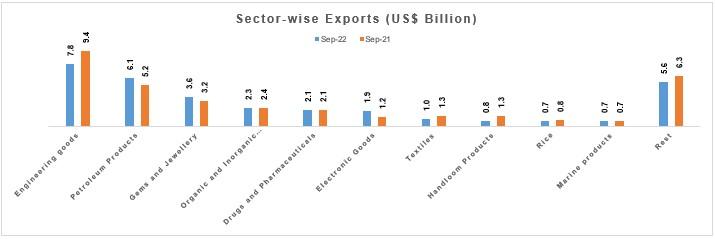
A picture containing line, screenshot, plot, diagram

Description automatically generated


Source: Ministry of Commerce and Industry

Major sector-wise exports of India include:

  • Engineering Goods: It registered exports at US$ 7.8 billion. This is primarily due to the benefits that the sector enjoys owing to the various trade agreements India has with other countries. Currently, all pumps, tools, carbides, air compressors, engines, and generators manufacturing MNC companies in India are trading at all-time highs with increased prospects of shifting production to India. It is expected to continue its upward trajectory in steel, auto components, and medical devices and India's push for Make in India.
  • Petroleum Products: Petroleum products have contributed in a major way to Indian export growth. They registered a growth of US$ 6.1 billion. Factors leading to the growth are rising crude oil prices which got aggravated by the post-pandemic world, demand spiking for oil, and the recent geopolitical tension.
  • Gems and Jewellery: Gems and jewellery made up US$ 3.6 billion of India's exports. This sector was one of the key focus areas of Indian exports and is expected to flourish more with the reduction of import duty on cut and polished diamonds and the Extension of the Emergency Credit Line Guarantee Scheme (ECLGS) for MSMEs, which make up 90% of the sector. The largest exports of gems and jewellery from India are to the United States of America (USA), United Arab Emirates (UAE) followed by the United Kingdom (UK), Germany, Singapore, the Netherlands, and many more.
  • Agriculture Exports: Agricultural exports were elated by the government’s push to meet the global demand for food amid the pandemic. India exported rice worth US$ 0.7 billion, the highest among agricultural commodities. The rise in the export of agricultural and processed food products has been largely due to the various initiatives taken by the government through the Agricultural and Processed Food Products Export Development Authority (APEDA) such as organizing B2B exhibitions in different countries, exploring new potential markets through product specific and general marketing campaigns by the active involvement of Indian Embassies.
  • Organic and Inorganic Chemicals: With strong demand from developed markets, organic and inorganic chemicals registered exports worth US$ 2.3 billion further contributing to the rise in Indian exports. The export growth of organic and inorganic chemicals has been achieved because of a surge in shipments of organic, and inorganic chemicals, agrochemicals, dyes, dye intermediates, and specialty chemicals. China is a major importer of dyes, dye intermediates, and organic chemicals from India. The USA remained the largest importer of essential oils, and inorganic chemicals while Brazil was the top importer of agrochemicals from India.
  • Electronic Goods: Electronic goods have also contributed massively to the export surge from India. The exports of electronic goods amounted to US$ 1.9 billion. The segment benefitted from several PLI schemes, such as the Scheme for Large Scale Electronics Manufacturing and the Scheme for the Promotion of Manufacturing of Electronic Components and Semiconductors (SPECS). As per the Union Budget economy survey of 2019-20 the integration of ‘Assemble in India for the World’ into ‘Make in India’, India can raise its export market share to about 3.5% by 2025 and 6% by 2030.
  • Textile and Apparel: India is among the top garment manufacturing countries in the world. India’s textile exports amounted to US$ 1 billion in September 2022. The government introduced various schemes such as the Scheme for Integrated Textile Parks (SITP), Technology Upgradation Fund Scheme (TUFS), and Mega Integrated Textile Region and Apparel (MITRA) Park scheme. In addition, Amazon India signed an MoU with the Manipur Handloom & Handicrafts Development Corporation Limited (MHHDCL). The sustainable Textiles for Sustainable Development (SusTex) project by the United Nations Climate Change will increase artisans’ engagement from Asia and especially India in the coming decade.
  • Drugs and Pharmaceuticals: India’s drugs and pharmaceuticals export amounted to US$ 2.1 billion, and it is the largest provider of generic medicines globally. Currently, the country has a share of 20% in the global supply volume and contributes to around 60% of the global vaccines. The USA, the UK, and Russia are among the largest importers from India with a share of 29%, 3%, and 2.4%, respectively during 2021-22. The Strengthening of Pharmaceutical Industry (SPI) scheme focuses on bolstering the existing infrastructure facility, with a total financial outlay of US$ 60 million (Rs. 500 crores).
  • Marine Products: India’s exports for marine products in September 2022 amounted to US$ 0.7 billion wherein India shipped 1,369,264 MT of seafood. Frozen shrimp remained the major export item in terms of quantity and value. The overall export of frozen shrimps during 2021-22 totalled up to 728,123 MT. The USA was the largest market for imported frozen shrimp, followed by China, European Union, South East Asia, Japan, and the Middle East.

Export Promotion Scheme

Foreign Trade Policy 2015-20 and other schemes provide promotional measures to boost India’s exports with the objective to offset infrastructural inefficiencies and associated costs involved to provide exporters a level playing field. Brief of these measures are as under:

1.1 Exports from India Scheme

i. Merchandise Exports from India Scheme (MEIS)

Under this scheme, exports of notified goods/ products to notified markets as listed in Appendix 3B of Handbook of Procedures, are granted freely transferable duty credit scrips on realized FOB value of exports in free foreign exchange at specified rate. Such duty credit scrips can be used for payment of basic custom duties for import of inputs or goods.

Exports of notified goods of FOB value upto Rs 5,00,000 per consignment, through courier or foreign post office using e-commerce shall be entitled for MEIS benefit. List of eligible category under MEIS if exported through using e-commerce platform is available in Appendix 3C.

MEIS has since been withdrawn w.e.f. 1st January, 2021. A new Scheme called Remission of Duties and Taxes on Exported Products (RoDTEP) has been introduced which shall refund the embedded duties suffered in export goods. 

ii. Service Exports from India Scheme (SEIS)

Service providers of notified services as per Appendix 3D are eligible for freely transferable duty credit scrip @ 5% of net foreign exchange earned.

2. Duty Exemption & Remission Schemes

These schemes enable duty free import of inputs for export production with export obligation. These scheme consists of:-

2.1 Advance Authorization Scheme

Under this scheme, duty free import of inputs are allowed, that are physically incorporated in the export product (after making normal allowance for wastage) with minimum 15% value addition. Advance Authorization (AA) is issued for inputs in relation to resultant products as per SION or on the basis of self declaration, as per procedures of FTP. AA normally have a validity period of 12 months for the purpose of making imports  and a period of 18 months for fulfillment of Export Obligation (EO) from the date of issue. AA is issued either to a manufacturer exporter or merchant exporter tied to a supporting manufacturer(s).

2.2 Advance Authorization for annual requirement

Exporters having past export performance (in at least preceding two financial years) shall be entitled for Advance Authorization for Annual requirement. This shall only be issued for items having SION.

2.3 Duty Free Import Authorization (DFIA) Scheme

DFIA is issued to allow duty free import of inputs, with a minimum value addition requirement of 20%. DFIA shall be exempted only from the payment of basic customs duty. DFIA shall be issued on post export basis for products for which SION has been notified. Separate schemes exist for gems and jewellery sector for which FTP may be referred.

2.4 Duty Drawback of Customs

The scheme is administered by Department of Revenue. Under this scheme products made out of duty paid inputs are first exported and thereafter refund of duty is claimed in two ways:

i) All Industry Rates :   As per Schedule

ii) Brand Rate          :   As per application on the basis of data/documents

2.5 Interest Equalisation Scheme (IES)

The Government announced the Interest Equalisation Scheme @ 3% per annum for Pre and Post Shipment Rupee Export Credit with effect from 1st April, 2015 for 5 years available to all exports under 416 tariff lines [at ITC (HS) code of 4 digit] and exports made by Micro, Small & Medium Enterprises (MSMEs) across all ITC(HS) codes. With effect from November 2, 2018, the rate of Interest Equalisation for MSME has been increased to 5%. The Scheme has also been extended to Merchant Exporters who will now avail the benefit @ 3% for all exports under 416 tariff lines w.e.f. January 2, 2019.

3. EPCG SCHEME

3.1 Zero duty EPCG scheme

Under this scheme import of capital goods at zero custom duty is allowed for producing quality goods and services to enhance India’s export competitiveness. Import under EPCG shall be subject to export obligation equivalent to six times of duty saved in six years. Scheme also allows indigenous sourcing of capital goods with 25% less export obligation.

3.2 Post Export EPCG Duty Credit Scrip Scheme

A Post Export EPCG Duty Credit Scrip Scheme shall be available for exporters who intend to import capital goods on full payment of applicable duty in cash.

4. EOU/EHTP/STP & BTP SCHEMES

Units undertaking to export their entire production of goods and services may be set up under this scheme for import/ procurement domestically without payment of duties. For details of the scheme and benefits available therein FTP may be required.

5. OTHER SCHEMES

5.1 Towns of Export Excellence (TEE)

Selected towns producing goods of Rs. 750 crores or more are notified as TEE on potential for growth in exports and provide financial assistance under MAI Scheme to recognized Associations.

5.2 Market Access Initiative (MAI) Scheme

Under the Scheme, financial assistance is provided for export promotion activities on focus country, focus product basis to EPCs, Industry & Trade Associations, etc.  The activities are like market studies/surveys, setting up showroom/warehouse, participation in international trade fairs, publicity campaigns, brand promotion, reimbursement of registration charges for pharmaceuticals, testing charges for engineering products abroad, etc.  

5.3 Status Holder Scheme

Upon achieving prescribed export performance, status recognition as one star Export House, two Star Export House, three star export house, four star export house and five star export house is accorded to the eligible applicants as per their export performance.  Such Status Holders are eligible for various non-fiscal privileges as prescribed in the Foreign Trade Policy.

In addition to the above schemes, facilities like 24X7 customs clearance, single window in customs, self-assessment of customs duty, prior filing facility of shipping bills etc are available to facilitate exports.

5.4 Gold Card Scheme

The Gold Card Scheme was introduced by the RBI in the year 2004. The Scheme provides for a credit limit for three years, automatic renewal of credit limit, additional 20% limit to meet sudden need of exports on account of additional orders, priority in PCFC, lower charge schedule and fee structure in respect of services provided by Banks, relaxed norms for security and collateral etc,. A Gold Card under the Scheme may be issued to all eligible exporters including those in the small and medium sectors who satisfy the pre-requisite conditions laid by individual Banks.

Apart from the above points, Government has recently unveiled new Trade Policy, link to which has been provided below:

Grene Robotics enhances anti-drone capabilities

Context: Hyderabad-based Grene Robotics has completed the successful acquisition of the C4ISRT platform from Apogee C4I LLP.

C4ISRT platform: 

  • C4ISRT stands for Command, Control, Communications, Computers, Intelligence, Surveillance, Reconnaissance, and Targeting. 
  • C4ISRT platform is typically equipped with advanced sensors and communication systems that enables it to gather and process large amounts of data from various sources, such as satellites, radar systems, and ground-based sensors.
  • This data is then analysed to provide situational awareness and decision-making support to military commanders to make informed decisions in real-time.
image 203

Indrajaal:

  • Indrajaal is India’s first indigenous drone defence dome designed and developed by Hyderabad-based technology R&D firm Grene Robotics. 
  • The drone defence dome has the capability to autonomously protect vast areas of up to 4000 sq. km per system against aerial threats by assessing and acting on aerial threats such as Unmanned Aerial Vehicles (UAVs), loitering munitions, and Low- Radar Cross Section (RCS) targets, smart bombs, rocket showers, nano and micro drones, swarm drones etc. 
  • ANTI-UAV systems will not only provide protection to defence bases but will be beneficial for linear infrastructures like international borders against advanced weaponry.

Salient features of Indrajaal:

  • Real-time situational awareness
  • Integrated and Intelligent meshed network
  • Integrated all current weapons suite and infrastructure
  • Honeycombed cell structure for seamlessly built
  • Synergic combination of 9-10 technologies
  • 24×7 persistent and autonomous monitoring, action and tracking. 

Significance:

  • By leveraging C4I’s deep-tech capabilities, Indrajaal will be able to detect and classify drones in real-time, provide unparalleled situational awareness and enable proactive air defence measures.

Dhruv Advanced Light Helicopter

Context: India's Centre for Military Airworthiness and Certification (CEMILAC) has called for a design review of a "safety-critical system" on the Dhruv advanced light helicopter, which has been involved in several accidents.

About Dhruv ALH: 

  • The Dhruv Advanced Light Helicopter (ALH) is a multi-role helicopter in the 5.5-tonne class.
  • It is designed to meet both military and civilian requirements and has been in service since 2002. The helicopter is operated by the Army, air force, navy, and coast guard. 
  • It is a twin-engine helicopter that can carry up to 14 passengers, including two pilots. It is equipped with a range of advanced avionics and sensors, including a glass cockpit, digital autopilot, and weather radar.
  • Utility: Dhruv ALH has been used in a variety of roles, including:
    • Search and rescue, medical evacuation, troop transport, and cargo transport
    • Disaster relief and humanitarian aid missions. 
  • The helicopter has been exported to several countries, including Nepal, Mauritius, and Ecuador.
  • Designed and developed by: Hindustan Aeronautics Limited.
image 202

Need for the review:

  • The regulatory body has ordered an expert panel to review the system to improve its airworthiness. The call for the design review comes on the back of the ALH’s troubling safety record (In the past five years, it has been involved in 12 accidents). 
  • The design review is critical as the Indian armed forces operate more than 300 multi-role ALHs.  

Centre for Military Airworthiness and Certification: 

  • CEMILAC is a regulatory body under the Defence Research and Development Organisation (DRDO), vested with the responsibility of Airworthiness certification of military Aircraft, Helicopter, Unmanned Aerial Systems (UAS), Aero-engines, Air launched weapons and other Airborne stores.
  • CEMILAC also works closely with the Indian aerospace industry to promote indigenous development and manufacture of military aircraft and systems.

Thalassemia

Context: The Union government have pledged to roll out a national mission to eradicate thalassemia from the country over the next 25 years, beginning with a country-wide screening exercise.

Screening can safely tackle the disease and spread awareness about getting tested before having children. 

Thalassemia:

  • Thalassemia is a group of inherited blood disorders characterised by abnormal haemoglobin production. The patient cannot make enough haemoglobin which leads to Anaemia, thus the patients require blood transfusions every two to three weeks to survive.
    • Haemoglobin is the protein in red blood cells that carries oxygen throughout the body.
  • Thalassemia results from a mutation in one or more of the genes that make haemoglobin and is passed down from one or both parents through their genes.
image 201

Types of Thalassemia:

1. Thalassemia Minor:

  • The haemoglobin genes are inherited during conception, one from the mother and one from the father.
  • People with a Thalassemia trait in one gene are known as carriers or are said to have thalassemia minor. Thalassemia minor is not a disease and they have only mild anaemia.
image 199

2. Thalassemia Major:

  • This is the most severe form of Thalassemia which occurs when a child inherits two mutated genes, one from each parent.
  • Patients Children with thalassemia major develop the symptoms of severe Anaemia within the first year of life.
image 200

Read also: Cord Blood

Prevalence in India:

  • India has the largest number of children with Thalassemia major in the world (about 1 to 1.5 lakhs). The only cure available is bone marrow transplantation (BMT), which is difficult and not affordable.

Hence, the mainstay of treatment is repeated blood transfusions, followed by regular iron chelation therapy to remove the excessive iron overload, consequent to the multiple blood transfusions.

Higher pension: EPFO offices told to work out dues of subscribers (Note about EPFO)

Context: The Employees’ Provident Fund Organisation (EPFO) has issued an internal circular directing its regional offices on the method to calculate the dues of subscribers who apply for higher Provident Fund (PF) pensions.

About EPFO:

  • The Employees' Provident Fund came into existence with the promulgation of the Employees' Provident Funds Ordinance on the 15th of November 1951.
  • It was replaced by the Employees' Provident Funds Act, of 1952.
  • The Employees' Provident Funds Bill was introduced in the Parliament as Bill Number 15 of the year 1952 as a Bill to provide for the institution of provident funds for employees in factories and other establishments.
  • The Act is now referred to as the Employees' Provident Funds & Miscellaneous Provisions Act, 1952 which extends to the whole of India.
  • The Act and Schemes framed there under are administered by a tri-partite Board known as the Central Board of Trustees, Employees' Provident Fund, consisting of representatives of Government (Both Central and State), Employers, and Employees.
  • The Central Board of Trustees administers a contributory provident fund, a pension scheme and an insurance scheme for the workforce engaged in the organized sector in India.
  • The Board is assisted by the Employees’ PF Organization (EPFO), consisting of offices at 138 locations across the country.
  • The Organization has a well-equipped training set-up where officers and employees of the Organization as well as Representatives of the Employers and Employees attend sessions for pieces of training and seminars.
  • The EPFO is under the administrative control of the Ministry of Labour and Employment, Government of India.
  • EPFO Organisation Structure (Annual Report 2019-20) The Board operates three schemes - EPF Scheme 1952, Pension Scheme 1995 (EPS) and Insurance Scheme 1976 (EDLI).
  • EPFO is one of the World's largest Social Security Organisations in terms of clientele and the volume of financial transactions undertaken.
  • At present it maintains 24.77 crore accounts (Annual Report 2019-20) pertaining to its members.

Focus on Methane emissions at COP-28

Context: Speaking at the inaugural UAE Climate Tech summit,  COP28 President Designate Sultan Ahmed Al Jaber called upon the oil and gas industry to phase out methane emissions by 2030 and align in favour of comprehensive net-zero emission plans by or before 2050.

COP28, or the 28th United Nations Climate Change conference is scheduled to be held between November 30 and December 12 in the UAE.

Methane & Climate Change

  • Methane is the second most abundant anthropogenic GHG after carbon dioxide (CO2), accounting for about 20 percent of global emissions.
  • It is emitted from a variety of anthropogenic and natural sources.
  • Anthropogenic emission sources include landfills, oil and natural gas systems, agricultural activities, coal mining, stationary and mobile combustion, wastewater treatment, and certain industrial processes.
  • Methane emissions are among the top causes of global warming and according to Paris-based International Energy Agency (IEA), fossil fuel operations generate over one-third of all methane emissions from human activity. Thus, action on methane is seen as one of the most effective measures the energy sector can take to mitigate climate change.
  • It is a hydrocarbon that is a primary component of natural gas.
Methane hydrates is a frozen methane locked inside the microscopic cages composed of water molecules. They are found in continental slopes where pressure is high and temperature is low. India’s coastal region is rich in Methane Hydrates.
Methane

Initiatives

International Methane Emissions Observatory (IMEO)

  • The International Methane Emissions Observatory (IMEO) was launched at the G20 Summit, on the eve of the COP26 UN climate conference in Glasgow.
  • It is a data-driven, action-focused initiative by the UN Environment Programme (UNEP) with support from the European Commission to catalyse dramatic reduction of methane emissions, for achieving Paris agreement goals.
  • An Eye on Methane (2021) is the report by International Methane Emissions Observatory 2021
  • IMEO will initially focus on methane emissions from the fossil fuel sector, and then expand to other major emitting sectors like agriculture and waste.
  • This will allow IMEO to engage companies and governments around the world to utilize this data to target strategic mitigation actions and support
  • science-based policy options.
  • IMEO will provide the means to prioritize actions and monitor commitments made by state actors in the Global Methane Pledge (Launched at Glasgow, COP26) – a US and EU-led effort by over thirty countries to slash methane emissions by 30 per cent by 2030. 
  • India has not signed up for the pledge.

Global Methane Initiative

  • It is an international public private partnership focused on reducing barriers to the recovery and use of methane as a valuable energy source.
  • GMI provides technical support to deploy methane to energy projects around the world that enable Partner Countries to launch methane recovery and use projects. 
  • GMI advances methane mitigation in 3 key sectors: Oil & Gas, Biogas (including agriculture, municipal solid waste, and wastewater) and Coal Mines.
  • Methane emissions from Oil & Gas Sector: Methane emissions from oil and natural gas systems result from both normal operations and system disruptions. These emissions can be cost-effectively reduced by upgrading technologies or equipment, and by improving operations.
  • Methane emissions from Biogas Sector: Biogas produced from the anaerobic digestion of organic material or emitted directly from landfills can be treated to create pipeline-quality natural gas, used as a cooking fuel, used to generate electricity, and captured on-site to provide heat and power.
  • Methane emissions from Coal Mines Sector: Removing fugitive methane gas from underground coal mines and using it in profitable and practical ways can improve worker safety, enhance mine productivity, increase revenues, and reduce greenhouse gas emissions.
  • Membership: GMI Partner Countries account for approximately 70% of global manmade methane emissions. India is a member of this organisation.

Through these efforts, GMI aims to:

a. Decreasing greenhouse gas emissions

b. Improving human health

c. Increasing worker safety

d. Improving air and water quality

e. Enhancing energy security

f. Expanding economic growth

Global Methane Assessment

  • The assessment was launched by Climate & Clean Air Coalition (CCAC) together with UNEP.

Key findings:

  • Europe has greatest potential to curb methane emissions from farming, fossil fuel operations & waste management.
  • India has greatest potential to reduce methane emissions in the waste sector.
  • China’s mitigation potential is best in coal production and livestock.
  • Africa’s mitigation potential is in livestock, followed by oil and gas.
  • Methane in the atmosphere reached record levels in 2020, which is a cause of concern as it is an extremely powerful GHG and is responsible for about 30 per cent of warming since pre-industrial times. 
  • However, carbon dioxide levels have dropped during the Covid-19 pandemic due to the lockdowns and travel restrictions.

A top-down code

Context: The central government has codified 29 labour laws into 4 labour codes but, labour legislation is under the concurrent list so the responsibility of framing the rules related to these codes lies with states but they have not framed the rules yet which is defeating the very purpose of these codes.

Labour Code (Wage Code) – 2019

  • After 73 years of independence, work is being done to provide wage security, social security and health security to 50 crore workers, covering organized and unorganized sectors.
  • The guarantee of minimum wages is available to 50 crore workers in organized and unorganized sectors.
  • Review of minimum wages every 5 years.
  • Guarantee of timely payment of wages to all workers
  • Equal remuneration to male and female workers.
  • For the first time, around 40 crore workers of the unorganized sector in the country have got this right.
  • To remove regional disparity in minimum wages the provision of floor wage has been introduced.
  • The determination of minimum wages has been made easy. It will be based on criteria such as skill level and geographical area.
  • From 28.08.2017 Payment of Wages Act has increased the wage ceiling from Rs. 18000 to Rs. 24000.

Social security code 2020

  • Through a small contribution, the benefit of free treatment is available under hospitals and dispensaries of ESIC.
  • The doors of ESIC will now be opened for the workers of all sectors and the unorganised sector workers.
  • Expansion of ESIC hospitals, dispensaries and branches up to the district level.
  • This facility is to be increased from 566 districts to all 740 districts of the country.
  • Even if a single worker is engaged in hazardous work, he would be given ESIC benefit.
  • Opportunity to join ESIC for platform and gig workers engaged in new technology.
  • Plantation workers get the benefit of ESIC.
  • Institutions working in hazardous areas are to be compulsorily registered with ESIC.

Expansion of Social Security

  • The benefit of a pension scheme (EPFO) to all workers of organized, unorganized and self-employed sectors.
  • Creation of social security fund for providing comprehensive social security to the unorganized sector.
  • The requirement of minimum service has been removed for payment of gratuity in the case of fixed-term employees.
  • Employees engaged on fixed terms get the same social security benefit as permanent employees.
  • Creating a national database of workers of the unorganized sector through registration on Portal.
  • Employers employing more than 20 workers to mandatorily report vacancies online.
  • A Universal Account Number (UAN) for ESIC, EPFO and Unorganised Sector workers.
  • Aadhaar-based Universal Account Number (UAN) to ensure seamless portability.

OSH Code (Occupational, Safety, Health and Working Conditions Code) - 2020

  • Various provisions in the OSH Code will ease the lives of the Inter-State Migrant Workers.
  •  Anomalies of the Inter-State Migrant Workers Act, of 1979 have been comprehensively addressed in the OSH Code. Earlier only workers appointed by a contractor were recognized as Inter-State Migrant Workers. However, under the new provisions of the Code, workers can be Aatmanirbhar as they can now register themselves as Inter-State Migrant Workers on the national portal. By this provision, the worker would get a legal identity which would enable them to get the benefits of all social security schemes.
  • A provision has been made for employers to provide a travelling allowance annually to an Inter-State Migrant Worker for undertaking a to-and-fro journey to his native place.
  • Providing of appointment letters to the workers has been made mandatory.
  • Mandatory, free annual health check-ups of the workers to be provided by the employers.
  • For a worker engaged in building and other construction work in one State and moving to another State, benefit from the Building and Other Construction Workers’ Cess fund will be provided.
  • Under the “One Nation - One Ration Card”, an Inter-State Migrant Worker would get a ration facility in the State he is working in and the remaining members of his family would be able to avail of the ration facility in the State where they reside.
  • Mandatory helpline facility in every State for the resolution of Inter-State Migrant Workers’ grievances.
  • A national database is to be created for the Inter-State Migrant Workers.
  • Instead of 240 days, now if a worker has worked 180 days, he shall be entitled to one-day leave for every 20 days of work done.
  • Women’s Empowerment through the Labour Codes
  • Right to women workers to work in all types of establishments.
  • Women have been given the right to work at night with their consent and it has also been ensured that the employer would make adequate arrangements to provide safety and facilities to women workers at night.
  • The Maternity Benefit Act was amended in 2017 to increase the paid Maternity leave for women workers from 12 to 26 weeks and ensure mandatory crèche facility in all establishments having 50 or more workers.

Industrial Relations (IR) Code, 2020

  • In case of job loss, a worker will get benefits under the Atal Bimit Vyakti Kalyan Yojna.
  • Under the Atal Bimit Vyakti Kalyan Yojna, a worker of the organized sector who loses his job gets financial aid from the Government. This is a type of unemployment allowance, the benefit of which is admissible to the workers covered under the ESI Scheme.
  •  At the time of retrenchment, a worker would Chapter 8 New Labour Code For New India 20 be provided 15 days’ wages for re-skilling. The wages would be credited directly into the bank account of the worker so as to enable him to learn new skills.
  • Faster justice for the workers through the Tribunal.
  • Workers’ disputes are to be resolved within a year in the Tribunal.
  • Industrial Tribunals to have 2 members to facilitate faster disposal of cases.
  • In industrial establishments, a Trade Union having 51 per cent votes shall be recognised as the sole negotiating union which can make agreements with employers.
  • In industrial establishments in which no trade union gets 51 per cent votes, a negotiating council of trade unions shall be constituted for making agreements with employer.

Fitch cuts India GDP growth forecast for this fiscal to 6%

Context: Fitch Ratings has lowered its 2023-24 GDP growth forecast for India to 6%, from 6.2%, citing headwinds from elevated inflation and interest rates along with subdued global demand, with the expansion seen quickening to 6.7% in 2024-25, as against the 6.9% projected earlier.

India's GDP Growth Projection

  • India was given default rating at ‘BBB-’ with a stable outlook. It indicates that expectations of default risk are currently low and payment capacity to meet financial commitments is considered adequate, but adverse business or economic conditions are more likely to impair this capacity.
  • It forecast headline inflation to decline, but remain near the upper end of the Reserve Bank of India’s 2%-6% target band, averaging 5.8% in FY24. 

About Fitch:

Fitch Ratings Inc. is an American credit rating agency and is one of the "Big Three credit rating agencies", the other two being Moody's and Standard & Poor's. It is one of the three nationally recognized statistical rating organizations (NRSRO) designated by the U.S. Securities and Exchange Commission in 1975. 

What Are Credit Rating Agencies?

  • Credit rating agencies (CRAs) evaluate and rate the creditworthiness of debt securities and their issuers, including companies and countries. These agencies assign credit risk ratings to such entities based on quantitative and qualitative analyses. Ratings show the likelihood of a borrower to default or repay a loan with interest.
  • Credit rating services use unique letter codes to depict the default risk and the financial stability of the debt issuer. While these ratings provide risk measures for an entity, investors get to know about its creditworthiness. Besides corporations and nations, these ratings can be for stocks, bonds, mortgage-backed securities, collateralized debt obligations, and credit default swaps.
  • The rating services assign letters to represent the risk of default and financial viability of the debt issuer, based on quantitative, qualitative, and contextual analyses.
  • Standard & Poor’s, Moody’s Investors Service, and Fitch Ratings are the 3 big credit rating agencies, with a combined market share of approximately 95%.
image 172

How Do Credit Rating Agencies Work?

  • Credit rating agencies evaluate and rate companies, nations, governments, or financial instruments. They essentially provide information about the quality of fixed-income securities and debt obligations and their issuers’ ability to repay the principal amount and interests. In short, these credit risk ratings help retail and institutional investors get an idea of the solvency of the borrower and its products. They can decide whether the security in question is worth the investment or just speculation.
image 171

What Do Credit Ratings Say?

  • Credit rating meaning differs with entities and financial instruments, though they evaluate issuers’ credit or default risks and debt obligations. For example, a company can use it to rate its debt securities, while a country can use the same to attract domestic and foreign investments. Ratings for sovereign debts indicate the country’s ability to repay its debt. Also, a sovereign credit rating facilitates access to international financial markets for the government.
  • Similarly, a bank can use it to assess the risk premium on loans. Poorly rated loans have a higher risk premium and higher interest rates. A higher credit rating enables the borrower to obtain loans at a lower interest rate. Credit ratings allow traders to trade fixed-income on the secondary market and influence their interest rates – a higher grade gets a lower interest rate.
  • Credit risk ratings indicate the likelihood of a borrower defaulting on its obligation. While low risk suggests investment, high risk implies speculation. Furthermore, these scores provide an outlook for an issuer or financial product in the future. Also, these scores aid in the development of the financial market and its regulations.

Role Of Credit Rating Agencies

  • The primary role of credit rating services is to assess the credit risks and solvency of structured debt securities and their issuers, i.e., companies and governments. Since they also act as financial intermediaries, there are multiple objectives that they fulfil, such as:
image 173

Credit rating agencies in India:

  • Currently, there are 7 leading Credit Rating Agencies (CRAs) in India, such as CRISIL, ICRA, CARE, Acuite Ratings & Research, Brickwork Ratings India Pvt. Ltd. India Ratings and Research Pvt Ltd, and Infomerics Valuation and Rating Pvt. Ltd. that are authorised by SEBI to assess credit ratings.
  • SEBI (Securities and Exchange Board of India) authorizes and regulates all Credit Rating Agencies (CRAs) in India as per SEBI Regulations, 1999 of the Securities and Exchange Board of India Act, 1992. 

What is the difference between credit rating and credit score?

  • Credit rating involves evaluating the creditworthiness of entities, usually governments and businesses, by credit rating agencies, such as CRISIL, ICRA, CARE, etc. Credit ratings are usually expressed as letter grades. 
  • Whereas, credit scores usually help determine the creditworthiness of individuals and are calculated on the basis of the credit history found in the credit report. 
  • Credit scores are computed by four major credit bureaus in India including TransUnion CIBIL, Equifax, Experian and CRIF Highmark. Credit score is a 3-digit number ranging between 300 to 900, where a score closer to 900 is generally considered to be a good score.

International trade in Indian Rupee

Context: RBI Governor Shaktikanta Das said the government and the central bank are in discussion with South Asian countries to have cross-border trade in rupee. India had already made similar agreements with Sri Lanka, Russia and Mauritius and in early discussions with UAE to trade non-oil commodities in Indian rupee.

Need for trading in local currencies:

  • Reduce transaction costs: When countries import and export goods and services, they have to make payments in a foreign currency. Since the US dollar is the world’s reserve currency, most of these transactions are settled in dollars.

E.g., If an Indian buyer enters into a transaction with a seller from Germany, the Indian buyer has to first convert his rupees into US dollars. The seller will receive those dollars, which is then converted into euro. 

Here, both the parties involved have to incur the conversion expenses and bear the risk of foreign exchange rate fluctuations.

  • Geo-political shocks: Geo-political tensions often create challenges in seamless trade between the countries.

E.g., Recent Russia-Ukraine war resulted in western sanctions on Russia which created challenges for India to trade with Russia in dollars. 

  • Reduce dependency over foreign currency: Increasing use of Indian rupee for cross-border transactions will not only reduce our dependency over foreign currency but also increases the credibility of rupee in the global market adding weight to Indian economy. 
  • Insulate from external shocks: Reducing dependence on foreign currency makes India less vulnerable to external shocks like mitigating the pain of reversal of capital flows. 

Mechanism of Rupee trade settlement:

Vostro accounts are accounts a bank holds on behalf of another foreign bank. Rupee Vostro accounts keep a foreign entity's holdings in the Indian bank, in Indian rupees. Recently RBI permitted various Indian banks to open 12 special vostro accounts for trade in rupees.

A Rupee Vostro account is used to facilitate international trade transactions in Indian rupee. When an Indian importer wants to make a payment to a foreign trader in rupees, the amount will be credited to this Vostro account, and when an Indian exporter needs to be paid for supplying goods or services, this Vostro account will be deducted, and the amount will be credited to the exporter's account. 

image 170

Challenges with Internationalisation of Indian currency:

  • Unfeasible with all the countries: Countries with whom we run trade deficit may reluctant to use this rupee settlement because the vostro accounts are left with surplus amount.  
  • Hampers independent monetary policy: 
  • Internationalisation of a currency could make simultaneous pursuit of exchange rate stability and autonomous monetary policy challenging.
  • As both residents and non-residents can buy and sell domestic currency denominated financial instruments, internationalisation can limit the ability of the RBI to control domestic money supply and influence interest rates in accordance with the requirements of domestic macroeconomic conditions.

Global financial contagion: Effective internationalisation of a currency would require taking steps towards full convertibility on the capital account, which may put at the India at the risk of global financial contagion.

Rise in RBI’s Gold Reserves

Context: The Reserve Bank of India’s (RBI) gold reserves touched 794.64 metric tonnes in fiscal year 2022-23, an increase of nearly 5% over fiscal 2022, when it held 760.42 metric tonnes of gold.

How Much Gold has RBI Purchased?

  • Between the fiscal year ended June 30, 2019 (the RBI used to follow the July-June accounting year then; this was changed to April-March starting 2020-21) and fiscal 2023, the RBI’s gold reserves swelled by 228.41 tonnes.
  • As on March 31, 2023, the country’s total foreign exchange reserves stood at $578.449 billion, and gold reserves were pegged at $45.2 billion. 
  • In value terms (USD), the share of gold in the total foreign exchange reserves increased from about 7% at the end of March 2022 to about 7.81% at the end of March 2023. It was 7.06% as of end-September 2022.

Reasons for Accumulation of Gold

  • Diversification: Gold is considered a more safe, secure, and liquid asset. It also safeguards returns amid global uncertainty and a rising inflation scenario.
  • Driving factors: Negative interest rates in the past, the weakening of the dollar and growing geopolitical uncertainty.
  • Gold offers long-term store of value and is a high performing asset during the times of crisis as this year was scarred by geopolitical uncertainty and rampant inflation.

Conclusion:

  • As the Central bank buying gold remains robust, there is little to indicate that this will change in the short term.

Lack of a drug recall law in India

Context: Despite the rise in substandard drugs, India still lacks a national law on recalling drugs. India has never witnessed domestic or foreign pharmaceutical companies recall substandard or mislabelled drugs in India.

Is there a drug recall law in India?

  • India has been mulling the creation of a mandatory recall law for substandard drugs that have failed to meet quality parameters since 1976, and yet no law exists that mandates such medicine be removed from the market to this day.
  • Consequences when substandard drugs are not recalled: People, including children, are almost certainly dying or suffering from adverse health events because substandard drugs are not swiftly removed from the market. 

Issues plaguing India’s pharmaceutical industry and the drug regulatory mechanism:

India's pharmaceutical industry has been plagued by several issues which include-

  • Weak regulatory framework: India's drug regulatory system is fragmented, with different agencies responsible for different aspects of drug regulation, such as drug approval, quality control, and pricing. This fragmentation often leads to duplication of efforts, delays, and inconsistencies in the regulatory process, making it difficult to ensure the safety and efficacy of drugs. Also, the incompetence of a regulator in one State can lead to adverse effects for patients in other states. 

E.g., Drugs ordered to be recalled by a state drug controller in one State are sometimes found to be on sale in another State. 

  • Lack of accountability: Due to lack of expertise and accountability from bureaucracy and the apathy of pharma companies, the circulation of substandard drugs in the Indian market has been the modus operandi for decades. The awareness in the public that such drugs can have dangerous consequences for consumers, has come recently when the drug failures overseas brought attention to the issue. 
  • Jurisdictional issues: Due to the presence of many regulators, it has become a challenge to enforce the law due to jurisdictional issues.
  • Lack of adequate quality control measures: Since drug manufacturing sector in India is highly fragmented, with a large number of small and medium-sized enterprises (SMEs) producing drugs. Many of these SMEs lack the resources and expertise to implement good manufacturing practices (GMP), resulting in poor quality control and the production of substandard drugs.
  • Prevalence of counterfeit drugs in the market: Counterfeit drugs are often sold at a lower price, making them attractive to consumers who cannot afford genuine drugs. However, intake of such drugs can be ineffective or even dangerous.
  • Issue of drug pricing: India has a complex system of drug pricing, with different pricing mechanisms for different categories of drugs. The lack of a transparent and rational drug pricing system often leads to high prices for essential drugs, making them unaffordable for many patients.
  • Focus on Pharma industry over public health: The government has displayed a greater interest in enabling the growth of the pharmaceutical industry than protecting public health.

Government initiatives to strengthen the regulatory framework for drug recall:

India has taken some measures to strengthen the regulatory framework for drug recall. Some of these measures include:

  • Establishment of the Central Drugs Standard Control Organization (CDSCO): In 2005, the CDSCO was established as the national regulatory body for drugs in India. The CDSCO is responsible for regulating the safety, efficacy, and quality of drugs in the country. In 2012, CDSCO proposed a set of draft recall guidelines, but it did not convert into a binding law.
  • Introduction of the Drugs and Cosmetics (Amendment) Act, 2008: The amendment act provides for the recall of drugs that are found to be substandard, spurious, or not of standard quality. The act also empowers the CDSCO to issue directions for the recall of such drugs.
  • Setting up of a Drug Alert System: The CDSCO has established a Drug Alert System to monitor adverse reactions to drugs and take necessary action to recall drugs that pose a risk to public health.
  • Strengthening of quality control measures: The CDSCO has issued guidelines on good manufacturing practices (GMP) for drugs, and drug manufacturers are required to comply with these guidelines.
  • Collaboration with international regulatory bodies: The CDSCO has signed several memoranda of understanding (MoUs) with international regulatory bodies to strengthen the regulatory framework for drugs. These MoUs provide for cooperation in areas such as information sharing, training, and capacity building.

Way Forward:

India's pharmaceutical industry and drug regulatory mechanism require a multifaceted approach that addresses the challenges, which include:

  • Strengthen regulatory enforcement: CDSCO should be strengthened to ensure that it has the resources and expertise necessary to enforce regulations effectively. This includes increasing the number of inspectors and providing them with appropriate training and equipment.
  • Centralising regulatory processes: To create an effective recall mechanism, the responsibility of recalling drugs has to be centralised, with one Central authority wielding the legal power to hold companies liable for failures to recall drugs from across the country. This would streamline the regulatory framework, simplify the drug approval process, reduce duplication and prevent issues of multiple jurisdictions in the regulatory process.
  • Formulate Public health policy: Central government needs to have a comprehensive and clear public health policy that prioritises public health over profit.
  • Improve quality control measures: The government should take measures to improve quality control measures for drugs. This includes rigorous implementation of good manufacturing practices (GMP) guidelines, providing technical support to SMEs to help them comply with GMP requirements, and strengthening the quality control infrastructure.
  • Increase transparency and accountability: The drug regulatory system needs to be more transparent and accountable to the public. This includes making information on drug approval and recall processes more readily available to the public, and ensuring that regulatory decisions are based on sound scientific evidence.
  • Strengthen international cooperation: The CDSCO should continue to collaborate with international regulatory bodies to share information and best practices and to learn from the experiences of other countries.
  • Promote innovation: There is a need to create an environment that encourages innovation in the pharmaceutical industry. This includes providing incentives for research and development, promoting collaboration between industry and academia, and supporting the development of new technologies. 

Raksha Mantri approves the posting of Women Officers of the Territorial Army along the Line of Control

Context: In a major development, the Ministry of Defence, Department of Military Affairs, has approved an amendment to existing cadre management provisions for Women Officers of the Territorial Army (TA).

About Territorial Army

  • The Territorial Army is a part of the Regular Army.
  • Its present role is to relieve the Regular Army from static duties and assist Civil Administration
  1. In dealing with natural calamities and maintenance of essential services in situations where the life of the communities is affected or the security of the Country is threatened and
  2. To provide units for the Regular Army as and when required.

Arguments in favour

Military Readiness: Allowing a mixed-gender force keeps the military strong. The all-volunteer forces are severely troubled by falling retention and recruitment rates. Widening the applicant pool for all jobs guarantees more willing recruits. Women, who choose to become active combat soldiers, are unlikely to shirk their duty by becoming pregnant after a call-up as these women have willingly joined the army.

Effectiveness: The blanket restriction for women limits the ability of commanders in theatre to pick the most capable person for the job.

Tradition: Training will be required to facilitate the integration of women into combat units. Cultures change over time and the masculine subculture can evolve too. Many previously masculine professions have been successfully opened to women over the past century like driving, managing, judging etc.

Modern warfare and public support: In the modern world of combat (Afghanistan, Iraq), all women serving in the military are exposed to “front-line risks”. Support for women serving in the armed forces has not wavered as warfare has changed, a clear sign that the necessity of women serving in combat is recognized.

Cultural Differences & Demographics: Women are more effective in some circumstances than men. Allowing women to serve doubles the talent pool for delicate and sensitive jobs that require interpersonal skills not every soldier has. Having a wider personnel base allows militaries to have the best and most diplomatic soldiers working to end the conflict quickly.

Career advancement: As combat, duty is usually regarded as necessary for promotion to senior officer positions, denying female personnel this experience ensures that very few will ever reach the highest reaches of the military and so further entrenches sexism. Women have to be given the same opportunities as men, in the army in order to have the same opportunities they have to be exposed to the same risks

Arguments in opposition

Physical Ability: While the majority of jobs in the armed forces are open equally to men and women, there are some to which women are just not physically suited. The standards of physical fitness have been set to suit men, and women attempting to reach them will over-stretch themselves.  In addition, combat units engage in activities designed to suit men’s capabilities. Women serving in integrated units will suffer higher injury rates as a result of this.

Efficiency: Some women will be able to meet the required standards, but most will not. While the integration of women into combat is possible for those qualified, the small number versus the additional logistical, regulatory and disciplinary costs associated with integration does not make it a worthwhile move.

Morale & Cohesion: Having women serving in direct combat may hamper mission effectiveness by hurting unit morale and cohesion.

Military readiness: Pregnancy can affect the deployability of a unit when the unit has a disproportionate number of women or is understaffed.

Tradition: Men, especially those likely to enlist, maintain traditional gender roles. In some situations, men may act foolishly to protect women in their combat units. Harassment and resentment of the presence of women in a hyper-masculine military subculture would likely become a problem.

Abuse by Enemy: Both male and female prisoners are at risk of torture and rape, but misogynistic societies may be more willing to abuse woman prisoners.