GS Paper 2

India and Japan Relations

CONTEXT: During the recent visit PM Kishida said that today’s Ukraine could be tomorrow’s Asia,” and indicated Japan’s concerns over China’s actions in the Senkaku Islands, South China Sea and Taiwan Straits. 

The issue of “shared responsibilities” on the rule of law between India and Japan was discussed by the two leaders during bilateral talks.

The Japanese Prime Minister went on to launch Japan’s New Plan for a Free and Open Indo-Pacific (FOIP).

The Japanese PM also highlighted the need for common perspective for international order.

The two leaders acknowledged that 2023 is a pivotal year for both India and Japan as chairs of the two major international groupings – India as the President of the G20 and Japan as the Chair of G7. Our countries have the unique opportunity of converging our priorities on issues of significance and drive through that and in the process, the global agenda. 

The two leaders spoke about the challenge that they face in the region (China) and also globally.

The two leaders further highlighted that  i.e. India and Japan and other like-minded countries can work together to address those challenges.

About India and Japan

India and Japan celebrated 70 years of friendship in 2022. Reflecting on how this relationship has developed from a Global partnership to a “special strategic and global partnership”. 

However we can see gaps in economic partnership and people-to-people connect. While the economic partnership was the pillar on which this relationship took shape, the two leaders will unquestionably direct the policymakers of both nations to scrutinize and reflect on how to enhance this pillar.

Moreover, much-touted civilizational linkages have not translated into robust people-to-people connections. 

The two leaders are hence putting forth various schemes to enable exchanges of people, namely youth, workforce, and artists, along with a stronger emphasis on tourism.

AGREEMENTS AND MOU’s IN RECENT MEETING

  1. The two leaders exchanged documents on the financing of the 4th tranche of Japanese funding for a loan of 300 billion Yen for the Mumbai-Ahmedabad High Speed Rail (MAHSR) or “Bullet Train” project. 
  2. A MoU on Japanese language education for the MEA. 
  3. Japan further plans to mobilise a total of U.S. $75 billion in public and private funds by 2030. Japanese leader also mentioned about coordinating with India for projects as a part of a “Bay of Bengal-Northeast India industrial value chain”.
  4. The two leaders also had discussions over co-innovation, co-design, co-creation in defence field and also investment collaboration, investment partnership in this space. Indian PM highlighted the openness of Indian defence sector to Japanese private companies and Japanese FDI.
  5. Ministry of Environment of Japan and Ministry of Environment, Forest and Climate Change of India, signed an Aide Memoire essentially on the Joint Crediting Mechanism (JCM) that has been under discussion for quite some time between the two countries.
  6. The two leaders announced 2023 as "India-Japan Year of Tourism”. Indian PM expressed the desire to declare the next year as the year of youth exchanges between the two countries.

Founding Pillars of India - Japan Relations

Strategic Collaboration between India and Japan 

  • Convergence on free, open and inclusive Indo-Pacific. 
  • Defence and security and in the region. – Quad, AUKUS, MALABAR. 
  • India and Japan signed a Reciprocal Provision of Supplies and Services Agreement (RPSS). 
  • The inaugural 2+2 ministerial meeting was held in November 2019. 
  • Act East Forum: A decision was taken in the 2017 Summit to establish the India-Japan Act East Forum. The objective is to coordinate developmental projects in North-East India in areas of connectivity, forest management, disaster risk reduction and capacity building. 
  • Northeast development - Upgradation of highways in Meghalaya, Tripura and Mizoram are underway. 20 km-long bridge over the Brahmaputra River between Assam and Meghalaya. 
  • Supply Chain Resilience Initiative (SCRI) – The Trade and Economy Ministers of India, Japan and Australia launched the (SCRI) on 27 April 2021. 

Economic Collaboration 

  • Investment Promotion Partnership 2014: Both have achieved the target of 3.5 trillion Japanese Yen in public and private investments in India. 
  • Industrial collaboration: 1,455 Japanese companies in India. Eleven Japan Industrial Townships (JIT). 
  • FDI: Japan is 5th largest source of FDI, largest supplier of ODA. 
  • Infrastructure projects are underway through Japanese assistance including Mumbai-Ahmedabad High Speed Rail, Dedicated Freight Corridor, metro projects, DMIC etc. 
  • Digital Partnership 2018 Indian start-ups have raised more than USD 10 billion from Japanese VCs. India and Japan have also launched a private sector driven fund-of-funds to invest in technology start-ups in India which has raised USD 100 million. 
  • Cooperation in ICT, in areas such as 5G, under-sea cables, telecom and network security. 
  • Movement of skilled workers: Japan’s population has peaked out its and working age population is reducing. In this respect, India with its surplus labour force can provide workers for Japan’s needs. India and Japan signed MoU on Specified Skilled Workers to promote movement of skilled workers and Japanese language requirement from India to Japan for employment on a contractual basis. `

Three main challenges which have constrained the Japan-India economic partnership:

  • India’s complex regulations, red tape, ad hoc nature of state-level interventions.
  • Japanese companies face considerable logistics challenges and non-availability of uninterrupted power supply constrains their manufacturing plans in India.
  • While India can emerge as a large market for Japanese infrastructure system exports (one of the core components of Abenomics), there have been incredible delays in the commencement of the projects. While there is the shining example of the Delhi Metro Rail, the delays with DMIC, CBIC are disappointing.

Collaboration in the Indo – Pacific 

  • Collaboration in QUAD, SRI, MALABR Naval exercise with US and other like-minded countries in the Indo–Pacific. 
  • Countering the Chinese assertion – Along the LAC, South China Sea and East China Sea. 
  • Japan's Open Indo-Pacific (FOIP)’ Strategy and India's ‘Act East’ Policy converge in action in the northeast of India—a bridge between South and Southeast Asia. Ex – Act EAST Forum. 
  • Collaboration through infrastructure development in third countries (in the Indo- Pacific) such as Sri Lanka, Myanmar and Bangladesh. 
  • Asia Africa Growth Corridor (AAGC)—a collaborative effort to soft-balance China’s Belt and Road Initiative (BRI) project. 

Collaboration on Global Issues 

  • Both believe in upholding freedom of navigation and reinforcing rules-based international order. 
  • Japan supported a waiver of Nuclear Suppliers Group’s (NSG) embargo on nuclear trade with India and backed its application for membership of group. 
  • Joint military exercises have contributed to the image of their rising regional power. JIMEX, MALABAR etc. 
  • Both works closely on global issues such as proliferation of Weapons of Mass Destruction (WMDs), terrorism, space and cyber security, and environment (e.g., the International Solar Alliance). 
  • Permanent membership of the UNSC – Both are members of G4 club besides Brazil and Germany. 

Differences between two countries

  • Neither of the two countries want to downgrade its own relations with China and neither is too eager to open alliance against China
  • Though two main political parties have positive disposition towards Japan their lies have shown negative attitude towards Japan due to its proximity with USA.
  • Japanese foreign policy is pre-eminence of Japanese career bureaucrats in foreign ministry that makes radical changes In policy difficult to accomplish
  • Weak political leadership and vertically divided administration as well as fragmented domestic consensus will continue to adversely affect Japan’s foreign policy
  • The trade and security bureaucratic establishment continue to have a rather negative opinion of India
  • Integration b/w Indian and Japanese economies remains shallow, in services sector both the countries have different demands from each other for opening up. For Japan these are maritime ,insurance, civil aviation and banking while for India these include IT , BIO TECH and Medical
  • Infrastructure inadequacy, a complicated legal and taxation system and insufficient regulation for interstate-transaction 

Conclusion

Thus there is a need to enhance the relationship between the two countries in order that India-Japan relations are elevated to a new dimension.

As the Ex Japanese PM  SHINZO ABE talked about a ‘broader Asia’ wherein he talked about advancing Japan’s national interest by strengthening its ties with India and in the next decade Japan-India relations to overtake Japan-US and Japan-China ties.

Russia China Nexus & Implications for India

Mr. Xi “will pay a state visit to Russia from March 20 to 22 at the invitation of Russian Presi­dent Vladimir Putin,

China “always believes pol­itical dialogue is the only way to resolve conflicts and disputes”

Beijing, earlier on the one ­year anniversary of Russia’s invasion, re­ leased a position paper that called on both sides to reach “a comprehensive ceasefire”. The paper reflected Beijing’s approach of, on the one hand, saying it supported the “sove­reignty” of all countries, while on the other, criticis­ing the West, which has questioned Beijing’s cre­dentials as a mediator, cit­ing its close “no limits” re­lationship with Russia.

Beijing’s recent hosting of landmark talks between Saudi Arabia and Iran has turned the spotlight on its aspirations to emerge as a key player in the Ukraine crisis. Over the past year, China hasn’t condemned Russia for its invasion. It has called for peace, but at the same time justified Russian security concerns with regard to the West and NATO.

Historical evolution of ties

The relationship between Russia and China can be described as multi-layered and complex with a side of strong geo-political alignment against a unipolar west dominated world order and other side being disagreements over the junior partner status for Russia, especially in the region of Central Asia which Russia sees as its backyard and is important for China to fuel its economic growth and expand the influence in middle east.

The relationship between the erstwhile USSR and China was marked with mistrust, hostility and different ideological affinity during the cold war phase . Though USSR and China both had communist regime and mutually collaborated in the initial years wherein USSR provided the necessary initial support to China but things started to change after China gradually opened its economy under Deng Xiaoping and border confrontations emerged between the two neighbouring nations.

The relationship between the two countries changed when Mikhail Gorbachev came to power and paid a state visit to China in 1989.

Along with that the disintegration of USSR, with the much weaker Russia was now looking for new partners also paved the way for cooperation.

Timeline

  • The two countries demarcated the land borders in 1991 and later the two countries also resolved the dispute over territories of ABAGAITU islet, BOLSHOY island and in 2005 over the disputed Vladivostok region.
  • In 1992, the two countries declared that they were pursuing a "constructive partnership"; in 1996, they progressed toward a "strategic partnership".
  • The two countries signed the Treaty of Good-Neighbourliness and friendly cooperation in 2001, which had mutual respect for sovereignty and territorial integrity, mutual non-aggression and non-interference each other’s internal affairs as the broad guidelines

Present Status

China-Russia relationship today are defined by a growing ideological affinity to rewrite the global order and a shared opposition to the United States on the global stage begins to come into focus.

China and Russia’s relationship had transformed in the 14 years as both Moscow and Beijing had accumulated  grievances against the West and China’s new ambition to replace the US as Asia’s dominant power have brought the countries much closer now.

  • The two countries signed a partnership (BEJING DECLARATION) “without limits” and with no “forbidden areas” in 2022.
  • It also  offered a blueprint for further political, economic, and military cooperation while showcasing a common front against the west.
  • The Beijing declaration laid out a solid basis for jointly confronting the West and this Sino-Russian alliance added to Moscow’s confidence in risking a confrontation with the West in Europe.

Cooperation

  • The main form of cooperation is the  economic relations between Russia and China is trade. From 2003 until 2013, mutual trade increased 7.7 times; in 2014 the scale of bilateral operations increased even more. The aggravation of relations between Russia and Western countries contributed to the expansion of economic ties with China.
  • The two countries entered into $400bn gas deal to supply 38 billion cubic meters of gas annually to China for next 30 years
  • The two countries again signed an agreement in 2022 for Power of Siberia 2
  • The trade between the two countries have almost tripled from the levels of 2016 and China has now emerged as the largest trading partner for Russia.
  • The countries are also in advance stages of formally linking Chinese belt and road Initiative and Russia’s Eurasian Economic Union.
  • Russia has reaffirmed its support to One-China principle and opposed any sort of independence for  Taiwan. China has also backed Russia’s stand on expansion of western military alliance in Europe.
  • Russia sold advanced fighter aircraft and missile systems to the Chinese (which includes advanced weapons like the S-400 missile-defence system and Su-35 fighter jets)
  • China has continued buying discounted Russian energy and aiming to make transactions in rubbles or Chinese renminbi owing to western sanctions post Russia-Ukraine war.
  • Many Russian regions have set new trade records with neighbouring Chinese provinces, a dependence that looks set to grow in the future.

Difference Between Russia & China

  • There is no-formal security alliance between China and Russia and the ideological affinity is also transactional
  • Russia’s position has further weakened after Ukraine war and its economy is one tenth the size of Chinese economy, thus compromising its position as equal partners.
  • China has still not ratified Crimea’s accession to Russia and further Russia wants to regain its lost glory of USSR days and will not willing to subscribe to junior partner status.
  • China is the EU’s largest trading partner and will not compromise on its economic interest and similarly it goes for Russia, wherein its trade with Europe is much more rewardable.

The Ukraine war has further complicated the relationship between China and Russia

  • Ukraine forms a critical part of Chinese BRI jig-saw and thus will not compromise its larger geo-economic interest in the region.
  • Russia’s  victory in Europe would have had a dramatic impact on Asia too. It would have reinforced the sentiment that America is in terminal decline, weakened US alliances in Asia, and boosted China’s ambition to radically reshape its periphery.
  • It has facilitated the resurrection of Western unity under American leadership.
  • War triggered the fear of Chinese territorial expansionism in Asia. This has led to the strengthening of US bilateral alliances with Australia and Japan.
  • Berlin and Tokyo are also now committed to raising their defence spending to cope with the security challenges from Moscow and Beijing.
  • Chinese firms aren't too excited about stepping up business with Russia as they fear that secondary sanctions could be applied, and Chinese firms don't want to take risks.

However China remains committed to Russia as a strategic partner, Russia may have proved itself less valuable, but [Beijing] continues to see the United States as a strategic competitor and will want to have Russia on its side.

Russia more dependent on China -- both politically and economically -- than ever before, and Putin’s willingness to openly challenge the United States still holds great appeal for Beijing as it continues to rise on the global stage.

Impact on India

  • The Sino-Russian alliance puts India in a terrible predicament: China can ramp up, at will, the military pressure on the disputed border with India and Delhi  depends on Russian military supplies which in turn is a junior partner of China.
  • The Russian partnership was long seen as the key to India’s “strategic autonomy”, Delhi’s arms dependence on Moscow is now the biggest constraint on India’s freedom of action.
  • Russia also opposes QUAD and align itself with Chinese claim, of Quad being aimed at containing China by calling Quad as ASIAN NATO
  • Russia is also critical of term INDO-PACIFIC and believes it as step back towards cold war mentality, a way contain Russia and China.

India’s alliance with the US and its allies to restore the regional balance of power and new Sino-Russian alliance  has further complicated the relationship.

‘herSTART’

What is herSTART?

It is a platform to encourage women entrepreneurs.

 Purpose:

  • e-certificate to all participants
  • Mentorship and guidance and networking support
  • Up to 2 years of incubation support at GUSEC
  • Access to government grants (a monthly allowance of ₹20,000 for up to one year for women-led Startups) and funds
  • Dedicated co-working space for women
  • Up to $1000k in cloud credits
  • Single window startup support
  • Technology Resources

Launched by: Government of India

Maharashtra, U.P. among  7 States to get textile parks

Centre has selected sites to set up new textile parks, a year and a half after the PM Mega Integrated Textile Regions and Apparel (PM MITRA) scheme was announced.

More about News:

The Indian government has selected sites in seven states to establish new textile parks under the PM Mega Integrated Textile Regions and Apparel scheme. The parks will offer state-of-the-art infrastructure for the textile sector and generate investment and jobs. The initiative will be a model of the government's 'Make in India' and 'Make for the World' policies, and is expected to attract INR70,000 crore ($9.3bn) of investment and provide jobs for 20 lakh (2 million) people. The parks will offer a complete textiles value chain, from spinning to garment manufacturing, all in one location. To provide extra benefits to the master developer and investor units, the facilitation of convergence with other Government of India schemes will also be ensured.

About PM MITRA Scheme:

  • PM MITRA (Mega Integrated Textile Region and Apparel) Scheme was launched in 2021 by Ministry of Textiles to strengthen the Indian textile industry with a total outlay of ₹4,445 crore for five years.
  • The aim is to develop integrated large scale and modern industrial infrastructure facility for entire value-chain of the textile industry.
  • It is inspired by 5F Vision i.e. Farm to fibre; fibre to factory; factory to fashion; fashion to foreign.
  • Scope: Setup 7 (PM MITRA) Parks in Greenfield/Brownfield sites in partnership with the willing State Governments.
  • Incentives to MITRA Parks:
  • For a Greenfield PM MITRA park, Development Capital Support will be 30% of the Project Cost, with a cap of ₹500 Cr.
  • For Brownfield sites, Development Capital Support @30% of project cost of balance infrastructure with a cap of Rs. 200 Crore.
  • A Competitive Incentive Support (CIS) up to ₹300 crore per park to the units in PM MITRA Park shall also be provided to incentivise speedy implementation.
  • PM MITRA park will be developed by a Special Purpose Vehicle which will be owned by State Government and Government of India in a Public Private Partnership (PPP) Mode. SPV will focus on expanding the PM MITRA Park, Skill Development of workers and other Welfare measures.

Significance of PM MITRA Scheme:

  • It will enhance the competitiveness of the textiles industry, by helping it in achieving economies of scale and will create huge job opportunities for millions of people and it will help Indian companies to emerge as Global Champions.
  • It will further help in reducing the logistics cost by developing large scale integrated value chain.
  • World-class industrial infrastructure would attract cutting age technology and boost FDI and local investment in the textiles sector.
  • It is envisaged to help India in achieving the United Nations Sustainable Development Goal 9 (“Build resilient infrastructure, promote sustainable industrialization and foster innovation”).

The PM MITRA will serve as a unique model to foster collaboration between the Central and State governments to enhance investment, encourage innovation, generate employment prospects, and ultimately establish India as a global hub for textile manufacturing and exports.

Pennaiyar River water dispute between Tamil Nadu and Karnataka

The time limit fixed by the Supreme Court to constitute an Inter-state river water dispute tribunal for the dispute over Pennaiyar River has expired. The settlement could not be achieved through talks.

Context

  • The Supreme Court's deadline for setting up a tribunal to hear the Inter-State River water dispute over the Pennaiyar River has passed. Negotiations were unsuccessful in reaching a settlement.
  • Tamil Nadu filed a lawsuit in 2018 against Karnataka's construction of check dams on the river.
  • The Karnataka government is intending to build a dam on the Markandeya River, which is the major tributary of Pennaiyar River.
  • Tamil Nadu has thus called for the creation of an Inter-State River Dispute Tribunal.

About Pennaiyar/ Ponnaiyar River

  • Pennaiyar River is also known as Thenpannai.
  • Origin: Originates on the eastern slope of Nandidurg Mountain which is located in the Chennakaseva Hills of Karnataka and then it flows through Karnataka to enter Tamil Nadu to finally enter the Bay of Bengal.
  • As per the Central Water Commission’s Basin Report, Pennaiyar Basin is the second largest interstate East flowing river basin among the 12 basins lying between Pennar and Cauvery basins.
  • 77% drainage basin of the river lies in Tamil Nadu.
  • Bounded By: Basin of the river is bounded on the North-West and South by various ranges of the Eastern Ghats like the Velikonda Range, the Nagari hills, the Javadu hills, the Shevaroy hills, the Chitteri hills and the Kalrayan hills.
  • Rocks found in the river Basin:
  • Archaean rocks- Pyroxene granulites, Quartzite, Ferruginous Quartzite, Amphibolites, Gneiss and Hornblende biotite gneiss with younger intrusive of Pegmatite and Dolerite in the central and western parts.
  • Cretaceous formations- argillaceous, calcareous sandstone with clay and limestone.
  • Tertiary formation- sandstones and the formation of river alluvium and coastal alluvium.
  • Soil types found in its basin: Inceptisols, Alfisols, Entisols and Vertisols.
  • Pennaiyar river basin lies within the tropical monsoon zone: 1) Monsoon period- June to December and 2) Non-monsoon period- from January to May.
  • Some tributaries of the river:  Markandanadhi, Kambainallur, Pambar, Vaniyar, Kallar, Valayar Odai, Pambanar, Aliyar, Musukundanadhi and Thurinjalar.

Concerns of Tamil Nadu

  • No exclusive ownership: The flowing water from an Inter-State River is a national asset. Tamil Nadu informed the Supreme Court that Karnataka had no right to exclusively decide on how to use the Pennaiyar's waters.
  • Karnataka moved forward with the project in a sou-motu manner without disclosing the specifics of its new schemes or projects or obtaining the lower riparian state's consent, which constitutes an infringement on the rights of inhabitants. Any constructions by Karnataka will block natural flows to downstream.
  • A river also contains its tributaries and streams: The 1892 agreement governs and controls the Markandeyanadhi, which has catchment areas in both Tamil Nadu and Karnataka.
  • Inter-State Water Disputes Act Violation:Building reservoirs in one of the tributaries of the Pennaiyar River is a breach of the Act. 

Arguments by Karnataka:

  • Karnataka has questioned the maintainability of the suit as well as Tamil Nadu's application. At a cost of Rs 240 crores, Karnataka has been granted permission to construct the dam over the Markandeya River in order to hold 500 million cubic metres of water.
  • It argued that since 75–80% of the project had already been finished, it should be permitted to finish the remaining 20%. The Karnataka government argued that neither the conditions of the 1892 nor 1933 accords had been broken.
    • According to the 1933 agreement, Tamil Nadu does not need to provide its permission before building a dam to supply drinking water.
    • If there would be no irrigation under the agreement of 1892, the Madras Government's approval will not be necessary for the building of any anicut.
  • According to the Karnataka Government, Tamil Nadu makes up 75% of the river basin's catchment area, hence the dam built over the Markandeya River won't have much impact on the lower riparian State-Tamil Nadu.
  • Since drinking water is given the greatest priority under the National Water Policy of 2002, the Karnataka government argued that it should be permitted to proceed with the project.

Inter State River Water Dispute Act

Constitutional Provisions on adjudicating river water disputes

  • Article 262 of Constitution provides for adjudication of inter-state water disputes. It makes two provisions:
  • Parliament may by law provide for the adjudication of any dispute with respect to the use, distribution and control of waters of any inter-state river.
  • Parliament may also provide that neither the Supreme Court nor any other court is to exercise jurisdiction in respect of any such disputes.

Water under constitution

  • Water is included in Entry 17 of State List under 7thSchedule. It can be subject to Centre’s arbitration if, and only if, it involves a clear case of conflict or dispute as mentioned under Entry 56 of Union List. 
  • Entry 56 of Union List relates to regulation and development of Inter-state rivers and river valleys to the extent to which such regulation and development under control of the Union is declared by Parliament by law.
  • Based on Article 262, Parliament has enacted Inter-State River Water Disputes Act (1956) & River Boards Act (1956).

Salient Features

  • Interstate River Water Disputes Act, 1956 to resolve water dispute through (adjudication by the Tribunal) that would arise in use, control and distribution of an interstate river or river valley. The Award of the tribunal is final and binding after its publication in the official gazette of central government with having same force as the order or decree of the Supreme Court.
  • Constitution of Tribunal: When any request under section 3 is received from any State Government in respect of any water dispute and the Central Government is of opinion that the water dispute cannot be settled by negotiations, the Central Government shall, within a period not exceeding one year from the date of receipt of such request, by notification in the Official Gazette, constitute a Water Disputes Tribunal for the adjudication of the water dispute
  • Scheme based on Tribunal’s Decisions: Central Government may by notification in Official Gazette, frame a scheme to give effect to decision of Tribunal.

Current River Water Dispute

  • Mahadayi river- Goa, Maharashtra and Karnataka.
  • Mahanadi river- Odisha and Chhattisgarh
  • Vansadhara Water dispute- Andhra Pradesh and Odisha.
  • Krishna Water Disputes- Telangana, Karnataka and Andhra Pradesh.
  • Sutlej-Yamuna Link Canal Project- Haryana and Punjab

Related PYQ:

Gandikota canyon of South India was created by which one of the following rivers?
  • A Cauvery
  • B Manjira
  • C Pennar
  • D Tungabhadra

Show Answer
The correct answer is C.

Calcutta HC Sets Aside Reappointment Of Vice-Chancellors

In the case of Anupam Bera v State of West Bengal, Division Bench of Calcutta High Court has set aside the West Bengal Education Department’s decision to appoint or re-appoint Vice-Chancellors from 24 state universities based on the amendments made in the West Bengal Universities Act in 2012 and 2014. The High Court held that the appointments made were “unsustainable and without the authority of law. Let us understand the laws pertaining to appointment of Vice-Chancellors by the Governor, whether Governor’s power of appointing Vice-Chancellors are discretionary power and also important recommendations of Sarkaria and Punchhi Commission’s Report.

PIL Filed by College Teachers

  • Public Interest Litigation (PIL) was filed by a forum of college teachers alleging that appointments were made in violation of University Grants Commission Regulations 2018 and the appointment were not approved by the then Governor of West Bengal who is also the Chancellor of State Universities according to the State University legislations.
  • The controversy regarding appointment of Vice-Chancellors are not new and have also been witnessed in the state of Kerala and Tamil Nadu.    
  • It was because of the constrained relation between Governor and Chief Minister in West- Bengal, the government earlier decided to make its Chief Minister the chancellor of its state-run universities by amending the State Universities Act.

Decision of the Calcutta High Court

  • Appointment Made Without Governor’s Approval - The Court further held that the appointments were made without the approval of the Governor who is the ex-officio Chancellor of the State-aided universities as per the State Universities Act of West Bengal. The appointments were done during the regime of former West Bengal Governor Jagdeep Dhankhar who had not given his approval to the order of the state higher education department for appointment of Vice-Chancellors. 
  • Power Cannot be Usurped by State - Once the power to reappoint or extend the tenure is vested with the Chancellor (who is the Governor), it cannot be usurped by the State. And if the state government extends the tenure of VCs, it has to show the laws under which it is doing so.
  • The provisions of UGC Regulations, 2018 will prevail over the conflicting provisions of the concerned State Universities Act, relating to appointment of Vice-Chancellor. Some of the Vice-Chancellors did not fulfill the minimum eligibility criteria of 10 years’ experience as professor in the university or 10 years’ experience in a reputed research and/or academic administrative organisation, as prescribed in the UGC regulation.
  • Search Committee not formed as per UGC Regulations 2018 - Search Committee formed by the state government for selection of Vice Chancellors of State/Private Universities did not have one member nominated by the Chairman of University Grants Commission. This violated the UGC Regulations of 2018.
  • Directions to State - Amendments made in the West Bengal Universities Act in 2012 and 2014 to the extent they are repugnant to the UGC Regulations, 2018 relating to appointment of Vice-Chancellor cannot be sustained and the State is directed to consider making suitable amendments in the concerned Acts to bring them in conformity with the UGC Regulations, 2018 preferably within a period of six months.   

  University Grants Commission has been constituted under The University Grants Commission Act, 1956. The UGC has the unique distinction of being the only grant-giving agency in the country which has been vested with two responsibilities: that of providing funds and that of coordination, determination and maintenance of standards in institutions of higher education.   UGC Mandate includes: Promoting and coordinating university education. Determining and maintaining standards of teaching, examination and research in universities. Framing regulations on minimum standards of education. Monitoring developments in the field of collegiate and university education; disbursing grants to the universities and colleges. Serving as a vital link between the Union and state governments and institutions of higher learning. Advising the Central and State governments on the measures necessary for improvement of university education.

State Universities Act

  • Constitution of India is silent on the role of Governor as Chancellors of State Universities.
  • State Universities Act passed by respective state governments generally appoints Governor as the Chancellor of state universities by virtue of Governor’s office.
  • For example, Uttar Pradesh State Universities Act, 1973 or West Bengal State Universities Act, 2007 appoints Governor as the Chancellors of all state universities.
  • Thus, Chancellors hold statutory powers.

The Chancellor, by virtue of his office is a Head of the University and vested with the following powers:

  • Appoints the Vice-Chancellors.
  • Presides over the Convocation of the State Universities.
  • Appoints nominees on various bodies like Senate, Syndicate, Board of Management, Selection Committee or Academic Council of the State Universities. 
  • Grant leave or institute disciplinary action and award penalties.
  • Power to hear representation of the employees and students.
  • Power to take final decisions on election disputes with regard to the representation in different bodies of the universities and managing committees of its colleges.
  • Power to nominate experts in the appointment of teachers of various categories in the  university.
  • Convenes review meetings of Vice-Chancellors and concerned ministries.

Reasons to Replace Governor as Chancellor of all State Universities

  • Governor while acting as Chancellor of State Universities takes decision without the aid and advise of Council of Minister. This discretionary based decision has become one of the major reasons of dispute.
  • Continuous disputes on the appointment of Vice-Chancellors of state universities.
  • Such disputes have resulted in strained relations between the appointed Governor and elected Chief Minister.
  • The dispute has politicized the appointment of vice-chancellors across state universities.

Concern Expressed by Sarkaria Commission’s Report

  • State University Acts generally provide that the Governor by virtue of his office, shall be the Chancellor or head of the University concerned and endowed with various powers such as appointment of vice-Chancellor.
  • The question is whether the Governor's functions as Chancellor of a University fall within the purview of Article 163(1).
  • This would imply that a Governor is bound to act on the aid and advice of his Council of Ministers in the discharge of his functions as Chancellor except in so far as he is required by the statute to exercise any of the functions in his discretion.
  • There have been instances where, in selecting Vice-Chancellors, Governors as Chancellors have acted in their discretion, over-ruling the advice of the Council of Ministers.
  • First Instance -The question first arose when the Governor of Bombay had to nominate members of the Senate of the University of Poona in consultation with the Vice-Chancellor. The Attorney-General for India reportedly held that, as Chancellor, the Governor was not bound to act on the aid and advice of his Ministers. The position was later accepted by Pandit G.B. Pant as Chief Minister of Uttar Pradesh when a question arose about the role of the Governor as Chancellor of Universities in that States.
  • Different Views of State Governments –According to one, Chancellor of a University (the Governor) is not bound to accept the advice of his Ministry. Yet another State Government has sought to make a distinction between the statutory functions of the Governor as Chancellor which can be challenged in a court of law, while the action taken by him in his capacity as Governor, which cannot be so challenged.
  • First ARC’s View -In its report on “State Administration” First ARC recommended that the functions assigned to a Governor by statute (e.g. those of Chancellor of the University) should be exercised by him in his discretion. The Governor may consult the Chief Minister if he so wishes, but he should not be bound by the latter's advice. The Commission surmised that the idea underlying the assignment of certain functions to the Governors by statute was to insulate them from political influence.

CONSTITUTIONAL PROVISIONS Article 154 - Executive power of State—(1) The executive power of the State shall be vested in the Governor and shall be exercised by him either directly or through officers subordinate to him in accordance with this Constitution.   Article163 - Council of Ministers to aid and advise Governor—(1) There shall be a Council of Ministers with the Chief Minister at the head to aid and advise the Governor in the exercise of his functions, except in so far as he is by or under this Constitution required to exercise his functions or any of them in his discretion.   Article 361 - Protection of President and Governors and Rajpramukhs—(1) The President, or the Governor or Rajpramukh of a State, shall not be answerable to any court for the exercise and performance of the powers and duties of his office or for any act done or purporting to be done by him in the exercise and performance of those powers and duties.

Reasons for Sarkaria Commission’s Recommendations:

The Commission bifurcated Governor’s Role, Powers & Duties into two categories:

  1. Powers & Functions conferred on the Governor in his capacity as Governor constitute one such category. Such functions pertain to the office of the Governor, as provided for in Article 154(1) and are to be exercised by him on ministerial advice in accordance with Article 163(1). Further, by virtue of Article 361(1), the Governor enjoys personal immunity from answerability to any court for the exercise by him of such functions.
  2. The other category of functions are those which a statute may confer on the Governor, not in his capacity as Governor but in a different capacity such as, for instance, the Chancellor of a University. Here, the Governor functions in pursuance of a statute in relation to the affairs of the University—not as Governor but as Chancellor, (irrespective of the fact that he holds the office in the University in an ex-officio capacity). Even though the governor is the chancellor by virtue of his office and would cease to be the Chancellor on ceasing to be Governor, it does not necessarily follow that the functions assigned to him as Chancellor of the University are to be performed by him in his capacity as the Governor. It has been held that the immunity given to the Governor, under Article 361(1) does not extend to the exercise of powers and duties falling under this category.

  • The statutory functions of the Chancellor do not fall within the purview of Article 154(1) and cannot be regarded as 'business of the Government of the State' under Article 166(3), the reason being that the office of Chancellor is distinct from that of the Governor.
  • The office of Chancellor, even though held by the Governor under a statute in an ex-officio capacity cannot be equated with the state. The former, being an officer of the University, is not obliged to seek the advice of the State Government in the matter of exercise of his functions such as the appointment of Vice-Chancellor under Article 163(1).The same view has been taken by the Andhra Pradesh High Court in M. Kiran Babu Vs. Government of Andhra Pradesh.
  • Governor as Chancellor must act based on the state law -The Governor, in his capacity as Chancellor of a University, may possibly be required by the University's statute (e.g. the Calcutta and the Burdwan University Acts) to consult a Minister mentioned in such statute on specified matters. In such cases, the Governor may be well advised to consult the Minister on other important matters also. In either case, there is no legal obligation for him to necessarily act on any advice received by him.

Punchhi Commission’s View

  • The Governor should not be burdened with positions and powers which are not envisaged by the Constitution and which may expose the office to controversies or public criticism.
  • This will allow the Governor to discharge the Constitutional obligations fairly and impartially.
  • Conferring statutory powers on the Governor by State Legislatures have that potential and should be avoided.
  • Making the Governor the Chancellor of the Universities and thereby conferring powers on him which may have had some relevance historically, has ceased with change of times and circumstances.
  • The Council of Ministers will naturally be interested in regulating University education and there is no need to perpetuate a situation where there would be a clash of functions and powers.
  • The Commission recommended that the Governor should not be assigned functions casually under any Statute and his role should be confined to the Constitutional provisions only.

Reaper drone down in Black Sea

The Biden administration released a video  of a Russian fighter jet dumping fuel on a US Airforce surveillance drone as the US sought to hold Russia responsible for the collision that led to the drone’s crash into the Black Sea without escalating already fraught tensions with the Kremlin.

What is the MQ-9 Reaper?

The MQ-9 Reaper is a large unmanned aircraft manufactured by military contractor, General Atomics. It is remotely operated by a two-person team, consisting of a pilot and an aircrew member who operates sensors and guides weapons.

The primary use is as “an intelligence-collection asset”, while also highlighting its “unique capability to perform” precision strikes against “high-value and time-sensitive targets”

Which countries use Reaper drones?

The US is by far the largest purchaser of Reaper drones. UK has accelerated its use of Reaper drones over the last decade.

France, Italy, Spain, India, Japan and the Netherlands all also operate Reaper drones.

Productivity of Parliament

Why is productivity of the parliament important?

The Parliament of India is the supreme legislative body in the country and is responsible for enacting laws and overseeing the functioning of the government. The roles of Parliament in India include:

  • Law making: The primary function of Parliament is to make laws. Bills are introduced in either house of Parliament, debated and discussed, and finally passed as Acts of Parliament.
  • Scrutiny of Government: Parliament has the power to hold the government accountable by asking questions, seeking clarifications, and conducting debates on government policies and actions.
  • Budgetary Control: Parliament has the power to approve or reject the government's budget proposals and to scrutinize government spending.
  • Oversight of Executive: Parliament has the power to investigate and examine the functioning of the executive branch of the government and its various agencies.
  • Electoral Functions: Parliament has the power to decide on the qualifications and disqualifications of members, conduct elections to fill vacancies, and determine the electoral boundaries.
  • Constitutional Functions: Parliament has the power to amend the Constitution, approve the proclamation of emergency, and to impeach the President, Vice-President, and other high officials.

Overall, the roles of Parliament in India are essential for maintaining the democratic system of the country and ensuring that the government is accountable to the people.

How do we know that the productivity is declining?

There are a few possible indicators that have been used to suggest that parliamentary productivity is declining in India. Here are a few examples:

  • Number of bills passed: According to data from the PRS Legislative Research, the number of bills passed by the Lok Sabha (the lower house of India's parliament) has declined in recent years. In the 16th Lok Sabha (2014-2019), a total of 205 bills were passed, compared to 248 bills in the previous Lok Sabha (2009-2014). In the current 17th Lok Sabha (2019-present), only 17 bills have been passed so far.
  • Question Hour: One important aspect of parliamentary productivity is the ability of MPs to ask questions of the government during Question Hour. However, Question Hour has been disrupted in recent years, with MPs often protesting and preventing the House from functioning. According to an analysis by IndiaSpend, the 16th Lok Sabha lost 29% of its scheduled time due to disruptions, while the current 17th Lok Sabha has lost 48% of its scheduled time so far.
  • Private Members' Bills: Private Members' Bills are bills introduced by MPs who are not part of the government. They are often seen as a way for backbenchers to contribute to the legislative process. However, the number of Private Members' Bills being introduced and passed in parliament has declined in recent years. According to data from PRS Legislative Research, only two Private Members' Bills were passed in the 16th Lok Sabha, compared to 14 in the previous Lok Sabha.

It should be noted that these statistics are just a few possible indicators of parliamentary productivity, and there may be other factors at play as well. Additionally, it is important to consider the context in which these numbers are being presented, as well as any potential biases in the data sources used.

image 46

image 47
Parliament has been sitting for lesser number of day and passing lesser bills

What is causing such a decline?

There are several reasons behind the declining parliamentary productivity in India.

  • One of the primary factors is the increasing polarization and confrontational politics, leading to frequent disruptions in the House. MPs often engage in protests, sloganeering, and walkouts, which prevent the smooth functioning of parliament. This has resulted in the loss of valuable time and resources, hindering the legislative process.
  • Another reason is the lack of adequate preparation and deliberation before introducing bills in parliament. The government often rushes to pass bills without thorough discussions, leading to inadequate scrutiny and oversight. This has resulted in poorly drafted legislation, causing delays, and controversies, ultimately reducing the productivity of parliament.
  • Moreover, the absence of a robust committee system has also contributed to the declining productivity of parliament. Committees play a crucial role in scrutinizing bills, conducting in-depth research, and engaging in consultations with stakeholders, which help in drafting effective legislation. However, the committee system in India is weak, resulting in the bypassing of committees and inadequate scrutiny of bills.
  • Furthermore, the Indian parliament lacks diversity, with a significant underrepresentation of marginalized groups, including women and religious minorities. This has resulted in the exclusion of diverse voices and perspectives, leading to the passing of legislation that does not reflect the needs and aspirations of all sections of society.

In conclusion, several factors contribute to the declining parliamentary productivity in India, including political polarization, lack of adequate preparation, weak committee system, and lack of diversity. Addressing these issues is crucial to ensure effective governance and strengthen the democratic process in India.

Way forward:

  • There are several ways to increase parliamentary productivity in India. Firstly, there needs to be a greater focus on constructive and consensus-based politics, where members from different parties work together towards common goals. This would reduce disruptions in the House and allow parliament to function more efficiently.
  • Secondly, there needs to be better preparation and scrutiny of bills before they are introduced in parliament. This can be achieved by establishing a robust committee system that engages in in-depth research and consultations with stakeholders. Such a system would ensure that bills are well-drafted, scrutinized thoroughly, and adequately debated in parliament, leading to more effective legislation.
  • Thirdly, the Indian parliament needs to focus on increasing diversity and representation, particularly of marginalized groups such as women, Dalits, and religious minorities. This would ensure that the voices of all sections of society are heard, and legislation reflects their needs and aspirations.
  • Moreover, parliament should leverage technology to improve productivity, such as using electronic voting systems, enabling remote attendance for members, and enhancing digital communication channels. This would enable parliament to function more efficiently, reduce disruptions, and save valuable time and resources.
  • Finally, there should be a focus on capacity-building and training for parliamentarians, particularly in areas such as legislative drafting, public speaking, and committee work. This would enable MPs to be more effective in their roles, contributing to better legislative outcomes and increased productivity.

In conclusion, increasing parliamentary productivity in India requires a multi-faceted approach, including constructive and consensus-based politics, better preparation and scrutiny of bills, greater diversity and representation, leveraging technology, and capacity-building for parliamentarians. By adopting these measures, India can strengthen its democratic institutions and ensure effective governance for all its citizens.

Mission Sahbhagita

  • The Ministry of Environment, Forest and Climate Change (MoEFCC) launched Mission Sahbhagita in 2022 with a mission of ‘a healthy and effectively managed network of 75 wetlands of national and international significance.
  • Mission Sahbhagita aims to enable a society ownership approach for participatory conservation and wise use of Wetlands.

SC on designation of lawyers as senior advocates

The Supreme Court has reserved its judgment on petitions to "fine-tune" a 2017 verdict which laid down guidelines for designation of lawyers as senior advocates.

Constitutional courts bestow 'senior advocate' status to lawyers as a recognition of their distinct ability in or specialised knowledge of law. This designation is however is not constitutional.  It has been provided in Senior Advocates Act, 1961

Senior Advocates Act, 1961

  • The Act provides that there shall be two classes of advocates, namely, senior advocates and other advocates. An advocate may, with his consent, be designated as senior advocate if the Supreme Court or a High Court is of opinion that by virtue of his ability, standing at the Bar or special knowledge or experience in law, he is deserving of such distinction.
  • Senior advocates shall, in the matter of their practice, be subject to such restrictions as the Bar Council of India may, in the interest of legal profession, prescribe. An advocate of the Supreme Court Who was a senior advocate of that Court immediately before the appointed day shall, for this purpose be deemed to be a senior advocate.

Later on in an important judgement of High Court of Delhi Designation of Senior Advocate Rules, 2018, Supreme court laid down detailed guidelines for the selection  of lawyers for such designations.

Election Commission in Talks with MEA to Ensure voting by overseas voters

The Election Commission (EC) has proposed to change the rules pertaining to the conduct of elections to facilitate the Electronically Transmitted Postal Ballot System (ETPBS) for overseas Indian voters. For this purpose, EC is in discussion with the Ministry of External Affairs to iron out logistical challenges in implementing the same.

There are three categories of Electors in India: 1. General Electors, 2. Overseas (NRI) Electors and 3. Service Electors or Voters. Union Law Minister stated that the total number of overseas voters on January 1 stood at over 1.15 lakh.

Who can Enroll as Overseas Elector/NRI Voter? A citizen of India, absent from the country owing to employment, education etc. who has not acquired citizenship of any other country and are otherwise eligible to be registered as a voter in the address mentioned in your passport.

Manner and procedure of registration of overseas electors It has been prescribed by the Registration of Electors (Amendment) Rules, 2011, notified by the Ministry of Law and Justice, Legislative Department, Government of India. According to Rule 8A of Registration of Electors Rules, 1960 application for registration as Overseas Electors has to be made to Election Registration Officers in Form 6A.

Constitution of India

  • Article 326 declares that elections to the House of the People and to the Legislative Assemblies of States shall be on the basis of adult suffrage and every person who is a citizen of India and who is not less than 18 years of age on a prescribed date and is not otherwise disqualified under this Constitution or any law made by the appropriate Legislature on the ground of non-residence, unsoundness of mind, crime or corrupt or illegal practice, shall be entitled to be registered as a voter at any such election. 
  • Further Section 62 of Representation of People Act, 1951 provides for the process of right to vote.

Important highlights - Section 62 - Right to vote (RPA-1952)

  1. Only such persons shall be entitled to vote whose name is registered in a constituency.
  2. A person shall not vote if he/she is disqualified under Section 16, RPA-1950.
  3. If any person votes in more than one constituency, then their votes in every constituency shall be void. 
  4. Voting more than once in the same constituency will also result in making the votes void.
  5. If a person is confined in a prison, whether under a sentence of imprisonment or transportation or otherwise, or is in the lawful custody of the police – then such person cannot vote. However, a person in preventive detention can vote including voting in the Presidential elections.
  6. However, a person can vote as proxy for another candidate and such proxy vote shall not be declared as void.

Prior to 2010

  • An Indian citizen who was an eligible voter and was residing abroad for more than six months owing to employment, education or otherwise was not allowed to vote.
  • This was because the NRI’s name was deleted from electoral rolls if he or she stayed outside the country for more than six months at a stretch.  

Post 2010

  • The Representation of the People (Amendment) Act, 2010 - eligible NRIs who had stayed abroad beyond six months were allowed to vote, but only in person at the polling station where they have been enrolled as an overseas elector.  (Section 20A) 
  • Overseas Indian citizens like other Indian citizens are therefore allowed to vote but have to be physically present.    
  • In the case of overseas voters, their address mentioned in the passport is taken as the place of ordinary residence and chosen as the constituency for the overseas voter for enrollment.    

THE REPRESENTATION OF THE PEOPLE ACT, 1950

Section 20A -  Special provisions for citizens of India residing outside India –

(1) Notwithstanding anything contained in this Act, every citizen of India— 

  • whose name in not included in the electoral roll; 
  • who has not acquired the citizenship of any other country; and 
  • who is absenting from his place of ordinary residence in India owing to his employment, education or otherwise outside India (whether temporarily or not), 

shall be entitled to have his name registered in the electoral roll in the constituency in which his place of residence in India as mentioned in his passport is located. 

(2) The time within which the name of persons referred to in sub-section (1) shall be registered in the electoral roll and the manner and procedure for registering of a person in the electoral roll under sub-section (1) shall be such as may be prescribed. 

(3) Every person registered under this section shall, if otherwise eligible to exercise his franchise, be allowed to vote at an election in the constituency. 

Service Voters

Service voter is a voter having service qualification. According to Section 20 (8) of Representation of People Act, 1950, service qualification means:

  • Being a member of the armed Forces of the Union; or
  • Being a member of a force to which provisions of the Army Act, 1950 (46 of 1950), have been made applicable whether with or without modification;
  • Being a member of an Armed Police Force of a State, and serving outside that state; or
  • Being a person who is employed under the Government of India, in a post outside India.
  • Election Commission during the Lok Sabha Elections of 2019 allowed voting through Electronically Transmitted Postal Ballot System (ETPBS).
  • The service voters were sent postal ballots electronically one way to save processing time, resources and avoid human errors.

Electronically transmitted postal ballot system (ETPBS)

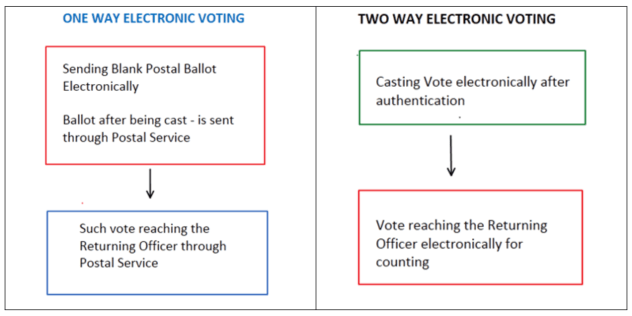
  • Electronically Transmitted Postal Ballot System (ETPBS) is the one-way electronic transmission of the Postal ballots to the Service Voters.
  • The Service Voter then cast their vote and send it to the respective returning officer via Post. The complete process is secured by way of multiple checks and transmission protocol to ensure safe transmission.
  • Upon receipt of the postal ballot at the counting centres, the returning officer validates the receipt by a series of QR codes with that of the transmitted system.

Functionality of ETPBS

  • Returning Officer generates ballot paper electronically by a specific desktop application. This ballot then gets encrypted in the system is ready to be sent.
  • The first functionality is the ability to generate the postal ballot online for transmitting through ETPBS.
  • Through ETPBS system, the ballots are automatically assigned to Service Voters based upon their constituency and get then gets transmitted.
  • The unit officer downloads the Postal ballots on behalf of the service voter. These downloaded ballots will be password protected.
  • The downloaded Postal Ballot can now be e-transmitted / hand-delivered using their secured network/infrastructure to the individual service voters.
  • The PIN will be transmitted/ dispatched to the individual service voters by the Record Officer to ensure that the downloaded Postal Ballot is opened by the concerned service voter only.
  • Thus ETPBS transmits the Postal ballot from the returning officer to the service voters electronically by a series of security protocol.       

Two way electronic voting

  • Two-way electronic transmission of vote envisages that - a registered voter from any location in India, once his identity is proved, will be able to cast his vote electronically through a secure encrypted system and the same will reach the designated returning officer for counting.  
  • EC is currently experimenting by using blockchain technology to facilitate two way electronic voting. 

Two way electronic voting

Providing Overseas Voters the Right to Vote
BENEFITS
CONCERNS
It will increase voter participation. Logistical Challenge to conduct voting either at Indian Embassies abroad or some other place which needs to be sanitized for voting.
It will cater to the vast Indian diaspora living abroad. It may impact several rights (employment, residence etc.) of such NRIs who intend to settle permanently in foreign countries.
Remove compulsions on part of Indians to travel to India especially for voting purpose.
It will fulfill the mandate of Article 326 and Section 62 of RPA, 1951 – which provides for right to vote for every citizen registered in the electoral roll.

Key Concerns on Online Voting using Blockchain Technology

Despite the benefits, security concerns have been raised by experts on the following grounds: 

  • Hacking of Blockchain Technology may result in:
  • Impersonation of voters
  • Transfer of votes for rival candidates
  • Cloning of biometric authentication
  • Denial-of-service attack might disallow citizens to register and vote
  • Disenfranchise a group or community of citizens
  • Decrypting votes casted 
  • Open to misuse by foreign intelligence & corporates     
  • Voting Preference and Pattern may become Public which is opposed to secret ballot   

What Needs to be Done to Allow Online Voting for  NRIS – Way Forward

  • If online voting is to be allowed by the government, then Section 20A of Representation of People Act, 1950 along with the Registration of Electors Rules, 1960 needs to be amended to allow online voting by NRIs even from outside India. 
  • Aspects related to logistics must be sorted out with the help of Ministry of External Affairs to allow smooth voting process for the overseas voters.
  • Two Way Electronic Voting can also be considered by the Election Commission by plugging the loopholes of online voting for the overseas voters.    

Are educated women likely to marry later?

National Family Health Survey (NFHS) data show that higher education levels could play a greater role than wealth in delaying a woman’s marriage.

Laws that prescribe minimum age for marriage in India:

  1. The Hindu marriage act (1955), Indian Christian marriages act (1872) and special marriages act (1954) prescribed the minimum age of marriage as 18 years for the bride and 21 years for the groom.
  2.  Prohibition of Child Marriage Act, 2006 prohibits marriage below 18 years for women and 21 years for men.

Child Marriages

Child marriage refers to a marriage to which either of the contracting parties is a child (if a male, has not completed 21 years of age, and if a female, has not completed 18 years of age). In India, it is estimated that there are over 24 million child brides. According to the National Family Health Survey, 40% of the World’s 60 million child marriages take place in India. According to NFHS-5 data, the share of women aged 20-24 who married before turning 18 is around 23%. Child marriage is far more prevalent amongst girls and this highlighted the gender dimension of the problem.

Causes

  1. Poverty: Poor families resort to child marriages to avoid all sorts of burden of a female child, like expenditure on education, dowry etc.
  2. Patriarchy: Girl in our patriarchal(patrilocal) set up is believed to be somebody’s property and are considered to be a liability as they are not seen as individuals who can contribute productively to the family. These beliefs lead parents to marry the girl child.
  3. Social mobility: The institution of marriage is often used to strengthen economic and social ties between different families and a young girl may be offered to a family in order to improve the financial and social standing of the girl’s family.
  4. Insecurity: To secure from offences like assaults, eve teasing against unmarried girls, their parents are in a hurry to marry their daughters soon after she attains puberty or even before that.
  5. Avoiding share in Ancestral Property: Early marriage is a way of denying share of ancestral property to females.
  6. Dropout of school: Dropout of teenage girls from school due to lack of basic amenities like toilets or for helping in the household work when both the parents go out for work, is one of the reasons for early marriage of girls. 
  7. Legal conundrum: Prohibition of child marriage act prohibits marriage of any women before the age of 18 but Muslim personal law mentions puberty or age of 15 years as minimum age of marriage for women.

Age of Marriage

Rationale behind raising the minimum age of Marriage for women:

  1. The Constitution guarantees gender equality as part of the fundamental rights and also guarantees prohibition of discrimination on the grounds of sex. The existing law do not adequately secure the Constitutional mandate of gender equality in marriageable age among men and women.
  2. Incidence of early marriage and childbearing are amongst the important causes of undernutrition in India. Children born to teenage mothers are more likely to be undernourished than children of adult mothers. India is home to more stunted children than any other country and is one of the ten countries with the largest burden of teenage pregnancy.
  3. It is important to bring down the incidence of teenage pregnancies, which are not only harmful for women's overall health but also result in more miscarriages and stillbirths.
  4. Early marriage often reduces the women labour force participation and increasing the legal limit of minimum age will give more chance for women to work.
  5. Early marriages reduces the educational and employment opportunities for women and make them financially dependent on men, which eventually results in skewed division of labour in domestic sphere.
  6. Age of marriage of females is a key factor that influences fertility. Demographic studies have revealed the apparent link between early marriage and increasing fertility rates.

Arguments against

  1. Restriction on choice of marriage: It can be used by parents to punish their daughters who marry against their wishes or elope to evade forced marriages, domestic abuse and housework.
  2. Legal limits are not successful: According to NFHS-5 (2019-2021), 23.3% of women aged 20-24 years married before the age of 18, which shows that the Prohibition of Child Marriage Act (PCMA), 2006, has not been successful in preventing child marriages.
  3. Depriving legal protection: Increasing the legal age at marriage for girls will expand the number of persons deemed underage and render them without legal protection.
  4. Declining fertility rates: India’s fertility rates have already been declining to well below replacement levels in many States, including those with higher levels of child marriage.
  5. Poverty is the underlying reason: Poverty and lack of higher education are major underlying reasons for early marriages. According to an analysis of NFHS-4 (2015-2016) data, 56% girls were married below the age of 21 and this figure was as high as 75% among the poorest category of population.

Way forward

Instead of focusing on age of marriage, following steps may eventually reduce the age of marriage

  1. Conditional cash transfer schemes to improve the attendance of girls in schools and skill training.
  2. Providing Increased access to contraceptives.
  3. Ensuring a safe environment to women free from the constant threat of rape and sexual assault which is why girls are married off early.