Governance

Parliamentary committees

Parliament has the primary responsibility of making laws and holding the government responsible for its actions. As representatives of citizens, MPs pass laws, oversee the working of the government and the efficient allocation of public funds. Parliamentary Committees act as a mechanism that helps in improving the effectiveness of Parliament. 

Over the years, responsibilities of the government have increased significantly. Government expenditure and legislation have become technical and complex in nature. While a significant amount of Parliament’s work gets done on the floor of the House, it is difficult for Parliament to scrutinise all government activities in the House in a limited time.

Thus, Parliamentary Committees were constituted to examine proposed legislation, government policies and expenditure in detail. They also examine petitions from the public, check whether rules framed by the government are in consonance with Acts of Parliament, and help manage the administration of Parliament. Deliberations in Committees present several advantages. 

Committees can get inputs from experts and stakeholders on various matters. Their ability to devote more time on each item allows them to examine matters in greater detail. They also help parties reach consensus on various issues. 

However, there are several areas where Committees need strengthening. For example, all Bills are not referred to Committees. They are thinly staffed and do not have full-time technical expert support. Some Committees may not seek evidence from experts on important Bills. Further, attendance of MPs in Committee meetings is about 50%, which is lower than the 84% attendance seen during the Parliament sittings. 

General Studies- II: Governance, Constitution, Polity, Social Justice and International relations.

  • Parliament and State legislatures—structure, functioning, conduct of business, powers & privileges and issues arising out of these.

So we will cover the following aspects: 

  • Why are parliamentary committees needed? 
  • Types of committees. 
  • How is the Functioning of the Committees? 
  • How to improve committees in India?

Why are parliamentary committees needed? 

Parliamentary committees are an integral part of the legislative process in India, and they serve several important functions. Here are some key reasons why parliamentary committees are needed in India:

  1. Detailed examination of bills: and other matters referred to them by the Parliament. This allows for a thorough review of legislation, including its various aspects such as legal, technical, financial, and policy implications. The committees can also seek inputs from experts and stakeholders, which helps in making informed decisions about the proposed legislation.
  2. Oversight of executive actions: They review the policies, programs, and actions of government departments and agencies to ensure that they are being implemented effectively and efficiently, and to hold the government accountable for its actions. This helps in ensuring transparency and accountability in the functioning of the government.
  3. Examination of budgetary allocations: They examine the estimates of expenditure, proposals for new spending, and the outcomes of past spending to ensure that public funds are being utilized efficiently and effectively. This helps in ensuring that taxpayer money is being spent wisely and in the best interests of the public.
  4. Public participation: They often invite inputs from the public, civil society organizations, and other stakeholders, and conduct public hearings on important issues. This allows for a diverse range of perspectives to be taken into account in the decision-making process and promotes participatory democracy.
  5. Expertise and specialization: This allows for in-depth examination of complex issues, as the committees can draw on the knowledge and experience of their members. It also helps in bridging the gap between legislation and implementation, as the committees can provide valuable insights and recommendations for effective implementation of laws.
  6. Efficient and specialized functioning: Parliamentary committees are smaller and more focused than the full Parliament, which allows for more efficient and specialized functioning. Committees can delve into issues in detail, conduct hearings, and interact with stakeholders, which may not be possible in the larger forum of Parliament. This leads to a more comprehensive and informed decision-making process.

Overall, parliamentary committees play a crucial role in the Indian legislative process by providing a platform for detailed examination, oversight, public participation, and specialized expertise. They contribute to the effective functioning of democracy by ensuring that legislation is thoroughly reviewed, government actions are scrutinized, and public interests are represented.

Types of committees

There are various types of Parliamentary Committees in India which look at matters such as government expenditure, legislation, government policies and schemes, and administration of Parliament.

They can be categorised into Departmentally Related Standing Committees, financial committees, administrative committees, accountability committees, and ad hoc committees. 

Departmentally Related Standing Committees (DRSCs) 

  • DRSCs were constituted in 1993 to assist Parliament in scrutinising funds allocated to Ministries. They also examine Bills referred to them by Parliament and analyse other relevant policy issues.
  • There are 24 DRSCs that oversee the working of a Ministry or group of Ministries. 
  • They are composed of 31 members: 21 from Lok Sabha and 10 from Rajya Sabha. These DRSCs are constituted for a period of one year. Financial Committees Parliament regulates government expenditure to ensure that public finances are used efficiently. 
  • Such financial oversight is a complex and technical task. Financial committees facilitate this task for Parliament.
  • They are the:
    • Committee on Public Accounts, Committee on Public Undertakings, and Estimates Committee. 
    • The Committee on Public Undertakings and Public Accounts consist of 22 members: 15 from Lok Sabha and seven members from Rajya Sabha. 
    • The Estimates Committee is composed entirely of Lok Sabha MPs. It has 30 members who are elected by the House. Members are elected for a period of one year. 

Financial Committees

Name of the CommitteeNo. of MembersTenureMembers Nominated or Elected
Estimates Committee301 yearElected by the Lok Sabha
Public Accounts Committee22(15LS+7RS)1 yearElected by the two House(s)
Committee on Public Undertakings22(15LS+7RS)1 yearElected by the two House(s)

Administrative Committees

Both Houses of Parliament also require significant administrative support for their day-to-day functioning. The Houses have set up different Committees, such as the Business Advisory Committee which helps decide the daily agenda of Parliament. Table 1 provides a list of administrative Committees in Parliament. 

CommitteesFunctions
Business Advisory CommitteeRecommends time to be allocated for the discussion of Bills and other business
Committee on Private Members' Bills and ResolutionsExamines all Private Members’ Bills after their introduction.
Committee on Government AssurancesScrutinises the assurances, promises, and undertakings given by Ministers.
Rules CommitteeConsiders matters of procedure and conduct of business in the House
Committee of PrivilegesExamines questions involving breach of rights, privileges, and immunities enjoyed by MPs
Committee on EthicsOversees the moral and ethical conduct of MPs
Committee on Absence of Members from the Sittings of the House Examines leave applications of MPs.
Joint Committee on Offices of Profit Examines the composition of other committees and recommends what offices may disqualify a person from becoming an MP. 
Joint Committee on Salaries and Allowances of MPsExamines salaries and allowances of MPs.
Committee on the Welfare of SCs and STsExamines measures taken by the government to improve the status of Scheduled Castes and Tribes
Committee on Empowerment of WomenRecommends measures to improve the status and conditions women.
Library Committee Advises on the improvement of Parliamentary library.
House CommitteeAdvises on matters related to residential accommodation of MPs. 
General Purposes CommitteeAdvises on matters concerning the affairs of the House referred to it by the Chairperson. 

Accountability Committees 

  • Apart from financial Committees and DRSCs, three other Committees ensure government accountability towards Parliament and citizens. These are the Committee on Government Assurances, the Committee on Subordinate Legislation, and the Committee on Petitions. 

Ad Hoc Committees 

  • Ad Hoc Committees are appointed by either House or the presiding officers from time-to-time for a specific purpose. They cease to exist when they finish the task assigned to them and submit a report. Some Ad Hoc Committees include: the Railway Convention Committee, and Select Committees formed to examine specific Bills.

How is the Functioning of the Committees ? 

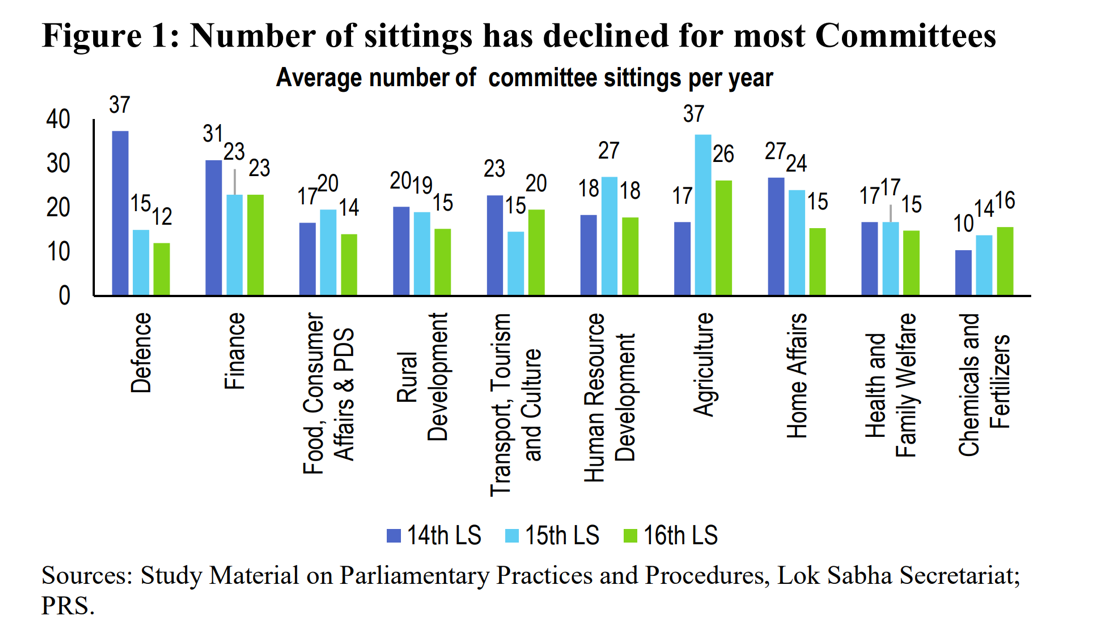
  • Departmentally Related Standing Committees Departmentally Related Standing Committees (DRSCs) meet to examine the expenditure of all Ministries, Bills referred to them, and policies or issues selected by them. These meetings are conducted while Parliament is in session or during inter-session periods. While it is difficult to analyse the quality of deliberations in these sittings, the number of sittings held by various DRSCs can be used as an indicator to measure the quantity of work done by them. Figure 1 shows the average number of sittings for 10 Committees which examine the largest (by expenditure) Ministries/Departments. 
CD 
Defence 
Finance 
Food, Consumer 
Affairs & PDS 
Rural 
Development 
Transport, Tourism 
and Culture 
Human Resource 
Development 
Agriculture 
Home Affairs 
Health and 
Family Welfare 
Chemicals and 
Fertilizers

Note that the Committees on Defence, Finance, and Home Affairs have seen a decrease in average number of sittings from the 14th to the 16th Lok Sabha, whereas the Committee on Chemicals and Fertilizers has seen an increase.

Examining Demands for Grants 

  • After the Budget is presented, the DRSCs examine the Demands for Grants of all Ministries under its purview. Demands for Grants refer to the detailed estimates of expenditure of each Ministry. DRSCs study allocations to schemes and programmes, spending by the Ministry, and the policy priorities of the Ministry. 
  • After this examination, the Committee compiles its recommendations in the form of a Report which is laid in both Houses of Parliament. These recommendations help MPs understand the implications of financial allocations. They also allow for a more informed debate and analysis of Demands for Grants in Lok Sabha.
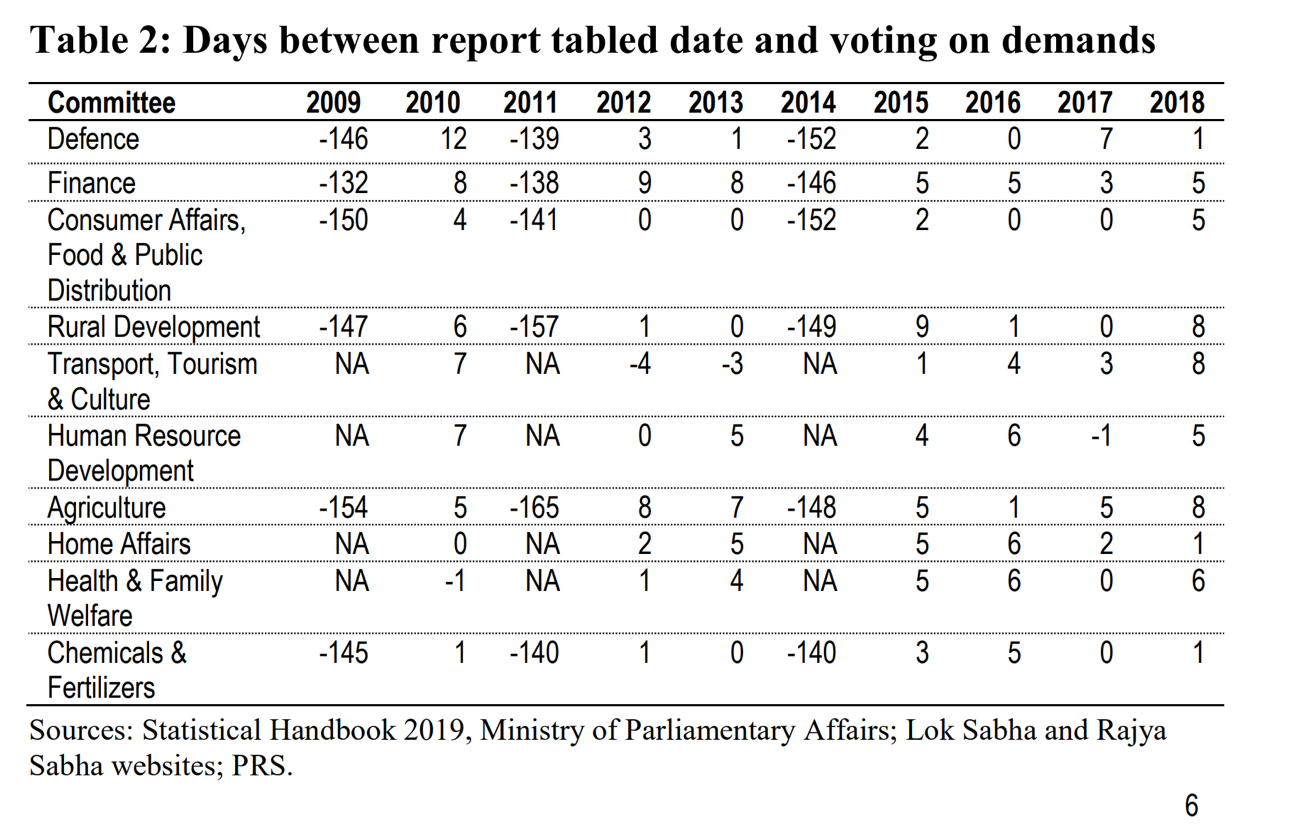
Table 2: Days between report tabled date and voting on demands 
Committee 
Defence 
Finance 
Consumer Affairs, 
Food & Public 
Distribution 
Rural Development 
Transport, Tourism 
& Culture 
Human Resource 
Development 
Agriculture 
Home Affairs 
Health & Family 
Welfare 
Chemicals & 
Fertilizers 
2009 
-146 
-132 
-150 
-147 
-154 
-145 
2010 
12 
2011 2012 2013 2014 2015 2016 2017 2018 
-139 
-138 
-141 
-157 
-165 
-140 
-152 
-146 
-152 
-149 
-148 
-140 
Sources: Statistical Handbook 2019, Ministry of Parliamentary Affairs; Lok Sabha and Rajya 
Sabha websites; PRS.

Negative numbers suggest that the report was presented after the Demand for Grants were voted upon. In 2009 and 2014, all reports on the Demands were presented a few months after they were voted in the House. Note that these were election years, and in these years the budget presented by the new government was passed in the month of July. 

The new DRSCs were not formed by then. The primary objective of reports on Demands for Grants is to help MPs examine government expenditure better. Therefore, it is necessary for MPs to have sufficient time to study these reports before the discussion in the House. The data suggests that in many cases MPs do not have sufficient time to study these reports. 

Examining Bills

  • Once a Bill has been introduced in Parliament, it may be referred to a DRSC for detailed scrutiny. The Bill can be referred to a Committee either by the Speaker of Lok Sabha, or the Chairperson of Rajya Sabha. It is sent to the DRSC that reviews the working of the Ministry under which the Bill is introduced. After concluding its examination, the DRSC lays its report in Parliament. The recommendations of the DRSC on the Bill may also be discussed in the House.
  • Note that a Bill passed by one House can still be referred to a Committee by the other House. For instance, in the 16th Lok Sabha, the Motor Vehicles (Amendment) Bill, 2016, and the Real Estate (Regulation and Development) Bill, 2013 were referred to a DRSC as well as a Select Committee. 
  • DRSCs were given the responsibility of scrutinising Bills because Parliament does not have the time and expertise to analyse each Bill in detail, on the floor of the House. However, the trend shows that fewer Bills are being referred to Committees as compared to previous Lok Sabha. 

Examination of Issues

  • Every year, DRSCs select subjects for detailed examination. These subjects could be on existing or potential issues that could come up in the sectors that the DRSC looks at, or implementation of programmes by the relevant Ministry. For example, some of the subjects identified for examination by DRSCs constituted for 2019-20 include: state of the Indian economy, implementation of the Ayushman Bharat Yojana, and digital payment and online security measures for data protection.

Reports submitted by DRSCs

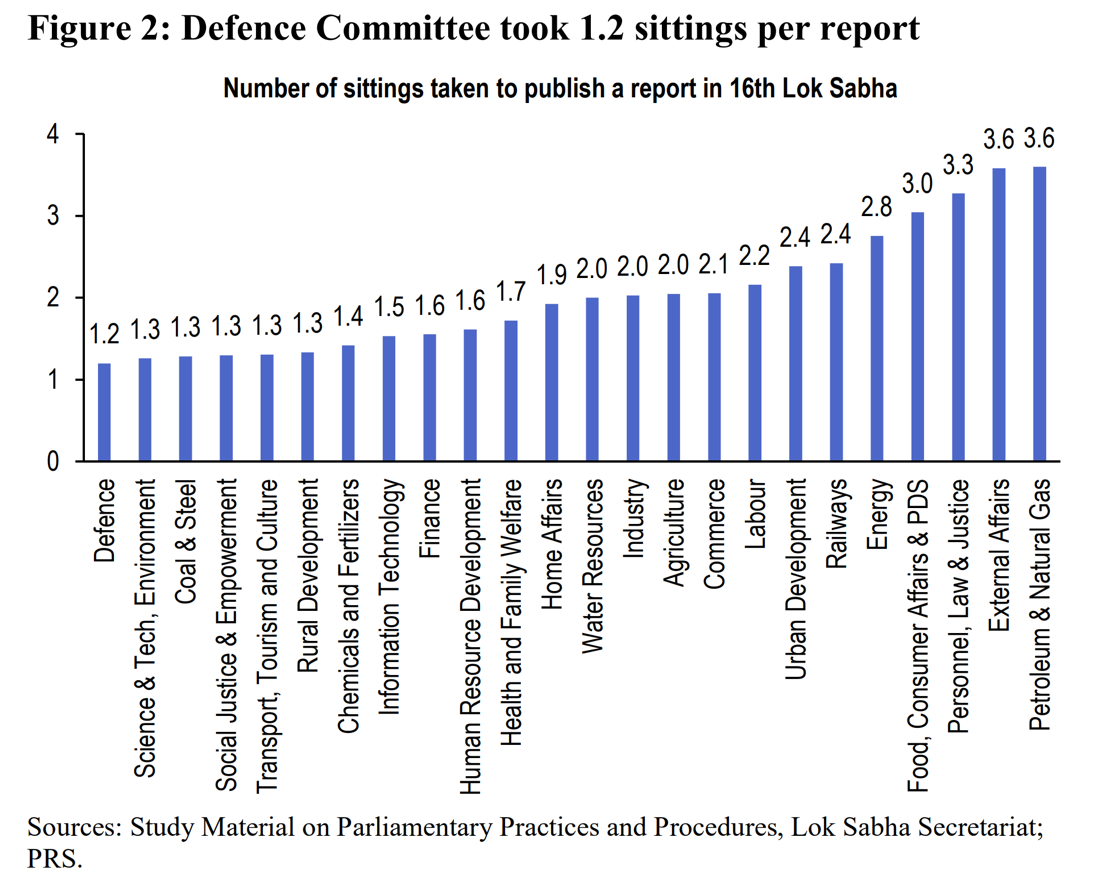
  • After examining Bills, Demands for Grants, and issues, DRSCs prepare reports and table them in Parliament. Subsequently, the DRSCs also submit Action Taken Reports which show the recommendations accepted by the government, and the progress made on them. The acceptance rate varies across Committees. During the 16th Lok Sabha, 2,038 sittings were held by DRSCs and they submitted 1,111 reports. On average, DRSCs published one report in 1.8 sittings. Average sittings taken to publish one report vary across DRSCs. However, it is difficult to evaluate quality of these deliberations without analysing each report. 
Defence 
Science & Tech, Environment 
Coal & Steel 
Social Justice & Empowerment 
Transport, Tourism and Culture 
Rural Development 
Chemicals and Fertilizers 
Information Technology 
Finance 
Human Resource Development 
Health and Family Welfare 
Home Affairs 
Water Resources 
Industry 
Agriculture 
Commerce 
Labour 
Urban Development 
Railways 
Energy 
Food, Consumer Affairs & PDS 
Personnel, Law & Justice 
External Affairs 
Petroleum & Natural Gas

Expert witnesses and research support 

  • To aid in their study, members of DRSCs can consult with expert witnesses, stakeholders, and government officials. Engaging with experts and stakeholders enables Committee members to better understand the details of complicated issues, and the potential impact of a policy or legislation.
  • Note that Committees invite witnesses to testify before them at their own discretion. 
    • For instance, the DRSC that examined the Right to Education Bill, 2008, which guarantees free education to all children ages six to 14, did not invite any expert witnesses.
  • Apart from consulting experts, Committees can also invite comments from the wider public. 
    • For example, the Committee on Labour and Employment published a press release inviting public comments on the Occupational, Safety, Health and Working Conditions Bill, 2019. Public comments help Committees consider the wider implications of a Bill or policy.
      • However, it is up to the discretion of the Committee whether or not they chose to invite public comments. 
  • Currently, the technical support available to Parliamentary Committees is limited to a secretariat that helps with matters such as scheduling meetings and note taking.
    • The National Commission to Review the Working of the Constitution (2002) had highlighted the lack of research support and specialist advisors with the DRSCs.4 It recommended that funds should be secured to assist these Committees in conducting inquiries, holding public hearings, and collecting data. Note that Committees in other countries such as the UK, USA, and Canada can retain specialist advisors (such as lawyers, economists, and statisticians) to assist in specific inquires.

Attendance of Members 

  • Parliamentary Committees hold several meetings to conduct in-depth analysis of various issues through extensive deliberations among Members. Success of the Committee system depends on the participation of Members in these meetings. Though Committee meetings are conducted in a closed-door environment, Lok Sabha publishes the attendance of Members in these meetings. Sixteen of the 24 DRSCs are administered by Lok Sabha and other eight by Rajya Sabha. Figure 7 shows the attendance of members during 2009-14 for the 16 DRSCs serviced by Lok Sabha. On average, 49% members were present for meetings of these Committees between this period. 
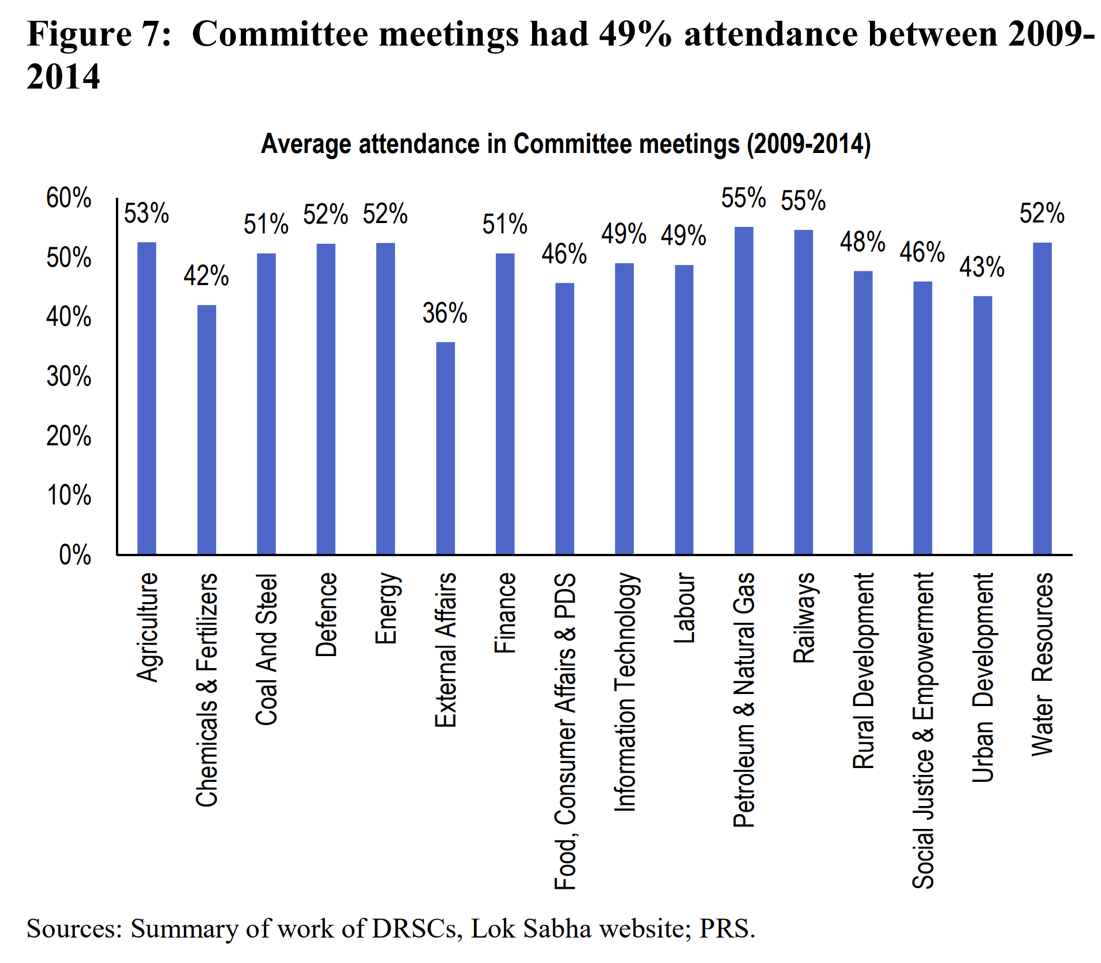
Figure 7: 
2014 
53% 
0% 
Committee meetings had 49% attendance between 2009- 
Average attendance in Committee meetings (2009-2014) 
52% 52% 
51% 
o 
06 
55% 55% 
06 
52% 
49% 
48% 46% 
o 
o 
Q) 
46% 
06 
E 
E 
E 
06 
E 
> 
E 
Sources: Summary of work ofDRSCs, Lok Sabha website; P RS

Way Forward

Committees in India, like any other organization or system, can be improved through various measures.

Here are some suggestions:

  • Diverse and Competent Membership: which brings a wide range of expertise and perspectives. This ensures that the committee is able to effectively address the issues at hand and make informed decisions.
  • Transparent and Inclusive Processes: including clear rules of procedure, open meetings, and opportunities for public input. This promotes accountability, fairness, and wider stakeholder engagement.
  • Adequate Resources and Support: including budgetary allocations, administrative assistance, and access to relevant information and data. This enables committees to function effectively and efficiently.
  • Timely Completion of Work: Committees should have a defined timeline for completing their work and submitting their recommendations or reports. This prevents undue delays and ensures that the committee's work is timely and relevant.
  • Implementation of Recommendations: should be seriously considered and implemented by the relevant authorities. This helps ensure that the committee's efforts result in tangible outcomes and real impact.
  • Regular Monitoring and Evaluation: Committees' performance should be regularly monitored and evaluated to assess their effectiveness and identify areas for improvement. This helps in continuously enhancing the functioning of committees and making necessary adjustments.
  • Capacity Building and Training: to enhance their skills, knowledge, and understanding of the committee's mandate and processes. This helps in improving their performance and overall effectiveness.
  • Review and Revision of Committee Structures: Periodic review and revision of committee structures, mandates, and processes can help identify gaps and areas for improvement. This may involve restructuring or redefining committees to align with changing needs and priorities.
  • Utilization of Technology: Committees can leverage technology for better communication, coordination, and documentation. This may include the use of online platforms for meetings, document sharing, and data analysis, which can streamline committee processes and enhance efficiency.

By implementing these measures, committees in India can be improved to function more effectively and contribute positively to decision-making and policy formulation processes.

National Human Rights Commission

Context: The All India Kisan Sabha (AIKS) has alleged that farmers were attacked and their sources were destroyed during the post-poll violence in Tripura. Leaders of the AIKS demanded urgent intervention of the National Human Rights Commission to control the violence.

Introduction about NHRC

The National Human Rights Commission (NHRC) of India was established in 1993. The statute under which it is established is the Protection of Human Rights Act (PHRA).

It is in conformity with the Paris Principles, adopted at the first international workshop on national institutions for the promotion and protection of human rights held in Paris in 1991, and endorsed by the General Assembly of the United Nations.  

The NHRC is an embodiment of India’s concern for the promotion and protection of human rights.

The Protection of Human Rights Act (PHRA), 1993 defines Human Rights as the rights relating to life, liberty, equality and dignity of the individual guaranteed by the Constitution or embodied in the International Covenants and enforceable by courts in India.  

Sub Committee on Accreditation (SCA) 

The National Human Rights Commission, India has retained its 'A' status of accreditation with the Global Alliance of National Human Rights Institutions, GANHRI.

The accreditation is given after a rigorous process of review of the NHRI by the GANHRI through its Sub Committee on Accreditation (SCA). 

The United Nations' Paris Principles provide the international benchmarks against which national human rights institutions (NHRIs) can be accredited. 

Paris Principles

The Paris Principles set out six main criteria that NHRIs require to meet. These are: Mandate and competence, Autonomy from Government, Independence guaranteed by a Statute or Constitution, Pluralism, Adequate resources; and adequate powers of investigation

Functions

The NHRC has the following key functions:  

  • To bridge the gap between responsibilities of the State and the rights of individuals 
  • To intervene in any judicial proceeding involving allegations of violation of Human Rights pending before a Court 
  • To protect Human Rights and recommend measures for their effective implementation 
  • To monitor and evaluate the factors, including acts of terrorism that curtail the enjoyment of Human Rights and recommend appropriate remedial measures 
  • To study treaties and other international instruments 
  • To enquire into complaints of violation of Human Rights 
  • To conduct research in the field of Human Rights 
  • To spread Human Rights literacy and awareness 
  • To encourage the efforts of Non-Governmental Organisations and Human Rights Defenders 
  • Assessment of developments in areas like IT, sports, business etc. impinging on Human Rights protection 
  • To perform any such functions as it may consider necessary for the promotion of Human Rights as provided in the Protection of Human Rights Act, 1993

Type of complaints not entertained by the Commission

Ordinarily, complaints of the following nature are not entertained by the Commission:

a) In regard to events which happened more than one year before the making of the complaints;

b) With regard to matters which are sub-judice;

c) Which are vague, anonymous or pseudonymous;

d) Which are of frivolous nature;

e) Which pertain to service matters.

Composition

The NHRC consists of: The chairperson and five members (excluding the ex-officio members)  

  • A Chairperson, who has been a Chief Justice of India or a Judge of the Supreme Court
  • One member who is, or has been, a Judge of the Supreme Court of India and one member who is, or has been, the Chief Justice of a High Court.
  • Three Members, out of which at least one shall be a woman to be appointed from amongst persons having knowledge of, or practical experience in, matters relating to human rights.
  • In addition, the Chairpersons of National Commissions viz., National Commission for Scheduled Castes, National Commission for Scheduled Tribes, National Commission for Women , National Commission for Minorities, National Commission for Backward Classes, National Commission for Protection of Child Rights; and the Chief Commissioner for Persons with Disabilities serve as ex officio members.

The sitting Judge of the Supreme Court or sitting Chief Justice of any High Court can be appointed only after the consultation with the Chief Justice of India.

Appointment

The Chairperson and members of the NHRC are appointed by the President of India, on the recommendation of a committee consisting of:

  • The Prime Minister (Chairperson)
  • The Home Minister
  • The Leader of the Opposition in the Lok Sabha 
  • The Leader of the Opposition in the Rajya Sabha 
  • The Speaker of the Lok Sabha 
  • The Deputy Chairman of the Rajya Sabha 

Limitations

  • Human right commissions can (including State Human Right Commissions) only make recommendations, without the power to enforce decisions. This lack of authority to ensure compliance has unfortunate consequences.
  • The Protection of Human Rights Act, 1993 requires that three of the five members of a human rights commission must be former judges but does not specify whether these judges should have a proven record of human rights activism or expertise or qualifications in the area.
  • Under the Act, human rights commissions cannot investigate an event if the complaint was made more than one year after the incident. Therefore, a large number of genuine grievances go unaddressed.
  • State human rights commissions cannot call for information from the national government, which means that they are implicitly denied the power to investigate armed forces under national control.
  • Most human rights commissions are functioning with less than the prescribed Members. This limits the capacity of commissions to deal promptly with complaints, especially as all are facing successive increases in the number of complaints.
  • Scarcity of resources - or rather, resources not being used for human rights related functions - is another big problem. Large chunks of the budget of commissions go in office expenses and in maintaining their members, leaving disproportionately small amounts for other crucial areas such as research and rights awareness programmes.
  • As human rights commissions primarily draw their staff from government departments - either on deputation or reemployment after retirement - the internal atmosphere is usually just like any other government office. 

Strict hierarchies are maintained, which often makes it difficult for complainants to obtain documents or information about the status of their case. 

The presence of security guards, armies of peons and office attendants creates barriers for ordinary people to personally meet officials in regard to their complaint.

Suggestion for reforms

  • The effectiveness of human rights commissions will be greatly enhanced if their decisions are immediately made enforceable by the government. 

This will save considerable time and energy as commissions will no longer need to either send reminders to government departments to implement the recommendations or alternatively to approach High Courts through a cumbersome judicial process to make the government take action.

  • Commissions must also have clear and well-defined powers to proceed against government departments furnishing false reports.  This will assist in preventing the many instances where the departmental version of events is more often than not a white-wash, particularly in those cases where the police has been accused of violations.
  • As non-judicial member positions are increasingly being filled by ex-bureaucrats, credence is given to the contention that commissions are more an extension of the government, rather than independent agencies exercising oversight. 
  • If commissions are to play a meaningful role in society, they must include civil society human rights activists as members.
  • Complaints regarding police excesses and misbehaviour take up most of the time of human rights commissions. It is perhaps time to think about an alternative agency, dedicated solely to civilian oversight of the police. 

Here we can learn from international experience: the UK, for instance, has an Independent Police Complaints Commission; South Africa has an Independent Complaints Directorate; and Brazil has Police Ombudsmen offices is some provinces to deal exclusively with police complaints. 

End note: Reform initiatives can only bear fruit when ordinary citizens take an active interest in good governance and human rights. 

Biotech Kisan Scheme

Context: As per the Central Government, during the last one-year (January 2022- December 2022) 1,60,000 farmers have received benefits under Biotech-KISAN scheme.

Biotech-KISAN Scheme

  • Biotech Krishi Innovation Science Application Network (Biotech KISAN) is a scientist-farmer partnership scheme launched in 2017 for agriculture innovation. 
  • Objective: To connect science laboratories with the farmers to find out innovative solutions and technologies on the problems related to water, soil, seeds, and marketing. 
  • The programme provides funding to establish the Biotech KISAN Hub in each of 15 Agro-climatic zones of the country.
  • Each Hub creates a network by developing strong linkages with top quality scientific institutions/State Agricultural Universities/Krishi Vigyan Kendras/existing state agriculture extension services/system and other Farmers’ organizations in the region as well as linkages with leading international institutions/organizations.
  • Initiative of: Department of Biotechnology under the Ministry of Science and Technology. 

Core activities of Biotech KISAN Hub

  • Understanding the problems of the local farmers.
  • Scouting for available technologies and solutions to problems of farmers in the region.
  • Demonstration and scale-up programmes for implementing the solutions to the problems of farmers – addressing water, soil, seed, and marketing issues.
  • Creation of strong Scientists-Farmers Interaction Platform and connectivity; training programmes for the farmer and immersion programmes for scientists.
  • Communication set up through radio and TV and connectivity through social media.
  • Individual thematic fellowship programmes for selected farmers in the zone at high-tech science laboratories.
  • Special solution-driven thematic fellowships to women farmers (Mahila Kisan Biotech Fellowship) to develop them as leaders and grass root scientists.

If Governor withholds nod, it means Bill is dead

Context:  Recently, Tamil Nadu Governor said that if a Governor withholds assent to a Bill passed by the Assembly, it means the “Bill is dead”. 

More about the news:

The Supreme Court has defined withholding assent as the Bill falls through, the Bill is dead.

Under Article 200, once a Bill has been passed by the State Legislature, then the Governor has three options:

 1. Either he assents to the Bill; or

 2. He withholds assent therefrom; or 

 3. Reserves the Bill for the consideration of the President.

  •  The Governor as soon as possible shall return the Bill for the consideration of the House with his message as to what provisions of the Bill should be reconsidered by the Assembly. Now, the term “as soon as possible” has not been defined. 
  • Now, when the Bill is so returned, the Assembly shall reconsider the Bill and look into the suggestions or messages of the Governor regarding any specific provision. 
  • However, if the Bill is passed again by the House or Houses with or without amendment and presented to the Governor for assent, the Governor shall not withhold assent therefrom
  • The Governor does not have discretion on matters of the Assembly and is bound to follow the advice of his Council of Ministers even on matters where he/she might be withholding assent.
  • Provided further that the Governor shall not assent to, but shall reserve for the consideration of the President, any Bill which in the opinion of the Governor would, if it became law, so derogate from the powers of the High Court as to endanger the position which that Court is by this Constitution designed to fill. 
  • In the entire provision of Article 200, no time frame as such has been provided. So, if the Bill is even reserved for the President’s Assent, then he is not time bound to accept or reject the Bill.

Is the president bound to accept or reject the bill which is reserved for president under Article 201? 

Article 201- Bills reserved for President’s consideration 

  • When a Bill is reserved by a Governor for the consideration of the President, the President shall declare either that he assents to the Bill or that he withholds assent therefrom.
  • Provided that, where the Bill is not a Money Bill - the President may direct the Governor to return the Bill to the House or Houses of the Legislature of the State together with such a message as is mentioned in the first proviso to article 200. 
  • And when a Bill is so returned, the House or Houses shall reconsider it accordingly within a period of six months from the date of receipt of such message and, 
  • if it is again passed by the House or Houses with or without amendment, it shall be presented again to the President for his consideration. 

Note - Even under Article 201, no time limit has been provided under which the President has to assent or reject the Bill once the Governor reserve the Bill for President’s Assent.

The Article ends with the words that the Bill shall again be presented again to the President for his consideration. But what happens after the Bill is presented again has not been mentioned. So, technically, the President is not time bound to assent or reject the Bill which is sent again for his consideration and the Bill can be delayed.

The Supreme Court order in Shamser Singh vs State of Punjab (1975) that “the constitutional conclusion is that the Governor is but a shorthand expression for the State government and the President is an abbreviation of the Central government.”

SC quashes ban on media one

Context: Court lifts telecast ban on Malayalam channel Media One; says unguided and ad hoc use of sealed covers infringes natural justice and open justice.

More on news: The Supreme Court rapped the government for silencing voices in the media who “speak truth to power” by branding them “anti-establishment”, as well as for the state’s “unguided and ad hoc” use of sealed covers in courts to outsmart citizens’ rights to personal liberty, life and profession.

Observations of Supreme Court

  • The critical views about government policies cannot be termed anti-establishment. The use of such a terminology betrays an expectation that the Press must support the establishment.
  • An independent Press is vital for the robust functioning of the democratic republic. 
  • The Press has a duty to speak truth to power and present citizens with hard facts.
  • A homogenised view on issues that range from socio-economic polity to political ideologies will present grave dangers to democracy.
  • State’s “unguided and ad hoc” use of sealed covers in courts to outsmart citizens’ rights to personal liberty, life and profession.

Public interest immunity (PII) 

  • Though recognising the top court’s power to “secure confidential material in a sealed cover” under Rule 7 of the Supreme Court Rules of 2013, the CJI noted that the state’s frequent reliance on sealed covers to validate its actions in courts had reduced constitutional rights and procedural guarantees of a fair hearing under the law to a “dry parchment”.
  • The Supreme Court then evolved the “less restrictive” public interest immunity (PII) claims proceedings as an “alternative” to the sealed cover proceedings while dealing with state requests for confidentiality.
  • Under the alternative PII proceedings, the court would test the relevance of the material the state desires to be kept confidential in ‘public interest’. The court would appoint an amicus curiae in order to “balance the concerns of confidentiality with the need to preserve public confidence in the objectivity of the justice delivery system”.
  • Though the PII proceedings would be a “closed sitting”, a reasoned order, allowing or dismissing the PII claim of the state, should be pronounced in open court. Even if the PII claim is successful, the court could opt to redact confidential portions of the document or provide both parties with a summary of the contents of the documents.
  • While PII claims proceedings conceivably impacts the principles of natural justice, sealed cover proceedings infringe the principles of natural justice and open justice

Right to life, liberty and profession Vs Confidentiality 

  • SC questioned the government’s view that it could investigate or collect intelligence on citizens and later claim blanket immunity from disclosure in court.
  • SC observed that “Intelligence agencies’ reports impact the life, liberty and profession of individuals and entities, and to give such reports absolute immunity from disclosure is antithetical to a transparent and accountable system.
  • SC reasoned that the argument that intelligence reports may contain confidential information is one thing, but to argue that all such reports are confidential is another. Such an argument is misplaced and cannot be accepted on the touchstone of constitutional values.

Principle of natural Justice

Principles of natural justice refer to the basic principles that are required to be followed while making a decision or taking any action. These principles aim to ensure that the decision-making process is fair, unbiased, and transparent. The following are the key principles of natural justice:

  • Audi alteram partem - The right to be heard: This principle means that both parties should be given a fair opportunity to present their case before a decision is made. It also includes the right to cross-examine witnesses and evidence.
  • Nemo judex in causa sua - No one should be a judge in his own cause: This principle requires that the decision-maker should be impartial and not have any personal interest or bias in the matter.
  • Impartiality: The decision-maker should be unbiased and impartial towards the parties involved in the decision-making process. The decision should be based solely on the facts and evidence presented before them.
  • Natural justice demands that a person should be informed of the charges against them and should have the opportunity to respond to those charges.
  • The decision should be based on relevant and admissible evidence.
  • The decision should be communicated in writing and should include the reasons for the decision.
  • Bias: Any actual or perceived bias on the part of the decision-maker can render the decision invalid.
  • The decision should be proportionate and reasonable.
  • Confidentiality: The decision-making process should be confidential to protect the privacy of the parties involved.
  • Evidence: Only admissible evidence should be considered while making a decision.

Principle of open justice 

Open justice is the principle that legal proceedings should be open and transparent to the public. It is a fundamental principle of the legal system in many countries and is considered essential to the rule of law. The following are the key aspects of open justice:

  • Public access to court proceedings: Open justice requires that court proceedings are open to the public, unless there are compelling reasons to restrict access. This means that anyone can attend court hearings and access court documents, subject to certain restrictions, such as protecting the privacy of vulnerable witnesses.
  • Transparency: Open justice also requires that court proceedings are conducted in a transparent manner, with the reasons for the court's decisions being explained to the parties involved and the public. This includes providing written judgments and reasons for decisions, which should be made available to the public.
  • Accountability: Open justice promotes accountability, by allowing the public to see how decisions are made and how justice is administered. This can help to maintain public confidence in the legal system and ensure that judges and other decision-makers are held accountable for their actions.
  • Fairness: Open justice promotes fairness, by ensuring that all parties to a legal proceeding have an equal opportunity to present their case and that the decision-making process is conducted in an impartial and transparent manner.
  • Media access: Open justice also allows the media to report on court proceedings, subject to certain restrictions, such as protecting the privacy of vulnerable witnesses. This allows the public to be informed about legal proceedings and helps to promote accountability and transparency.
  • Exceptions: Although open justice is a fundamental principle of the legal system, there are some exceptions, such as cases involving national security, confidential information, or the privacy of vulnerable individuals. In such cases, restrictions on public access may be necessary to protect the interests of justice.

Overall, open justice is an essential principle of the legal system, promoting transparency, accountability, and fairness. It helps to ensure that the legal system is accessible to all and that justice is administered in a transparent and impartial manner.

Poll bonds on sale for 10 days starting from April 3

Electoral Bonds

  • Electoral Bonds are bearer instrument, sort of a Promissory Note and are an interest free banking instrument. 
  • Electoral Bond shall be issued for any value, in multiples of Rs 1000, Rs 10,000, Rs 1 lakh, Rs 10 lakh and Rs 1 crore from the Specified Branches of the State Bank of India (SBI). 
  •  The purchaser would be allowed to buy Electoral Bonds only on due fulfilment of all the extant KYC norms and by making payment from a bank account. It will not carry the name of payee.
  •  The Electoral Bonds would have a life of only 15 days during which it can be used for making donation only to political parties which has secured not less than one per cent of the votes polled in the last general election to the House of the People or to Legislative Assembly.
  • Every political party in its returns will have to disclose the amount of donations it has received through electoral bonds to the Election Commission.

Concerns associated with electoral bonds

  • Identity of Donor remains unknown goes against transparency of electoral funding
  • No Upper Limit for Donation Increases Corruption and red tapism through undisclosed identity.
  • Exemption allowed under RTI Act – Section 8(1)(e) , Results in Frivolous Donations from unaccounted source. Further it strengthens Corporate-Political Nexus and results in quid pro quo scenario post elections.
  • Prohibition of donation to be provided by companies older than 3 years removed. This will lead to formation of Shell Companies to route funds as part of electoral finance.
  • Restrictions on corporates for donating more than 7.5% of their average net profit over the previous 3 years to the Political parties removed. FCRA Amendment enables political parties to accept donations from foreign companies – Indian elections may have foreign influence.

Karnataka notifies 10% EWS quota on eve of announcement of poll schedule

Context: 

  • Days after scrapping the 2B Category for Muslims under the OBC quota and on the eve of the announcement of the Assembly elections, the Karnataka government notified the Economically Weaker Section (EWS) category to provide 10% reservation in education and employment.
  • Muslims have been included under this category as per the Cabinet decision taken last week. The order issued on March 28, the day before the model code of conduct came into force, stated that those castes that do not enjoy reservation status provided to the Scheduled Castes and Scheduled Tribes and are not in the list of backward classes and communities transferred to the EWS reservation from the backward classes will be eligible for 10% reservation. The five communities of Brahmins, Arya Vysyas, Mudaliars, Jains, and Nagarathas have been identified to benefit from the EWS reservation in Karnataka. Muslims are the new addition.

Disclaimer: In order to understand the topic as controversial as reservation, We have to wear the veil of ignorance.

The veil of ignorance is a thought experiment proposed by philosopher John Rawls to help individuals think about justice and fairness in society. It asks individuals to imagine that they are behind a veil of ignorance, where they do not know their social status, class, race, gender, or other personal characteristics.
In the case of reservations, the veil of ignorance could help individuals consider the issue from a neutral standpoint, without being influenced by their own personal experiences or biases. By doing so, individuals can think about the issue of reservations solely based on principles of justice and fairness, rather than their own interests or identities.
Wearing the veil of ignorance can help individuals understand the perspectives of both supporters and opponents of reservations, and can help promote a more rational and balanced discussion around the issue. 

Why do we need to cover this? 

  • The debate around reservation is centered on the practice of providing preferential treatment to individuals or groups who have historically faced social, economic, and educational disadvantages. In many countries, including India, the United States, and South Africa, reservations are implemented in education, employment, and political representation.
  • On one hand, supporters of reservations argue that they are necessary to correct historical injustices and provide opportunities for marginalized communities. They argue that without affirmative action programs, members of disadvantaged groups would continue to be excluded from positions of power and influence.
  • On the other hand, opponents of reservations argue that they are discriminatory and violate the principle of meritocracy. They argue that reservations create a system where people are chosen based on their identity rather than their abilities, leading to inefficiencies and lowering the overall quality of institutions.
  • Additionally, there are debates around the efficacy of reservations in achieving their intended goals. Some argue that while reservations may provide temporary relief, they do not address the root causes of social and economic inequality and may even perpetuate the marginalization of certain groups.

Overall, the debate around reservation is complex and multifaceted, with both supporters and opponents presenting valid arguments.

Apart from this, the syllabus of GS Paper II clearly expects us to has a clear understanding of this debate: 

Syllabus: 

General Studies- II: Governance, Constitution, Polity, Social Justice and International relations.

  • Indian Constitution—historical underpinnings, evolution, features, amendments, significant provisions and basic structure.

Hence, we will: 

  • What is reservation? 
  • Constitutional Provisions regarding Reservation 
  • What are the recent debates regarding reservation? 
  • Issues associated with reservation in India:
  • Way Forward

What is reservation? 

  • It is a form of affirmative action whereby a percentage of seats are reserved in the government service and educational institutions for the socially and educationally backward communities and the Scheduled Castes and Tribes who are inadequately represented in these services and institutions.

Constitutional Provisions regarding Reservation 

  • Article 15 (4) allows the State to make any special provision for the advancement of any socially and educationally backward classes of citizens or for the Scheduled Castes and the Scheduled Tribes. This provision was extended to admission in educational institutions by 93rd Amendment Act, 2006 (except minority educational institutions) 
  • Article 16 (4) allows State to make any provision for the reservation of appointments or posts in favour of any backward class of citizens which, in the opinion of the State, is not adequately represented in the services under the State. 
  • Article 16(4A), empowers state to make provisions for reservation in matters of promotion to SC/ST employees. 
  • Article 46 states that the State shall promote with special care the educational and economic interests of the weaker sections of the people, and, in particular, of the Scheduled Castes and the Scheduled Tribes, and shall protect them from social injustice and all forms of exploitation. 
  • Article 243D provides reservation of seats for SCs and STs in every Panchayat. 
  • Article 243T provides reservation of seats for SCs and STs in every Municipality. 
  • Article 330 states that seats shall be reserved in the Lok Sabha for the Scheduled Caste and Scheduled Tribes. 
  • Article 332 of the Constitution of India provides for reservation of seats for the Scheduled Castes and the Scheduled Tribes in the Legislative Assemblies of the States.

Reservation in India is a complex and controversial issue. While it was introduced as a measure to address historical and structural inequalities, it has also been criticized for creating new forms of inequality and perpetuating caste-based divisions.

What are the recent debates regarding reservation? 

  • Sub categorization of OBC: The idea is to create sub-categories within the larger group of OBCs for the purpose of reservation. OBCs are granted 27% reservation in jobs and education under the central government. This has been a legal debate for other reservation categories too: in September last year, a Constitution Bench of the Supreme Court reopened the debate on sub-categorisation of Scheduled Castes and Scheduled Tribes for reservations.
  • Dominant castes demanding reservation: Marathas, Patels, Jats, Kapus and others are asking for reservations today, preferably through their recognition as Other Backward Classes. This demand reflects the challenges they are facing on the job market.
  • Reservation to Muslims and Christians: Currently, the constitutional right to reservations in jobs and education as a member of the SC community is extended only to people from Hindu, Sikh or Buddhist faiths, in accordance with the Constitution (Scheduled Castes) Order, 1950.
  • Local reservation in private sector: Haryana State Employment of Local Candidates Act, 2020 was passed reserving 75% of private sector jobs for people of the state.

Issues associated with reservation in India:

  1. Debate around meritocracy: One of the main arguments against reservation is that it goes against the principle of meritocracy, which is the idea that individuals should be rewarded based on their abilities and hard work, rather than their social background. Critics argue that reservation policies favor candidates from certain castes or communities, regardless of their abilities or qualifications, and therefore undermine the concept of meritocracy.
  2. Limited impact: While reservation has been in place for several decades, it has not been able to fully address the issue of caste-based discrimination and inequality. Many argue that it has only benefited a small section of the population, leaving the majority of Dalits and other marginalized groups outside its purview.
  3. Backlash from dominant castes: Reservation has often been met with resistance from dominant castes, who see it as a threat to their own interests and privileges. This has led to tensions and conflicts between different caste groups, and in some cases, even violence.
  4. Political manipulation: Reservation policies have been used by political parties as a tool to gain votes and maintain power. This has led to the creation of new caste-based political alliances and the use of reservation quotas as a bargaining chip in electoral politics.
  5. Inadequate implementation: Despite the existence of reservation policies, many institutions and organizations continue to discriminate against marginalized groups. The implementation of reservation policies has been uneven and often marred by corruption and inefficiency, which has limited their impact.

Way Forward:

Improving the reservation system in India requires a multi-pronged approach that addresses its various shortcomings. Here are some ways in which the reservation system in India could be improved:

  1. Ensure effective implementation: One of the biggest challenges with the reservation system in India is the lack of effective implementation. There is a need to ensure that reservation policies are implemented in a transparent and efficient manner, and that benefits reach the intended beneficiaries.
  2. Expand the scope of reservation: Reservation policies could be expanded to include other marginalized groups such as economically weaker sections, transgender individuals, and people with disabilities, who face discrimination and exclusion.
  3. Address the issue of creamy layer: The creamy layer refers to the affluent sections within reserved categories who benefit from reservation policies and may not necessarily require them. There is a need to exclude the creamy layer from reservation benefits to ensure that the benefits reach the most disadvantaged sections.
  4. Encourage merit-based affirmative action: Reservation policies could be supplemented by other measures that promote merit-based affirmative action. For example, institutions could adopt diversity targets, scholarships, and mentorship programs to support underprivileged students.
  5. Focus on quality education: Improving the quality of education in marginalized communities is critical to reducing the dependence on reservation policies. Investment in quality education infrastructure, teacher training, and curriculum development could go a long way in promoting equality and social mobility.
  6. Promote social awareness and dialogue: Creating a social awareness and dialogue around the issues of caste and reservation is important to promote greater understanding and acceptance of the need for affirmative action policies. This could be done through public education campaigns, media outreach, and community engagement programs.

Overall, reservation in India is a complex issue that needs to be approached with nuance and sensitivity. While it has helped to address some forms of inequality, it has also created new challenges that need to be addressed.

CEC in Assam: Delimitation, NRC can be simultaneous processes

Context: Various political parties in Assam had submitted to Election commission of India (ECI) to hold the delimitation exercise, till the conclusion of National Register of Citizen (NRC) process. In response to this chief election commissioner said that delimitation and NRC are “different issues” and there is no legal bar on carrying them out separately.

Delimitation Commission

The Delimitation Commission is established by Parliament under Article 82 to determine allocation of seats in the House of the People to the States based on 1971 Census and divide states into territorial constituencies based 2001 Census.

Delimitation means the act or process of fixing limits or boundaries of territorial constituencies in a country or a province having a legislative body. In India, the job of delimitation has been assigned to a high power body known as Delimitation Commission or Boundary Commission.

Four Delimitation Commission have been constituted since independence

1952 – under Delimitation Commission Act, 1952

1963 -  under Delimitation Commission Act, 1962

1973 - under Delimitation Commission Act, 1972

2002 - under Delimitation Commission Act, 2002

Orders of Delimitation Commission cannot be called in question before any Court of law. 

The copies of its orders are laid before the House of People and the State Legislative Assembly concerned, but no modifications are permissible therein by them. 

The Central Government shall constitute a Commission to be called the Delimitation Commission which shall consist of three members as follows: 

(a) one member, who shall be a person who is or has been a Judge of the Supreme Court, to be appointed by the Central Government who shall be the Chairperson of the Commission; 

(b) the Chief Election Commissioner or an Election Commissioner nominated by the Chief Election Commissioner, ex officio: 

(c) the State Election Commissioner of concerned State, ex officio. 

The Commission shall determine its own procedure and shall, in the performance of its functions, have all the powers of a civil court under the Code of Civil Procedure. 

Role played by delimitation commission 

  • Balance of representation to achieve the ideals of ‘One Vote One Value’ 
  • Ensure adequate representation to vulnerable sections including SC/ST. 
  • Fair division of geographical areas for adequate representation of diverse communities

Challenges 

  • Delimitation exercise is restricted by Constitution 84th and 87th Amendment. 
  • This has frozen the seats in Lok Sabha and State Assemblies till 2026. 
  • Seats reserved for SC and ST population also remains frozen and increasing population of vulnerable section is not accounted for. 

Thus the need of the hour is to develop a National consensus exercise for undertaking delimitation along with 2031 census to ensure adequate representation of states and vulnerable sections of India. 

National Register of Population (NRC)

  • The National Register of Citizens (NRC) is the register containing names of Indian citizens. The only time that a National Register of Citizens (NRC) was prepared was in 1951 when after conduct of the Census of 1951, the NRC was prepared by recording particulars of all the persons enumerated during that Census.
  • It was only done by the state of Assam , though it was mandated for all the states. However, recently Home Ministry has expressed, that it is planning to do this process for entire country.
  • Citizenship being a subject of the Union List, policy decisions, guidelines and funds for NRC updation are provided by the Central Government but its implementation is done through the State Government machinery under the guidance of the Registrar General of India who functions as the Registrar General of Citizen Registration under Rule 15 of Citizenship Rules, 2003 as amended in 2009 and 2010.
  • The provisions governing NRC updation are The Citizenship Act, 1955, and The Citizenship (Registration of Citizens and Issue of National Identity cards) Rules, 2003 (prepared under The Citizenship Act, 1955).

‘herSTART’

What is herSTART?

It is a platform to encourage women entrepreneurs.

 Purpose:

  • e-certificate to all participants
  • Mentorship and guidance and networking support
  • Up to 2 years of incubation support at GUSEC
  • Access to government grants (a monthly allowance of ₹20,000 for up to one year for women-led Startups) and funds
  • Dedicated co-working space for women
  • Up to $1000k in cloud credits
  • Single window startup support
  • Technology Resources

Launched by: Government of India

Calcutta HC Sets Aside Reappointment Of Vice-Chancellors

In the case of Anupam Bera v State of West Bengal, Division Bench of Calcutta High Court has set aside the West Bengal Education Department’s decision to appoint or re-appoint Vice-Chancellors from 24 state universities based on the amendments made in the West Bengal Universities Act in 2012 and 2014. The High Court held that the appointments made were “unsustainable and without the authority of law. Let us understand the laws pertaining to appointment of Vice-Chancellors by the Governor, whether Governor’s power of appointing Vice-Chancellors are discretionary power and also important recommendations of Sarkaria and Punchhi Commission’s Report.

PIL Filed by College Teachers

  • Public Interest Litigation (PIL) was filed by a forum of college teachers alleging that appointments were made in violation of University Grants Commission Regulations 2018 and the appointment were not approved by the then Governor of West Bengal who is also the Chancellor of State Universities according to the State University legislations.
  • The controversy regarding appointment of Vice-Chancellors are not new and have also been witnessed in the state of Kerala and Tamil Nadu.    
  • It was because of the constrained relation between Governor and Chief Minister in West- Bengal, the government earlier decided to make its Chief Minister the chancellor of its state-run universities by amending the State Universities Act.

Decision of the Calcutta High Court

  • Appointment Made Without Governor’s Approval - The Court further held that the appointments were made without the approval of the Governor who is the ex-officio Chancellor of the State-aided universities as per the State Universities Act of West Bengal. The appointments were done during the regime of former West Bengal Governor Jagdeep Dhankhar who had not given his approval to the order of the state higher education department for appointment of Vice-Chancellors. 
  • Power Cannot be Usurped by State - Once the power to reappoint or extend the tenure is vested with the Chancellor (who is the Governor), it cannot be usurped by the State. And if the state government extends the tenure of VCs, it has to show the laws under which it is doing so.
  • The provisions of UGC Regulations, 2018 will prevail over the conflicting provisions of the concerned State Universities Act, relating to appointment of Vice-Chancellor. Some of the Vice-Chancellors did not fulfill the minimum eligibility criteria of 10 years’ experience as professor in the university or 10 years’ experience in a reputed research and/or academic administrative organisation, as prescribed in the UGC regulation.
  • Search Committee not formed as per UGC Regulations 2018 - Search Committee formed by the state government for selection of Vice Chancellors of State/Private Universities did not have one member nominated by the Chairman of University Grants Commission. This violated the UGC Regulations of 2018.
  • Directions to State - Amendments made in the West Bengal Universities Act in 2012 and 2014 to the extent they are repugnant to the UGC Regulations, 2018 relating to appointment of Vice-Chancellor cannot be sustained and the State is directed to consider making suitable amendments in the concerned Acts to bring them in conformity with the UGC Regulations, 2018 preferably within a period of six months.   
  University Grants Commission has been constituted under The University Grants Commission Act, 1956. The UGC has the unique distinction of being the only grant-giving agency in the country which has been vested with two responsibilities: that of providing funds and that of coordination, determination and maintenance of standards in institutions of higher education.   UGC Mandate includes: Promoting and coordinating university education. Determining and maintaining standards of teaching, examination and research in universities. Framing regulations on minimum standards of education. Monitoring developments in the field of collegiate and university education; disbursing grants to the universities and colleges. Serving as a vital link between the Union and state governments and institutions of higher learning. Advising the Central and State governments on the measures necessary for improvement of university education.

State Universities Act

  • Constitution of India is silent on the role of Governor as Chancellors of State Universities.
  • State Universities Act passed by respective state governments generally appoints Governor as the Chancellor of state universities by virtue of Governor’s office.
  • For example, Uttar Pradesh State Universities Act, 1973 or West Bengal State Universities Act, 2007 appoints Governor as the Chancellors of all state universities.
  • Thus, Chancellors hold statutory powers.

The Chancellor, by virtue of his office is a Head of the University and vested with the following powers:

  • Appoints the Vice-Chancellors.
  • Presides over the Convocation of the State Universities.
  • Appoints nominees on various bodies like Senate, Syndicate, Board of Management, Selection Committee or Academic Council of the State Universities. 
  • Grant leave or institute disciplinary action and award penalties.
  • Power to hear representation of the employees and students.
  • Power to take final decisions on election disputes with regard to the representation in different bodies of the universities and managing committees of its colleges.
  • Power to nominate experts in the appointment of teachers of various categories in the  university.
  • Convenes review meetings of Vice-Chancellors and concerned ministries.

Reasons to Replace Governor as Chancellor of all State Universities

  • Governor while acting as Chancellor of State Universities takes decision without the aid and advise of Council of Minister. This discretionary based decision has become one of the major reasons of dispute.
  • Continuous disputes on the appointment of Vice-Chancellors of state universities.
  • Such disputes have resulted in strained relations between the appointed Governor and elected Chief Minister.
  • The dispute has politicized the appointment of vice-chancellors across state universities.

Concern Expressed by Sarkaria Commission’s Report

  • State University Acts generally provide that the Governor by virtue of his office, shall be the Chancellor or head of the University concerned and endowed with various powers such as appointment of vice-Chancellor.
  • The question is whether the Governor's functions as Chancellor of a University fall within the purview of Article 163(1).
  • This would imply that a Governor is bound to act on the aid and advice of his Council of Ministers in the discharge of his functions as Chancellor except in so far as he is required by the statute to exercise any of the functions in his discretion.
  • There have been instances where, in selecting Vice-Chancellors, Governors as Chancellors have acted in their discretion, over-ruling the advice of the Council of Ministers.
  • First Instance -The question first arose when the Governor of Bombay had to nominate members of the Senate of the University of Poona in consultation with the Vice-Chancellor. The Attorney-General for India reportedly held that, as Chancellor, the Governor was not bound to act on the aid and advice of his Ministers. The position was later accepted by Pandit G.B. Pant as Chief Minister of Uttar Pradesh when a question arose about the role of the Governor as Chancellor of Universities in that States.
  • Different Views of State Governments –According to one, Chancellor of a University (the Governor) is not bound to accept the advice of his Ministry. Yet another State Government has sought to make a distinction between the statutory functions of the Governor as Chancellor which can be challenged in a court of law, while the action taken by him in his capacity as Governor, which cannot be so challenged.
  • First ARC’s View -In its report on “State Administration” First ARC recommended that the functions assigned to a Governor by statute (e.g. those of Chancellor of the University) should be exercised by him in his discretion. The Governor may consult the Chief Minister if he so wishes, but he should not be bound by the latter's advice. The Commission surmised that the idea underlying the assignment of certain functions to the Governors by statute was to insulate them from political influence.
CONSTITUTIONAL PROVISIONS Article 154 - Executive power of State—(1) The executive power of the State shall be vested in the Governor and shall be exercised by him either directly or through officers subordinate to him in accordance with this Constitution.   Article163 - Council of Ministers to aid and advise Governor—(1) There shall be a Council of Ministers with the Chief Minister at the head to aid and advise the Governor in the exercise of his functions, except in so far as he is by or under this Constitution required to exercise his functions or any of them in his discretion.   Article 361 - Protection of President and Governors and Rajpramukhs—(1) The President, or the Governor or Rajpramukh of a State, shall not be answerable to any court for the exercise and performance of the powers and duties of his office or for any act done or purporting to be done by him in the exercise and performance of those powers and duties.

Reasons for Sarkaria Commission’s Recommendations:

The Commission bifurcated Governor’s Role, Powers & Duties into two categories:

  1. Powers & Functions conferred on the Governor in his capacity as Governor constitute one such category. Such functions pertain to the office of the Governor, as provided for in Article 154(1) and are to be exercised by him on ministerial advice in accordance with Article 163(1). Further, by virtue of Article 361(1), the Governor enjoys personal immunity from answerability to any court for the exercise by him of such functions.
  2. The other category of functions are those which a statute may confer on the Governor, not in his capacity as Governor but in a different capacity such as, for instance, the Chancellor of a University. Here, the Governor functions in pursuance of a statute in relation to the affairs of the University—not as Governor but as Chancellor, (irrespective of the fact that he holds the office in the University in an ex-officio capacity). Even though the governor is the chancellor by virtue of his office and would cease to be the Chancellor on ceasing to be Governor, it does not necessarily follow that the functions assigned to him as Chancellor of the University are to be performed by him in his capacity as the Governor. It has been held that the immunity given to the Governor, under Article 361(1) does not extend to the exercise of powers and duties falling under this category.
  • The statutory functions of the Chancellor do not fall within the purview of Article 154(1) and cannot be regarded as 'business of the Government of the State' under Article 166(3), the reason being that the office of Chancellor is distinct from that of the Governor.
  • The office of Chancellor, even though held by the Governor under a statute in an ex-officio capacity cannot be equated with the state. The former, being an officer of the University, is not obliged to seek the advice of the State Government in the matter of exercise of his functions such as the appointment of Vice-Chancellor under Article 163(1).The same view has been taken by the Andhra Pradesh High Court in M. Kiran Babu Vs. Government of Andhra Pradesh.
  • Governor as Chancellor must act based on the state law -The Governor, in his capacity as Chancellor of a University, may possibly be required by the University's statute (e.g. the Calcutta and the Burdwan University Acts) to consult a Minister mentioned in such statute on specified matters. In such cases, the Governor may be well advised to consult the Minister on other important matters also. In either case, there is no legal obligation for him to necessarily act on any advice received by him.

Punchhi Commission’s View

  • The Governor should not be burdened with positions and powers which are not envisaged by the Constitution and which may expose the office to controversies or public criticism.
  • This will allow the Governor to discharge the Constitutional obligations fairly and impartially.
  • Conferring statutory powers on the Governor by State Legislatures have that potential and should be avoided.
  • Making the Governor the Chancellor of the Universities and thereby conferring powers on him which may have had some relevance historically, has ceased with change of times and circumstances.
  • The Council of Ministers will naturally be interested in regulating University education and there is no need to perpetuate a situation where there would be a clash of functions and powers.
  • The Commission recommended that the Governor should not be assigned functions casually under any Statute and his role should be confined to the Constitutional provisions only.

Parliamentary Standing Committee Questions Huge Cut in MGNREGA Outlays

Parliamentary Standing Committee on Rural Development and Panchayati Raj in its report has expressed concerns over reduction of Rs 29,400 crore in the budget for the Mahatma Gandhi National Rural Guarantee Scheme (MGNREGS)  rural job scheme for financial year 2023-24 when compared to Revised Estimates of 2022-23.

Parliamentary Standing Committees makes the Executive more Accountable by Considering the demands for grants of the related Ministries/ Departments and report thereon. The report shall not suggest anything of the nature of cut motions; Examining Bills pertaining to the related Ministries/ Departments, referred to the Committee by the Chairman or the Speaker, as the case may be, and report thereon; Considering Annual Reports of the Ministries/Departments and report thereon; and Considering National Basic Long Term Policy Documents presented to the Houses, if referred to the Committee by the Chairman or the Speaker and report on such policy documents.  

Understanding MGNREGA

  • The Mahatma Gandhi National Rural Employment Guarantee Act, 2005 is the foundation for the Mahatma Gandhi National Rural Employment Guarantee Scheme Mahatma Gandhi NREGS) and provides guaranteed employment.
  • Demand Based Employment - MGNREGA is bottom-up, people centred, demand-driven, self-selecting and rights-based programme. It provides a legal guarantee for wage employment by providing allowances and compensation both in cases of failure to provide work on demand and delays in payment of wages for work undertaken.
  • Involvement of Panchayats - Plans and decisions regarding the nature and choice of works to be undertaken, the order in which each worksite selection etc., are all to be made in open assemblies of the Gram Sabha (GS) and ratified by the Gram Panchayat.    
  • Social audit is a new feature of MGNREGA which creates accountability of performance, especially towards immediate stakeholders.  
  • The mandate of the MGNREGA is to provide at least 100 days of guaranteed wage employment in a financial year to every rural household whose adult members volunteer to do unskilled manual work.
  • The core objectives of the MGNREGS are:
  • Providing not less than one hundred days of unskilled manual work as a guaranteed employment in a financial year to every household in rural areas as per demand, resulting in creation of productive assets of prescribed quality and durability.
  • There is also a provision for additional 50 days of unskilled wage employment in a financial year in drought/natural calamity notified rural areas.
  • Strengthening the livelihood resource base of the poor.
  • Proactively ensuring social inclusion and
  • Strengthening Panchayati Raj Institutions. 

Goals of MGNREGA are

  • Social protection for the most vulnerable people living in rural India by guaranteeing wage employment opportunities.
  • Enhance livelihood security of the rural poor through generation of wage employment opportunities in works leading to creation of durable assets.
  • Rejuvenate natural resource base of rural areas.
  • Create a durable and productive rural asset base.
  • Empowerment of the socially disadvantaged, especially, women, Scheduled Castes (SCs) and Scheduled Tribes (STs), through the processes of a rights-based legislation.
  • Strengthen decentralised, participatory planning through convergence of various anti-poverty and livelihoods initiatives.
  • Deepen democracy at the grassroots by strengthening Panchayati Raj Institutions.
  • State Government may by notification make rules to carry out the provisions of Act subject to the conditions of consistency with Mahatma Gandhi NREGA and rules made by the Central Government.
  • Transfer of Funds - MGNREGA is demand driven wage employment programme and resource transfer from Centre to States is based on the demand for employment in each State.  

Permissible Work under MGNREGA

  • Mahatma Gandhi National Rural Employment Guarantee Act allows Central Government to add new works in the permissible list of works under Schedule 1 of the Act.
  • As per Schedule 1 of Act, there are 265 permissible works under Mahatma Gandhi NREGA.
  • The demand from States to add work in the list of permissible works is examined in consultation with stakeholders.
  • Also, the list of permissible works is reviewed annually by a Committee of Central Government having different States as member of the Committee.
  • Recently, plantation of Dragon-fruit under horticulture plantation has been permitted under the Scheme against the request from States keeping in view the local requirements and the objective of MGNREGA Act.
  • Some of recently added works in the list of permissible works under Mahatma Gandhi NREGA are given below:
  • Construction of bio-gas plant for individual
  • Unskilled wage component towards the construction of bio-gas plant for community;
  • Maintenance of tunnel constructed by Border Road Organisation (BRO); and
  • Maintenance of bridges constructed by Border Road Organisation (BRO)

Employment Status under MGNREGA

  • Data on Job Employment - The details of households demanded employment and households offered employment under Mahatma Gandhi NREGS in last three financial years 2019-2020, 2020-2021, 2021-2022 and current financial year 2022-23 (as on 31.07.2022) is given below:   
Financial Year2019-202020-212021-222022-23
Households demanded employment (in crores)6.168.558.065.09
Households offered employment (in crore)6.158.548.025.08
  • MGNREGA provided employment during COVID Pandemic – not only to the members of rural household but also to the families which migrated back from the cities due to job loss and lockdown.       
  • Demand for work under MGNREGA increased during the Pandemic – Upto 72% more household demanded work in July 2020 as compared to July 2019 and upto 66% more household demanded work in August 2020 as compared to August 2019.
  • Significant proportion of women worked under the employment guarantee scheme
image 37
image 38

Important Highlights of the Standing Committee’s Report

  • Important Role Played during COVID - The Report highlighted the important role played by MGNREGA during COVID pandemic it acted as a ray of hope for the needy in times of distress. 
  • Increased Outlay during COVID - The importance of the scheme got highlighted through the substantially huge increment at the Revised Estimate stage in 2020-21 and 2021-22 from Rs 61,500 crore to Rs 1,11,500 crore, and Rs 73,000 crore to Rs 99,117.53 crore, respectively, to meet the increase in demand of work during the pandemic.
  • The Committee is unable to comprehend the rationale for reduced allocation of funds under MGNREGA and strongly feels that the matter needs to be looked afresh.
  • Ministry of Rural Development should Apprise Min. of Finance of Ground Reality - The Committee “strongly” recommended that the Department of Rural Development apprise itself of the still-existing high demand for jobs under MGNREGA at the ground level “more realistically and press upon the Ministry of Finance to increase allocation for MGNREGA.
  • Problems in Uploading Attendance - The Committee also highlighted the problems faced by workers on updating their attendance through mobile app twice a day. Digital capturing of attendance of the workers takes place through the National Mobile Monitoring System, a mobile based application.
  • MGNREGA beneficiaries belong to extremely deprived sections of the society, and come from different linguistic milieu. It is difficult to expect that MGNREGA workers are well-versed with the functioning and language of the mobile app and depending upon a nodal human intervention for attendance further compounds the problem.
  • Delay in Compensation – The Committee further flagged a chronic problem of non-adherence to the provision of delay compensation which has been pointed out by several activists and organisations working in the field.
  • Increase Rates under MGNREGA - The committee has recommended that the government should increase wage rates under MGNREGA by linking it to a suitable pricing index and explore the feasibility of notifying a uniform wage rate under MGNREGA for the entire country.

Recommendations of Sixth Common Review Mission (CRM) for MGNREGA

National Level Monitoring, Common Review Mission and Internal Audits are some of the periodic exercises carried out to monitor implementation of MGNREGA at grassroot level. The Ministry of Rural Development in its Sixth Common Review Mission (CRM) has called for decentralisation of the programme to allow greater flexibility in its implementation.

  • Need for greater diversification of permissible work under the MGNREGA Act
  • Broad categories of work should be listed and flexibility should be given at the ground level to select types of work.
  • Job Card needs to be updated for better access and information despite presence of digital records.
  • Payments to material vendors need to be done in timely manner.
  • Timely and Regular flow of the funds needs to be ensured as effective fund flow is the backbone of any government scheme.
  • Option of Revolving Fund may be explored to ensure timely flow of funds. Revolving Fund is a fund or an account that remains available to finance an organization's continuing operations without any fiscal year limitation.
  • There is a need for common vertical and social audit for all schemes of Ministry of Rural Development and Ministry of Panchayati Raj.

Green National Highway Corridors Project

The Government of India and the World Bank have signed an agreement for the construction of Green National Highway Corridors Project (GNHCP) in an aggregate length of 781 km in the states of Himachal Pradesh, Rajasthan, Uttar Pradesh and Andhra Pradesh, with loan assistance of US $ 500 million against total project cost of US $ 1288.24 million (Rs. 7,662.47 crore).

About Green National Highway Corridors Project (GNHCP)

  • It is an initiative under the Green Highways (Plantation, Transplantation, Beautification & Maintenance) Policy, 2015.
  • The policy was launched in the year 2015 by the Union Ministry of Road Transport & Highways and shipping (MoRTH).
  • The aim of the policy is to promote greening of Highway corridors with participation of the community, farmers, private sector, NGOs, and government institutions. 

Objectives of Green National Highway Corridors Project (GNCHP)

  • To demonstrate safe and green highway keeping in view climate resilience and use of green technologies by incorporating the provisions of conservation of natural resources.
  • This would be achieved by using cement treated sub base/reclaimed asphalt pavement, use of local/ marginal material such as lime, fly ash, waste plastic, bio-engineering measures for slope protection such as hydroseeding, coco/jute fibre etc., which will enhance the ability of Ministry to bring Green technologies into the mainstream.

This project has three components

  • The first component includes upgradation and maintenance for five years of selected stretches of existing National Highways in the states of Rajasthan, Himachal Pradesh, Uttar Pradesh and Andhra Pradesh incorporating green technologies and demonstrating resource efficiency, climate resilience, green and safety aspects.
  • The second component focuses on Institutional Capacity Enhancement.
  • The third component focuses on  Road Safety.

Significance

  • The project will enhance the capacity of the MoRTH in mainstreaming safety and green technologies.
  • This project will also support analytics to map the freight volume and movement pattern on the national highway network, identify constraints, and provide innovative logistics solutions.
  • The project will support the ministry with an in-depth analysis of gender-related issues in the transport sector. It will also help in creating jobs for women by training women-led micro enterprises and women collectives to implement green technologies in the highway corridors.
  • The project will strengthen and widen existing structures; construct new pavements, drainage facilities and bypasses; improve junctions; and introduce road safety features.
  • The project will provide efficient transportation for road users in the four states, connect people with markets and services and promote efficient use of construction materials.