Ethics

SC’s New Directions on Stray Dogs 

Context: The Supreme Court has issued new directives to manage stray dogs in Delhi-NCR after the death of a six-year-old girl from rabies highlighting the need to balance animal rights with public safety.

Relevance of the Topic: Prelims: Prevention of Cruelty to Animals Act 1960; ABC Rules.
Mains: Balancing animal rights with human safety.

SC’s New Directions on Stray Dogs

  • In a suo motu case, the SC directed Municipal Authorities to pick up and house all stray dogs in Delhi and parts of the National Capital Region in dedicated shelters within eight weeks.
  • The SC directed that the stray dogs, once they are picked up and brought in, should be sterilised and immunised.
  • The dog shelters must be put under CCTV surveillance in order to ensure the dogs were neither released nor taken out.
  • Municipal Authorities must maintain a record of strays captured and housed in pounds, and produce the records in court.
  • The Bench directed the authorities to start a helpline to report incidents of dog attacks. The authorities would assist the victim in accessing treatment without delay. 
image 11

Dog Bites in India

  • India has the largest population of stray dogs. In 2019, the government told Lok Sabha that stray dogs numbered 1.53 crore; it repeated this data in 2022.
  • In 2024, over 37 lakh cases of dog bites were reported throughout the country. Over 50 people died from rabies in 2024. 
  • As per the WHO: 
    • Dog bites are responsible for about 96% of the mortality and morbidity associated with rabies in India.
    • 36% of Rabies death in the world occur in India.
    • 30-60% of reported rabies cases and deaths in India occur in children under the age of 15 years.

About Rabies: 

  • Vaccine-preventable zoonotic disease caused by a RNA virus which infects the central nervous system of mammals, including humans. 
  • Transmission: Bite of an infected animal (dogs, cats, bats, monkeys, foxes), contact with saliva or other bodily fluids of infected animal. 
  • Symptoms: Fever and headache, hallucinations, paralysis and hydrophobia.
  • Treatment: Once symptoms appear, there is no cure for Rabies (100% fatal). 
  • Vaccines are available such as RABIVAX-S, VaxiRab N and VERORAB to immunise people both before and after potential exposures.

Government Policy on Stray Dogs:  

Prevention of Cruelty to Animals Act, 1960 : 

  • The Prevention of Cruelty to Animals Act, 1960 provides the primary legal basis for regulating and protecting stray animals in India.
  • The Act aims to prevent the infliction of unnecessary pain or suffering on animals. 
  • Under the Act, the Centre in 2001 promulgated the Animal Birth Control (Dogs) Rules.

Animal Birth Control (ABC) Programme : 

  • The ABC (Dogs) Rules, 2001 mandate that stray dogs must be humanely captured, sterilised, vaccinated against rabies, and then released back into the same locality from where they were caught.
  • Under no circumstances are stray dogs to be killed unless they are rabid, critically injured, or fatally ill.
  • Under the ABC Rules 2023, stray dogs have been recognised as community animals, acknowledging their co-existence in public spaces. This classification allows for regulated community feeding and protection against displacement.

Previous Court Judgments on Stray Dogs: 

  • Supreme Court’s Stand on Culling: In earlier hearings, the Supreme Court observed that indiscriminate culling of stray dogs is not permissible under Indian law. The SC emphasised that stray dog management must be carried out in accordance with the Animal Birth Control Rules.
  • Kerala High Court Observations (2015): In response to rising dog-bite incidents, the HC permitted local bodies to eliminate dangerous and rabid stray dogs. This order was challenged, leading to the matter being taken up by the Supreme Court.
  • Supreme Court Intervention (Post-2015): The SC stayed orders allowing mass killing of stray dogs and directed that the ABC Rules must be strictly implemented instead. The Court stressed that balance must be maintained between human safety and animal rights.
  • Bombay High Court (2018): The HC upheld the right of citizens to feed stray dogs, provided it is done at designated spots identified by local authorities. The Court underlined that feeding should not cause public nuisance or health hazards.

Also Read: Animal Birth Control Rules 2023 

Animal Birth Control Rules 2023

Context: While hearing a plea by a Noida resident harassed for feeding stray dogs in common areas, the Supreme Court observed that citizens who wished to feed stray dogs should consider doing so inside their own homes. 

The case highlights the relevance of the Animal Birth Control Rules 2023, which aims to regulate feeding practices while balancing animal welfare and public safety.

Relevance of the Topic: Prelims: Animal Birth Control Rules, 2023, Prevention of Cruelty to Animals Act, 1960, Fundamental Duties (Article 51A(g)), Article 21.Mains: GS-IV Ethical Dilemma: Compassion vs Public order 

Animal Birth Control Rules 2023

  • Animal Birth Control Rules 2023 (ABC Rules) were notified under The Prevention of Cruelty to Animals Act, 1960.
  • The Rules seek to control stray dog populations through sterilisation, and to curb the spread of rabies by vaccinating them. 
  • The Rules lay down protocols to ensure that the feeding of dogs respects both animal welfare and public safety.
  • The Rules replaced the Animal Birth Control (Dog) Rules, 2001.
  • These Rules use the expression “community animals” instead of “stray dogs”- recognising that these dogs are not ownerless intruders but territorial beings that inhabit and belong to their local environments.

Rule 20 of the ABC Rules 2023: Feeding of Community Animals

  • If a resident feeds street animals, the Resident Welfare Association (RWA), Apartment Owners’ Association, or local body’s representative must arrange designated feeding spots.
  • Feeding spots must be away from public entry points, stairs, or play areas.
  • The designated spaces must be kept clean and litter-free, and community dogs should be fed at an appointed time.
  • The Rule also lays down a dispute resolution mechanism involving the Chief Veterinary Officer, Representatives of the Police, the District Society for Prevention of Cruelty to Animals, Organisations conducting Animal Birth Control, and the RWA.

Constitutional Provisions:  

  • Article 51A(g) places a fundamental duty on citizens to have compassion for living creatures. 

Important Court Judgments

  • In Jallikattu Case 2014 (Animal Welfare Board of India vs A. Nagaraja): The Supreme court ruled that animal life falls within the meaning of Article 21 of the Constitution. The SC noted that all living creatures (including animals) have inherent dignity, right to live peacefully and the right to protect their well-being. 
  • Bombay High Court in Sharmila Sankar v. Union of India (2023) ruled in favour of residents who had faced opposition from their housing societies for feeding dogs. The court affirmed that the ABC Rules have the force of law. RWAs and societies cannot restrict the feeding of community animals or threaten or penalise individuals who do so. 

The presence of dogs in residential areas cannot automatically be considered unlawful. Nor can those who feed them be considered offenders unless their actions violate specific behavioural and spatial guidelines set by the law.

Abortion and Foetal Viability: Legal Framework in India 

Context: Abortion rights remain a contentious issue globally, often caught between ethical concerns and legal frameworks. India has a progressive abortion law compared to some nations but still presents challenges beyond 24 weeks of pregnancy.

Relevance of the Topic: Mains: Abortion rights in India- Issues, Case Study, etc.

Abortion Laws in India

  • The law on abortion in India is primarily governed by Sections 312-316 of the Indian Penal Code and the provisions of the Medical Termination of Pregnancy Act, 1971.
  • The MTP (Amendment) Act, 2021 has expanded the access to safe and legal abortion services on therapeutic, eugenic, humanitarian and social grounds to ensure universal access to comprehensive care.
Abortion Laws in India

Major Provisions of the MTP (Amendment) Act, 2021: 

  • Increase in Gestation Periods:
    • The Amendment Act increases the maximum gestational limit for pregnancies that may be aborted on the advice of one 'registered medical practitioner' from 12 weeks to 20 weeks.
    • For pregnancies that may be aborted on the advice of two medical practitioners, the limit has been raised to 24 weeks.
    • Earlier, if the length of the pregnancy was over 20 weeks and a woman wished to undergo a termination, she would have to file a writ petition before the High Court concerned or the Supreme Court.
  • Recognition of Pregnancies outside of Traditional Marriages:
    • The Amendment reflects the change in definition from "pregnant married woman" to "pregnant woman" and from "her husband" to "her partner".
  • Termination due to Failure of Contraceptive Method/Device:
    • Another laudable amendment is the inclusion of unwanted pregnancies due to the failure of contraceptives, as a ground for abortion.
    • Under the original MTP Act, abortions could take place only by proving that there was grave risk to the pregnant woman or grave risk of serious physical or mental abnormality.
  • Setting up of Medical Boards:
    • All state and union territory governments will constitute a Medical Board. The Board will decide if a pregnancy may be terminated after 24 weeks due to substantial foetal abnormalities.
    • Earlier, the medical boards were created by various High Courts and Supreme Court after entertaining writs filed by women, and were not in any way statutorily mandated.
  • Privacy: A registered medical practitioner may only reveal the details of a woman whose pregnancy has been terminated to a person authorised by law.

Also Read: Medical Termination of Pregnancy (Amendment) Act, 2021 

Important Judgement(s) by the Supreme Court w.r.t. Abortion

  • 2023 Supreme Court Judgment on Late-Term Abortions:
    • The Supreme Court ruled that a woman's bodily autonomy must be respected, even in late-term pregnancies.
    • However, it also emphasised the role of medical boards in determining whether abortion can be granted beyond 24 weeks.
    • This judgment highlighted the conflict between individual reproductive rights and state-mandated medical scrutiny.
    • This case has shown that women can be compelled to carry pregnancies, even if they vouch that the pregnancy is unwanted and dangerous to their well-being.
  • X v/s NCT of Delhi (2022):
    • In this judgement, the Supreme Court held that termination of pregnancies between 20 and 24 weeks is available to all women who are undergoing any change in their material circumstances.
    • The Court said that ‘it is the woman alone who has the right over her body’ and is the ‘ultimate decision-maker’ in deciding if she wants an abortion.

Key Considerations on ‘Abortion Rights’ in evolving Medico-legal landscape: 

1. Rights of a Foetus Under Indian Law: The rights of a foetus under the Indian Constitution are unclear as there has been no upfront articulation of it. A 2016 Bombay High Court decision relied on international human rights law to hold that the foetus does not have rights till birth. Hence, there is an urgent need to articulate the rights of a foetus under the Indian Laws.

2. Challenges in Accessing Late-Term Abortions (Medico-legal Barriers): Medical boards follow strict guidelines, allowing abortion only in extreme cases. Even severe congenital conditions may not guarantee approval for termination. Women seeking abortions post-24 weeks face lengthy legal battles, delaying decisions. E.g., A woman with postpartum depression was denied abortion at 26 weeks despite medical complications.

3. Implications of Advancements in Neonatal Medicine: With medical advancements, premature babies as early as 24-26 weeks can survive with intensive care. This raises concerns that should abortion rights be reduced as neonatal care improves? However, there is a risk of legal precedence restricting abortion rights based on medical developments rather than reproductive autonomy.

4. Privacy Concerns (Case study: Haryana’s Pregnancy registration mandate): Haryana state government aims at curbing female foeticide by ensuring early pregnancy registration. It mandates ultrasound centers to register pregnant women. Critics argue it violates privacy rights and deters women from seeking legal abortions. Could push women towards unsafe abortions outside formal healthcare systems. The mandate is in conflict with the MTP Act, which ensures confidentiality in abortion cases.

Ethical Dilemmas in navigating Farmer Protests

Context: A prominent farmer leader is on an indefinite hunger strike demanding legal guarantee for Minimum Support Price, while following Gandhian principles of Non-violence. The government faces criticism from courts for not providing medical care, while farmers threaten mass mobilisation if force is used. 

Relevance of the Topic: Mains: Ethics and Human Interface: Essence, determinants and consequences of ethics in human actions. 

Ethical Analysis of the Situation

  1. Deontological Ethics (Kant): "Act only according to rules you could as universal law."
    • Government's categorical duty to protect life is absolute
    • Farmer's right to protest cannot override duty to preserve life
    • Medical care is a moral imperative regardless of circumstances.
  2. Utilitarian Ethics (Bentham): "Greatest good for greatest number"
    • Calculate total welfare impact on farmers, consumers, economy
    • Consider long-term effects on agricultural sustainability
    • Balance individual sacrifice against collective benefit.
  3. Virtue Ethics (Aristotle): "Moral excellence comes about as a result of habit"
    • Courage shown by protest leader
    • Government's prudence in handling situation
    • Finding meaning between force and inaction (Golden Mean Principle).
  4. Gandhian Philosophy: "Non-violence is the greatest force at Mankind's disposal". In a gentle way you can change the world - Gandhiji
    • Satyagraha as moral force
    • Self-suffering to highlight injustice
    • Non-violent resistance against perceived wrong.
  5. Social Contract Theory (Rousseau, Locke): "Government derives legitimacy from people's consent"
    • State's obligation to protect citizens
    • Citizens' right to protest unjust policies
    • Balance between individual and collective rights.
  6. Care Ethics (Nel Noddings): "Moral Action stems from Compassion"
    • Empathy for farmer's situation
    • Responsibility for protestor's wellbeing
    • Community relationships and interdependence.
  7. Buddhist Ethics: "Avoid extremes, follow Middle Path"
    • Reduce suffering of all parties
    • Seek compromise and harmony
    • Compassion for all stakeholders.
  8. Contemporary Rights Theory (Rawls): "Justice as Fairness"
    • Fair distribution of benefits and burdens
    • Protection of basic liberties (Liberty principle)
    • Special consideration for disadvantaged groups (Difference principle)

Resolution Framework with Philosophical Underpinnings

1. Immediate Actions: 

  • Medical Care Approach: Hippocratic Tradition
    • "First, do no harm" principle guides medical intervention
    • Balance autonomy with protection of life - Respects individual choice while ensuring survival
    • Respect dignity while ensuring care - Maintains human rights during medical intervention
  • Dialogue Framework (Habermas):
    • Communicative action theory for conflict resolution
    • Create conditions for authentic discourse
    • Enable rational consensus-building
  • Peace Maintenance (Perpetual Peace - Kant):
    • Establish provisional arrangements 
    • Create conditions for lasting resolution
    • Maintain civil order without force

2. Medium-term Solutions:

  • Policy Development (Amartya Sen):
    • Capability approach to agricultural policy
    • Development as freedom concept
    • Participatory policy-making
  • Stakeholder Engagement (Freeman):
    • Multiple stakeholder consideration
    • Balanced interest representation
    • Ethical business approach

3. Long-term Structural Changes:

  • Social Justice (Rawls):
    • Difference principle in agricultural policy
    • Fair equality of opportunity
    • Just savings principle
  • Sustainable Development (Hans Jonas):
    • Imperative of responsibility
    • Future generations consideration
    • Environmental sustainability

4. Implementation Framework:

  • Administrative Ethics (Max Weber):
    • Bureaucratic responsibility
    • Rational-legal authority
    • Professional duty
  • Democratic Theory (Dahl):
    • Inclusive participation
    • Effective opposition
    • Institutional accountability

5. Monitoring Mechanisms:

  • Social Accountability (Rousseau):
    • General will consideration
    • Public oversight
    • Transparent governance
  • Ethics of Care (Gilligan):
    • Relationship maintenance
    • Community healing
    • Trust rebuilding. 

Overall the action must integrate philosophical wisdom with practical governance needs, ensuring both theoretical soundness and implementational feasibility. 

China is World’s largest Debt Collector

Context: Recently, the International Debt Report 2024 was released by the World Bank. Among other trends, the report shows that over 25% of the world’s bilateral external debt was owed to China in 2023, making the country the leading debt collector in the world. 

This has raised ethical concerns over the debt trap diplomacy used by China.

Relevance of the Topic: Mains: Ethics in contemporary International Aid. 

Discussion of Ethical Issues:

1. Deontological Duty Kantian deontology focuses on respecting sovereignty and autonomy.  

  • Example: China's $8 billion loan to Sri Lanka maximised infrastructure development (utilitarian good) but violated the country's right to self-determination when it had to surrender Hambantota port (deontological violation).

2. Virtue Ethics in International Relations Focuses on character traits like benevolence, justice, and integrity in lending practices.

  • Example: China's lending to 16 cobalt mines in Democratic Republic of Congo demonstrates lack of virtuous lending - prioritising resource acquisition over genuine development assistance.

3. Care Ethics and Relational Responsibilities – Emphasises contextual relationships and responsibilities toward vulnerable parties.

  • Example: China's 75% debt hold over Laos shows failure of care ethics - exploiting rather than nurturing development relationships despite obvious vulnerability.

4. Social Contract Theory International aid should reflect mutually beneficial agreements between equal parties.

  • Example: Pakistan owing 60% bilateral debt to China violates social contract principles - creates coercive rather than cooperative relationships.

5. Rawlsian Justice Theory - Aid should benefit least advantaged and ensure fair equality of opportunity.

  • Example: China's Belt and Road Initiative violates difference principle - targets strategic advantages rather than helping neediest nations improve their position. Concentration of debt ownership (25% of world's bilateral external debt held by China). Disproportionate burden on lower-income countries.

Also Read: China’s Debt Trap Diplomacy

Ethical framework for International Aid

1. Foundational Justice (John Rawls)

  • The 'veil of ignorance' test: Aid policies should be designed as if we don't know which country we'll be born in
  • Difference Principle: Aid should prioritize improving conditions for the worst-off nations
  • Fair Equality of Opportunity: Aid should create genuine development opportunities, not dependence

2. Capability Development (Amartya Sen & Martha Nussbaum)

  • Aid should enhance recipients' fundamental capabilities and freedoms.
  • Focus on developing human capital and institutional capacity.
  • Respect for local agencies in determining development priorities.

3. Relational Ethics (Nel Noddings & Virginia Held)

  • Aid relationships should be based on care and mutual respect.
  • Emphasis on long-term relationships over transactional assistance.
  • Recognition of contextual needs and cultural sensitivities.

4. Cosmopolitan Responsibility (Peter Singer & Thomas Pogge)

  • Global moral obligations transcend national boundaries
  • Wealthy nations have positive duties to assist poorer ones
  • Addressing structural inequalities in global economic system

5. Sustainable Development (Hans Jonas)

  • Imperative of responsibility toward future generations
  • Environmental and social sustainability in aid programs
  • Long-term viability over short-term gains

6. Practical Implementation:

  1. Trust & Accountability (Onora O'Neill)
  2. Democratic Participation (Jürgen Habermas)
  3. Local Empowerment (Paulo Freire)
  4. Cultural Respect (Charles Taylor)
  5. Strategic Effectiveness (Peter Drucker)

Conclusion: International aid must balance moral imperatives with practical effectiveness while respecting recipient autonomy and dignity.

Privacy Rights Vs Security

Context: While the government maintains that collection of individual data is necessary to streamline services delivery, however, the explosion of data generation, coupled with the rise of cyber threats, underscores the importance of safeguarding personal information. 

Relevance of the Topic: Mains: GS-IV- Ethical concerns and dilemmas in government and private institutions; Accountability and ethical governance. 

1. Utilitarian Perspective on Privacy vs Security focuses on maximising overall Societal Welfare.

Moral Consequences:

  • Lives saved through prevented terrorism/crime
  • Reduced criminal activity through deterrence
  • Enhanced investigation capabilities
  • More efficient law enforcement resource allocation

Moral Considerations:

  • Erosion of public trust
  • Violation of moral authority. 
  • Potential data misuse for political gain
  • Reduced innovation due to privacy concerns
  • Psychological burden of constant surveillance
  • Discouragement to alternative security measures' effectiveness

Quantitative Analysis:

  • Cost-benefit calculations of surveillance programs
  • Statistical likelihood of preventing attacks
  • Economic impacts of privacy loss
  • Healthcare costs from surveillance-induced stress

The utilitarian approach requires gathering empirical evidence about outcomes while acknowledging measurement challenges for intangible costs like lost privacy.

2. Social Contract Theory analysis of Surveillance vs Privacy:

Core Principles:

  • Citizens come together to surrender certain rights for collective security.
  • Government's power derives from consent of the governed.
  • Mutual obligations between state (moral authority) and citizens (civic duty).
  • Transparency and accountability requirements for trustworthiness.

Key Questions:

  • Have citizens meaningfully consented to surveillance?
  • Is the social contract being upheld by both parties?
  • Are surveillance powers being used as agreed?
  • Do citizens have adequate oversight mechanisms?

Institutional Requirements:

  • Clear legal frameworks limiting state power
  • Independent oversight bodies
  • Protections of the due process
  • Regular public reporting
  • Democratic discussion on surveillance policies

Legitimacy Conditions:

  • Proportional measures only
  • Equal application across society
  • Protection of fundamental rights
  • Redress mechanisms for abuse
  • Regular review and reform of surveillance authority

The social contract approach emphasises procedural safeguards and democratic consent rather than just outcomes.

India’s corneal blindness problem

Context: India is facing an acute shortage of corneas required for transplantation, whereas the cases of corneal blindness in the country are on the rise. 

Corneal Blindness in India

  • Prevalence: Corneal blindness, a leading cause of vision impairment in India, with the country seeing an estimated 20,000 to 25,000 new cases every year.
  • Corneal blindness is vision loss due to damage or scarring of the cornea (the eye's transparent outer layer).
    • Reasons include- Infectious diseases like keratitis, eye trauma, injuries, congenital conditions and deficiencies like vitamin-A.
    • Without timely treatment, it can lead to irreversible blindness.
  • Annual Requirement: Approximately 1,00,000 corneal transplants.
  • Availability: Only 30% of corneal transplants demand is met. 
  • Infrastructure Deficit:
    • India has only 12–14 high-functioning eye banks against the required 50 facilities.
    • Shortage of skilled corneal surgeons with a current need for 500 active specialists.
eye anatomy diagram

Policy Proposals: Presumed Consent vs. Required Request:

  • The Ministry of Health is proposing a policy to allow corneal retrieval from deceased patients without prior family consent, aiming to address the shortage. 
  • It will require a ‘presumed consent’ amendment to the Transplantation of Human Organs and Tissues Act (THOTA), 1994 to allow cornea retrieval from all eligible deaths in hospitals.

1. Presumed Consent:

  • Definition: All deceased individuals are treated as donors unless they have explicitly opted out. 
  • Advantages: Quicker organ-retrieval, the process is simplified by by-passing the requirement of consent from the next-of-kin. (Corneas need to be retrieved within eight to 10 hours after death)
  • Issues: Undermines public trust due to lack of explicit consent. 

2. Required Request:

  • Definition: Seeking consent explicitly from the next-of-kin of the deceased person even if a presumed consent law exists. 
  • Advantages: Builds trust between donors, recipients and the healthcare system. 
  • Challenges: Time-consuming and requires counselling at hospitals. 

India’s Hospital Cornea Retrieval Programme (HCRP):

  • India has a successful model of ‘required request’ corneal donation: a hospital cornea retrieval programme (HCRP).
  • In an HCRP, a grief counsellor approaches the kin of the deceased and initiates a conversation, gently motivating them to consider a donation. The donation is processed only after receiving explicit consent from the kin.
    • Of the 1,40,000 corneas harvested by the Ramayamma International Eye Bank in Hyderabad, over 70% have come from HCRP. 

Way Forward

  • Programs focusing on eye health education and nutritional support, particularly with Vitamin-A supplementation for vulnerable populations.
  • Widespread educational campaigns using media and community events to inform the public about the significance of eye donation, the processes involved, and its positive impact.
  • Building high-functioning eye banks, training corneal surgeons and building specialised units for grief-counseling in general hospitals. 
  • Enhance collaboration between public health bodies, NGOs, and private healthcare providers.

It is therefore possible for India to eliminate avoidable corneal vision loss by investing in a consent-driven donation paradigm, 50 high-functioning eye banks, and by activating 500 corneal surgeons. 

No Immunity for MPs/MLAs Taking Bribe for Vote/Speech in Legislature: Supreme Court

Context: Supreme Court in the Sita Soren vs Union of India judgement has overruled its 1998 judgement in P V Narsimha Rao Vs State (CBI/SPE) which granted immunity to the legislators in context of votes made in parliament and legislative assemblies.

Background of the Issue (P V Narsimha vs State (CBI/SPE) Case)

Article 105(2) of the Constitution of India grants immunity to Members of Parliament (‘MPs’) against prosecution in respect of anything said or any vote given by him in Parliament or any committee. Article 194(2) of the Constitution grants similar immunity to the members of Legislative Assembly.  

PV Narsimha Rao case, Constitution Bench of 5 judges upheld the above immunity to the MPs as per Article 105(2) which included the speech or vote made in furtherance of receiving illegal gratification or bribe.

Privileges provided by the Constitution of India:

  • In context of Powers, Privileges and Immunities of Parliament and its Members, Article 105(2) reads:
    • No member of Parliament shall be liable to any proceedings in any court in respect of anything said or any vote given by him in Parliament or any committee thereof, and no person shall be so liable in respect of the publication by or under the authority of either House of Parliament of any report, paper, votes, or proceedings.
  • In context of Powers, Privileges and Immunities of State Legislatures and their Members, Article 194(2) reads:
    • No member of the Legislature of a State shall be liable to any proceedings in any court in respect of anything said or any vote given by him in the Legislature or any committee thereof, and no person shall be so liable in respect of the publication by or under the authority of a House of such a Legislature of any report, paper, votes, or proceedings.

Observations in Sita Soren vs Union of India

  1. Nature of Privileges in India:
    • Privileges not absolute: Unlike the House of Commons in the UK, India does not have ‘ancient and undoubted’ privileges which were vested after a struggle between Parliament and the King. Privileges in pre-independence India were governed by statute in the face of a reluctant colonial government. The statutory privilege transitioned to a constitutional privilege after the commencement of the Constitution.
    • Individual Member's Claim of Privilege: An individual member of the legislature cannot claim privilege to seek immunity from prosecution under Articles 105 and 194 of the Constitution for charges of bribery related to their votes or speeches in the legislature.
    • Such claim of immunity fails to meet the twofold test which involves examining whether such action is (1) connected to the collective functioning of the legislative house and (2) the action has a functional relationship "to the discharge of the essential duties of a legislator."
    • Purpose of Articles 105 and 194: Articles 105 and 194 aim to create an environment conducive to debate and deliberation within the legislature.
    • This purpose gets undermined when a member is influenced to vote or speak in a particular manner due to bribery.
    • Interpretation of Expressions: The expressions "anything" and "any" in Articles 105(2) and 194(2) must be interpreted in the context of the accompanying expressions.
    • The phrase "in respect of" means 'arising out of' or 'bearing a clear relation to' and cannot be construed to include anything remotely connected to the speech or vote given by a legislator.
  • Bribe as a crime:
    • Bribery and Immunity under Articles 105(2) and 194: Bribery is not immune under Article 105(2) and its corresponding provision in Article 194 because it constitutes a crime that is not essential to the casting of a vote or the ability to decide how a vote should be cast.
      • The same principle applies to bribery in connection with a speech in the House or a Committee.
    • Impact of Corruption and Bribery:
      • Corruption and bribery by members of the legislatures undermine probity in public life.
    • Misuse and Immunity:
      • The potential for misuse against individual members of the legislature is neither increased nor decreased by recognizing the court's jurisdiction to prosecute a legislator alleged to have engaged in bribery.
    • Completion of Bribery Offense: The offense of bribery is completed at the moment when the legislator accepts the bribe, regardless of whether the agreed action is performed or not.
    • The majority interpretation in the PV Narasimha Rao case created a paradox. While accepting a bribe and voting as promised granted immunity, whereas voting independently or contrary led to prosecution. This situation has been corrected by the present case.

Conclusion:

  • By committing an act of bribery, the immunity of speech or action without fear or favour is taken away when a member votes in a certain way not because of their belief or position on an issue but because of a bribe taken by the member.
  • Corruption and bribery of members of the legislature erode the foundation of Indian Parliamentary democracy. It is destructive of the aspirational and deliberative ideals of the Constitution and creates a polity which deprives citizens of a responsible, responsive, and representative democracy.

ICMR releases ethical guidelines for AI usage in healthcare

Context: The Indian Council of Medical Research (ICMR) has released the country’s first ‘Ethical Guidelines for Application of Artificial Intelligence in Biomedical Research and Healthcare’, aimed at creating “an ethics framework which can assist in the development, deployment, and adoption of AI-based solutions” in the fields specified.

Ethical Principles for AI Technology in Healthcare

The implementation and advancement of AI technology in healthcare should be guided by ethical values and principles followed by all relevant stakeholders.

AI technology employs diverse data sets and algorithms including supervised, semi-supervised, and unsupervised learning. Although AI holds promise in healthcare, its complex and machine-driven analytical processes warrant vigilance among healthcare professionals and researchers.

Unlike other AI fields, AI for Health has a direct impact on human life and may have significant implications on patients' well-being.

Thus, an ethical and prudent approach is essential before integrating these algorithms into routine healthcare practices. Additionally, safety and confidentiality issues pertaining to patients' health data must be cautiously addressed during all phases of AI for Health development and deployment.

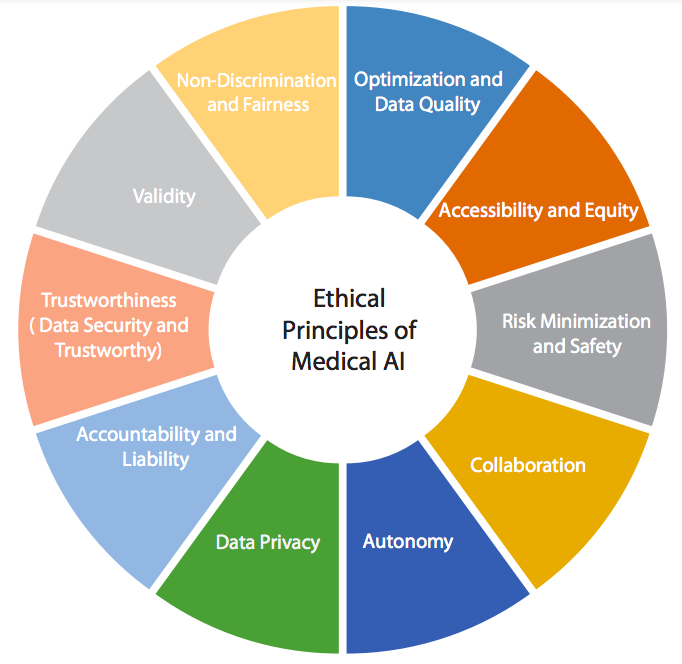
MVAggM7SP0IEnzTF lCkGp1pcZEfJjaUEexdYRqbgDYno7X2Y SnlSNeFEpWlyAgFYRCEuBeMxXhbYE9kMVOS8A5L8DO17ezESyA4

The ten ethical principles in the above figure addresses issues specific to AI for health. These principles are patient-centric and are expected to guide all the stakeholders in the development and deployment of responsible and reliable AI for health. These principles are as follows –

  1. Autonomy – The use of AI in healthcare raises concerns about the potential for the system to operate independently and compromise human autonomy. Incorporating AI into healthcare may result in machines taking over the responsibility of decision-making. It is essential that humans maintain full control over AI-based healthcare systems and medical decision-making. Under no circumstances should AI technology interfere with patient autonomy.
  1. Safety and Risk Minimization – Before widespread implementation, it is necessary to ensure that any AI technology-based system will operate safely and reliably. All stakeholders involved in the development and deployment of the technology bear the responsibility of ensuring participant safety. Patient dignity, rights, safety, and well-being must be the highest priority. Risk levels associated with deploying AI technology in clinical research or patient care depend on the use case and deployment methodology. For instance, unsupervised models run the risk of being more hazardous than those supervised by AI researchers and healthcare professionals. Similarly, the deployment of AI-enabled tools in high-risk patient care areas is riskier than their deployment in other areas.
  1. Trustworthiness Trustworthiness is the most desirable quality of any diagnostic or prognostic tool to be used in AI healthcare. Clinicians need to build confidence in the tools that they use and the same applies to AI technologies. In order to effectively use AI, clinicians and healthcare providers need to have a simple, systematic and trustworthy way to test the validity and reliability of AI technologies.
  1. Data Privacy AI-based technology should ensure privacy and personal data protection at all stages of development and deployment. Maintaining the trust of all the stakeholders including the recipient of healthcare over the safe and secure Ethical Guidelines for Application of Artificial Intelligence in Biomedical Research and Healthcare 19 use of their data is of prime importance to the successful and widespread deployment of AI. Data privacy must aim to prevent unauthorized access, modification, and/ or loss of personal data. The application of AI to personal data must not unreasonably curtail people’s real or perceived liberty.
  1. Accountability and Liability – The concept of accountability entails that an individual or organization is responsible for their actions and should be transparent about their activities. When it comes to AI technologies for healthcare, it is crucial that they are subject to scrutiny by relevant authorities at any given time. Regular internal and external audits must be conducted to ensure that the AI technologies are functioning effectively. The results of these audits should be made available to the public.
  1. Optimization of Data Quality – The performance of AI technology heavily relies on the data utilized for training and testing purposes, making it a data-driven technology. In the healthcare sector, the quality and size of the dataset are critical as a skewed or insufficient dataset can result in issues such as data bias, errors, and discrimination. Data bias is regarded as the most significant risk to data-driven technologies like AI in healthcare. It is crucial to exercise due diligence to ensure that the training data is unbiased and represents a substantial portion of the target population.
  1. Accessibility, Equity and Inclusiveness – The use of computers for development as well as the deployment of AI technologies in healthcare presupposes wider availability of infrastructure. The digital divide is known to exist in almost all countries and is more prominent in low- and middle-income countries (LMICs). The heavy reliance on technology may therefore interfere with the wider application of promising tools in areas where it is expected to make a greater difference. 
  1. Collaboration –  In the field of AI for health, having a large and well-curated dataset is crucial for effective utilization of AI. This can only be achieved through fostering collaboration at all levels. With the rapidly changing landscape of AI technology, it is essential to collaborate among AI experts during research and development to ensure the most appropriate techniques and algorithms are used to address healthcare issues. Collaboration between AI researchers and healthcare professionals throughout the development and adoption of AI-based solutions is expected to enhance the benefits of this promising technology.
  1. Non Discrimination and Fairness Principles: In order to refrain from biases and inaccuracies in the algorithms and ensure quality, the following principles should be followed:
    • The data set used for the training algorithm must be accurate and representative of the population in which it is used. The researcher has the responsibility to ensure data quality.
    • Inaccuracy and biases can cause suboptimal or malfunctioning of AI technologies external independent algorithmic audits and continuous end-user feedback analysis should be performed to minimize inaccuracies and biases. The AI developers/researchers must acknowledge any biases involved and should take the necessary steps to rectify it.
    • AI should never be used as a tool for exclusion. Special attention must be given to under-represented and vulnerable groups like children, ethnic minorities, persons with disabilities, etc. The AI developers should promote the active inclusion of women and minority groups.
    • Developers should give special attention to promoting and protecting the equality of individuals. Freedom, rights and dignity, should be treated with equality and justice.
    • AI technologies should be designed for universal usage. Discrimination of individuals or groups on the grounds of race, age, caste, religion, social status is unethical.
    • The reversibility of decisions made by the AI technology should be considered; if harm has occurred to any patient/ participant. Before implementing the technology, the option for reversibility of decision must be integrated with the AI design.
    • In case of any unfortunate events arise from the malfunctioning of the AI technology occurs, then there should be an appropriate redressal mechanism for the victim. The manufacturer must ensure that there is a provision for proper grievance redressal.
    • There must be a safe mechanism to raise concerns pertaining to the AI technology the issues can be technical, functional, ethical, or misuse of technology. There should be a proper mechanism for protecting the whistleblower.
  1. Validity – AI technology applied in healthcare must undergo rigorous validation in both clinical and field settings to ensure its safety and efficacy for patients or participants. Differences in datasets used for training AI algorithms can amplify the divergence of AI-based algorithms. This discordance in diagnostic abilities among different AI solutions may cause confusion for end-users, including health professionals and patients. It is essential to have an internal mechanism to monitor such issues and provide appropriate feedback to developers while considering the clinical context. An efficient feedback mechanism is also crucial for necessary updates when AI technology affects individuals or healthcare systems. The application of AI-based decisions in clinical settings can lead to potential health hazards or mismanagement.