Context: Supreme Court issued notice to the Election Commission of India on a petition calling for counting of all Voter Verified Paper Audit Trail (VVPAT) paper slips in elections.
About VVPAT
Voter Verifiable Paper Audit Trail (VVPAT) is an independent system attached with the Electronic Voting Machines that allows the voters to verify that their votes are cast as intended.
When a vote is cast, a slip is printed containing the serial number, name and symbol of the candidate and remains exposed through a transparent window for 7 seconds.
Thereafter, this printed slip automatically gets cut and falls in the sealed drop box of the VVPAT.
This allows the voter to verify & confirm that he vote has gone to the candidate of her choice. The system has been made essential for all EVMs.
This is due to fact that many concerns have been raised by stakeholders on the integrity of EVMs.
Supreme Court in Subramanian Swamy vs Election Commission of India gave a judgement that 'paper trail' is an indispensable requirement for free and fair elections. Confidence of voters in EVMs can be achieved only with the introduction of 'Paper Trail'.
Current Rules for counting of VVPATs
Limited counting of VVPATs: Presently, the VVPATs are counted in a limited sense and election results totally depend on EVM vote count. Mandatory verification of VVPAT paper slips is done, as under:
In case of General and Bye elections to State Legislative Assembly, verification of VVPAT paper slips is done for randomly selected 5 polling stations per Assembly Constituency.
In case of General and Bye elections to Lok Sabha, verification of VVPAT paper slips of randomly selected OS(five) polling stations of each Assembly Segment of the Parliamentary Constituency concerned.
The mandatory counting takes place after the last round of counting of votes as recording in EVMs.
The 5 polling stations for which the counting is to be done are randomly selected by draw of lots.
Sequence of VVPAT count: ECI has prescribed given a priority order in which counting of VVPATs is to be done. This causes undue delay. If simultaneous verification of VVPAT paper slips is done the process of counting can be made more efficient.
Opinion of Election Commission of India
EVMs are non-tamperable, both owing to technological and strict administrative measures. Hence, EVMs cannot be tampered with or manipulated.
Counting all VVPATs slips manually would be labour and time-intensive and will also be prone to 'human error' and 'mischief'. This will be as going back to paper ballot system.
According to ECI, Ballot slips of 38,156 randomly selected VVPATs have been tallied till date with the electronic counts of their control unit (CU), asserting that not a single case of transfer of vote meant for one candidate to another has been detected.
Context: The high-level committee headed by former President Ram Nath Kovind has recommended simultaneous elections to the Lok Sabha and State Assemblies as the first step, and holding municipal and panchayat polls within 100 days of the general election in the next phase.
MERITS OF HOLDING SIMULTANEOUS ELECTIONS
More focus on long term development & growth - Cycle of continuous elections affects developmental process and good governance and also forces political class to typically think in terms of immediate electoral gains rather than focus on long-term programs and policies for the overall progress of the nation and its people. A period of election free years will allow political class and government members in states and centre to focus more on long term development process.
Lesser period for imposition of MCC: Imposition of Model Code of Conduct (MCC) puts on hold the entire development program and activities of the Union and State Governments in the poll bound State. It even affects the normal governance. Frequent elections lead to imposition of MCC over prolonged periods of time. This often leads to policy paralysis and governance deficit”. Thus, periodic elections will help government to focus more on developmental works.
Reduce massive expenditure on elections - Elections lead to huge expenditures by various stakeholders. Every year, Union and State Government bear expenditures on account of conduct, control and supervision of elections. Besides the Government, candidates contesting elections and political parties also incur huge expenditures. The candidates normally incur expenditures on account of various necessary aspects such as travel to constituencies, general publicity, organizing outreach events for electorates etc. while the political parties incur expenditures to run the party’s electoral machinery during elections, campaigning by star leaders and so on. Thus, holding simultaneous elections will help in reducing cost significantly.
Will decrease Corruption & Black Money Expenditure during elections - Candidates and political parties in their bid to win elections end up spending significantly more than the prescribed expenditure limits. The urge to spend more than prescribed limits to win elections, is consequently blamed as one of the key drivers for corruption and black-money in the country. Dr. S. Y. Quraishi, former Chief Election Commissioner, remarked, “elections have become the root cause of corruption in the country. After winning elections, the politician-bureaucrat nexus indulges in recovering the investment” and that is where corruption begins”. Thus, holding simultaneous elections will provide less opportunity to politicians to use unaccounted money for bribe and corruption.
Manpower can be better utilised - The Election Commission of India takes help of a significant number of polling officials as well as armed forces to ensure smooth, peaceful and impartial polls. While conducting elections to the 16th Lok Sabha, the ECI took the help of approximately 10 million personnel as polling officials for running and supervising the election process across 9,30,000 Polling Stations of the country. For providing the required security arrangements, the Election Commission generally involves Central Armed Police Forces (CAPF). As the demand for CAPF is typically higher than the supply, police forces such as State Armed Police, Home Guards, District Police etc. are often deployed as well to complement security arrangements. The role of such security forces starts much before polling and ends only after the counting of votes and declaration of results effectively covering the entire duration of the elections. These security officials are also deployed during state elections. Thus, holding simultaneous elections will allow better utilisation of central and state security forces.
Disruptions to public life and essential services will be limited for a fixed period - Frequent elections disrupt normal public life. frequent elections lead to disruption of normal public life and impact the functioning of essential services. Holding of political rallies disrupts road traffic and leads to noise pollution. If simultaneous elections are held, this period of disruption would be limited to a certain pre-determined period of time”.
Lesser disruptions because of polarisations taking place during elections - Elections are polarising events which have accentuated casteism, communalism, corruption and crony capitalism. If the country is perpetually on election mode, there is no respite from these evils. Holding simultaneous elections would certainly help in this context”. Thus, holding elections every five years will lead to greater period of peace without unnecessary polarisation.
DEMERITS OF HOLDING SIMULTANEOUS ELECTIONS
National Issues overriding Regional Issues - Assembly elections are fought on local state issues and, in the true spirit of federalism, parties and leaders are judged in the context of their work done in the state. Clubbing them with the general election could lead to a situation where the national narrative submerges the regional problems and issues.
Difficult for Voters to decide on national & regional lines - India has a federal structure and a multi-party democracy where elections are held for State Assemblies and Lok Sabha separately. The voters are better placed to express their voting choices keeping in mind the two different governments which they would be electing by exercising their franchise. This distinction gets blurred somewhat when voters are made to vote for electing two types of government at the same time, at the same polling booth, and on the same day.
No Guarantee of Tenure of 5 Years for Lok Sabha & State Assemblies - There may be a scenario where due to constitutional failure in a state, the state assembly has to be dissolved. Or, Lok Sabha can be dissolved prematurely if No Confidence Motion is passed. So, such scenarios must be provided for in the constitution. This will need constitutional amendment.
Need to align state assemblies with Lok Sabha - Holding Simultaneous Elections along with Lok Sabha would need either extending tenure of some State Assembly for more than 5 years or reducing tenure of other state assemblies. This will require another constitutional amendment.
Difficult to Deploy entire Security Forces at the same time throughout India
Lack of Political Consensus on holding simultaneous elections among different political parties.
Kovind Panel Recommendation ·
Elections to Lok Sabha and state Assemblies should be held at the same time and, subsequently, elections to local bodies (municipalities and panchayats) too should be “synchronised” so that they are held within 100 days of the simultaneous state and national elections.·
Committee has suggested an overall 15 amendment to the constitution - in the form of both new provisions and changes to existing provisions — to be carried out through two Constitution Amendment Bills.· The first Bill will deal with the transition to a simultaneous election system, and the procedure for fresh elections to Lok Sabha or a state Assembly before the expiration of their stipulated five-year term.
The first Bill recommended by the Kovind committee would begin by inserting a new article— 82A —into the Constitution.
According to the committee report, Article 82A(1) will state that “on the date of the first sitting of the House of the People after a general election”, the President will issue a notification bringing Article 82A into effect. The date of this notification “shall be called the Appointed date”.
Article 82A(2) will state that “all the Legislative Assemblies constituted in any general election held after the appointed date shall come to an end on the expiry of the full term of the House of the People”.
The proposed Article 82A(3) requires the ECI to hold “General elections to the House of the People and the Legislative Assemblies simultaneously”. If the ECI believes that elections to any legislative assembly cannot be conducted simultaneously, “it may make a recommendation to the President, to declare by an Order, that the election to that Legislative Assembly may be conducted at a later date”. (Article 82A(4)).
"The full term of the Legislative Assembly shall end on same date as the end of the full term of the House of the People constituted in the General Election”. (Article 82A(5)) o The power of Parliament under Article 327 should be expanded to include “conduct of simultaneous elections” as well.
When Lok Sabha or State Assembly is dissolved before ‘full term’ ends – Panel proposed amendments to Article 83 (“Duration of Houses of Parliament”) and Article 172 (“Duration of the State Legislatures”).
If Lok Sabha or a state Assembly is dissolved before the expiry of the full term, the remaining period will be referred to as the “unexpired term”.
The recommended Articles state that the Lok Sabha or state Assembly that replaces the previous one will serve only for the remaining “unexpired term” before being dissolved again once simultaneous elections are conducted as scheduled.
The report has also recommended the amendment of certain laws relating to legislative Assemblies in Union Territories to ensure that Assembly elections in UTs also take place simultaneously with Lok Sabha and state Assembly elections. ·
The second Bill will deal with municipal and panchayat elections, as well as the creation of a Single Electoral Roll by the Election Commission of India (ECI), with details of every voter and the seat for which they are eligible to vote.
The committee has suggested the inclusion of a new Article 324A in the Constitution. This new article would empower Parliament to make laws to ensure that municipality and panchayat elections are held simultaneously with the General Elections (to Lok Sabha and state Assemblies).
The new Article 325(2) proposed by the committee that will create a “Single Electoral Roll for every territorial constituency for election in the House of the People, Legislature of a State or to a Municipality or a Panchayat”.
This electoral roll “shall be made by the Election Commission in consultation with the State Election Commissions”
WAY FORWARD
The proposal to introduce simultaneous elections in India both to Lok Sabha and State Assemblies is a bold reform and must be carried forward with the consensus of all state assemblies and political parties.
Draft proposal must be made by NITI Aayog on important constitutional amendments and other amendments in Representation of People Act and other laws which would be needed to hold simultaneous elections in India.
Election Commission must come up with its administrative framework regarding the steps necessary to ensure free, fair and transparent elections in India.
Context: Government had established a committee under the Chairmanship of Former President Ramnath Kovind and other legal luminaries to evaluate the need, challenges and suggest practical reforms for operationalisation of simultaneous elections at the level of the House of the People (Lok Sabha), State Legislative Assemblies and Local bodies such as Panchayats and Municipalities.
Suggestions by Ramnath Kovind Committee on Operationalisation of Simulataneous Elections
Government must develop a legally tenable mechanism to restore the cycle of simultaneous elections.
Proposed Mechanism by the Committee:
Step 1: Simultaneous elections to Lok Sabha and State Legislative Assemblies should be held.
Step 2: Elections to Municipalities and Panchayats will be synchronized with Lok Sabha and State Legislative Assemblies n such a way that elections to Municipalities and Panchayats are held within a hundred days of elections of Lok Sabha and State Legislative Assemblies.
Proposal for bring synchronisation between the House of People and State Legislative Assemblies:
President, may by notification, issued on the date of first sitting of House of the People (Lok Sabha) after a General Election. The date of this notification shall be called the Appointed date.
Tenure of all State Legislative Assemblies, constituted by elections to State Legislative Assemblies after the Appointed Date and before the expiry of the full term of Lok Sabha, shall be only for the period pending up to the subsequent General elections to the Lok Sabha. (ie Tenure of State Legislative Assemblies will be full term of the House of People).
Thereafter, all General elections to Lok Sabha and all State Legislative Assemblies shall be held simultaneously.
Proposal for enabling simultaneous elections in Constitutional Local Bodies (Panchayats & Municipalities with Lok Sabha and State Legislative Assembly): (Introduction of Article 324A) This Constitution Amendment should be introduced for enabling simultaneous elections in Panchayats and Municipalities with General elections of Lok Sabha and State Legislative Assemblies.
Solution to Hung House, No-Confidence Motion or Defection:
In the event of a hung house, no-confidence motion or any such events, fresh elections may be held to constitute the new House. However, the tenure of the newly House of People or State Legislative Assembly will be only for the unexpired term (or remaining term) of the immediately preceding full term of House of People. After the expiration of this remaining term, there will be dissolution of the House.
Similarly, where fresh elections are held for State Legislative Assemblies, then such new Legislative Assembly unless sooner dissolved, shall continue up to the end of the full term of the House of People.
These changes will require amendments Article 83 (Duration of Houses of Parliament) and Article 172 (Duration of State Legislatures). This Constitution Amendment will not need ratification by the States.
Single Electoral Roll and Single Elector's Photo Identity Card: (Amendment of Article 325) Required for enabling Single Electoral Roll and Single Elector's Photo Identity Card (EPIC), which shall be prepared by ECI in consultation with State Election Commission. This Single Electoral Roll will substitute any other electoral roll prepared by ECI under Article 325 or State Election Commission (SEC) under Article 243K and 243ZA of Indian Constitution. This amendment to the Constitution will require ratification by more than 50% of State Legislative Assemblies.
Addressing of Logistical Challenges:
For Simultaneous elections to Lok Sabha and State Legislative Assemblies: For making logistical arrangements for conduct of simultaneous elections to the House of People and State Legislative Assemblies, the ECI may estimate in advance for the procurement of equipment such as EVMs and VVPATs, deployment of polling personnel and security forces and make other arrangements.
For elections to Municipalities and Panchayats: State Election Commission in consultation with Election Commission of India may estimate in advance for procurement of equipment such as EVMs & VVPATs, deployment of polling personnel and security forces.
Context: Recently, Election Commissioner Arun Goel resigned from the office of Election Commissioner. This has reduced the number of members in Election Commission to only one member. As the General Elections approach in 2024, there is a need to appoint new members as Election Commissioners for efficient conduct of General Elections.
Context of the Enactment of the Act
Constitution Bench of Supreme Court in the Anoop Baranwal vs UoI case that a committee comprising Prime Minister, Leader of Opposition of Lok Sabha and Chief Justice of India will advise the President on appointments to the Election Commission of India until Parliament enacts a law on the subject.
Grounds for this judgement
The executive full control over the appointment of CEC and other ECs to the Election Commission of India (ECI) degraded the independence of ECI.
Collegium like independent body for appointment of CEC and other ECs will provide a level playing field to all parties.
Greater trust among the opposition.
Greater check on the political party enjoying power in the Centre.
Ensuring greater fairness in elections.
Article 324 of Constitution of India
Superintendence, direction and control of the preparation of electoral rolls and conduct of all elections to Parliament, State Legislature of every State and elections to the offices of President and Vice-President shall be vested in the Election Commission of India (ECI).
Appointment of CEC and other ECs to be made by President shall be subject to provisions of any law made in the behalf by Parliament.
CEC to act as the Chairman of ECI.
Subject to provisions of any law made by Parliament, the conditions of service and tenure of office of CEC, other ECs and Regional Commissioners shall be such as the President may determine.
Before each general election to Lok Sabha, Legislative Assembly of each State and before each biennial election to Legislative Council of each State, the President may also appoint after consultation with Election Commission such Regional Commissioners to assist Election Commission.
Conditions of service and tenure of office of CEC and other ECs and Regional Commissioners shall be determined by President.
CEC shall not be removed from his office except in like manner and grounds as a judge of Supreme Court. Also, conditions of service of CEC shall not be varied to his disadvantage after his appointment.
Other ECs and Regional Commissioners shall not be removed from office except on the recommendation of CEC.
President, Governor of a State shall make available to the ECI or Regional Commissioner such staff as may be necessary for the discharge of functions.
Salient features of Act
Composition of Election Commission: Election Commission shall consist of (a) Chief Election Commissioner and (b) such number of other Election Commissioners as the President may fix.
Qualifications of CEC and other ECs: Persons holding or have held a post equivalent to the rank of Secretary to Government of India. They shall be persons of integrity having knowledge and experience in management and conduct of elections.
Search Committee: A Search Committee headed by the Minister of Law & Justice and comprising two other members not below the rank of secretary to Government of India shall prepare a panel of five persons for consideration of the Selection Committee for appointment as CEC and other ECs.
Selection Committee: CEC and other ECs shall be appointed by the President on the recommendation of a Selection Committee consisting of:
Prime Minister - Chairperson
Leader of Opposition of Lok Sabha - Member
Union Cabinet Minister to be nominated by Prime Minister - Member
(Note: Selection Committee can also consider any other person than those included in the panel by the Search Committee).
Term of office of CEC and other ECs:
CEC and other ECs shall hold office for a term of 6 years from the date on which he assumes his office or till he attains the age of 65 years.
CEC and other ECs shall not be eligible for re-appointment.
Where an Election Commissioner is appointed as CEC, his term of office shall not be more than 6 years in aggregate as the EC and the CEC.
Salary: CEC and other Election Commissioners salary will be equal to the salary of Supreme Court judge.
Resignation & Removal:
CEC and other ECs can resign office by writing to the President.
CEC shall not be removed from his office except in like manner and on like grounds as a Judge of Supreme Court.
Other ECs shall not be removed from office except on the recommendation of the CEC.
Leave
CEC and other ECs may be granted leaves in accordance with the rules of the service to which he belonged before appointment. They are also eligible to carry forward the leave standing at his credit on such date.
Power to grant or refuse leave to the CEC and other ECs is vested in the President.
Other conditions of service: President may be rules determine the conditions of service relating to travelling allowance, medical facilities, leave travel concession, conveyance facilities and such other conditions relating to CEC and other ECs.
Transaction of business of Election Commission
Election Commission may regulate procedure and allocation of its business by a unanimous decision amongst the CEC and other ECs.
However, if there is any difference of opinion, such a matter shall be decided according to the opinion of majority.
Protection of CEC and other ECs: No court shall entertain to continue any civil or criminal proceedings against any person who is or was a CEC or an EC for any act, thing or word, committed, done or spoken by him in the course of acting or in the discharge of his official duty or function.
Context: Supreme Court sought a response from the States of Madhya Pradesh and Rajasthan on a plea that public funds are being misused to offer irrational freebies ahead of elections.
Freebies
The dictionary meaning of the word freebie is something that you’re given free. But in practice, there is no precise definition of freebies.
The services or provisions provided by the state or union government, such as free electricity, free water, free public transportation, waiver of pending utility bills, and farm loan waivers, etc., straining their resources in the hope of electoral benefits, can be regarded as freebies.
It is important to distinguish them from public-merit goods, expenditure on which brings economic benefits, such as the public distribution system, employment guarantee schemes, states’ support for education and health.
Issues Associated with Freebies
Election Commission observed that the distribution of freebies undoubtedly by influencing the decision of electorate shakes the root of free and fair elections.
Governments resort to the freebie culture to cover up their failure in providing adequate jobs or skilling or ensuring decent livelihood to citizen.
Critics argue that freebies disrupt state finances and throw governments into a debt spiral.
It undermines credit culture and promotes rent seeking behavior among citizens.
It distorts prices through cross-subsidisation eroding incentives for private investment.
The widespread practice of offering freebies by politicians, across party lines and for electoral benefits, drains public finances that can be used instead for more concrete policy initiatives.
For example, Punjab’s electricity subsidy and its rising cost to the state exchequer is over 16 per cent of total revenues.
Section 126 of the RP Act
It prohibits displaying any election matter by means, inter alia, of television or similar apparatus, during the period of 48 hours before the hour fixed for conclusion of poll in a constituency.
Steps Taken
Guideline Issued by Election Commission Regarding Manifesto and Freebies
The Commission, in the interest of free and fair elections directed that Political Parties and Candidates while releasing election manifestos for any election to the Parliament or State Legislatures, shall adhere to the following guidelines:
Provision
“The election manifesto shall not contain anything repugnant to the ideals and principles enshrined in the Constitution and further that it shall be consistent with the letter and spirit of other provisions of the Model Code of Conduct.”
“Provides that political parties should avoid making those promises which are likely to vitiate the purity of the election process or exert undue influence on the voters in exercising their franchise.”
“In the interest of transparency, level playing field and credibility of promises, it is expected that manifestos also reflect the rationale for the promises and broadly indicate the ways and means to meet the financial requirements for it. Trust of voters should be sought only on those promises which are possible to be fulfilled.”
In the case of single-phase election, manifesto shall not be released during the prohibitory period, as prescribed under Section 126 of the Representation of the People Act, 1951.
In case of multi-phase elections, manifesto shall not be released during the prohibitory periods, as prescribed under Section 126 of the Representation of the People Act, 1951, of all the phases of those elections.”
Supreme Court Cases
Indira Nehru Gandhi v. Raj Narain (1975)
In this case the Supreme Court held “free and fair elections” to be a basic structure of the Constitution.
S. Subraminam Balaji v. State of Tamil Nadu & Others (2013)
In this case, the Supreme Court ordered the Election Commission to develop election manifesto guidelines after discussing with all recognised political parties.
In light of this, the Election Commission created the rules and included them in the Model Code of Conduct.
The court determined that while the promises made in the election manifestos cannot be considered “corrupt practices” under Section 123 of the Representation of People’s Act, 1951, it is unavoidable that the giving away of freebies of any kind impacts voters.
Ashwini K Upadhyay v. Government of National Territory of Delhi (2021)
In this case, the Apex Court observed that a poll manifesto does not have statutory backing and, hence, its enforceability is not within the purview of the courts.
So, the court cannot give directions to any Government to pass or provide anything that is promised by political parties in their party manifesto.
Way Forward:
The Election Commission has said the issue of freebies should be left to voters as it cannot regulate state policies and decisions which may be taken by the winning party when they form the government. Such an action, without enabling provisions in the law, would be an overreach of powers, the commission has said.
For a country with high poverty rates and persistent economic disparities, welfare schemes are a lifeline for huge populations that demand that a clear definition of freebies differentiating them from the welfare programmes should be arrived at.
The democratic forum such as inter-governmental institutions can frame the freebies debate and build a political consensus.
The parliament, as a representative body, can debate on the freebies and legislate policies to regulate them.
It is essential that political consensus are built, involving the Centre as well as states, to arrest the misuse of welfare schemes and the resultant adverse impacts on the country’s fiscal health.
The promises of welfare made by political parties to their electorates are part of the key process of bargaining in a democracy where the voter’s judgement is paramount. The interference perceived or real, of non-elected institutions can distort the dynamics of electoral democracy.
It also belittles the electorate’s agency and sense of judgement undermining the basic principle of democracy. So, while regulation of freebies is a necessary evil, political education should be promoted among citizens at the same time.
Context: Recently constituted committee under the leadership of former President Ram Nath Kovind to examine and recommend if the constitutional amendments for simultaneous elections would require ratification by the States.
Provisions that may demand amendment of constitution for simultaneous election
Simultaneous elections will need at least five constitutional amendments. The articles that would require amending are:
Article 83 (2): It says the Lok Sabha's term should not exceed five years, but it may be dissolved sooner.
Article 85 (2) (b): A dissolution ends the very life of the existing House, and a new House is constituted after general elections.
Article 172 (1): A state assembly, unless sooner dissolved, shall continue for five years
Article 174 (2) (b): The Governor has the power to dissolve the assembly on the aid and advice of the cabinet. Governor can apply his mind when the advice comes from a Chief Minister whose majority is in doubt.
Law Commission draft report on Simultaneous Election (2018)
The Law Commission of India chaired by Justice B. S. Chauhan provide the following:
It suggested that simultaneous elections would require amendments to various constitutional provisions, the Representation of the People's Act 1951, and the Rules of Procedure of Lok Sabha and State Assemblies.
The Commission highlighted that a constitutional amendment to this effect must receive ratification from at least 50% of the States.
Amendment Process Mentioned in the Constitution
Most of the constitution can be amended through a simple majority of those present and voting in each House of Parliament. Some examples include amendments contemplated in:
Article 4: changes related to the organisation of States.
Article 169: abolition or creation of Legislative Councils in States
Schedule VI: provisions for the administration of Tribal Areas in the States of Assam, Meghalaya, Tripura and Mizoram. Etc.
Amendment under Article 368
Under Article 368 Constitution provide for two kinds of amendments
Article 368(1): For amending the provision like Fundamental Rights just ‘Special majority’ (not less than two-thirds of the members are present and voting in each House of Parliament as well as a majority of the total membership of each House) is needed.
Article 368(2): For amendment under this article both a ‘special majority’ and ratification by at least one-half of the State legislatures is required. These are commonly referred to as ‘entrenched provisions’ and are as follows:
if there is a change in the provisions regarding elections to the post of the President of India (Article 54 and 55).
if there is a change in the extent of the executive power of the Union or the State governments (Article 73 and 162).
if there is any change in the provisions regarding the Union judiciary or the High Courts (Articles 124–147 and 214–231).
if the distribution of legislative and administrative powers between the Union and the States is affected (Article 245 to 255).
if any of the Lists in the Seventh Schedule is affected.
if the representation of the States in Parliament is changed (Article 82).
if Article 368 itself is amended.
Constitutional Perspective about the ratification by the states
Federal Structure: Dr. B.R Ambedkar was in favour of the ratification by States for the amendment of certain constitutional provisions to ensure that the federal structure of the Constitution remains fundamentally unaltered.
Principle of separation of Power: Dr. Ambedkar cautioned that permitting all constitutional amendments to take place by a simple majority would defeat the principle of separation of powers among the three organs of the State.
Need of State Ratification: Supreme Court Cases
Kihoto Hollohan versus Zachillhu (1992): The Anti-Defection case
In this case the constitutional validity of the Constitution (Fifty-second Amendment) Act, 1985 was challenged on the grounds that the amendment was not ratified by the States.
Though the Tenth Schedule was to deal with defection, it also seems to oust the jurisdiction of all courts by virtue of Paragraph 7.
The amendment brought about changes with respect to the jurisdiction of the Supreme Court and the High Courts one of the provisions that require ratification by half of the States.
A Constitution Bench of the Supreme Court upheld the validity of the Tenth Schedule but declared Paragraph 7 of the Schedule invalid for want of ratification.
Union of India versus Rajendra N. Shah (2021)
in this case SC struck down provisions of the Constitution (97th Amendment) Act, 2011 to the extent that it introduced Part IX B in the Constitution to deal with co-operative societies.
The Court unanimously held that the amendment required ratification by at least one-half of the State legislatures as per Article 368(2) of the Constitution, since it dealt with an exclusive State subject of the Seventh Schedule.
The majority judgment invoked the doctrine of severability to make Part IXB operative only insofar as it concerns multi-State cooperative societies.
Context: A committee has been formed under the headship of former President of India Ram Nath Kovind, to look into the feasibility of simultaneous elections to State Assemblies and the Lok Sabha.
About One Nation One Election
The idea of "One Nation One Election" entails aligning the electoral cycles of Indian Lok Sabha (LS) and State Assemblies, allowing voters to cast their ballots for both on a single day.
This practice was prevalent until 1967, but it was discontinued following the dissolution of some assemblies in 1968 and 1969, followed by the dissolution of the Lok Sabha in 1970.
Arguments in Favour
Firstly, it reduces the frequent imposition of the Model Code of Conduct (MCC), which often leads to policy paralysis and disrupts essential developmental work.
Secondly, it curtails substantial expenditures incurred bypolitical parties, individual candidates, and other stakeholders.
Thirdly, it optimises the deployment of security forces, freeing them up for other vital internal security purposes.
Fourthly, it addresses the issue of frequent elections hindering legislative work, preventing governments from squandering resources on short-term, unproductive freebies.
Furthermore, it diminishes the divisive influence of caste, religion, and communal issues in society.
Lastly, it minimises the hidden and unquantifiable socio-economic costs, such as teachers missing from schools, revenue machinery diverted to election-related work, and the economic costs of lost teaching weeks and poorly executed welfare programs for the disadvantaged.
Arguments Against
Aligning the terms of various assemblies would necessitate constitutional changes, which are currently difficult to implement.
Additionally, the absence of fixed terms for the Lok Sabha and state assemblies complicates synchronisation efforts.
Further, this move infringes upon the spirit of federalism, limiting the state legislatures' authority to unseat a government through no-confidence motions.
It also complicates voters' decision-making as they must weigh national and local issues simultaneously.
Frequent elections and electoral outcomes serve as mechanisms for governments to make necessary course corrections, and this might be hindered by simultaneous elections.
Logistic challenges, including arranging Electronic Voting Machines (EVMs), manpower, and security forces, present practical difficulties.
Moreover, regional parties may face a comparative disadvantage against national parties in such a setup.
The Way Forward
To address these concerns, various suggestions have been proposed.
One approach is to conduct electionsin two phases, as recommended by a Parliamentary Standing Committee. Phase I would coincide with Lok Sabha elections, while Phase II would occur approximately midway through the Lok Sabha's term, resulting in elections every 2.5 years once synchronisation is achieved.
The Election Commission has recommended measures to avoid premature dissolution, such as moving confidence and no-confidence motions together and conducting fresh elections for the remainder of the term.
Additionally, the Law Commission has put forward recommendations:
It includes defining "simultaneous elections” in the Representation of the People Act (RPA) of 1951 and amending provisions to ensure that LS and assembly constituencies formed after midterm elections serve only for the remaining term.
The anti-defection law could be amended to prevent stalemates, and the statutory limit for general election notifications could be extended. It's proposed that no-confidence motions could be followed by the option to form an alternative government.
Lastly, the Prime Minister or Chief Minister could be elected to lead the Lok Sabha or Assembly by the entire house, similar to electing the Speaker of the Lok Sabha, providing greater stability to the government.
Conclusion
Implementing simultaneous elections in India is a complex undertaking requiring extensive coordination and consultation among all stakeholders. A phased synchronisation of LS and Assembly tenures, as suggested by a Parliamentary Committee, may be a more feasible approach than an immediate, one-time overhaul of the electoral system.
Context:The recent announcement made by the Prime Minister of India during the inauguration of the new Parliament building highlighted a plan to expand the representation in Lok Sabha by increasing the number of seats and Members of Parliament (MPs).
What is Delimitation?
Delimitation refers to the process of redrawing the boundaries of constituencies or electoral areas. This process is carried out periodically to ensure that each constituency has a roughly equal number of voters, based on the principle of "one vote, one value."
After each census, a readjustment is to made in (a) allocation of seats in the Lok Sabha to the States, and (b) division of each state into territorial constituencies.
Parliament is empowered to determine the authority and the manner in which it is to be made.
Delimitation is necessary because population distribution changes over time, with some areas experiencing significant growth while others may decline. This can result in a situation where certain constituencies have a much larger or smaller number of voters compared to others, leading to an imbalance in representation.
About Delimitation Commission:
Delimitation Commission is appointed by the President of India.
Composition: Chief Election Commissioner, Retired Judge of Supreme Court and Election Commissioner of the concerned State.
Orders of Delimitation Commission cannot be called in question before any court of law.
The copies of its orders are laid before the House of People and State Legislative Assembly concerned, but no modifications are permissible therein by them.
Impact of Delimitation:
Balancing the Political Power: Delimitation can alter the distribution of political power among different regions and communities. The Redrawal of the constituencies can impact the electoral prospects of political parties and candidates, potentially impacting the political dynamics and power balance within a particular region or state. E.g., During 2008 delimitation exercise, Jharkhand witnessed a significant realignment of political power when the boundaries of constituencies were redrawn.
Addressing Demographic Shifts: In 2002, constituencies in states like Maharashtra and Tamil Nadu were redefined to address the substantial population growth in urban areas. It paved the way for better reflection of population changes and ensured that urban centers had adequate representation in the legislative bodies.
Minority Representation: Delimitation exercises have been instrumental in ensuring better representation for minority communities. In the 2008 delimitation exercise, constituencies in regions with a significant concentration of minority communities, such as Malappuram in Kerala, were adjusted to ensure their political interests were adequately represented.
Enhanced Gender Representation: Delimitation exercises have also contributed to improving gender representation in politics. E.g., during the 2008 delimitation exercise, the constituencies in certain states were redrawn to facilitate reservation of seats for women in local bodies, thereby promoting greater participation of women in the political process.
Fair Representation: Delimitation aims to ensure fair representation by readjusting the boundaries of constituencies based on population changes. It helps in balancing the number of voters per representative, ensuring that each vote holds relatively equal weight and upholding the democratic principle of "one person, one vote."
Issues associated with Delimitation:
The delimitation exercise, aimed at rearranging and standardizing the number of people per constituency, may result in decreased representation for States that have achieved population stabilization. E.g., Kerala, Tamil Nadu. It may lead to increased representation for States that are still experiencing population growth and have not yet achieved stability.
Delimitation exercises often face challenges in implementation due to logistical and administrative issues. For instance, the delimitation exercise planned for the state of Jammu and Kashmir faced delays and obstacles due to the unique circumstances and complexities of the region.
Roadmap for Future
The Commission can choose to implement freezing of seats, until all States have achieved population stabilization.
Alternatively, Commission can develop a customized mathematical model inspired by the 'Cambridge Compromise'. This model would aim to provide a mathematically equitable formula for the allocation of seats, similar to the apportionment of seats in the European Parliament. #Best Practice
It is essential to ensure that the delimitation process is carried out fairly, transparently, and with adequate consideration for the interests of all communities and regions.
Context: The Election Commission of India has announced by polls for one Lok Sabha seat and four Assembly constituencies, to be held on May 10, with results on May 13.
What is By poll or bye election?
In India, a by-election (also known as a by poll or bye-election) is an election held to fill a vacancy in the Lok Sabha (the lower house of the Indian Parliament) or a state legislative assembly.
These vacancies can occur due to various reasons such as the death, resignation or disqualification of a sitting member of parliament or the state assembly.
By-elections are conducted by the Election Commission of India, which is an independent body responsible for organizing and overseeing elections at various levels of government in India.
By-elections are usually held within six months of the vacancy occurring, although this can vary depending on the specific circumstances.
Candidates from various political parties can contest the by-election, and the winner is elected to fill the vacant seat until the next general election.
By-elections are important as they provide an opportunity for citizens to exercise their right to vote and elect a representative to fill a vacant seat in the legislative assembly or parliament.
They also have the potential to impact the balance of power in parliament or the state assembly, as a single seat can sometimes make a significant difference in the overall composition of the house.
About Representation of the People Act, 1951
The provisions for the actual conduct of elections to the Houses of Parliament and to the House or Houses of the Legislature of each State, the qualifications and disqualifications for the membership of these Houses, the corrupt practices and other election offences, and the decision of election disputes were all left to be made in a subsequent measure. In order to provide for these provisions, the Representation of the People Act, 1951 was enacted.
Broadly speaking, this Act contains provisions relating to the following electoral matters:
Qualifications and disqualifications for membership of Parliament and State Legislatures.
The Election Commission (EC) has proposed to change the rules pertaining to the conduct of elections to facilitate the Electronically Transmitted Postal Ballot System (ETPBS) for overseas Indian voters. For this purpose, EC is in discussion with the Ministry of External Affairs to iron out logistical challenges in implementing the same.
There are three categories of Electors in India: 1. General Electors, 2. Overseas (NRI) Electors and 3. Service Electors or Voters. Union Law Minister stated that the total number of overseas voters on January 1 stood at over 1.15 lakh.
Who can Enroll as Overseas Elector/NRI Voter? A citizen of India, absent from the country owing to employment, education etc. who has not acquired citizenship of any other country and are otherwise eligible to be registered as a voter in the address mentioned in your passport.
Manner and procedure of registration of overseas electors It has been prescribed by the Registration of Electors (Amendment) Rules, 2011, notified by the Ministry of Law and Justice, Legislative Department, Government of India. According to Rule 8A of Registration of Electors Rules, 1960 application for registration as Overseas Electors has to be made to Election Registration Officers in Form 6A.
Constitution of India
Article 326 declares that elections to the House of the People and to the Legislative Assemblies of States shall be on the basis of adult suffrage and every person who is a citizen of India and who is not less than 18 years of age on a prescribed date and is not otherwise disqualified under this Constitution or any law made by the appropriate Legislature on the ground of non-residence, unsoundness of mind, crime or corrupt or illegal practice, shall be entitled to be registered as a voter at any such election.
Further Section 62 of Representation of People Act, 1951 provides for the process of right to vote.
Important highlights - Section 62 - Right to vote (RPA-1952)
Only such persons shall be entitled to vote whose name is registered in a constituency.
A person shall not vote if he/she is disqualified under Section 16, RPA-1950.
If any person votes in more than one constituency, then their votes in every constituency shall be void.
Voting more than once in the same constituency will also result in making the votes void.
If a person is confined in a prison, whether under a sentence of imprisonment or transportation or otherwise, or is in the lawful custody of the police – then such person cannot vote. However, a person in preventive detention can vote including voting in the Presidential elections.
However, a person can vote as proxy for another candidate and such proxy vote shall not be declared as void.
Prior to 2010
An Indian citizen who was an eligible voter and was residing abroad for more than six months owing to employment, education or otherwise was not allowed to vote.
This was because the NRI’s name was deleted from electoral rolls if he or she stayed outside the country for more than six months at a stretch.
Post 2010
The Representation of the People (Amendment) Act, 2010 - eligible NRIs who had stayed abroad beyond six monthswere allowed to vote, but only in person at the polling station where they have been enrolled as an overseas elector. (Section 20A)
Overseas Indian citizens like other Indian citizens are therefore allowed to vote but have to be physically present.
In the case of overseas voters, their address mentioned in the passport is taken as the place of ordinary residence and chosen as the constituency for the overseas voter for enrollment.
THE REPRESENTATION OF THE PEOPLE ACT, 1950
Section 20A - Special provisions for citizens of India residing outside India –
(1) Notwithstanding anything contained in this Act, every citizen of India—
whose name in not included in the electoral roll;
who has not acquired the citizenship of any other country; and
who is absenting from his place of ordinary residence in India owing to his employment, education or otherwise outside India (whether temporarily or not),
shall be entitled to have his name registered in the electoral roll in the constituency in which his place of residence in India as mentioned in his passport is located.
(2) The time within which the name of persons referred to in sub-section (1) shall be registered in the electoral roll and the manner and procedure for registering of a person in the electoral roll under sub-section (1) shall be such as may be prescribed.
(3) Every person registered under this section shall, if otherwise eligible to exercise his franchise, be allowed to vote at an election in the constituency.
Service Voters
Service voter is a voter having service qualification. According to Section 20 (8) of Representation of People Act, 1950,service qualification means:
Being a member of the armed Forces of the Union; or
Being a member of a force to which provisions of the Army Act, 1950 (46 of 1950), have been made applicable whether with or without modification;
Being a member of an Armed Police Force of a State, and serving outside that state; or
Being a person who is employed under the Government of India, in a post outside India.
Election Commission during the Lok Sabha Elections of 2019 allowed voting through Electronically Transmitted Postal Ballot System (ETPBS).
The service voters were sent postal ballots electronically one way to save processing time, resources and avoid human errors.
Electronically transmitted postal ballot system(ETPBS)
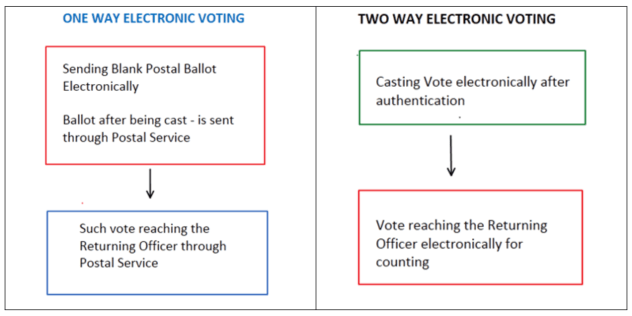
Electronically Transmitted Postal Ballot System (ETPBS) is the one-way electronic transmission of the Postal ballots to the Service Voters.
The Service Voter then cast their vote and send it to the respective returning officer via Post. The complete process is secured by way of multiple checks and transmission protocol to ensure safe transmission.
Upon receipt of the postal ballot at the counting centres, the returning officer validates the receipt by a series of QR codes with that of the transmitted system.
Functionality of ETPBS
Returning Officer generates ballot paper electronically by a specific desktop application. This ballot then gets encrypted in the system is ready to be sent.
The first functionality is the ability to generate the postal ballot online for transmitting through ETPBS.
Through ETPBS system, the ballots are automatically assigned to Service Voters based upon their constituency and get then gets transmitted.
The unit officer downloads the Postal ballots on behalf of the service voter. These downloaded ballots will be password protected.
The downloaded Postal Ballot can now be e-transmitted / hand-delivered using their secured network/infrastructure to the individual service voters.
The PIN will be transmitted/ dispatched to the individual service voters by the Record Officer to ensure that the downloaded Postal Ballot is opened by the concerned service voter only.
Thus ETPBS transmits the Postal ballot from the returning officer to the service voters electronically by a series of security protocol.
Two way electronic voting
Two-way electronic transmission of vote envisages that - a registered voter from any location in India, once his identity is proved, will be able to cast his vote electronically through a secure encrypted system and the same will reach the designated returning officer for counting.
EC is currently experimenting by using blockchain technology to facilitate two way electronic voting.
Providing Overseas Voters the Right to Vote
BENEFITS
CONCERNS
It will increase voter participation.
Logistical Challenge to conduct voting either at Indian Embassies abroad or some other place which needs to be sanitized for voting.
It will cater to the vast Indian diaspora living abroad.
It may impact several rights (employment, residence etc.) of such NRIs who intend to settle permanently in foreign countries.
Remove compulsions on part of Indians to travel to India especially for voting purpose.
It will fulfill the mandate of Article 326 and Section 62 of RPA, 1951 – which provides for right to vote for every citizen registered in the electoral roll.
Key Concerns on Online Voting using Blockchain Technology
Despite the benefits, security concerns have been raised by experts on the following grounds:
Hacking of Blockchain Technology may result in:
Impersonation of voters
Transfer of votes for rival candidates
Cloning of biometric authentication
Denial-of-service attack might disallow citizens to register and vote
Disenfranchise a group or community of citizens
Decrypting votes casted
Open to misuse by foreign intelligence & corporates
Voting Preference and Pattern may become Public which is opposed to secret ballot
What Needs to be Done to Allow Online Voting for NRIS – Way Forward
If online voting is to be allowed by the government, then Section 20A of Representation of People Act, 1950 along with the Registration of Electors Rules, 1960 needs to be amended to allow online voting by NRIs even from outside India.
Aspects related to logistics must be sorted out with the help of Ministry of External Affairs to allow smooth voting process for the overseas voters.
Two Way Electronic Voting can also be considered by the Election Commission by plugging the loopholes of online voting for the overseas voters.