India’s net direct tax collections have risen 17.6% in 2022-23 to touch ₹16.61 lakh crore (growth of 16.9% in the year), exceeding the Revised Estimates target for the year by 0.7%, as per provisional data released by the Finance Ministry on Monday.
The contribution of corporate tax collections in the gross direct tax kitty was ₹10.04 lakh crore, just a tad higher than the ₹9.61 lakh crore paid by taxpayers as personal income tax and Securities Transaction Tax (STT) ( personal income tax and STT yielded a growth of 24.2%).
At a gross level, the share of personal income tax and STT to the tax kitty has touched 48.9% in 2022-23 compared to around 47.4% in 2021-22, while corporate tax accounted for just 51.1% in the year gone by as opposed to 52.6% in 2021-22.
The Ministry said gross tax collections grew 20.33% to ₹19.68 lakh crore in 2022-23, compared to ₹16.36 lakh crore in the previous financial year.
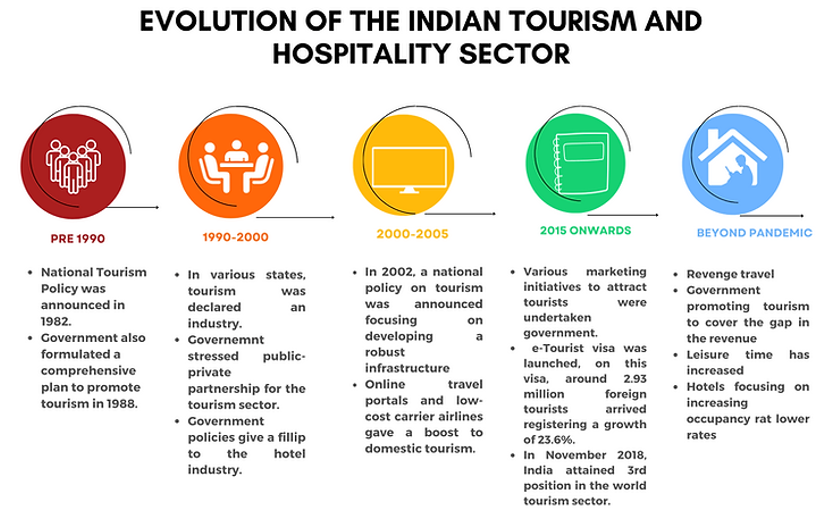
Context: Central Government at the second G-20 Tourism Working Group meeting in Siliguri, West Bengal has envisioned making India a $1 trillion tourism economy with 100 million international visitors by 2047.
The vision of the second G-20 TWG meeting was to project domestic tourism in a mission mode to maximise tourism potential in India.
Tourism Sector in India
The tourism industry in India accounts for roughly 5% of the country's gross domestic product (GDP).
in the financial year 2019-2020, the travel and tourism sector in India employed nearly 80 million people and accounted for about 15.3% of overall jobs in the country.
In 2021, India has ranked 54th in the World Economic Forum's (WEF) Travel and Tourism Development Index, down from 46th in 2019, but still, India remains at the top within South Asia.
Benefits of development of the Tourism Sector
Economic growth: Tourism can contribute significantly to the country's economic growth, as it generates earnings and creates employment opportunities for people in various sectors.
Increased foreign exchange earnings: Tourism can be a major source of foreign exchange earnings for India, as it attracts a large number of foreign tourists who spend money on accommodations, food, transportation, and other travel-related expenses.
Infrastructure development: Development of tourism sector can lead to the construction and improvement of infrastructure, such as roads, airports, and other transportation facilities, which can benefit other sectors as well.
Preservation of culture and heritage: Tourism can help preserve and promote the rich culture and heritage by encouraging the preservation of monuments, art, and traditions.
Improve standards of living: Lead to the development of local economies and improve the standard of living of the people. Also, it helps to renew the sense of pride and responsibility, especially among the local population.
Increased awareness and understanding: Help promote understanding and awareness of different cultures, traditions, and ways of life.
International recognition: Help raise India's international profile and reputation, which can initiate a cultural exchange, increases soft power, promote cultural diplomacy and have positive effects on various other sectors of the economy.
Types of Tourism in India
Religious and Cultural tourism: India offers a rich cultural heritage with religious and historical monuments. Prominent sites include-Ajanta & Ellora caves (Maharashtra), Mahabalipuram (TamilNadu), Hampi (Karnataka), Taj Mahal (Uttar Pradesh), Hawa Mahal (Rajasthan), Char Dham (Uttarakhand), Sanchi Stupa (Madhya Pradesh) etc.Various fairs and festivals include Pushkar fair (Rajasthan), Taj Mahotsav (Uttar Pradesh), and Suraj Kund mela (Haryana).
Adventure tourism: It offers opportunities for exploration of remote areas and exotic locales and engaging in various activities. The activities may include- trekking, Skiing facilities in the Himalayas, Paragliding, Ropeway, etc.
Beach Tourism: India’s vast coastline and islands provide ample opportunities for beach tourism. E.g., Blue flag beaches of Odisha, the backwaters of Kerala, Water sports in Goa, Scuba-diving in Andaman & Nicobar Islands and coral watching in Lakshadweep islands etc.
Eco-tourism: India has the potential to become a competitive ecotourism destination due to its abundant natural wealth (vast variety of flora & fauna) and wetlands. E.g., Thenamala (Kerala), Kaziranga National Park (Assam), Sundarbans.
This would ensure the socio-economic development of local communities while also entails the sustainable preservation of a naturally endowed area and its biodiversity.
Wildlife tourism: India has a rich forest cover and exotic species of wildlife which can boost wildlife tourism in India. E.g., Sariska Wildlife Sanctuary (Rajasthan), Corbett National Park (Uttarakhand).
Medical tourism: India avails cost-effective but superior-quality healthcare in terms of surgical procedures, general medication and Ayurvedic treatment and Yoga. E.g., Chennai (Tamil Nadu) attracts around 45% of medical tourists from foreign countries, Rishikesh (Yoga capital of World)
Rural Tourism: India offers a vast potential for rural tourism that focuses on exploring and experiencing the rural lifestyle and culture and participating in various activities such as farming, handicrafts, farm tourism and village walks etc.
Challenges of the Tourism Sector in India
Infrastructure: Inadequate infrastructure and connectivity in terms of transportation, accommodation, and tourist facilities is a major challenge for India's tourism industry, especially for remote destinations and hilly areas. E.g., Absence of basic amenities like clean drinking water, clean toilets, first aid and good public transport facilities.
Seasonality: India's tourism sector is highly seasonal, with most tourists visiting the country between October and March. This seasonal nature of tourism creates a challenge for the industry to maintain stable employment throughout the year.
Lack of skilled workforce: India's tourism sector faces a shortage of skilled workers, particularly in areas such as hospitality and tourism management which hampers quality service delivery to tourists.
Safety and security: Tourists may face risks of theft, harassment, and racial attacks in some parts of the country.
Environmental sustainability: Rapid growth of tourism in India has put significant pressure on the country's natural resources and environment. Lack of sustainable practices in the tourism industry has led to pollution (like plastic pollution in mountains), overuse of water resources, and damage to natural habitats.
Cultural sensitivity: India's diverse cultural heritage is one of its greatest attractions for tourists. However, the lack of sensitivity and understanding of cultural differences among tourists can lead to misunderstandings and conflicts.
Bureaucratic hurdles: Bureaucratic processes involved in obtaining permits, licenses, and other necessary paperwork can be time-consuming and challenging. E.g., Despite the introduction of the e-visa facility, visitors find the process for application cumbersome.
GOI has taken some critical steps to develop the Indian tourism industry
In the Union Budget 2023, for the promotion of tourism into mission mode, the Ministry of Tourism was allocated Rs 2,400 crore and a slew of measures were announced.
Focus on promoting domestic tourism: Initiatives like 'Dekho Apna Desh,' 'Swadesh Darshan Scheme,' and 'Vibrant Villages Programme - to encourage tourism in border villages' are launched to promote tourism within the country. These schemes focus on encouraging middle-class citizens to travel within the country instead of going overseas.
Also, under these schemes, the government aims to develop theme-based tourist circuits and better tourism infrastructure in remote parts of India.
Visit India Year 2023: The government has launched Visit India Year 2023 as India is heading G20 in 2023. It is a programme which invites the world to explore India and gives impetus to the tourism sector. Under the initiative, more than one lakh foreign delegates who will visit India in 2023 will be showcased the entire gamut of India's Culture, including monuments and festivals.
Boost to Adventure Tourism: To achieve the target of 1 trillion tourism economy, the focus is being put on various government-led initiatives under Public-Private Partnership (PPP) mode. Major push is being given to make India an ideal destination for sustainable adventure tourism.
Priority is given to green tourism, digitalisation, skilling, tourism MSMEs and destination management. The Ministry is working with States and industries for the development of the two mega-adventure tourism trails that would be launched in the Himalayas and the Ganga in 2023. These trails would be followed by others like the Narmada trail from Amarkantak in Madhya Pradesh to the Arabian sea, the Cauvery river trail, the West Coast trail from Kutch to Kanyakumari, and the East Coast trail from West Bengal to Kanyakumari.
Develop 50 new tourist destinations: Government would develop 50 new tourist destinations to attract more tourists across India. The new destinations will be selected through 'challenge mode' considering critical factors like connectivity to the destination, tourists' security, etc., and the focus will be on developing a complete package keeping in mind the needs of Indian and foreign tourists.
Promote eco-tourism: A new scheme, 'Amrit Dharohar,' has been announced to enhance biodiversity and support the optimum use of wetlands.
Starting Unity Malls: Apart from promoting domestic tourism, to promote local handicraft products, all the states are encouraged to build 'Unity Malls' at all prominent locations. These malls will act as a place to display and sell the state's local speciality products manufactured and made by local artisans.
Building new airports and improving railway connectivity: To promote and develop the Indian tourism industry further, Budget 2023 announced that India would develop 50 new airports, water aerodromes, and heliports to improve connectivity within the cities and smaller towns. Also, a budget has been allocated to develop railways in India.
Way Forward
Unlocking India’s immense tourism potential requires a comprehensive strategy that addresses the six key pillars of planning, place, people, policy, process, and promotion. The “6Ps” cover destination planning and management, infrastructure development, sustainability and safety, development of human capital, policy and process interventions to align the Centre and states as well as promoting the narrative of Indian tourism.
Presently, Tourism is a state subject. The central tourism department has been batting for it to be moved to the concurrent list, which can allow policy-making both at the Central and the State level.
Granting tourism infrastructure status will provide further impetus to the growth of the sector. Some Indian states have already provided industry status to tourism, a key demand of the sector for decades now.
Artificial Reality/Virtual Reality can help travellers explore destinations before they even arrive, providing virtual tours and simulations of famous landmarks, historical sites, and cultural experiences. AI-powered chatbots and digital assistants can help travellers plan their trips, recommend personalised activities, and offer real-time assistance while travelling.
Context: Union Budget 2023-24 announced a one-time new small savings scheme, Mahila Samman Savings Certificate which will be made available for a two-year period up to March 2025. This will offer deposit facility up to Rs 2 lakh in the name of women or girls for a tenor of 2 years at fixed interest rate of 7.5% with partial withdrawal option. To operationalise this scheme, Department of Economic Affairs has now notified the Mahila Samman Savings Certificate Scheme.
About Mahila Samman Savings Certificate
Application for opening an account: Application for opening an account under MSSC Scheme shall made by a woman for herself, or by the guardian on behalf of a minor girl on or before 31st March, 2025. The account will be single holder type account.
Deposits: A maximum limit of two lakh rupees can be deposited in an account or accounts held by an account holder. An individual may open any number of accounts subject to maximum limit for MSSC and time gap of three months shall be maintained between existing account and opening another account. Minimum amount for opening is an account is thousand rupees and any sum in multiples of one hundred rupees and no subsequent deposit shall be allowed in that account.
Interest: Deposits made under this scheme shall bear interest rate of 7.5% per annum compounded on quarterly basis.
Payment of maturity: Deposit shall mature on completion of two years from the date of deposit.
Withdrawal from account: Account holder shall be eligible to withdraw maximum up to 40% of Eligible Balance once after expiry of one year from the date of opening of account but before maturity of the account.
Premature closure of account: The account can be closed prematurely only after completion of 6 months since the opening of account in the following cases:
Death of account holder.
If post office or bank concerned is satisfied, in cases of extreme compassionate grounds such as medical support in life threatening diseases, death of guardian.
Administrative control of the scheme: Department of Economic Affairs under Ministry of Finance has notified Mahila Samman Savings Certificate Scheme, 2023 under the Government Savings Promotion Act, 1873.
Context: The Foreign Trade Policy (FTP) of 2023 allows exporters to get insurance coverage for losses caused by sudden trade barriers, and addresses grievances of exporters through a ministerial panel.
More on news
The new Foreign Trade Policy (FTP) for India in 2023 intends to broaden the scope of "political risk" covered under the export guarantee scheme, enabling exporters to receive insurance coverage for losses incurred due to the sudden imposition of non-tariff barriers by importing nations after the shipment has left India.
The policy also proposes the establishment of a ministerial panel to address the concerns of small exporters and an inter-ministerial committee to investigate trade-related grievances of micro, small, and medium enterprises (MSMEs).
This is expected to provide greater support to Indian exporters and improve their ability to navigate challenges posed by trade barriers.
Export Credit Guarantee Scheme
It is a scheme to provide enhanced export credit risk insurance cover to the extent of 90% to support small exporters under the Export Credit Insurance for Banks Whole Turnover Packaging Credit and Post Shipment (ECIB- WTPC & PS).
It is expected to benefit a number of small-scale exporters availing of export credit with banks which hold the ECGC WT-ECIB covers.
This will also enable the small exporters to explore new markets/new buyers and diversify their existing product portfolio competitively.
Enhanced Cover to Banks
The enhanced cover shall be available for manufacturer- exporters availing fund-based export credit working capital limit up to ₹ 20 crore (i.e., total Packaging Credit and Post Shipment limit per exporter/exporter-group) excluding the Gems, Jewellery & Diamond sector and merchant exporters/traders.
This new scheme will enable the banks holding ECGC’s WT-ECIB cover to explore the possibility of reducing interest rates further so that all the stakeholders are benefitted.
Export Credit Guarantee Corporation (ECGC)
Established in 1957 and fully owned by the government of India, the Export Credit Guarantee Corporation of India Ltd. (ECGC) was created to boost exports from the country by offering credit risk insurance and associated services for exports.
ECGC manages the National Export Insurance Account (NEIA) Trust, which caters to project exports of national and strategic importance.
ECGC provides (i) a range of insurance covers to Indian exporters against the risk of non-realization of export proceeds due to commercial or political risks (ii) different types of credit insurance covers to banks and other financial institutions to enable them to extend credit facilities to exporters and (iii) Export Factoring facility for MSME sector which is a package of financial products consisting of working capital financing, credit risk protection, maintenance of sales ledger and collection of export receivables from the buyer located in overseas country.
Context: Ministry of Commerce has unveiled a New Trade Policy, 2023.
About Foreign Trade Policy (FTP):
It is a set of rules and procedures for facilitating imports into, augmenting exports from India and creating favourable balance of payment position.
Department of Commerce looks in formulation and monitoring of FTP.
Powers to formulate a FTP policy or EXIM policy lies under the Foreign Trade Development and Regulation Act, 1992.
Director General of Foreign Trade implements FTP
Foreign Trade Policy - 2015-2020:
Goals:
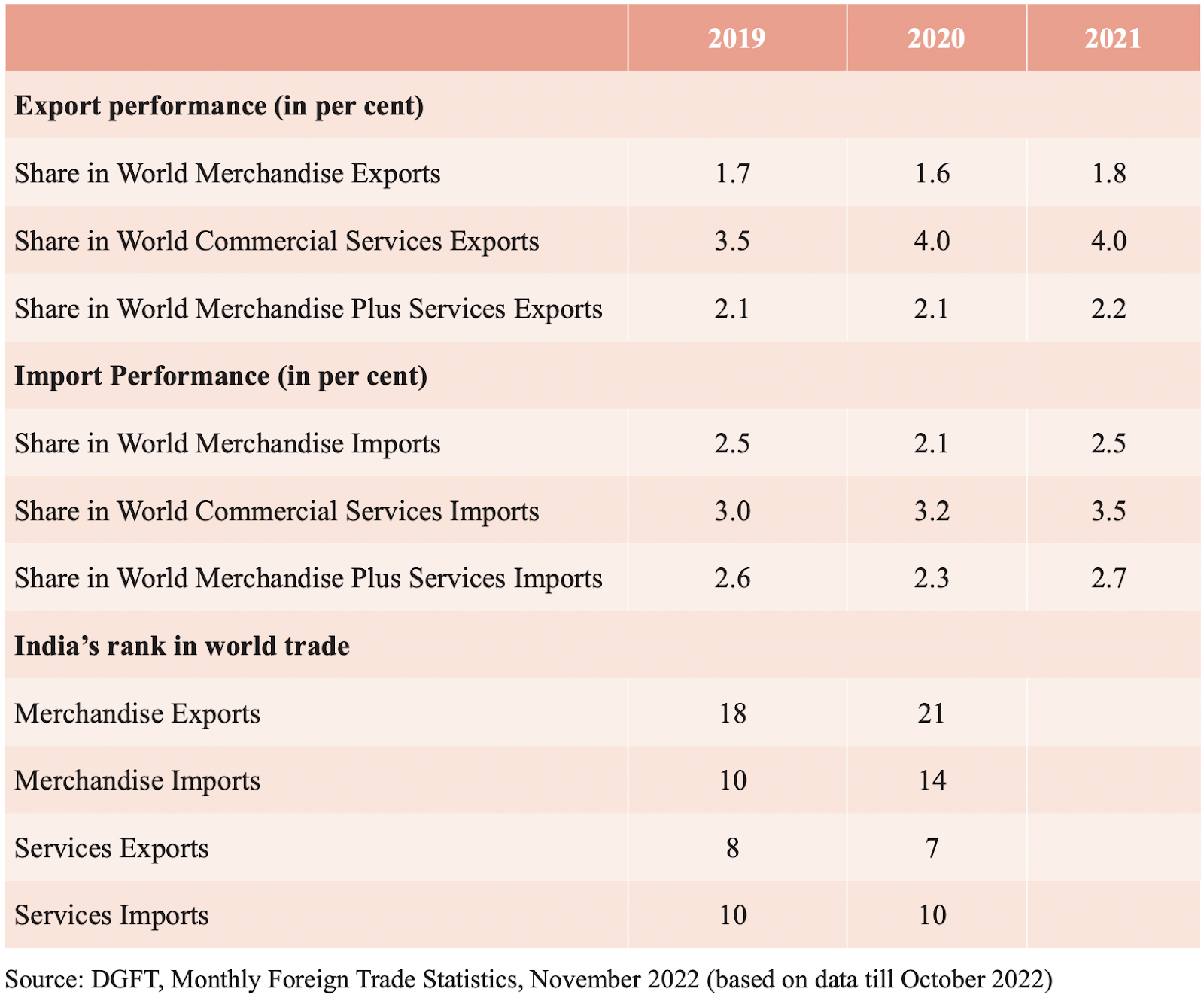
Increase India’s exports of merchandise and services to USD 900 billion by 2019-20
Raise India’s share in world exports from 2% to 3.5%.
Objectives:
Stable and sustainable policy environment
Export Promotion Mission for India;
Diversification of India’s export basket
Achieve global competitiveness
Better integration with major regions and countries,
Provide boost to Make in India initiative;
To rationalize imports
Reduce the trade imbalance.
Features:
FTP 2015-20 introduces two new schemes, namely ‘Merchandise Exports from India Scheme (MEIS)’ for export of specified goods to specified markets and ‘Services Exports from India Scheme (SEIS)’ for increasing exports of notified services.
Duty credit scrips issued under MEIS and SEIS and the goods imported against these scrips are fully transferable.
For grant of rewards under MEIS, the countries have been categorized into 3 Groups, whereas the rates of rewards under MEIS range from 2 per cent to 5 per cent. Under SEIS the selected Services would be rewarded at the rates of 3 per cent and 5 per cent.
Measures have been adopted to nudge procurement of capital goods from indigenous manufacturers under the EPCG scheme by reducing specific export obligation to 75per cent of the normal export obligation.
Measures have been taken to give a boost to exports of defense and hi-tech items.
E-Commerce exports of handloom products, books/periodicals, leather footwear, toys and customised fashion garments through courier or foreign post office would also be able to get benefit of MEIS (for values up to INR 25,000).
Manufacturers, who are also status holders, will now be able to self-certify their manufactured goods in phases, as originating from India with a view to qualifying for preferential treatment under various forms of bilateral and regional trade agreements. This ‘Approved Exporter System’ will help manufacturer exporters considerably in getting fast access to international markets.
A number of steps have been taken for encouraging manufacturing and exports under 100 per cent EOU/EHTP/STPI/BTP Schemes. The steps include a fast track clearance facility for these units, permitting them to share infrastructure facilities, permitting inter unit transfer of goods and services, permitting them to set up warehouses near the port of export and to use duty free equipment for training purposes.
108 MSME clusters have been identified for focused interventions to boost exports. Accordingly, ‘Niryat Bandhu Scheme’ has been galvanised and repositioned to achieve the objectives of ‘Skill India’.
Trade facilitation and enhancing the ease of doing business are the other major focus areas in this new FTP. One of the major objective of new FTP is to move towards paperless working in 24x7 environment.
Why do we need a new Trade policy?
Policy of 2015 is old now and has been on extension for two years.
New sectors are making their mark: E-commerce, IT, mobile apps etc.
India’s export growth has not been very promising (missed last targets)
India’s trade deficit is ever widening.
Poor diversification of exports with respect to destinations and composition.
New policies and schemes are not in line with Policy of 2015: Development of Enterprise and Service Hubs (DESH) Bill, One District One Product, etc.
Previous policy missed on the skill development with respect to external sector.
India needs to take advantage of Transition goods and network goods.
New Trade Policy 2023:
Target: to take India's exports to 2 trillion dollars by 2030.
4 pillars of FTP 2023: Incentive to Remission, Export promotion through collaboration, Ease of doing business and Emerging Areas.
Provisions:
1. Process Re-Engineering and Automation: The policy emphasizes export promotion and development, moving away from an incentive regime to a regime which is facilitating, based on technology interface and principles of collaboration.
2. Towns of Export Excellence: Four new towns, namely Faridabad, Mirzapur, Moradabad, and Varanasi, have been designated as Towns of Export Excellence (TEE) in addition to the existing 39 towns. The TEEs will have priority access to export promotion funds under the Market Access Initiative scheme and will be able to avail Common Service Provider (CSP) benefits for export fulfilment under the EPCG Scheme. This addition is expected to boost the exports of handlooms, handicrafts, and carpets.
3. Recognition of Exporters: Exporter firms recognized with 'status' based on export performance will now be partners in capacity-building initiatives on a best-endeavor basis. Similar to the 'each one teach one' initiative, 2-star and above status holders would be encouraged to provide trade-related training based on a model curriculum to interested individuals.
4. Promoting export from the districts: The FTP aims at building partnerships with State governments and taking forward the Districts as Export Hubs (DEH) initiative to promote exports at the district level and accelerate the development of grassroots trade ecosystem. Efforts to identify export worthy products & services and resolve concerns at the district level will be made through an institutional mechanism – State Export Promotion Committee and District Export Promotion Committee at the State and District level, respectively.
5. Streamlining SCOMET Policy: A robust export control system in India would provide access of dual-use High end goods and technologies to Indian exporters while facilitating exports of controlled items/technologies under SCOMET from India.
6. Facilitating E-Commerce Exports: FTP 2023 outlines the intent and roadmap for establishing e-commerce hubs and related elements such as payment reconciliation, book-keeping, returns policy, and export entitlements. As a starting point, the consignment wise cap on E-Commerce exports through courier has been raised from ₹5Lakh to ₹10 Lakh in the FTP 2023. Depending on the feedback of exporters, this cap will be further revised or eventually removed. Extensive outreach and training activities will be taken up to build capacity of artisans, weavers, garment manufacturers, gems and jewellery designers to onboard them on E-Commerce platforms and facilitate higher exports.
7. Facilitation under Advance authorization Scheme: Special Advance Authorisation Scheme extended to export of Apparel and Clothing sector under para 4.07 of HBP on self-declaration basis to facilitate prompt execution of export orders – Norms would be fixed within fixed timeframe. Benefits of Self-Ratification Scheme for fixation of Input-Output Norms extended to 2 star and above status holders in addition to Authorised Economic Operators at present.
8. Merchanting trade: FTP 2023 has introduced provisions for merchanting trade. Merchanting trade of restricted and prohibited items under export policy would now be possible. Merchanting trade involves shipment of goods from one foreign country to another foreign country without touching Indian ports, involving an Indian intermediary.
9. Amnesty Scheme: government is strongly committed to reducing litigation and fostering trust-based relationships to help alleviate the issues faced by exporters. In line with "Vivaad se Vishwaas" initiative, which sought to settle tax disputes amicably, the government is introducing a special one-time Amnesty Scheme under the FTP 2023 to address default on Export Obligations. All pending cases of the default in meeting Export Obligation (EO) of authorizations mentioned can be regularized on payment of all customs duties that were exempted in proportion to unfulfilled Export Obligation.
To watch in-depth analysis on New Foreign Trade Policy 2023, watch the Daily New Simplified dated 01, April 2023. Follow the link given below:
Context: Recently, Himachal Pradesh’s famous Kangra Tea has been awarded a protected Geographical Indication (GI) tag by the European Union (EU), opening up new opportunities for the tea to enter the European market.
The EC notified granting PGI on March 22 and this will come into effect from April 11, 2023.
The key characteristics of 'Kangra tea’
It is produced in the slopes of the Dhauladhar mountain ranges of the Western Himalayas. The tea is cultivated in various areas, including Palampur, Baijnath, Kangra, Dharmshala, Jogindernagar, and Bhatiyat.
It is grown at an elevation ranging from 900 to 1,400 metres above sea level with the annual rainfall being 270-350 cm.
This unique tea is derived from the leaves, buds, and tender stems of the Camellia sinensis species cultivated in the Kangra Valley of Himachal Pradesh, India.
It is available in green, oolong, white, and orthodox black types. While the black tea has a sweet lingering after-taste, the green tea has a delicate woody aroma.
The tea has a light colour, high body in liquor, and leaves that contain up to 13% catechins, 3% caffeine, and amino acids such as theanine, glutamine, and tryptophan.
Kangra tea is a little milder than Darjeeling tea in terms of flavour and has more body and liquor.
Kangra Tea previously received an Indian Geographical Indication tag in 2005, and since 1999, the cultivation and development of the tea have steadily improved in the Kangra region.
About geographical indication
A geographical indication (GI) is a sign used on products that have a specific geographical origin and possess qualities or a reputation that are due to that origin. In order to function as a GI, a sign must identify a product as originating in a given place.
In India
Geographical Indications registration is administered by the Geographical Indications of Goods (Registration and Protection) Act, 1999 which came into force with effect from September 2003.The Act would be administered by the Controller General of Patents, Designs and Trade Marks- who is the Registrar of Geographical Indications under Department for Promotion of Industry & Internal Trade, which is in turn under the Ministry of Commerce & Industry
The term “geographical indications”, in its broad sense, includes a variety of concepts used in international treaties and national/regional jurisdictions, such as: appellation of origin (AO), protected designation of origin (PDO) and protected geographical indication (PGI).
For instance
“Appellation of origin” is defined in the Lisbon Agreement for the Protection of Appellations of Origin and their International Registration and in the Geneva Act of the Lisbon Agreement on Appellations of Origin and Geographical Indications.
“Protected Designation of Origin (PDO)” and “Protected Geographical Indication (PGI)” are terms used within the European Union.
Protected designation of origin (PDO): Product names registered as PDO are those that have the strongest links to the place in which they are made.
Specifications: Every part of the production, processing and preparation process must take place in the specific region.
Products: food, agricultural products and wines.
Protected geographical indication (PGI): PGI emphasises the relationship between the specific geographic region and the name of the product, where a particular quality, reputation or other characteristic is essentially attributable to its geographical origin.
Products: food, agricultural products and wines.
Specifications: For most products, at least one of the stages of production, processing or preparation takes place in the region.
Context: Ministry of MSME has issued guidelines for revamping of Credit Guarantee Scheme for Micro & Small Enterprises with effect from 1st April 2023. CGTMSE created a landmark by touching the milestone approving guarantees worth Rs 1 lakh crore during FY 2022-23.
Revamped Credit Guarantee Scheme for Micro & Small Enterprises Scheme
Objective of CGTMSE Scheme: Aims to encourage first generation entrepreneurs to venture into self-employment opportunities by facilitating credit guarantee support for collateral free/third party guarantee free loans to Micro & Small enterprises (MSEs), especially in absence of collateral. To operationalise the scheme, Government of India and SIDBI set up the Credit Guarantee Fund Trust for Micro and Small Enterprises (CGTMSE).
Guarantee coverage ranges from 85% for Micro enterprises up to Rs 5 lakhs to 75% for others. 50% coverage for retail activity.
Corpus of Credit Guarantee Fund Trust for Micro & Small Enterprises (CGTMSE) has been infused with a sum of Rs 8,000 crore to enable additional collateral free guaranteed credit of Rs 2 lakh crore and reduction in cost of credit by 1%.
Reduction of Annual Guarantee Fee for loans up to Rs 1 crore from a peak rate of 2% p.a. to as low as 0.37% per annum. This will reduce overall cost of credit to Micro & Small Enterprises to a great extent.
Limit on ceiling for guarantees has been enhanced from Rs 2 crore to 5 crores. Hence, under the scheme provides credit guarantee for loans up to Rs 5 crore, without collateral and third-party guarantee.
No legal proceedings up to Rs 10 lakhs: For settlement of claims in respect of guarantees for loan outstanding up to Rs 10 lakh, initiation of legal proceedings will no longer be required.
Lending Institutions through which CGTMSE Scheme is eligible: Scheduled Commercial Banks including private banks, select Regional Rural Banks, Selected NBFCs and Small Finance Banks, NSIC, NEDFI, SIDBI and The Tamil Nadu Industrial Investment Corporation(TNIIC).
Context: Petroleum & Natural Gas Regulatory Board has amended PNGRB (Determination of Natural Gas Pipeline Tariff) Regulations to incorporate regulations pertaining to Unified Tariff for natural gas pipelines with a mission of 'One Nation, One Grid & One Tariff). National Gas Grid System means network of all such natural gas pipelines within India which are fully interconnected with each other (including those which are partly commissioned and so interconnected)
Salient Features of Unified Tariff Regime for Natural Gas Pipelines
Levelised Unified Tariff: PNGRB has notified a levelized Unified Tariff of Rs 73.93 per MMBTU additional GST tax will be Rs. 0.19/MMBTU. All entities part of National Gas Grid will get the tariff as per their entitlement while customers would pay Unified Tariff applicable for different zones. Difference between the entitlement tariffs to be earned by pipeline companies and unified tariffs paid by customers will be settled between pipeline entities by a settlement mechanism.
Tariff zones for unified tariff:
First Tariff zone for unified tariff: Length of 300 km from the entry point on either side of national gas grid system.
Second Tariff zone for unified tariff: length between 300 to 1200 km on either side of the first tariff zone on national gas grid
Third Tariff zone for unified tariff: Remaining length of national gas grid system on either side of second tariff zone.
UNIFIED ZONE
TARIFF (Rs./MMBTU on GCV basis)
Zone 1
39.45
Zone 2
74.97
Zone 3
99.90
Companies covered: National Gas Grid covers all interconnected pipeline networks owned and operated by following entities: Indian Oil Corporation, Oil & Natural Gas Corporation (ONGC), GAIL (India), Pipeline Infrastructure ltd., Gujarat State Petronet Ltd, Gujarat Gas, Reliance Gas Pipelines, GSPL India Gasnet & GSPL India Transco. All these entities will be members of Industry Committee.
Settlement mechanism: The settlement mechanism will be applicable to all the entities including shippers availing transportation services through natural gas pipelines forming part of National Gas Grid System. Out of the members of the Industry Committee 5 members will be selected to form a part of Settlement Committee will decide the ratio of settlement among different entities part of National Gas Grid System.
Significance of Unified Price for National Gas Grid System
Expansion of National Gas Grid: With commissioning of newer interconnected gas pipelines, the national gas grid will keep expanding for Union tariff.
Affordable access to natural gas in far-flung areas: This reform will specially benefit consumers located in far-flung areas by making natural gas available at competitive and affordable rates. In the current regime, additive rates are applicable for gas consumers in these areas.
Transition to gas economy: India plans to raise the share of gas in the economy to about 15% by 2030 from 6.4% in 2022. The uniform price mechanism for transportation will aid in this regard.
About Petroleum & Natural Gas Regulatory Board (PNGRB)
PNGRB is a statutory body formed under the Petroleum & Natural Gas Regulatory Board Act, 2006.
The Board is headed by a Chairperson, a Member (legal) and three other members to be appointed by Central Government.
Functions of PNGRB are:
Protect interests of consumers by fostering fair trade and competition among entities.
Maintain a data bank of information on activities related to petroleum, petroleum products & natural gas.
Lay down technical standards, specifications & safety standards related to petroleum, petroleum products, natural gas, pipeline construction, operation & maintenance related to downstream petroleum and natural gas.
Adjudicate and decide disputes arising amongst entities and receive complaints.
Context: Union Minister of Commerce and Industry has launched the Foreign Trade Policy 2023 saying that it is dynamic and has been kept open ended to accommodate the emerging needs of the time.
More on news:
India's Foreign Trade Policy expands export benefits to e - commerce overseas shipments, with the aim to increase exports to $200 - $300 billion annually by 2030. There is a plan to create hubs for exports with designated zones for warehousing. These hubs will help e-commerce aggregators to undertake everything from stocking to customs clearances and processing of returned orders. These hubs would also include a processing facility for last mile activities like labelling, testing and repackaging.
Foreign Trade Policy (FTP) 2023
It aims at process re-engineering and automation to facilitate ease of doing business for exporters.
It also focuses on emerging areas like dual use high end technology items under SCOMET (Special Chemicals, Organism, Materials, Equipment and Technologies), facilitating e-commerce export, collaborating with States and Districts for export promotion.
It is introducing a one-time Amnesty Scheme for exporters to close the old pending authorizations and start afresh.
It encourages recognition of new towns through “Towns of Export Excellence Scheme” and exporters through “Status Holder Scheme”.
It will facilitate exports by streamlining the popular Advance Authorization and Export Promotion Capital Goods (EPCG) schemes, and enabling merchanting trade from India.
To develop India into a merchanting trade hub, it has introduced provisions for merchanting trade. Merchanting trade of restricted and prohibited items under export policy would now be possible. (Merchanting trade involves shipment of goods from one foreign country to another foreign country without touching Indian ports, involving an Indian intermediary).
Key pillars of FTP 2023
Incentive to Remission
Export promotion through collaboration - Exporters, States, Districts, Indian Missions
Ease of doing business, reduction in transaction cost and e-initiatives
Emerging Areas – E - Commerce Developing Districts as Export Hubs and streamlining SCOMET policy
Context: Recently the Central government allowed those jewellers to sell their old stock of gold jewellery or gold artefacts with old ‘four marks hallmarking’ till June 30, 2023, which they had declared prior to July 1, 2021—the date on which the 6-digit hallmarking ID (HUID) was introduced in the country.
About Hallmarking
Hallmarking is the accurate determination and official recording of the proportionate content of precious metal in the jewellery/artefacts or bullion/coins.
Quality control order for mandatory hallmarking of gold jewellery/artefacts has been issued on 23 June 2021 by the Govt. of India which makes hallmarking mandatory in 256 districts of the country where there is at least one assaying and hallmarking centre.
The Indian Standard on Gold Hallmarking IS 1417:2016 specifies three grades for hallmarking of gold jewellery/ artefacts which are 14 Carat, 18-carat and 22-carat.
The same has been amended to include additional grades of 20 carats, 23 carats and 24 carats.
Indian standard on silver hallmarking IS 2112: 2014 specifies six grades of silver alloys viz 990,970,925,900,835,800 used in the manufacture of jewellery/artefacts of silver.
For hallmarking of gold bullion and coins of fineness 995 and 999 parts per thousand, a refinery or a mint obtains a license and applies a hallmark during the manufacturing. At present 44 refineries have taken licences from BIS for refining gold.
Coding of Hallmarked article
The jeweller will submit the request for hallmarking online and the data for all the processes undertaken in the centre from inward receipt and weighing, XRF, Sampling, Fire assay and laser marking is maintained online and can be monitored on a real-time basis.
At the end of the testing, a unique six-digit alphanumerical code is generated from the BIS server for each jewellery article and is laser marked by the assaying and hallmarking centre on the jewellery along with the BIS logo and purity mark.
Earlier (Before 1 July 2021) hallmarked Jewellery consists of the following four marks:
With the introduction of a six-digit alphanumeric code from 1 July 2021, the four marks have now been replaced by three marks for gold jewellery/ artefacts as given below
Registration of Jeweller with BIS
For hallmarking of jewellery, a jeweller who wants to sell hallmarked jewellery has to obtain a registration from BIS.
The registration of the jeweller’s process has been made online.
The registration of jewellers is free and valid for a lifetime.
The registered jeweller submits the jewellery for hallmarking to BIS recognized Assaying & Hallmarking (A&H) centre.
About Assaying & Hallmarking (A&H) centre.
A&H centres are the testing centres where the jewellery is tested.
After testing, the A&H centre applies a hallmark on the jewellery which is found to meet the requirement of the standard.
The A&H centre can apply for recognition to BIS online.
BIS has developed a digital solution wherein the entire workflow in the assaying and hallmarking centre is automated and made online.
BIS also carries out periodic surveillance audits of the A&H centre to ascertain its continuation with the specified requirements.
Context: Recently Government of India approves a plan to establish two lacks new multipurpose Primary Agricultural Credit Societies (PACS) / dairy/fishery primary cooperative societies for covering all the remaining Panchayats/ villages in the country.
What are Primary Agricultural Credit Societies (PACS)?
It is a cooperative credit institution at the village/lowest level.
PACS is an association of borrowers and non-borrowers residing in a particular locality.
The funds of the society are derived from the share capital and deposits of members and loans from a central cooperative bank.
PACS is the foundation of the cooperative credit structure.
The first PACS was established in 1904.
PACS is the final link between the borrower at the village level on one hand and the higher agencies like the central cooperative bank, state cooperative bank and reserve bank of India.
Who regulates PACS?
PACS are registered under the Co-operative Societies Act which means they are regulated by the State government (specifically administrative aspects) and also regulated by the RBI.
NABARD is a nodal refinancing agency for PACS including other cooperative banks.
They are governed by the “Banking regulation Act-1949” and Banking Laws (Co-operative societies) Act 1965.
Objectives of PACS
To raise the capital to meet the demands of its members
To collect the deposits from its members.
They also supply agricultural inputs and other services (in the form of money or in-kind) to their members.
They can also provide a storage facility to produce its members.
Who can form PACS?
Gorp of ten or more people in a village or from many villages can form PACS
Membership fees are there to be a member of PACS but it is very low so that the poorest man can join it.
Members of the PACS have unlimited liability, which means each member assumes full responsibility for the society’s entire loss in the event of failure.
Management of the PACS is overseen by the elected body
What are the Capital Sources of PACS?
PACS derives its working capital from
Their own funds (share capital, membership fee, and reserve funds),
Deposits,
Borrowing and
Other sources
Significance of PACS
PACS accounts for 41% of all KCC loans provided by all entities in the country.
PACS is the main source of credit for rural marginal farmers because 95% of beneficiaries of PACS are small and marginal farmers,
Participants of Multipurpose Primary Agricultural Credit Societies
State Governments,
the National Bank for Agriculture and Rural Development (NABARD),
the National Dairy Development Board (NDDB)
the National Fisheries Development Board (NFDB)
Approach and period of Multipurpose Primary Agricultural Credit Societies
The scheme will be implemented through the convergence of various existing schemes of the Government of India and by leveraging the ‘whole-of-Government’ approach in the next five years.
Other initiatives
The Government of India has approved setting up of three national-level Multi-State Cooperative Societies (MSCS) one each for Organic, Seeds and Exports registered under MSCS Act, 2002 i.e.
National Co-operative Export Society,
National Co-operative Society for Organic Products and
National Level Multi-State Seed Co-operative Society
Purpose of national-level Multi-State Cooperative Societies (MSCS)
These cooperative societies are expected to support the fisheries in the areas of supply of seed and quality fish marketing with a focus on the integrated project for the development of Inland fisheries, fisherwomen cooperatives, branding & trade promotion and capacity building.
Context: 12th session of AMIS Rapid Response Forum met in Chandigarh, India on the margins of 2nd meeting of G20 Agriculture Deputies in 2023.
About Agricultural Market Information System
AMIS is an inter-agency platform to enhance food market transparency and policy response for food security launched in 2011 by G20 Ministers of Agriculture following global food price hikes in 2007/08 and 2010.
By enhancing transparency and policy coordination in international commodity markets, AMIS has helped to prevent unexpected price hikes and strengthened global food security.
It brings together principal trading countries of agricultural commodities, it assesses global food supplies (focusing on wheat, maize, rice & soybeans) and provides a platform for constructive dialogue.
Membership: Composed of G20 members plus Spain and 7 additional major exporting & importing countries of AMIS crops, representing a large share of global food markets.
Structure of AMIS: AMIS consists of three main bodies:
Global Food Market Information Group: Composed of technical representatives from AMIS participants to collect market & policy information.
Rapid Response Forum (RRF): Assembles policymakers to promote early discussion about critical market conditions and ways to address them. In the event of market instability, RRF of AMIS coordinates appropriate policy measures.
Multiagency Secretariat: Currently, includes 11 international organisations and entities, produces short-term market outlooks, assessment and analyses, and supports all functions of the Information Group and the Rapid Response Forum.
Outputs of AMIS
Market Monitor: Assessing global market situation and outlook for AMIS crops.
Indicator Portal: Featuring key measures to identify critical market conditions that might require policy action.
Market Database: Providing latest forecasts on production, consumption, trade and stocks.
Policy Database: Compiling information on policies that might impact on global food markets.