Science & Technology

WIPO Treaty on Intellectual Property, Genetic Resources & Associated Traditional Knowledge (GRATK)

Context: The Treaty on Intellectual Property, Genetic Resources and Associated Traditional Knowledge was agreed upon by Diplomatic Conference hosted by World Intellectual Property Organisation (WIPO). The treaty was first proposed in 1999 by Colombia, calling for recognition of intellectual property of indigenous peoples and local communities. The negotiations started in 2001.

Objectives of WIPO Treaty on Genetic Resources & Traditional Knowledge (GRATK)

  • Promotion of efficacy, transparency and quality of patent system in relation to genetic resources and traditional knowledge.
  • Protection of genetic resources and traditional knowledge associated with genetic resources.
  • Prevention of patents being granted erroneously for inventions that are not novel or inventive with regard to genetic resources and traditional knowledge related to genetic resources.
  • International disclosure related to genetic resources and associated traditional knowledge in patent applications contributes to legal certainty and consistency

Salient Features of GRATK

  • Mandatory Patent Disclosure Requirement: The treaty establishes a mandatory patent disclosure requirement requiring patent applicants to disclose the country of origin of genetic resources and/or the Indigenous people or local community providing the associated traditional knowledge.
  • Sanctions and Remedies:
    • Failure to disclose required information would be subject to appropriate, effective and proportionate measures.
    • Patent applicants would have the opportunity to rectify a failure to disclose the requirement information unless
  • Information Systems:
    • Voluntary establishment of information systems (ex databases) of genetic resources and associated traditional knowledge, in consultation with indigenous people and local communities, wherever applicable.
    • Genetic resources databases can compile and reference a wide range of information. Ex. Information about genetic resources, associated traditional knowledge, known uses of genetic resources and relevant scientific compilations.
    • Information systems should be accessible to patent offices for search and examination of patent applications.
  • Non-retroactivity: No obligations of the Treaty would be imposed in relation to patent applications filed prior to entry into force of this treaty.
  • Review Mechanism: The treaty provides an in-built review mechanism to allow certain issues to be reviewed like extension of disclosure requirement to other areas of intellectual property and other issues like new and emerging technologies four years after the entry into force of the treaty.

Significance of the GRATK

  • Significant win for countries of Global South and India which are host bulk of global biodiversity and traditional knowledge. India being a megadiverse country holds 7-8% of global biodiversity and a rich repertoire of knowledge based on genetic resources.
  • First WIPO treaty to address the interface between intellectual property, genetic resources and traditional knowledge. Also, first WIPO treaty to include provisions specifically for indigenous people and local communities.
  • Multilateralism: Given the opposition of advanced countries like USA, EU and Japan for this treaty and the divided world we live in, the fact that a consensus treaty could emerge is a win and provides hope of the spirit of multilateralism.

Concerns with the Treaty

  • Fails to address biopiracy due to weak sanctions regime: The WIPO Treaty suffers from a weak sanctions regime which is not adequate address the issues of bio-piracy. Some issues with the sanctions regime of the treaty are:
    • No provision for penalties for non-disclosure.
    • Countries to provide opportunity for rectification of failure to disclose information before implementing sanctions.
    • No obligation on patent offices to verify the authenticity of disclosure.
    • No country can revoke, invalidate or render unenforceable conferred patent rights solely on the basis of applicant's failure to provide mandatory patent disclosure.
    • No provision for revocation of patent except when the information is withheld due to fraudulent intentions. Even in such cases, the treaty leaves it to the State to decide on the sanctions to be imposed.
  • Silent on positive protection of traditional knowledge for indigenous people and local communities (IPLC):
    • No recognition of traditional knowledge as intellectual property of IPLC which would have provided indigenous people with exclusive collective rights to control their traditional knowledge.
    • No fair & equitable sharing of benefits in favour of IPLC in return of use of their traditional knowledge.
    • Silence on right of attribution and right to use of their own traditional knowledge for IPLC.
    • Fails to protect traditional cultural expressions i.e., the forms in which IPLC express their traditional cultural practices and knowledge like music, dance, art & handicrafts.
  • Dilution of India's patent laws: India would need to align its domestic laws like Patents Act & Biological Diversity Act with the WIPO Treaty on Genetic Resources and Associated Traditional Knowledge. These amendments could potentially dilute existing protections aiming to safeguard traditional knowledge and genetic resources. For example, India's Patent Law already provides for pre-grant opposition against non-disclosure of source of origin and also for a revocation of granted patent for non-disclosure of information.

CERN moves ahead on Future Circular Collider (FCC)

Context: European Council for Nuclear Research, popularly known as CERN, plans to build a 91-kilometer-long largest particle collider underneath the Earth below the French and Switzerland borders.

About Future Circular Collider

  • Future Circular Collider is a proposed 91 km long at the CERN. It will overtake the 27 km long Large Hadron Collider (LHC) facility LHC is currently world’s largest particle collider.
  • Construction of the machine will require drilling a circular tunnel 200 metres underground. The facility will also have four experimental halls.
  • The facility will be used to collide electrons with their antimatter particles, positrons, with the aim of generating and studying in precise detail around one million Higgs bosons and other Standard Model particles.
  • FCC-hh: for hadron-hadron collisions, including proton-proton and heavy ion collisions.
  • FCC-ee: for electron-positron collisions
  • FCC-eh: for electron-hadron collisions
  • The second step would be an energy frontier collider, offering collision energies of 100 TeV or higher (i.e., 8 times the energy of the LHC) following developments in the superconducting and magnet technologies.
  • The final approval for the Future Circular Collider (FCC) will be given by CERN Council
image 104

Concerns against the Future Circular Collider

  • High cost of constructing the facility: Future Circular Collider facility will cost around 15 billion Swiss Francs. Bulk of the funding will come from the existing CERN budget. But the project will still require financial contributions from the countries that are full members of CERN (European Countries, USA & Japan etc.)
  • Criticism of design: A section of physicists have argued against the FCC’s design which aims to collide electrons with positrons. They have argued for colliding beams of muons instead of electrons or protons. Muons are much more massive than electrons, allowing for higher-energy collisions.

Other Proposed Particle Accelerators

  • High Luminosity LHC: High Luminosity Large Hadron Collider project aims to crank up the performance of the LHC to increase by increasing the integrated luminosity by a factor of 10 beyond the LHC’s design value. Luminosity is an important indicator of the performance of a particle accelerator as it is proportional to the number of collisions that occur in a given amount of time. The HL-LHC will produce at least 15 million Higgs bosons per year, compared to around three million from LHC. It is expected to be operational from 2029.
  • International Linear Collider (Japan): A proposed linear particle accelerator with a planned collision energy of 500 GeV with a possibility for a later upgrade to 1000 GeV. The ILC would collide electrons with positrons with length between 30 & 50 km. This will be more than 10 times as long as the 50 GeV Stanford Linear Accelerator, longest existing linear particle accelerator. Japan has shown interest in hosting the long planned International Linear Collider.
  • Circular Electron Positron Collider (China): A proposed Chinese electron positron collider. It would be world’s largest particle accelerator with a circumference of 100 kms.
  • Muon Collider: Particle Physicists in the US have called for building a muon collider. Muons are like electrons but about 200 times heavier. However, muons are unstable and quicly decay into other particles.

About CERN

  • CERN is an intergovernmental organisation that operates the largest particle physics laboratory in the world.
  • Established in 1954.
  • Based in Meyrin, western suburb of Geneva, on the France-Switzerland border.
  • Governance: CERN Council is the highest authority of the organisation.
  • CERN is an official UNGA observer. CERN's main function is to provide the particle accelerators and other infrastructure needed for high-energy physics research – consequently, numerous experiments have been constructed at CERN through international collaborations. 
  • Member States of CERN: Currently, there 23 member states of CERN: Austria, Belgium, Bulgaria, Czech Republic, Denmark, Finland, France, Germany, Greece, Hungary, Israel, Italy, Netherlands, Norway, Poland, Portugal, Romania, Serbia, Slovak Republic, Spain, Sweden, Switzerland and the UK. Israel is the only non-European full member. (Cyprus, Estonia and Slovenia are Associate Member States in pre-stage to membership).
  • Associate Members of CERN: Croatia, India, Latvia, Lithuania, Pakistan, Turkiye and Ukraine. (India is also Associate member of CERN).

Cabinet Committee on Security approves mega Navy deal for Brahmos Missiles

Context: Cabinet Committee on Security has approved the acquisition of over 200 BrahMos extended range supersonic cruise missiles for deployment on warships of Indian Navy. The deal is expected to cost Rs 19,000 crore for the exchequer.

About Brahmos Supersonic Cruise Missiles

  • Brahmos is a medium range ramjet supersonic cruise missile.
  • Brahmos is a two stage missile:
    • First stage: Powered by solid propellant booster engine as its first stage with brings it to supersonic speed.
    • Second stage: Powered by Liquid ramjet engine that takes the missile closer to 3 Mach speed in cruise phase.
  • Flight range: Brahmos has a flight range of up to 290 km with supersonic speed all through the flight, leading to shorter flight time, consequently ensuring lower dispersion of targets, quicker engagement time and non-interception by any known weapon system in the world.
  • Altitude: Cruising altitude of Brahmos is up to 15 km and terminal altitude is as low as 10 metres.
  • Warhead capacity: It can carry a conventional warhead weighing 200-300 kgs.
  • Launch capability: Brahmos has capability to be launched from land, sea, air and submarines. Brahmos has identical configuration for all the platforms and uses a Transport Launch Canister for transportation, storage and launch.
  • Fire and forget principle: Brahmos operates on the principle of Fire and Forget which means that the missile system adopts varieties of flights on its way to the target.
  • Range of Brahmos was kept at 290 km as India was earlier not a signatory of the Missile Technology Control Regime (MTCR). MTCR prohibits member countries to transfer technologies for missiles with range up to 300 km. Since, Russia is a party to the MTCR it did complied with the regulations of MTCR.
image 98

Ship based Brahmos: This version has been designed for launch in either vertical or inclined mode from a moving or static maritime platform against sea or land targets. It has been deployed on Indian Navy's frontline surface combat platforms as the prime strike weapon. This version also has 'salvo' launch capability, where multiple missiles can be fired in different trajectories to hit a single or group of targets. It is primarily used as Anti-Ship Missile.

Air-launched Brahmos: Brahmos Air Launched Cruise Missile (ACLM) with precision attack capability against sea and land targets is the designed as the heaviest and most powerful weapon to arm Indian Air Force's Su-30 strike fighter.

Submarine launched Brahmos: Brahmos missile is capable of bring launched from submarine from a depth of 40-50 metres. The missile is launched in the same configuration similar to the ship launched system.

Brahmos-NG & Brahmos-II (Future versions of Brahmos)

  1. Brahmos-NG: Brahmos NG stands for Brahmos Next Generation. It is envisioned as a smaller and lighter but smarter weapon having high versatility, lethality and flexibility along with ultra-precision for deployment onboard a wide range of military platforms. Key features:
    1. Reduced dimension & weight for widespread range
    2. Advanced next generation stealth
    3. Greater effectiveness against ECCM
    4. Higher versatility in underwater combat applications
    5. Launch readiness from Torpedo tube and vertical orientation
  2. Brahmos II: It is a planned hypersonic cruise missile currently under joint development by Brahmos Aerospace. It is expected to have a range of 1,500 km and a speed of Mach 8. Since, India is now a signatory of the MTCR, Russia can transfer technologies for longer ranges.

About Brahmos Aerospace

  • Brahmos Missile is manufactured by Brahmos Aerospace which is a joint venture of DRDO (India) and NPO Mashinostroyenia (Russia). The company was established in India through an Inter-Governmental Agreement between India and Russia in 1998.
  • India has 50.5% ownership while Russia has 49.5% ownership in Brahmos Aerospace.
  • The name 'Brahmos' is combination of Brahmaputra (India) and Moskva (Russia) rivers.
  • Brahmos Aerospace is responsible for designing, developing, producing and marketing the Brahmos Supersonic cruise missiles with active participation of a consortium of Indian and Russian industries.
  • Indigenization of Brahmos: In 1998, indigenous contribution in the Brahmos system was around 30% only. However, now about 75% indigenous capacity has been achieved in the Brahmos missile project.
  • Exports: Brahmos missiles will be exported to the Philippines, which will its first global customer. Many countries from the Southeast Asian region have also shown interest in buying the system. Brahmos Aerospace aims to export $5 billion worth of missiles by 2025. Exports of Brahmos missiles to other countries would also allow sale and exports of other systems such as Akash, ATAGS Howitzers and other equipment from the Indian defence industry.

SLIM (Smart Lander for Investigating Moon) Mission by JAXA (Moon Sniper)

Context: The SLIM (Smart Lander for Investigating Moon) mission has established Japan as the fifth country to successfully land a spacecraft on the moon. This milestone was achieved through the deployment of the robotic "Moon Sniper," which is designed for lunar exploration and surface testing. The SLIM Mission is labelled as Moon Sniper.

About SLIM (Smart Lander for Investigating Moon)

image 106
  • SLIM (Smart Lander for Investigating Moon) is a small-scale exploration of JAXA (Japan’s Space Agency) lander.
  • "SLIM" is a technology demonstrator, and the expertise gained in precision landing and other technologies will be inherited by future missions such as the Martian Moon eXploration (MMX) and lunar polar missions. It is designed for:
  • Pinpoint landings on the Moon's surface with a landing accuracy of less than 100 metres. SLIM Mission employs ‘Vision based navigation’ technology for its higher landing accuracy.
  • Reduction in the size and weight of equipment used in Moon landings which will result in more frequent lunar and planetary landings. SLIM Mission employs small, lightweight and high performance chemical propulsion systems and light-weight materials in designing systems such as computers to save on the weight.
  • Investigation into the Moon's origins through composition analysis of rocks estimated to be derived from the lunar mantle. There is a theory that the moon was formed by a giant impact. In this case, the composition of the moon's mantle, which makes up 90% of the moon, would be similar to that of Earth. SLIM Mission has selected the landing site close to the SHIOLI crater near the "Sea of Nectar" as the landing target site. Olivine mineral is expected to be present at the Shioli crater, expected to be ejected from Moon’s mantle.

Importance of Pinpoint Landing

image 107
  • SLIM Mission employs Vision Based Navigation System for ensuring enhanced landing accuracy. 
  • Most conventional lunar landers land at a distance of several kilometres to tens of kilometres away from the planned landing site. Low landing accuracy. 
  • Over the years, Moon rovers and landers have adequately mapped the surface of the moon. To take the researcher frontier forward, researchers now aim to study specific sites and rocks on the surface of the Moon. This will require pin-point landing.
  • For high-resolution lunar in-situ observation of individual rocks, it is necessary to land the spacecraft precisely.
  • Traversing steep slopes and rough terrain on the moon can be made less challenging with precision landing. 
  • Locations with sustainable water resources are limited to a very narrow area on the Moon. To explore such areas precision landing is required.

Landing on sloped surfaces

Since the SLIM Mission plans to land at a site near a crater which has slope of 15 degrees. The SLIM mission will employ and demonstrate capabilities to land at sloped surfaces by employing a unique two-step landing technology.

The landing sequence of SLIM will be conducted as follows:

image 108

Benefits of SLIM Mission

  1. Future solar science exploration will demand the level of navigation accuracy that JAXA is seeking through the SLIM mission.
  2. As scientific knowledge builds on the study object, more specific research will be needed. Placing spacecraft with precision facilitates expertise.
  3. Planetary science exploration will additionally call for highly capable equipment for observation.
  4. Downsizing the exploration system can reinforce the instruments to be placed into a locale especially well-suited for its landing mission.

India's second Indigenous Nuclear Power Reactor at Kakrapar achieves criticality

Context: India's second indigenous 700 MW Nuclear power reactor at Kakrapar Atomic Power Project (KAPP) in Gujarat has achieved its first criticality. It has set the stage for its gradual move towards producing electricity for commercial purposes.

Nuclear Fission

  • Most Nuclear Power Plants produce energy using Nuclear Fission mechanism.
  • Nuclear fission is the process of disintegrating a heavy atom’s nucleus, such as Uranium or Plutonium, into two or more smaller nuclei.
  • When a fissile atom, like uranium-235, absorbs a neutron, it splits into two smaller atoms and releases several more neutrons.
  • These neutrons can then go on to cause other fissile atoms to split, creating a chain reaction.
  • This process releases a substantial amount of Nuclear energy, which is harnessed and converted into steam to power a turbine that generates electricity.
  • Criticality of Nuclear Reactor: A Nuclear reactor is said to be critical when the number of neutrons produced in Nuclear fission reactions equals the number of neutrons lost through absorption, leakage, and other processes. This equilibrium state allows for a sustained and controlled chain reaction.
  • Fuel used: U-235 (low-enriched or reactor-grade uranium)
image 132

Uranium Enrichment

  • Naturally occurring Uranium is composed of three major isotopes:
    • Uranium-238 (99.284% natural abundance)
    • Uranium-235 (0.711%)
    • Uranium-234 (0.005%)
  • U-235 atomsis the only nuclide existing in nature (in appreciable amount) that is fissile with thermal neutrons.Since naturally occurring Uranium does not have a high enough concentration of U-235, Uranium enrichment is necessary to create an effective nuclear fuel out of mined Uranium.
  • Uranium enrichment is the process of increasing the concentration/percentage of U-235 in Natural uranium beyond through the process of isotope separation.
  • U-235 atomsis the only nuclide existing in nature (in appreciable amount) that is fissile with thermal neutrons.Since naturally occurring Uranium does not have a high enough concentration of U-235, Uranium enrichment is necessary to create an effective nuclear fuel out of mined Uranium.
  • Uranium enrichment is the process of increasing the concentration/percentage of U-235 in Natural uranium beyond through the process of isotope separation.

Present Installed Nuclear Power Capacity in India

Presently, India operates 22 nuclear reactors across eight sites, with a total capacity of 6,780 MWe. Among these 18 reactors are Pressurised Heavy Water Reactors (PHWRs) and 4 are Light Water Reactors (LWRs).

Pressurised Heavy Water Reactor (PHWR)

  • PHWR is a nuclear power reactor, commonly using unenriched natural uranium as its fuel and heavy water (deuterium oxide, D2O) as both coolant and moderator.
    • Coolant: Coolant in a nuclear reactor absorbs all the excess heat generated by the ongoing nuclear reactions, preventing the reactor from melting down.
    • Moderator: Heavy water acts as a moderator, slowing down neutrons to the right speed making them more likely to collide with other Uranium atoms and trigger fissions. This chain reaction is the very essence of how a PHWR produces energy.
  • Control Rods: Boron or cadmium control rods are used to absorb excess neutrons and regulate the nuclear reaction.
  • Advantages: PHWRs are known for their ability to use natural uranium fuel, produce less high-level radioactive waste, and operate at lower pressures compared to some other reactor types.
image 133

Kakrapar Atomic Power Station

  • Kakrapar Atomic Power Station is a nuclear power plant located in Mandvi, Surat district in Gujarat.
  • Operated by: Nuclear Power Corporation of India Limited (NPCIL).
  • Kakrapar site consists of four pressurised heavy water reactors (PHWRs).
    • Two 220 MW units
    • Two 700 MW units
  • KAPP Unit-3 (first indigenously developed PHWR plants with modern safety features)had started commercial operation in August 2023.

JN.1 variant of Sars-CoV-2

Context: Kerala has registered the first case of infection due to JN.1 variant of Sars-CoV-2 — the latest sub-variant of the virus that is behind a spike of infections in several countries across the world.

JN.1 variant of Sars-CoV-2

  • The JN.1 sub-variant is a new sub-lineage of the BA.2.86 (also known as Pirola) — which itself is an off-shoot of the widely circulating Omicron variant of Sars-CoV-2.
  • The JN.1 variant has been classified as a variant of interest by the World Health Organisation.
    • Variants of Interest: Variants that, compared with earlier forms of the virus, are less effectively neutralised in labs by antibodies from infection or vaccination and have a potential to spread.
    • Variants of Concern: Variants that result in increased transmission, severe disease leading to hospitalisation, and reduce effectiveness of vaccines.
image 129

SARS-CoV-2 Virus

  • Coronavirus disease 2019 (COVID-19) is a highly contagious viral illness caused by severe acute respiratory syndrome coronavirus 2 (SARS-CoV-2).
  • SARS-CoV-2 is a novel beta coronavirus belonging to the same subgenus as the severe acute respiratory syndrome Coronavirus (SARS-CoV) and Middle East Respiratory Syndrome Coronavirus (MERS-CoV).
  • It was first identified in December 2019 in Wuhan, China, and then caused a global pandemic leading to the COVID-19 pandemic.
  • Coronaviruses are positive-stranded RNA viruses with a crown-like appearance due to the presence of spike glycoproteins on the envelope.
  • Like other RNA viruses, SARS-CoV-2, while adapting to their new human hosts, is prone to genetic evolution with the development of mutations over time. This results in mutant variants that may have different characteristics than its ancestral strains.
  • Origin: Although the origin of SARS-CoV-2 is currently unknown, it is widely postulated to have originated from an animal, implicating a zoonotic transmission.
  • Transmission: Exposure to respiratory droplets carrying the infectious virus from close contact or droplet transmission from presymptomatic, asymptomatic, or symptomatic individuals. 

What is mutation of a virus?

  • Mutation of a virus, in simple words, means that it is acquiring genetic changes. Mutations are errors in the replication of the virus’s genetic code.
  • During replication, the virus copies its genetic material (usually RNA or DNA) to create new copies of itself.
  • Sometimes, mistakes happen during this copying process. These mistakes can lead to changes in the virus's genetic code, which are called mutations.
image 130

Why do Viruses mutate?

image 131

Effects of mutations on the virus

  • Neutral: This means that they have no effect on the virus's ability to replicate or cause disease.
  • Potent: These mutations can make the virus more replicative or more virulent. E.g., Delta variant of COVID-19.
  • Less Potent: Some mutations could make the virus less replicative or less infectious. In some cases, these mutations can even make the virus unable to replicate at all.

Thallium- a lethal weapon

Context: In a crime-incident in India, Thallium, a toxic metal, was administered in food leading to a series of deaths and illnesses within a family.

About Thallium

  • Thallium is a chemical element with the symbol Tl and atomic number 81.
    It is a highly toxic metal that was once used in various industrial applications, including rat poison and as a depilatory agent.
  • Thallium is an abundant element and is present in about 0.7 mg/kg of the Earth’s crust.
  • Thallium does not exist in free elemental form in nature. It mostly exists in the form of ores with other elements, mostly potassium.
  • Commercially, thallium is extracted from its sulphide-ores of heavy metals, such as zinc, lead, copper etc.
  • Thallium compounds are tasteless, odourless, and colourless, which makes it particularly dangerous for human consumption.
  • Thallium poisoning can occur through various routes, including ingestion, inhalation, or skin contact with thallium compounds. It interferes with the normal functioning of cells by disrupting various enzymes and processes in the body.
  • Symptoms of thallium poisoning can vary and may include severe gastrointestinal distress, neurological symptoms, and hair loss.

Cholera cases double in 2022: WHO

Context: According to World Health Organization (WHO), the world reported more than twice as many cholera cases in 2022 as in 2021. Also, between these years, the number of countries reporting more than 10,000 cholera cases doubled. Most cholera cases continue to be reported from Africa and Asia, with Europe accounting for a few imported cases.

About Cholera

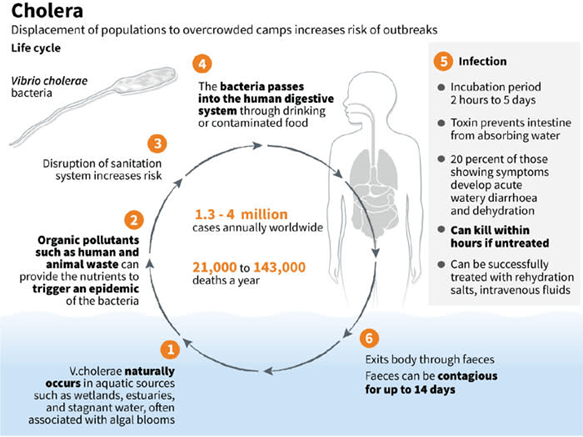
  • It is bacterial infection of small intestine that causes a large amount of watery diarrhoea.
  • It is caused by ingestion of food or water contaminated (water-borne) with the bacterium Vibrio cholerae.
  • Vibrio cholerae has two strains called O1 and O139 of the bacteria Vibrio cholerae.
  • Of these, O1 is responsible for almost all outbreaks; outbreaks of O139 are rare and none have been recorded outside Asia.
  • V. cholerae O139 was first identified in Bangladesh in 1992.
image 1

Symptoms of Cholera

  • It is highly contagious disease that can cause severe acute watery diarrhoea.
  • It takes between 12 hours and 5 days for a person to show symptoms like profuse watery diarrhoea, vomiting, leg cramps, sunken eyes, reduced urine output,etc.

Transmission of Cholera

  • Transmitted to humans through water or food which is contaminated with the cholera bacterium.
  • Cholera can spread rapidly in areas with inadequate treatment of sewage and drinking water.

Prevention and Control of Cholera

  • It is an easily treatable disease. Majority of people can be treated successfully through prompt administration of oral rehydration solution (ORS).
  • Zinc is an important adjunctive therapy for children under 5, which also reduces duration of diarrhoea.
  • Currently, there are three WHO pre-qualified oral cholera vaccines (OCV), Dukoral, Shanchol, and Euvichol-Plus. All three vaccines require two doses for full protection.

Initiatives

  • Global Task Force on Cholera Control (GTFCC) by WHO: Provide a forum for technical exchange, coordination, and cooperation on cholera-related activities to strengthen country's capacity to prevent and control cholera;
  • Created in 1992 in the context of an unprecedent cholera outbreak in Peru.
  • Ending Cholera: Roadmap to 2030: In 2017, aims to reduce cholera deaths by 90% and to eliminate cholera in as many as 20 countries by 2030.
  • Country Support Platform (CSP): To strengthen GTFCC support to countries, hosted by the International Federation of Red Cross and Red Crescent Societies (IFRC) provides multisectoral operational support for countries.

Current Situation  

image
  • Since 2021, there has been an increase in cholera cases and their geographical distribution globally.
  • In 2021, 23 countries reported cholera outbreaks, mainly in Africa and the Eastern Mediterranean. This trend has continued into 2022 with over 29 countries reporting cholera cases or outbreaks.
  • The average cholera case fatality ratio (CFR) reported globally in 2021 was 1.9% (2.9% in Africa).