GS Paper 3

India's second Indigenous Nuclear Power Reactor at Kakrapar achieves criticality

Context: India's second indigenous 700 MW Nuclear power reactor at Kakrapar Atomic Power Project (KAPP) in Gujarat has achieved its first criticality. It has set the stage for its gradual move towards producing electricity for commercial purposes.

Nuclear Fission

  • Most Nuclear Power Plants produce energy using Nuclear Fission mechanism.
  • Nuclear fission is the process of disintegrating a heavy atom’s nucleus, such as Uranium or Plutonium, into two or more smaller nuclei.
  • When a fissile atom, like uranium-235, absorbs a neutron, it splits into two smaller atoms and releases several more neutrons.
  • These neutrons can then go on to cause other fissile atoms to split, creating a chain reaction.
  • This process releases a substantial amount of Nuclear energy, which is harnessed and converted into steam to power a turbine that generates electricity.
  • Criticality of Nuclear Reactor: A Nuclear reactor is said to be critical when the number of neutrons produced in Nuclear fission reactions equals the number of neutrons lost through absorption, leakage, and other processes. This equilibrium state allows for a sustained and controlled chain reaction.
  • Fuel used: U-235 (low-enriched or reactor-grade uranium)
image 132

Uranium Enrichment

  • Naturally occurring Uranium is composed of three major isotopes:
    • Uranium-238 (99.284% natural abundance)
    • Uranium-235 (0.711%)
    • Uranium-234 (0.005%)
  • U-235 atomsis the only nuclide existing in nature (in appreciable amount) that is fissile with thermal neutrons.Since naturally occurring Uranium does not have a high enough concentration of U-235, Uranium enrichment is necessary to create an effective nuclear fuel out of mined Uranium.
  • Uranium enrichment is the process of increasing the concentration/percentage of U-235 in Natural uranium beyond through the process of isotope separation.
  • U-235 atomsis the only nuclide existing in nature (in appreciable amount) that is fissile with thermal neutrons.Since naturally occurring Uranium does not have a high enough concentration of U-235, Uranium enrichment is necessary to create an effective nuclear fuel out of mined Uranium.
  • Uranium enrichment is the process of increasing the concentration/percentage of U-235 in Natural uranium beyond through the process of isotope separation.

Present Installed Nuclear Power Capacity in India

Presently, India operates 22 nuclear reactors across eight sites, with a total capacity of 6,780 MWe. Among these 18 reactors are Pressurised Heavy Water Reactors (PHWRs) and 4 are Light Water Reactors (LWRs).

Pressurised Heavy Water Reactor (PHWR)

  • PHWR is a nuclear power reactor, commonly using unenriched natural uranium as its fuel and heavy water (deuterium oxide, D2O) as both coolant and moderator.
    • Coolant: Coolant in a nuclear reactor absorbs all the excess heat generated by the ongoing nuclear reactions, preventing the reactor from melting down.
    • Moderator: Heavy water acts as a moderator, slowing down neutrons to the right speed making them more likely to collide with other Uranium atoms and trigger fissions. This chain reaction is the very essence of how a PHWR produces energy.
  • Control Rods: Boron or cadmium control rods are used to absorb excess neutrons and regulate the nuclear reaction.
  • Advantages: PHWRs are known for their ability to use natural uranium fuel, produce less high-level radioactive waste, and operate at lower pressures compared to some other reactor types.
image 133

Kakrapar Atomic Power Station

  • Kakrapar Atomic Power Station is a nuclear power plant located in Mandvi, Surat district in Gujarat.
  • Operated by: Nuclear Power Corporation of India Limited (NPCIL).
  • Kakrapar site consists of four pressurised heavy water reactors (PHWRs).
    • Two 220 MW units
    • Two 700 MW units
  • KAPP Unit-3 (first indigenously developed PHWR plants with modern safety features)had started commercial operation in August 2023.

JN.1 variant of Sars-CoV-2

Context: Kerala has registered the first case of infection due to JN.1 variant of Sars-CoV-2 — the latest sub-variant of the virus that is behind a spike of infections in several countries across the world.

JN.1 variant of Sars-CoV-2

  • The JN.1 sub-variant is a new sub-lineage of the BA.2.86 (also known as Pirola) — which itself is an off-shoot of the widely circulating Omicron variant of Sars-CoV-2.
  • The JN.1 variant has been classified as a variant of interest by the World Health Organisation.
    • Variants of Interest: Variants that, compared with earlier forms of the virus, are less effectively neutralised in labs by antibodies from infection or vaccination and have a potential to spread.
    • Variants of Concern: Variants that result in increased transmission, severe disease leading to hospitalisation, and reduce effectiveness of vaccines.
image 129

SARS-CoV-2 Virus

  • Coronavirus disease 2019 (COVID-19) is a highly contagious viral illness caused by severe acute respiratory syndrome coronavirus 2 (SARS-CoV-2).
  • SARS-CoV-2 is a novel beta coronavirus belonging to the same subgenus as the severe acute respiratory syndrome Coronavirus (SARS-CoV) and Middle East Respiratory Syndrome Coronavirus (MERS-CoV).
  • It was first identified in December 2019 in Wuhan, China, and then caused a global pandemic leading to the COVID-19 pandemic.
  • Coronaviruses are positive-stranded RNA viruses with a crown-like appearance due to the presence of spike glycoproteins on the envelope.
  • Like other RNA viruses, SARS-CoV-2, while adapting to their new human hosts, is prone to genetic evolution with the development of mutations over time. This results in mutant variants that may have different characteristics than its ancestral strains.
  • Origin: Although the origin of SARS-CoV-2 is currently unknown, it is widely postulated to have originated from an animal, implicating a zoonotic transmission.
  • Transmission: Exposure to respiratory droplets carrying the infectious virus from close contact or droplet transmission from presymptomatic, asymptomatic, or symptomatic individuals. 

What is mutation of a virus?

  • Mutation of a virus, in simple words, means that it is acquiring genetic changes. Mutations are errors in the replication of the virus’s genetic code.
  • During replication, the virus copies its genetic material (usually RNA or DNA) to create new copies of itself.
  • Sometimes, mistakes happen during this copying process. These mistakes can lead to changes in the virus's genetic code, which are called mutations.
image 130

Why do Viruses mutate?

image 131

Effects of mutations on the virus

  • Neutral: This means that they have no effect on the virus's ability to replicate or cause disease.
  • Potent: These mutations can make the virus more replicative or more virulent. E.g., Delta variant of COVID-19.
  • Less Potent: Some mutations could make the virus less replicative or less infectious. In some cases, these mutations can even make the virus unable to replicate at all.

India proposes Group Standards for Millets at Codex Alimentarius and gets elected to Executive Committee

Context: India has unanimously elected as a member representing Asian region in the Executive Committee of Codex Alimentarius Commission (CAC) during 46th meeting of FAO Headquarters in Rome.

About Codex Alimentarius Commission

  • Codex Alimentarius  or 'Food Code' is a collection of internationally adopted food standards and related texts presented in a uniform manner. These standards are developed by consensus and are based on the most robust up-to-date science available. Codex Alimentarius standards are adopted by the Codex Alimentarius Commission.
  • Codex Alimentarius Commission is a body established by FAO and WHO to develop food standards under Joint FAO/WHO Food Standards Program.
  • Codex Alimentarius Commission meets in regular session once a year alternating between Geneva and Rome.
  • Codex Alimentarius Commission is based in FAO in Rome, Italy.
  • Scope: Includes standards for all principal foods, whether processed, semi-processed or raw for distribution to the consumer. Codex texts are voluntary and do not have binding effect on national food legislation. However, WTO Agreements on Sanitary and Phytosanitary Measures (SPS Agreement) and on Technical Barriers to Trade (TBT Agreement) encouraged WTO members to harmonise national regulations with the international standards.
  • Members of Codex Alimentarius Commission: Currently, Codex Alimentarius has 189 Codex Members and 1 Member Organisation i.e., European Union. Membership to Codex Alimentarius Commission is open to all member nations and associate members of FAO and WHO which are interested in international food standards.

Mandate of Codex Alimentarius

  • Contribute to safety, quality and fairness of international food trade.
  • Protection of consumer's health
  • Promote coordination of all food standards at work.

Executive Committee of Codex Alimentarius

  • Executive Committee of Codex comprises of Chair, three vice Chairs along 6 regional and 7 elected representatives from various geographical groups of Codex.
  • Between sessions, Executive Committee acts as the Executive organ of the Codex Alimentarius Commission.
  • Executive Committee of Codex Alimentarius contributes substantially in International standard setting process for different food products and is involved in the decision making process. It makes proposals to Codex Alimentarius Commission regarding general orientation, strategic planning and programming of the Codex Alimentarius Commission.

India's Proposal for Group Standards on Millets

  • Codex Alimentarius Commission  accepted India's proposal for development of global standards for millets.
  • Currently, Codex Alimentarius Commission has brought out standards for Sorghum and Pearl Millets.
  • India put forward a proposal for development of global standards for millets, particularly for Finger millet, Barnyard millet, Proso millet and Little millet as group standards in case of pulses.
  • Currently, FSSAI (a statutory regulatory body mandated for food standards) has framed a comprehensive group standard for 15 types of millets specifying 8 quality parameters. They are:
    • Maximum limits for moisture content
    • Uric acid content
    • Extraneous matter
    • Other edible grains
    • Defects
    • Weevilled grains
    • Immature grains
    • Shriveled grains.
  • The group standard for millets developed by FSSAI will act as an important foundation for development of global standards for millets. The existing Codex standards for Sorghum and Pearl millet would also be reviewed while making group standards for millets.
  • Important standards proposed by India include Standard for Okra, BWG Pepper, Aubergines, Dried and Dehydrated Garlic, Dried or Dehydrated Chilli Pepper and Paprika, Fresh Dates, Mango Chutney, Chili Sauce, Ware Potatoes and labelling requirements for non-retail containers.

Thallium- a lethal weapon

Context: In a crime-incident in India, Thallium, a toxic metal, was administered in food leading to a series of deaths and illnesses within a family.

About Thallium

  • Thallium is a chemical element with the symbol Tl and atomic number 81.
    It is a highly toxic metal that was once used in various industrial applications, including rat poison and as a depilatory agent.
  • Thallium is an abundant element and is present in about 0.7 mg/kg of the Earth’s crust.
  • Thallium does not exist in free elemental form in nature. It mostly exists in the form of ores with other elements, mostly potassium.
  • Commercially, thallium is extracted from its sulphide-ores of heavy metals, such as zinc, lead, copper etc.
  • Thallium compounds are tasteless, odourless, and colourless, which makes it particularly dangerous for human consumption.
  • Thallium poisoning can occur through various routes, including ingestion, inhalation, or skin contact with thallium compounds. It interferes with the normal functioning of cells by disrupting various enzymes and processes in the body.
  • Symptoms of thallium poisoning can vary and may include severe gastrointestinal distress, neurological symptoms, and hair loss.

Lewis Model of Economic Transformation not applicable in India

Context: There is a persistent debate with respect to the development models which would suit Indian scenario, traditionally the Lewis model (known as farm-to-factory model) was considered as a benchmark for industrialization, but NITI Aayog has recently come up with a new model called as farm-as-factory model.

About Lewis model

  • In 1954, Economist, W.A. Lewis wrote about the enormous industrialization opportunities available in developing countries due to availability of labour at subsistence wages.
  • Since the marginal productivity of such labour is already low because of surplus availability of labour, so, the withdrawal of such labour would also make existing holdings more viable and increase their productivity.
  • This surplus labour can be absorbed by expanding capital sector as long as it matches the wages earned in farm sector.
  • One success story of Lewis model is China which leveraged its large population from 1970-2000 to become the “world’s factory”.

How Lewis model has functioned in India

  • Agriculture employed around 66% of India’s workforce till early 90s.
  • It fell to 49% in 2011-12, the current share of labour employed by agriculture is 45.8%.
  • Paradoxically, the dip in share of agriculture employment has been accompanied by a dip in the manufacturing sector which stands only at 11.4 %.
  • Labour employment in manufacturing is even lower than labour force in construction sector (13%) and trade, hotels & restaurants sector (12.1%).
  • Thus, the virtuous structural transformation i.e., from farm-to-factory proposed by Lewis hasn’t happened in India.
  • Rather the movement of labour has been happening within the “subsistence sectors”, the jobs generated outside the agriculture sector are not in manufacturing sector.

At states level

  • In agriculture dependent states, the share of employment is more in construction sector compared to manufacturing.
  • In less agriculture dependent states, the labour force in services is 2-3 times more than manufacturing, with Gujarat as exception where the 24% of labour is engaged in manufacturing.
  • This makes Gujarat the only state which comes closer to Lewis model.

Relevance of Lewis Model

  • Thus, Lewis model had relevance for India of 1950s, as it was the time when industries such as jute and textile employed large number of people.
  • Even though India still has unlimited supply of labour, but manufacturing is becoming capital intensive, making the model less relevant.
  • With robotics and AI, technology is making manufacturing process labour saving and labour displacing.

Way forward

  • NITI Aayog is working on a new economic model where jobs will be created “in and around agriculture”.
  • Jobs such as aggregation, grading, processing, packaging, warehousing, transportation and retailing, supply of inputs and services to farmers.
  • Biofuel has also opened new avenues, crop stubble and residue collection and processing for biofuel industries too has potential for jobs.
  • There is a rising demand for bio-based products in cosmetics, medicine, polymers, chemicals, insecticides and fertilizers or even as construction material which can be avenues outside yet linked to farm.
  • Thus, even though the Lewis model of farm-to-factory didn’t work out for India, we can adopt farm-as-factory labour model to suit our requirements.

Cholera cases double in 2022: WHO

Context: According to World Health Organization (WHO), the world reported more than twice as many cholera cases in 2022 as in 2021. Also, between these years, the number of countries reporting more than 10,000 cholera cases doubled. Most cholera cases continue to be reported from Africa and Asia, with Europe accounting for a few imported cases.

About Cholera

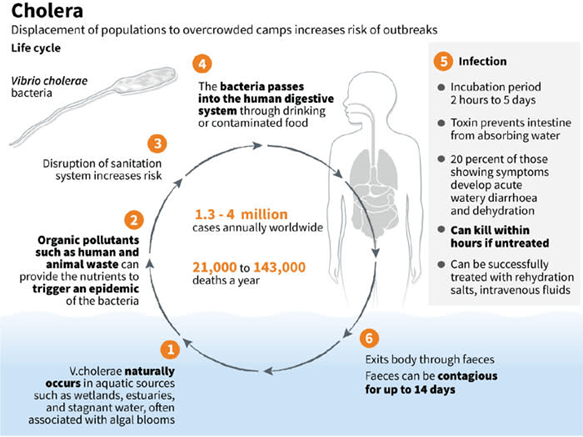
  • It is bacterial infection of small intestine that causes a large amount of watery diarrhoea.
  • It is caused by ingestion of food or water contaminated (water-borne) with the bacterium Vibrio cholerae.
  • Vibrio cholerae has two strains called O1 and O139 of the bacteria Vibrio cholerae.
  • Of these, O1 is responsible for almost all outbreaks; outbreaks of O139 are rare and none have been recorded outside Asia.
  • V. cholerae O139 was first identified in Bangladesh in 1992.
image 1

Symptoms of Cholera

  • It is highly contagious disease that can cause severe acute watery diarrhoea.
  • It takes between 12 hours and 5 days for a person to show symptoms like profuse watery diarrhoea, vomiting, leg cramps, sunken eyes, reduced urine output,etc.

Transmission of Cholera

  • Transmitted to humans through water or food which is contaminated with the cholera bacterium.
  • Cholera can spread rapidly in areas with inadequate treatment of sewage and drinking water.

Prevention and Control of Cholera

  • It is an easily treatable disease. Majority of people can be treated successfully through prompt administration of oral rehydration solution (ORS).
  • Zinc is an important adjunctive therapy for children under 5, which also reduces duration of diarrhoea.
  • Currently, there are three WHO pre-qualified oral cholera vaccines (OCV), Dukoral, Shanchol, and Euvichol-Plus. All three vaccines require two doses for full protection.

Initiatives

  • Global Task Force on Cholera Control (GTFCC) by WHO: Provide a forum for technical exchange, coordination, and cooperation on cholera-related activities to strengthen country's capacity to prevent and control cholera;
  • Created in 1992 in the context of an unprecedent cholera outbreak in Peru.
  • Ending Cholera: Roadmap to 2030: In 2017, aims to reduce cholera deaths by 90% and to eliminate cholera in as many as 20 countries by 2030.
  • Country Support Platform (CSP): To strengthen GTFCC support to countries, hosted by the International Federation of Red Cross and Red Crescent Societies (IFRC) provides multisectoral operational support for countries.

Current Situation  

image
  • Since 2021, there has been an increase in cholera cases and their geographical distribution globally.
  • In 2021, 23 countries reported cholera outbreaks, mainly in Africa and the Eastern Mediterranean. This trend has continued into 2022 with over 29 countries reporting cholera cases or outbreaks.
  • The average cholera case fatality ratio (CFR) reported globally in 2021 was 1.9% (2.9% in Africa).