Current Affairs

Science behind Magnetic Resonance Imaging

Magnetic Resonance Imaging (MRI):

  • MRI is an indispensable tool to look inside the human body without surgery. It is used to obtain images of soft tissues within the body. Soft tissue is any tissue that has not become harder through calcification.
  • It is a non-invasive diagnostic procedure widely used to image the brain, the cardiovascular system, the spinal cord and joints, various muscles, the liver, arteries, etc.
  • MRI scans do not pose any threats; once the magnetic fields are taken away, the atoms in the scanned part do not remain affected. There is no long-term harm associated with scans.
image 22

Applications: 

  • Brain imaging: MRI can help identify abnormalities such as tumours and track neurological conditions including Alzheimer’s, dementia, epilepsy, and stroke etc. Functional MRI (fMRI) is a specialised technique that measures brain activity by detecting changes in blood flow, providing insights into brain function and mapping brain networks.
  • Cardiovascular imaging: MRI can produce detailed images of the heart and blood vessels without using ionising radiation. It helps diagnose heart conditions such as coronary artery disease, cardiac tumours, and congenital heart defects.
  • Spinal cord imaging: MRI is effective in visualising the spinal cord and various structures like joints, ligaments, tendons, and muscles.
  • Abdominal and pelvic imaging: MRI is used to examine abdominal and pelvic organs, including the liver, pancreas, kidneys, uterus, ovaries, and prostate. It can detect tumours, cysts, infections, and other abnormalities, and it is often employed when other imaging methods like ultrasound or computed tomography (CT) provide inconclusive results.
  • Cancer detection: Its use is particularly important in the observation and treatment of certain cancers, including prostate and rectal cancer. 
image 23

How does MRI work?

  • An MRI procedure reveals an image of a body part using the hydrogen atoms in that part. A hydrogen atom is simply one proton with one electron around it. These atoms are all spinning, with axes pointing in random directions. Hydrogen atoms are abundant in fat and water, which are present almost throughout the body.
  • The MRI machine itself looks like a giant doughnut. The hole in the centre, called the bore, is where the person whose body is to be scanned is inserted. Inside the doughnut is a powerful superconducting magnet whose job is to produce a powerful and stable magnetic field around the body. Once the body part to be scanned is at the centre of the bore, the magnetic field is switched on.
  • Each hydrogen atom has a powerful magnetic moment, which means in the presence of a magnetic field, the atom’s spin axis will point along the field’s direction. The superconducting magnet applies a magnetic field down the centre of the machine, such that the axes of roughly half of the hydrogen atoms in the part to be scanned are pointing one way and the other half are pointing the other way. This matching is almost exact: in around a million atoms, only a handful remain unmatched — that is, a small population of ‘excess’ atoms pointing one way or the other.
  • The machine has a device that emits a radiofrequency pulse at the part under the scanner. When the pulse is ‘on’, only the small population of ‘excess’ atoms absorbs the radiation and gets excited. When the pulse goes ‘off’, these atoms emit the absorbed energy and return to their original, lower energy states. 
  • Finally, a detector receives the emissions and converts them to signals, which are sent to a computer that uses them to recreate two- or three-dimensional images of that part of the body.

Limitations:

  • Because of the MRI technique’s use of strong magnetic fields, individuals with embedded metallic objects (like shrapnel) and metallic implants, including pacemakers, may not be able to undergo MRI scans. 
  • MRI machines are expensive: Depending on the specifications, including the strength of the magnetic fields and the imaging quality, they cost from a few tens of lakh rupees to a few crores. Diagnostic facilities pass this cost on to its patients. Based on the clinical requirements, scans often cost ₹10,000 or more each — a sizable sum in India.
  • Discomfort: Inside the machine, the individual is expected to lie still for tens of minutes, until the scan is complete. If the individual moves, the resulting image will be distorted and the scan will have to be repeated. The problem is exacerbated if the individual is claustrophobic (although some ‘open-bore’ MRI machine designs can alleviate this issue).

Press Freedom Index

Context: India’s press freedom has rapidly declined in recent years and is currently ranked 159 out of the 180 nations. 

Press Freedom

image 1

More information: 

  • World Press Freedom Index (2024) is published annually by Reporters Without Borders (RSF).
  • The index evaluates 180 countries based on the freedom and independence of journalists.
  • The press freedom questionnaire covers five categories
    • Political context
    • Legal framework
    • Economic context
    • Socio cultural context
    • Security
  • Norway and Denmark topped the RSF table while Eritrea was at the bottom, with Syria just ahead of it.
  • Press freedoms fell by an average 7.6 points globally.
  • No Asian country made it to the Index’s top 15 in 2024, indicating a pervasive challenge to press freedom in the region.
  • In the Asia-Pacific region, which ranks as the world’s second most challenging area for journalism, several countries, including Myanmar, China, North Korea, Vietnam, and Afghanistan, are among the most dangerous for media personnel.

    India’s rank:

    • India is ranked at 159th (a slight improvement from its previous rank of 161 in 2023), while Pakistan stands marginally higher at 152 and Sri Lanka stands at 150th place. 
    • Scores for India dropped (worsened) in all but the security indicator.
    • However, the government has in the past dismissed international rankings of freedoms in India as misinformed and propaganda driven.

    About Reporters Without Borders: 

    • It is an international non-profit and non-governmental organization focused on safeguarding the right to freedom of information.
    • It describes its advocacy as founded on the belief that everyone requires access to the news and information, in line with Article 19 of the Universal Declaration of Human Rights that recognises the right to receive and share information regardless of frontiers. 
    • RSF works on the ground in defence of individual journalists at risk and at the highest levels of government and international forums to defend the right to freedom of expression and information. 
    • Head office is based in Paris.
    • The World Press Freedom Index (WPFI) is an annual ranking of countries compiled and published by Reporters Without Borders (RSF) since 2002 based upon the organization's own assessment of the countries' press freedom records in the previous year.

    West Nile fever

    Context: The Kerala government issued an alert in the State against West Nile fever, a mosquito-borne viral infection, after one death and eight cases were reported in recent days.

    About West Nile Virus: 

    image 21
    • It is a flavivirus associated to the viruses that are also responsible for causing St. Louis encephalitis, Japanese encephalitis, and yellow fever. 
    • It is a single-stranded RNA virus and is spread by the Culex species of mosquitoes.
    • It was first isolated in a woman in the West Nile district of Uganda in 1937. It was identified in birds in the Nile delta region in 1953.
    • Along all major bird migratory routes, WNV outbreak sites are found: Africa, Europe, the Middle East, North America, and West Asia.
    • No vaccine for WNV is available. Only supportive treatments can be provided to neuroinvasive WNV patients.

    Transmission: 

    • Principal vector is the culex species of mosquitoes.
    • Birds act as the reservoir host of the virus.
    • Infected mosquitoes transmit WNV between and among humans and animals, including birds.
    • WNV can also get transmitted from an infected mother to her child through blood transfusion.
      • A very small proportion of human infections have occurred through organ transplant, blood transfusions and breast milk. There is one reported case of transplacental (mother-to-child) WNV transmission.
    • No instance of transmission by contact with infected humans or animals has been reported.
    • It does not spread ‘through eating infected animals, including birds.
    • According to the World Health Organization (WHO), no human-to-human transmission of WNV through casual contact has been reported till date.

    Symptoms:

    • Symptoms of the infection include high fever, headache, disorientation, stupor, coma, tremors, convulsions, muscle weakness, and paralysis.
    • Most of the symptoms are similar to that of Japanese encephalitis.
    • However, 80% of the patients need not show any symptoms. 
    • Severe infection may even cause neurological diseases like West Nile encephalitis or meningitis or West Nile poliomyelitis or acute flaccid paralysis.
    • There are reports of WNV-associated Guillain-Barré syndrome and radiculopathy.
    • The Flaviviridae are a family of positive, single-stranded, enveloped RNA viruses.
    • They are found in arthropods, (primarily ticks and mosquitoes), and can occasionally infect humans.
    • Members of this family belong to a single genus, Flavivirus, and cause widespread morbidity and mortality throughout the world.
    • Some of the mosquitoes-transmitted viruses include: Yellow Fever, Dengue Fever, Japanese encephalitis, West Nile viruses, and Zika virus.
    • Other Flaviviruses are transmitted by ticks and are responsible of encephalitis and haemorrhagic diseases: Kyasanur Forest Disease (KFD) and Alkhurma disease. 

    What is Carbon farming?

    About Carbon Farming?

    • Carbon farming (also known as carbon sequestration) is a system of agricultural management that helps the land store more carbon and reduce the amount of greenhouse gases that it releases into the atmosphere.
    • In other words, it is a whole farm approach to optimizing carbon capture on working landscapes by implementing practices that are known to improve the rate at which CO2 is removed from the atmosphere and stored in plant material and/or soil organic matter.
    • Carbon farming explicitly recognizes that it is solar energy that drives farm ecosystem dynamics and that carbon is the carrier of that energy within the farm system. 
    • Carbon farming is synonymous with the term ”regenerative agriculture” when that term is explicitly rooted in an understanding of the underlying system dynamics and positive feedback processes that actually make a “regenerative” upward spiral of soil fertility and farm productivity possible, as depicted in the figure below.
    image 19

    What are various Carbon farming practices?

    • Carbon farming practices are management practices that are known to sequester carbon and/or reduce GHG emissions.
    • All those practices that improve soil health and sequester carbon while producing important co-benefits, including: increased soil water holding capacity, hydrological function, biodiversity, and resilience are its example.
      • Alley cropping is the cultivation of food, forage or specialty crops between rows of trees. It is a larger version of intercropping.
      • No-till farming is an agricultural technique for growing crops or pasture without disturbing the soil through tillage.
      • Riparian-zone restoration is the ecological restoration of riparian-zone habitats of streams, rivers, springs, lakes, floodplains etc.
      • Silvopasture is the deliberate integration of trees and grazing livestock operations on the same land.
      • Integrated crop-livestock system is a form of mixed production that utilizes crops and livestock in a way that they can complement one another.
      • Mulching - covering the soil with mulches, such as bark, wood chips, leaves, and other organic material, in order to preserve moisture and improve the condition of the soil.

    What are various merits of Carbon farming?

    • Restore of landscapes and upgradation of natural asset capital – it shields against soil erosion while simultaneously enhancing soil structure, improving nutrient absorption, and optimising water retention.
    • Climate adaptation and meeting of greenhouse gas reduction targets – By improving soil structure and management practices, carbon farming enhances a farm’s ability to withstand challenges such as strong winds and soil erosion. Certain agroforestry designs act as natural barriers to adverse weather conditions, fostering a microclimate that supports crop growth. Through carbon farming, farmers can adapt to climate change while safeguarding their agricultural operations.
    • Improving agricultural resilience and productivity through farm-based forestry- By adopting efficient practices and minimising resource consumption, such as fertilisers and fuel, farmers can maximise output without unnecessary waste. Effective farm management, particularly in water usage, allows for strategic allocation of resources, resulting in improved yields and enhanced productivity.
    • Diversification of income and generation of new revenue streams - additional income through the sale of carbon credits thereby contributing to their financial well-being.

    What are the associated challenges?

    • It becomes challenging in hot and dry areas where the availability of water is limited, and prioritised for drinking and washing needs. Limited water availability can hinder the growth of plants, thus restricting the potential for sequestration through photosynthesis.
    • Small-scale farmers may lack the resources to invest in sustainable land management practices and environmental services.
    • Lack of skills and management abilities further affects their implementation.
    • Lack of awareness - many farmers don’t understand the exact meaning of carbon farming, and they lack detailed information about the pros and cons of carbon farming.
    • Difficulty in monitoring the progress of such initiatives.
    • Uncertainty regarding carbon market selling practices

    What steps have been taken by Government of India in this regard?

    • National Innovations in Climate Resilient Agriculture (NICRA) is a network
    • project of the Indian Council of Agricultural Research (ICAR) aiming to enhance the resilience of Indian agriculture, covering crops, livestock and fisheries to climatic variability and climate change.
    • The National Mission for Sustainable Agriculture (NMSA) includes programmatic interventions like Soil Health Card, Paramparagat Krishi Vikas Yojana, Mission Organic Value Chain Development for Northeastern Region, Rainfed Area Development, National Bamboo Mission and Sub-mission on Agro-Forestry.
    • National Adaptation Fund for Climate Change (NAFCC) was established to meet the cost of adaptation to climate change for the State and Union Territories of India that are particularly vulnerable to the adverse effects of climate change.
    • Climate-smart village (CSV) is an institutional approach to test, implement, modify and promote CSA at the local level and to enhance farmers‟ abilities to adapt to climate change.
    • Pradhan Mantri Krishi Sinchayee Yojna (PMSKY) planned and formulated to give more priority on water conservation and its management in agriculture with the vision to extend the area under irrigation.
    • Paramparagat Krishi Vikas Yojna (PKVY) with the objective of supporting and promoting organic farming through adoption of organic village by cluster approach, which in turn result in improvement of soil health.
    • Biotech-KISAN:  scientist-farmer partnership for agriculture innovation with an objective to connect science laboratories with the farmers to find out innovative solutions and technologies to be applied at farm level.

    Some Global examples

    Chicago Climate Exchange and the Carbon Farming Initiative in Australia
    demonstrate efforts to incentivise carbon mitigation activities in agriculture. The processes range from no-till farming (growing crops without disturbing the soil) to reforestation and pollution reduction.

    Kenya’s Agricultural Carbon Project, which has the World Bank’s support, also highlight the potential for carbon farming to address climate mitigation and adaptation and food security challenges in economically developing countries.

    '4 per 1000’ initiative during the COP21 climate talks in 2015 in Paris highlights the particular role of sinks in mitigating greenhouse-gas emissions.

    Food Safety and Standards Authority of India (FSSAI) to probe allegations against Fast Moving Consumer Goods (FMCG) companies

    Context: The Union Consumer Affairs Ministry has asked the Food Safety and Standards Authority of India (FSSAI) to investigate the allegations against the leading Fast Moving Consumer Goods (FMCG) companies. This follows recent claims that Nestle’s baby food products in India, as well as those in Africa and Latin America, contain excessive sugar levels.

    About Fast Moving Consumer Goods (FMCG)

    • FMCGs are products that sell quickly at relatively low cost. These goods are also called consumer packaged goods.
    • They have a short shelf life because of high consumer demand such as soft drinks and confections or because they are perishable (e.g., meat, dairy products, and baked goods).
    • There are several types of FMCGs such as: 
      • Processed foods such as cheese products, cereals, and boxed pasta
      • Beverages such as bottled water, energy drinks, and juices
      • Fresh foods, frozen foods, and dry goods
      • Medicines such as aspirin, pain relievers, and other medication that can be purchased without a prescription
      • Cleaning products such as baking soda, oven cleaner, and window and glass cleaner
      • Cosmetics and toiletries such as hair care products, concealers, toothpaste, and soap
      • Office supplies such as pens, pencils, and markers
    • The FMCG sector, as India's fourth-largest industry, employs about 3 million people, making up 5% of the country's total factory employment.

    About FSSAI:

    • Body: Statutory body has been established under Food Safety and Standards, 2006.It works as an independent authority and attained a special status. The FSS Act took 7 older acts into one umbrella.
      • Prevention of Food Adulteration Act, 1954. 
      • Fruit Products Order, 1955 
      • Meat Food Products Order, 1973
      • Vegetable Oil Products (Control) Order, 1947  
      • Edible Oils Packaging (Regulation) Order 1998  
      • Solvent Extracted Oil, De- Oiled Meal and Edible Flour (Control) Order, 1967  
      • Milk and Milk Products Order, 1992 
    • Nodal ministry: Ministry of Health & Family Welfare, is the Administrative Ministry for the implementation.
    • Headed by: Non-executive chairperson, appointed by the Central Government, either holding or has held the position of not below the rank of Secretary.
    • Objective: To establish a single reference point for all matters relating to food safety and standards, by moving from multi- level, multi- departmental control to a single line of command.
    • Function: 
      • Framing of regulations to lay down food safety standards
      • Laying down guidelines for accreditation of laboratories for food testing
      • Providing scientific advice and technical support to the Central Government
      • Contributing to the development of international technical standards in food
      • Collecting and collating data regarding food consumption, contamination, emerging risks, etc.
      • Disseminating information and promoting awareness about food safety and nutrition in India.

    Removing exotic plants will ensure food for wild animals, finds study

    Context: A study by the Kerala State Forest Protective State Organisation, an association states that removing exotic plants from forest areas will help ensure food for wild elephants at Chinnakkanal in Munnar.

    Chinnakkanal

    • Chinnakkanal is a village in Devikulam Block in Idukki District of Kerala State.
    • It is a part of the elephant corridor from Anayirankal to Old Devikulam in Munnar.

    Background

    • This village was in news due to rising reports of Man – Animal conflict especially the elephants who were attacking local shops and agricultural fields.
    • Kerala High court appointed an expert panel to address human-animal conflict in Chinnakanal.
    • This panel recommended the reopening of the elephant corridor from Anayirankal to Old Devikulam in Munnar.
    • Securing the corridor between Anayirankal and Old Devikulam, spanning a 60-acre shola forest, is proposed to facilitate the free movement of wild elephants. This move could potentially grant access to a vast 4,500 sq. km area within the Munnar landscape.
    • Kerala State Forest Protective State Organisation also tried to investigate the about steps to mitigate human-elephant conflict in the region.

    Suggestions 

    • Removing exotic species such as Acacia mearnsii (black wattle), West Indian Lantana (kongini) and eucalyptus from forests is vital to addressing the problems.
    • Many areas are filled with exotic trees, which inhibit the growth of other plants.
    • Wild animals, including elephants, are unable to move through these areas. If these areas change to natural grasslands, it will ensure food and water for wild elephants.

    Acacia mearnsii (black wattle)

    • It is a species of flowering plant
    • It is native to south-eastern Australia and Tasmania, but has been introduced to North America, South America, Asia, Europe, Pacific and Indian Ocean islands, Africa, and New Zealand. 
    • In these areas it is often used as a commercial source of tannin or a source of firewood for local communities.
    image 16
    • As an exotic species they threaten native habitats by competing with indigenous vegetation, replacing grass communities, reducing native biodiversity and increasing water loss from riparian zones. 

    West Indian Lantana (kongini)

    • Species of flowering plant.
    • It is native to tropical Americas, the West Indies (Caribbeans).
    • Its vibrant flowers and aromatic foliage have made it an ornamental plant in Gardens and landscapes worldwide.
    image 17
    • As an exotic species it has established itself as a notorious weed
    • In Goa it was introduced by the Portuguese.
    • Lantana can outcompete native species, leading to a reduction in biodiversity.
    • It create a mat-like structure leading to degradation and destruction of the biodiversity. As a result, herbivores like Gaur, Chital and Sambar are deprived of their food. This also affects the survival of carnivores such as tigers and panthers, interlinked to the ecological equilibrium.

    Eucalyptus

    • It is native to Australia.
    image 18
    • Eucalypts have been grown in plantations in many other countries because they are fast growing, have valuable timber, or can be used for pulpwood, honey production, or essential oils. 
    • In some countries, they have been removed because of the danger of forest fires due to their high flammability.
    • They are also termed as thirsty trees as they are responsible for rapid ground water depletion in areas of their plantation.
    • Introduced about four centuries ago to create tannin in the Nilgiris have colonised the grasslands extensively and encroached upon the adjoining shola forests. 

    For further reading about the invasive species

    Eta Aquariid Meteor Shower

    Context: The Eta Aquariid meteor shower, which has been active since April 15, will peak on May 5 and 6. These showers are seen in May every year, and are best visible to countries such as Indonesia and Australia in the Southern Hemisphere.

    Comets:

    image 14
    • Comets are frozen leftovers from the formation of our solar system, some 4.6 billion years ago.
    • Comets are composed of dust, rock and ice, and orbit around the Sun in highly elliptical orbits which can, in some cases, take hundreds of thousands of years to complete.
    • According to NASA, a total of 3,910 comets are currently known, although billions more are theorised to be orbiting the Sun beyond Neptune, in the Kuiper Belt and even more distant Oort cloud.
    • Comets come in different sizes, although most are roughly 10 km wide. However, as they come closer to the Sun, comets heat up and spew gases and dust into a glowing head that can be larger than a planet.  This material also forms a tail which stretches millions of miles.

    Asteroids:

    • Asteroids are rocky remnants from the early formation of our solar system (about 4.6 billion years ago) that mainly orbit the Sun between Mars and Jupiter.
    • The asteroid belt is a nearly flat ring that contains millions of asteroids, ranging in size from less than 10 metres to 530 kms (The largest asteroid is Ceres, which is about one-quarter the size of Earth’s moon). 
    image 15

    Meteoroids, Meteors and Meteorites: 

    • Meteoroids are rocky fragments of asteroids, comets, moons, and planetary collisions. They are much smaller than asteroids, ranging in size from tiny grains up to a metre. In our solar system, most meteoroids come from the asteroid belt, but a few come from comets and fragments of the Moon and Mars formed by impacts.
    • Meteor is a flash of light (shooting star or falling star) seen when a meteoroid, asteroid, or comet heats up in the Earth’s atmosphere. Since most meteors are tiny (the size of a grain of sand) they completely burn up in Earth’s atmosphere. This burning also creates a brief tail. 
    • Meteorites are meteoroids that enter the Earth’s atmosphere and survive to impact the Earth’s surface. A large enough meteor can pass through the atmosphere and hit the Earth’s ground, often causing significant damage.

    Eta Aquariid meteor shower:

    • The Eta Aquariid meteor shower is formed when Earth passes through the orbital plane of the famous Halley’s Comet, which takes about 76 years to orbit the Sun once.
      • Last seen in 1986, Halley’s comet is due to enter the inner solar system again in 2061.
      • Like Eta Aquariids, the Orionids meteor shower is also caused by the Halley’s Comet, and appears every October.
    • The Eta Aquariid meteor shower is known for its rapid speed. This makes for long, glowing tails which can last up to several minutes. The meteor shower consists of burning space debris moving at speeds of around 66 km per second (2.37 lakh kmph) into Earth’s atmosphere.

    Southern Hemisphere: a better vantage point: 

    • The difference in meteor rates between the Northern and Southern Hemispheres during the Eta Aquarid meteor shower is primarily due to the position of this radiant point relative to each hemisphere.
    • The radiant point of the Eta Aquarids (apparent origin of the meteors) is located near the star Eta Aquarii in the Aquarius constellation (in the southern part of the sky).
      • From the Southern Hemisphere, this radiant is higher above the horizon, which means meteors appear to streak outwards in different directions and are more spread out across the sky.
      • From the Northern Hemisphere, the radiant point of the Eta Aquarids is much closer to the horizon. This positioning causes the meteors to skim the Earth's atmosphere at a shallower angle. Consequently, they may appear as "Earthgrazers," which are long, slow-moving meteors that appear to skim or graze the surface of the Earth.
    • Consequently, In the Southern Hemisphere, where the radiant is higher in the sky, observers can see more meteors per hour during the peak of the shower (around 30 to 40 meteors per hour). Conversely, in the Northern Hemisphere, with the radiant nearer to the horizon, observers typically see fewer meteors (around 10 per hour) and often in the form of Earthgrazers.

    Tobacco

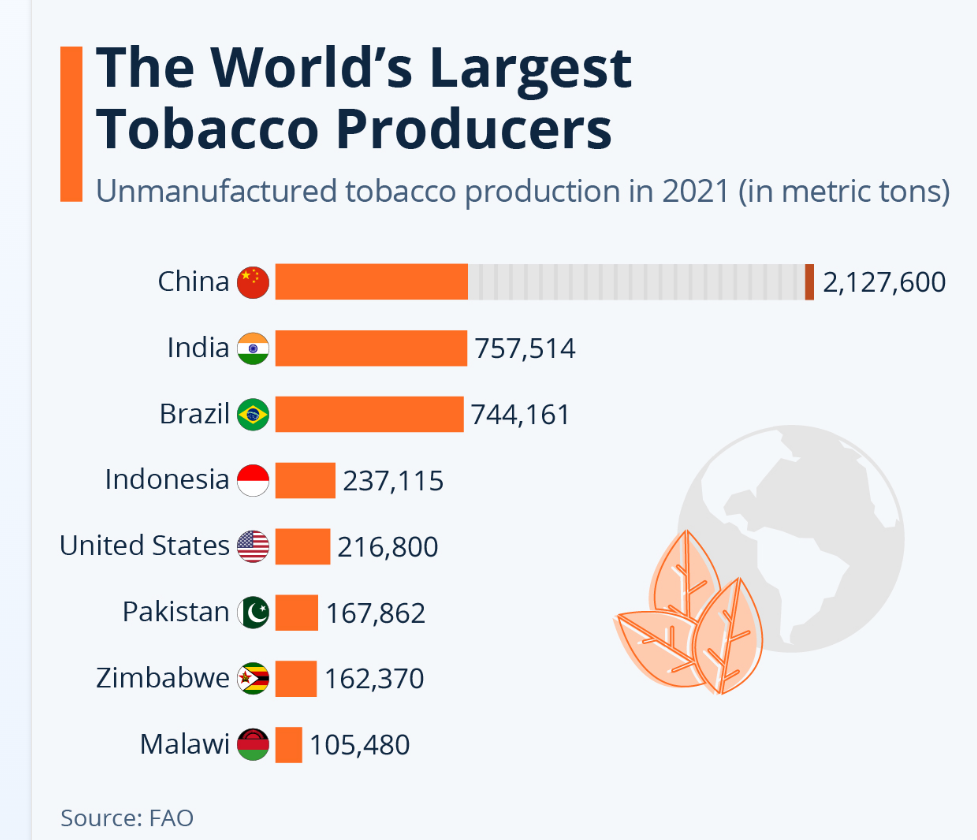
    Context: With top global tobacco producers such as China, Brazil and Zimbabwe reporting issues relating to production output, the demand for Indian tobacco has increased significantly. Tobacco farmers in Andhra Pradesh and Karnataka, who reaped a good harvest in the 2023-24 season, have reported record prices for the produce.

    Tobacco crop

    • Tobacco refers to several plants in the genus Nicotiana, primarily N. tabacum, which is the chief commercial crop used for various products

    Etymology:

    • The English word “tobacco” originates from the Spanish word “tabaco.”
    • Its precise origin is disputed, but it likely derives from the Taíno language of the Caribbean. In Taíno, it meant either a roll of tobacco leaves or an L-shaped pipe used for sniffing tobacco smoke.

    History:

    • Tobacco has been used in the Americas for centuries. Cultivation sites in Mexico date back to 1400–1000 BC.
    • Traditional use includes smoking, chewing, snuffing, and extraction of nicotine.
    • Iroquois mythology attributes tobacco’s origin to Earth Woman’s head after she died giving birth to her twin sons, Sapling and Flint.

    Health Impact:

    • Tobacco use is associated with many deadly diseases, including heart, liver, and lung conditions, as well as various cancers.
    • In 2008, the World Health Organization named tobacco use as the world’s single greatest preventable cause of death.

    Global Impact:

    • Tobacco kills up to half of its users who don’t quit and causes over 8 million deaths worldwide.
    • WHO provides resources to reduce tobacco demand and its health and economic consequences, including measures like pictorial health warnings, taxes, and advertising bans.

    Tobacco Cultivation and Climate:

    Origin: Tobacco is tropical in origin, but it is grown successfully under tropical, sub-tropical, and temperate climates.

    Ideal Conditions:

    • Frost-Free Climate: Tobacco requires about 100 to 120 days of frost-free climate to mature.
    • Temperature: An average temperature of around 80°F (27°C) is ideal for tobacco growth.
    • Rainfall: A well-distributed rainfall of 88 to 125 mm per month is essential for tobacco crops.
    • Soil: Tobacco is grown in warm climates with rich, well-drained soil.

    Global scenario of Tobacco

    • In India, Gujrat is the largest producer followed by Andhra Pradesh which is 41% and 22% respectively.

    Tobacco Board of India

    • The Tobacco Board was constituted as a statutory body on 1st January 1976 under Section (4) of the Tobacco Board Act, 1975. 
    • The Board is headed by a chairman with its headquarters at Guntur, Andhra Pradesh and is responsible for the development of the tobacco industry. 
    • While the primary function of the Board is export promotion of all varieties of tobacco and its allied products, its functions extend to production, distribution (for domestic consumption and exports) and regulation of Flue Cured Virginia (FCV) tobacco.

    Read also: World No Tobacco Day

    Practically every state in India cultivates some type of tobacco, and the country ranks second in global tobacco production after China.

    Oxytocin Ban

    Context: The Delhi High Court has ordered the Department of Drugs Control in Delhi to check weekly and make sure that any cases of fake Oxytocin being used or held are officially recorded under Section 12 of the Prevention of Cruelty to Animals Act, 1960, and Section 18(a) of the Drugs and Cosmetics Act, 1940.

    About Oxytocin: 

    • It is also known as the ‘love hormone’ or bonding hormone, is a hormone produced in the hypothalamus and secreted by the pituitary glands of mammals during sex, childbirth, lactation or social bonding.
    • It acts both as a hormone and as a brain neurotransmitter. In the brain, where it acts as a neurotransmitter, oxytocin is involved in a variety of social behaviours, bonding, and emotional responses.
    • It helps contract the uterus and induce delivery, control bleeding, and promote the release of breast milk. Its use is especially crucial to prevent new mothers from excessively bleeding after giving birth, a common cause of maternal deaths.
    • It can also be chemically manufactured and is sold by pharma companies for use during childbirth. It is administered either as an injection or a nasal solution.
    • It was banned in April 2018, saying that it was being misused on milch cattle to increase yield, which not only affects the health of the cattle but also humans who consumed the milk.
    • It is also used to increase the size of vegetables such as pumpkins, watermelons, eggplants, gourds, and cucumbers.

    Swell Waves

    Context: Hyderabad-based INCOIS has issued an alert to coastal States on the possibility of swell surges and rough sea conditions.

    About Swell Waves:

    image

    High-Energy Swell Waves

    All swells are created by wind blowing over the surface of the ocean. When strong winds persist over vast distances (such as during storms), they generate waves. The strength, duration, and area of the ocean that the wind affects determine the size of the waves, how far they’ll travel, and the energy they carry when they reach the shore.

    Working:

    • Wind Energy: As winds blow across the ocean, they transfer energy to the water surface. This energy causes ripples to form, which eventually evolve into waves.
    • Distance and Duration: The longer the wind blows and the greater the distance it covers, the more energy is transferred to the waves. Consequently, the waves become larger and cover more distance.
    • Swells: Swells can be categorized based on their origin:
      • Groundswell: These swells originate from winds far out at sea, covering longer distances. They have longer swell periods and more energy. Groundswells often result in cleaner, organized surf conditions.
      • Windswell: Wind swell forms closer to the shore. The swell period is shorter, waves are less organized, and they arrive faster.

    Issuing Authority: Hyderabad-based Indian National Centre for Ocean Information Services (INCOIS).

    Recipient States: Coastal States of Goa, Maharashtra, West Bengal, Odisha, Tamil Nadu, Kerala, Lakshadweep, and Andaman & Nicobar Islands.

    Alert Content:

    • INCOIS alerted coastal states about the possibility of high-energy swell waves over the weekend.
    • Urged the total suspension of operational and recreational activities at beaches and nearshore regions on Saturday and Sunday.
    • Advised fishermen and coastal populations to be cautious about potential surge waves, especially in low-lying areas.

    Scientific Explanation:

    • Senior scientist T. Balakrishnan Nair explained that high-period swells originating approximately 10,000 km away from the Indian coast in the southern Atlantic Ocean on April 26 were causing high-energy swell propagation towards Indian coastal regions.
    • Expected impact: hitting the southern tip of India early Saturday, potentially causing coastal flooding in low-lying areas when combined with high tide conditions.

    Safety Recommendations:

    • Small vessels cautioned against plying nearshore.
    • Recommended anchoring boats at a fair distance from each other to prevent damage.

    Special Advisory for Kerala:

    • Kerala coastal communities advised to remain vigilant.
    • State put on red alert for high-energy swell waves, locally known as 'Kallakadal' (rogue sea), likely lasting until 11:30 p.m. on Sunday.
    • Potential swell waves: ranging from 0.5 meters to 1.7 meters high in low-lying areas.

    Actions by Kerala State Disaster Management Authority (KSDMA):

    • Issued directions to suspend recreational activities along beaches.
    • Advised coastal residents to temporarily evacuate if necessary.
    • First instance of a red alert being issued for the State regarding the Kallakadal phenomenon, according to KSDMA member secretary Sekhar Kuriakose.

    Standard Essential Patent

    About Standard Essential Patent:

    • A ‘standard’ is a set of technical requirements or agreed technical descriptions which cover ideas, products or services and make sure that technologies interact and work together.
    • A Standard Essential Patent (SEP) is a patent granted for technological invention which is essential for implementation and working of a standard.
    • Patents which are essential to a standard and have been adopted by a Standard Setting Organisation (SSO) are known as SEPs.
      • SSOs are either governmental, quasi-governmental or private groups of independently governed industry associations.
      • SSOs set, develop, coordinate, interpret, and maintain standards. Industry participants can collaborate on a single technical solution because of such standards.
    • When a patent is acknowledged by the SSO and designated as a SEP, manufacturers can only produce their goods in the market after first acquiring a licence under the SEP.

    SEPs and the Telecommunications Sector: 

    • SEPs are widely used in the telecommunications sector as it is a highly standardised industry primarily driven by the requirement for interoperability between communication devices.
    • Technologies such as CDMA, GSM, LTE are all industry standards in the telecom sector. Such technological standards are especially important to ensure interoperability of different brands of cellular phones manufactured by different companies.
      • For example, once GSM was adopted as a standard, all manufacturers had to ensure that the handsets that they manufactured were compatible with GSM. Otherwise there would be no demand for their phones.
    • In industries like consumer electronics, the automotive industry, and the electricity grid industry, such communication standards are also essential for the growth of the hyperconnected society. 
    • The goal of making standards accessible to everyone for public use may be defeated by the exclusive rights granted to inventors by patents. To address this issue, the majority of SSOs have established IPR policies that require SSO members to agree to licensing their SEPs under "Fair, Reasonable and Nondiscriminatory" (FRAND) terms and conditions.
      • These commitments are intended to safeguard technology implementers while making sure that Patent holders are fairly compensated for their research and development expenditures.

    SEP protection in India: 

    • The Patent laws in India neither contain a special provision for SEPs nor lays down any specific criteria or terms and conditions to be complied with while licensing a patented technology. However, it does restrain a patentee (proprietor of the patent) from abusing its patent right and engaging in practices that unreasonably restrain trade. 
    • Moreover, the Indian judiciary has been framing laws through court cases for the regulation of the SEPs.
    • Through its National Telecom Policy (2012), India has aimed to increase standardisation and intellectual property creation. India’s national SSO is the Bureau of Indian Standards. 

    FRAND licensing (Fair, Reasonable and Non-Discriminatory): 

    • The Judiciary and the Standard Setting Organisations have mandated licensing of the patents based on FAIR, REASONABLE and NON-DISCRIMINATORY (FRAND) principles.
    • FRAND terms encourage the adoption of the standard and mitigate any concerns about unfair competition. 
    • SEPs can be protected in India only by registering a patent in India. A SEP holder must agree to licence the SEP to willing licensees at Fair, Reasonable, and Non-Discriminatory (FRAND) rates. 

    Challenges: 

    • Globally, the process of setting standards in the technology sector is largely privatised and dominated by “standard setting organisations” (SSOs) run largely by private technology companies. Countries such as India with little innovation in the telecom sector, have very little influence over how standards are set or how SEPs are licensed.
    • Theoretically, the companies which own the SEPs, gain enormously because every manufacturer of cellular phones has to licence the technological standards in question in order to survive in the market. The lack of alternatives also means that owners of SEPs can demand extortionary royalties or licensing terms from manufacturers that block competition. 
    • In theory, the SSOs are supposed to prevent such a scenario by requiring the owners of SEPs to licence their technologies at a fair, reasonable and non-discriminatory (FRAND) rate. In practice, this model of self-regulation by the technology industry has been marked with opacity. 

    Way Forward: 

    • On the lines of international agreements, the Indian government needs to intervene and put in place the measures to regulate standard essential patents for greater transparency and protect the rights of Indian manufacturers. 

    Australia-India trade pact working well for both nations

    Context: The India-Australia Economic Cooperation and Trade Agreement (ECTA) has been beneficial for India. The exports of Indian farm products and industrial goods such as iron and steel products, showed a marked increase.  

    India-Australia Economic Cooperation and Trade Agreement (ECTA):

    image 12
    • Australia is an important strategic partner of India. They are also part of the four nation QUAD, Trilateral Supply Chain Initiative and the Indo-Pacific Economic Forum (IPEF).
    • The Australia-India ECTA entered into force in the year 2022.
    • It provides an institutional mechanism to encourage and improve trade between the two countries and covers almost all the tariff lines dealt by India and Australia.
    • Provisions: 
      • Preferential market access for goods: 
        • India is benefitting from preferential market access provided by Australia on 100% of its tariff lines, including all the labour-intensive sectors of export such as Gems and Jewellery, Textiles, leather, footwear, furniture, food, and agricultural products, engineering products, medical devices and Automobiles.
        • India is offering preferential access to Australia on over 70% of its tariff lines, including lines of export interest to Australia, which are primarily raw materials and intermediaries such as coal, mineral ores and wines.
      • Services: 
        • Australia has offered wide-ranging commitments in around 135 sub-sectors and Most Favoured Nation (MFN) status in 120 sub-sectors covering key areas of interest to India.
        • India has offered market access to Australia in around 103 sub-sectors and Most Favoured Nation status in 31 sub-sectors from the 11 broad service sectors such as ‘business services’, ‘communication services’, ‘construction and related engineering services.’
      • Separate Annex on Pharmaceutical products: This agreement will enable fast-track approval for patented, generic and biosimilar medicines.
      • Employment generation
        • An additional 10 lakh jobs would be created in India under ECTA.
        • Indian Yoga teachers and chefs are set to gain the annual visa quota. 
        • Over 1 lakh Indian students would benefit from a post-study work visa (for 18 months to 4 years) under the ECTA.
    • Increase in exports: 
      • Indian exports of iron and steel products were up 16 per cent at $322 million, apparel exports increased 6 per cent to $342 million and exports of jewellery increased 6 per cent to $169 million.
      • Indian exports of agriculture also increased 15 per cent.

    India and Australia are now negotiating to sign a full-fledged Comprehensive Economic Cooperation Agreement (CECA). 

    • The proposed CECA is expected to cover goods (some of the remaining ones that are out of CEPA), services, digital trade, government procurement and Rules of Origin (ROO)-Product Specific Rules Schedule.
    image 13

    Conclusion: 

    India-Australia bilateral trade, currently valued at about $30 billion per annum, has the potential of touching $100 billion over the next few years with the increased cooperation between the two sides and as India is aspiring to be at the centre of the supply chains of the future, a comprehensive partnership with Australia will assist it attaining its ambitions.