Context: The Central Administrative Tribunal (CAT) has refused to stay the termination of Bibhav Kumar, personal secretary of Chief Minister Arvind Kejriwal. He was suspended by Delhi Government's Vigilance department in a 19-year-old case of obstructing and threatening a public servant.
About Tribunals:
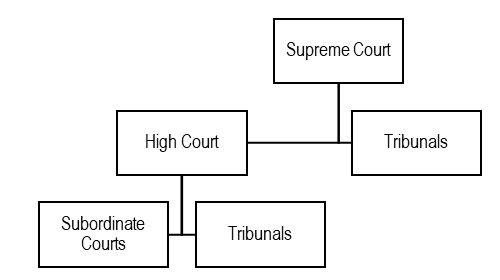
- Tribunals are institutions established for discharging judicial or quasi-judicial duties. The objective can be to reduce caseload of the judiciary or to bring in subject expertise for technical matters.
- The Supreme Court has ruled that tribunals, being quasi-judicial bodies, have the same level of independence from the executive as the judiciary. Independence is ensured by the mode of selection of members, the composition of tribunals, and the terms and tenure of service.
- Tribunals were not mentioned in the original constitution. The 42nd Amendment Act of 1976 added a new Part XIV-A to the Constitution. This part is titled as 'Tribunals' and consists of only two Articles-Article 323A dealing with administrative tribunals and Article 323B dealing with tribunals for other matters.
About Central Administrative Tribunal:
- Origin: Central Administrative Tribunal (CAT) was set up in 1985 with the principal bench at New Delhi and additional benches in different states, at present, it has 19 regular benches, 17 of which operate at the principal seats of high courts and the remaining two at Jaipur and Lucknow.
- Membership and appointment: At present, the sanctioned strength is Chairman and 69 members. They are drawn from both judicial and administrative streams.
- A person who has not completed the age of 50 years is not eligible for appointment as a chairman or Member.
- They hold office for a term of four years or until they attain the age of 70 years in case of Chairman and 67 years in case of Members, whichever is earlier.
- The appointment of Chairman and Members in CAT is made by the central government based on recommendations of a search-cum-selection committee chaired by the Chief Justice of India or a Judge of Supreme Court, who is nominated by the Chief Justice of India.
- Jurisdiction: The CAT exercises original jurisdiction in relation to recruitment and all service matters of public servants covered by it.
- Its jurisdiction extends to the All-India Services, the Central civil Services, civil posts under the Centre and civilian employees of defence services. However, the members of the defence forces, officers and servants of the Supreme Court and the secretarial staff of the Parliament are not covered by it.
- Functioning: The CAT is not bound by the procedure laid down in the Civil Procedure Code of 1908. It is guided by the principles of natural justice.
- Appeal: Appeals against the orders of the CAT shall lie before the division bench of the concerned high court.