Daily Current Affairs

January 17, 2024

Current Affairs

What are light-emitting diodes?

Diode: 

  • A diode is an electronic component that has two points of contact, or terminals, called its anode and cathode.
  • It is typically made from a semiconductor material, such as silicon or germanium. A diode’s primary purpose is to allow current to flow in only one direction. It achieves this using a p-n junction. 

Semiconductors: 

  • Semiconductors are materials that have electrical conductivity between that of a conductor (like copper) and an insulator (like rubber). A diode consists of two regions of semiconductor material: the p-type region and the n-type region. 
  • P-type Semiconductor: A p-type semiconductor is a type of semiconductor material that has an excess of positive charge carriers (holes) and is created by introducing certain impurities into the semiconductor crystal.
  • N-type Semiconductor: An n-type semiconductor is a type of semiconductor material that has an excess of negative charge carriers (electrons) and is also created by introducing specific impurities into the semiconductor crystal.
  • P-N Junction: When a p-type and n-type semiconductor are joined, they form a special jone/ interface called the p-n junction. 
  • At the p-n junction (depletion region) when a forward voltage is applied across the diode (positive voltage at the p-type and negative voltage at the n-type), the depletion region becomes thinner, allowing current to flow easily through the diode. 
  • On the application of a suitable voltage across the diode, more electrons flow from the n-side to the p-side, implying an electric current flowing from the p-side to the n-side, that is from the anode terminal to the cathode terminal. But if the voltage is reversed, current won’t flow in the opposite direction. 
image 77

What is an LED? 

  • An LED is a diode that emits light. Inside the diode’s p-n junction, the electrons have more energy than the holes. When an electron meets and occupies a hole, it releases energy into its surroundings. 
  • If the frequency of this energy is in the visible part of the electromagnetic spectrum, the diode will be seen to emit light. The overall phenomenon is called electroluminescence. 
    • In LEDs, the energy emitted when an electron and a hole recombine is the energy of the band gap. 
    • The colour of the light emitted by the LED depends on the energy bandgap of the semiconductor material used.
    • By carefully choosing the materials that make up the p-layer and the n-layer, researchers can engineer the composite p-n junction to have a band gap that corresponds to visible light.
  • LEDs can produce all three primary colours — red, green, and blue — different LEDs can be combined on a display board to produce a large variety of colours.
    • Scientists were able to create red and green LEDs more than 40 years before they created blue LEDs.
    • In the late 1980s, three Japanese researchers produced a bright blue LED with gallium nitride. For this feat they received the physics Nobel Prize in 2014.
image 78

Advantages of LEDs: 

  • Energy Efficiency: LEDs are more efficient than incandescent bulbs and fluorescent lamps. They convert a higher percentage of electrical energy into light.
    • Per watt of power consumed, LEDs can produce up to 300 lumen (amount of visible light emitted per second) versus incandescent bulbs’ 16 lumen and fluorescent lamps’ 70 lumen. 
    • Together with their greater durability and light contrast, LEDs’ lead to higher cost savings and less material waste. 
  • Long Lifespan: LEDs have a much longer lifespan and durability compared to conventional bulbs. They can last up to 25 times longer, which means fewer replacements and reduced maintenance costs over time.
  • Instantaneous Lighting: LEDs light up instantly without any warm-up time. They reach their full brightness immediately, which is particularly useful in applications where quick and frequent switching is required. 
  • Compact Size: LEDs are compact and can be made in very small sizes. This makes them versatile and allows for innovative lighting designs and applications where space is limited.

Applications: 

  • Lighting: Residential lighting, Commercial lighting, Automotive Lighting, Dashboard and instrument panel lighting, Backlighting for LCD screens in smartphones, tablets, and laptops. 
  • Electronic Displays: LED TVs and monitors, Digital billboards and signage, Information displays (public transportation, airports).
  • Traffic Signals and Signs: Pedestrian crossing signals, Road signs and signal boards.
  • Indicator Lights: Power indicators on electronic devices, Status indicators on appliances and equipment.
  • Medical Applications: Surgical lights, Phototherapy for medical treatments.
  • Horticultural Lighting: Grow lights for indoor farming and plant cultivation, Greenhouse lighting.
  • UV-C Disinfection: UV-C LED lights for disinfection and sterilisation purposes, Water and air purification systems. 

Trade Connect ePlatform

Context: Union Minister of Commerce and Industry, Consumer Affairs, Food and Public Distribution and Textiles announced initiation of work on Trade Connect ePlatform.

Trade Connect ePlatform

  • It is an intermediary platform providing the facility to connect Indian exporters and entrepreneurs with various stakeholders in international trade.
  • The ePlatform is expected to:
    • Provide facilitation for new and aspiring exporters.
    •  Provide information on various regulations to access markets, sectors, export trends.
    •  Provide easy access of benefits under Free Trade Agreements.
    • Provide access to sector specific events along with a facility to address trade related queries to officials in Government of India and associated entities to get expert advice.
  • Anyone can get all the information for export promotion activities, including contact details of all resource persons.
  • It provides a platform to the State governments and UTs for sharing State-oriented perspectives on exports.
  • It also acts as a platform for the Government of India for appraising State and UTs about international developments affecting India’s trade and the role States and UTs can play in promoting exports. 
  • It remains an important mechanism for deliberations on trade related issues with Industry bodies, Associations, Export Promotion Councils, and State/UT governments.

Significance

  • To achieve the $2 trillion export target for year 2030.
  • To internationalize the goods and services to help in improving the quality of the products and increase the size of the economy.
  • The launch of the Trade Connect ePlatform is to increase the participation of Micro, Small and Medium Enterprises (MSME), and startups in exports, a move aimed at promoting exports with the involvement of small and medium traders.

Chief Secretary and Current Issue with Extension of its Tenure in Delhi

Context: The Supreme Court of India, through an order, permitted the Union Government to unilaterally extend the tenure of the incumbent Chief Secretary despite the opposition from the Delhi government on allegations of conflict of interest.

Timeline of Current Issue with respect to Service of Chief Secretary in Delhi 

Government of NCT of Delhi vs Union of India Case, 2017 (Service Judgement):

  • In this case, the Supreme Court unequivocally held that references to "state government" in the relevant All India Rules (AIR) or Joint Cadre Rules (JCR) related to Delhi would mean the Government of Delhi.
  • Following this ruling, the Delhi government's recommendation became necessary for extending the Chief Secretary's tenure under Rule 16 of the All India Services (Death-cum-Retirement Benefits) Rules, 1958.

Government of National Capital Territory of Delhi (Amendment) Act, 2021:

  • This act amended Section 21 of the Government of National Capital Territory of Delhi Act, 1991, by inserting subsection (3), specifying that the expression "Government" referred to in any law to be made by the Legislative Assembly shall mean the Lieutenant Governor.

Current Supreme Court Order:

  • The Supreme Court carved an exception for the Chief Secretary of Delhi, asserting that he is differently placed than other officers under the AIR or JCR and is not bound by the Services judgement.
  • Despite the earlier ruling emphasizing the Delhi government's role in extending the Chief Secretary's tenure, the Supreme Court's current order permits the Union Government to unilaterally extend the incumbent Delhi Chief Secretary's tenure. 
  • This decision comes despite the opposition of the Delhi Government, citing serious allegations of conflict of interest against the Chief Secretary, which are currently under investigation.

Chief Secretary of a State 

While the Constitution of India does not have an explicit provision related to the chief secretary of states under Article 166, it provides for the conduct of the business of the state government. Their appointment is an executive action done by the chief minister in the name of governor.

  • Depending on the state, the powers and functions of chief secretaries are defined in the rules of business. 
  • The Chief Secretary is at the apex of the administrative hierarchy of a state. 
  • Many of their functions have evolved through parliamentary custom and convention, and the rules are amended from time to time to accommodate new evolving roles.

Role of Chief Secretary 

The Chief Secretary of a state acts as the ex-officio Secretary to the Council of Ministers and, in that capacity, he is known as the Secretary to the Cabinet and plays an important role in policy formulation.

  1. Head of the Cabinet Secretariat Department: The Chief Secretary oversees the Cabinet Secretariat Department, functioning under the Chief Minister's political leadership.
  2. Work Pertaining to Cabinet Meetings:
    • The Chief Secretary is responsible for preparing agenda papers for cabinet meetings.
    • As the ex-officio Secretary to the Council, they attend cabinet meetings and sub-committee meetings.
    • The Chief Secretary records decisions made in cabinet meetings and forwards copies to the Governor, Chief Minister, and council of ministers.
  3. Participation in the Policy Formulation Process:
    • The Chief Secretary serves as the primary source of information and advice to the Chief Minister and other ministers.
    • Their presence in cabinet meetings is crucial to counterbalance ministers who may be influenced by public opinion or constituency pressure, ensuring decisions are made with long-term considerations.
  4. Role in the Follow-up of Cabinet Decisions:
    • After cabinet decisions, the Chief Secretary oversees the implementation by the secretary of the concerned department.
    • The Chief Secretary has the authority to request documents related to any department's case.
  5. Representation at the National Level Consultations:
    • The Chief Secretary represents the state in national-level consultations, contributing to discussions and decisions on broader issues.

Function and Responsibilities of Chief Secretary 

1.     He chairs an expert body, which decides matters of awarding honours and distinctions.

2.     He deals with matters relating to inter-state disputes.

3.     The Chief Secretary can initiate changes in Rules of Business but the final decision in this respect rests with the cabinet.

4.     All matters of housing accommodation and government buildings and circuit houses fall under his jurisdiction.

The functioning and responsibilities of the Chief Secretary affect all the departments and, therefore, the role of the Chief Secretary as the head of the General Administration Department remains of substantial significance.

First ever IUCN Assessment of Himalayan Wolf

Context: Himalayan Wolf has been assessed for the first time in the IUCN's Red List as Vulnerable.

image 17

About Himalayan Wolf

  • Himalayan Wolf (scientific name: Canis lupus chanco) is a prominent lupine predator found across the Himalayas.
  • It is well adapted to cold environment and is found in alpine steppe and tundra habitats above 3,900 m on the Tibetan Plateau and Himalayas. 
  • Himalayan Wolf possesses genetic adaptations to cope with hypoxic conditions in their high-altitude habitats. 
  • They are sympatric with snow leopards in large parts of their range. Both Wolves and Snow Leopards are apex predators in the high-altitude habitats with some degree of competition for prey resources.
  • Himalayan Wolf feeds on ungulates (Tibetan gazelle, Tibetan argali, blue sheep) and small mammals (Himalayan Marmot, Pika, Wolly hare) and livestock such as domestic yaks and goat.
  • The population size of Himalayan Wolf has been estimated to be 2,275-3,792 individuals by researchers from the Wildlife Institute of India. Of this, India has 277-378 individuals in its part of Himalayas.
  • Found in Tibet, Nepal and Indian Himalayas. 
  • Locations where it is found in India: Ladakh (Ut of Ladakh), Spiti Valley (Himachal Pradesh), Uttarakhand and Sikkim. 
  • IUCN Status: Vulnerable
image 76

Threats to Himalayan Wolf

  • Depredation conflict (Man-Animal Conflict)
  • Habitat modification and encroachment
  • Depletion of wild prey populations
  • Hybridisation with dogs
  • Illegal hunting for fur and body parts including paws, tongues, heads and other parts.

Distinction from Indian Wolf

  • Earlier the Himalayan Wold and Indian Wolf were considered to be the same species. However, in 2018 researchers confirmed that Himalayan or Woolly Wolf was a genetically unique clade/lineage/race of wolves. 
  • Indian/Common/Peninsular Wolf is found in the plains and the Deccan Plateau.

Davos Summit

Context: The World Economic Forum is holding its annual meeting from January 15 to 19 in Davos, Switzerland.

About World Economic Forum (WEF):

  • Professor Klaus Schwab founded WEF in 1971, originally called the European Management Forum, as a non-profit foundation based in Geneva, Switzerland.
  • It is the International Organization for Public-Private Cooperation.
  • It introduced the concept of ‘stakeholder capitalism’ i.e. a form of capitalism in which companies do not only optimize short-term profits for shareholders, but seek long term value creation, by taking into account the needs of all their stakeholders, and society at large.
  • In 2015, the Forum was formally recognised as an international organization.
  • The Forum is chaired by Founder and Executive Chairman Professor Klaus Schwab.
  • The Managing Board, chaired by the Forum's President, Børge Brende, acts as the executive body of the World Economic Forum.
  • The Great Reset Initiative is an economic recovery plan drawn up by the World Economic Forum (WEF) in response to the COVID-19 pandemic.
  • The Global Redesign Initiative (2010) of WEF was a global, multistakeholder dialogue on the future of international cooperation. Set up in the midst of the global financial crisis, its purpose was to stimulate thinking and debate about how the international community and its institutions and organizations in their widest sense can be adapted to contemporary challenges.
  • Reports released by WEF:
    • Global Risks Report
    • Global Gender Gap Index (#2017 Prelims)
    • Fostering Effective Energy Transition Report
    • Travel and Tourism Development Index
    • Global Cyber Security Outlook
    • Global Competitiveness Report (#2019 Prelims)

Multidimensional Poverty

Context: According to Niti Aayog, India’s multidimensional poverty rate has reduced to 11.28% in 2022-23 from 29.17% in 2013-14.

image 75

Findings of NITI Aayog:

  • It estimated that around 24.82 crore people escaped multidimensional poverty in the last nine years.
  • States like Uttar Pradesh, Bihar, Madhya Pradesh, and Rajasthan recorded the sharpest decline in the number of people classified as poor.
  • Indicators in the standard of living dimension showed highest levels of deprivation in 2005-06. For instance, 74.4 per cent of the population was deprived of cooking fuel in 2005-06, which fell to 43.9 per cent between 2019-21. 
  • Similarly, 70.92 per cent of the population was deprived of adequate sanitation facilities in 2005-06, which reduced to 30.93 per cent between 2019-21.
  • Bihar recorded a 53 per cent drop from 56.3 per cent share of MPI poor in 2013-14 to 26.59 per cent in 2022-23.

About Multidimensional Poverty:

  • Multidimensional poverty encompasses the many deprivations that people can experience across different areas of their lives. This could include a lack of education or employment, inadequate housing, poor health and nutrition, low personal security, or social isolation.
  • Applying a narrow definition of poverty and focusing on one dimension alone, such as income, fails to capture the true reality of people’s circumstances. In contrast, multidimensional poverty measurement offers a more holistic approach which better reflects peoples lived experiences.

About Multidimensional Poverty Index (MPI): 

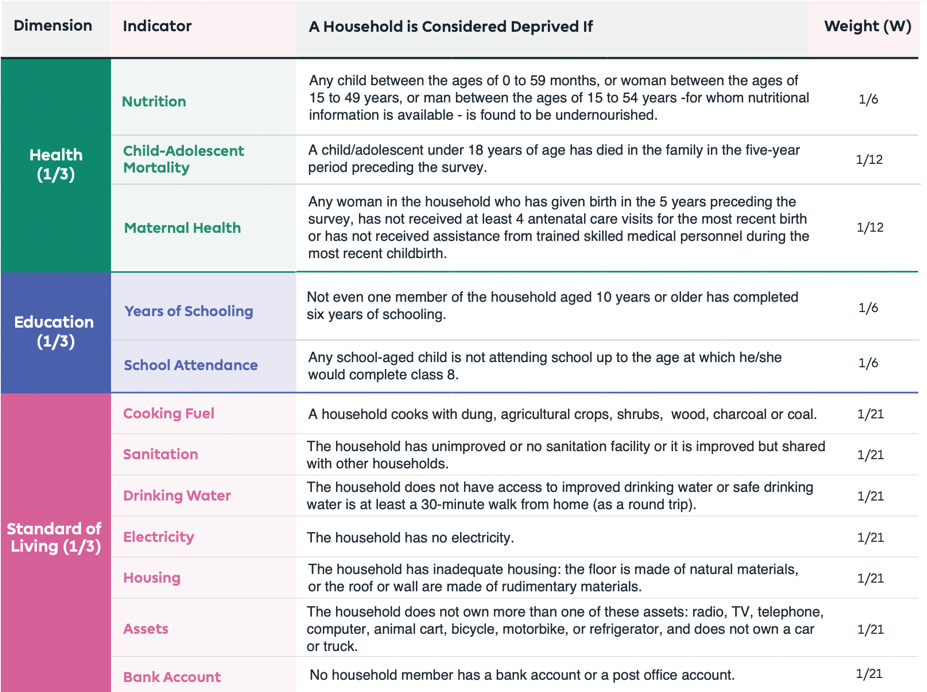
  • Global MPI:  Developed by Oxford Poverty & Human Development Initiative (OPHI) in collaboration with the UN Development Programme (UNDP), in its flagship Human Development Report since 2010 and is the most widely used non-monetary poverty index in the world. It captures overlapping deprivations in health, education and living standards.
  • These dimensions are broken into ten indicators, including child mortality, nutrition, years of schooling, school attendance, cooking fuel, sanitation, drinking water, electricity, housing, and assets.

g3JuZUPK8A vDZ16Jq3Q vxluUIIElwij7AQr5CHZ

  • National MPI: Niti Aayog released its Multidimension Poverty Index in 2021 for the first time.
  • India’s national MPI is a contribution towards measuring progress on target 1.2 of the SDGs which aims at reducing “at least by half the proportion of men, women and children of all ages living in poverty in all its dimensions.

Government initiative to reduce poverty in all dimensions:

  • Poshan Abhiyan: To reduce malnutrition and stunting in children, adolescent girls, and women. It focuses on promoting a healthy diet, proper nutrition, and addressing related health issues.
  • Anemia Mukt Bharat: This initiative is part of the larger Poshan Abhiyan and focuses specifically on preventing and reducing the prevalence of anemia among women, children, and adolescents.
  • Targeted Public Distribution System under the National Food Security Act: Covers 81.35 crore beneficiaries, providing food grains to rural and urban populations. 
  • Pradhan Mantri Garib Kalyan Anna Yojana: Provide additional free food grains to the poor and vulnerable sections of society to alleviate the hardships faced due to the COVID-19 pandemic. 
  • Ujjwala Yojana : To provide free LPG connections to women from below-poverty-line households.
  • Saubhagya:  Providing electricity to rural and urban areas, aiming to enhance the quality of life and economic development.
  • Swachh Bharat Mission: To achieve universal sanitation coverage and make India open-defecation free.
  • Jal Jeevan Mission: To provide piped water supply to all rural households by 2024.
  • Pradhan Mantri Jan Dhan Yojana: To provide access to banking services for all households.
  • PM Awas Yojana: To facilitate access to affordable housing for the low and moderate-income residents of the country.

Significance of multidimensional poverty:

  • It is qualitative measure of poverty and it used non-monetary metrics to measure poverty in the world by measuring overlapping deprivations in access to health, education and living standards. 
  • Monetary measures of poverty based on poverty lines only give headcount ratios i.e., number of people who are poor. However, these measures fail to measure depth of poverty. It is possible that while the overall number of poor individuals reduce, while at the same time the poorest get poorer. Also, gains in quality of life may be completely missed unless the poor cross the poverty line or exit poverty. 
  • Thus, MPI provides insights not just into the distribution of poverty within a country but also indicates contribution of each indicator to multidimensional poverty. 
  • Using MPI, it has been possible to device schemes which target specific deprivations.
  • Helps to create a comprehensive understanding of poverty by identifying who is poor and the manner in which they experience poverty.

Limitations with MPI: 

  • It does not capture intra-household inequality or inequality among the poor.
  • The multitude of indicators can be overwhelming and may result in ineffective implementation.
  • Determining the relevance of dimensions and deciding how many should be considered or prioritized is also challenging.
  • Poverty is a complex issue with numerous factors, making it challenging to address all aspects.
  • Collecting data for multidimensional indicators can be extremely challenging and demanding, requiring additional efforts from the agency to achieve meaningful results.
  • MPI data released by NITI Aayog based on the National Family Health Survey (NFHS), which raises the issues of reliability of poverty assessments and subsequent policy decisions. (no independent assessment by NITI Aayog).

Way forward:

  • Integrating the Multidimensional Poverty Index (MPI) with government policy measures can indeed enhance the effectiveness and precision of schemes like the Public Distribution System (PDS) and the Mahatma Gandhi National Rural Employment Guarantee Act (MGNREGA).
  • Simplify the set of indicators to avoid overwhelming complexity. Prioritize the most relevant and impactful dimensions, taking into account the local context and priorities. This will help focus efforts on the most critical aspects of poverty.
  • Involve local communities in the data collection process to enhance accuracy and inclusivity.
  • Baseline survey should be conducted with the involvement of local communities to enhance accuracy and inclusivity.