Daily Current Affairs

2023

Current Affairs

Cereal solution

Context: The United Nations has declared 2023 as the International Year of Millets, and Finance Minister Nirmala Sitharaman has singled them out as the "best among grains." With rising demand for sustainable agriculture, India is looking to market millet as a global panacea.

Prime Minister of India has recently inaugurated a global conference on millets, Millets have been recognized by the government as a potential ally against climate change and malnutrition, and the United Nations has declared 2023 as the International Year of Millets. Promoting millets as a superior crop to rice and wheat ignores the economics of production and could have negative consequences for marginal farmers. 

Millets:

Millets, a group of small-grained cereal crops, are highly resilient to extreme weather conditions and can be grown with minimal chemical inputs such as fertilizers and pesticides. Millets are a versatile and healthy grain alternative, as they are both gluten-free and non-allergenic. They are nutri-cereals which are highly nutritious and are known to have high nutrient content which includes protein, essential fatty acids, dietary fibre, B-Vitamins, minerals such as calcium, iron, zinc, potassium, and magnesium. 

Significance & Benefits of Millets:

  1. Nutritionally rich: Millet grains are an excellent choice for meeting your nutritional needs due to their abundance of nutrients such as carbohydrates, protein, dietary fibre, and good-quality fat. They also possess a variety of phytochemicals, known for their therapeutic properties, which can offer anti-inflammatory and anti-oxidative benefits. 
  2. Health benefits: They contain high amounts of antioxidants which are known to effectively reduce both LDL (low-density lipoprotein) and total cholesterol levels while promoting healthy blood vessels, ultimately lowering the risk of heart disease and stroke. Furthermore, millets are beneficial in managing health concerns such as obesity, diabetes, etc.
  3. Climate Resilient: Millets are an essential component of dry land agriculture, serving as hardy and resilient crops with minimal carbon and water footprint. These "miracle grains" or "crops of the future" possess the ability to endure high temperatures and grow in poor soil conditions, requiring minimal external inputs. 
  4. Ecologically Sustainable: Millet production is not dependent on the use of chemical fertilizers. These crops do not attract pests, and a majority of the millets are not affected by storage pests. 

Millets are categorized as Major or Minor Millets based on grain size.

Major Millets:

  1. Sorghum (Jowar)
  • Rich in potassium, phosphorous, calcium with sufficient amount of iron, zinc, and sodium.
  1. Pearl Millet (Bajra)
  • Contains considerably high proportion of proteins as well as lipids.
  • It is also rich in calcium and unsaturated fats.
  1. Finger Millet (Ragi)
  • Richest source of calcium & it has highest mineral content.
  • It has high antioxidant activity.

Minor Millets:

  1. Foxtail Millet (Kakum)
  • Rich in carbohydrates and has double quantity of protein content compared to rice.
  • It contains minerals such as copper and iron.
  1. Kodo Millet (Kodon)
  • It has high protein content, low fat, and very high fibre content.
  • It contains high amount of lecithin and is an excellent for strengthening the nervous system.
  1. Barnyard Millet (Sanwa)
  • It is the richest source of crude fibre and iron.
  1. Little Millet (Kutki/Shavan)
  • It is high in iron content.
  • It has high antioxidant properties.
  1. Proso Millet (Chenna/Barri)
  • It contains highest amount of protein.
  • It is cheaper source of manganese as compared to other conventional source like spices and nuts.

Pseudo Millets: 

Two prominent pseudo-millets are: 

  1. Amaranth (Ramdana/Rajgira)
  • High protein & fibre content
  • A rich dietary source of phytosterols, with cholesterol lowering properties.
  1. Buckwheat (Kuttu) Amaranth (Ramdana/Rajgira) 
  • It is rich in carbohydrates (mainly starch).
  • Contains Vitamin B1, C and E.

Efforts to promote Millets by India:

  1. India celebrated 2018 as “The National Year of Millets” to promote the production and consumption of millets in the country. 
  2. Recognizing the importance of millets, and creating a domestic and global demand along with providing nutritious food to the people, the Government of India, spearheaded the United Nations General Assembly (UNGA) resolution for declaring the year 2023 as International Year of Millets.
  3. The Government, under the Sub Mission on National Food Security Mission (NFSM) -Nutri-cereals, is creating awareness among farmers for Nutri Cereals (Millets) such as ragi, sorghum, bajra and small millets through demonstration and training.
  4. Indian Institute of Millets Research in Hyderabad will be promoted as centre of excellence for millets.
  5. The Agricultural and Processed Food Products Export Development Authority (APEDA) and Agriculture Ministry participated in a trade show in Belgium (in January 2023) wherein a multi-stakeholder delegation showcased the diversity of Indian millets.

Status of Millets Production in India:
OspFu04uFLE9E205lmBcgDdITzz DZemtydMw9JqrASnUAEzyThvwYCYQZdVjjxGXjypykTi0luRVsbWwW5j6 T99YVkLgn8Cw epoiwSg4usEzC1qd5Em2XjXWMB9LsqiuFSoPkt3Kwcz8ab Qg
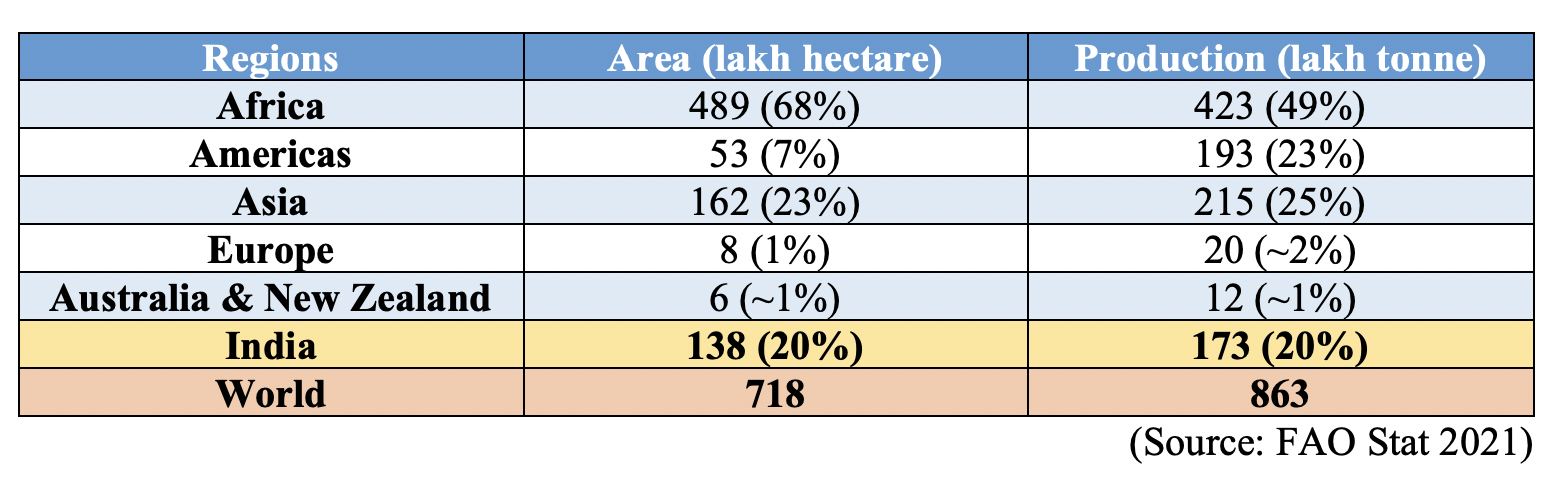
  1. India produces more than 170 lakh tonnes of millet, which is 80 per cent of Asia’s and 20 per cent of global production.
  2. India produces all the nine commonly known millets and is the largest producer and fifth-largest exporter of millets in the world.
  3. India recorded 27 per cent growth in millet production in 2021-22 as compared to millet production in the previous year was 15.92 MMT.
  4. Pearl millet (60%) followed by Sorghum (27%), and Finger millet (11%) are the major millets produced in India (as per the 4th Advance estimate 2021- 22).
  5. The major millets producing states in India are Rajasthan, Uttar Pradesh, Haryana, Gujarat, Madhya Pradesh, Maharashtra, Karnataka, Tamil Nadu, Andhra Pradesh, and Telangana.
  6. India exported millets products worth of USD 34.32 million during 2021-22. In 2020- 21, India exported millets worth USD 26.97 million against USD 28.5 million in 2019-20.

The UN General Assembly's declaration of 2023 as 'The International Year of Millets' has paved the way for a global increase in the cultivation of millet. India, being the world's largest producer of millet, is taking comprehensive measures to capitalize on this opportunity.

However, the success of this movement depends on striking a balance between promoting the advantages of millets, supporting the livelihoods of all farmers, and ensuring food security for all.

ESMA to penalise but let EU banks deal with India CCPs

European Union's financial market regulator, European Securities and Markets Authority (ESMA) has proposed derecognising 6 Indian counterparty clearing corporations (CCPs) from April 30, 2023. However, now ESMA has said that it will allow European banks to deal with Indian Central Counterparties (CCPs), even after its April 30 deadline, by imposing a penal capital charge.

Six Central Counterparties to be Derecognised by ESMA are:

  1. Clearing Corporation of India.
  2. Indian Clearing Corporation Limited
  3. NSE Clearing Limited.
  4. India International Clearing Corporation Limited
  5. Multi-Commodity Exchange Clearing Corporation Limited
  6. NSE IFSC Clearing Corporation.

Reasons for Derecognition

  • European Market Infrastructure Regulation (EMIR) which regulates the recognition of third country central counterparties by ESMA mandates that:
  • ESMA enter into agreement with regulators of other national jurisdictions and mandates conditions such as audits and counterparties in other countries. 
  • Regulators in India have not agreed to external audits and supervise by ESMA and want ESMA to have faith in Indian regulators.

Impact of Derecognition

  • As per the decisions these Third Country-CCPs will not be able to provide services to the clearing members and trading venues established in European Union.
  • Some of the Major Banks dealing in the domestic forex, forward, swap and equities and commodities markets include Societe Generale, Deutsche Bank and BNP Paribas (European Banks).
  • The de-recognition will impact these lenders as they will not be able to provide clearing and settlement facilities to their clients.
  • They will also have to set aside additional capital to trade in the domestic market, reports suggest. Of the total foreign portfolio investors (FPI) registered in India, close to 20 per cent are from Europe,
  • Banks would be able to continue doing business but would face increased capital costs as they would only be able to do bilateral trades and not go through the clearing houses.
  • Well India has earlier also faced such controversies wherein Europe has tried to tighten its standards across all types of markets from carbon credit, green hydrogen , which has led to improvements in Indian standards .

Central Counterparties (CCPs)

  • They are system providers who interpose between counterparties to contracts traded, becoming the buyer to every seller and the seller to every buyer. 
  • CCPs perform two main functions as the intermediary in a transaction - Clearing and Settlement – Guarantee the terms of trade.
  • Facilitates trading and works towards efficiency and stability in the financial markets. 
  • Reduces risk related to the counterparty and other risks like operational, settlement, market and legal risks.
  • Counterparty Clearing house or CCP is important in the trading world as it collects money from both the trading parties including the buyers and sellers which ensures that both parties will follow through the said agreement.
  • The money collected is enough to cover the potential losses in case any party fails to follow through the contract.
  • A CCP is authorised by RBI to operate in India under Payment & Settlement Act, 2007.
  • Clearing Corporation of India, Indian Clearing Corporation, NSE Clearing, Multi Commodity Exchange Clearing, India International Clearing Corporation and NSE IFSC Clearing Corporation. 

Clearing Corporation of India

  • Clearing Corporation of India has established in 2001 to provide guaranteed clearing and settlement functions for transactions in Money, G-Secs, Foreign Exchange and Derivative Markets. 
  • Clearing Corporation of India acts as central counterparty for all trades in G-Sec markets, Forex markets, 
  • Promoters: Commercial banks (SBI, IDBI, ICICI Bank, Bank of Baroda and HDFC Bank) have 66%, Financial Institutions etc. holding others. 

An Englishman in Jahangir’s Court

Context: The entrance of Thomas Roe in the Mughal Court is discussed by Nandini Das in her book ‘Courting India: England, Mughal India, and the Origins of English’. As the English ambassador to the court of the Mughal Emperor Jahangir, Thomas Roe arrived in India in 1615.

In the Mughal Court: Sir Thomas Roe

  • Sir Thomas Roe was a merchant diplomat with the East India Company and England's first appointed ambassador to India.
  • In September 1615, he arrived at the port of Surat carrying a letter from King James I requesting a commercial deal with the Mughal Emperor, Jahangir. Roe's arrival revealed that his mission's dual goals were to enhance Britain's standing abroad and secure trade and privileges for the Company.
  • On August 17th, 1616, Jahangir presented Sir Thomas Roe with a "medal of gold as huge as sixpence" to symbolise his status as the emperor's client.
  • He was identified as belonging to the noble class in the Mughal Court.
  • Despite not being "a great general, a great organiser, or a great builder" like his predecessors, Thomas Roe wrote in one of his memoirs that the emperor Jahangir who governed from 1605, was "a great lover of the arts, particularly painting and architecture." 
  • Roe's memoirs from his time spent in the Mughal court is a crucial source not only for the factual information it contains but also for the cultural presumptions it exposes. Historians like Michael Brown and Colin Mitchell have shown that Roe did not write with imperialist goals in mind. 
  • Roe's journal, on the other hand, reveals aspects of the society he belonged to, including attitudes on English supremacy and the inferiority of foreign strangers, which later in the nineteenth and twentieth centuries became fundamental elements of English Imperialist culture.

Progress of English in India: 

  • 1600: English East India Company was founded. 
  • 1609: Captain William Hawkins arrived 
  • 1613: Surat became the location of the company's first factory.
  • Sir Thomas Roe, King James I's envoy, came in 1615. The Emperor Jahangir and Prince Khurram both gave Farmans. Free commerce was made available to the Company with no inland tariffs.
  • 1616: At Masulipatnam, the First Factory in the South was founded.
  • 1633: EIC's first factory in Eastern India was founded in Hariharpur, Balasore (Odisha)
  • 1667: English were awarded farman by Emperor Aurangzeb to trade in Bengal.
  • In 1717, Emperor Farrukhsiyar issued the Golden Farman, popularly known as the Magna Carta. Many trade concessions were given.

Mughal Paintings:

  • During the Mughals, the emphasis of paintings moved from representing the god to exalting the emperor and illustrating his life. They concentrated on paintings depicting hunting scenes, historical events, and other courtly subjects.
  • Indian painters were influenced by the masters of miniature painting, Abdu's Samad and Mir Sayyid Ali, who had travelled to India with Humayun from Central Asia.
  • The fundamental goal of painting was to provide visuals for textual works. Paintings created by different painters used as illustrations for the Persian texts Akbar-Namah and the Mahabharata.
  • In Akbar's court, two well-known painters were Daswant and Basawan. Portuguese introduced European painting to Akbar's court.
  • Rembrandt, a famous Dutch painter, was influenced by Mughal miniatures.
  • While Shah Jahan carried on the tradition of painting, Aurangzeb's disregard for it resulted in the scattering of the painters to other regions, which in turn promoted painting in the provinces.

During Jahangir’s reign 

  • The Mughal paintings reached its pinnacle under the reign of Jahangir (1605–1627). By nature, he was a naturalist and favoured depictions of flora and wildlife, such as birds, animals, trees, and flowers. 
  • Portrait painting and animal paintings had advanced under Jahangir's reign. He placed a strong emphasis on reviving naturalism in portraiture.
  • Decorated margins surrounding the paintings that were occasionally as elaborate as the paintings themselves became one of the distinctive themes that emerged during this time.
  • Ustad Mansoor, who was a master in rendering the features of even the most complex faces, was one of the most well-known artists of his day.

During his rule, illustrations for the animal fable Ayar-i-Danish (Touchstone of Wisdom) were produced.

Supreme Court directs govt. to clear  ₹28,000crore OROP arrears by February next year

Context:

  • The Supreme Court on March 20 gave the government leeway to pay in installments ₹28,000 crore in arrears due to veterans under the One Rank One Pension (OROP) scheme.
  • The staggered payment of OROP arrears would be made to various categories of eligible pensioners, totaling 21 lakh persons, from April 2023 till February 2024.
  • The entirety of the arrears was supposed to be paid by March 2023, according to an earlier deadline given by the court.

What is One rank, one pension? 

  • OROP means that any two military personnel retiring at the same rank, with the same years of service, must get an equal pension.
  • While this might appear almost obvious, there are several reasons why two military personnel who may have retired at the same rank with the same years of service, may get different pensions.
  • Military personnel across the three services fall under two categories:
    • The officers and the other ranks. 
    • The other ranks, which are soldiers, usually retire at age 35. Unlike government employees who retire close to 60, soldiers can thus miss out on the benefits from subsequent pay commissions. And since pensions are based on the last drawn salary, pensions, too are impacted adversely.
    • Similarly, the age when officers in the military retire depends upon their ranks. The lower the rank, the earlier they superannuate. But the problem is not just that.
  • Benefits of Pay commissions not reaching Servicemen: 
    • The benefits of the successive pay commissions were not passed to servicemen who had retired earlier. 
    • Pensions differed for those who had retired at the same rank, with the same years of service, but years apart.

Why is there an issue with OROP arrears?

  • After the government’s December 2022 decision — further reiterated by a government order issued in January this year — a group of ex-servicemen moved the apex court seeking that the arrears be paid in a single instalment instead of four instalments.
  • The January order stated that the OROP arrears would be paid in four half-yearly installments.
  • The ex-servicemen in its plea said the Centre, by issuing this order, subverted the apex court’s March 2022 order, in which it had said that arrears payable to all eligible pensioners of the armed forces shall be computed and paid over accordingly within a period of three months.

What are the Centre’s issues with clearing OROP arrears in one go?

  • As per officials in the government, the cabinet note, which was approved by the union cabinet last year, had mentioned that installments be cleared in four installments, barring exceptions.  
  • While the government did make an appropriation of 28,138 crores in the budget for 2023-24 for payment of OROP arrears, officials explained this does not mean that this entire budget is available to the government for a lump sum payment.
  • They said for every installment paid, the Ministry of Finance will have to balance cash inflows and outflows — in the absence of which the government might need to go for additional borrowings to fill the deficit. Currently, the government is not in favour of such a move.

Matua Maha Sabha

Union Minister of Ports, Shipping & Waterways visited the auspicious “Matua Dharma Maha Mela” at the Shreedham Thakurnagar, Thakurbari, in West Bengal. 

The reason behind the event:

  • Mela is being organised to celebrate the 212th Birth Anniversary of Shri Shri Harichand Thakur ji. 
  • Mela showcases the vibrant culture of Matua Community. It is organised by the All India Matua Mahasangha. 

Matua Mahasangha:

  • Matua Mahasangha is a religious reformation movement that originated, around 1860 AD, in modern-day Bangladesh, with a considerable number of adherents both in Bangladesh and in West Bengal of India. 
  • Matua is a sect of depressed class AVARNA Hindus who are Namasudras, a Scheduled Caste group.
  • The movement was launched as a reformation by the followers of Harichand Thakur.

Harichand Thakur:

  • He worked among the untouchable people of Bengal Presidency. He formed the Matua sect of Hindus. 
  • He belongs to a Namashudra (or avarna) peasant family from Bangladesh. 
  • After experiencing atma darshan or self-revelation, he began to preach his own religious realization which is only based on Bhakti. According to his doctrine, all traditional rituals, except devotion to God, faith in mankind, and love for living beings, are meaningless and distortions from the real aim of attaining God. 
  • He organized downtrodden peoples of his own community under the banner of his new religious doctrine (known as Matua religion) and established Matua Mahasangha. They started considering him as God (Param Brahma) Harichand and as an avatar (incarnation) of Vishnu or Krishna. Thus, he became known as Sri Sri Harichand Thakur. 
  • His newly founded Matua religion is based on only three basic principles - Truth, Love, and Sanity. 

He gave twelve instructions to his followers.

These twelve instructions are: 

  1. Always speak the truth 
  2. Treat the woman as your mother-being; Respect the woman 
  3. Always respect your parents 
  4. Treat your neighbors and all earthly living beings with love, pity, and kindness 
  5. Never discriminate on racial grounds 
  6. Bring all the six passions of the mind under your control. These six passions of mind are - Lust, Anger, Greed, Infatuation, Pride, and Jealousy. 
  7. Remain liberal to all other religions and creeds 
  8. Become honest in mind and activities and avoid saintly dress to adorn yourself with 
  9. Perform your duties devotedly and utter the sacred Haribol and pray to God simultaneously 
  10. Build a temple of pure thoughts in your heart and soul and a temple of Shree Hariparameshwar at your dwelling place 
  11. Pray daily to God with devotion and sanctity 
  12. Sacrifice yourself to the cause of God.

A History of Poor Choice

Context: Ex-chairman of the National Monument Authority claims that the declaration of the monument of national importance should be based on more rational and logical parameters.

What is a Monuments of National Importance?

A "Monument of National Importance" is designated by the Archaeological Survey of India and includes the following:

  • The remains of an ancient monument
  • The site of an ancient monument
  • The land on which there are fences or protective covering structures for preserving the monument
  • Land by means of which people can freely access the monument

The largest number of such sites are in Uttar Pradesh, followed by Karnataka and Tamil Nadu. 

National Monuments Authority (NMA) is a statutory body under the Ministry of Culture, Govt. of India has been setup as per provisions of The Ancient Monuments and Archaeological Sites and Remains or AMASR Act, 1958 (amended in 2010).

Functions of NMA:

  • Protection and preservation of monuments and sites through management of the prohibited and regulated area around the centrally protected monuments.
  • To consider grant of permissions to applicants for construction-related activity in the prohibited and regulated area.
  • To categorize all the protected monuments and protected areas declared as of National importance as per AMASR act 1958.
  • To balance the needs of individuals and growth and development on the one hand and the requirements of preservation and protection of these monuments on the other.
  • Make recommendations to the Central Government for grading and classifying protected monuments and protected areas.

World sparrow day

Context - National Zoological Park, New Delhi (Delhi Zoo) celebrated World Sparrow Day today.

Key Facts:

  • Theme – ‘I love sparrows.’
  • Emphasis - The role of individuals and communities in sparrow conservation.
  • Six sparrow species found in India:
  • Theme – ‘I love sparrows.’
  • Emphasis - The role of individuals and communities in sparrow conservation.
w6ic5RDqXKPqe4uRNgGfs7QkWCFyYmrsoowNyqbRM1Ev6p9IZb0KnnhK8KLcUThfRTnShyicSFk WiPg Xeq7lcnAhsEMeyrfZnFuABdeSW0NmFnGmCmWMsgvBtUNAYafG42Yt5LYZO3sTJ aEh94g

Ecological significance of Sparrows:

  • Seed dispersion: Sparrows spread seeds to places away from the fruit tree. This is important for germination of the seeds, because if the seeds fall close to the parent plant, they would have to compete for nutrition with the mature plant. This would reduce the chance of germination of the seed as well as growth of the plant.
  • Biodiversity: Although primarily seed-eaters, sparrows also feed on small insects and worms such as caterpillars, beetles and aphids. Some of these creatures destroy certain plants. Sparrows keep their population in check; otherwise, the insects would have eaten certain plant species to extinction. Here also sparrows play an important role in preserving the ecosystem.
  • Food chain: Most birds of prey, such as eagles and falcons, eat other smaller birds. Snakes, which are also secondary consumers, are known to eat sparrows. For example, sharp-shinned hawks prefer sparrows for food. Hence they provide food for the secondary consumers.

World Happiness Report 2023

About World Happiness Report

  • World Happiness Report is annually published by Sustainable Development Solutions Network. 
  • The report uses data from Gallup World Poll Data based on Self-Reported levels of Happiness. 
  • The first edition of the World Happiness Report was published in 2012. 
  • UN General Assembly adopted a resolution in 2012 proclaiming March 20 to be observed as annually as International Day of Happiness. 

The Report ranks countries on six parameters to explain variation in self-reported levels of happiness across the world:

  • Social Support: Provides having someone to count on in times of trouble.
  • Income measured by GDP per capita: Provides information about the size of the economy and how the economy is performing.
  • Healthy Life Expectancy: Also focuses on Mental Health which is a key component of subjective well-being and a risk factor for future physical health and longevity. 
  • Freedom to make life choices: This also includes human rights. Human Rights include the right to life and liberty, freedom from slavery and torture, freedom of opinion and expression, right to work and education etc. Everyone is entitled to these 
  • Generosity: Measured by donation of money to a charity in the past month. Generosity is a clear marker for a sense of positive community engagement and a central way that humans connect. In all cultures, people are drawn to behaviours which benefit other people.

Absence of corruption measures if people trust their governments and have trust in the benevolence of others.

Rankings:

  • Happiest countries: Finland remains the happiest sixth year in a row. 
  • Least Happy countries: War-torn Afghanistan is the least happy country just below Lebanon. 
  • India is ranked 125 on World Happiness Rankings.

About Sustainable Development Solutions Network (SDSN)

  • UN Sustainable Development Solutions Network was launched under the auspices of the UN Secretary-General. 
  • SDSN started with 10 thematic working groups focusing on a range of environmental, social and economic topics, which contributed to the debate and ultimately the adoption of SDGs.
  • SDSN has now grown and founded its global networks program which is a membership-based alliance of top-tier knowledge-generating institutions focused on sustainable development, organised in national and regional clusters. In 2022, SDSN has over 1700 members in 50 networks across 144 countries.
  • SDG Academy: In 2016, SDSN expanded its mission and created the SDG Academy which creates and curates free, open educational resources on sustainable development and offers them as a global public good.
  • Six Transformations Framework: In 2019, introduced six SDG Transformations as modular building blocks for SDG achievement. The six transformations provide a shared understanding of how the 17 SDGs can be operationalised.
    • Education, Gender and Inequality
    • Health, Wellbeing and Demography
    • Energy Decarbonisation and Sustainable Industry
    • Sustainable Food, Land, Water and Oceans 
    • Sustainable Cities and Communities
    • Digital Revolution for Sustainable Development 
  • Reports by SDSN: SDSN synthesises knowledge for sustainable development and produces renowned annual reports:
    • Sustainable Development Report (SDR)
    • World Happiness Report (WHR)

Reverse the hostility

Prelims: Position of Speaker in Britain, Role of the Speaker in India.

Mains: Importance of Speaker, Issues associated with the speaker.

Adversarial relations between the ruling party and the Opposition are inevitable in a democracy and, in a way, such relations that bring strong differences of opinion and contentious views to the fore are critical. Democracy flourishes when there is reconciliation through legislative debate. Yet, adversarial relations resulting in confrontation following the lack of discourse over differences on issues of public import, speak poorly of legislative conduct.

This holds true of Kerala, where legislative business has come to a standstill after a severe deterioration in relations between the ruling coalition and the Opposition.

What began as an issue of the Speaker repeatedly disallowing discussion on Rule 50 notices by the Opposition United Democratic Front last week has grown into a full-blown confrontation, with legal cases being filed against legislators after incidents that resulted in a ruckus in the Assembly. 

Securing the neutrality of the Speaker is a question that experts in India have been grappling with for 60-plus years. A watchful Parliament forms the foundation of a well-functioning democracy. The presiding officers of Parliament are the key to securing the effectiveness of this institution. The MPs look to them to facilitate debate, protect their rights and uphold the dignity of Parliament. 

The primary challenge before any Speaker is to conduct the proceedings of the Lok Sabha free from disruptions.

To do so, the Speaker will have to earn the trust of the Members of Parliament: One way to earn the trust of MPs will be by being neutral, both in practice and perception while running the House. Securing the neutrality of the Speaker is a question that experts in India have been grappling with for 60-plus years.

Why is the role of speaker so important? 

  • Securing the neutrality of the Speaker is a question that experts in India have been grappling with for 60-plus years.  A watchful Parliament forms the foundation of a well-functioning democracy. The presiding officers of Parliament are the key to securing the effectiveness of this institution. The MPs look to them to facilitate debate, protect their rights and uphold the dignity of Parliament. 
  • The primary challenge before the any Speaker is to conduct the proceedings of the Lok Sabha free from disruptions. To do so, the Speaker will have to earn the trust of the Members of Parliament: One way to earn the trust of MPs will be by being neutral, both in practice and perception while running the House.
  • Securing the neutrality of the Speaker is a question that experts in India have been grappling with for 60-plus years.

How is the position of Speaker in Britain?

  • In Britain, the promise of continuity in office for many terms is used to ensure the Speaker’s impartiality.
  • By convention, political parties (usually) do not field a candidate against the Speaker at the time of general elections. And the Speaker can continue in office, until deciding otherwise. By convention, the Speaker also gives up the membership of his/her political party.

What is the role of the Speaker in India?

In India, the Speaker of the Lok Sabha (lower house of parliament) holds several powers like: 

  • Presiding Officer: The Speaker presides over the meetings of the Lok Sabha, maintains order and decorum in the House, and ensures that the proceedings are conducted in accordance with the rules and procedures.
  • Decision-making: The Speaker decides on the admissibility of questions, motions, and amendments, and also decides on the allocation of time for discussions and debates.
  • Committee Formation: The Speaker appoints the members and chairpersons of various parliamentary committees, such as the Committee on Public Accounts, the Committee on Estimates, and the Committee on Privileges.
  • Casting Vote: In case of a tie during a voting, the Speaker has the power to cast the deciding vote.
  • Disqualification of members: The Speaker has the power to disqualify a member of the Lok Sabha on the grounds of defection, misconduct, or violation of parliamentary rules.
  • Maintenance of Order: The Speaker has the power to suspend or expel a member who violates the rules of the House or behaves in a disorderly manner.
  • Parliamentary Affairs: The Speaker is responsible for the administration of the Lok Sabha, including the preparation of the annual budget, allocation of funds, and the recruitment of staff.

Hence we can see that the Speaker of the Lok Sabha plays a crucial role in ensuring the smooth functioning of the parliament and maintaining the integrity of the democratic process in India.

What are the mechanisms to ensure the neutrality of Speaker in India?

  • His salaries and allowances are fixed by Parliament. They are charged on the Consolidated Fund of India 
  • His work and conduct cannot be discussed and criticised in the Lok Sabha except on a substantive motion.
  • Powers of regulating procedure or conducting business or maintaining order in the House are not subject to the jurisdiction of any Court. 
  • Only exercise a casting vote in the event of a tie. This makes the position of Speaker impartial. 
  • He is given a very high position in the order of precedence. He is placed at seventh rank, along with the Chief Justice of India

Issues associated with speaker 

  • With no security in the continuity of office, the Speaker is dependent on his or her political party for re-election.
  • This makes the Speaker susceptible to pulls and pressures from her/his political party in the conduct of the proceedings of the house. 
  • The persistence of allegations of prejudice can be attributed to the issue of partisanship resulting from the way the Speaker is appointed and the duration of their tenure.
    • There has been a tradition of appointing the Speaker from the majority party and the Deputy Speaker from the opposition side, which has led to structural problems.
  • There is no convention of Speakers relinquishing their party membership and hence they are often perceived as being partisan. 
  • It is common for Indian Speakers to have occupied ministerial roles shortly before or after their term. As a result, even if there is no evidence to substantiate such allegations, it is not unexpected for Speakers in India to be accused of partisanship.
  • The challenge posed by coalitions is twofold.
    • Firstly, the growing number of parties has led to a reduction in the amount of time each party has to articulate its interests during discussions. 
    • Secondly, there has been a decline in the frequency of annual sittings of Parliament/Legislatures.
    • Rise in the number of political parties and varied political interest has made it harder for the Speaker to find consensus between members on use of disciplinary powers 
  • Unparliamentary conduct: Members seek to use unparliamentary means such as disruptions etc. for attaining the indulgence of the Speaker.
  • The Anti-Defection Law assigns the responsibility of deciding whether a member should be disqualified to the Speaker, who has significant discretion. However, this discretion has often been exploited by the ruling party to eliminate dissenting voices.
  • Determination of money bill: It has been criticised for certifying bills such as Aadhaar Bill etc. as Money Bill, though it may not have met the strict criteria laid out in the Constitution.

Way forward

  • The responsibility of the Speaker in dealing with defections, splits, and mergers should be assigned to an impartial entity such as the Election Commission or a neutral body outside the legislature.
  • To ensure a smooth and uncontested re-election process, it is recommended to establish a tradition of re-electing the Speaker without any opposition.
  • During parliamentary discussions and question hour, efforts should be made to allocate time to members based on party strength and also to accommodate those who wish to express diverse concerns or viewpoints.
  • In order to enhance trust in the Speaker's decision-making process, it is advisable to increase transparency by making the Speaker's decisions publicly available.
  • The reluctance of Speakers to take action against disorderly members could be mitigated if the media plays a constructive role in highlighting instances of misconduct and their negative impact on the House's performance.

The wide disparities in human development

Today’s Hindu newspaper (21st march 2023) has an article on disparities in human development. with the help of this article, we will analyse the various aspect of human development in India.

What is Human Development?

The United Nations Development Programme defines human development as "the process of enlarging people's choices", said choices allowing them to "lead a long and healthy life, to be educated, to enjoy a decent standard of living", as well as "political freedom, other guaranteed human rights and various ingredients of self-respect".

How to measure human development?

United Nations Development Programme created Human Development Index to evaluate and compare the level of human development in different regions around the world. It was introduced in 1990 as an alternative to conventional economic measures such as Gross Domestic Product (GDP), which do not consider the broader aspects of human development. 

The HDI assesses a country’s average accomplishment in three aspects: 

  • long and healthy life (life expectancy at birth)
  • knowledge (Mean year of schooling, expected years of schooling)
  • a decent standard of living (Gross national income per capita)

Disparities in Human development in India

The five States with the highest HDI scores are Delhi, Goa, Kerala, Sikkim, and Chandigarh. Delhi and Goa have HDI scores above 0.799, which makes them equivalent to countries in Eastern Europe with a very high level of human development.

The bottom five States are Bihar, Uttar Pradesh, Madhya Pradesh, Jharkhand, and Assam, with medium levels of human development. This category also includes States such as Odisha, Rajasthan, and West Bengal, which have HDI scores below the national average. The scores of these low-performing States resemble those of African countries such as Congo, Kenya, Ghana, and Namibia.

Does high GDP necessarily translate into high HDI?

No, it is not true because despite having the highest SGDP per capita among larger States, Gujarat and Haryana have failed to translate this advantage into human development and rank 21 and 10, respectively.

Conversely, Kerala stands out with consistently high HDI values over the years, which can be attributed to its high literacy rates, robust healthcare infrastructure, and relatively high-income levels.

Bihar, however, has consistently held the lowest HDI value among the States, with high poverty levels, low literacy rates, and poor healthcare infrastructure being the contributing factors.

What are the reasons behind regional disparities in India?

Unevenly distributed economic growth: The top 10% of the Indian population holds over 77% of the wealth. This has resulted in significant disparities in access to basic amenities, healthcare and education.

Poor quality of services: While India has made significant progress in reducing poverty and increasing access to healthcare and education, the quality of such services remains a concern. For example, while the country has achieved near-universal enrolment in primary education, the quality of education remains low. 

How to reduce these disparities in human development?

This requires a multi­faceted approach which includes

  • Address income inequality and gender inequality; 
  • Improve access to quality social services; 
  • Address environmental challenges; 
  • Greater investment in social infrastructure such as healthcare, education, and basic household amenities including access to clean water, improved sanitation facilities, clean fuel, electricity and Internet in underdeveloped States.
  • Investment in human development and job creation, particularly for its youth

India and Japan Relations

CONTEXT: During the recent visit PM Kishida said that today’s Ukraine could be tomorrow’s Asia,” and indicated Japan’s concerns over China’s actions in the Senkaku Islands, South China Sea and Taiwan Straits. 

The issue of “shared responsibilities” on the rule of law between India and Japan was discussed by the two leaders during bilateral talks.

The Japanese Prime Minister went on to launch Japan’s New Plan for a Free and Open Indo-Pacific (FOIP).

The Japanese PM also highlighted the need for common perspective for international order.

The two leaders acknowledged that 2023 is a pivotal year for both India and Japan as chairs of the two major international groupings – India as the President of the G20 and Japan as the Chair of G7. Our countries have the unique opportunity of converging our priorities on issues of significance and drive through that and in the process, the global agenda. 

The two leaders spoke about the challenge that they face in the region (China) and also globally.

The two leaders further highlighted that  i.e. India and Japan and other like-minded countries can work together to address those challenges.

About India and Japan

India and Japan celebrated 70 years of friendship in 2022. Reflecting on how this relationship has developed from a Global partnership to a “special strategic and global partnership”. 

However we can see gaps in economic partnership and people-to-people connect. While the economic partnership was the pillar on which this relationship took shape, the two leaders will unquestionably direct the policymakers of both nations to scrutinize and reflect on how to enhance this pillar.

Moreover, much-touted civilizational linkages have not translated into robust people-to-people connections. 

The two leaders are hence putting forth various schemes to enable exchanges of people, namely youth, workforce, and artists, along with a stronger emphasis on tourism.

AGREEMENTS AND MOU’s IN RECENT MEETING

  1. The two leaders exchanged documents on the financing of the 4th tranche of Japanese funding for a loan of 300 billion Yen for the Mumbai-Ahmedabad High Speed Rail (MAHSR) or “Bullet Train” project. 
  2. A MoU on Japanese language education for the MEA. 
  3. Japan further plans to mobilise a total of U.S. $75 billion in public and private funds by 2030. Japanese leader also mentioned about coordinating with India for projects as a part of a “Bay of Bengal-Northeast India industrial value chain”.
  4. The two leaders also had discussions over co-innovation, co-design, co-creation in defence field and also investment collaboration, investment partnership in this space. Indian PM highlighted the openness of Indian defence sector to Japanese private companies and Japanese FDI.
  5. Ministry of Environment of Japan and Ministry of Environment, Forest and Climate Change of India, signed an Aide Memoire essentially on the Joint Crediting Mechanism (JCM) that has been under discussion for quite some time between the two countries.
  6. The two leaders announced 2023 as "India-Japan Year of Tourism”. Indian PM expressed the desire to declare the next year as the year of youth exchanges between the two countries.

Founding Pillars of India - Japan Relations

Strategic Collaboration between India and Japan 

  • Convergence on free, open and inclusive Indo-Pacific. 
  • Defence and security and in the region. – Quad, AUKUS, MALABAR. 
  • India and Japan signed a Reciprocal Provision of Supplies and Services Agreement (RPSS). 
  • The inaugural 2+2 ministerial meeting was held in November 2019. 
  • Act East Forum: A decision was taken in the 2017 Summit to establish the India-Japan Act East Forum. The objective is to coordinate developmental projects in North-East India in areas of connectivity, forest management, disaster risk reduction and capacity building. 
  • Northeast development - Upgradation of highways in Meghalaya, Tripura and Mizoram are underway. 20 km-long bridge over the Brahmaputra River between Assam and Meghalaya. 
  • Supply Chain Resilience Initiative (SCRI) – The Trade and Economy Ministers of India, Japan and Australia launched the (SCRI) on 27 April 2021. 

Economic Collaboration 

  • Investment Promotion Partnership 2014: Both have achieved the target of 3.5 trillion Japanese Yen in public and private investments in India. 
  • Industrial collaboration: 1,455 Japanese companies in India. Eleven Japan Industrial Townships (JIT). 
  • FDI: Japan is 5th largest source of FDI, largest supplier of ODA. 
  • Infrastructure projects are underway through Japanese assistance including Mumbai-Ahmedabad High Speed Rail, Dedicated Freight Corridor, metro projects, DMIC etc. 
  • Digital Partnership 2018 Indian start-ups have raised more than USD 10 billion from Japanese VCs. India and Japan have also launched a private sector driven fund-of-funds to invest in technology start-ups in India which has raised USD 100 million. 
  • Cooperation in ICT, in areas such as 5G, under-sea cables, telecom and network security. 
  • Movement of skilled workers: Japan’s population has peaked out its and working age population is reducing. In this respect, India with its surplus labour force can provide workers for Japan’s needs. India and Japan signed MoU on Specified Skilled Workers to promote movement of skilled workers and Japanese language requirement from India to Japan for employment on a contractual basis. `

Three main challenges which have constrained the Japan-India economic partnership:

  • India’s complex regulations, red tape, ad hoc nature of state-level interventions.
  • Japanese companies face considerable logistics challenges and non-availability of uninterrupted power supply constrains their manufacturing plans in India.
  • While India can emerge as a large market for Japanese infrastructure system exports (one of the core components of Abenomics), there have been incredible delays in the commencement of the projects. While there is the shining example of the Delhi Metro Rail, the delays with DMIC, CBIC are disappointing.

Collaboration in the Indo – Pacific 

  • Collaboration in QUAD, SRI, MALABR Naval exercise with US and other like-minded countries in the Indo–Pacific. 
  • Countering the Chinese assertion – Along the LAC, South China Sea and East China Sea. 
  • Japan's Open Indo-Pacific (FOIP)’ Strategy and India's ‘Act East’ Policy converge in action in the northeast of India—a bridge between South and Southeast Asia. Ex – Act EAST Forum. 
  • Collaboration through infrastructure development in third countries (in the Indo- Pacific) such as Sri Lanka, Myanmar and Bangladesh. 
  • Asia Africa Growth Corridor (AAGC)—a collaborative effort to soft-balance China’s Belt and Road Initiative (BRI) project. 

Collaboration on Global Issues 

  • Both believe in upholding freedom of navigation and reinforcing rules-based international order. 
  • Japan supported a waiver of Nuclear Suppliers Group’s (NSG) embargo on nuclear trade with India and backed its application for membership of group. 
  • Joint military exercises have contributed to the image of their rising regional power. JIMEX, MALABAR etc. 
  • Both works closely on global issues such as proliferation of Weapons of Mass Destruction (WMDs), terrorism, space and cyber security, and environment (e.g., the International Solar Alliance). 
  • Permanent membership of the UNSC – Both are members of G4 club besides Brazil and Germany. 

Differences between two countries

  • Neither of the two countries want to downgrade its own relations with China and neither is too eager to open alliance against China
  • Though two main political parties have positive disposition towards Japan their lies have shown negative attitude towards Japan due to its proximity with USA.
  • Japanese foreign policy is pre-eminence of Japanese career bureaucrats in foreign ministry that makes radical changes In policy difficult to accomplish
  • Weak political leadership and vertically divided administration as well as fragmented domestic consensus will continue to adversely affect Japan’s foreign policy
  • The trade and security bureaucratic establishment continue to have a rather negative opinion of India
  • Integration b/w Indian and Japanese economies remains shallow, in services sector both the countries have different demands from each other for opening up. For Japan these are maritime ,insurance, civil aviation and banking while for India these include IT , BIO TECH and Medical
  • Infrastructure inadequacy, a complicated legal and taxation system and insufficient regulation for interstate-transaction 

Conclusion

Thus there is a need to enhance the relationship between the two countries in order that India-Japan relations are elevated to a new dimension.

As the Ex Japanese PM  SHINZO ABE talked about a ‘broader Asia’ wherein he talked about advancing Japan’s national interest by strengthening its ties with India and in the next decade Japan-India relations to overtake Japan-US and Japan-China ties.

Charges Against President Putin of Russia fixed by ICC

  • ICC has held him responsible for the war crime of unlawful deportation of the population (children) and unlawful transfer of the population (children) from occupied areas of Ukraine to the Russian Federation for violation of the Rome Statute.
  • These children were taken away from orphanages and childcare homes. Many of these children have been given for adoption in Russian Federation. Law was changed in Russia, by Presidential decrees by President Putin, to expedite the conferral of Russian citizenship.
  • The war crimes were allegedly committed in Ukrainian occupied territory by Russian Forces on 24 February 2022.
  • While not a United Nations organization, the Court has a cooperation agreement with the United Nations. When a situation is not within the Court’s jurisdiction, the United Nations Security Council can refer the situation to the ICC granting it jurisdiction.

About International Criminal Court

  • International Criminal Court (ICC) investigates and where warranted tries individuals charged with gravest crimes of concern to international community, genocide, war crimes, crimes against humanity and crime of aggression.
  • ICC came into existence by the Rome Statute which established ICC as the world's first permanent international criminal court.
  • ICC aims to end impunity through international criminal justice, holds those responsible accountable for their crimes and helps prevent these crimes from happening again.
  • As a court of last resort, ICC seeks to complement, not replace, national courts.
  • The seat of ICC is in the Hague, Netherlands.

Rome Statute grants ICC jurisdiction over four main cases:

  1. Crime of Genocide: Characterised by specific intent to destroy in whole or in part a national, ethnic, racial or religious group by killing its members or by others means; causing serious bodily or mental harm to members of the group; deliberately inflicting on the group conditions of life to bring about its physical destruction; imposing measures intended to prevent births within the group; or forcibly transferring children of the group to another group.
  2. Crimes against humanity: These crimes constitute serious violations committed as part of large-scale attach against any civilian population. 15 forms of crimes against humanity listed in Rome Statute include offences such as murder, rape, imprisonment, enforced disappearances, enslavement - particularly of women and children, sexual slavery, torture, apartheid and deportation.
  3. War crimes: They are grave breaches of Geneva conventions in context of armed conflict and include, for ex., use of child soldiers, killing of torture of persons such as civilians or prisoners of war; intentionally directing attacks against hospitals, historic monuments, or buildings dedicated to religion, education, art, science or charitable purposes.
  4. Crime of aggression: These consists of armed force by a State against sovereignty, integrity or independence of another State. The definition of this crime was adopted through amending the Rome Statute in 2010.

Geneva Conventions

Geneva Conventions and their Additional Protocols are international treaties that contain the most important rules limiting the barbarity of war. They protect people who do not take part in the fighting and those who can no longer fight.

  • First Geneva Convention: Protects wounded and sick soldiers on land during war.
  • Second Geneva Convention: Protects wounded, sick and shipwrecked military personnel at sea during war.
  • Third Geneva Convention: Applies to prisoner of war.
  • Fourth Geneva Convention: Affords protection to civilians, including in occupied territory.
  • Common Article 3: Covers situations of non-international armed conflicts like traditional civil wars, internal armed conflicts that spill over into other States or internal conflicts in which third States or a multinational force intervenes alongside the government.

Additional Protocols to Geneva Conventions

  • Additional Protocol I: Strengthen the protection of victims of international armed conflicts.
  • Additional Protocol II: Strengthen the protection of victims of non-international armed conflicts.
  • Additional Protocol III: Created an additional emblem, the Red Crystal, which has the same international status as the Red Cross and Red Crescent emblems.

Jurisdiction with respect to State Parties

  1. 123 countries are State Parties to the Rome Statute of the International Criminal Court. Out of them 33 are African States, 19 are Asia-Pacific States, 18 are from Eastern Europe, 28 are from Latin America and Caribbean and 25 from Western Europe and other States.
  2. ICC has jurisdiction only with respect to crimes committed after the entry into force of this Statute. ICC may exercise jurisdiction only with respect to crimes committed after the entry into force of Rome Statute for that State, unless that State has made a declaration.
  3. A State which becomes a Party to Rome Statute accepts jurisdiction of ICC with respect to crimes listed above.
  4. ICC may exercise its jurisdiction if one or more of the following States are Parties to this Statute or have accepted the jurisdiction of ICC:
    1. State on the territory of which the conduct in question occurred or, if the crime was committed on board a vessel or aircraft, the State of registration of that vessel or aircraft.
    1. State of which the person accused of the crime is a national.
  5. Acceptance of a State which is not a party to ICC: A State may by declaration lodged with Registrar accept the jurisdiction of ICC with respect to the crime in question. (Ukraine was a not a State Party to ICC. However, Ukraine has accepted jurisdiction of ICC throughout the territory of Ukraine from 20th February 2014 onwards.)

Jurisdiction of ICC

ICC exercises jurisdiction in a situation of genocide, crimes against humanity or war crimes committed on or after 1st July 2002 and:

  1. Crimes were committed by a State Party National, in the territory of a State Party or in a State that has accepted the jurisdiction of ICC. (Since in the present case, the alleged crimes were committed in the territory of Ukraine which is not a State party but has accepted the jurisdiction of ICC, hence ICC has jurisdiction in the present case, despite Russia not being a party to ICC).
  2. Crimes were referred to ICC Prosecutor by the UN Security Council (UNSC) under a resolution adopted under Chapter VII of UN Charter.