GS Paper 4

A very different conception of ‘Ram Rajya’

Context: Shashi Tharoor (Member of Parliament), have talked in his books, ‘Why I Am a Hindu’ and ‘The Battle of Belonging’, the principles of Gandhiji and his ideas about ‘Ram Rajya’.

About the concept of ‘Ram Rajya’

Ram Rajya is a term that was popularized by Mahatma Gandhi. It's an ideal society that he envisioned, based on the rule of Lord Rama. The concept of Ram Rajya reflects the idea of an ideal society where everyone is equal, and justice prevails. 

The term represents the ideal king who ruled with wisdom, compassion, and justice. His rule was characterized by the following principles:

  • Equality: Gandhi emphasized the importance of equality in his concept of Ram Rajya. He believed that all individuals, regardless of their caste, creed, or gender, should have equal opportunities and rights.
  • Justice: Ram Rajya was a society where justice was served, and no one was above the law. Gandhi emphasized the importance of self-discipline and self-sufficiency in achieving justice. He believed that individuals should work to become self-sufficient, both economically and spiritually, in order to be better equipped to address injustices in society.
  • Non-Violence: Ram Rajya was a society where violence was shunned, and conflicts were resolved through peaceful means. Non-violence is the cornerstone of Gandhi's concept of Ram Rajya. He believed that violence only begets violence and that the use of force can never bring about lasting peace. Instead, he advocated the use of non-violent means such as satyagraha (civil disobedience), ahimsa (non-violence), and self-control to achieve one's goals.
  • Self-Rule: Ram Rajya was a society where people should be self-governing and should have the power to make decisions that affect their lives.
  • Prosperity: Ram Rajya was a society where everyone had access to the basic necessities of life and had the opportunity to pursue their dreams.
  • Moral and Spiritual Values: Gandhi's vision of Ram Rajya was not merely a political system but rather a society based on moral and spiritual values. He believed that society should be grounded in truth, love, compassion, and forgiveness. Individuals follow conscience to serve others, not self-interest.
  • Decentralization of Power: Gandhi believed that power should be decentralized and that decision-making should be made at the local level. He advocated for the establishment of Gram Sabhas, or village assemblies, where the people could come together to make decisions that affect their community.
  • Trusteeship: Gandhi believed that Trusteeship was essential for creating an equitable and just society. He argued that wealth was not an end in itself, but a means to serve the common good. In Ram Rajya, the wealthy and powerful would act as trustees, using their resources for the betterment of the poor and the needy.
    • Gandhi's idea of Trusteeship was based on the principle of non-violence and voluntary cooperation. He believed that the wealthy and powerful should voluntarily surrender their wealth for the betterment of society, rather than through force or coercion.
  • Economic Equality: Gandhi believed that economic inequality was one of the root causes of social unrest. He advocated for the abolition of the caste system and the establishment of a society based on economic equality.
  • Self-Sufficiency: Gandhi believed that self-sufficiency was crucial for the development of society. He advocated for the establishment of small-scale industries and the use of local resources to promote self-sufficiency.
  • Education: Gandhi believed that education was essential for the development of individuals and society. He emphasized the importance of holistic education, which includes both intellectual and moral development.

Other Theories Of Ideal Society

Several other philosophers and thinkers have envisioned ideal states and governance systems similar to Gandhiji's Ram Rajya:

  • Plato proposed an ideal just society in his book 'The Republic' where kings are philosophers and philosophers are kings. He envisioned a state built on reason, justice, courage and temperance. The rulers and guardians govern to maximize the welfare of citizens.
  • John Stuart Mill advocated a liberal form of governance in his work 'On Liberty' where individual liberty is balanced with social good. He proposed democratic self-government with representation of all citizens, free speech and protection of minorities. The state protects people's basic liberties and welfare.
  • Henry David Thoreau put forth the idea of a minimalist governance in his essay 'Civil Disobedience'. He believed that government is best which governs the least. Individual conscience is the moral guide. People govern themselves with self-restraint and don't need an overbearing state apparatus. Simple living and high thinking are valued.
  • Leo Tolstoy's vision of an ideal society in 'The Kingdom of God is Within You' renounced violence and preached universal love, truth, morality and service to others. He believed individuals can transform society through enlightenment and moral development, not political means. Ethical and spiritual uprising, not material progress, leads to human well-being. 
  • Aurobindo Ghose theorized the 'Rule of the Spirit' in his work where the inner moral and spiritual elements govern society, not outer political machinery. Truth, unity, harmony and a higher consciousness emerge from within individuals. There is a collective moral aspiration to realize the divine in each human being. 
  • Sarvepalli Radhakrishnan believed in the 'Rule of Spiritual Truth' where reason, morality and justice prevail; and education develops integral personalities. He envisioned a world federation of free individuals in free societies guided by the spiritual truth of oneness of humanity.
  • Dalai Lama advocates a 'spiritual democracy' where compassion, ethics and conscience shape society. There is no tyranny of the majority. Well-being of all humans including future generations is core. Outer liberal values emerge from inner morality and wisdom in each person.

Comparison Between Gandhian "Ram Rajya" And Plato's Just Society

ParametersGandhian "Ram Rajya"Plato's Just Society
JusticeSatya and dharma are the guiding principles. Means and ends should be moral.Knowledge of the Good guides rulers. Justice is harmony between reason, spirit and appetites.
Justice within the individualsGandhiji focused on spiritual self-sufficiency in order to be better equipped to address injustices in society.
Philosopher-KingsGandhian concept does not emphasize the role of rulers or philosopher-kings in governance.Plato's Just Society places great emphasis on the role of philosopher-kings, who possess wisdom and virtue, in governing society.
TrusteeshipLeaders act as trustees of citizens. Power is not concentrated but decentralized.Philosopher-kings rule for the benefit of all. No private advantage or privilege.
Non-violenceGandhian concept places great emphasis on non-violence, or ahimsa, as a means of achieving social change and justice. Conflicts are resolved through mutual understandingAuxiliaries enforce orders and defend the state
Simplicity in governanceGandhian concept emphasizes simplicity in governance, with a focus on decentralization and community participation in decision-making. Administration focuses on meeting. basic needs of allStrict control over luxuries and private property. Necessities provided by the state.
Representation in governanceAll sections participate in governance.Society divided into rational rulers, spirited auxiliaries and appetitive producers but share a sense of community.
Common good educationResources and facilities distributed equitably so none remain in wretched conditions.Though classes have different natures, they share a common interest in justice and welfare of the whole.
Social ClassesThe concept of social class was not relevant as he believed in equality and universal brotherhood.Rational rulers, spirited auxiliaries and appetitive producers
Women's equalityGandhian concept emphasizes women's equality and empowerment. He said, “To call woman the weaker sex is a libel; it is man's injustice to woman. If by strength is meant moral power, then woman is immeasurably man's superior.”Plato's Just Society does not necessarily prioritize women's equality. He however said that women could also become philosopher-kings if they had the necessary qualities and virtues.
Communal livingGandhian concept emphasizes communal living and the need for voluntary renunciation of personal property and wealth.Plato's Just Society does not emphasize communal living as a key concept.

How to combat corruption in India

What corruption is?

Corruption refers to the abuse of power or position for personal gain, typically involving bribery or dishonest behaviour. It involves the use of one's public or private office for personal benefit or the benefit of a group to which one belongs, rather than for the public interest or common good. Corruption can take many forms, including accepting or offering bribes, embezzlement, nepotism, fraud, and other illegal or unethical activities. Corruption undermines democratic processes, weakens the rule of law, and harms economic and social development.

Much evidence indicates that corruption has been around for thousands of years, but in recent years it has attracted increasing attention. Does the attention reflect an increasing awareness or an increasing scope of the problem? Probably, corruption has increased in recent decades. Actions can be taken to reduce corruption, but the fight against it cannot be seen independently from the need to reform the role of the state. The reason is that a certain role of the state almost inevitably creates a fertile ground for corruption.

Defining Corruption

  • Corruption is a term of many meanings, but at the broadest level, corruption is the misuse of office for unofficial ends. Office is a position of duty, or should be; the office-holder is supposed to put the interests of the institution and the people first.
  • Corruption can go beyond bribery to include nepotism, neglect of duty and favouritism. Corrupt acts can involve third parties outside the organisation (in transactions with clients and citizens, such as extortion and bribery) or be internal to an organisation (theft, embezzlement, some types of fraud). Corruption can occur in government, business, civil society organisations and international agencies. Each of these varieties has the dimension of scale, from episodic to systemic.

V.S. Naipaul, the Trinidad-born Nobel Prize winner, once noted that underdevelopment is characterised by a duplicitous emphasis on honorific titles and simultaneously the abuse of those titles: judges who love to be called “your honour” even as they accept bribes, civil servants who are uncivil and serve themselves.

Categories of corruption

  • Bribery: The act of dishonestly persuading someone to act in one’s favour by a payment or other inducement. Inducements can take the form of gifts, loans, fees, rewards or other advantages (taxes, services, donations, etc.). The use of bribes can lead to collusion (e.g. inspectors under-reporting offences in exchange for bribes) and/or extortion (e.g. bribes extracted against the threat of over-reporting).
  • Embezzlement: To steal, misdirect or misappropriate funds or assets placed in one’s trust or under one’s control. From a legal point of view, embezzlement need not necessarily be or involve corruption. Facilitation payment A small payment, also called a “speed” or “grease” payment, made to secure or expedite the performance of a routine or necessary action to which the payer has legal or other entitlement.
  • Fraud: The act of intentionally and dishonestly deceiving someone in order to gain an unfair or illegal advantage (financial, political or otherwise).
  • Collusion: An arrangement between two or more parties designed to achieve an improper purpose, including influencing improperly the actions of another party.
  • Extortion: The act of impairing or harming, or threatening to impair or harm, directly or indirectly, any party or the property of the party to influence improperly the actions of a party.
  • Patronage, clientelism and nepotism: Patronage at its core means the support given by a patron. In government, it refers to the practice of appointing people directly.

What are the major causes of corruption?

Corruption is a phenomenon with many faces. It is characterised by a range of economic, political, administrative, social and cultural factors, both domestic and international in nature. Corruption is not an innate form of behaviour, but rather a symptom of wider dynamics. It results from interactions, opportunities, strengths and weaknesses in socio-political systems. It opens up and closes down spaces for individuals, groups, organisations and institutions that populate civil society, the state, the public sector and the private sector. It is, above all, the result of dynamic relationships between multiple actors.

Principal-agent

  • A principal-agent problem exists when one party to a relationship (the principal) requires a service of another party (the agent) but the principal lacks the necessary information to monitor the agent’s performance in an effective way.
  • The “information asymmetry” that arises because the agent has more or better information than the principal creates a power imbalance between the two and makes it difficult for the principal to ensure the agent’s compliance.
    • So, for instance, public servants or elected officials (who in this case would both be the agents) may be able to abuse their public office to secure private rents in exchange for public services because members of the public (the “principals” in this case) cannot hold them to account.

States and markets

  • Economic systems where the state is heavily interventionist (India before 1991) are also more prone to corruption.
  • The logic is that large involvement of the state in the economy, especially where checks and balances and wider accountability mechanisms are lacking, allows individual politicians and bureaucrats to manipulate markets as a means of generating profits through non-competitive mechanisms.
  • They use such mechanisms not only to enrich themselves but also to build a basis of patronage and political support.

Weak institutions

  • Weak governance is one of the fundamental causes of corruption. The political and economic opportunities available in different political systems, as well as the strength and effectiveness of state, social and economic, shape the conditions in which corruption can thrive.
  • In particular, the centralisation of power in the executive and in accountability mechanisms that are deficient gives actors (especially elites) too much discretion.

Much of the literature on institutions and corruption argues that corruption tends to be especially prevalent in so-called (neo-)patrimonial systems, where:

  • There is weak separation of the public and private spheres, which results in the widespread private appropriation of public resources;
  • Vertical (e.g. patron–client) and identity-based (e.g. kinship, ethnicity, religion) relationships have primacy over horizontal and rights-based relationships;
  • Politics are organised around personalism or “big man” syndrome, reflected in the high centralisation of power and patron–client relations replicated throughout society.

Neopatrimonialism is a system of social hierarchy where patrons use state resources to secure the loyalty of clients in the general population. It is an informal patron–client relationship that can reach from very high up in state structures down to individuals in small villages.

More generally, it is countries undergoing processes of political and economic transition (because of struggles over sources of accumulation, distribution of access, cost of buying legitimacy, etc.) that are particularly susceptible to corruption.

image 1

Corruption and democracy/electoral competition in Plurality Systems:

  • Overall plurality systems (Like in India) are more candidate-centred, which tends to provide greater incentives for politics based on the allocation of patronage, especially if the systems encourage internal (i.e. within-party) competition among candidates.
  • Are less likely to produce desirable public goods. This is because so-called “pork barrel politics” (or the appropriation of government spending for localised projects secured to benefit a narrow group of citizens often in the politician’s home district) are more prevalent where the electoral system is based on candidate-centred electoral competition and candidates need to differentiate themselves from other candidates.
  • Are more prone to electoral malpractice. This is because, by contrast, parties operating in PR systems parties have a greater incentive to enforce compliance with electoral rules to protect party reputation than in plurality systems, which gives individual candidates greater leeway to manipulate the rules.
  • In addition, under plurality, in a close contest only a small number of votes needs to be manipulated to alter electoral outcomes, whereas a far greater number of votes would need to be altered in PR systems to achieve the same result.

Corruption and natural wealth: the resource curse

  • Ample evidence from across the developing world shows countries rich in natural resources also tend to be highly corrupt and poorly governed, in part because of the dynamics and incentives extractive resources tend to generate for the ruling elites.

Corruption as embedded in social relations

  • First, there is evidence that the public sector in some Sub-Saharan African countries is undergoing a process of “informal privatisation”. Rather than signifying an absence of rules, this process is characterised by an excess of complex de facto norms that are at odds with formal rules and blur the boundaries between licit and illicit practices.
  • Second, the boundaries between corrupt practices and other behaviour or actions are often difficult to define because corruption is situated within wider everyday practices that are not corrupt but often facilitate and legitimise corruption.

What are the major impacts of corruption?

  • Macroeconomic costs of corruption
    • Corruption need not have deleterious effects on growth, with countries that vary considerably in terms of their governance environments equally able to achieve high levels of sustained growth over time.
    • As governance quality increases, corruption becomes more damaging to economic growth.
    • Improved governance quality may be able to mitigate the effects of corruption
  • Microeconomic costs of corruption: firms, efficiency and domestic investments
    • There is a substantial body of evidence assessing the impact of corruption on firm profitability, and on the commercial behaviour and choices of individuals and businesses. The evidence overwhelmingly suggests corruption has negative impacts on productivity, on investment and, overall, on profitability and growth.
  • Corruption, trade and foreign direct investment
    • Just as domestic investors are likely to make decisions about production and investment affected by corrupt business environments, so importers, exporters and foreign investors are likely to amend their commercial calculations based on such factors.
    • Typically, they will have to weigh up the costs of engaging in corrupt activities against the benefits of short-term efficiency and/or longer-term profitability.
  • Corruption and inequality
    • Lower income households and businesses pay a higher proportion of their income in bribes than do middle- or upper-income households: as such, bribes are like a regressive tax, since they must allocate a greater amount of their income than the rich to bribes.
  • Corruption and public services
    • Perceptions of a government as corrupt may reduce tax revenues, in turn affecting the delivery of public services.
    • Corruption reduces not just the total level of public investment but also the quality of services procured.
    • The effects of corruption in public service delivery may have gender-specific effects: where women are unable to generate income, they are particularly vulnerable to shortfalls in public service provision.
  • Corruption, trust and legitimacy
    • Trust in public institutions
      • There is a large and statistically significant negative correlation between corruption and levels of confidence in public institutions.
      • Corruption drives down levels of confidence in public institutions; others suggest lower public confidence increases corrupt practices
    • Corruption and social trust
      • Increased levels of corruption undermine social trust
    • Corruption, fragility and conflict
      • Corruption and political instability is positively correlated.
      • Corruption “has doubly pernicious impacts on the risks of violence, by fuelling grievances and by undermining the effectiveness of national institutions and social norms”.
      • Deeper analysis explores some of the circumstances in which corruption may 1) mitigate for or 2) exacerbate conflict
  • Corruption and the environment
    • Corruption leads to worsened environmental outcomes, such as increased polluting emissions, higher rates of deforestation, increased depletion of natural resources and trafficking in illegal or highly regulated environmental products like wildlife and wood.

What are the measures which can act against corruption?

  • Public financial management
    • Public expenditure tracking: Budget tracking reduces leakage (a proxy indicator for corruption).
    • Procurement: reforms can be effective at reducing corruption.
    • Central budget planning and management: has positive effects on reducing corruption.
  • Supreme audit institutions (SAIs)
    • SAIs carry out audits on government accounts to ensure the proper and effective use of public funds, the proper execution of administrative activities, the development of sound financial management and the satisfactory sharing of information with public authorities and the general public.
  • Direct anti-corruption interventions
    • Anti-corruption authorities (ACAs): are ineffective in curbing corruption, but these are often constrained by a poor data foundation and lack of a systematic approach to evaluating performance.
    • National anti-corruption strategies: Design and implementation are critical to the success of NACSs and warns against a one-size fits-all approach. There is currently no evidence to suggest a NACS adds value above and beyond the constituent reforms and initiatives it aims to pull together and coordinate.
  • Social accountability
    • Social accountability mechanisms are intended to enable citizens to hold public institutions accountable in ways other than the traditional vertical channels (e.g. elections) and horizontal channels (e.g. legislatures, courts and institutional checks and balances) of formal political accountability.
    • It includes a broad range of mechanisms: participatory budgeting; public expenditure tracking (PETS); citizen monitoring of service delivery; information dissemination; and public complaints mechanisms, among others.
    • Transparency, and, linked to this, Access To Information, is generally expected to have a positive impact on corruption control.
    • Freedom of the press can reduce corruption and that the media plays a role in the effectiveness of other social accountability mechanisms.
    • Mobilisation and involvement of civil society organisations (CSOs) helps constrain corruption, although the impact is not always direct and is highly dependent on the conditions within which they operate.
  • Civil service reform
    • Factors accentuating corruption include proliferation of opportunities for corruption linked to economic growth; lack of focus on integrity in recruiting, training, appraising and promoting civil servants; failure to establish a merit-based civil service; and macro-level factors such as general accountability and transparency in the public service.
    • E-government initiatives may help reduce corruption and increase accountability in the civil service.

Overall, the evidence on the conditions under which different types of anti-corruption interventions help effectively reduce corrupt practices (or fail to do so) is mixed, and causal effects are hard to prove. The evidence on contextual factors influencing the effectiveness of anti-corruption reforms is still sparse, although its importance is increasingly being recognised, in particular for social accountability mechanisms. The difficulty of separating contextual factors from reforms, and the complexity of identifying the direction of causality, remains a challenge to clearly identifying contextual factors and their effects on reforms.

"Corruption is like a ball of snow, once it's set a rolling it must increase.

The quote by Charles Caleb Colton suggests that corruption can be a self-perpetuating phenomenon, much like a snowball that grows in size as it rolls downhill. Once corruption starts, it can be difficult to stop or reverse, and it may even become more widespread over time.

This analogy highlights the potential danger of corruption and emphasizes the importance of preventing it from taking root in the first place. By addressing the root causes of corruption and taking steps to promote transparency and accountability, individuals and institutions can help prevent corruption from gaining momentum and becoming a more significant problem.

ICMR releases ethical guidelines for AI usage in healthcare

Context: The Indian Council of Medical Research (ICMR) has released the country’s first ‘Ethical Guidelines for Application of Artificial Intelligence in Biomedical Research and Healthcare’, aimed at creating “an ethics framework which can assist in the development, deployment, and adoption of AI-based solutions” in the fields specified.

Ethical Principles for AI Technology in Healthcare

The implementation and advancement of AI technology in healthcare should be guided by ethical values and principles followed by all relevant stakeholders.

AI technology employs diverse data sets and algorithms including supervised, semi-supervised, and unsupervised learning. Although AI holds promise in healthcare, its complex and machine-driven analytical processes warrant vigilance among healthcare professionals and researchers.

Unlike other AI fields, AI for Health has a direct impact on human life and may have significant implications on patients' well-being.

Thus, an ethical and prudent approach is essential before integrating these algorithms into routine healthcare practices. Additionally, safety and confidentiality issues pertaining to patients' health data must be cautiously addressed during all phases of AI for Health development and deployment.

MVAggM7SP0IEnzTF lCkGp1pcZEfJjaUEexdYRqbgDYno7X2Y SnlSNeFEpWlyAgFYRCEuBeMxXhbYE9kMVOS8A5L8DO17ezESyA4

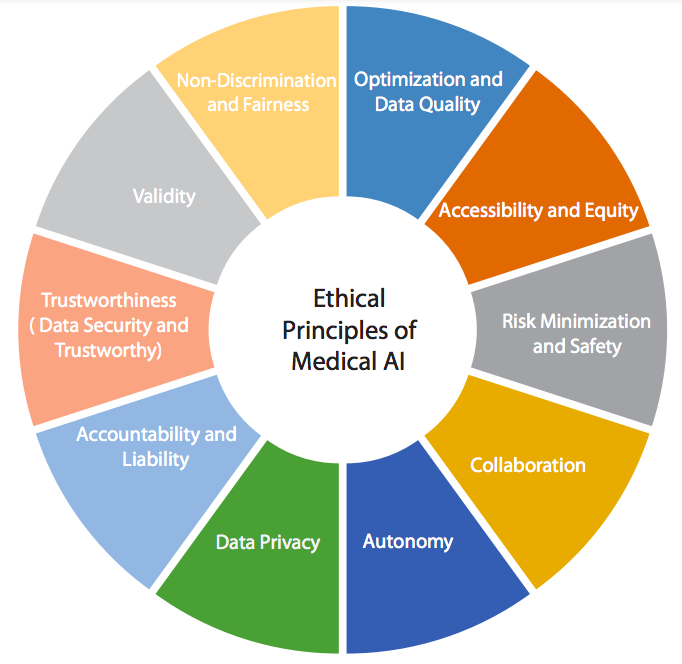
The ten ethical principles in the above figure addresses issues specific to AI for health. These principles are patient-centric and are expected to guide all the stakeholders in the development and deployment of responsible and reliable AI for health. These principles are as follows –

  1. Autonomy – The use of AI in healthcare raises concerns about the potential for the system to operate independently and compromise human autonomy. Incorporating AI into healthcare may result in machines taking over the responsibility of decision-making. It is essential that humans maintain full control over AI-based healthcare systems and medical decision-making. Under no circumstances should AI technology interfere with patient autonomy.
  1. Safety and Risk Minimization – Before widespread implementation, it is necessary to ensure that any AI technology-based system will operate safely and reliably. All stakeholders involved in the development and deployment of the technology bear the responsibility of ensuring participant safety. Patient dignity, rights, safety, and well-being must be the highest priority. Risk levels associated with deploying AI technology in clinical research or patient care depend on the use case and deployment methodology. For instance, unsupervised models run the risk of being more hazardous than those supervised by AI researchers and healthcare professionals. Similarly, the deployment of AI-enabled tools in high-risk patient care areas is riskier than their deployment in other areas.
  1. Trustworthiness Trustworthiness is the most desirable quality of any diagnostic or prognostic tool to be used in AI healthcare. Clinicians need to build confidence in the tools that they use and the same applies to AI technologies. In order to effectively use AI, clinicians and healthcare providers need to have a simple, systematic and trustworthy way to test the validity and reliability of AI technologies.
  1. Data Privacy AI-based technology should ensure privacy and personal data protection at all stages of development and deployment. Maintaining the trust of all the stakeholders including the recipient of healthcare over the safe and secure Ethical Guidelines for Application of Artificial Intelligence in Biomedical Research and Healthcare 19 use of their data is of prime importance to the successful and widespread deployment of AI. Data privacy must aim to prevent unauthorized access, modification, and/ or loss of personal data. The application of AI to personal data must not unreasonably curtail people’s real or perceived liberty.
  1. Accountability and Liability – The concept of accountability entails that an individual or organization is responsible for their actions and should be transparent about their activities. When it comes to AI technologies for healthcare, it is crucial that they are subject to scrutiny by relevant authorities at any given time. Regular internal and external audits must be conducted to ensure that the AI technologies are functioning effectively. The results of these audits should be made available to the public.
  1. Optimization of Data Quality – The performance of AI technology heavily relies on the data utilized for training and testing purposes, making it a data-driven technology. In the healthcare sector, the quality and size of the dataset are critical as a skewed or insufficient dataset can result in issues such as data bias, errors, and discrimination. Data bias is regarded as the most significant risk to data-driven technologies like AI in healthcare. It is crucial to exercise due diligence to ensure that the training data is unbiased and represents a substantial portion of the target population.
  1. Accessibility, Equity and Inclusiveness – The use of computers for development as well as the deployment of AI technologies in healthcare presupposes wider availability of infrastructure. The digital divide is known to exist in almost all countries and is more prominent in low- and middle-income countries (LMICs). The heavy reliance on technology may therefore interfere with the wider application of promising tools in areas where it is expected to make a greater difference. 
  1. Collaboration –  In the field of AI for health, having a large and well-curated dataset is crucial for effective utilization of AI. This can only be achieved through fostering collaboration at all levels. With the rapidly changing landscape of AI technology, it is essential to collaborate among AI experts during research and development to ensure the most appropriate techniques and algorithms are used to address healthcare issues. Collaboration between AI researchers and healthcare professionals throughout the development and adoption of AI-based solutions is expected to enhance the benefits of this promising technology.
  1. Non Discrimination and Fairness Principles: In order to refrain from biases and inaccuracies in the algorithms and ensure quality, the following principles should be followed:
    • The data set used for the training algorithm must be accurate and representative of the population in which it is used. The researcher has the responsibility to ensure data quality.
    • Inaccuracy and biases can cause suboptimal or malfunctioning of AI technologies external independent algorithmic audits and continuous end-user feedback analysis should be performed to minimize inaccuracies and biases. The AI developers/researchers must acknowledge any biases involved and should take the necessary steps to rectify it.
    • AI should never be used as a tool for exclusion. Special attention must be given to under-represented and vulnerable groups like children, ethnic minorities, persons with disabilities, etc. The AI developers should promote the active inclusion of women and minority groups.
    • Developers should give special attention to promoting and protecting the equality of individuals. Freedom, rights and dignity, should be treated with equality and justice.
    • AI technologies should be designed for universal usage. Discrimination of individuals or groups on the grounds of race, age, caste, religion, social status is unethical.
    • The reversibility of decisions made by the AI technology should be considered; if harm has occurred to any patient/ participant. Before implementing the technology, the option for reversibility of decision must be integrated with the AI design.
    • In case of any unfortunate events arise from the malfunctioning of the AI technology occurs, then there should be an appropriate redressal mechanism for the victim. The manufacturer must ensure that there is a provision for proper grievance redressal.
    • There must be a safe mechanism to raise concerns pertaining to the AI technology the issues can be technical, functional, ethical, or misuse of technology. There should be a proper mechanism for protecting the whistleblower.
  1. Validity – AI technology applied in healthcare must undergo rigorous validation in both clinical and field settings to ensure its safety and efficacy for patients or participants. Differences in datasets used for training AI algorithms can amplify the divergence of AI-based algorithms. This discordance in diagnostic abilities among different AI solutions may cause confusion for end-users, including health professionals and patients. It is essential to have an internal mechanism to monitor such issues and provide appropriate feedback to developers while considering the clinical context. An efficient feedback mechanism is also crucial for necessary updates when AI technology affects individuals or healthcare systems. The application of AI-based decisions in clinical settings can lead to potential health hazards or mismanagement.