Fiscal Policy

Subsidy burden of states

Context: Comptroller and Auditor General urged states to make a proper accounting of subsidies, remove revenue deficits, reduce fiscal deficits and keep outstanding debt at an acceptable level. In this context, let us discuss the problems with the subsidy regime.

Subsidies & freebies

As per CAG, the state government’s expenditure on subsidies has grown at 12.9 per cent and 11.2 per cent during 2020-21 and 2021-22. 

 In the recent period, state governments have started delivering a portion of their subsidies in the form of freebies.  Though there is no precise definition of freebies, they are different from subsidies provided by the government on public/merit goods, such as the public distribution system, employment guarantee schemes, states’ support for education and health, and expenditure which brings economic benefits.

On the other hand, freebies like the provision of free electricity, free water, free public transportation, waiver of pending utility bills and farm loan waivers often undermine credit culture, and disincentivise work at the current wage rate leading to a drop in labour force participation.

Issues with Subsidies & freebies

  • Regressive: Some of the subsidies such as Electricity, Fertilisers, MSP etc. are universal in nature and are given to all households irrespective of their socio-economic status. Being universal in nature, such subsidies benefit the richer households more than the poor households and hence are considered to be regressive in nature.
  • Leakages & Corruption: Inclusion and Exclusion errors; Duplicate and Ghost Beneficiaries; Presence of Middlemen, Poor administrative efficiency etc. E.g., 46% leakage in PDS.
  • Subsidies create distortions and ultimately affect poor people: Farm subsidies like MSP encouraged the production of water-intensive crops like rice & wheat and prevented crop diversification. This ultimately resulted in the low-income growth of the farmers. 
  • Cross-subsidization: Subsidies/Freebies like low/free passenger fares or free electricity for the public result in cross-subsidization through commercial usage. This increases the cost of doing business and hence hinders the growth of a private investment.
  • Distorts credit culture: Freebies like Agricultural loan waivers hampers the credit culture among the public and may result in the accumulation of bad assets in the banking sector. 
  • Revenue deficit: Increasing investments on subsidies & freebies increase the Revenue expenditure and hence the Revenue deficit. This leaves little headroom for the governments to invest in capital expenditure. 

Hence, rationalising subsidies is important for state governments to reduce their debt burden in the long term. 

Goods & Service Tax Appellate Tribunal

Context: Finance Act amended the Central Goods & Services Tax Act, 2017 and provided the framework for the functioning of GST Appellate Tribunal for hearing appeals against the orders passed by Appellate Authority or Revisional Authority.

Need for GST Appellate Tribunal

  • GST Appellate Tribunal is the forum of second appeal in GST laws and first common forum of dispute resolution between Centre & States. 
  • Appeals against the orders in first appeals issued by Appellate Authorities under Central & State GST Acts lie before the GST Appellate Tribunal, which is common under the Central & State GST Acts. Currently, due to want to GST Appellate Tribunal appeals from Appellate Authorities lie in various High Courts and Supreme Court which renders the process of dispute resolution slow.
  • Being a common forum, GST Appellate Tribunal will ensure that there is uniformity in redressal of disputes arising under GST and in implementation of GST across the country. 
  • Earlier GST Council had formed a group of ministers committee under the Chairmanship of Dushyant Chautala of Haryana. GST Council in its 49th meetings accepted the committee reports and recommended the constitution of GST Appellate Tribunal. 

GST Appellate Tribunal formed by Finance Act, 2023

  • Central Government shall establish an Appellate Tribunal known as Goods and Services Tax Appellate Tribunal for hearing appeals against the orders passed by the Appellate Authority or the Revisional Authority.
  • Jurisdiction, powers & authority conferred on the Appellate Tribunal shall be exercised by Principal Bench and State Benches of GSTAT. 
  • Principal Bench & State Benches shall hear appeals against orders passed by Appellate Authority or Revisional Authority. However, if a case involves dispute over the place of supply, the Principal Bench shall only hear it. 
  • Principal Bench of GSTAT will be established at New Delhi and will consist of President, a Judicial Member, a Technical (Centre) and a Technical Member (State). President shall distribute the business of the GST Appellate Tribunal among the Benches and may transfer cases from one bench to another.
  • State Benches of GSTAT
  • Central Government to establish State Benches on the request of the State Governments. 
  • Number of Benches, their locations and their jurisdictions to be recommended by GST Council to the Central Government. 
  • State Benches of GSTAT will consist of two Judicial Members, a Technical Member (Centre) and a Technical Member (State) i.e., total four members. 
  • Senior-most Judicial Member in State Bench shall act as Vice-President for such State benches and will exercise similar functions as played by President in relation of Principal Bench of GSTAT. 
  • Administration of Benches of GSTAT for both State Benches and Principal Bench of GSTAT: 
  • For disputes in which the amount of fine, fee or penalty, tax or input tax credit is less than Rs 50 lakhs and not involving any question of law, may with the approval of President, can be heard by a single member.
  • All other cases will be heard by two-member bench comprising of one judicial member and one technical member. 
  • In case of difference of opinion among members: If after hearing the cases, members differ in their opinion on any point or points, such members shall state the points on which they differ and the President shall refer such case for hearing:
  • For a State Bench: To another member of a State Bench within the State or where no such other State Bench is available in the State, to a Member of a State Bench in another State.
  • For a Principal Bench: To another member of Principal Bench, or, where no such other Member is available, to a Member of any State Bench. 

And such points shall be decided according to the majority opinion including the opinion of the Members who first heard the case.

Qualifications for members of Principal Bench

A person shall not be qualified for appointment as:

  • President should have been a Judge of the Supreme Court or is or has been the Chief Justice of a High Court.
  • Judicial Member should have been a Judge of High Court or District Judge or Additional District Judge for a combined period of 10 years.
  • Technical Member (Centre) should be or been a member of Indian Revenue (Customs & Indirect Taxes) Service, Group A or All India Service with at least three years of experience in administration of an existing law or goods & service tax in the Central Government, and has completed 25 years of service in Group A.
  • Technical Member (State) should have been an officer of State Government or an officer of All India Services, not below the rank of Additional Commissioner of Value Added Tax or State goods and services tax or such rank not lower than First Appellate Authority to be notified by concerned State Government, on the recommendations for GST Council and has completed 25 years in Group A service
  • President, Judicial Member, Technical Member (Centre) & Technical Member (State) shall be appointed or re-appointed by the Central Government on the recommendations of a Search-cum-Selection Committee.

Search-cum-Selection Committee for all members apart from Technical Member (State)

  • Chief Justice of India or a Judge of Supreme Court nominated by him, to be Chairperson of Search-cum-Selection Committee. 
  • Secretary of Department of Revenue in Ministry of Finance of Central Government, to be Member Secretary of Search-cum-Selection Committee. (Does not have right to vote)
  • Secretary of Central Government nominated by Cabinet Secretary.
  • Chief Secretary of a State to be nominated by GST Council.
  • One member, who
    • For appointment of a President of a Tribunal, this member will be the outgoing President of the GSTAT.  
    • For appointment of a member of a Tribunal, this member will be the sitting President of Tribunal. 
    • For considering reappointment of President of GSTAT or when outgoing President is not available or when removal of incumbent President is being considered, this member will a retired judge of Supreme Court or a retired Chief Justice of a High Court to be nominated by CJI.
  • Search-cum-Selection Committee shall recommend a panel of two names for appointment or re-appointment to the post of President or a Member. 

Search-cum-Selection Committee for Technical Member (State)

  • While making selection for Technical Member (State) of a State Bench, first preference to be given to officers who have worked in the State Government of the State to which jurisdiction of the Bench extends.
  • Search-cum-Selection for Technical Member (State) of a State Bench consists of the following members:
  • Chairperson: Chief Justice of High Court in whose jurisdiction the State Bench is located.
  • Senior-most Judicial Member in the State and where no Judicial Member is available, a retired Judge of High Court in whose 
  • Chief Secretary of the State in which State Bench is located.
  • One Additional Chief Secretary or Principal Secretary or Secretary of the State in which the State Bench is located 

Conditions of Service of members of GSTAT

  • Tenure of service for members: All the members of GSTAT including the President will hold office for a term of four years from the date on which they enter office. The President can stay in office until he reaches 67 years of age and shall be eligible for re-appointment for a period not exceeding two years. Other members can stay in office until they reach 65 years of age and shall be eligible for re-appointment for a period not exceeding two years.
  • Resignation of Members: President or any member resign from his office by notice addressed to Central Government. 
  • Removal of Members: Government may on the recommendations of Search-cum-Selection Committee remove from office a member including President, who:
    • Has been adjudged an insolvent.
    • Has been convicted of an offence which involves moral turpitude
    • Has become physically or mentally incapable of acting as President or Member.
    • Has acquired such financial or other interest
    • Has abused his position to render his continuance in office prejudicial to public interest.
  • Suspension of Members: Central government may suspend from office the President and other members on the recommendations of Search-cum-Selection Committee against whom proceedings for removal have been initiated.
  • Transfer of Members: Central Government may in consultation with the President for administrative efficiency transfer Members from one Bench to another Bench. However, a Technical Member (State) of a State Bench may be transferred to a State Bench only of the same State in which he was originally appointed, in consultation with State Government. 
  • President or other Members, on ceasing to hold their office, shall not be eligible to appear, act or plead before the Principal Bench or State Bench
  • Salary of President & Members of GSTAT: 
  • Salary of the President and Members of GSTAT shall be such as may be prescribed and their allowances and other terms and condition of service shall be same as applicable to Central Government officers carrying same pay. 
  • Salary and allowances and other terms of service will not be varied to their disadvantage after their appointment. 

Old Pension Scheme & New Pension Scheme

Context: Some non-BJP-ruled states, including Himachal Pradesh, Rajasthan, Chhattisgarh, Jharkhand, and Punjab, have decided to return to OPS, while a few others have been said to be considering the move.

About Old Pension Scheme (OPS)

  • In OPS, the pension to government employees at the Centre as well as states was fixed at 50 per cent of the last drawn basic pay. This entire amount was paid by the Government.
  • The attraction of the OPS lay in its promise of an assured or ‘defined’ benefit to the retiree. It was hence described as a ‘Defined Benefit Scheme’.
  • In OPS, the pension constituted 50% of the last drawn salary of an employee.

Benefits of reverting back to OPS

  • Short-term gains for the state government: they save money since they will not have to put the 10 percent matching contribution towards employee pension funds.
    • For employees too, it will result in higher take-home salaries, since they too will not set aside 10 percent of their basic pay and dearness allowance towards pension funds.

Concerns with OPS

  • Pension liability remained unfunded: there was no corpus specifically for pension, which would grow continuously and could be dipped into for payments.
    • The Government of India budget provided for pensions every year; there was no clear plan on how to pay year after year in the future.
    • The government estimated payments to retirees ahead of the Budget every year, and the present generation of taxpayers paid for all pensioners as on date.
    • Overall, pension payments by states eat away a quarter of their own tax revenues. For some states, it is much higher. For Himachal, it is almost 80 per cent (pensions as a percentage of the state’s own tax revenues); for Punjab it is almost 35 per cent; for Chhattisgarh 24 per cent; and for Rajasthan 30 per cent.
    • The ‘pay-as-you-go’ scheme created inter-generational equity issues — meaning the present generation had to bear the continuously rising burden of pensioners. Today’s taxpayers paying for the ever-increasing pensions of retirees, with Pay Commission awards almost taking the pension of old retirees to current levels, means the pension of someone who retired in 1995 may well be the same as that for someone who retires in 2025.
  • Unsustainable:
    • Firstly, pension liabilities would keep climbing since pensioners’ benefits increased every year; like salaries of existing employees, pensioners gained from indexation.
  • Secondly, better health facilities would increase life expectancy, and increased longevity would mean extended payouts.
    • Over the last three decades, pension liabilities for the Centre and states have jumped manifold. In 1990-91, the Centre’s pension bill was Rs 3,272 crore, and the outgo for all states put together was Rs 3,131 crore. By 2020-21, the Centre’s bill had jumped 58 times to Rs 1,90,886 crore; for states, it had shot up 125 times to Rs 3,86,001 crore.
image 2

About New Pension Scheme (NPS)

  • The New Pension System proposed by the Project OASIS report became the basis for pension reforms - what was originally conceived for unorganised sector workers, was adopted by the government for its own employees.
  • The government thus replaced this PAYG system with the national pension scheme (NPS) or contributory pension scheme which was made mandatory for employees who joined on or after April 1st, 2004.
  • NPS is a tax-efficient fund which gets accumulated throughout the career of a person and acts as an income after their retirement.
  • Regulation: under the PFRDA (The Pension Fund Regulatory & Development Authority) Act, 2013

Who Can Join?

  • Any citizen of India (both resident and Non-resident) and Overseas Citizen of India (OCI) in the age group of 18-70 years. Earlier, the maximum age for entry was 65. In Aug 2021, PFRDA increased the maximum age limit to 70.
  • Different SectorsGovernment SectorCentral Government: Introduced with effect from January 1, 2004 (except for armed forces). State Government: Almost all the State Governments (except few such as West Bengal) have also adopted NPS through their own notifications.Private Sector (Non-Government Sector):CorporatesAll Citizens of India: Any individual not being covered by any of the above sectors has been allowed to join NPS 2009 onwards.
  • Contribution: Every government employee has to mandatorily contribute 10% of pay and dearness allowance to the pension fund, which is matched by the government. This money can then be invested by fund managers. After the latest amendment, in 2019, the government share of the contribution has been raised to 14% from 10%. The State Governments have also been given an option to increase their contribution to 14% through their own gazette notification.
  • What happens to the contribution?  Invested in certain pension funds which in turn invest in different asset classes such as G-secs, shares, bonds etc. to generate higher returns.
  • Returns:  NPS is designed on a Defined contribution basis wherein the subscriber contributes to his account. However, there is no defined benefit that would be available at the time of exit from the system. The accumulated wealth depends on the contributions made and the income generated from investment of such wealth.
  • Withdrawals:
    • Upon Normal Superannuation: At least 40% of the accumulated pension wealth of the Subscriber has to be utilised for purchase of annuity providing for monthly pension of the Subscriber and the balance is paid as lump sum to the subscriber.
    • Upon Death: The entire accumulated pension wealth (100%) would be paid to the nominee/legal heir of the Subscriber and there would not be any purchase of annuity/monthly pension.
    • Exit from NPS Before the age of Normal Superannuation – At least 80% of the accumulated pension wealth of the Subscriber should be utilised for purchase of an annuity providing the monthly pension of the Subscriber and the balance is paid as a lump sum to the Subscriber.
  • The basic difference is that the NPS is a contribution-based pension system. Under the old system, pension was fixed as 50% of the last basic salary drawn, along with other benefits. Hence, the benefit due was defined beforehand. However, in the case of the NPS, the pension benefit is determined by factors such as the amount of contribution made, the age of joining, type of investment, and the income drawn from that investment.
  • Over the last eight years, the NPS has built a robust subscriber base, and its assets under management have increased.
    • As on October 31, 2022, the Central government had 23,32,774 subscribers, and states had 58,99,162 subscribers.
    • The corporate sector had 15,92,134 subscribers, and the unorganised sector 25,45,771.
    • There were 41,77,978 subscribers under the NPS Swavalamban scheme. The total assets under management of all these subscribers stood at Rs 7,94,870 crore as on October 31, 2022.

Different Types of NPS Accounts

CriteriaTier-1 AccountTier-2 Account
PurposePension accountInvestment account
EligibilityAny citizen between 18-70 yearsNRI/OCIs are not eligible
NatureCompulsoryOptional: Person needs to have a tier-1 account to open a tier-2 account.
Min. contribution per yearRs.1000Rs.250
Tax Benefits availableYesNo
Withdrawals allowed?Restricted as per rules and regulations.Unrestricted withdrawals.

Difference between New Pension Scheme and Old Pension Scheme

CriteriaNew Pension System (NPS)Old Pension Scheme
Nature of SchemeDefined ContributionDefined benefit
ContributionBoth by Government and EmployeeOnly the Government
BenefitNo Defined benefit as the accumulated wealth depends upon the contribution made.Defined benefit. Pension of 50% of the last drawn salary.
Pension AmountDepends upon the number of years of service. Longer the years of service. Higher Contribution. Higher Pension.Depends upon the last drawn salary. Pension is equal to 50% of last drawn salary.

Net direct tax collections up 17.6%

Direct Tax Collections in 2022-23

  • India’s net direct tax collections have risen 17.6% in 2022-23 to touch ₹16.61 lakh crore (growth of 16.9% in the year), exceeding the Revised Estimates target for the year by 0.7%, as per provisional data released by the Finance Ministry on Monday.
  • The contribution of corporate tax collections in the gross direct tax kitty was ₹10.04 lakh crore, just a tad higher than the ₹9.61 lakh crore paid by taxpayers as personal income tax and Securities Transaction Tax (STT) ( personal income tax and STT yielded a growth of 24.2%).
  • At a gross level, the share of personal income tax and STT to the tax kitty has touched 48.9% in 2022-23 compared to around 47.4% in 2021-22, while corporate tax accounted for just 51.1% in the year gone by as opposed to 52.6% in 2021-22.
  • The Ministry said gross tax collections grew 20.33% to ₹19.68 lakh crore in 2022-23, compared to ₹16.36 lakh crore in the previous financial year.

Revenue Income: (Budget 2023-24)

image

Mahila Samman Savings Certificate, 2023 (Mssc)

Context: Union Budget 2023-24 announced  a one-time new small savings scheme, Mahila Samman Savings Certificate which will be made available for a two-year period up to March 2025. This will offer deposit facility up to Rs 2 lakh in the name of women or girls for a tenor of 2 years at fixed interest rate of 7.5% with partial withdrawal option. To operationalise this scheme, Department of Economic Affairs has now notified the Mahila Samman Savings Certificate Scheme. 

About Mahila Samman Savings Certificate

  • Application for opening an account: Application for opening an account under MSSC Scheme shall made by a woman for herself, or by the guardian on behalf of a minor girl on or before 31st March, 2025. The account will be single holder type account.
  • Deposits: A maximum limit of two lakh rupees can be deposited in an account or accounts held by an account holder. An individual may open any number of accounts subject to maximum limit for MSSC and time gap of three months shall be maintained between existing account and opening another account. Minimum amount for opening is an account is thousand rupees and any sum in multiples of one hundred rupees and no subsequent deposit shall be allowed in that account. 
  • Interest: Deposits made under this scheme shall bear interest rate of 7.5% per annum compounded on quarterly basis. 
  • Payment of maturity: Deposit shall mature on completion of two years from the date of deposit.
  • Withdrawal from account: Account holder shall be eligible to withdraw maximum up to 40% of Eligible Balance once after expiry of one year from the date of opening of account but before maturity of the account. 
  • Premature closure of account: The account can be closed prematurely only after completion of 6 months since the opening of account in the following cases:
    • Death of account holder.
    • If post office or bank concerned is satisfied, in cases of extreme compassionate grounds such as medical support in life threatening diseases, death of guardian. 
  • Administrative control of the scheme: Department of Economic Affairs under Ministry of Finance has notified Mahila Samman Savings Certificate Scheme, 2023 under the Government Savings Promotion Act, 1873.

Old vs New hotting up, government forms panel to relook at pension

Context: Union Finance minister announced the formation of a committee to look into improving the system of pension for government employees. The committee will be headed by Finance Secretary T V Somanathan

Details about National Pension System (NPS)

What is it? Pension cum investment scheme to provide old age security to Citizens of India. Regulated by Pension Fund Regulatory and Development Authority (PFRDA)

Who can Join? Any citizen of India (both resident and Non-resident) and Overseas Citizen of India (OCI) in the age group of 18-70 years. Earlier, the maximum age for entry was 65. In Aug 2021, PFRDA has increased the maximum age limit to 70.

Different Sectors

  1. Government Sector
    • Central Government: Introduced with effect from January 1, 2004 (except for armed forces). 
    • State Government: Almost all the State Governments (except few such as West Bengal) have also adopted NPS through their own notifications.
  2. Private Sector (Non-Government Sector):
    • Corporates
    • All Citizens of India: Any individual not being covered by any of the above sectors has been allowed to join NPS 2009 onwards.

Contribution: Govt. employees make a monthly contribution at the rate of 10% of their salary and Dearness allowance and a matching contribution is paid by the Govt. For central Govt. employees, the employer’s contribution rate has been enhanced to 14% from 1 April 2019. The State Governments have also been given an option to increase their contribution to 14% through their own gazette notification.

Different Types of NPS Account

CriteriaTier-1 AccountTier-2 Account
PurposePension accountinvestment account
Eligibilityany citizen between 18-70 yearsNRI/OCIs are not eligible
NatureCompulsoryoptional, Person needs to have tier-1 account to open tier-2 account.
Min. contribution per yearRs.1000Rs.250
Tax Benefits availableYesNo
Withdrawals allowed?Restricted as per rules and regulation.Unrestricted withdrawals.

What happens to the contribution? Invested in certain pension funds which in turn invest in different asset classes such as G-secs, shares, bonds etc. to generate higher returns.

Returns:  NPS is designed on Defined contribution basis wherein the subscriber contributes to his account. However, there is no defined benefit that would be available at the time of exit from the system. The accumulated wealth depends on the contributions made and the income generated from investment of such wealth.

Withdrawals

  • Upon Normal Superannuation – At least 40% of the accumulated pension wealth of the Subscriber has to be utilized for purchase of annuity providing for monthly pension of the Subscriber and the balance is paid as lump sum to the subscriber.
  • Upon Death – The entire accumulated pension wealth (100%) would be paid to the nominee/legal heir of the Subscriber and there would not be any purchase of annuity/monthly pension.
  • Exit from NPS Before the age of Normal Superannuation – At least 80% of the accumulated pension wealth of the Subscriber should be utilized for purchase of an annuity providing the monthly pension of the Subscriber and the balance is paid as a lump sum to the Subscriber.

Difference between New Pension Scheme and Old Pension Scheme

CriteriaNew Pension System (NPS)Old Pension Scheme
Nature of SchemeDefined Contribution Defined benefit
ContributionBoth by Government and EmployeeOnly the Government
BenefitNo Defined benefit as the accumulated wealth depends upon the contribution made.Defined benefit.
Pension of 50% of the last drawn salary.
Pension AmountDepends upon number of years of service.
Longer the years of service.
Higher Contribution.
Higher Pension.
Depends upon the last drawn salary.
Pension is equal to 50% of last drawn salary.

Blow for bond markets as Long-term tax benefit scrapped for debt Mutual Funds

Context: The government has proposed changes in taxation of debt mutual funds under which no benefit of indexation for calculation of long-term capital gains (LTCG) on debt mutual funds will be available for investments made on or after April 1, 2023.

From April 1, 2023, such debt mutual funds will be taxed at income tax rates as per an individual’s income. The move will remove the tax advantage a debt mutual fund has compared to bank deposits. 

Consequences

  • As a result, bank fixed deposits will become more attractive. 
  • This may have a negative impact on all debt funds, particularly in the retail category, as ultra-high net worth and high net worth individuals may choose to invest in safe havens like bank fixed deposits.
  • There will be a loss to the bond market which is already struggling for the liquidity. 

What is a mutual funds?

  • A mutual fund is a pool of money managed by a professional Fund Manager. 
  • It is a trust that collects money from a number of investors who share a common investment objective and invests the same in equities, bonds, money market instruments and/or other securities. And the income / gains generated from this collective investment is distributed proportionately amongst the investors after deducting applicable expenses and levies, by calculating a scheme’s “Net Asset Value” or NAV. Simply put, the money pooled in by a large number of investors is what makes up a Mutual Fund.

What is indexation?

  • Indexation is a process by which the cost of acquisition of an asset (mutual fund in this case) can be indexed (adjusted or inflated) over a period of time in order to bring it to current prices after taking inflation into consideration. 
  • Indexation is done through a mechanism using a Price Index which is adjusted for inflation. The Price Index adjusts for inflation at the time of purchase of an asset as well as at the time of its sale. 
  • It is a well-known fact that inflation erodes an asset’s value over a period of time. 
  • Indexation gives the investor an option to inflate (increase) the price of purchase of the asset. This helps in lowering the adverse cost impact due to inflation.

Indexation In Mutual Funds

  • Mutual fund investments generate Capital gains (Capital gain is a gain or profit realized by way of selling a property or other such asset/investment). These gains can either be Short Term or Long Term in nature, depending on the period for which these assets are held. 
  • However, indexation benefit is available only for capital gains realized in Debt mutual funds
  • A holding period of 36 months or more is considered as long term for Debt Funds. (For Equity mutual funds, long term means a holding period of 12 months or more)
  • Any holding period which is less than 36 months for Debt funds is treated as short term and the gains are added to the income of investor for tax calculation.

Windfall Tax

Context: The Union government scrapped a 30-month old windfall tax on domestically produced crude oil and export of jet fuel (ATF), diesel and petrol following a decline in international oil prices.

Relevance of the topic: Prelims- Key facts about Windfall Tax.

What is the Windfall Tax?

  • A windfall tax is a higher tax levied by the government on specific industries when the industry experiences unexpected and above-average profits.
    • India first imposed the windfall tax on July 1, 2022, when crude oil prices were well over $100 per barrel, following the Russia-Ukraine war.
    • When an industry (in this case oil and gas sector) benefits from a one-off external situation and makes sudden profits, these profits are separately taxed, which are over and above the normal taxes.
  • Country’s upstream oil companies (ONGC, Oil India, GAIL) as well as private refiners Reliance Industries and Nayara Energy, who are the key buyers of discounted Russian supplies, were reaping major profits by aggressively boosting fuel exports instead of domestic sales.

Economic rationale for imposing windfall taxes: 

  • India’s trade deficit had increased to record high levels and a weak rupee had increased the value of India’s imports.
  • Government spending has gone up after it had cut Central Excise Duty and spent more on food and fertilisers.
  • The government then decided to levy windfall tax on oil companies to make up for this gap as the windfall tax adds to the government's earnings.

Economic rationale for removing windfall tax:

  • Falling oil prices; Global crude oil prices have been falling since June 2022, and are currently under $75 per barrel. This has led to a decline in profits for domestic oil producers. 
  • Relief to oil companies: The removal of the tax is expected to benefit major oil producers like Reliance Industries and ONGC by lifting their refining margins. 
  • Relief to consumers: The removal of the tax could lead to lower airfares for airlines, and lower prices for petrol, diesel, and ATF for oil companies. 
  • Reduced government revenue: The windfall tax was not generating significant revenue, with collections dropping from ₹25,000 crore in FY23 to ₹6,000 crore in FY25. 

Distribution of Net Proceeds among States

Context: 

  • With population given a higher weightage over performance, the revenue-sharing formula has created friction between States and the Centre.
  • Southern states feel that horizontal distribution of net proceeds by the Centre as per formula suggested by 15th Finance Commission are “inequitable”, putting them at a disadvantage vis-a-vis Northern states.

Facts:

  • The Centre’s tax collections are pooled-in from States and a part of it is distributed among them, based on the Finance Commission’s (FC) formula. 
  • The share of taxes that each state gets is decided by a formula. The largest weight in this formula is given to what is called the “income distance” parameter, which is essentially the inverse of the per capita income of a state. Thus, the lower the per capita income, the more the state gets.
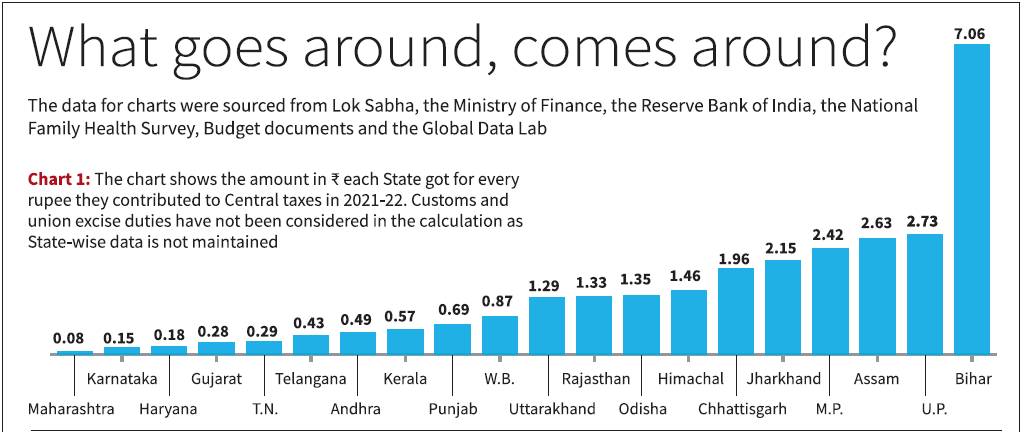
  • India’s poorest states, Bihar and Uttar Pradesh, therefore, have the highest share in tax devolution to states, much higher than they would get if population was the only parameter
  • The 15th FC formula is skewed in favour of some States, resulting in wide inter-State variations. As population is given a higher weightage, it tilts the balance in favour of some northern States. 
  • For every one rupee that Tamil Nadu gives the Centre, it gets back 29 paise. On the other hand, Uttar Pradesh gets ₹2.73, and Bihar gets back ₹7.06.
gBk
  • The 15th FC had arrived at the States’ share in the divisible pool of taxes based on each State’s needs (population, area and forest and ecology), equity (per capita income difference) and performance (own tax revenue and lower fertility rate).
  • The weight assigned to needs was 40%, equity 45%, and 15% for performance.
    • This formula meant that Uttar Pradesh and Bihar got 17.9% and 10%, respectively in the XVFC. Karnataka, Kerala and Tamil Nadu got 3.65%, 1.93% and 4.08%, respectively. 
    • Chart below shows that in successive FCs, the share of southern States has seen a consistent decline.
ZiAmM0WgbmJKzxk xX6tK0jkflisUZc6APQaXwCw7vze bHT8sxa1O5jKm3SfqoNl1wb72sUPYl YXNSuH7yLoppM Clw0wwig9z l5j9 zoKo y2gm8wpJjVd6kfQK6bh6 Y208AfLUDo6rcgYvA
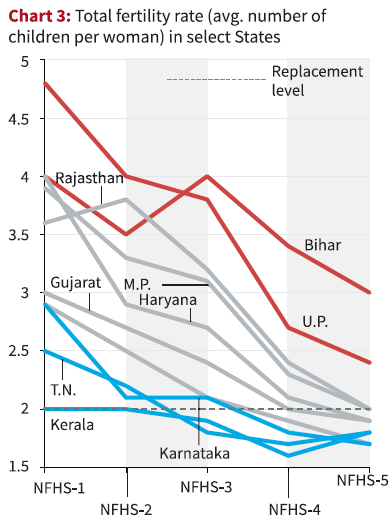
  • Also, the 15th FC introduced the fertility rate in the formula to reward States which had reduced the fertility levels.
  • While this does favour the developed States which have pushed their TFR below replacement rate as shown in the chart below, the weightage given to the component is relatively lower than equity and need
nn6ODZJjgRXuR8p9z2uhIR0VZNAL7t NjfSUg6TWfIBCT1kMoB45 ZleaEUuskPhvGEz43sQWyMKFOPTd8ZwD9BuF3y8kQ

Rationale for Equitable Distribution

  • Active state intervention was envisaged to reduce the developmental disparities. 
  • The mechanism employed to achieve these goals was the transfer of resources from the Centre to the states.
  • These transfers, which are more heavily directed to populous and poorer states, were channelled in the past through the Finance Commission and the Planning Commission.

Arguments:

  • In Favour: The objective is not to return the money you get from a State. Transfers enable a State to provide comparable levels of services. The basic rationale is horizontal equity. Taxes accrued to Tamil Nadu are not necessarily from the State. Yes, per capita income levels increased substantially in Karnataka, Kerala and Tamil Nadu. Now, the increase need not necessarily have to do only with the States’ efforts.
  • Against: The southern States have grown faster, and contribute larger revenue to the central kitty. The argument is that both Northern as well as Southern states should get equally higher amounts. Equity needs to be balanced so that it does not adversely impact efficiency of Southern states. The Centre needs to incentivise developing States to generate more tax revenue for an even more effective distribution.

Article 280 of the Indian Constitution:

  • Clause (1): The President shall, within two years from the commencement of this Constitution and thereafter at the expiration of every fifth year or at such earlier time as the President considers necessary, constitute a Finance Commission which shall consist of a Chairman and four other members to be appointed by the President.
  • Clause (2): Parliament may by law determine the qualifications which shall be requisite for appointment as members of the Commission and the manner in which they shall be selected.
  • Clause (3): It shall be the duty of the Commission to make recommendations to the President as to:
    • (a) the distribution between the Union and the States of the net proceeds of taxes which are to be, or may be, divided between them under this Chapter and the allocation between the States of the respective shares of such proceeds;
    • (b) the principles which should govern the grants in-aid of the revenues of the States out of the Consolidated Fund of India;
    • (bb) the measures needed to augment the Consolidated Fund of a State to supplement the resources of the Panchayats in the State on the basis of the recommendations made by the Finance Commission of the State; 
    • (c) the measures needed to augment the Consolidated Fund of a State to supplement the resources of the Municipalities in the State on the basis of the recommendations made by the Finance Commission of the State;
    • (d) any other matter referred to the Commission by the President in the interests of sound finance.
  • Clause (4): The Commission shall determine their procedure and shall have such powers in the performance of their functions as Parliament may by law confer on them.

15th Finance Commission:

Criteria for Horizontal distribution of taxes among States:

  • The criteria for distribution of central taxes among states for the 2021-26 period is the same as that for 2020-21.
Criteria14th Finance Commission15th Finance Commission
Income Distance5045
Population (1971 Census)17.5Not Considered
Population (2011 census)1015
Demographic PerformanceNot Considered12.5
Forest Cover7.5Not Considered
Forest and EcologyNot Considered10
Area1515
Tax EffortNot considered2.5
Total100100

Way Forward:

  • The inequalities between rich and poor states are manifest in almost every economic dimension. Incomes, assets and discretionary purchasing power are higher in the richer states. They are the locus of formal employment and of high value jobs, which is why the hunger for government jobs is so much more intense in the poorer regions of India. The overwhelming majority of foreign investment comes to the richer states. They have better healthcare, higher levels of literacy and better public services than the poorer states.
  • Therefore, any scheme of allocation should take into account both development needs as well as past performance, with the latter serving both to incentivize better performance and to allocate resources where they can be most effectively used.
  • ‘Committee for Evolving a Composite Development Index of States’ in 2013 proposed a general method for allocating funds from the Centre to the states based both on a state’s development needs as well as its development performance.
  • The methodology developed by the Committee first allocates funds across states based on need. Need is based on a simple index of (under) development. The index proposed here is an average of the following ten sub-components: (i) monthly per capita consumption expenditure, (ii) education, (iii) health, (iv) household amenities, (v) poverty rate, (vi) female literacy, (vii) percent of SC-ST population, (viii) urbanisation rate, (viii) financial inclusion, and (x) connectivity.
    • The proposed allocation scheme accommodates differences in needs, even while recognizing that the truly needy should be given disproportionately more. Less developed states rank higher on the index, and would get larger allocations based on the need criteria.
  • Given that poor administration or weak institutions in a recipient state can fritter away allocated resources to the detriment of the population, there should be some recognition for effective governance and the efficiency of resource use. This becomes all the more necessary since the proposal to give substantially more to underdeveloped states might create a mild disincentive to develop.
  • In sum, 8.4% of funds will be allocated as a fixed basic allocation. Of the remaining 91.6%, we choose parameters such that 3/4th of it is allocated based on need and 1/4th based on performance. 
  • A positive feature of this formula for allocation of funds is that the incremental reward for performance is increasing in the level of underdevelopment – this is because the reward for performance is multiplied by need.