Environmental Conventions

US SEC and Hague Service Convention

Context: The U.S. Securities and Exchange Commission (SEC) has sought assistance from the Union Law Ministry of India under the Hague Service Convention to serve summons to Gautam Adani and his associates in a securities fraud case. 

Relevance of the Topic:Prelims: Key facts about SEC; Hague Service Convention

About Hague Service Convention

  • The Hague Service Convention is formally known as the Convention on the Service Abroad of Judicial and Extrajudicial Documents in Civil or Commercial Matters (1965).
  • It is an international treaty that standardises the process of serving legal documents across borders.

Key features of the Hague Service Convention

  • Established in 1965 to standardise the service of judicial and extrajudicial documents across borders. 
  • Purpose:
    • To facilitate the service of judicial and extrajudicial documents in civil and commercial matters between signatory countries. 
    • To ensure timely and actual notice of legal proceedings for defendants in foreign jurisdictions.
  • Central Authority: Each member country designates a Central Authority to receive and process service requests.
    • It has been signed by 84 states, including India and the U.S.
    • It is applicable only when both the sending and receiving countries are signatories.
  • Modes of transmission vary by country but generally include:
    • Primary method: Service through the designated Central Authority.
    • Alternative channels: Diplomatic/consular service, postal service (if permitted), direct service by judicial officers, or direct contact between government authorities.

Service of Process in India

  • India acceded to the Convention on November 23, 2006, with expressly opposing all alternative service methods under Article 10.
  • India opposes all alternative service methods, including postal service, except for nationals of the requesting country.
  • Service must be done exclusively through the Ministry of Law and Justice (India’s Central Authority).
  • Requests must be in English or accompanied by an English translation.
  • India’s Central Authority can reject a service request under Article 13 if it compromises sovereignty or security but not based on exclusive jurisdiction claims.
  • The service process typically takes 6 to 8 months and is treated as an Indian court summons under Section 29(c) of the Code of Civil Procedure, 1908.

Judicial Precedents on Alternative Service Methods

  • Federal Trade Commission v. PCCare247 Inc. (2013) (U.S.):
    • It allowed service in India via Facebook and email, arguing these methods were not explicitly objected to under Article 10.
  • Punjab National Bank (International) Ltd. v. Boris Shipping Ltd. & Ors. (2019) (UK):
    • Rejected alternative service methods, ruling that service must comply with India’s designated procedure under the Convention.
  • Rockefeller Technology Investments v. Changzhou SinoType Technology Company (2020) (U.S.):
    • Ruled that contractually agreed service methods can override a state’s objections under Article 10.

Default judgments under the Convention

  • A default judgment may be issued under the Convention if a foreign government refuses to cooperate in serving summons on a defendant residing within its jurisdiction. 
  • Article 15 allows a default judgment if:
    • The document was transmitted using a Convention-approved method.
    • At least six months have passed without service confirmation.
    • The court deems that all reasonable efforts were made to obtain proof of service.
  • India allows default judgments even without a service certificate, provided Article 15 conditions are met.
  • Duong v. DDG BIM Services LLC (2023) (U.S.): The U.S. court acknowledged Article 15 as a safety valve, allowing default judgment when India’s Central Authority fails to process service requests efficiently.

WIPO Treaty on Intellectual Property, Genetic Resources & Associated Traditional Knowledge (GRATK)

Context: The Treaty on Intellectual Property, Genetic Resources and Associated Traditional Knowledge was agreed upon by Diplomatic Conference hosted by World Intellectual Property Organisation (WIPO). The treaty was first proposed in 1999 by Colombia, calling for recognition of intellectual property of indigenous peoples and local communities. The negotiations started in 2001.

Objectives of WIPO Treaty on Genetic Resources & Traditional Knowledge (GRATK)

  • Promotion of efficacy, transparency and quality of patent system in relation to genetic resources and traditional knowledge.
  • Protection of genetic resources and traditional knowledge associated with genetic resources.
  • Prevention of patents being granted erroneously for inventions that are not novel or inventive with regard to genetic resources and traditional knowledge related to genetic resources.
  • International disclosure related to genetic resources and associated traditional knowledge in patent applications contributes to legal certainty and consistency

Salient Features of GRATK

  • Mandatory Patent Disclosure Requirement: The treaty establishes a mandatory patent disclosure requirement requiring patent applicants to disclose the country of origin of genetic resources and/or the Indigenous people or local community providing the associated traditional knowledge.
  • Sanctions and Remedies:
    • Failure to disclose required information would be subject to appropriate, effective and proportionate measures.
    • Patent applicants would have the opportunity to rectify a failure to disclose the requirement information unless
  • Information Systems:
    • Voluntary establishment of information systems (ex databases) of genetic resources and associated traditional knowledge, in consultation with indigenous people and local communities, wherever applicable.
    • Genetic resources databases can compile and reference a wide range of information. Ex. Information about genetic resources, associated traditional knowledge, known uses of genetic resources and relevant scientific compilations.
    • Information systems should be accessible to patent offices for search and examination of patent applications.
  • Non-retroactivity: No obligations of the Treaty would be imposed in relation to patent applications filed prior to entry into force of this treaty.
  • Review Mechanism: The treaty provides an in-built review mechanism to allow certain issues to be reviewed like extension of disclosure requirement to other areas of intellectual property and other issues like new and emerging technologies four years after the entry into force of the treaty.

Significance of the GRATK

  • Significant win for countries of Global South and India which are host bulk of global biodiversity and traditional knowledge. India being a megadiverse country holds 7-8% of global biodiversity and a rich repertoire of knowledge based on genetic resources.
  • First WIPO treaty to address the interface between intellectual property, genetic resources and traditional knowledge. Also, first WIPO treaty to include provisions specifically for indigenous people and local communities.
  • Multilateralism: Given the opposition of advanced countries like USA, EU and Japan for this treaty and the divided world we live in, the fact that a consensus treaty could emerge is a win and provides hope of the spirit of multilateralism.

Concerns with the Treaty

  • Fails to address biopiracy due to weak sanctions regime: The WIPO Treaty suffers from a weak sanctions regime which is not adequate address the issues of bio-piracy. Some issues with the sanctions regime of the treaty are:
    • No provision for penalties for non-disclosure.
    • Countries to provide opportunity for rectification of failure to disclose information before implementing sanctions.
    • No obligation on patent offices to verify the authenticity of disclosure.
    • No country can revoke, invalidate or render unenforceable conferred patent rights solely on the basis of applicant's failure to provide mandatory patent disclosure.
    • No provision for revocation of patent except when the information is withheld due to fraudulent intentions. Even in such cases, the treaty leaves it to the State to decide on the sanctions to be imposed.
  • Silent on positive protection of traditional knowledge for indigenous people and local communities (IPLC):
    • No recognition of traditional knowledge as intellectual property of IPLC which would have provided indigenous people with exclusive collective rights to control their traditional knowledge.
    • No fair & equitable sharing of benefits in favour of IPLC in return of use of their traditional knowledge.
    • Silence on right of attribution and right to use of their own traditional knowledge for IPLC.
    • Fails to protect traditional cultural expressions i.e., the forms in which IPLC express their traditional cultural practices and knowledge like music, dance, art & handicrafts.
  • Dilution of India's patent laws: India would need to align its domestic laws like Patents Act & Biological Diversity Act with the WIPO Treaty on Genetic Resources and Associated Traditional Knowledge. These amendments could potentially dilute existing protections aiming to safeguard traditional knowledge and genetic resources. For example, India's Patent Law already provides for pre-grant opposition against non-disclosure of source of origin and also for a revocation of granted patent for non-disclosure of information.

Summit for a New Global Financing Pact

Context: As world leaders and finance moguls land in Paris for the Summit for a New Global Financing Pact, it’s time to take concrete steps for sustainable finance and not let this be another international summit without substance.

India, the president of the G20 this year, is co-chairing the steering committee of the summit with France and can be counted on to be that voice of the Global South.

image 116

About the summit:

  • What: a new deal to be signed among world leaders to ensure fixed funding amount and mechanism for various developmental issues.
  • When: on 22-23 June
  • Initiative: Taken by the French President, Emmanuel Macron

Aims

  • Aim of the Summit is to lay the groundwork for a new financial system suited to the common challenges of the 21st century, such as fighting inequalities and climate change and protecting biodiversity.
  • It aims to establish a sufficiently robust international financial architecture to provide greater resources, protect the most vulnerable countries from shocks, help achieve the Sustainable Development Goals (SDGs), restore the long-term trend of poverty reduction, and preserve global public goods such as climate and health.
  • Aim to “build a new contract with the North and the South”, in order to facilitate the access of vulnerable countries to the financing they need to address the consequences of ongoing and future crises.

Four main objectives

  • Restore fiscal space to countries facing short-term difficulties, especially the most indebted countries.
  • Fostering private sector development in low-income countries.
  • Encourage investment in "green" infrastructure for the energy transition in emerging and developing countries.
  • Mobilize innovative financing for countries vulnerable to climate change.

High level steering committee composition:

It includes France, Barbados, South Africa, Germany, Brazil, China, the United Arab Emirates, the United States, India, Japan, the United Kingdom, Senegal, the European Commission, the United Nations Secretariat, the International Monetary Fund, the World Bank and the OECD.

Challenges in such funding:

1. Demand and Supply gap of funding:

Demand - According to One Planet Lab’s white papers released for the Summit, the scale of investment needed to meet the United Nation’s Sustainable Development Goals, climate COP21 and Biodiversity COP15 objectives set at the global and national levels is to the tune of an additional $4 trillion every year.

Supply - only $204 billions of official development assistance came last year. 

2. Regional difference: only 25% of global climate investment goes to South Asia, Latin America, and Africa, which house some of the most vulnerable regions. 

3. Not focusing on equal but differentiated responsibility: developed nations despite historically responsible for the emission are not taking responsibility to lead a way and fund more. They demand equal contribution of funds from developing nations like India for being current emitter. 

Way forward

  • Modernising and standardising existing tax structures, clamping down on illegal cross-border money movement, empowering tax administrations and curbing ineffectual fossil fuel subsidies.
  • At international level, taxing the production of fossil fuels, shipping of goods, and transportation of fossil fuels to raise funds.
  • Financing novel mechanisms, such as a Global Clean Investment Risk Mitigation Mechanism that pool risks across geographies and lower costs for all. It would help to attract private financing for such needs.
  • Transparency and real-time data can bridge the psychological and financial divides.
  • Chart a political pathway that creates time-bound deliverables on climate finance from one summit to another. 

Conclusion

The summit must outline the maths of finance, the mechanisms of delivery, and establish the momentum for real investment over the next two years. When we approach the 80th anniversary of the UN in 2025, reformed finance for sustainable development should have formed the basis for renewed and meaningful multilateralism.

Kalakkad Mundanthurai Tiger Reserve

Context: Ending an operation that lasted over five days, the Tamil Nadu Forest Department officials successfully tranquillised wild elephant, Arikompan in the Chinna Ovulapuram reserve forest in Theni district, early on Monday, June 5, 2023. Sources said Arikomban will be released at Muththukuzhivayal beyond Upper Gothaiyar area in Kalakad Mundanthurai Tiger Reserve (KMTR).

Kalakkad Mundanthurai Tiger Reserve

Kalakkad Mundanthurai Tiger Reserve

  • Location:
    • It is located in the South Western Ghats montane rain forests in Tirunelveli district and Kanyakumari district in the South Indian state of Tamil Nadu.
    • It includes three sanctuaries, viz. Kalakad, Mundanthurai and part of Kanyakumari Sanctuary, with portions of Tirunelveli forest division of the State.
    •  It is the second-largest protected area in Tamil Nadu. 
    • It is part of the Agasthyamala Biosphere Reserve.
    • Kalakad Wildlife Sanctuary together with the Mundanthurai Wildlife Sanctuary has been notified as the 17th Project Tiger Reserve in 1988.
    • The topography of Kalakad is rugged with numerous perennial hill streams originating from the rainforest areas on the upper slopes and they confluence to form the rivers of Tamirabarani, Manimuthar and Ramanadhi.
  • Flora: The vegetation types ranges from forests of tropical West Coast Tropical Wet Ever Green forest to Tropical Dry Mixed Deciduous Forest and Thorn Forest makes it one of the richest biodiversity areas in the world.

The forests are categorized as below: 

  1. West Coast tropical evergreen forests 
  2. Southern dry mixed deciduous forests 
  3. Ochlandra Reed Brakes 
  4. Tropical riparian fringing forests 
  5. Dry teak forests 
  6. Southern moist mixed deciduous forests 
  7. Southern montane wet grass land 
  8. Southern hilltop evergreen forests 
  9. Carnatic umbrella thorn forests 
  10. Tirunelveli Semi evergreen forests 
  11. Grass lands.
  • Fauna: The faunal diversity is tremendous and around 84 threatened species have been reported (4 critical, 24 endangered and 56 vulnerable). Tiger and elephant are the charismatic mammals, besides a large array of co-predators (leopard, small carnivores), ungulates (sambar, spotted deer), birds, reptiles (crocodile) and fishes
  • Tiger Status:  The reserve has a comparatively low tiger status and the 2010 country level tiger assessment has estimated around 15-18 tigers. 

Read also: List of tiger reserves in India

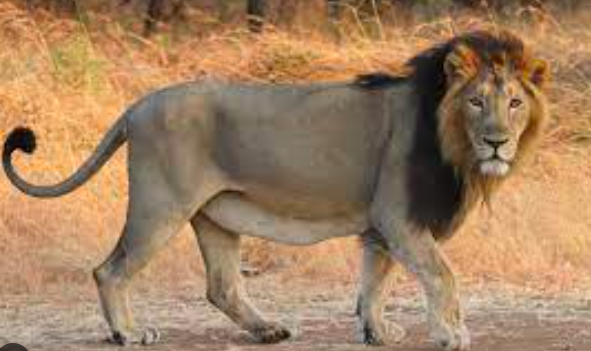
Govt to re-examine plan to shift Gir lions to Kuno

Context: The Union Enviornment Ministry and National Tiger Conservation Authority(NTCA) have recently decided to re-examine the entire aspect of translocation of Asiatic lions from Gir to Kuno from an expert’s perspective”.

About Asiatic Lion

TqPf5TouAsI7
  • The Asiatic lion, also known as the Indian lion or Persian lion, is a population of Panthera leo leo that currently survives in the wild only in India.
  • Habitat: They live in a compact tract of dry deciduous forest and open grassy scrublands.
  • Distribution (subheading)
    • Historically, it inhabited much of the Middle East to northern India.
    • Since the turn of the 20th century, its range has been restricted to Gir National Park and the surrounding areas in the Indian state of Gujarat. 

Characteristics

  • They are slightly smaller than African lions.
  • The most striking morphological character is a longitudinal fold of skin running along the belly.
  • The colour of their fur varies from buffish-grey with occasional silvery tones, to ruddy-tawny, covered with black spots.

Conservation Status

  • IUCN Red List: Endangered 
  • CITES: Appendix I
  • Wildlife (Protection) Act 1972: Schedule I
  • State Animal of Gujarat

About Gir National Park

  • Location: Gir is a dry deciduous forest ecosystem in the Saurashtra region of Gujarat. It is the abode of the last surviving population of the free ranging Asiatic Lion 
  • Flora: It consists of teak with an admixture of deciduous trees, including sal, dhak, and thorn forests.
  • Fauna: Asiatic lions, leopards, wild pigs, spotted deer, nilgai, four-horned antelope, and chinkaras.

Intergovernmental Panel on Climate Change (IPCC)

The Intergovernmental Panel on Climate Change (IPCC) is meeting in Switzerland this week to finalise the last report of its sixth assessment cycle, which is expected to set up the tempo for a string of climate change-focused discussions over the next fortnight.

About Intergovernmental Panel on Climate Change (IPCC)

  • It was set up in 1988 by the World Meteorological Organisation (WMO) and the UN Environment Programme (UNEP). 
  • It has a secretariat in Geneva, Switzerland, hosted by the WMO, and is governed by 195 member states.
  • Its main activity is to prepare Assessment Reports, special reports, and methodology reports assessing the state of knowledge of climate change.
  • It is  a scientific body whose periodic assessments of climate science form the basis of global climate action, is set to finalise what is known as the Synthesis Report, incorporating the findings of the five reports that it has released in the sixth assessment cycle since 2018.
  • However, the IPCC does not itself engage in scientific research.
  • Instead, it asks scientists from around the world to go through all the relevant scientific literature related to climate change and draw up the logical conclusions.

About Assessment Reports

  • The IPCC’s Assessment Reports (ARs), form the basis for government policies to tackle climate change, and provide the scientific foundation for the international climate change negotiations.
  • Six Assessment Reports have been published so far, the sixth report (AR6) coming in three parts — the first in August 2021, the second in February 2022, and the third to be finished in March 2023.

About Synthesis Report

  • It is the last of the Sixth Assessment reports.
  • It is supposed to be a relatively non-technical summary of the previous reports, aimed largely at policymakers around the world.
  • It is meant to address a wide range of policy-relevant scientific questions related to climate change, but, like all IPCC reports, in a non-prescriptive manner.

What previous reports have said

  • The first Assessment Report (1990)  formed the basis for the negotiation of the UN Framework Convention on Climate Change (UNFCCC) in 1992, known as the Rio Summit.
  • The second Assessment Report (1995) -AR2 was the scientific underpinning for the Kyoto Protocol of 1997.
  • The third Assessment Report (2001) presented new and stronger evidence to show global warming was mostly attributable to human activities.
  • The fourth Assessment Report (2007) won the 2007 Nobel Peace Prize for IPCC. It was the scientific input for the 2009 Copenhagen climate meeting.
  • The fifth Assessment Report (2014) -AR5 formed the scientific basis for negotiations of the Paris Agreement in 2015.