Defence Technology

VTOL loitering munition

Context: The Air Force has received the first indigenously designed and developed loitering munitions.

What is Loitering Munition

  • Named the ALS 50, the munition - also known as a suicide drone - has been developed by Tata Advanced Systems Limited (TASL).
  • The autonomous system is designed for Vertical Take Off and Landing (VTOL) and has successfully demonstrated its capability to carry out precision strikes (less than 2 meters) during trials and tests.
  • These are capable of operating from all kinds of terrain and high-altitude areas and can take down targets at a range of over 50 km, without exposing any personnel to risk.
  • The weapon enables real-time targeting, either by the operator or autonomously and can be scaled up to increase firepower as well as targeting distance.

Significance

  • VTOL capability gives the system the ability to operate in areas where limited space is available, like narrow valleys, fortified mountain positions, small jungle clearings and the decks of warships.
  • Loitering munition can be used to destroy enemy targets that may be beyond line of sight, including high-value targets like command centres and missile launchers, that may be located at a distance.

Real-time, operational picture among several automation initiatives of Army

Context: Army formations at all levels — from the Commander on the ground to the Corps level will soon have a real-time, common operating picture, with information and data from various sensors and inputs fused into one comprehensive image for quick decision-making.

  • A new Battlefield Surveillance System (BSS) under Project Sanjay is in the process of being deployed, after extensive validation carried out in the plains, deserts, and mountains.
  • Under BSS, the aim is to have surveillance centres for all field formations by December 2025. It will integrate thousands of sensors which will enable provision of an integrated surveillance picture to commanders and staff at all levels, besides completing the sensor-shooter grid by integrating with the Artillery Combat Command and Control System (ACCCS)
  • This is among a series of automation projects being rolled out which are expected to cumulatively improve operational efficiency, enhance battlefield awareness for Commanders on the ground, and also provide functional efficiency for human resource management, logistics, inventory management, medical services and other administrative functions.

India’s Defence Modernisation Challenges:

The pace of modernisation of the Indian Armed Forces over the years has been rather slow and, technologically, they are not where they should have been. Indigenous development of modern defence hardware continues to remain a concern, and Indian policy aspiration for defence self-sufficiency remains largely elusive.

The Indian defence industry suffers from major policy, structural, and cultural challenges that beset a military-industrial complex that continues to struggle in terms of delivering modern defence hardware that could have added to the greater Indian defence indigenisation and production.

  • A Military Strategy to address National Security- National security is determined by the threats that a nation faces. Military strategy is the ability to identity and respond to a threat. In olden times armies fought in battlefield. Today there are terrorist, insurgency and cyber threats. The armed forces have to modernise to face such threats. 
  • The lack of military inputs in decision-making is considered to be the most significant lacuna. It is also observed that the national security strategy of India suffers from flaws such as the absence of a National Security Doctrine and the absence of a long-term defence planning. 
  • The decision making in India on national security and strategic matters have been however projected to be slow and complex because of the hierarchical structure of the decision-making process. Further observers have questioned the efficacy of the established process of decision-making in defence acquisition or during times of crises, which is managed by Cabinet Committee on Security (CCS)
  • Economy - The country's economy is determined by the Gross Domestic Product (GDP). The bigger the GDP the faster is the economic growth. Faster the economic growth, quicker will be the modernisation of the armed forces. 
  • It is to be noted that capability building of the Army is a continuing process, where budget, especially capital funds, are requested for annually, based on the projected needs for implementing a 15 year long term perspective plan. However, it has been the experience for many years now that adequate capital funds for modernisation are not allotted, and consequently, there are major shortfalls in acquiring new equipment and other war-fighting capability in a time bound manner.
  • Adequate Budget Allocation - Defence is allotted budget every year as part of the country's yearly budget. Modernisation requires a huge allocation since modern arms and ammunition are purchased from other countries. This allocation of budget depends upon the economic growth. India is now under 'Make in India' project and is hoping to reduce dependence on other countries and also save money. 
  • The Standing Committee on Defence (2018) had recommended that the Ministry of Defence should be allocated a fixed budget of about 3% of GDP to ensure adequate preparedness of the armed forces. However, over the last decade, India’s spending on defence has consistently been lower than this recommended level. In 2023-24, allocation to the Ministry is estimated to be marginally lower than 2% of GDP
  • Challenge within forces: The Indian Army has continued to expand, in manpower terms, in its quest to build up capability to deal with potential threats and challenges. The problem was compounded by some faulty human resources (HR) policies of the Army in recent years, which had incentivised holding of more manpower by linking it to calculation of senior rank positions in the Army.
  • There is lack of expertise within the Army in the field of weapon designs and technology, resulting in lack of meaningful inputs for the indigenous defence industry. 
  • The Army remains rooted to the outdated policies of employing ‘generalists’ rather than ‘specialists’ to man the weapon procurement functions at Army Headquarters. Unless serious efforts are made to create a cadre of specialists to man critical functions related to procurement of Army weapons and equipment, starting with the Apex level, the situation is not likely to improve
  • Research in Military Technology, Artificial Intelligence and Cyber Warfare - A portion of the defence budget is given to research and development. A good research and development will make the country self-sufficient in critical technology. For this we must modernise Defence Research and Development Organisation (DRDO), and Defence Public Sector units such as, Ordnance Factory Board (OFB), 
  • These organisations are marred with inefficiency and apparent lack of accountability which are responsible for indigenous design and manufacture of weapons, equipment and ammunition for the Army, namely the Defence Research and Development Organisation (DRDO), Ordnance Factory Board (OFB) and Defence Public Sector Units (DPSUs)
  • Further the indigenous defence industry, mostly based on the public sector, is unable to provide items of desired quality in a timely manner. Most procurement through this route is affected by huge cost overruns.

Recent steps taken by the government

  • DRDO has established 05 DRDO Young Scientist Laboratories (DYSLs) to provide solutions in advanced technology areas viz artificial intelligence, quantum technologies, cognitive technologies, asymmetric technologies and smart materials to tackle emerging challenges in military warfare.
  • Announcement of 18 major defence platforms for industry led Design & Development in March 2022.
  • Notification of three ‘Positive Indigenisation lists’ of total 310 items of services and two Positive Indigenisation lists of total 2958 items of DPSUs for which there would be an embargo on the import beyond the timelines indicated against them.
  • Launch of innovations for Defence Excellence (iDEX) scheme involving start-ups & Micro, Small and Medium Enterprises (MSMEs).
  • Launch of an indigenisation portal namely SRIJAN to facilitate indigenisation by Indian industry including MSMEs.
  • Opening up of Defence Research & Development (R&D) for industry, start-ups and academia with 25% of defence R&D budget earmarked to promote development of defence technology in the country.

The defence ministry is seriously looking at implementing the ambitious Strategic Partnership model for defence production, it could not firm up any major deal under it. Under the policy, government had planned to rope in foreign defence majors to build key military platforms like submarines and fighter jets in India in partnership with Indian companies.

Indigenous suicide drones Nagastra-1

Context: Army has used its emergency powers to order more than 300 indigenous suicide drones ‘Nagastra 1’ from Nagpur-based Solar Industries. The procurement would enable shorter selection time and expedited deliveries of the drones within one year.

Major Highlights

  • Nagastra 1 is the first indigenous Loiter Munition (LM) which can strike targets within 15-30 km using GPS-enabled precision. It can loiter over a target for a maximum of 60 minutes and has an accuracy of less than 2 metres.
  • The fixed-wing electric-powered unmanned aerial vehicle (UAV) uses GPS for precision strikes and is capable of destroying various soft-skinned targets using its pre-fragmented high explosive warhead. The munition also carries a day-and-night camera for surveillance as well.
  • The Nagastra-1 in its 'Kamikaze' mode can search and destroy any target by crashing into it. If the target is not found or the mission is aborted, the munition can be called back and recovered using a parachute.
  • Developed by: Economic Explosives Limited
image 46

Significance

  • It is a cost-effective weapon against low-value targets. The drones can undertake shallow strikes with precision, without endangering the lives of soldiers.
  • It will enhance options for armed forces to strike terrorist camps and launch pads across the Line of Control in Pakistan.
  • The system has over 75% indigenous content, cutting down dependence on foreign sources, and is fully designed and developed in India.

It is also likely to have a strong export potential, given the growing demand for economical stand-off weapons that can deliver precision strikes.

Successful Trial of BMD Interceptor from Naval Platform

Context: Defence Research and Development Organisation (DRDO) and Indian Navy successfully conducted a maiden flight trial of sea-based endo-atmospheric interceptor missile off the coast of Odisha in the Bay of Bengal on April 21, 2023.

Major Highlights

  • DRDO and the Indian Navy were successful in test-firing an endo-atmospheric interceptor missile, capable of taking down incoming ballistic missiles from sea.
    • Endo-atmospheric interception means the missile fired by Indian testing agencies had destroyed the incoming enemy ballistic missile within the Earth’s atmosphere. 
    • Exo-atmospheric interception, on the other hand, is for destroying incoming enemy ballistic missiles outside of the Earth’s atmosphere at a higher altitude.
  • The purpose of the trial was to engage and neutralize a hostile ballistic missile threat thereby elevating India into the elite club of Nations having Naval BMD (Ballistic Missile Defence) capability. 

India’s Ballistic Missile Defence capability

  • The BMDs are capable of intercepting incoming long-range nuclear missiles and hostile aircraft including AWACS (airborne warning and control systems).
  • Prior to this BMD test from a warship, India successfully demonstrated the land-based BMD system with the capability to neutralize ballistic missile threats emerging from adversaries.

In November 2022, India’s DRDO successfully conducted the maiden flight test of Phase-II of the BMD interceptor, code-named AD-1 missile, with a large kill altitude bracket. 

  • AD-1 is a long-range interceptor missile designed for both low exo-atmospheric and endo-atmospheric interception of long-range ballistic missiles and aircraft.
  • It is propelled by a two-stage solid motor and equipped with an indigenously developed advanced control system, navigation, and guidance algorithm to precisely guide the vehicle to the target.
  • The successful trial of AD-1 from both land-based and sea-based platforms would provide great operational flexibility to the Indian armed forces.
image 45

Origins of the BMD Program 

  • India launched the BMD program after the war with Pakistan in the Kargil sector in 1999 to counter the enemy nation’s widening spectrum of ballistic missiles that usually delivered both conventional and nuclear warheads.
  • The two-tiered BMD program involved Prithvi missile-based Air Defense that can intercept enemy missiles at altitudes of 50 km to 180 km in the first layer. The Pradyumna interceptor has replaced the Prithvi Air Defense BMD already.
    • The Prithvi Air Defense system was first tested in 2006, then making India only the fourth nation globally to have such capabilities, after the United States, Russia, and Israel.
  • The second layer under the program is the Advanced Air Defense system for low-altitude interceptions. The Advanced Air Defense system is designed to destroy hostile missiles at 15 km to 40 km altitudes.
    • The Advanced Air Defense system got tested for the first time in 2007. Since then, both systems have gone through successive and multiple rounds of tests and are now in the process of deployment with the Indian armed forces.

India’s Other Missile Capabilities 

  • India conducted the first successful Anti-Satellite Test under its Mission Shakti project in March 2019, taking India to a league of nations such as the United States, Russia, and China possessing such a capability.
  • While the India-made Akash missile is part of the air defence systems possessed by the Indian armed forces, it is now in the process of inducting the Russian-origin S-400 Truimf, even though the Ukraine war has delayed the delivery of these air defence missiles to India.

In 2021, the Indian Navy inducted INS Dhruv, a nuclear missile tracking warship, to join an elite club of nations such as the US, Russia, China, the United Kingdom, and France to have such a platform. The 17,000-tonne INS Dhruv was developed by the DRDO in collaboration with the National Technical Research Organization (NTRO), and built by Hindustan Shipyard Limited. It can be used to provide early warning of attacks by ballistic missiles launched from Pakistan and China.

India, Russia to build BrahMos hypersonic version

Context: In the recent meeting of the National Security Advisors of India and Russia, the possibility of joint development of the hypersonic version of BrahMos or BrahMos-II missile was discussed. 

Hypersonic Weapon Systems (HWS)

  • Hypersonic weapon systems are advanced military technologies that can travel at extremely high speeds, typically defined as Mach 5 or higher (five times the speed of sound).
  • These weapons are designed to be extremely manoeuvrable, able to change course quickly during flight and evade enemy defence systems.
    • They are different from ballistic missiles, which can also travel at hypersonic speeds (of at least Mach 5) but have set trajectories and limited manoeuvrability.
  • There are two main categories of hypersonic weapons: hypersonic glide vehicles and hypersonic cruise missiles.
    • Hypersonic glide vehicles are launched from a rocket. The glide vehicle then separates from the rocket and “glides” at speeds of at least Mach 5 toward a target.
    • Hypersonic cruise missiles are powered by high-speed, air-breathing engines.
  • HWS are capable of carrying out launches from a variety of platforms, including ground-based systems, aircraft, and submarines.
  • They are typically designed to carry conventional or nuclear warheads and are seen as a potential game-changer in military operations, particularly in terms of their speed, range, and ability to penetrate enemy defences.
    • The United States, Russia and China are developing hypersonic weapons. 
e2hfxcLb8xSZKa8oyGjNN7NXSdNN

BrahMos-II Missile

  • BrahMos-II is a hypersonic cruise missile currently under joint development by India's Defence Research and Development Organisation and Russia's NPO Mashinostroyenia, which have together formed BrahMos Aerospace Private Limited.
  • BrahMos-II is expected to be capable of travelling at speeds of over Mach 7 (possibly reaching Mach 8) and has a range of around 620 miles (1000 kms).
  • It is being designed to be launched from multiple platforms, including land, air, and sea.
  • It is likely to have the same characteristics as Russia's Tsircon missile.
brahmos: India, Russia to build BrahMoS hypersonic version - The Economic  Times

Key Facts

  • India is a party to the Missile Technology Control Regime (MTCR), which allows the country to develop a missile with a range of over 300 km and weighing more than 500 kg but not to export it to other countries.
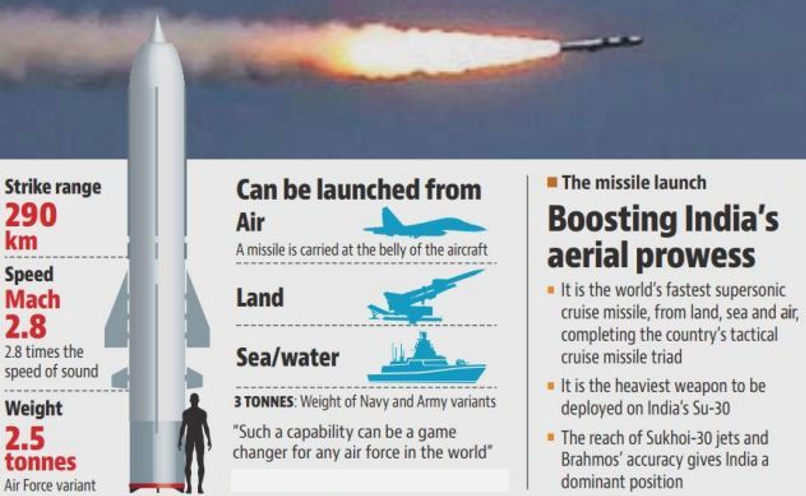
  • The export version of BrahMos is capped at 290 km to comply with the MTCR restrictions of 300 km.

Lynx U2 fire control systems

Context: Ministry of Defence signed a contract with Bharat Electronics Limited for the procurement of 13 Lynx-U2 fire control systems for the Navy at a cost of over Rs 1,700 crore, under the Buy Indian – IDMM (Indigenously Designed Developed and Manufactured) category.

Lynx-U2 fire control system:

  • The Lynx-U2 system is a naval gun fire control system capable of accurately tracking and engaging targets amid sea as well as air or surface targets.
  • The fourth generation, completely indigenous systems, will be installed on New Generation Offshore Patrol Vessels to be built indigenously at Garden Reach Shipbuilders and Engineers and Goa Shipyard Limited. 

Next-generation Offshore Patrol Vessels

Context: Ministry of Defence has signed a deal to buy eleven Next Generation Offshore Patrol Vessels and six Next Generation Missile Vessels at Rs 19,600 crore. 

Next Generation Offshore Patrol Vessels (NGOPV):

  • The contract for 11 NGOPVs worth Rs 9,781 crore was signed between Goa Shipyard Limited and Garden Reach Shipyard Limited under Buy (Indian-IDDM) category. 
  • NGOPVs will increase the Navy’s various operational capabilities such as Anti-Piracy, Counter-Infiltration, Anti-Poaching, Anti-Trafficking, Non-Combatant Evacuation Operations, Search and Rescue (SAR), Protection of Offshore Assets etc.
    • An offshore patrol vessel (OPV) is a small surface ship designed for coastal defence.
    • They can carry a crew of up to 80-90 sailors, but are much more lightly armed — and therefore much cheaper — than capital warships like corvettes, frigates, or destroyers.
    • For performing tasks that do not require heavy fighting, OPVs offer a far more economical option than using heavily armed capital warships.
    • These warships are well equipped to tackle a range of roles such as maritime security, border control, anti-smuggling, counter-terrorism, disaster relief etc.

Next Generation Missile Vessels (NGMV):

  • The contract for constructing six Next Generation Missile Vessels (NGMVs) was signed with Cochin Shipyard (CSL) at Rs 9,805 crore.
  • NGMVs would be heavily armed war vessels incorporating stealth, high speed and offensive capability.
  • The primary role of the ships would be to provide offensive capability against enemy warships, merchantmen and land targets.
    • These warships will be capable of conducting maritime strike operations, Anti-Surface Warfare Operations and would be a potent instrument of sea denial for enemy ships, especially at choke points. 
    • In the defensive role, these ships would be employed for Local Naval Defence operations and seaward defence of the Offshore Development Area. 

Next-generation mobile maritime coastal batteries and BrahMos missile

Context: Ministry of Defence has signed a deal with BrahMos Aerospace Private Limited (BAPL) for the procurement of Next Generation Maritime Mobile Coastal Batteries (Long Range) and BrahMos missiles, valued at over Rs 1,700 crore, under Buy (Indian) category. 

Aim: To enhance the Indian Navy's maritime strike capabilities along the coast. 

Next-Generation Maritime Mobile Coastal Batteries (Long Range)

  • Next-Generation Maritime Mobile Coastal Batteries come equipped with new missiles like the BrahMos surface-to-surface cruise missiles. 
  • This system will allow the Indian Navy to target enemy platforms operating close to the Indian coast. 

Supersonic BrahMos missiles

  • BrahMos is the fastest cruise missile in the world with a top speed of Mach 2.8 or almost three times the speed of sound.
  • It is a two-stage missile (solid propellant engine in the first stage and liquid ramjet in the second stage) with a range of 290 km.
  • The multiplatform missile can be launched from land, air, and sea with pinpoint accuracy during day and night irrespective of weather conditions.

Special features of BrahMos

  • Universal for multiple platforms
  • Stealth technology and guidance system
  • “Fire and Forget” principle of operation
  • Pinpoint accuracy with high lethal power 
  • Quicker engagement time and non-interception by any known weapon system
E5nmsj4rgImhlJnCyMWaJRED9NC ZcjyRiCEPykw87hiC8ED9II4J7S8hnd3tFPtPLJ0uOXpM8LgWtMp56RCT9WI8 f7mMAkXiVqfDWeE 5pVYW4bK6QweWAkg7 vEtqRLUFF0Hh9WKisOIccrZRew

Significance

  • Enhance the multi-directional maritime strike capability of the Indian Navy. 
  • Boost indigenous production of the critical weapon system and ammunition with the active participation of indigenous industries.
  • Generate employment of more than 90,000 man-days over a period of four years.

BrahMos Aerospace Pvt Ltd (BAPL)

  • BrahMos Aerospace Pvt Ltd is a joint venture between India and Russia that produces supersonic cruise missiles that can be launched from submarines, ships, aircraft, or land platforms.
  • BrahMos was established through an inter-governmental agreement in 1998 as a joint venture between India's state-run Defence Research and Development Organisation and NPO Mashinostroyenia of Russia.
  • Although BrahMos missiles still depend on Russian parts and raw materials, the percentage of local input had gone up to over 70% from around 15% at the start of the venture.

Swathi Weapon locating radar

Context: Ministry of Defence signed a contract for the Weapon locating radar Swathi (Plains) with Bharat Electronic Limited (BEL) at a cost of over Rs 990 crore. 

WLR Swathi:

  • Swathi weapon-locating radars provide fast, automatic, and accurate location of enemy weapons like mortars, shells and rockets within a 50-kilometre range.
  • The radars can simultaneously detect multiple projectiles fired from different weapons at different locations.
  • Indigenously developed by: Defence Research and Development Organisation 
  • Induction is planned to be completed in 24 months. 

Improved Akash Weapon System

Context: Ministry of Defence signed a contract for procurement of an improved Akash Weapon System (AWS) with Bharat Dynamics Limited for over Rs 8,160 crore for the third and fourth regiments of Army Air Defence, comprising live missiles and launchers with upgrades, ground support equipment, vehicles and infrastructure. 

Akash Weapon System

  • The AWS is a Short Range Surface to Air Missile (SRSAM) Air Defence System, indigenously designed and developed by Defence Research and Development Organisation.
  • Improved AWS has Seeker technology, reduced footprint, 360° engagement capability and improved environmental parameters.

Relevance of AWS

  • Increase India's self-reliance in Short Range Missile capability.
  • Boost the overall economy by avoiding the outgo of precious foreign exchange to other countries.
  • Increasing employment avenues in India. 
  • Boost the Indian missile manufacturing industry in particular and the indigenous defence manufacturing ecosystem (Indian MSMEs) as a whole.

MoD signs three contracts worth ₹5,400 crore

Context: Ministry of Defence (MoD) has signed three contracts worth ₹5,400 crores recently. All these projects are under Buy {Indian – IDMM (Indigenously Designed Developed and Manufactured)} category.

Major Highlights

  • Two contracts were signed with Bharat Electronics Limited (BEL) worth ₹2,400 crores for the procurement of:
    • Automated Air Defence Control and Reporting System ‘Project Akashteer’ for the Army
    • Sarang Electronic Support Measure (ESM) systems for the Navy.
  • Another ₹2,963 crore contract was signed with NewSpace India Limited (NSIL) for an advanced communication satellite, GSAT 7B, for the Army. 

Project Akashteer

  • ‘Project Akashteer’ worth ₹1,982 crores is an automated air defence control and reporting system that will allow the army’s air defence units to operate in an integrated manner.
  • It will enable monitoring of low-level airspace over the battle areas of the Indian Army and effectively control the ground-based air defence weapon systems.

Sarang Electronic Support Measure (ESM) systems

  • The second contract worth ₹412 crores with BEL is for Sarang Electronic Support Measure systems for Indian Navy helicopters. ‘Sarang’ is designed and developed indigenously by the Defence Electronics Research Laboratory, Hyderabad under the programme, Samudrika.
  • It will generate employment of approximately two lakh man-days over a period of three years.

GSAT 7B

  • The five-tonne geostationary satellite will be developed indigenously by Indian Space Research Organisation (ISRO).
  • The satellite will considerably enhance the communication capability of the Indian Army by providing mission-critical beyond-line-of-sight communication to troops and formations as well as weapon and airborne platforms.
  • The Army is likely to get the satellite in 2026. Unlike the Indian Air Force and the Navy, the Army currently does not have a dedicated satellite.

Many parts and sub-assemblies and systems of the satellite will be sourced from indigenous manufacturers, including micro, small and medium enterprises (MSMEs) and start-ups. The project will generate employment of around 300,000 man-days over the next three-and-a-half years.

Project Himshakti

Context: Ministry of Defence has inked a Rs 3,000 crore contract for the procurement of two Integrated Electronic Warfare Systems under Project Himshakti for the Army in mountainous terrain. 

Major Highlights:

  • The contract signed with defence PSU Bharat Electronics (BEL) is under the “Buy Indian-IDMM (indigenously designed, developed and manufactured)” category comprising contemporary and niche technologies. 

Significance:

  • Project Himshakti will generate employment of approximately three lakh man-days over a period of two years. 
  • The project is a significant leap forward in developing indigenous capabilities making the country ‘self-reliant’ in defence manufacturing.