Defence Technology

Jet Engine Deal between India & USA

Context: During the visit of Prime Minister Narendra Modi to USA there was landmark deal between General Electric of USA and Hindustan Aeronautics Limited of India to co-manufacture fighter jet engines in India. The manufacturing of jet engines will start with technology sharing of over 50% which will further increase over the production cycle. 

About the GE-HAL fighter jet engine deal

  • Under the deal, GE will transfer technology and manufacturing capabilities for F414 jet engine which has been used by US Navy aircraft for more than 30 years.
  • More than 1400 such engines have been deployed and have clocked more than 5 million flight hours.
  • The F414 jet engine currently or in future will power fighter jets in US, Sweden, Australia, Kuwait, Brazil, South Korea, India & Indonesia.
image 8

Current Engines Used in Tejas

  • Currently, HAL's Tejas uses GE's F404 engine which is predecessor of F414. 
  • Tejas Mark 2 which is a more powerful fighter aircraft needs a bigger engine for which HAL plans to use F414 engine of GE.
  • F414 will also be used for India's next generation Advanced Medium Combat Aircraft.

India's efforts to develop jet engines

  • India has made great leaps in indigenous development of defence systems and platforms in developing a world class missiles, aircrafts, submarines and aircraft carriers. 
  • However, India has failed to develop a viable and functional jet engines for its fleet of fighter aircrafts. 
  • Kaveri aero engine was developed by the Gas Turbine Research Establishment (GTRE), under the DRDO, after a 30-year developmental period. This, however, was not found suitable for the indigenous Light Combat Aircraft (LCA), as it was underpowered and overweight to meet the aircraft’s performance requirements.
  • Challenges in developing
    • Development of indigenous jet engines is complex, costly and time consuming process requiring
    • Managing extreme engine temperatures
    • Composites & Alloys: Jet engines use superalloys and composite materials which can withstand temperatures beyond 1800oC. Thus, there is a need to develop high-resistance materials like silicon carbide or ceramic matrix composites

Significance of Jet Engine deal for India

  • Significant step forward in India-USA relations:
    • This is the first instance when US will be sharing a cutting edge technology in its defence capabilities with a non-ally.
    • This deal also marks the first time when there will be a co-production of jet engines of US with a country with which US does not have a treaty. 
    • Under the deal, US will be sharing a substantial share of sensitive jet engine technology with a provision of technology transfer ratio to increase. This is the most technology transfer the US has ever authorised.
    • The deal would reduce India's reliance of defence aircrafts offered by Russia to India and will expand the growing interoperability between US and Indian military.
  • Entry into exclusive club: India will become the fifth country in the world to produce jet engines. Currently, only Russia, USA, France & UK have the capability to produce jet engines.
  • Boost to defence capabilities: This deal is expected to boost and modernise India's fighter jet capabilities as it will allow India to indigenously produce jet engines for its Tejas fleet with one of the most powerful and reliable engines. It will help India's to replace its reliance on ageing Russian fleet which currently power its air force and naval aircrafts.
    • Domestic manufacturing of jet engines will reduce cost of fighter jets in India.
    • Reduce dependence on foreign suppliers for engines for India's fighter aircrafts.
  • Boost to defence manufacturing: 
  • Edge over China: The jet engines offered by US have more power and efficiency, longer life and need lower maintenance compared to jet engines currently manufactured by China. Thus, giving India an edge over China in terms of defence capabilities. 

Concerns over the deal

  • Not complete transfer of technology: Though the deal has a significant transfer of technology component. However, transfer of technology is not complete. 
  • Better jet engines are available as compared to F414 jet engines which is being offered to India. For ex. US has been developing advanced F136 jet engine for its F35 fighter aircrafts. 
  • Importance of Russia: US demands India to shun military ties with Russia to further boost its defence collaboration with Russia for the fear of its defence technology falling in Russian hands. However, India and Russia enjoy unparallel trust and collaboration in defence relations like Brahmos cruise missiles. Thus, India would not want to compromise its defence relations with Russia. 

Way forward for Indigenous Jet Engine Development

  • Focus on indigenous development of jet engines: Despite GE-HAL jet engine deal, India should try and develop its own engines for both civilian and fighter jets. India has a lot of engineering talent which could be harnessed for this. Government and Private sector should collaborate on this. This will result:
    • Increasing India's strategic autonomy.
    • Reduce reliance on other countries.
    • Reduce cost of manufacturing of fighter aircrafts.
    • Increase India's potential as a global supplier and exports of defence aircraft systems.
  • HAL-BHEL Joint Venture for Jet Engines: The technology for development of jet engines and industrial gas turbines is similar with difference in weights and compression ratios, dealing with different levels of heat and oxygen availability. A joint venture can be explored between these to develop indigenous jet engines in India. 

Astra Missile

Context: Recently, Tejas, Light Combat Aircraft (LCA) LSP-7 successfully fired the ASTRA off the coast of Goa in August. Officials said that the successful launch of the ASTRA from Tejas fighters would significantly enhance the combat prowess of Tejas and reduce the dependency on imported weapons.

image 6

About Astra

  • It is an indigenous all-weather Beyond Visual Range (BVR) air-to-air missile to engage and destroy highly manoeuvring supersonic aerial targets.
  • It is designed and developed by the Defence Research and Development Laboratory (DRDL), Research Centre Imarat (RCI) and other laboratories of DRDO.
  • Different missiles of this family are capable of engaging targets at varying distances of 500 m up to 340 km.
  • It boasts advanced air combat capabilities and its ability to simultaneously engage multiple high-performance targets.
  • It is integrated with various aircraft platforms, including the Su-30MKI fighter jet, Mirage 2000, Tejas light combat aircraft (LCA), MiG-29 and MiG-21 Bison fighter jets.

About Tejas

  • It is a weather and multi-role fighter aircraft. 
  • The aircraft is designed to be a multi-role aircraft to carry a range of air-to-air, air-to-surface, precision-guided weapons.
  • It is also designed to undertake Ground Maritime Operations. 
  • The maximum payload capacity of Tejas is 4000 kg and the Speed upto Mach 1.8.

Arrow 3

Context: Israel said the United States approved the landmark sale of the Arrow 3 hypersonic missile defense system to Germany, in the country's biggest military deal worth $3.5 billion.

Arrow 3

About Arrow 3

  • It is also known as Hetz 3 is an exoatmospheric interception method that includes a two-stage interceptor, like the Arrow 2, but purely based on hit-to-kill technology.
  • It is jointly funded, developed, and produced by Israel and the United States.
  • It is part of the Arrow Weapon System (AWS) which is the world's first operational, national, stand-alone ATBM (Anti Tactical Ballistic Missiles) defense system.
  • Based on the uniquely effective Arrow 2 and Arrow 3 interceptors, the Arrow modular air defense systems detect, track, intercept, and destroy incoming TBMs carrying a range of warheads and over a large footprint, thereby protecting strategic assets and population centers.
  • It provides exo-atmospheric interception of ballistic missiles (during the space-flight portion of their trajectory), including intercontinental ballistic missiles (ICBMs) carrying nuclear, chemical, biological, or conventional warheads. 
  • With divert motor capability, its kill vehicle can switch directions dramatically, allowing it to pivot to see approaching satellites. The missile's reported flight range is up to 2,400 km.
  • Unlike most kill vehicles, which use liquid or gas propulsion, the new Israeli kill vehicle will be propelled by an ordinary rocket motor equipped with a thrust-vectoring nozzle.
  • It will also be fitted with a gimbaled seeker for hemispheric coverage. By measuring the seeker's line-of-sight propagation relative to the vehicle's motion, the kill vehicle will use proportional navigation to divert its course and line up exactly with the target's flight path.
  • The system was first deployed in an Israeli air force base in 2017 and has been used to protect Israel against attacks from Iran and Syria.

New Scorpene class submarines for the Navy

Context: The Defence Acquisition Council, the apex decision-making body for the acquisition of military equipment, cleared proposals to buy three additional Scorpene.

image 79

Scorpene Submarines 

  • The Scorpene submarines are conventional attack submarines, meaning that they are designed to target and sink adversary naval vessels. 
  • Capable of launching a large array of torpedoes and missiles. 
  • Equipped with a range of surveillance and intelligence-gathering mechanisms.
    • They have a state-of-the-art SONAR suite and sensor suite permitting outstanding operational capabilities.
  • They have a length of 220 feet and height of approximately 40 feet. 
  • They can reach the top speeds of 11 knots (20 km/h) when surfaced and 20 knots (37 km/h) when submerged.
  • Scorpene class submarines use diesel electric propulsion systems.
    • This propulsion system alternates between using diesel (for functioning on the surface) and electric (for functioning underwater).
    • They can operate independently without refuelling for approximately 50 days, after that they need to come on surface to recharge batteries.

Scorpene Vs Nuclear Submarine

Scorpene Submarine Nuclear Submarine 
conventional submarines are restricted in submerged endurance as per their battery capacity which powers them, they need to resurface to recharge.  Nuclear submarines theoretically have unlimited endurance. A nuclear reactor on a submarine has an operational life of up to 30 years.
As refueling is required they come to surface more often.These submarines only need to come to the surface for replenishing supplies for the crew.
Diesel electric technology has improved the range of conventional submarines as well as their stealth. But they are slower than the nuclear submarine.They are able to move much faster than conventional submarines.
Cost of building and operating of conventional submarine is almost half in comparison to Nuclear Submarine.Nuclear submarines are expensive and require a significant amount of specialised experience to operate.
These submarines are almost silent, with the only noise coming from the shaft bearings, propeller, and flow around the hull.They are comparatively noisy, the reactor is always running, creating steam noise, which can be heard on sonar.

Project 75(I)

Project-75 (India), also known as P-75(I), is a military acquisition initiative by the Ministry of Defence (MoD). The initiative aims to procure diesel-electric attack submarines with fuel cells and Air-Independent Propulsion System (AIP) for the Indian Navy to build India's naval strength and develop indigenous submarine-building capabilities.

  • Conventional diesel-electric submarines such as the Scorpene etc. are under this project.
  • Under this program six conventional submarines are to be built with air-independent propulsion (AIP) systems that will allow them to stay underwater for longer.

First French long-range missiles already in Ukraine

Context: France has already made a delivery of a number of SCALP long-range cruise missiles to Ukraine, a military source told after President Emmanuel Macron announced the supplies.

image 36

Types of Missiles 

Ballistic Missiles 

Ballistic missiles are powered initially by a rocket or series of rockets in stages, but then follow an unpowered trajectory that arches upwards before descending to reach its intended target. Ballistic missiles can carry either nuclear or conventional warheads. 

There are four general classifications of ballistic missiles based on their range, or the maximum distance the missile can travel: 

  • Short-range: less than 1,000 kilometers (approximately 620 miles), also known as “tactical” ballistic missiles.
  • Medium-range: between 1,000 and 3,000 kilometers (approximately 620-1,860 miles), also known as “theater” ballistic missiles. 
  • Intermediate-range: between 3,000 and 5,500 kilometers (approximately 1,860-3,410 miles) 
  • Long-range: more than 5,500 kilometers (approximately 3,410 miles), also known as intercontinental or strategic ballistic missiles.
    • Intercontinental ballistic missiles (ICBMs) can fly much further than the minimum range; for example, Russia could hit Chicago with an ICBM launched from the Krasnoyarsk ICBM base, which is located 9,156 kilometers (5,689miles) away.

Cruise Missiles

Cruise missiles are unmanned vehicles that are propelled by jet engines, much like an airplane. They can be launched from ground, air, or sea platforms. 

  • Cruise missiles remain within the atmosphere for the duration of their flight and can fly as low as a few meters off the ground. Flying low to the surface of the earth expends more fuel but makes a cruise missile very difficult to detect. 
  • Cruise missiles are self-guided and use multiple methods to accurately deliver their payload, including terrain mapping, global positioning systems (GPS) and inertial guidance, which uses motion sensors and gyroscopes to keep the missile on a pre-programmed flight path. 
  • As advanced cruise missiles approach their target, remote operators can use a camera in the nose of the missile to see what the missile sees. This gives them the option to manually guide the missile to its target or to abort the strike.

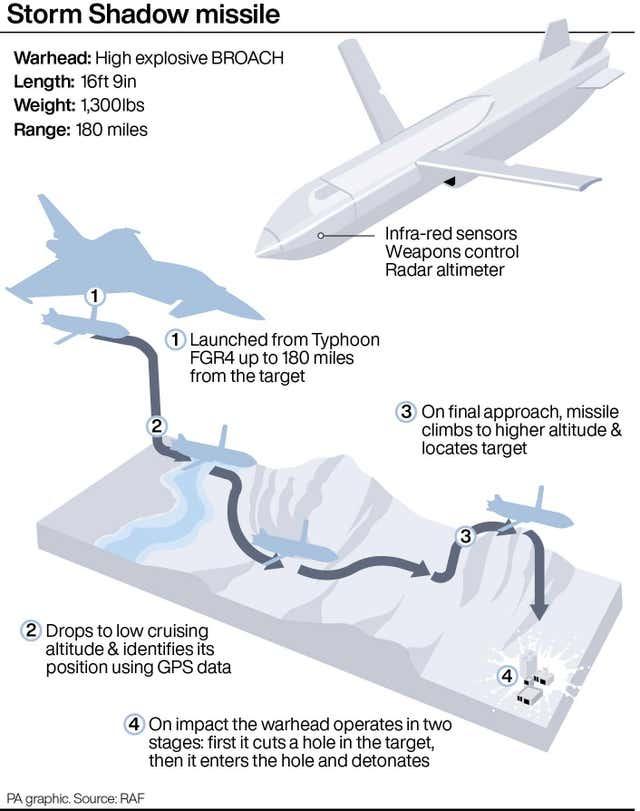
Storm Shadow Cruise missile aka SCALP long-range cruise missiles  

Storm Shadow is a long-ranged, air-launched, conventionally armed, deep-strike supersonic missile, which is manufactured by the France-based MBDA Missile Systems. 

  • Range: More than 250 km.
  • It is capable of being operated day and night in all weathers and is designed to destroy high-valued stationary targets such as airbases, radar installations, communications hubs and port facilities. 
  • It is equipped with fire-and-forget technology and offers high-precision deep strike capability as it features a sophisticated navigation system that includes inertial navigation (INS), a global positioning system (GPS) and terrain reference navigation for better control over the path. 

The missile features the BROACH (Bomb Royal Ordnance Augmented Charge) warhead — a high-technology warhead, which first cuts the surface of the target, penetrates into it and then explodes.

MQ-9B Drones

Context: The Prime Minister’s visit to the US has set the stage for the acquisition of 31 of these armed UAVs, 15 SeaGuardians for the Indian Navy and 16 SkyGuardians — eight each for the Indian Army and Air Force.

MQ-9B Drones

The MQ9Bs, which will be assembled in India. As part of this plan, General Atomics will also establish a Comprehensive Global Maintenance, Repair and Overhaul (MRO) facility in India in support of India’s long-term goals to boost indigenous defence capabilities.

About MQ-9B

  • It is an unmanned aerial vehicle capable of remotely controlled or autonomous flight operations.
  • It is the first hunter-killer UAV designed for long-endurance, high-altitude surveillance.
  • It is a larger, heavier, more capable aircraft than the earlier General Atomics MQ-1 Predator and can be controlled by the same ground systems.
  • It has been developed by General Atomics Aeronautical Systems (GA-ASI) primarily for the United States Air Force (USAF).
  • It is a variant of the MQ-9 Reaper.
  • It has two variants the Sky Guardian and the Sea Guardian, its maritime variant. 
  • It is designed to fly over the horizon via satellite for up to 40 hours, depending on configuration, in all types of weather, and safely integrate into civil airspace. 
  • The MQ-9 “Reaper” is a significant technological leap from the original RQ1/MQ1Predator that heralded the arrival of long-endurance armed drones at the end of the twentieth century. Armed with AGM114 Hellfire missiles.
  • The Reaper is employed primarily as an intelligence-collection asset and secondarily against dynamic execution targets. Given its significant loiter time, wide-range sensors, multi-mode communications suite, and precision weapons, it provides a unique capability to perform strike, coordination, and reconnaissance against high-value, fleeting, and time-sensitive targets.

Significance

  • Enhance Capability of Armed Forces: These drones will enhance the Intelligence, Surveillance, and Reconnaissance (ISR) capabilities of India’s armed forces across domains. 
  • Lower Operational Costs: The MQ9B can provide roughly 80% of the capability of a large human-flown maritime patrol aircraft at about 20% of its cost per hour. That makes it much more economical for navies to, for example, send out SeaGuardians to clear big volumes of air or sea and then, if anything of interest is discovered, vector in a human-crewed aircraft to save it the time, cost, and wear that it otherwise might have expended. 
  • Reduce Human Fatigue: This is the primary reason the Indian Navy is keen on these UAVs as it significantly reduces the wear and tear on manned aircraft, its fleet of 12 P8I long range maritime patrol aircraft, as well as reduce crew fatigue in keeping an eye over the wide expanse of the Indian Ocean Region and beyond.
  • Provides Round-the-clock Surveillance: For the Army and Air Force, the MQ9Bs can provide round-the-clock surveillance looking far beyond the borders, for instance on the movement of Chinese military buildup and troop movement along the Line of Actual Control (LAC) and deep inside. 
  • Integration with existing platforms: It also seamlessly integrates with other U.S.origin platforms that India operates, the P8Is, AH64 Apache attack helicopters, MH60R multirole helicopters among others expanding MQ9B’s multidomain mission set.

About MQ-9B SkyGuardianIt is the next generation of remotely piloted aircraft systems (RPAS), delivering persistent intelligence, surveillance, and reconnaissance (ISR) around the globe.About MQ-9B Sea GuardianIt is the maritime-focused sibling of the revolutionary SkyGuardian remotely piloted aircraft system (RPAS).It not only integrates the most advanced maritime intelligence, surveillance, and reconnaissance (ISR) capabilities, but it is also the first RPAS in its class to enable real-time search and patrol above and below the ocean’s surface.Its configuration can include a 360-degree surface-search maritime radar, automatic identification system, sonobuoy monitoring system, and sonobuoy dispensers for persistent anti-surface and anti-submarine warfare missions.

hnjNNmCUkoLSXj79gedH nzj B8Md7E9rmh8ph lfk65mZF4P1jRlercbp7CVNiYh5iGPb

DRDO successfully tests ballistic missile ‘Agni Prime’

Context: The new generation ballistic missile ‘Agni Prime’ was successfully flight-tested by Defence Research and Development Organisation (DRDO) from Dr. A.P.J. Abdul Kalam Island off Odisha.

Agni series of missiles

  • The Agni series of missiles is a family of long-range, surface-to-surface ballistic missiles that can carry nuclear bombs.
  • Developed by: Defence Research and Development Organisation
  • There are currently six operational missiles in the Agni series: Agni-I, Agni-II, Agni-III, Agni-IV, Agni-V, and Agni-Prime and one missile is under development (Agni-VI). Each missile has different ranges and capabilities.

1. Agni-I

  • Agni-I is the shortest-range and oldest missile in the Agni family of Indian nuclear-capable missiles. It was first tested at the Chandipur test range, off the coast of Odisha in 1989.
  • It is a two-stage solid-fuel missile that can be stored in canisters and transported by road and rail.
  • Range: 700 km
  • The missile has a specialised navigation system that ensures it reaches the target with a high degree of accuracy and precision.
  • Agni-I is used by the Strategic Force Command (SFC) of the Indian Army. 

2. Agni-II

  • The Agni-II is a medium-range ballistic missile equipped with two solid fuel stages.
  • Range: 2000-2500 km
  • They are said to be a component of "credible deterrence" against China and Pakistan.

3. Agni-III

  • Agni-III is a two-stage ballistic missile that can carry nuclear weapons.
  • Range: 3500 km

4. Agni-IV

  • It is an Intermediate Range Ballistic Missile which uses a two-stage rocket engine powered by solid propellants.
  • Range: 4000 km 
  • It is equipped with state-of-the-art avionics, an accurate Ring Laser Gyro-based Inertial Navigation System, supported by the highly reliable redundant Micro Navigation System for high precision. 

5. Agni-V

  • The Agni 5 is the first of its kind inter-continental ballistic missile (ICBM) of India. 
  • It is a three-stage solid-rocket-powered missile system capable of delivering a 1.5-tonne nuclear warhead.
  • Range: exceeding 5000 km
  • Agni-V can bring almost the entire Asia, including the northernmost part of China, as well as some regions in Europe, under its striking range.
image 64

6. Agni-P

  • The Agni Prime missile is a new-generation advanced variant of the Agni class of missiles.
  • The two-stage canisterised ballistic missile has a range between 1000 and 2000 kilometres.
  • It is India's first 'declared' MIRV (Multiple Independently-targetable Reentry Vehicles) missiles, and it is 50% lighter than Agni-III.
  • Agni-Prime may be launched from train and road and stored for an extended period. It can be used to target enemy ships in the Indian Ocean.

7. Agni-VI

  • Agni-VI is a three-stage solid-fuel intercontinental ballistic missile in the early phases of development in India.
  • It will be able to launch from both submarines and land and carry independently targetable re-entry vehicles (MIRV) payloads. 
  • Range: 8000-10000 km 

Submarines- India's Sea-based deterrent

Context: Recently, the Navy’s Kilo-class submarine INS Sindhuratna underwent a major upgrade (Medium Refit Life Certification process) in Russia which extended its life.

 About INS Sindhuratna: 

  • INS Sindhuratna is a Sindhughosh-class diesel-electric submarine of the Indian Navy that was commissioned in 1988.
    • The Sindhughosh-class submarines were built in the Soviet Union (now Russia) and were later acquired by the Indian Navy.
  • The submarine with its modernised weapon and sensor suite enhances the force level in the Indian Ocean Region. 

Main classes of submarines in service with the Indian Navy:

  • Sindhughosh-class: Variant of the Russian Kilo-class submarines. E.g., INS Sindhurakshak, INS Sindhuvir, INS Sindhuratna.
  • Shishumar-class: Based on the German Type 209 design, these are diesel-electric submarines equipped with advanced systems. E.g., INS Shishumar, INS Shankush, INS Shalki, and INS Shankul.
  • Kalvari-class (Scorpène-class): Based on the Scorpène design developed by Naval Group (France). E.g., INS Kalvari, INS Khanderi, INS Karanj, INS Vela, INS Vagir, and INS Vagsheer (yet to be commissioned).
  • Arihant-class: India's indigenous nuclear-powered ballistic missile submarines (SSBNs). Currently, INS Arihant is the only operational submarine of this class. The second in the series, INS Arighat, is in the final stage of sea trials. These submarines are equipped with nuclear propulsion and are capable of carrying ballistic missiles.
  • Chakra-class: Nuclear-powered attack submarines leased from Russia. Currently, INS Chakra-II, the submarine of this class, is in service with the Indian Navy. Chakra-III is expected to be delivered to the Indian Navy by 2025. 
image 400

Project 75: 

  • Project 75 includes the indigenous construction of six Kalvari-classScorpene submarines developed by the Naval Group- a French defence major and the Spanish state-owned entity Navantia.
    • The submarines are being constructed at Mazagon Dock Shipbuilders Limited (MDL) Mumbai in collaboration with Naval Group.
  • The submarines are INS Kalvari, INS Khanderi, INS Karanj, INS Vela and INS Vagir (already commissioned into the Navy) and INS Vagsheer (under sea-trail) was launched in April 2022. 
  • This class of submarines have Diesel Electric transmission systems and are attack submarines or the ‘hunter-killer’ type which are designed to target and sink adversary naval vessels.
  • They have the capability of operating in a wide range of Naval combat including anti-warship and anti-submarine operations, intelligence gathering and surveillance, and naval mine laying.

Project 75-I:

  • Project 75-I is distinct from Project 75. Project 75-I seeks to acquire submarines with more advanced capabilities to meet evolving maritime challenges and technological advancements.
  • Project 75-I is an initiative by the Indian Navy to acquire six conventional, diesel-electric attackadvanced submarines for its fleet. The advanced capabilities include air-independent propulsion (AIP), ISR, special operations forces (SOF), anti-ship warfare (AShW), anti-submarine warfare (ASW), anti-surface warfare (ASuW), land-attack capabilities and other features.
    • Air-independent propulsion (AIP) systems allow submarines to remain submerged for longer durations without the need to surface, and thus, significantly enhance the operational endurance and stealth capabilities of submarines.

The project aims to build these submarines under the strategic partnership model, which involves collaboration between Indian shipyards and foreign original equipment manufacturers (OEMs).

Defence Ministry’s iDEX reaches milestone

Context: Innovations for Defence Excellence (iDEX), the Ministry of Defence's flagship initiative, achieved a significant milestone with the signing of its 250th contract.

What is iDEX?

  • The Union Government introduced the Innovations for Defence Excellence (iDEX) framework to stimulate innovation and technological advancements in the Defence and Aerospace Sector. 
  • This initiative engages various stakeholders, including Industries, MSMEs, start-ups, individual innovators, R&D institutes, and academia, with the goal of promoting self-reliance. 
  • The scheme's primary objective is to offer financial assistance to approximately 300 Start-ups/MSMEs/individual innovators and approximately 20 Partner Incubators through the Defence Innovation Organisation (DIO). 
  • In order to encourage the participation of start-ups, the Government provides substantial grants and facilitates their contributions to the defence sector. 
  • Additionally, start-ups are granted easier and faster access to test facilities and infrastructure available with various Government agencies. 
  • The framework promotes co-creation and co-innovation, streamlining operating procedures and reducing the need for extensive documentation. 
  • Furthermore, the Government facilitates procurement processes, creating a conducive environment for start-ups to develop the aerospace sector within the country.

Storm Shadow Cruise Missile

Context: The United Kingdom will provide long-range Storm Shadow cruise missiles to Ukraine which could bolster the country’s counter-offensive capabilities.

What is a Storm Shadow cruise missile? | Shropshire Star

Storm Shadow Cruise missile:

  • Storm Shadow is a long-ranged, air-launched, conventionally armed, deep-strike supersonic missile, which is manufactured by the France-based MBDA Missile Systems.
  • Range: More than 250 km
  • It is capable of being operated day and night in all weathers and is designed to destroy high-valued stationary targets such as airbases, radar installations, communications hubs and port facilities.
  • It is equipped with fire-and-forget technology and offers high-precision deep strike capability as it features a sophisticated navigation system that includes inertial navigation (INS), a global positioning system (GPS) and terrain reference navigation for better control over the path. 

The missile features the BROACH (Bomb Royal Ordnance Augmented CHarge) warhead — a high-technology warhead, which first cuts the surface of the target, penetrates into it and then explodes.

Grene Robotics enhances anti-drone capabilities

Context: Hyderabad-based Grene Robotics has completed the successful acquisition of the C4ISRT platform from Apogee C4I LLP.

C4ISRT platform: 

  • C4ISRT stands for Command, Control, Communications, Computers, Intelligence, Surveillance, Reconnaissance, and Targeting. 
  • C4ISRT platform is typically equipped with advanced sensors and communication systems that enables it to gather and process large amounts of data from various sources, such as satellites, radar systems, and ground-based sensors.
  • This data is then analysed to provide situational awareness and decision-making support to military commanders to make informed decisions in real-time.
image 203

Indrajaal:

  • Indrajaal is India’s first indigenous drone defence dome designed and developed by Hyderabad-based technology R&D firm Grene Robotics. 
  • The drone defence dome has the capability to autonomously protect vast areas of up to 4000 sq. km per system against aerial threats by assessing and acting on aerial threats such as Unmanned Aerial Vehicles (UAVs), loitering munitions, and Low- Radar Cross Section (RCS) targets, smart bombs, rocket showers, nano and micro drones, swarm drones etc. 
  • ANTI-UAV systems will not only provide protection to defence bases but will be beneficial for linear infrastructures like international borders against advanced weaponry.

Salient features of Indrajaal:

  • Real-time situational awareness
  • Integrated and Intelligent meshed network
  • Integrated all current weapons suite and infrastructure
  • Honeycombed cell structure for seamlessly built
  • Synergic combination of 9-10 technologies
  • 24×7 persistent and autonomous monitoring, action and tracking. 

Significance:

  • By leveraging C4I’s deep-tech capabilities, Indrajaal will be able to detect and classify drones in real-time, provide unparalleled situational awareness and enable proactive air defence measures.

Dhruv Advanced Light Helicopter

Context: India's Centre for Military Airworthiness and Certification (CEMILAC) has called for a design review of a "safety-critical system" on the Dhruv advanced light helicopter, which has been involved in several accidents.

About Dhruv ALH: 

  • The Dhruv Advanced Light Helicopter (ALH) is a multi-role helicopter in the 5.5-tonne class.
  • It is designed to meet both military and civilian requirements and has been in service since 2002. The helicopter is operated by the Army, air force, navy, and coast guard. 
  • It is a twin-engine helicopter that can carry up to 14 passengers, including two pilots. It is equipped with a range of advanced avionics and sensors, including a glass cockpit, digital autopilot, and weather radar.
  • Utility: Dhruv ALH has been used in a variety of roles, including:
    • Search and rescue, medical evacuation, troop transport, and cargo transport
    • Disaster relief and humanitarian aid missions. 
  • The helicopter has been exported to several countries, including Nepal, Mauritius, and Ecuador.
  • Designed and developed by: Hindustan Aeronautics Limited.
image 202

Need for the review:

  • The regulatory body has ordered an expert panel to review the system to improve its airworthiness. The call for the design review comes on the back of the ALH’s troubling safety record (In the past five years, it has been involved in 12 accidents). 
  • The design review is critical as the Indian armed forces operate more than 300 multi-role ALHs.  

Centre for Military Airworthiness and Certification: 

  • CEMILAC is a regulatory body under the Defence Research and Development Organisation (DRDO), vested with the responsibility of Airworthiness certification of military Aircraft, Helicopter, Unmanned Aerial Systems (UAS), Aero-engines, Air launched weapons and other Airborne stores.
  • CEMILAC also works closely with the Indian aerospace industry to promote indigenous development and manufacture of military aircraft and systems.