Constitution & Polity of India

Supreme Court upholds abrogation of Article 370

Context: Constitutional bench of Supreme Court of India in its unanimous ruling has upheld the repealing of Jammu and Kashmir’s special status granted by Article 370.

About Article 370: 

State of Jammu and Kashmir is a constituent state of the Indian Union, but the state enjoyed special status under the Article 370 of the Constitution in terms of greater autonomy and powers enjoyed by other states. The state had its separate constitution regulating certain matters. 

Constitutional status of J&K before abrogation of Article 370:

  • Prior approval of State government: Union government needed approval from the state government to apply laws in Jammu and Kashmir, except for those related to defense, foreign affairs, finance, and communications. 
  • Special rights to the citizens: Special rights were provided to the permanent residents of J&K with regard to employment under the state, acquisition of immovable property in the State, settlement in the State, and scholarship or other forms of aid as the state government may provide.
  • Property rights: No citizen from other states could buy land or property in J&K.
  • Fifth and Sixth Schedule: The fifth Schedule pertaining to the administration and control of Schedule Areas and Scheduled Tribes and the sixth Schedule pertaining to administration of tribal areas were not applicable to the state of J&K.
  • Emergency provisions: It barred the central government from declaring emergency in the state on grounds of internal unrest without the concurrence of the state government. Further, Union had no power to declare financial emergency under Article 360 in J&K.
  • Fundamental Duties and DPSPs not applicable: Part IV (Directive Principles of the State Policy) and Part IVA (Fundamental Duties) of the Constitution WERE not applicable to J&K. In addition to other fundamental rights, Articles 19(1)(f) and 31(2) of the Constitution were still applicable to J&K; hence the Fundamental Right to property was still guaranteed in J&K.

Abrogation of Article 370:

The Union Government on August 5 and August 6, 2019, through Presidential Order 272 and 273 made the Constitution of India applicable to State of J&K, furthermore all provisions of Article 370 were rendered inoperative. This was challenged by Writ Petition before the Supreme Court.

Impact of Abrogation on constitutional status of J&K:

  • Application of Constitution: Constitution of India is applicable to the State of J&K in totality.
  • Economic development: Implementation of Prime Minister Development package and Central sector scheme for development of J&K has led to increased development, job creatin and sustained economic growth of 8%.
  • Government schemes: Key central government schemes like Saubhagya and Ujjwala have been implemented for the weaker sections of the society will be extended to J&K.
  • Reservation provisions: Reservation provisions for the Scheduled Tribes and OBCs shall now be applicable to the State.
  • Nomination of Kashmiri Migrants:   Two members shall be nominated to Legislative Assembly from Kashmiri migrant community to the legislative assembly (one being female).
  • Delimitation and increase in number of seats: Number of seats in legislative assembly of J&K shall be increased by 7 to accommodate the Scheduled Tribe (ST) community.
  • Grassroot governance: With the conduct of elections of Panchayati Raj Institutions such as Panch and Sarpanches, Block Development Councils and District Development Councils, the 3-tier system of grassroot level democracy has now been established in J&K. Earlier It had its own J&K PRI Act of 1989.

Key questions before the court and the opinion of Judiciary:

  • On sovereignty of Jammu and Kashmir:
    • J&K listed as State in original constitution: Article 1 (in the original Constitution) referenced Part III States, and Jammu and Kashmir was listed as a Part III State in the First Schedule to the Constitution of India. (In 1950, the Constitution contained fourfold classification of States and territories of India, these were subsequently abolished by 7th Constitutional Amendment Act 1956)
    • Section 3 of J&K Constitution: Section 3 of the Constitution of Jammu and Kashmir declared that Jammu and Kashmir is an integral part of India. The provision read: “Relationship of the State with the Union of India: The State of Jammu and Kashmir is and shall be an integral part of the Union of India. “Section147 of the J&K Constitution prohibited any amendment to Section 3.
    • Effective merger: When the Ruler of J&K adopted the Indian Constitution, it effectively had the effect of a ‘merger’ like situation, so it cannot be said that J&K exercised internal sovereignty. The King of J&K signed the same instrument of accession as had other princely states who had decided to merge their territory into Union of India. 

Whether Article 370 is temporary or permanent?

  • Temporary feature: Article 370 was meant to be a “temporary” feature, and since it is meant to be a temporary arrangement, it cannot be said that the mechanism under Article 370(3) which empowered the President to make rules for J&K came to an end after the State Constituent Assembly was dissolved.
  • Act as a legal bridge: There are two aspects which show the temporary nature of Article 370. First, it was intended as an interim arrangement until the Constituent Assembly of the State was formed since in the interim, there was needed a legal bridge between J&K and India. Once the J&K Constitution was enacted and it was adopted as integral part of India, this arrangement would not have been necessary.
  • Product of historical circumstances: Article 370 was adopted because of special circumstances in the state which was experiencing war like situation.
  • On legality of abrogation of Article 370.
    • On August 5, 2019, then President issued Constitutional Order 272, which amended Article 367 of the Constitution (Article 367 deals with interpretation of the Constitution, and the CO added a new meaning to “Constituent Assembly of Jammu and Kashmir” to mean “legislative assembly of Jammu and Kashmir.”)
    • Presidential Order 273 was promulgated seeking the consent of Parliament (which had assumed powers of the J&K legislature) to recommend that “all clauses of the said article 370 shall cease to be operative”.
    • Circuitous route was not needed: CJI held that the circuitous route of first changing the meaning of the Constituent Assembly of J&K was not needed at all.
      • Essentially, after the Constituent Assembly of the state ceased to exist, the President could have always unilaterally abrogated Article 370.
      • President's power under Article 370(3) remains unaffected even if the Constituent Assembly of J&K is dissolved. Thus, the President has power to declare the article inoperative.
  • On action taken under president’s rule:
    • Presidential action only to be challenged on the ground of mala fide or irrational: Relying on S.R. Bommai ruling, the court said that the standard to decide the validity of the President’s action was to see whether it was not “mala fide or palpably irrational”, or that the “advisability and necessity of the action was not borne in mind by the President”. But in this case, since there is no such consideration, the Action is valid.

Concerns with respect to judgement:

  • Subverts spirit of federalism: Judgement has subverted the spirit of federalism, Indian Constitution has emphasized on asymmetric federalism, which provides special status to certain states because of historical context.
  • Undermines Constitutional procedure under Article 3: Under Article 3, state can be reorganized with prior consultation of State Legislatures, this principle was not followed.
  • Undermines the rights of States: While the State J&k was under President’s rule, the Parliament passed the act on behalf of State. This precedent undermines federalism as the basic structure of the constitution which provides for State governments rights and protections against the hostile actions by executive in absence of state legislature.
  • Creation of Union Territory: Creation of Ladakh as UT has simplified the way in which Union can carve out areas from a State and declare them as Union Territory in future which could have implications in long term. 
  • Judicial silence on creation of UT: Court has stayed silent on the creation of UT, this is a kind of evasion of duty as a guardian of Indian Constitution.
  • Sovereignty is pluralistic: In federal constitutions, sovereignty is not a monistic concept, it has to be shared with the constituent units.

Way forward:

  • Truth and reconciliation commission: A truth and reconciliation commission should be set up to-
    • Investigate and report the violations of human rights by both the state and on state actors in J&K
    • Recommend measures for reconciliation and resolution of conflict.
  • Restoration of Statehood and conduct of elections: Statehood should be restored for J&K and elections should be held at the earliest for reinstatement of democratic process.
Tussle over appointments of CEC and ECs

Context: The Rajya Sabha passed the Chief Election Commissioner and Other Election Commissioners (Appointment, Conditions of Service and Term of Office) Bill, which will guide the appointment of the Chief Election Commissioner (CEC) and the Election Commissioners (ECs) in future.

Issues pertaining to the appointment of Election commissioners

  • Absence of Law: The appointment of CEC and other ECs according to the Article 324, shall be done as per the law made by the Parliament in this regard. However, no such law has yet been made which leaves a “gap” and leaves the appointment of such a crucial post solely to the executives.
  • Lack of security of tenure for Election Commissioners (ECs)- Article 324(5) of the Constitution protects only CEC from removal, i.e. only if the manner and grounds of removal are the same as a judge of the Supreme Court. However, other ECs can be removed by the government on the recommendation of the Chief Election Commissioner. 
  • No Qualification criteria -  The constitution has not prescribed the qualifications (legal, educational, administrative, or judicial) of the members of the election commission
  • Post-retirement appointment - The constitution has not debarred the retiring Election commissioner from any further appointment by the government. 
  • Power division between CEC and other ECs - There is no clarity regarding the power division between the Chief Election Commissioner and other Election Commissioners. 

Some key provisions of the bill

  • It says that the CEC and other ECs will be appointed by the President on the recommendation of a Selection Committee which will include
    • Prime Minister—Chairperson.
    • Leader of Opposition in the House of the People i.e. LS
    • a Union Cabinet Minister to be nominated by the Prime Minister Member.
  • It provides for a search committee headed by a Cabinet Secretary to find a panel of 5 persons to be appointed as CEC and other ECs. But now this committee will be headed by minister of law and justice.
  • The bill provides for the eligibility criteria also and says that Such persons must have expertise in managing and conducting elections also the person must be holding or have held a post equivalent to the rank of Secretary to the Government of India.
  • The Bill provides that salary, allowance, and service conditions of the CEC and other ECs will be the same as that of the Cabinet Secretary. After stiff resistance from opposition, bill retains the parity with SC judges.
  • Under the Bill, the CEC and other ECs will not be eligible for re-appointment.

Issues with the new bill

  • Independence: The bill has excluded the judiciary from the selection process and has majority of the executive. This questions the independence of selection committee as being impartial in the appointing process.
  • Constitutional Question: Article 324(5)  which deals with the terms of service of the CEC and ECs cannot be amended by ordinary law of Parliament. It will need an amendment of the Constitution by Parliament.

Arguments in favour of the Bill  

  • In line with Judgement: According to the Supreme Court the direction given was subject to the law made by the parliament, so the bill agrees with the judgement. 
  • Provide for Qualification: the proposed bill provides for the qualification which reduces the ambiguity and discretion of executive in appointment.
  • Constitution of Search and Selection Committees: the bill provides for the constitution of these bodies to streamline the process of selecting and appointing an individual. 
  • Clarity about Reappointment: initially the act does not have clear provision about the reappointment, the bill tries to remove the ambiguity and clearly states that there cannot be any reappointment which ensure the independence of the election commission of India.

Way forward

  • Clear Powers Division: Clearly define roles and responsibilities of Chief Election Commissioner and other Commissioners to prevent conflicts.
  • Transparent Selection: Form a diverse selection committee including judiciary and civil society to assess candidates fairly.
  • Enhance Independence: Consider amending the Constitution to grant the Election Commission greater autonomy from government influence.
  • Capacity Building: Invest in regular training for Commissioners and staff to improve their understanding of electoral processes and technologies.
  • Ongoing Review: Periodically review of Commission’s functioning to address emerging challenges and maintain electoral integrity.

Security Breach in Parliament

Context: In the wake of security breach in parliament, many MPs said that despite their requests, the Joint Parliamentary Committee on Security in Parliament Complex had not been reconstituted during the 17th Lok Sabha.

Rules of Procedure and Conduct of Business in the Lok Sabha provide for the admission, withdrawal, and removal of strangers under the following rules:

  1. Rule 386: Admission of strangers: The admission of strangers during the sittings of the House to those portions of the House which are not reserved for the exclusive use of members shall be regulated in accordance with orders made by the Speaker.
  2. Rule 387: Withdrawal of strangers: The Speaker, whenever thinks fit, may order the withdrawal of strangers from any part of the House.
  3. Rule 387A: Removal and taking into custody of strangers: An officer of the Secretariat authorised in this behalf by the Speaker shall remove from the precincts of the House or take into custody, any stranger seen therein or who may be reported to such officer to be, in any portion of the precincts of the House which is reserved for the exclusive use of members, and also any stranger who, having been admitted into any portion of the precincts of the House, misconducts or wilfully infringes the regulations made by the Speaker under rule 386 or does not withdraw when the strangers are directed to withdraw under rule 387 while the House is sitting.

Joint Parliamentary Committee on Security in Parliament Complex

  • The Joint Parliamentary Committee on Security in Parliament Complex is a committee in the Indian Parliament responsible for overseeing and reviewing the security arrangements within the Parliament complex. 
  • This committee plays a crucial role in ensuring the safety and security of the Members of Parliament (MPs), parliamentary staff, and the overall functioning of the Parliament.
  • Committee Composition: Typically, the committee is composed of members from both the Lok Sabha (House of the People) and the Rajya Sabha (Council of States), reflecting a bipartisan approach to security oversight.
  • Policy Recommendations: The committee may make recommendations for the formulation of security policies and guidelines within the Parliament complex. This includes addressing issues related to access control, surveillance, emergency response, and coordination with relevant security agencies.
  • This joint committee is headed by the Speaker of Lok Sabha.

What is Anarcho-Capitalism?

Context: Anarcho-capitalism refers to a political philosophy which calls for the abolition of the state and for the provision of law and order to be controlled by private companies in a free market. It has recently gained popularity with Javier Milei, who calls himself an anarcho-capitalist, winning the race to become the President of Argentina last month.

Traditionally, free market advocates have supported the private provision of most goods and services, except police and courts which, it was believed, could only be provided by the state. But anarcho-capitalists believe that private companies competing in a free market can provide policing and legal services as well, often far better than the state when it comes to quality and price.

Just the way private companies today can offer better cars, telephone services, etc. at cheaper prices than the government, anarcho-capitalists argue, private companies can also provide a far better police and legal system.

It should be noted that in an anarcho-capitalist society, people would be paying private police and courts to offer them protection against crime and to adjudicate disputes with others.

Anarcho-capitalists argue that private companies, which depend on customer patronage for their survival, would effectively serve the needs of their customers.

This is in contrast to the current monopoly police and court system offered by the state that is funded using taxpayer money and characterised by delays and various inefficiencies.

Since citizens often need to pay taxes regardless of the quality of the policing and legal services offered by the state, the police and courts are not accountable to citizens.

Further, the quality of these public services is often quite low while their cost is significantly high. In an anarcho-capitalist society, on the other hand, customers who are unhappy with the services of a certain private court or police can stop paying them and switch to a competing court or police in the marketplace.

In other words, competition would ensure that the quality of police and legal services is high and prices low.

Ladakh’s Demand for Inclusion in the Sixth Schedule Area

Context: The Ministry of Home Affairs (MHA) has agreed to examine the demands of civil society groups in Ladakh and has formed a high-powered committee to assess the feasibility, with specific terms of reference.

Ladakh’s Demand for Inclusion 

On 5th August 2019, the erstwhile state of Jammu and Kashmir (J&K) was bifurcated into two Union Territories: J&K with a legislature and Ladakh without a legislature. 

Ladakh, the newly created Union Territory with a population of 2.74 lakh (2011 Census), has concerns regarding the protection of land, resources, and employment for the locals. The following are the main concerns for the demand for the inclusion in 6th schedule: 

  • The UT of J&K would have a legislature, the UT of Ladakh would not lead to administration of the region being completely in the hands of bureaucrats.
  •  The changed domicile policy in Jammu and Kashmir has raised fears in the region about its own land, employment, demography, and cultural identity.
  • The UT has two Hill councils in Leh and Kargil, but neither is under the Sixth Schedule. Their powers are limited to collection of some local taxes such as parking fees and allotment and use of land vested by the Centre.

Inclusion of Ladakh in Sixth Schedule

  • The National Commission for Scheduled Tribes recommended the inclusion of Ladakh under the Sixth Schedule, noting that the new UT was predominantly tribal (more than 97%), people from other parts of the country had been restricted from purchasing or acquiring land there, and its distinct cultural heritage needed preservation.
    • Notably, no region outside the Northeast has been included in the Sixth Schedule. In fact, even in Manipur, which has predominantly tribal populations in some places, the autonomous councils are not included in the Sixth Schedule. Nagaland and Arunachal Pradesh, which are totally tribal, are also not in the Sixth Schedule.
    • “Ladakh’s inclusion in the Sixth Schedule would be difficult. The Constitution is very clear, the Sixth Schedule is for the Northeast. For tribal areas in the rest of the country, there is the Fifth Schedule. However, it remains the prerogative of the government — it can, if it so decides, bring a Bill to amend the Constitution for this purpose.

Recent Developments in Ladakh’s Demand for Sixth Schedule

The Ministry of Home Affairs has constituted a committee chaired by Minister of State for Home Nityanand Rai with the following terms of reference:

  • To discuss measures to protect the region’s unique culture and language taking into consideration its geographical location and strategic importance.
  • To ensure protection of land and employment for the people of Ladakh.
  • To discuss measures for inclusive development and employment generation in the region.
  • To discuss measures related to the empowerment of the Ladakh Autonomous Hill District Councils of Leh and Kargil.
  • To examine constitutional safeguards that could be provided to ensure the measures and protection detailed above.

Sixth Schedule 

Sixth schedule to the constitution provides power to tribal communities to administer the tribal areas in Assam, Meghalaya, Tripura and Mizoram under the provision of article 244(2) and 275(1) of the constitution. 

Article 244 provides a special system of administration for certain areas designated as ‘scheduled areas’ and ‘tribal areas. 

Article 275 makes provisions for statutory grants to be charged on Consolidated Fund of India. Such grants also include specific grants for promoting the welfare of the scheduled tribes or for raising the level of administration of the scheduled areas in a state. 

The Sixth Schedule under Article 244 provides for the formation of autonomous administrative divisions — Autonomous District Councils (ADCs) — that have some legislative, judicial, and administrative autonomy within a state.

  • ADCs have up to 30 members with a term of five years, and can make laws, rules and regulations with regard to land, forest, water, agriculture, village councils, health, sanitation, village- and town-level policing, inheritance, marriage and divorce, social customs and mining, etc. 
  • The Bodoland Territorial Council in Assam is an exception with more than 40 members and the right to make laws on 39 issues.
  • The Sixth Schedule applies to the North-eastern states of Assam, Meghalaya, Mizoram (three Councils each), and Tripura (one Council).

Advantages of Inclusion In Sixth Schedule 

  • Autonomous District Councils (ADC): ADCs are bodies representing a district to which the Constitution has given varying degrees of autonomy within the state legislature. Each autonomous district council consists of 30 members, including nominated and elected members. 
  • Autonomous region: If there are different Scheduled Tribes in an autonomous district, it can be divided into autonomous regions. 
  • Legislative Power: ADCs are empowered to make legislative laws with due approval from the governor. 
  • Limitation to power of Parliamentary or state legislature over autonomous regions: Acts passed by Parliament and state legislatures may or may not be levied in these regions unless the President and the governor gives her or his approval.
  • Judicial powers: councils can constitute village courts within their jurisdiction to hear trials of cases involving the tribes. 
  • Regulatory power: The district council can establish, construct or manage primary schools, dispensaries, markets, ferries, fisheries, roads and so on in the district. It can also make regulations for the control of money lending and trading by non-tribal. But such regulations require the assent of the governor.
  • Tax revenue collection: The district and regional councils are empowered to assess and collect land revenue and to impose certain specified taxes. They can also receive grants-in-aids from the Consolidated Fund of India to meet the costs of schemes for development, health care, education, roads and regulatory powers to state control. 

Issues with Sixth Schedule 

  • No Decentralisation of powers and administration: For example, in Bodo Territorial Area districts, there is only district council which elects few people who enjoy unbridled power. Thus, units should be created that will represent people at all strata. 
  • Legislative power of state over councils: The laws made by the councils require the assent of the governor. This process has no time limits which delayed the legislation for years. Also, Para 12 (A) of the Sixth Schedule clearly states that, whenever there is a conflict of interest between the District Councils and the state legislature, the latter would prevail. 
  • Conflict in discretionary powers of governor: There are differing views over the discretionary power of governors with respect to the administration of these areas. Thus, conflict is there on the requirement of consultation of governor with council of ministers. 
  • Lack of codification of customary law: Customary laws need to be codified and brought into practical use to ensure protection of tribal cultural identity. 
  • Lack of skilled professionals: Almost all Councils do not have access to planning professionals which results in ad-hoc conceiving of development projects without proper technical and financial consideration. 
  • Financial dependency: Autonomous councils are dependent on their respective state governments for funds in addition to the occasional special package from the Centre. There is no State Finance Commission for recommending ways to devolve funds to District Councils and Regional Councils. 
  • Lack of development: Although 6th schedule was enacted to give more benefit to the people and bring fast paced development, yet due to no panchayats or parishad at people level, they have no power and money which non-6th schedule areas have for implementation of various schemes like MGNREGA etc. 
  • Corruption: Financial mismanagement and rampant corruption have often been detected in the functioning of different Councils under the Sixth Schedule provision. 

WAY FORWARD 

  • Creation of elected village councils in all areas and ensuring accountability of Village Councils to Gram Sabha. 
  • Ensure regular election conducted by the State Election Commission. 
  • Recognize Gram Sabha under law and specify its powers & functions. 
  • Ensure women and other ethnic minorities are not excluded from representation in council. ·      Bring transparency in planning, implementation and monitoring of developmental programmes.

Draft National Pharmacy Commission Bill

Context: The Union Ministry of Health welcomed public and stakeholder input regarding the National Pharmacy Commission Bill 2023. The ministry put up the draft bill on its website on November 14 seeking comments from the public.

About National Pharmacy Commission Bill 2023

Salient Provisions of the National Pharmacy Commission Bill 2023

  • New Body: It seeks to establish the National Pharmacy Commission by replacing the Pharmacy Act, 1948, and the Pharmacy Council of India (PCI). PCI will be regulating both the profession and practise of pharmacy.
  • Accessibility of pharma professionals: It seeks to ensure the availability of quality pharmacists across the country. For this, the focus is on increasing access to high-quality, reasonably priced pharmacy education.
  • National Pharmacy Commission: The bill aims to establish the National Pharmacy Commission (HQ-New Delhi). The Commission will have 14 part-time members, 13 ex-officio members, and a chairperson.
  • New boards: The central government will establish three boards which will function under the Commission. These are the Pharmacy Education Board, the Pharmacy Assessment and Rating Board, and the Pharmacy Ethics and Registration Board.
  • New pharmacy institution: The bill prohibits the creation of new pharmacy schools or programmes without first obtaining approval from the Pharmacy Assessment and Rating Board.
    • The board will review and assess pharmacy schools and post evaluation reports on its website.
    • Minimum standard violations could lead to fines ranging from warnings to revocation of recognition. 
  • National Pharmacy Register: To ensure openness, a National Pharmacy Register will be maintained under the Pharmacy Ethics and Registration Board with information on pharmacy professionals.
  • Implementation: States are required to create a state pharmacy chapter within a year of the passage of the Act.
    • This will facilitate the exercise of any authority and the performance of any obligations outlined in the Act.
  • Periodic and open evaluation: The bill also calls for transparent and periodic evaluation of pharmacy schools.
  • Additional provisions: The Bill also pushes professionals to maintain high ethical standards, participate in research, and incorporate the most recent findings into their work.
    • It is an efficient grievance redressal procedure.
    • The draft bill aims to establish an efficient grievance redressal system and suggests flexibility to adjust to changing needs.

Concerns Associated with the Bill 

  • The threat of bureaucratisation: It is feared by Pharma bodies and organisations that the move will bureaucratise pharmaceutical regulation. 
  • Decline in Standard of Regulation: Pharma bodies allege that the new National Pharmacy Commission will take away the control of pharmacists over the Pharma body thereby impacting the technical guidance provided by the PCI. 

Way-Forward

  • Proper Consultation: Since the bill is still in the draft stage, a proper consultation among key stakeholders is necessary, and the bill intends to bring about a significant change in the pharma sector of India, which is still largely governed by the 1948 Act. 
  • Expansion of Scope:  Since the draft bill seeks to replace an archaic law of 1948, it should include emerging challenges in the sector, especially the rise of unethical practices such as a gift culture between a doctor and an MR. 
  • Integration with NEP: Changes in pharma education must not be limited to the curriculum alone; they should be integrated with the innovative pedagogy of the New Education Policy. 

Net Neutrality

Context: Net neutrality in India has been a subject of discussion, regulatory action, and public concern for several years. Content and service providers in India, including major technology companies, have been vocal supporters of net neutrality. On the other hand, Telecom Companies have been very vocal regarding the implementation of network usage fees depending on the consumption of bandwidth. 

Stakeholders in the Internet Space

  • There are four different kinds of stakeholders in the Internet space which include:
    • Consumers of any Internet service. 
    • Telecom Service Providers (TSPs/Telcos) or Internet Service Providers (ISPs), which provide connectivity to the Internet and charge subscribers for it.
    • Over-The-Top (OTT) service providers are streaming services that distribute content over the internet.
    • Government, which may regulate and define relationships between these players. Telecom Regulatory Authority of India (TRAI) is an independent regulator in the telecom sector, which mainly regulates TSPs and their licensing conditions, etc.

What is the demand of the Telecom companies (Telcos)?

  • Cost compensation:
    • Telcos have seen revenue from traditional streams such as voice calls and Short Message Service (SMS) come under pressure, as competing OTT services are often free.
    • Telcos have had to invest heavily in upgrading their infrastructure to handle increased data traffic, without necessarily seeing an equivalent rise in revenue.
  • OTT services are not subject to the same level of taxation and licensing fees, leading to an uneven playing field.
  • The Telecom companies have demanded that OTT content providers such as Netflix, Amazon Prime, and Disney+ Hotstar share in the costs of bandwidth. They argue that streaming platforms are free riders, benefiting from the infrastructure built and maintained by the telecom companies. 

However, this argument is fundamentally flawed and sets a dangerous precedent that undermines the principle of net neutrality.

What is Net Neutrality?

  • Net Neutrality is the principle that Internet access providers (ISPs) must treat all traffic originating from and terminating to the Internet equally without discrimination.
    • The modern articulation of the idea may be largely credited to Columbia Law School professor Tim Wu, who coined the term “net neutrality” in 2003 to promote an even playing field on the Internet.

Key principles and concepts of net neutrality:

  • Equal Access: All Internet users should have equal access to all lawful content, applications, and services on the Internet without any blocking or throttling of specific websites or services.
  • Non-Discrimination: ISPs should not discriminate against or favour particular internet traffic, services, or content based on factors like their source, ownership, or the type of data being transmitted. This means that ISPs should not give preferential treatment to their own services or those of affiliated companies.
  • No Paid Prioritization: Net neutrality opposes the practice of paid prioritisation, where ISPs would charge content providers or consumers for faster or better access to certain websites or online services. All internet traffic should be treated equally, regardless of whether extra fees are paid.
  • Open Internet: The concept of an open Internet is closely tied to net neutrality. An open internet is one where users can access and communicate with any lawful content or service, and where innovation and competition can thrive without artificial barriers.

Flawed arguments of Telcos that affect Net Neutrality: 

  • Telecom companies do not own the Internet; rather, they provide access to it. Consumers pay the telcos for access services by purchasing data plans. 
  • By offering services that consumers desire, OTT platforms generate demand for Internet access. The use of OTT services has led to a surge in data consumption, which is a growing revenue stream for telecom companies.
  • In the marketplace for Internet access, consumers are free to choose the provider that offers them the highest bandwidth, data volume, and reliability at an affordable price.
    • Telecom companies are at liberty to increase their prices which should go towards maintaining and upgrading their infrastructure. 
    • These are distinct markets because services from one are not substitutable for services in the other. Therefore, it is logical to maintain a separation of costs between these two markets.

Hence, the attempt of telcos to double dip by charging both consumers and content providers undermines net neutrality.

How Internet would be in the absence of Net Neutrality?

  • Monopolize Internet: In the absence of net neutrality, ISPs could exert greater control over internet traffic, allowing them to monetize specific online services. This would enable them to charge companies like YouTube and Netflix extra fees for their data-intensive content, in contrast to ordinary websites.
  • Cost passed on to consumers: If OTT platforms subscribe to the demands of the telcos, the incurred costs would trickle down to subscribers, either through increased subscription fees or degraded service quality for those platforms unwilling or unable to pay the charge. This outcome can only be detrimental to consumers who have come to rely on OTT services for entertainment, education, and professional pursuits.
  • Stifle Innovation: The absence of net neutrality could stifle web innovation. Startups would face a significant disadvantage compared to well-established corporations with the financial means to secure faster internet access. This might lead to a web dominated by a select few major players, hindering the development of an open and diverse online ecosystem.

Is there a law which enforces Net Neutrality in India? 

  • There are no laws enforcing net neutrality in India. Although TRAI guidelines for the Unified Access Service License promote net neutrality, it does not enforce it.
    • Indian telcos are bound by their license conditions to ensure net neutrality. 
  • The Information Technology Act 2000 also does not prohibit companies from throttling their service. 
  • In 2016, TRAI released a set of regulations known as the "Prohibition of Discriminatory Tariffs for Data Services Regulations" to uphold the principles of net neutrality.
    • Net neutrality formed the basis of TRAI’s regulation on the prohibition of discriminatory tariffs for data services brought out on February 8, 2016. The regulator’s action forced the withdrawal of Facebook’s Free Basics platform and some other offerings in India. 
    • Later, on November 28, 2017, TRAI released its comprehensive recommendations, which have largely guided the adoption of this principle in India.
  • The Body of European Regulators for Electronic Communications (BEREC) and TRAI adopted a Joint Statement for an Open Internet on June 14, 2018, later reaffirmed in 2020. The two organisations agreed through this memorandum of understanding to cooperate in developing technological and policy initiatives for net neutrality.

Way Forward

  • Increase prices of services by telcos if needed: Telcos may consider adjusting their pricing models to accommodate increased operational costs while still offering competitive services to consumers.
  • Advocate towards Open Internet: Upholding the principles of net neutrality is not merely about preserving the ethos of an open internet but is also intrinsic to fostering a conducive environment for innovation, competition, and consumer welfare, especially in countries such as India where the internet is going to be the carrier of all Digital Public Infrastructure (DPI). Promoting an open internet is essential for ensuring that everyone, including marginalised communities, has equal access to the benefits of the digital age. 
  • Devise a legal framework: Establishing a legal framework for net neutrality is crucial to provide a clear set of rules and guidelines that govern how ISPs and telcos should treat internet traffic. Legislation can help prevent discrimination, blocking, or throttling of certain content or services while allowing for reasonable network management practices. This framework should also outline penalties and enforcement mechanisms to deter violations.
  • Proactive approach by consumers: Consumers can play an active role in safeguarding net neutrality. They should be encouraged to report any instances of net neutrality violations, such as the blocking or throttling of specific websites or services by their ISPs. Consumer complaints and feedback can help regulatory authorities take action against violators and ensure compliance with net neutrality principles.

Surveillance in India

Context: Over a dozen Opposition leaders and journalists in India received email alerts from Apple informing them that their devices may be targeted by “state-sponsored attackers”.

Surveillance means close observation of a person or group, especially the one who is under suspicion or the act or observing or the condition of being observed. 

With the growing technological developments surveillance technologies have also been introduced such as internet surveillance, CCTV surveillance, telephone, and e-mail id surveillance, artificial intelligence, facial recognition, integrated database systems, social media analytics, etc.

Types of Surveillance 

Surveillance can be categorized in various ways, primarily based on the actor conducting the surveillance and the individuals affected by it. Here are different types of surveillance based on these factors:

Based on the Actor

Surveillance by State: This involves government agencies, law enforcement, or other state entities monitoring individuals or groups for various purposes, including national security, law enforcement, and public safety.

Surveillance by a Private Actor: Private entities, such as corporations, businesses, or individuals, may conduct surveillance for various reasons, including commercial interests, security, or personal reasons.

Based on the Affected Person

Mass Surveillance: In mass surveillance, a large population or a broad group of individuals is subject to monitoring, often without specific targeting. This can involve the collection of data on a wide scale, such as integrated data systems, social media analytics, etc., the monitoring of internet communications or the use of public surveillance cameras.

Targeted Surveillance: Targeted surveillance is focused on specific individuals, groups, or entities. It involves monitoring and data collection with a specific objective, often in cases where there is a perceived threat or suspicion.

Lateral Surveillance: Lateral surveillance occurs when individuals monitor or surveil others within their social or peer groups. It can involve citizens watching or reporting on each other's behaviour, often facilitated by social media or community networks. E.g., During Covid this surveillance was used to report infected persons.

Mechanism Used by State for Surveillance in India

National Intelligence Grid (NATGRID)

NATGRID allows investigation and law enforcement agencies to access real-time information from data stored within agencies like the Income Tax Department, banks, insurance companies, the Indian Railways, and other offices. There are a total of 21 categories of data that NATGRID has access to.  

Central Monitoring System (CMS) 

Where the NATGRID has access to real-time data, CMS is a centralized telephone interception provisioning system. And it’s exactly what it sounds like. It can bypass the middleman the telecom companies to directly monitor text messages, social media posts and phone calls.  

Network Traffic Analysis (NETRA)

NETRA is the third leg of India’s security infrastructure. While the CMS is tapping into your phone’s network, NETRA is watching everything you do online, not just on social media.

It can monitor any text-based messages containing direct messages on Facebook, within your personal emails or online blogs. Using filters and keywords, it can identify words even in encrypted messages.

Automated Facial Recognition System (AFRS)

Delhi Police have used AFRS, a large database containing videos and photos of people's faces. A new face can be identified by matching a photo of a person with this database, and their identity can be ascertained.

Crime and Criminal Tracking Network System (CCTNS) 

CCTNS aims at collecting, storing, analysing, transferring, sharing of data between various police stations and with State Headquarters and police organisations.

Law Governing State-Surveillance in India

In India, there are no specific laws governing surveillance, although there are many acts and rules passed by legislature which governs surveillance indirectly.

  • Section 69 Information Technology (IT) Amendment Act, 2008 gives power to the government to intercept, monitor or decrypt any data or information stored on any computer resources for the reason of public safety, public order etc.
  • The Indian Telegraph Act (ITA), 1885 had also given power to the central or state government to intercept any message if it is against public safety.

Need for Surveillance by State

  • To monitor and protect borders against illegal crossings, smuggling, and other illicit activities.
  • It plays a crucial role in gathering intelligence about foreign governments, organisations, and individuals to protect national interests and security.
  • It helps in identifying and preventing cyberattacks on critical infrastructure and sensitive information.
  • It helps in identifying and preventing terrorist activities, organised crimes and gathering intelligence on potential threats.
  • It assists law enforcement agencies in investigating and solving crimes, including theft, fraud, cybercrime, and other illegal activities.
  • It helps in monitoring and preventing activities related to insurgency, Left wing extremism and other threats to national security.

Incidents

In October 2012, The Hindu a newspaper, released a report stating that over 10,000 phone calls and 1000 email Ids are under the scanner.  

In 2012, Rajya Sabha was informed that the government has now acquired technology to monitor or block content on the internet and has also started surveillance on Facebook and twitter walls.  

In 2019, WhatsApp confirmed that some of its users were targeted with spyware in India. 

In 2023, Many opposition leaders, journalists and other received an email alert from Apple informing them about snooping in their devices by state sponsored attackers. 

Concerns with the State-Surveillance 

  • Privacy Rights: The Indian Constitution guarantees the fundamental right to privacy under Article 21, but the use of surveillance technologies like use of Pegasus, facial recognition, and CCTV cameras can compromise citizens' privacy.
  • Lack of oversight mechanism: The IT Act and ITA grant government surveillance powers without independent legislative oversight, potentially enabling unchecked surveillance by concentrating power within the executive.
  • Lack of Accountability: The lack of accountability in surveillance activities, especially when it comes to government agencies and law enforcement. 
  • Lack of Transparency: The government has implemented various surveillance programs, such as the CMS, NETRA and NATGRID facing criticism for their lack of transparency and potential for abuse.
  • Potential for Political Misuse: Surveillance can be misused for monitoring political opponents, activists, and journalists. This can have a chilling effect on freedom of expression and dissent.
  • Misuse of Biometric Data: The system which collects and stores biometric data on millions of Indian citizens, has raised concerns about the security of this data and the potential for misuse. 
  • Facial Recognition Technology: The use of facial recognition technology by law enforcement agencies and private entities has raised concerns about its accuracy and potential for misuse, including tracking citizens without their consent.
  • Lack of Consent: Sometimes, people aren't sufficiently informed about the extent of surveillance they're under, leading to a lack of informed consent for data collection and monitoring.
  • Unintended consequences: Storing vast amounts of sensitive personal data in surveillance databases poses cybersecurity risks leading to data breaches, identity theft and related risks.
  • Risk of Social Profiling: Surveillance technologies can be used for social profiling which potentially can be used to change electoral behaviour, and stereotyping based on personal data.

Way forward

  • An overhaul of surveillance laws is necessary to prevent the indiscriminate monitoring of people and entities by the state.
  • Oversight and accountability mechanisms should be embedded in the legal mechanism provided for surveillance.
  • Balancing the use of technology with the advantages it offers in terms of surveillance and the rights of citizens is crucial.
  • A joint parliamentary committee can be formed to find the best legal practices in the world and find a legislative mechanism suitable for India.
  • Legislation should be changed to address the emerging threats the existing legislations in India are from an era before spyware such as Pegasus and, thus, do not respond effectively to the modern-day surveillance industry.
  • A Select Committee on surveillance can be formed in Parliament where the government submits specific reports about surveillance, explaining the need for such action.

Global Practices with regards to State Surveillance 

United States of America (USA) 

USA has a very strict policy on surveillance. In USA, 

  • The Attorney General shall report to the House of Permanent Select Committee on Intelligence and Senate Select Committee. 
  • The CJI can form a panel for surveillance to grant, modify or deny the application regarding surveillance.
  • Any federal officer can file such an application for electronic surveillance.  

United Kingdom (UK) 

  • In the UK, Regulation of Investigatory Powers Act, 2000 governs the provisions for surveillance and investigation by governmental bodies. 
  • Under this act and guidelines, the surveillance and investigation can be done in case of terrorism, crime, public safety, or emergency services.
  • Surveillance includes full electronic surveillance such as intercepting communication on cell phones or emails or letters, GPS locations of targets and access to electronic data encrypted or password protected.  

Fill vacancies in CIC SICs, top court tells Centre, States

Context: The Supreme Court has directed the Centre and State governments to take immediate steps to fill up vacancies in CIC and SICs before the commissions become “defunct” and render the citizen’s right to know a dead letter.

About RTI Act 2005

  • The RTI Act provides for setting up of the practical regime of Right to Information for citizens to secure the right to access to information held by or under the control of public authorities.
  • RTI act was brought with an intent to foster transparency and accountability in the functioning of public authority.
  • Every citizen has the right to information subject to the provisions of RTI act.
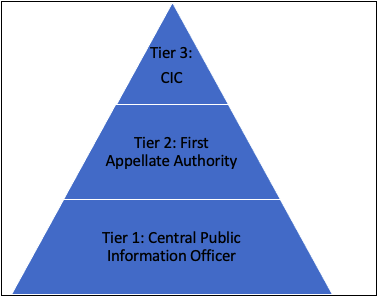
  • Organizational structure is as follows:
  • Tier 1: The Public information officer is responsible for providing information to an RTI applicant within 30 days of receipt of request.
  • Tier 2: It is designated as First Appellate Authority, the applicant who does not receive the required information or is aggrieved by the decision of CPIO can file an appeal within 30 days.
  • Tier 3: At third tier, Central Information Commissioner has been appointed as the apex body under RTI Act 2005. If the applicant is not satisfied or does not receive any order from First Appellate Authority, he/she can file Second appeal within 90 days.

WXWL12UDo05RAUK1pLMFVPiQDRGCoCErxUEL0YuufsrTKbxnTmtTa jTJ5VNVeatIS TypVLpUzAkyLyZvQ51D2Qu8bYQqSwsYBtBgfA5zNoDsjDJWG8mwYInlRu5yt fQiKiuoP1f5

Benefits of RTI Act

  • Accountability: Empowers Citizens to hold government accountable for non- performance of their duties by providing citizens access to government files and records.
  • Participative Decision Making: Allows citizens to participate in decision making process and shape public opinion through access to important information.
  • Accessible to marginalized: Helps marginalized and vulnerable sections in demanding their basic rights and access to important government services and welfare schemes.
  • Proactive governance: Discloses steps taken by governments in times of crisis – e.g.: food, medicines, healthcare facilities provided during pandemic or disasters, steps taken during COVID, natural disasters.
  • Empowers citizens: Citizens and NGOs in the past have used information to file writ petitions in Courts against instances of misgovernance, non- implementation of various rules or laws or even schemes, lack of access to government services etc.
  • Clean Governance: Expose extent of criminalization of politics and helped in de-criminalizing Indian politics through important SC judgments.
  • Exposes corruption and scandals:  Adarsh Housing Society Case, 2G case, Commonwealth Games Case etc.
  • Universalized regime of rights: RTI Act has ensured application of Article 19 of Universal Declaration of Human Rights.
  • Bridges the gap between information seeker and information provider.

Issues arising in the functioning of RTI Act

  • Amendment in 2019: Amendment in 2019 have considerably diluted the powers of CIC/SICs with respect to appointment, tenure, and service conditions. (Earlier CICs conditions of service were similar to the Election Commissioners).
  • Pendency: There is a pendency of more than 19,000 complaints with CIC as per the recent data, which account for average waiting period of 2 years for disposal of cases.
  • Vacancy: Vacancy of seats against the sanctioned strength of 10 (CIC), at state level, 25% of the posts of information commissioners are vacant.
  • Recruitment of retired bureaucrats: Commissions have become parking lot of retired bureaucrats considered as close to ruling party. Since most bureaucrats are accultured in secrecy, they tend to favour non-disclosure of information.
  • Low disposal rates and opaque functioning: SICs have been accused of low disposal rates in the appeal matters.
  • Defunct offices: The offices of SIC Jharkhand, Tripura and Telangana have been defunct of over three years.
  • Lack of digital infrastructure: Only 11 information commissions out of 29 provide e-filing facility for RTI applications or appeals, but only five are functional. 
  • No imposition of penalties: A study on penalties imposed found that the commissions didn’t impose penalties in 95% of the cases where penalties were potentially imposable.
  • Improper file management: Ineffective record management system particularly in state field offices/departments.
  • Conflict of interest of PIOs: PIO is a functionary of the office from which the information is sought. This often prevents him to divulge critical information affecting his colleagues.
  • Conflict with OSA: Legislations such as OSA restrict the free flow of information.
  • Suo moto disclosure: Reluctance of authorities, especially at state level for Suo moto disclosure, maintenance of records which is duly catalogued and accessible.
  • Intimidation and threat by the person in power and by political parties

Suggestions:

  • Open data regime: Government should follow Open data policy and proactive disclosure to increase transparency at maximum possible instances.
  • Capacity building: through continuous training and issuance of guidelines to CPIOs to dispose of information at the first stage itself.
  • E-courts and video conferencing: for early hearing of second appeals/complaints.
  • Digitization of records: electronic receipt of cases to enhance efficient delivery of information.
  • Social audits can be carried out with respect to the functioning of CIC/SICs.
  • Public Spirited individuals as Information Commissioners: The need is for the commission to have public spirited individuals as information commissioners.

Master of Roster; Chief Justice of India

Context: Supreme Court while underlining the importance of the roster has said that Judges have to follow discipline and ought not to take up any case unless it is specifically assigned by the Chief Justice.

Chief Justice of India as Master of Roster   

Chief Justice of India (CJI) is the master of roster, and in this role he alone has the power to allocate cases.   

  • Registrar General of Supreme Court prepares the roster as per the orders of CJI and CJI alone has the prerogative to constitute Benches.
  • Roster contains general or specific instructions regarding assignment or allocation of case to a particular Bench, allocation of work of a Bench, on account of non-availability of Judges.
  • CJI may instruct the Registrar to re-allocate judicial work to some other Bench in case of emergency.
  • Forming Constitution Bench by CJI as per Article 145(3) to adjudicate matters involving substantial question of law or for interpretation of the Constitution or under Article 143 pertaining to Presidential reference.  
  • Supreme Court Rules, 2013 framed under Article 145 with the approval of the President to regulate general practice and procedure of Supreme Court.
  • In Shanti Bhushan vs Supreme Court of India through its Registrar and another case (Master of Roster case) Supreme Court clarify the administrative authority of CJI as the Master of Roster and laid down the procedure and principles preparing the Roster.

Chief Justice of High Courts as Master of Roster

In State of Rajasthan vs. Prakash Raj (1998), the Supreme Court concluded:

  • That the administrative control of the High Court vests in the Chief Justice alone. On the judicial side, however, he is only the first amongst the equals.
  • That the Chief Justice is the master of the roster in this role he alone has the prerogative to constitute benches of the court and allocated cases to the benches so constituted.
  • That the puisne Judges can only do that work as is allotted to them by the Chief Justice or under his directions.
  • That the puisne Judges cannot “pick and choose” any case pending in the High Court and assign the same to himself or themselves for disposal without appropriate orders of the Chief Justice.
  • That no Judge or Judges can give directions to the Registry for listing any case before him or them which runs counter to the directions given by the Chief Justice.

Forum Shopping

When litigants or lawyers attempt to deliberately move their case to a particular judge or Court where they think the judgment could be more favourable, they are said to be “forum shopping.”

Collection of Data During Investigation

Context: The Centre is all set to roll out “DNA and face-matching” systems at some police stations across the country.

DNA Matching  

DNA matching identifies an individual by analysing segments from their DNA. The technology sequences the DNA in a lab and compares it with samples in a database.

Face Matching 

  • The process of face matching normally consists of the collection of a database, detection, analysis, and recognition.  
  • In the collection of the database, facial data of all individuals are collected, such as the distance between the eyes, distance from the forehead to the chin, depth of the eye sockets, contour of the lips, ears, and chin, etc.  
  • This database is used to match the required person through the analysis of this data by facial recognition technology.

Prison Identification Act, 1920

The Identification of Prisoners Act, 1920 became a necessity when the recording of newer forms of evidence such as fingerprints, footprints and measurements started becoming more accurate and reliable. 

Criminal Procedure (Identification) Act, 2022 

  • It replaced the Identification of Prisoners Act, 1920.
  • It was introduced with the objective of authorising the taking of measures of convicts and other persons for the sake of identification and investigation in criminal circumstances, as well as the preservation of records etc. 
  • It authorises the National Crime Records Bureau(NCRB) to collect, store, and maintain specified records and also assign the task of finalising the standard operating procedures (SOP) to be followed by police officials.
  • The act defines “measurements” as Finger imprints, palm print and footprint impressions, photos, iris and retina scan, physical, biological samples and their analysis.

Changes Proposed by Criminal Procedure (Identification) Act, 2022 

Provisions Prison Identification Act, 1920Criminal Procedure Identification Act 2022
Data collection allowed Fingerprints, foot-print impressions, photographs.Adds: (i)biological samples, and their analysis, (ii)behavioural attributes including signatures, handwriting, and (iii)examinations under sections 53 and 53A of CrPC (includes blood, semen, hair samples, and swabs, and analyses such as DNA profiling)
Whose data may be collectedConvicted or arrested for offences punishable with rigorous imprisonment of one year or more Convicted or arrested for any offence.Biological samples may be taken forcibly only from persons arrested for offences against a woman or a child, or if the offence carries a minimum of seven years imprisonment
Persons ordered to give security for good behaviour or maintaining peacePersons detained under any preventive detention law 
Magistrate may order in other cases collection from any arrested person to aid criminal investigationOn the order of Magistrate, from any person (not just an arrested person) to aid investigation
Authority who give direction for collection of dataInvestigating officer, officer in charge of a police station, or of rank Sub-Inspector or aboveOfficer in charge of a police station, or of rank Head Constable or above.  In addition, a Head Warder of a prison.
MagistrateMetropolitan Magistrate or Judicial Magistrate of first class.  In case of persons required to maintain good behaviour or peace, the Executive Magistrate

National Automated Fingerprints Identification System (NAFIS) 

NAFIS project is a country-wide searchable database of crime and criminal related fingerprints. It is conceptualised and managed by NCRB.

Functions 

  • The web-based application functions as a central information repository by consolidating fingerprint data from all states and Union Territories. 
  • It enables law enforcement agencies to upload, trace, and retrieve data from the database in real time on a 24×7 basis.
  • NAFIS assigns a unique 10-digit National Fingerprint Number (NFN) to each person arrested for a crime. 
  • This unique ID will be used for the person’s lifetime, and different crimes registered under different FIRs will be linked to the same NFN.
  • This database is also being integrated with the Criminal Procedure Identification Act

Scope and issues related to SC’s power to do complete justice (Article 142)

Context: The Supreme Court, while using its extraordinary power under Article 142, ordered the appointment of a citizen as a postal assistant on a probationary basis in order to ensure complete justice for someone who had fought for it for nearly three decades.

Article 142

Enforcement of decrees and orders of Supreme Court and orders as to discovery, etc.—

(1) The Supreme Court in the exercise of its jurisdiction may pass such decree or make such order as is necessary for doing complete justice in any cause or matter pending before it, and any decree so passed or order so made shall be enforceable throughout the territory of India in such manner as may be prescribed by or under any law made by Parliament and, until provision in that behalf is so made, in such manner as the President may by order prescribe. 

(2) Subject to the provisions of any law made in this behalf by Parliament, the Supreme Court shall, as respects the whole of the territory of India, have all and every power to make any order for the purpose of securing the attendance of any person, the discovery or production of any documents, or the investigation or punishment of any contempt of itself. 

In simple terms, Article 142 empowers the Supreme Court (SC) to issue such orders or decrees as needed to achieve complete justice. This is a special and exclusive power granted to the SC by the constitution, which even the high courts do not possess.

Need of Article 142 

The Constitution's framers believed this provision was crucial for those suffering due to judicial system delays.

To Fill the Legislative vacuum:

  • When there's a legal void for certain offenses, as seen in the Bhanwari Devi case in 2002, where there was no law addressing workplace sexual harassment, the SC introduced the Vishaka guidelines to ensure justice.

To Correct the Executive non-compliance: 

  • The executive's non-compliance in Bihar during trials resulted in a high number of undertrials, leading to the SC’s  intervention in the 1979 Hossainara Khatoon Case, the first Public Interest Litigation (PIL) in India.

About Supreme Court’s Power Under Article 142

  • These are SC's plenary powers for ensuring complete justice are inherent and complement its other constitutional and statutory powers.
  • These powers are of wide amplitude and are supplementary in nature.
  • No independent proceeding or procedure is required before the court seeking the application of such powers.
  • The application of such powers depends upon the discretion of the apex court.
  • The application of these powers cannot be done while ignoring or overriding the existing statutory or constitutional provisions.
  • These constitutional powers cannot, in any way, be controlled by any statutory provisions.

Article 142: Source of Judicial Legislation

Judicial legislation is the process by which judges create or modify laws. This can be done through the interpretation of law, or the issuance of judicial decrees. 

Article 142 of the Indian Constitution gives the SC the power to issue any order or decree that it deems necessary to do complete justice, even if it is not specifically mentioned in the law.  

Environmental Protection:

  • The SC issued directions to ensure green belts and open spaces, emphasising the importance of ecological balance in M C Mehta case of 1996.
  • Prohibited stone-crushing activities near residential complexes to safeguard public health in M C Mehta case of 1992.

Indigenous Rights:

  • Earmarked a portion of reserved forests for Adivasis to ensure their habitat and means of livelihood, recognising the importance of protecting indigenous communities in the Banwasi Seva Ashram case of 1993.

Public Health:

  • Compelled the municipal authorities of the Delhi Municipal Corporation to perform their statutory obligations for protecting the health of the community in B. L. Wadhera case of 1996.

Cultural Heritage:

  • Issued directions to regulate the level of air pollution around the Taj Mahal, recognising the need to protect cultural heritage sites in M. C. Mehta case of 1997.

Legislative Void Filling and Criminal Justice Reforms:

  • Filled legislative gaps in various areas such as inter-country adoption, sexual harassment at workplaces, ensuring the independence and autonomy of the Central Bureau of Investigation (CBI) in Vineet Narain case of 1998, arrest procedures, treatment of undertrials, and advance directives.

Women's Rights:

  • Addressed issues of sexual harassment at workplaces, thereby enhancing the protection of women's rights in the workplace. (Vishaka judgement)

Public Interest Litigation:

  • Emergence of PIL allowed the judiciary to play a pivotal role in safeguarding public interest, environmental conservation, human rights, and administrative accountability, often resulting in the government giving direction, forming guidelines etc.

Appointment and encroachment in executive domain: 

  • Provided a procedure of the appointment of Election Commissioner of India and held that ECI shall be appointed by a committee in Anoop Baranwal case of 2023.

Issue with Judicial Legislation 

  • Lack of Expertise: The Court is composed of judges who are experts in law, but they may not have the same expertise in policy or other areas that are relevant to law-making.
  • Lack of Legitimacy: Laws made by the Court are not subject to the same scrutiny and debate as laws passed by Parliament. This raises concerns about the legitimacy of judicial legislation.
  • Uncertainty: When the Court makes new laws or modifies existing ones, it can be difficult for people to know what the law is leading to uncertainty and confusion among citizens.
  • Hurts the doctrine of separation of power: Encroachment in the areas of legislative and executive domains create imbalance in the power of three organs of government and impact doctrine of separation of power.
  • Lack of accountability: The Constitution under collective responsibility makes the executive accountable to people’s mandate. Courts while legislating bypass such responsibility.

Ambiguity: 

  • In certain cases SC gives direction, change or modify the application of law without clarifying whether it is under article 142 or not. 
  • Subjective application in different cases by the court has created ambiguity, e.g., in NALSA court applied the article but in Sama sex marriage case it refused to apply it.

Judicial Restraints provided by the Court

  • In Prem Chand Garg Court, it was established that an order to ensure complete justice must align with both constitutional rights and relevant statutory laws.
  • In certain cases, SC held that it cannot be used to take away any fundamental rights and cannot supersede Article 32. 
  • The possibility of a conflict between powers under article 142 and other provisions of the constitution necessitate application of the rule of harmonious construction.

Case Laws 

  • In Justice K.S.Puttaswamy(Retd) vs Union Of India Court used Article 142 to expand the scope of the right to life and personal liberty to include the right to privacy.
  • In Vishaka and Others v. State of Rajasthan, Court used Article 142 to lay down guidelines for the prevention of sexual harassment at the workplace.

Way Forward

  • The primary purpose of Article 142 is to enable judges to alleviate the strict application of the law in situations where doing so is essential for the administration of justice.
  • In essence this power must always operate within the bounds of constitutional and statutory provisions. Going beyond these limits may lead to injustices rather than the delivery of justice itself.
  • The exercise of this power places a significant responsibility on the Supreme Court to use it with great care, keeping in mind democratic system and upholding the principles of justice, and constitutional values.

Article 142 should be invoked judiciously and with restraint. It is not a universal remedy for all legal issues. Supreme Court judges must neither become "good men not obeying the law too well," which means they can deviate from strict legal procedures when necessary for justice, nor should they turn into "knights errant roaming at will in pursuit of their own ideal of beauty or goodness," which would be considered an abuse of judicial discretion.