Miscellaneous topics in Science

Smart Meters

Context: The Power Ministry has extended the deadline for installing 25 crore smart meters across the country under the Revamped Distribution Sector Scheme (RDSS) by two years till March 2028.

Relevance of the Topic: Prelims: Key facts about Smart Meters; Revamped Distribution Sector Scheme.

Revamped Distribution Sector Scheme

  • Initiative of: Ministry of Power
  • Duration: 5 years i.e., from FY 2021-22 to FY 2025-26. Extended by two years till FY 2027-28.
  • Aim: To reduce the Aggregate Technical & Commercial (AT&C) losses to pan-India levels of 12-15% and Average Cost of Supply (ACS)-Average Revenue Realised (ARR) gap to zero by 2024-25.
  • The scheme has two parts: 
    • Part-A: Upgradation of distribution infrastructure and Pre-paid Smart Metering & System Metering. The Smart Meter National Programme under RDSS envisages the installation of 25 crore Smart Meters across the country.
    • Part-B: Training & Capacity Building and other Enabling & Supporting Activities.
  • Progress: As of July 2025, a total of 20.33 crore smart meters have been sanctioned under the RDSS, out of which 2.44 crore smart meters have been installed throughout the country.

Smart Meters:

  • Prepaid Smart Meters are the new generation of energy meters that are used to record electricity consumption in real-time. As they are connected to the internet, users and utilities can easily track and monitor electricity usage and get accurate bills. They can:
    • Eliminate the need for manual inspection, making them highly efficient and convenient.
    • Tell about electricity use during different times of the day, months and seasons.
    • Alert in case of insufficient/low balance or abnormal usage to best optimize their consumption on a user-friendly web portal or mobile app.
    • Notifies about changes in power tariffs that can help to plan activities during low-tariff periods.
    • Point towards appliances that are using more electricity than they should and suggests options to replace them with new, efficient ones.
image 87

How does the Smart Meter Work?

Smart meters are digital devices that measure and record electricity (or gas or water) consumption in real time and relay the information to utility companies.

  • Metering device: For electricity meters, sensors measure the voltage and current flowing through the electrical circuits. These values are then multiplied to calculate the power consumption (measured in watts). By integrating the power consumption over time, the meter can determine total electricity use (measured in kilowatt-hours).
  • Transmit usage information: After recording energy consumption data, the communications module is responsible for transmitting usage information to the company, by using one of the following methods:
    • Radio frequency (RF) signals to transmit data. This method is cost-effective and allows for long-range communication. However, RF signals can be susceptible to interference from other wireless devices and might require more infrastructure, such as repeaters or gateways, to ensure reliable communication.
    • Cellular networks: Some smart meters rely on existing cellular networks (for example, 4G or 5G) to transmit data. This approach offers widespread coverage and can be more resistant to interference than RF signals.
    • Broadband connections  like DSL and fiber-optic networks are another option for smart meter communication.
    • Power line communication technology allows smart meters to transmit data over existing power lines, eliminating the need for additional communication infrastructure.

Way Forward:

As India marches towards its vision of a financially sound and digitalised power sector through smart metering interventions, it must pursue a user-centric design and deployment strategy. 

  • Spread Awareness: The Ministry of Power should drive a nationwide campaign to educate consumers about smart meter benefits and improve the uptake of smart meter apps. The apps should be accessible to users from diverse socio-economic backgrounds and provide actionable tips and information.
  • Capacity Building: The majority of smart meters in India are being deployed by the Advanced Metering Infrastructure Service Providers (AMISPs), responsible for installation and operation of the AMI system for the project lifetime (10 years). Discoms must closely work with AMISPs to ensure a smooth installation and recharge experience for users, to leverage smart meter data for revenue protection and consumer engagement. For this, discoms will need to strengthen their internal capacity through suitable staffing and training interventions.
  • Foster Innovation: Discoms, system integrators and technology providers should collaborate to devise innovative and scalable data solutions. Effective use of smart meter data is fundamental to unlocking their true value proposition. This would require an ecosystem that fosters innovation in analytics, data hosting and sharing platforms, and enables key actors to collaboratively test and scale new solutions.
  • Strengthen Regulatory framework: Policymakers and regulators must strengthen regulations to empower consumers to unlock new retail markets.
    • Currently, important provisions concerning the phase-out of paper bills, arrear adjustment, frequency of recharge alerts, buffer time, rebates, and data privacy are scattered across different regulatory orders or simply missing. Their incorporation within existing State frameworks will be crucial for a positive technology experience for end users.
    • Regulators must also enable simplification and innovation in tariff design and open the retail market to new business models and prosumagers (producers, consumers, and storage users). 

Sonic Weapons

Context: The President of Serbia has denied that his police forces deployed a banned ‘sonic weapon’ to disperse protestors in the capital city, Belgrade. Serbia is currently witnessing mass anti-government protests against widespread corruption and nepotism.

Relevance of the Topic: Prelims: Key facts about Sonic Weapons.

Acoustic or Sonic Weapons: 

  • Acoustic or sonic weapons are devices that produce very loud sounds over long distances. They can be designed to emit painful audible or inaudible sound waves.
  • Working: Such weapons typically comprise hundreds of transducers — electrical devices that convert energy from one form to another — to create highly concentrated and amplified sound. 
  • Utility: 
    • Crowd dispersal weapon. In 2004, for the first time, the US military used speciality equipment capable of projecting loud sounds over vast distances in Iraq. 
    • Can be used as voice amplifiers to transmit voice messages or other sounds.

Damage: These weapons can cause significant harm to the eardrums and delicate organs of the ears and cause tinnitus (ringing sensation in ears) and hearing loss.

image 81

Different types of Sonic Weapons: 

  • Long-range acoustic devices (LRADs): It has a range of 8,900 metres for intelligible speech, and produces a highly directional beam of extremely loud sound which can reach up to 160 decibels (dB).
    • Sounds over 120 dB can cause permanent hearing damage from even short periods of exposure. Sounds over 140 dB are extremely painful. 
  • Infrasonic weapon: It delivers very low-frequency sounds that would be inaudible but could cause pain and disorientation. Experts are still investigating its capabilities.

Mosquito: This device produces very high-pitched sounds that are audible and painful to only younger people — usually teenagers and those in their twenties. It does not affect older people (30 and above). It is not audible to adults because hearing fades as one gets older.

What is Pink Fire Retardant used against California Wild Fire?

Context: Pink retardants are being used to contain Los Angeles and Southern California wildfires, with thousands of gallons of it being dropped using the planes. 

Relevance of the Topic: Prelims: Key facts about Pink Fire Retardant. 

What is the pink fire retardant?

image 105
  • Fire retardant is a mix of chemicals used to extinguish or slow down the spread of fires. There are different types of fire retardants but Phos-Chek (a brand of fire retardant) is the most common in the United States. 
  • Phos-Chek is a mix of water, fertilizer, and colour. Phos-Chek commonly contains two types of salt: diammonium phosphate ([NH4]2HPO4) and ammonium polyphosphate ((NH4PO3)n).
    • Salts such as ammonium polyphosphate do not evaporate easily like water and stay for longer.
    • The retardant is sprayed ahead of the fire to coat vegetation and prevent oxygen from allowing it to burn.
    • The reaction between the retardant and cellulose (in plants) consumes heat energy from the approaching fire and produces non-flammable carbon material.
  • Colour is usually added to the fire retardant to ensure that firefighters can see it against the landscape. This helps them create fire lines around the fire retardant, potentially saving lives and property.

What are the concerns?

  • A 2024 US found that Phos-Chek is laden with toxic metals.
    • Between 2009 and 2021, more than 400 tons of heavy metals were released into the environment from fire suppression. 
    • These toxic metals include chromium and cadmium which can cause cancer, and kidney and liver diseases in humans. 
    • Further, these metals can enter waterways (growing source of pollution for rivers and streams) and can kill aquatic life. 
  • The effectiveness of Phos-Chek also remains unclear. Aerial retardant is effective over a narrow range of conditions (dependent on slope, fuel type, terrain and weather). The windows of opportunity for these conditions are narrowing each year due to climate change.

Cause of the devastating wild fires

  • Southern California (the site of the fires) has been experiencing drought conditions and has not seen significant rainfall for months. 
  • The dry conditions are aided by the Santa Ana winds (dry and hot winds common in the area) which most likely caused the wildfires.
  • Further, climate change has contributed to an increase in the frequency, season length and burned area of wildfires. 

Read more:Santa Ana winds drive Wildfire 

Important types of clocks 

What is a clock?

Clocks are devices that measure the passage of time and display it. A clock measures the amount of time that has passed by tracking something that happens in repeating fashion, at a fixed frequency.

  • Sundials in ancient times allowed people to ‘tell’ time by casting shadows of changing lengths against sunlight. 
  • In water clocks/ sand clocks, water/sand would slowly fill a vessel, with its levels at different times indicating how much time had passed.

Important types of clocks: 

Some important types of clocks are the quartz clock, atomic clock, optical clock and nuclear clocks. 

1. Quartz clocks:

  • The fundamental setup of both quartz clock and the atomic clock is similar: they have a power source, a resonator, and a counter. 
  • Working: 
    • Quartz clocks use a tiny piece of quartz crystal as the resonator. 
    • The Quartz crystal has a special property- on the application of electricity to it, it vibrates at a very precise and constant speed - 32,768 times per second. The power source in the clock sends electrical signals to a quartz crystal, whose crystal structure oscillates due to the piezoelectric effect.
    • The Electronic circuit (counter) in the clock counts these vibrations and uses them to create regular electric pulses, one per second. These pulses power a tiny motor. The motor turns gears that move the hands of the clock.   
  • Hence, quartz clocks are much more accurate than older mechanical clocks. These clocks are inexpensive to make and easy to operate, and their invention led to watches and wall-clocks becoming very common from the mid-20th century.
AD 4nXc95jIyuUAepO3c4xY9CTOjmzNquHA6BuzaeLtinTrWFKoTpr8EkM33Z YKrKkouiBw7hsATDzWoe euue5mOk1xoTjsTyw Ijogn6Bp0nT08xQXhvyRogAdVCMnsB jsH3J13eHC6bDqUgkat76 2NXKhhtvGSQufFO82wjv7PgqMo6fndtKE?key=94wc ips G1bwypVTn iTA
Piezoelectric effect: Piezoelectric effect is the ability of a material to generate an electric charge in response to an applied mechanical stress or pressure. https://compass.rauias.com/current-affairs/piezoelectric-effect/ 

2. Atomic clocks:

  • An atomic clock is a highly accurate timekeeping device that uses the properties of atoms to measure time. In these clocks, a laser serves as the power source, and a group of atoms of the same isotope acts as the resonator.
  • Atoms Used: Caesium-133 (most commonly used and is the basis for the definition of the second in the International System of Units (SI)), Rubidium-87 (less accurate than caesium clocks but are more compact and cost-effective), Hydrogen and Strontium.
  • Working: 
    • The laser provides enough energy for the atom to jump from its low energy state to a specific higher energy state.
    • When the atom returns to its lower energy state, it emits radiation with a very precise frequency. For example, in a caesium atomic clock, caesium-133 atoms emit radiation at a frequency of 9,192,631,770 Hz. The counter in the clock counts these waves, and when it detects exactly 9,192,631,770 waves, it records that one second has passed.
AD 4nXcigmTpr63pzl5VBr4J401qXJFQR4ApMWSjYoiBYbtagpMYzo4P CART7c 8qV8NDi0RwwQPdDTIw xbaA9J4DZi6yMpmBRoWE0KQy7c7ZPrAeBN33A6 XCiqoV3VHmTnAauj3sQI6sCd7Od5WpnkA69XotpcMGIpc9Oh01Ra1C1AuBOJMOiFM?key=94wc ips G1bwypVTn iTA
  • Significance: 
    • Atomic clocks are extremely precise and stable, losing or gaining only a second every 20 million years
    • Because of their accuracy, they serve as time standards. For instance, India’s official time is maintained by a caesium atomic clock at the National Physical Laboratory in New Delhi. 
    • The frequency of the radiation emitted by caesium clocks is in the microwave range, making them essential for applications where precise timing is crucial.
  • Applications of Atomic Clocks: 
    • Global Positioning System (GPS) and other satellite navigation systems to provide precise location data. 
    • Telecommunications to help synchronise communication networks and Internet synchronisation.
    • Scientific Research and timekeeping standards.
    • Financial Systems for timestamping transactions in financial markets.

3. Optical clocks:

  • An optical clock is an advanced timekeeping device that uses the properties of atoms or ions, but at optical frequencies rather than microwave frequencies (as in atomic clocks). These clocks offer even greater accuracy and stability than traditional atomic clocks.
  • Atoms/Ions Used: Strontium, Ytterbium and Aluminium Ion.
  • Working:
    • Laser Excitation: A laser excites electrons in the atom or ion to a higher energy state.
    • Optical Frequency: When the electron returns to a lower energy state, it emits radiation at an optical frequency (much higher than the microwave frequencies in atomic clocks).
    • Counting Oscillations: The clock measures these oscillations, with the optical frequency allowing for more precise time measurement due to the higher number of cycles per second.
AD 4nXdJe6N oQNzSDSXQeg8XyimJ8bClSgjNy2zPs5c1G8N48jsK3qBLARW7I55P15IwRaJqOgoeoWWLAlQfO7xHP1 7a A41ZzjXd7oEFnVHvGue76muvMEX61u5Nj0Ynlk8 iPHEBgjRaOLoIFg6cNGK7yHG0Crhoo 54DQ9z2PpAExQ3HpKbPtM?key=94wc ips G1bwypVTn iTA
  • Significance:
    • High Precision: Optical clocks are even more precise than atomic clocks, with potential accuracies that would lose or gain only a second in more than 10 billion years.
    • Future Time Standards: These clocks are being researched as potential successors to atomic clocks for defining the second.
  • Applications of Optical Clocks:
    • Scientific Research: Used in testing fundamental physics theories, such as relativity and quantum mechanics.
  • Redefining Time Standards: May lead to a new definition of the second in the International System of Units (SI).
  • Navigation Systems: Potentially used in next-generation satellite navigation and communication systems for even greater precision.

4. Nuclear Clocks

  • A nuclear clock is an experimental timekeeping device that uses the energy levels within an atomic nucleus, rather than electron transitions, to measure time. These clocks are still in the research phase but promise unprecedented precision.
    • Atomic clocks need to make sure the resonator atoms are not affected by energy from other sources, like a stray electromagnetic field.
    • An atom’s nucleus is located well within each atom, surrounded by electrons, and thus could be a more stable resonator. 
    • The nucleus’s de-excitation emission has a frequency of 2,020 terahertz, which indicates an ultra-high precision. 
  • Nucleus Used: Scientists are experimenting with Thorium-229 nuclei.
  • Working:
    • Nuclear Transitions: The clock relies on a transition between energy levels within the atomic nucleus itself, which occurs at a much higher frequency than electron transitions.
    • Laser Excitation: A laser tuned to the nuclear transition frequency excites the nucleus. The frequency of this transition is counted to measure time.
  • Significance:
    • Unprecedented Precision: Nuclear clocks could be far more precise than even optical clocks, with theoretical accuracies that would lose or gain only a second over the entire age of the universe.
    • Resistant to Environmental Interference: Nuclear transitions are less affected by external electromagnetic fields, making these clocks potentially more stable.
  • Applications of Nuclear Clocks:
    • Fundamental Physics: Potential to explore new areas of fundamental physics, such as the study of time variation in fundamental constants.
    • Ultra-Precise Timekeeping: Could redefine precision timekeeping, impacting scientific research, telecommunications, and global positioning systems.
    • Testing Gravitational Effects: Useful in experiments testing the effects of gravity on time, contributing to our understanding of general relativity.

Caustic Soda (NaOH) - Properties & Uses

Caustic soda, also known as sodium hydroxide (NaOH), is a corrosive white crystalline solid. 

It is strongly alkaline, meaning it readily dissolves in water and releases hydroxide ions (OH-), giving it a pH of around 14.

It is primarily produced through electrolysis. This process involves passing an electric current through a brine solution (sodium chloride dissolved in water) to separate the sodium and chloride ions.

image 23

Uses: 

  • Cleansing agent: Unblocking drains, drain pipe cleaner, removes built up grease from ovens.
  • Soap and detergent production: Key ingredient in the production of soap and detergents. 
  • Chemical manufacturing: Used in the production of a variety of chemicals, including chlorine, rayon, and paper.
  • Aluminium production: Used in Bayer process to extract aluminium from aluminium ore.
  • Textile processing: Used in processing of textiles, such as mercerizing cotton and finishing fabrics.
  • Food processing: Used in food industry as an acidity regulator and an anti-caking agent. 
  • Oil refining: Used to remove sulphur impurities from crude oil.
  • Water treatment: Used to adjust the pH of water and remove certain contaminants.
  • Biodiesel production: Used as a catalyst in the production of biodiesel. [Biodiesel is made by reacting vegetable oil or animal fat with an alcohol (methanol or ethanol) and a catalyst (sodium hydroxide or potassium hydroxide)].

What is Rail Gauge?

Rail gauge is a fundamental concept in the railway industry. It refers to the spacing of the rails on a railway track and is measured between the inner faces of the load-bearing rails.

Rail Gauge

The gauge determines the width and stability of the railway track, which in turn impacts the size and design of the rail vehicles that can operate on the track.

Over 60% of the world's railway network uses the standard gauge of 1435 mm.

India has four distinct kinds of railway gauges:

  • Broad gauge
  • Meter gauge
  • Narrow gauge
  • Standard gauge (specifically used for the Delhi Metro)
image 8

Broad gauge:

  • Broad gauge is a railway track configuration where the separation between the two tracks in these railway gauges is 1676 mm.
    • Any gauge above the conventional gauge measurement of 1,435 mm is often referred to as a broad gauge. 
  • The first railway line constructed in India was a wide gauge track from Bore Bunder (now known as Chhatrapati Shivaji Terminus) to Thane in the year 1853. 
  • The use of broad-gauge railway systems is also seen at port facilities for the purpose of accommodating cranes and other related equipment. 
  • Thicker gauges provide enhanced stability and surpass thinner gauges in terms of performance.

Meter gauge:

  • The separation between the two tracks is 1,000 mm. 
  • The installation of meter-gauge lines was undertaken with the objective of minimising expenses. 
  • Under the Unigauge project, it is planned to convert all meter gauge lines in India, except the Nilgiri Mountain Railway (a historical railway operating on a meter gauge) into a wide gauge.

Narrow gauge:

  • The smaller gauge is sometimes referred to as a narrow gauge or little line. 
  • The narrow-gauge railway refers to a kind of railway track characterised by a distance of 762 mm and 610 mm between the two tracks. 
  • The Darjeeling Mountain Railway was officially designated as a UNESCO World Heritage site
  • The Kalka Shimla Railway is well recognised and has significant popularity.

Standard gauge:

  • The railway gauge in question exhibits a distance of 1435 mm between its two tracks. 
  • In the context of rail transportation systems in India, it is observed that the standard gauge is only used for urban rail transit systems such as Metro, Monorail, and Tram, the only standard gauge railway line in India was the Kolkata (Calcutta) tram system. 
  • In metropolitan regions, it is preferable to construct metro lines only using the standard gauge due to the greater accessibility of rolling equipment for this gauge, as opposed to the Indian gauge.

Lack of a drug recall law in India

Context: Despite the rise in substandard drugs, India still lacks a national law on recalling drugs. India has never witnessed domestic or foreign pharmaceutical companies recall substandard or mislabelled drugs in India.

Is there a drug recall law in India?

  • India has been mulling the creation of a mandatory recall law for substandard drugs that have failed to meet quality parameters since 1976, and yet no law exists that mandates such medicine be removed from the market to this day.
  • Consequences when substandard drugs are not recalled: People, including children, are almost certainly dying or suffering from adverse health events because substandard drugs are not swiftly removed from the market. 

Issues plaguing India’s pharmaceutical industry and the drug regulatory mechanism:

India's pharmaceutical industry has been plagued by several issues which include-

  • Weak regulatory framework: India's drug regulatory system is fragmented, with different agencies responsible for different aspects of drug regulation, such as drug approval, quality control, and pricing. This fragmentation often leads to duplication of efforts, delays, and inconsistencies in the regulatory process, making it difficult to ensure the safety and efficacy of drugs. Also, the incompetence of a regulator in one State can lead to adverse effects for patients in other states. 

E.g., Drugs ordered to be recalled by a state drug controller in one State are sometimes found to be on sale in another State. 

  • Lack of accountability: Due to lack of expertise and accountability from bureaucracy and the apathy of pharma companies, the circulation of substandard drugs in the Indian market has been the modus operandi for decades. The awareness in the public that such drugs can have dangerous consequences for consumers, has come recently when the drug failures overseas brought attention to the issue. 
  • Jurisdictional issues: Due to the presence of many regulators, it has become a challenge to enforce the law due to jurisdictional issues.
  • Lack of adequate quality control measures: Since drug manufacturing sector in India is highly fragmented, with a large number of small and medium-sized enterprises (SMEs) producing drugs. Many of these SMEs lack the resources and expertise to implement good manufacturing practices (GMP), resulting in poor quality control and the production of substandard drugs.
  • Prevalence of counterfeit drugs in the market: Counterfeit drugs are often sold at a lower price, making them attractive to consumers who cannot afford genuine drugs. However, intake of such drugs can be ineffective or even dangerous.
  • Issue of drug pricing: India has a complex system of drug pricing, with different pricing mechanisms for different categories of drugs. The lack of a transparent and rational drug pricing system often leads to high prices for essential drugs, making them unaffordable for many patients.
  • Focus on Pharma industry over public health: The government has displayed a greater interest in enabling the growth of the pharmaceutical industry than protecting public health.

Government initiatives to strengthen the regulatory framework for drug recall:

India has taken some measures to strengthen the regulatory framework for drug recall. Some of these measures include:

  • Establishment of the Central Drugs Standard Control Organization (CDSCO): In 2005, the CDSCO was established as the national regulatory body for drugs in India. The CDSCO is responsible for regulating the safety, efficacy, and quality of drugs in the country. In 2012, CDSCO proposed a set of draft recall guidelines, but it did not convert into a binding law.
  • Introduction of the Drugs and Cosmetics (Amendment) Act, 2008: The amendment act provides for the recall of drugs that are found to be substandard, spurious, or not of standard quality. The act also empowers the CDSCO to issue directions for the recall of such drugs.
  • Setting up of a Drug Alert System: The CDSCO has established a Drug Alert System to monitor adverse reactions to drugs and take necessary action to recall drugs that pose a risk to public health.
  • Strengthening of quality control measures: The CDSCO has issued guidelines on good manufacturing practices (GMP) for drugs, and drug manufacturers are required to comply with these guidelines.
  • Collaboration with international regulatory bodies: The CDSCO has signed several memoranda of understanding (MoUs) with international regulatory bodies to strengthen the regulatory framework for drugs. These MoUs provide for cooperation in areas such as information sharing, training, and capacity building.

Way Forward:

India's pharmaceutical industry and drug regulatory mechanism require a multifaceted approach that addresses the challenges, which include:

  • Strengthen regulatory enforcement: CDSCO should be strengthened to ensure that it has the resources and expertise necessary to enforce regulations effectively. This includes increasing the number of inspectors and providing them with appropriate training and equipment.
  • Centralising regulatory processes: To create an effective recall mechanism, the responsibility of recalling drugs has to be centralised, with one Central authority wielding the legal power to hold companies liable for failures to recall drugs from across the country. This would streamline the regulatory framework, simplify the drug approval process, reduce duplication and prevent issues of multiple jurisdictions in the regulatory process.
  • Formulate Public health policy: Central government needs to have a comprehensive and clear public health policy that prioritises public health over profit.
  • Improve quality control measures: The government should take measures to improve quality control measures for drugs. This includes rigorous implementation of good manufacturing practices (GMP) guidelines, providing technical support to SMEs to help them comply with GMP requirements, and strengthening the quality control infrastructure.
  • Increase transparency and accountability: The drug regulatory system needs to be more transparent and accountable to the public. This includes making information on drug approval and recall processes more readily available to the public, and ensuring that regulatory decisions are based on sound scientific evidence.
  • Strengthen international cooperation: The CDSCO should continue to collaborate with international regulatory bodies to share information and best practices and to learn from the experiences of other countries.
  • Promote innovation: There is a need to create an environment that encourages innovation in the pharmaceutical industry. This includes providing incentives for research and development, promoting collaboration between industry and academia, and supporting the development of new technologies. 

Lab Grown Diamonds

Context: Budget 2023-24 has introduced incentives for lab grown diamonds.

About Lab Grown Diamonds (LGDs)

  • Lab grown diamonds (also known as lab created diamonds, manmade diamonds, engineered diamonds, and cultured diamonds) are grown in highly controlled laboratory environments using advanced technological processes that duplicate the conditions under which diamonds naturally develop when they form in the mantle, beneath the Earth’s crust. 
  • These manmade diamonds consist of actual carbon atoms arranged in the characteristic diamond crystal structure. Since they are made of the same material as natural diamonds, they exhibit the same optical and chemical properties.
  • Lab Grown Diamonds is a technologically and innovation driven emerging sector with high employment potential. These environment friendly diamonds which have optically and chemically the same properties as natural diamonds. 

Reasons for interest in Lab Grown Diamonds

  • Mining Free: These diamonds are produced in laboratories. Hence, they are an environmentally responsible choice as a no mining is required.
  • Quality: Lab Grown Diamonds have same physical, chemical and optical properties as mined diamonds.
  • Value for Money & Affordable: Lab grown diamonds offer excellent value. They are more cost-effective than natural diamonds of comparable size and quality.
  • Scarcity of diamonds: As natural diamonds become scarce due to depleting reserves and escalating costs. 
  • Strengthening India’s Gems & Jewellery Industry: India is a global leader in cutting and polishing of natural diamonds, contributing about 3/4th of global turnover by value. With the depletion of natural diamonds, the industry is moving towards Lab Grown Diamonds. 

Process of making Lab-Grown Diamonds

  • Lab Grown diamonds are made in laboratories with a seed of natural diamonds, which is a slice of another diamond - on which the LGD is created. It takes less than month to make a distinctively shaped crystal of Lab Grown Diamond. 
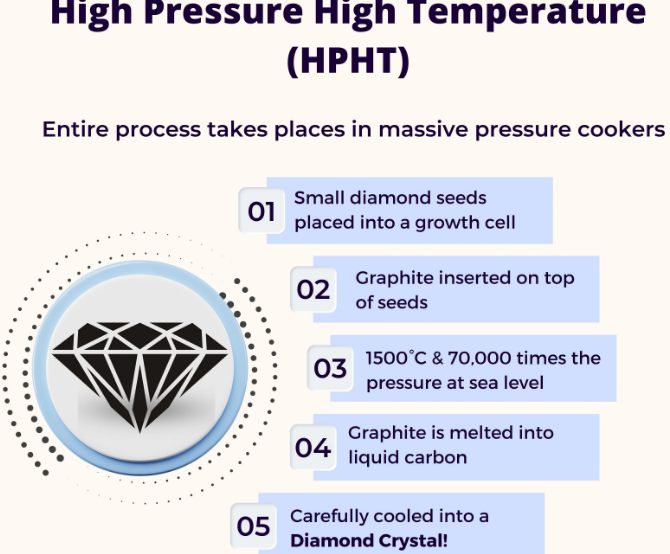
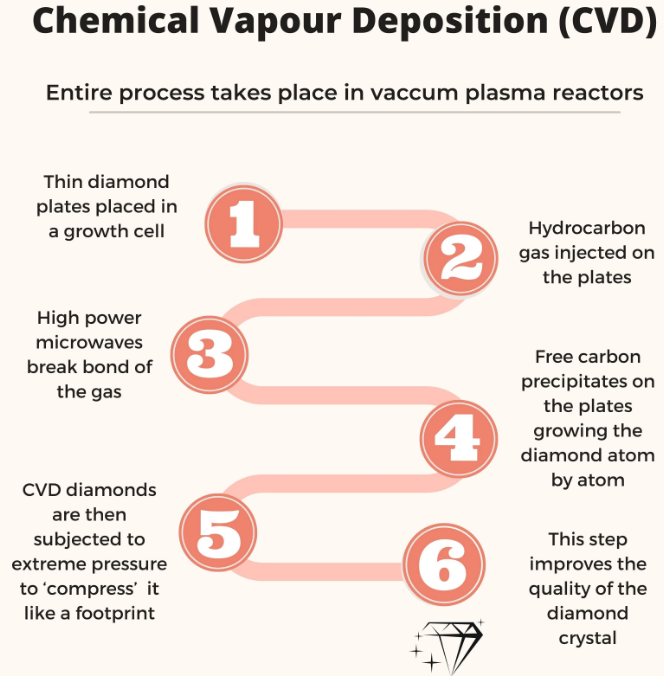
  • There are two methods by which LGDs are created: (i) Chemical Vapour Deposition (CVD) method (ii) High Pressure, High Temperature (HPHT) method.
  • High Pressure, High Temperature (HPHT) method: This process mimics the high-pressure, high-temperature conditions that occur under the Earth to form a natural diamond. The seed and graphite carbons are exposed to extreme temperatures (1,500oC) and with extremely high pressures to make LGDs. This method can also enhance the colour of diamonds making them colourless, pink, green, blue or yellow. Diamonds produced by this method may have some impurities of Boron or Nitrogen. This method is popular in China. 
high pressure high temp
  • Chemical Vapour Deposition (CVD) method: It is a chemical process in which the seed is heated up to 800oC in a sealed chamber filled with molecules of carbon-rich gas such as methane. These gas molecules are broken down into carbon and hydrogen atoms, which get deposited on the seed giving it a shape of square, tabular diamond crystal. This process also requires heat or irradiation to give the crystal a colour effect. Diamonds produced by this method most chemically pure diamonds i.e., free from impurities of nitrogen and boron. CVD method is more popular in India. 
chemical vapour deposition

Identification of Laboratory Grown Diamonds

  • Laboratory grown diamonds require advanced testing in a gemmological laboratory to be identified with certainty. 

Proposals in Union Budget 2023-24 for Lab Grown Diamonds

  • Grant for R&D: To encourage indigenous production of LGD seeds and machines and to reduce import dependency, a R&D grant will be provided to one of the IITs (IIT Madras) for five years.
  • Relief in Customs duty: Budget 2023-24 has abolished customs duty on imports of seeds used for manufacturing of rough lab-grown diamonds. This will boost domestic manufacturing of LGDs and reduce imports of LGDs. 
  • Implications of Fiscal support: Fiscal support provided for LGDs is aimed at boosting exports of LGDs from India and to reduce dependence of imports for key inputs i.e., seeds and equipments. 
  • LGDs in India: In India, share of LGDs in overall diamond business is just 2-3% with LGDs being used majorly for jewelleries and exports. About 80% of cut and polished LGDs are exported, while only 20% are consumed globally. 
  • Trends in LGD trade: India imported rough LGDs worth Rs 7,656 crore in April-December 2022 and exported 10,587 crores of LGDs in the same period. US & Europe are key markets for India’s CVD labs grown diamonds. With further government support, LGD industry will become competitive globally. 

Diamond Simulants

  • Diamond stimulants, such as cubic zirconia and moissanite, look like diamonds but are not true carbon crystals. Simulants do not have the same chemical and physical properties as natural diamonds and therefore sell at much lower prices than lab created diamonds. 
  • Moissanite is a gemstone born from stars and was first discovered in a crater created by a meteorite in Arizona, USA. They are composed of crystal of silicon carbide and not of carbon as diamonds. However, they appear like Diamonds. 
  • Natural Moissanite is incredibly rare on Earth. Hence, most moissanite available today is laboratory created. Moissanite, referred to as a diamond simulant, is engineered to give the illusion of similarity to diamonds, but is compositionally and visually quite different from a real diamond. 

Prussian Blue drug

Recently, the Drugs Controller General of India (DCGI) has granted manufacturing and marketing licenses for the commercial use of Prussian blue insoluble formulations, developed under the Technology Development Fund (TDF) scheme.

About Prussian blue:

  • or potassium ferric hexacyanoferrate is used as a medication to treat Thallium poisoning or radioactive Caesium poisoning.
  • It is one of the critical medicines listed by the World Health Organisation (WHO) for radiological and nuclear emergencies.

Drugs Controller General of India (DCGI):

  • DCGI is responsible for the approval of licences for specified categories of drugs such as blood and blood products, IV fluids, vaccines, and sera in India. It also sets standards for the manufacturing, sales, import, and distribution of drugs in India.
  • It comes under the Ministry of Health & Family Welfare.

Technology Development Fund (TDF) scheme:

  • TDF has been established to promote self-reliance in defence technology as a part of the 'Make in India' initiative.
  • It encourages the participation of public/private industries especially MSMEs to create an eco-system for enhancing cutting-edge technology capability for defence applications.
  • It is an initiative of the Ministry of Defence executed by the Defence Research and Development Organisation meeting the requirements of Tri-Services, Defence Production and DRDO.