Fundamental Rights & Rights Issues

Press and Registration of Periodicals Act 2023

Context: Press and Registration of Books Act amendments to come into force on Sept. 1

image

About Press and Registration of Periodicals Act 2023

  • It seeks to simplify the registration process for periodicals and make it mandatory for digital news platforms to do a “one-time registration” in order to operate.
  • It replaces the existing Press and Registration of Books (PRB) Act, of 1867, which governs the registration of the print and publishing industry in the country.
  • The aim is to bring transparency and ease of doing business. It will provide for a simple process that will help small and medium publishers.

Provision of Press and Registration of Periodicals Act 2023

  • Registration of periodicals: The Act allows for registering newspapers, periodicals, and books, and cataloguing books. The act focuses on registering periodicals containing public news or comments on it, excluding books and academic journals.
  • Declaration of periodicals: In the 1867 Act, only the district magistrate (DM) could cancel the declaration of a periodical, while the Press Registrar General (PRG) did not have suo motu powers to cancel or suspend the Certificate of Registration granted by it. However, the PRP Act empowers the PRG to suspend/cancel registration.
  • Foreign periodicals:  An exact reproduction of a foreign periodical may be printed in India only with the prior approval of the central government.  The manner of registration of such periodicals will be prescribed. 
  • Appellate Authority: It also provides for an appellate authority. The Appellate Board (Press and Registration Appellate Board) will comprise the chairperson, Press Council of India (PCI), and two members of PCI to hear an appeal against the refusal of grant of registration, imposition of any penalty or suspension/cancellation of registration by PRG.
  • Suspension and cancellation of registration:  The act allows the Press Registrar General to suspend a periodical’s registration for a minimum period of 30 days which can extend to 180 days.
  • Reason for suspension and cancellation of registration: The registration may be suspended due to: (i) registration obtained by furnishing false information, (ii) failure to publish periodicals continuously, and (iii) giving false particulars in annual statements.  The Press Registrar General may cancel the registration if the publisher does not correct such defects.
  • Registration may also be cancelled if: (i) a periodical has the same or similar title as any other periodical, (ii) the owner/ publisher has been convicted of a terrorist act or unlawful activity, or for acting against the security of the state.    
  • Offence: A person who has been convicted by any court for an offence involving a terrorist act or unlawful activity, or having done anything against the security of the state shall not be permitted to bring out a periodical.
  • Penalties: It waters down the penal provisions of the PRB Act, which made improper declaration of information a punishable offence with a prison term of up to six months. Under the new Act, imprisonment for up to six months is only applicable if a periodical is published without registration, and the publisher continues printing it after a six-month notice from PRG to stop.
  • Appeal: Any person may appeal against the refusal to issue a registration certificate, suspension/ cancellation of registration or imposition of penalty.  Such appeals may be filed before the Press and Registration Appellate Board within 60 days.  
  • Exclusion: Books, which were part of the PRB Act, of 1867, have been taken out of the purview of this act as books as a subject are administered by the Ministry of Education.

Press Registrar General

The Office of the Registrar of Newspapers for India, more popularly known as RNI came into being in 1956, on the recommendation of the First Press Commission in 1953 and by amending the Press and Registration of Books Act 1867.

Functions: The office performs both statutory as well as non-statutory functions.

Statutory functions Compilation and maintenance of a Register of Newspapers containing particulars about all the newspapers published.Issue of Certificate of Registration to the newspapers published under valid declaration;Informing the District Magistrates about availability of titles, to intending publishers for filing declaration;

Non-statutory functions:

Formulation of Newsprint Allocation Policy - Guidelines and issue of Eligibility Certificate to the newspapers to enable them to import newsprint and to procure indigenous newsprint.Assessing and certifying the essential need and requirement of newspaper establishments to import printing and composing machinery and allied materials.

Standing up for National Anthem

Context: An executive magistrate in Srinagar has sent 11 men to jail after they were detained for allegedly not rising for the National Anthem at an event on June 25 where J&K Lt Governor Manoj Sinha was present.

Bound Down In legal terms, to be “bound down” means to be required to appear before the investigating officer or the court on a given date. The expression is usually used in court orders to indicate that an accused is “bound” by surety or personal guarantee to appear before authorities.

Provision of CrPC used for arrest 

Section 107 Of CrPC  

“It authorises a Magistrate, in case of emergency when breach of peace is imminent, to order the accused person to agree to a bond which asks him to maintain peace for the prescribed period of time, not exceeding one year, as the Judge thinks would fit.”

Section 151 of CrPC

“A police officer knowing of a design to commit any cognizable offence may arrest, without orders from a Magistrate and without a warrant, the person so designing, if it appears to such officer that the commission of the offence cannot be otherwise prevented.

Such a detention period should not exceed twenty-four hours from the time of his arrest unless his further detention is required or authorised under any other provisions of this Code or of any other law for the time being in force.”

Standing up for national anthem 

Constitutional Provisions 

  • Art 19(1)(a) provides for freedom of speech and expression 
  • Art 19(2) put restriction on the freedom provided under article 19(1)(a) in the interests of the sovereignty and integrity of India, the security of the State, friendly relations with foreign States, public order, decency or morality or in relation to contempt of court, defamation or incitement to an offence
  • Art 25 provides for Freedom of conscience and free profession, practice and propagation of religion subject to public order, morality and health and to the other provisions of Part 3.
  • In Part 4A, under Art 51A(a) every citizen has a duty to abide by the Constitution and respect its ideals and institutions, the National Flag and the National Anthem.

The Prevention of Insults to National Honour Act, 1971

Section 3 of The Prevention of Insults to National Honour Act, 1971 prescribes jail up to three years and/ or a fine for “intentionally preventing the singing of the National Anthem or causing disturbance to any assembly engaged in such singing”.

Issues

  • Whether mere standing and not singing the national anthem under a religious belief can be protected under Article 19 (1) (a) and 25 (1) of the Constitution of India.
  • Art 51A(a) of the Constitution makes it every citizen’s duty to “abide by the Constitution and respect its ideals and institutions, the national flag and the national anthem”

The Issue arises because these provisions neither expressly spell out the proper way to show respect, nor do they talk about sitting or standing while the national anthem plays.

Supreme Court Cases

Bijoe Emmanual & Others v. State of Kerala & Ors, 1986

In this case, Hon'ble Supreme court (SC) granted protection to three children of Jehovas witness Sect, who didn’t join in singing of national anthem but stand respectfully at their school. The court held that forcing the children to sing national anthem is a violation of their fundamental right to religion.

Shyam Narayan Chouksey v. Union of India

Supreme Court said that 

  • Article 25 (“Freedom of conscience and free profession, practice and propagation of religion was incorporated in recognition of the principle that the real test of a true democracy is the ability of even an insignificant minority to find its identity under the country’s Constitution.
  • SC passed an interim order that “All the cinema halls in India shall play the National Anthem before the feature film starts and all present in the hall are obliged to stand up to show respect to the National Anthem.” 
  • The court had also ordered that “entry and exit doors shall remain closed” when the Anthem is played, and that “when the National Anthem shall be played…it shall be with the National Flag on the screen”

Later, in 2018, the order passed was modified to the extent that playing of the National Anthem prior to the screening of feature films in cinema halls is not mandatory, but optional or directory.

Instruction for Correct use of National Anthem by Ministry of Home Affairs (MOHA)
Instructions have been issued by MOHA from time to time about the correct versions of the Anthem, the occasions on which these are to be played or sung, and about the need for paying respect to the anthem by observance of proper decorum on such occasions.

  • In an order issued by, the Ministry of Home Affairs (MHA) had stated that “whenever the anthem is played, the audience shall stand to attention”.
  • However, when in the course of a newsreel or documentary the anthem is played as a part of the film, it is not expected of the audience to stand as standing is bound to interrupt the exhibition of the film and would create disorder and confusion rather than add to the dignity of the anthem,” the ministry added.

Constitutional Patriotism

Constitutional Patriotism is a German Jurisprudence concept which indicated complete devotion to constitutional principles as a way of encouraging social cohesion and dwells on building a common identity for all its citizens over their individual culture, religion tradition etc., thereby making the constitutional principles as binding factors and nothing else. 

  • The idea was introduced by the German philosopher Karles Jaspers after World War II to inculcate the feelings of unity among the German people. 
  • It was believed to be a kind of solidarity that is different from the context of nationalism and the ideas of a single community. 

However, in this context, the Supreme Court has used this concept to play the national anthem as a means to instill patriotism and nationalism which is symbolic of the nation and not of the constitution.

Difference between Nationalism, Cosmopolitanism and Constitutional Patriotism

  • In general, the concept of constitutional patriotism designates the idea that political attachment ought to center on the norms, the values, and, more indirectly, the procedures of a liberal democratic constitution.
  • Thus, political allegiance is owed, primarily, neither to a national culture, as proponents of liberal nationalism have claimed, nor to “the worldwide community of human beings,” as, for instance, Martha Nussbaum's conception of cosmopolitanism has it. 
  • Constitutional patriotism promises a form of solidarity distinct from both nationalism and cosmopolitanism.

Law Commission Recommendations on Sedition

Context: Law Commission of India has opined that Section 124A criminalising sedition should be retained. However, with some procedural safeguards.

image 29

S. G. Vombatkere Case (Supreme Demands Review of Sedition Law)

  • The opinion of Law Commission is significant as a Supreme Court bench last year decided to put in abeyance all cases of Sedition and directed Centre & State Governments not register any fresh FIR invoking the offence. (S. G. Vombatkere Case)
  • The Court also directed the Government for examining the sedition law as it found the sedition law not in tune with current times. 

Reasons for demand of repeal of sedition law:

  • Sedition law has a chilling effect on free speech and expression.
  • Alleged misuse of sedition law for curbing political dissent.
  • Vague definition of sedition law leading to erroneous interpretation
  • Very easy to use this law and lack of checks & safeguards
  • Overzealous application of this law to please political masters (important particularly in light of lack of police reforms)

Reasons for Retaining Sedition as a Crime

For safeguarding the Unity & Integrity of India: 

  • All organised societies have right to protect itself against attempts to overthrow. It is the chief duty of any government to safeguard State & its institutions against external and internal attack. 
  • Precondition of enjoying freedom is to ensure the security of the State because without such guarantee of stability the rest of the law will be ineffective.
  • Section 124A provides a prompt and effective mechanism for suppression of disintegrating tendencies and protects & preserves the integrity of Indian State. It is a deterrent for persons who want to commit acts of incitement to violence & acts causing disturbance of public order. 
  • Sedition law can check the proliferation of radicalisation against India, promotion of hatred against Government particularly on the social media. 

Sedition is a Reasonable Restriction under Article 19(2)

  • Critics have argued that Sedition Law is violative of Right to speech and expression under Article 19(2) of Constitution. But arguments against this position are:
  • Constituent Assembly substituted 'sedition' with 'which undermines the security of, or tends to overthrow the State', as the later phrase had a wider import and was more expansive in meaning.
  • First Amendment of the Constitution incorporated public order, friendly relations with foreign states and incitement to an offence as reasonable restrictions under Article 19(1)(a). SC in Kedar Nath Singh judgement held that sedition was a constitutional restriction under the ambit reasonable restrictions to speech & expression.
  • When two interpretations of a law are possible the one rendering it constitutional and the other making it unconstitutional, the former interpretation should prevail. 

Existence of counter-terror legislations does not obviate the need for Section 124A: 

  • Critics argue that counter terror laws like UAPA & National Security Act makes the sedition law irrelevant. However, these special laws & anti-terror legislations dealing with national security seek to prevent or punish the commission of offences targeted towards the state. 
  • On the other hand, Sedition law seeks to prevent violent, illegal & unconstitutional overthrow of a democratically elected government established by law. Hence, the existence of counter terror laws does not imply all elements of the offence envisaged under Sedition.

Sedition being a colonial legacy is not a valid ground for its repeal: 

  • Critics argue that sedition law is of a colonial legacy and was used against freedom fighters. However, if we go by this logic then the entire legal system of India should be overthrown as India's legal system is a colonial legacy.
  • The colonial government acted like a master and treated Indians not a citizens but as its servant. 
  • However, in today's constitutional and democratic set up, Government is based on the will of the people, wherein the government is only a servant of the people as it is elected by the people. 
  • Constitution provides ample space and liberty to people to indulge in healthy & constructive criticism of their government in a democratic set up. 
  • However, there is a need to penalise pernicious tendency to incite violence or cause public disorder in the guise of right to freedom of speech & expression.

Realities differ in every jurisdiction: 

  • The argument that just because some countries have repealed sedition from law books means India should also repeal sedition means turning a blind eye to the glaring ground realities & security concerns existing in India. 
  • Even the countries which have repealed sedition law, mere cosmetic changes have been made in the law of sedition without taking away the core of law of sedition or merely merged their sedition law with counter terror laws.

Recommendations of Law Commission on Sedition

  1. Incorporation of ratio of Kedar Nath Judgement of Section 124A of IPC: Supreme Court laid down in Kedar Nath Singh that unless the words used or actions in question 
  • Do not tend to incite violence or 
  • Cause public disorder or
  • Cause disturbance to public peace
  1. Procedural Guidelines for Preventing any Alleged Misuse of Section 124A of IPC
  • To prevent any alleged misuse of Section 124A of IPC, the Law Commission has suggested certain procedural safeguards to be undertaken prior to registration of FIR with respect to commission of an offence of Sedition. 
  • These procedural safeguards can be introduced by issuance of guidelines by central government or an amendment in Section 154 of CrPC (dealing with filing of FIR for cognizable offence).
  • A FIR for an offence of Sedition can be filed only after a police officer not below the rank of inspector conducts a preliminary inquiry. Based on this preliminary report, the Central or State Government should grant permission for registering a FIR.
  1. Removal of Oddity in Punishment Prescribed for Section 124A of IPC: Currently, the punishment prescribed for sedition is either life imprisonment or imprisonment for three years, but nothing in between. There is a need to reform the punishment prescribed for sedition under IPC to allow courts greater room to award punishment for sedition in line with scale and gravity of act committed. 
Proposed definition of SeditionCurrent Definition of SeditionProposed Definition of Sedition
Medium of SeditionBy words, either spoken or written By signsBy visible representationOtherwiseBy words, either spoken or written By signsBy visible representationOtherwise
What Qualifies as Sedition?Attempts to bring into hatred or contempt or excites or attempts to excite disaffection towards the Government established by law.Expression of 'disaffection' includes disloyalty & all feelings of enmity.  Attempts to bring into hatred or contempt or excites or attempts to excite disaffection towards the Government established by law, with a tendency to incite violence or cause public disorder (new addition).Tendency means mere inclination to incite violence or cause public disorder rather than proof of actual violence or imminent threat to violence. Expression of 'disaffection' includes disloyalty & all feelings of enmity.
What is not Sedition?Comments expressing disapprobation of measures of Government with a view to obtain their alteration by lawful means, without exciting or attempting to excite hatred, contempt or disaffection. Comments expressing disapprobation of administrative or other action of Government without exciting or attempting to excite hatred, contempt or disaffection.Comments expressing disapprobation of measures of Government with a view to obtain their alteration by lawful means, without exciting or attempting to excite hatred, contempt or disaffection. Comments expressing disapprobation of administrative or other action of Government without exciting or attempting to excite hatred, contempt or disaffection.
Punishment for SeditionLife imprisonment to which fine may be added, orImprisonment which may extend to three, or with fine.Life imprisonment to which fine may be added, orImprisonment for a term which may extend to seven years, or with fine.

Supreme Court upholds Tamil Nadu Jalikattu Law

Context: A five judge bench of the Supreme Court upheld the amendments made by Tamil Nadu, Maharashtra and Karnataka to the Prevention of Cruelty to Animals (PCA) Act of 1960. These amendments allowed the bull taming sports like Jallikattu, Kambala and bullock cart races.   

What is Jallikattu?

Jallikattu is a traditional bull-taming sport that is primarily practiced in the Indian state of Tamil Nadu. The word "Jallikattu" is derived from the Tamil words "Jalli" (meaning gold or silver coins) and "Kattu" (meaning a bundle). The sport involves the running of bulls in an open field, and participants attempt to grab the bull's hump and hold on to it for a certain distance or time to win prizes, which are usually tied to the bull's horns.

image 303

What is the controversy surrounding Jallikattu?

  • Controversy surrounding Jallikattu stems from concerns related to animal welfare and the treatment of the bulls involved.
  • Animal rights activists argue that the sport inflicts unnecessary harm and cruelty on the bulls.
  • They claim that the bulls are often subjected to physical abuse, including being prodded, poked, and harassed by the participants, which can lead to injuries and distress.
  • Activists also highlight instances where the bulls are reportedly force-fed alcohol or chili powder to agitate them before the event.

How the Supreme Court has seen this case so far?

  • In 2014, the Supreme Court of India banned Jallikattu, citing animal welfare concerns. The court observed that the bulls used in the sport are often subjected to unnecessary pain and suffering.
  • The ban sparked protests in Tamil Nadu, where Jallikattu is deeply rooted in the cultural and social fabric. Supporters of Jallikattu argue that it is an integral part of Tamil tradition and should be preserved as a cultural heritage.
  • They claim that proper regulations and safeguards can be implemented to ensure the welfare of the animals without completely banning the sport.
  • The controversy surrounding Jallikattu intensified in 2017 when widespread protests erupted in Tamil Nadu against the ban. The protests gained momentum, with people demanding the revival of the sport and a reversal of the court's decision.
  • Eventually, in 2017, the Tamil Nadu government passed an amendment to the Prevention of Cruelty to Animals Act, which exempted Jallikattu from the ban and allowed its practice under certain regulations. This move received mixed reactions, with some celebrating it as a victory for tradition and others expressing disappointment over what they perceived as a compromise on animal welfare.

What happened after the 2014 ban by the Supreme Court?

  • The Supreme Court over-ruled its 2014 judgement, which had essentially outlawed sports like Jalikattu, Kambala and Bullock Cart race.
  • In 2017, the Tamil Nadu government amended the PCA act thereby allowing jallikattu in the state. The state government sought exemption on grounds to preserve the cultural heritage of Tamil Nadu and to ensure survival and well-being of native breeds of bulls.
  • Following the Tamil Nadu, Karnataka government amended the PCA Act in Jan- 2017 to pave the way for Kambala.
  • In July-2017, Mahrashtra government also followed the suit.

What is the latest Supreme Court judgement all about?

  • Tamil Nadu Amendment Act is not a piece of colourable legislation.
  • 2017 amendment act minimises cruelty to animals in the concerned sports.
  • The sports will not come under the definition of cruelty defined in the 1960 Act.
  • 2017 amendment does not violate Article 51-A (g) and 51-A(h), which imposes duties of Indian citizen to protect the environment and develop scientific temper.
  • The amendment does not violate Article 14 and 21.

What is doctrine of colourable legislation?

  • The doctrine of colourable legislation is a legal principle used to determine the constitutional validity of a law or legislation. It refers to a situation where a law appears to be valid on its face, but its true purpose is to circumvent constitutional limitations or deceive the courts or the public.
  • The term "colourable" means something that appears to be true or genuine but is, in fact, false or deceptive. In the context of legislation, it refers to a law that is enacted under the pretense of exercising a valid legislative power, but its actual purpose is to achieve an unconstitutional objective.

What is Kambala?

  • Kambala is a traditional sport that originated in the southern coastal region of Karnataka, India. It is a form of buffalo racing that has been practiced for centuries in rural communities.
  • Kambala is usually held in the months of November to March during the harvest season.
  • In Kambala, two buffalo racers called "jockeys" run through a muddy paddy field while holding onto a wooden plow. The jockeys are typically barefoot and are often seen wearing colorful attire.
image 304
  • The buffaloes used in the race are specially bred and trained for this purpose. They are typically guided by the jockey, who tugs at the plow to urge the buffaloes to run faster.
  • Kambala is not only a sporting event but also a significant cultural celebration in the region. The races are often accompanied by traditional music and dance performances, and the entire community comes together to participate in the festivities. Kambala is seen as a way to honor and showcase the agricultural heritage of the region.

What is Bullock Cart race festival of Maharashtra?

  • Bullock cart racing starts from November and lasts till May.
  • It is a cultural activity and popular amongst farming  community in Alibag Taluka in Maharashtra.
  • Local Bullock art owners and farmers arrange this race mostly in their villages. Bullock cart owners pay obeisance to   Shri Nageshwar during Vaikunth Chaturdashi Yatra at Awas.
image 305
  • The Maharashtrian version of bullock cart racing was known as Bailgada Sharyat, a 450-year-old tradition of the farmers of Konkan, western Maharashtra and Marathwada.
  • These cattle races formed an integral part of the Jatras or village fairs that were held between Makar Sankranti and the Monsoon months, a time when the farmers were not busy in the fields.
  • The money that is  raised by the races is  utilized for the betterment of the village and for the renovation of the local temples. In this manner, cattle racing in India is  an adventure sport that also helped to raise funds for social causes.

Do CCTV cameras protect us or invade our privacy?

Context: India’s CCTV camera coverage has grown rapidly over the years. Today, Delhi and Chennai have more cameras per square mile than cities in China. States argue that CCTV cameras reduce crime, and the public finds the presence of these cameras reassuring. However, surveillance is a big concern. Recently, in Telangana, the wrong man was apprehended when authorities purportedly recognised him from security camera footage as a potential culprit in a chain-snatching event. He died days after being released.

Arguments in Favour of the installation of CCTV cameras

  • Cameras can help the police identify suspects
  • It can help in gathering evidences and clues of crime
  • They may help in bringing convenience for everyday life.
  • Cameras can help in reducing crime against women

Arguments against CCTV cameras

  • There are multiple studies in the U.K. that show that there is no connection between CCTV cameras and the reduction of crime.
  • Many times, cameras don’t even function, a CAG audit of 2018-19 stated that only 55-68% of cameras were working in Delhi
  • The majority of crimes against women take place at home. CCTV cameras are not helpful in those situations.
  • It is impossible to install CCTV in all places.
  • Over-reliance on these systems, which leads to false negatives (the police have not been able to identify the criminal and he goes free) and false positives (an innocent person is identified as the suspect).
  • Police may use the footage for otherwise
  • There is no oversight of the actions of the police, for instance, the New York and London police departments have oversight committees.
  •  According to the Criminal Procedure (Identification) Act, fingerprints, handprints or any evidence can be kept for 75 years. Why 75 years? There is no explanation. So, even after someone dies, evidence such as your fingerprints could be on record.
  • There are barriers to how freely people can protest and one of them is police intimidation. For example, if the police record me while I am protesting, this can affect not just me, but have a chilling effect on others. They may be scared to be identified by the police. The right to protest, to freedom of speech and to privacy all get violated.
  • There is no law that regulates how the data is collected, processed, stored, when it should be deleted, or with whom it can be shared.
  • There is no specific law with regard to facial recognition, or a standard operating procedure on how the police should use CCTVs or facial recognition technology
  • It is easy to tamper with video footage these days.

Way forward

  • Only the data to be used for a lawful purpose should be collected and stored. It is stored only for the time until which the purpose is carried out. After that, it should be deleted.
  • There should be comprehensive laws regulating the use of data recorded in CCTV cameras.
  • There should be a compulsory provision of an oversight committee to look into the actions of police.

Bilkis Bano case convicts playing for time: SC judge

Context: Justice K.M. Joseph, on a Division Bench of the Supreme Court on Tuesday, said that it was “more than obvious” that the men released early from life imprisonment in the case of gang rape of Bilkis Bano and murder of her family members during the 2002 Gujarat riots were raising a maze of procedural objections in successive court hearings to avoid his Bench.

Time line of Bilkis Bano case

  • During the Gujarat riots of 2002, Bilkis Bano (then five months pregnant) along with her three-and-a-half-year-old daughter and 15 other family members were abruptly attacked by about 20-30 people armed with sickles, swords, and sticks. 
  • Among the attackers were the 11 accused men. Bilkis, her mother, and three other women were raped and brutally assaulted. Of the 17-member of the group eight were found dead, six were missing. Only Bilkis (who reportedly was five months pregnant at that time), a man, and a three-year-old survived the attack.
  • The case was looked upon by the National Human Rights Commission (NHRC) and the Supreme Court, which ordered an investigation by the Central Bureau of Investigation. 
  • Bilkis Bano was not able to receive her well-deserved justice instead, she got threat notices and so, the case was moved to Mumbai from Gujarat.
  • A special CBI court in Mumbai sentenced the accused to life imprisonment on the charges of gang rape and murder in January 2008. 
  • The Bombay high court maintained the conviction of the accused in 2017, and in 2019
  • The SC ordered the Gujarat state government to compensate the victim with Rs 50 lakh, a job, and a house.
  • Almost after ten years, the Mumbai High Court, in May 2017, upheld the conviction and life imprisonment of 11 people in the gang rape case.
  • In 2019, the Supreme Court awarded compensation of Rs 50 lakh to Bilkis Bano.
  • One of the convicts, Radheshyam Shah, had approached the Gujarat High Court seeking remission of the sentence under section 432 (which mentions the empowerment of the state government to remit sentences as prison is a state subject under the constitution) and section 433 (which adds a caveat; convicts who have received a life sentence for an offence that even carry a death sentence) of the Code of Criminal Procedure. The Gujarat HC dismissed his plea saying that the "appropriate government" to decide about his remission is Maharashtra and not Gujarat.
Power of Remission Under Cr.Pc Different From Constitutional Powers of Pardon

Suspend or Remit – Criminal Procedure Code (Cr.PC) under Section 432 empowers central and state government to suspend or remit a sentence, in whole or in part, with or without conditions. 

Commutation – Section 433 empowers central and state governments to commute death sentence, imprisonment for life and rigorous imprisonment to a lesser degree.

State Government to Consult the Centre – Section 435 of Cr.PC states that powers of state government to suspend, remit or commute a sentence must be done in consultation with the central government if: 

1. The case was investigated by Central Bureau of Investigation (CBI) or 

2. The case was investigated by any other agency empowered to make an investigation into an offence under any Central Act. 

3. The offence involved misappropriation or destruction of, or damage to, any property belonging to the Central Government, or 

4. The offence was committed by a person in the service of the Central Government while acting in the discharge of his official duty.

Section 433A adds a restriction on powers of remission or commutation in certain cases. It states that where a sentence of imprisonment for life is imposed on conviction of a person for an offence for which death is one of the punishments provided by law, or where a sentence of death imposed on a person has been commuted under section 433 into one of imprisonment for life, such person shall not be released from prison unless he has served at least 14 years of imprisonment.
  • The Gujarat government had on August, 2022 granted remission to the convicts, as they had served over 15 years in prison and reportedly showed good conduct in Jail. However, the trial court judge at Mumbai as well as the prosecuting agency, the CBI, had opined against grant of remission on the ground that they committed the heinous offences in a gruesome manner.
  • A series of petitions have been filed in the Apex court , challenging the release of the 11 rapists. The court took up the issue explained it was important for it to examine the records to see whether the State government had independently applied its mind to all the relevant factors before granting remission to 11 men sentenced to life imprisonment for the gangrape of Bilkis Bano and the “horrendous mass murder” of her family members during the 2002 riots.

For further readings regarding constitutional and legal provisions related to remission and pardon kindly refer following link

In Karnataka, BJP promises uniform civil code if elected

Context: The BJP’s released its manifesto for the May 10 Karnataka Assembly elections with several poll promises. Prominent among them are implementing the Uniform Civil Code in the State based on the recommendations by a high-level committee which will be constituted if the party is voted to power.

Uniform Civil Code (UCC)

  • Article 44 of the Indian Constitution states that the State shall endeavor to secure for the citizens a uniform civil code throughout the territory of India. However, it is not so easy to make a uniform law on personal laws of all religions as each aspect of personal life like marriage, divorce, succession etc. are governed differently. So, Uniform Civil Code is an attempt to unify all civilian laws including personal laws for people of all faith living in India
  • UCC is the proposal to administer same set of secular civil laws to govern all people irrespective of their religion, gender, domicile, caste, etc. This law will be distinguished from public law and will subsume all laws covering marriage, divorce, inheritance, adoption and maintenance of different religions into one codified law. However, so far it has been difficult to achieve uniformity in personal laws of all religion.

Present push for UCC

  • Recent promises by BJP in its poll manifesto for Karnataka poll.
  • Proposal to Examine UCC by Uttarakhand CM days after Uttarakhand Chief Minister took oath.
  • Private Members’ Bill proposed on UCC by Rakesh Sinha, Rajya Sabha member.
  • Matter to be taken by 22nd Law Commission as per the Law Minister.
  • Supreme Court - government should explore the UCC to secure gender justice, equality and dignity of women.
  • Proposal by Chancellor of Maulana Azad National Urdu University asked the Supreme Court to direct the government to constitute a judicial commission or a high-level expert committee to prepare a draft UCC in tune with international conventions which protect the rights of women.

UCC and Indian constitution

  • UCC has been provided under part IV of the Indian constitution and is part of DPSP. Article 44 states - “The State shall endeavor to secure for the citizens a uniform civil code throughout the territory of India.”
  • The objective is to harmonize diverse cultural practices and address the discrimination meted out to various vulnerable groups under the garb of religious practices.
  • During the drafting of the constitution, UCC met with stiff opposition from various corners. Various minority religions especially the Muslims felt that UCC would curtail their freedom of religion, hence were apprehensive of replacing their personal laws with UCC.
  • It was due to this apprehension that UCC was included as a DPSP rather than a Fundamental right and it was envisaged that it will be achieved gradually and not all at once.
  • Nevertheless, having UCC embodied in DPSP reflects the intention of securing justice and equality for all citizens.

Benefits of Uniform Civil Code 

  • UCC would not only protect the vulnerable sections, including women and religious minorities, but “promote nationalistic fervour through unity” as well as simplify the complex personal laws. 
  • It will do away with diversity in matrimonial laws, simplify the Indian legal system and make Indian society more homogeneous. 
  • It will de-link law from religion. 
  • It will create a national identity and will help in containing fissiparous tendencies in the country. 
  • It will also help in establishing social justice and gender equality in family matters. 
  • The introduction of UCC will promote monogamy among all the citizen of India including Muslim and it will lead to betterment in the position of women. 
  • It will also remove prejudices against women regarding personal laws on divorce and maintenance. 
  • It will help in strengthening the secular fabric of the country and promote unity. 

UCC and the Supreme Court 

a) Shah Bano case: In 1985, the Supreme Court ruled in favour of Shah Bano, who had moved the apex court seeking maintenance after her husband divorced her. The then Chief Justice, Y.V. Chandrachud, observed that a Common Civil Code would help the cause of national integration by removing disparate loyalties to law. The Court directed Parliament to frame a Uniform Civil Code. 

Despite the Judgment, the government, in 1986, enacted the Muslim Women (Protection of Rights on Divorce) Act, which nullified Shah Bano judgment. The Act allowed maintenance to women only for 90 days after the divorce”. 

b) In the John Vallamattom v. Union of India case in 2003, Chief Justice V.N. Khare had observed: “It is a matter of regret that Article 44 of the Constitution has not been given effect to. Parliament is still to step in for framing a common civil code in the country.”

c) S.R. Bommai - SC warned against “mixing politics with religion”. The court had worried whether a secular state should bring a code which can be perceived to be a threat to personal laws based on the religious beliefs of individual religions. 

Goa is the only state where Uniform Civil code exists

The Goa Civil Code collectively called Family Laws, was framed and enforced by the Portuguese colonial rulers through various legislations in the 19th and 20th centuries. After the liberation of Goa in 1961, the Indian State scrapped all the colonial laws and extended the central laws to the territory but made the exception of retaining the Family Laws. 

Law commission report on UCC - 2018

  • Law commission said that UCC is currently neither necessary nor desirable in India.
  • Need for Religion wise Amendment - The commission has recommended religion-wise amendment in personal laws to end discrimination against women within the communities. 
  • Ensure equality within community - It urged the legislator to “first consider equality within communities i.e. between men and women rather than equality between communities:”
  • Preserve diversity of personal laws in absence of consensus through codification - In the absence of consensus over UCC Commission felt that preserving the diversity of personal law is best way forward. To achieve this, it is desirable that all personal laws relating to matters of family must first be codified to the greatest extent possible and then the inequalities that have crept into codified law, should be remedied by amendment. 

Argument Against UCC

  • Against Right to Freedom of Religion - It will introduce  State interference in religious affairs hence against  the concept of secularism and may violate Article 25. This may go against S.R. Bommai Judgment which  held - The Constitution has chosen secularism as its  vehicle to establish an egalitarian social order.  Secularism is part of the fundamental law and structure of the Indian political system. 
  • It may impact the cultural practices of some tribal communities in India.
  • Considering the plural society of India – it will be a complex task to unify all personal laws of all religions, castes, communities, tribes etc. across the country. 

Way Forward

  • Hence, when and if an Uniform civil Code is brought into effect, it will have to ensure a balance between the protecting of fundamental rights and religious principles of different communities. Before enacting a common personal law, it is necessary to take into confidence all religion and communities of India. 
  • Further, steps can be taken to legislate on such common matters which are least controversial but with complete consent of every community in India. The idea is to provide uniformity in set of rules by consent and not to create more fissures and fault lines in the name of enforcing a uniform common law for India. 


SC quashes ban on media one

Context: Court lifts telecast ban on Malayalam channel Media One; says unguided and ad hoc use of sealed covers infringes natural justice and open justice.

More on news: The Supreme Court rapped the government for silencing voices in the media who “speak truth to power” by branding them “anti-establishment”, as well as for the state’s “unguided and ad hoc” use of sealed covers in courts to outsmart citizens’ rights to personal liberty, life and profession.

Observations of Supreme Court

  • The critical views about government policies cannot be termed anti-establishment. The use of such a terminology betrays an expectation that the Press must support the establishment.
  • An independent Press is vital for the robust functioning of the democratic republic. 
  • The Press has a duty to speak truth to power and present citizens with hard facts.
  • A homogenised view on issues that range from socio-economic polity to political ideologies will present grave dangers to democracy.
  • State’s “unguided and ad hoc” use of sealed covers in courts to outsmart citizens’ rights to personal liberty, life and profession.

Public interest immunity (PII) 

  • Though recognising the top court’s power to “secure confidential material in a sealed cover” under Rule 7 of the Supreme Court Rules of 2013, the CJI noted that the state’s frequent reliance on sealed covers to validate its actions in courts had reduced constitutional rights and procedural guarantees of a fair hearing under the law to a “dry parchment”.
  • The Supreme Court then evolved the “less restrictive” public interest immunity (PII) claims proceedings as an “alternative” to the sealed cover proceedings while dealing with state requests for confidentiality.
  • Under the alternative PII proceedings, the court would test the relevance of the material the state desires to be kept confidential in ‘public interest’. The court would appoint an amicus curiae in order to “balance the concerns of confidentiality with the need to preserve public confidence in the objectivity of the justice delivery system”.
  • Though the PII proceedings would be a “closed sitting”, a reasoned order, allowing or dismissing the PII claim of the state, should be pronounced in open court. Even if the PII claim is successful, the court could opt to redact confidential portions of the document or provide both parties with a summary of the contents of the documents.
  • While PII claims proceedings conceivably impacts the principles of natural justice, sealed cover proceedings infringe the principles of natural justice and open justice

Right to life, liberty and profession Vs Confidentiality 

  • SC questioned the government’s view that it could investigate or collect intelligence on citizens and later claim blanket immunity from disclosure in court.
  • SC observed that “Intelligence agencies’ reports impact the life, liberty and profession of individuals and entities, and to give such reports absolute immunity from disclosure is antithetical to a transparent and accountable system.
  • SC reasoned that the argument that intelligence reports may contain confidential information is one thing, but to argue that all such reports are confidential is another. Such an argument is misplaced and cannot be accepted on the touchstone of constitutional values.

Principle of natural Justice

Principles of natural justice refer to the basic principles that are required to be followed while making a decision or taking any action. These principles aim to ensure that the decision-making process is fair, unbiased, and transparent. The following are the key principles of natural justice:

  • Audi alteram partem - The right to be heard: This principle means that both parties should be given a fair opportunity to present their case before a decision is made. It also includes the right to cross-examine witnesses and evidence.
  • Nemo judex in causa sua - No one should be a judge in his own cause: This principle requires that the decision-maker should be impartial and not have any personal interest or bias in the matter.
  • Impartiality: The decision-maker should be unbiased and impartial towards the parties involved in the decision-making process. The decision should be based solely on the facts and evidence presented before them.
  • Natural justice demands that a person should be informed of the charges against them and should have the opportunity to respond to those charges.
  • The decision should be based on relevant and admissible evidence.
  • The decision should be communicated in writing and should include the reasons for the decision.
  • Bias: Any actual or perceived bias on the part of the decision-maker can render the decision invalid.
  • The decision should be proportionate and reasonable.
  • Confidentiality: The decision-making process should be confidential to protect the privacy of the parties involved.
  • Evidence: Only admissible evidence should be considered while making a decision.

Principle of open justice 

Open justice is the principle that legal proceedings should be open and transparent to the public. It is a fundamental principle of the legal system in many countries and is considered essential to the rule of law. The following are the key aspects of open justice:

  • Public access to court proceedings: Open justice requires that court proceedings are open to the public, unless there are compelling reasons to restrict access. This means that anyone can attend court hearings and access court documents, subject to certain restrictions, such as protecting the privacy of vulnerable witnesses.
  • Transparency: Open justice also requires that court proceedings are conducted in a transparent manner, with the reasons for the court's decisions being explained to the parties involved and the public. This includes providing written judgments and reasons for decisions, which should be made available to the public.
  • Accountability: Open justice promotes accountability, by allowing the public to see how decisions are made and how justice is administered. This can help to maintain public confidence in the legal system and ensure that judges and other decision-makers are held accountable for their actions.
  • Fairness: Open justice promotes fairness, by ensuring that all parties to a legal proceeding have an equal opportunity to present their case and that the decision-making process is conducted in an impartial and transparent manner.
  • Media access: Open justice also allows the media to report on court proceedings, subject to certain restrictions, such as protecting the privacy of vulnerable witnesses. This allows the public to be informed about legal proceedings and helps to promote accountability and transparency.
  • Exceptions: Although open justice is a fundamental principle of the legal system, there are some exceptions, such as cases involving national security, confidential information, or the privacy of vulnerable individuals. In such cases, restrictions on public access may be necessary to protect the interests of justice.

Overall, open justice is an essential principle of the legal system, promoting transparency, accountability, and fairness. It helps to ensure that the legal system is accessible to all and that justice is administered in a transparent and impartial manner.

SC Bench seeks data on alternatives to hanging

  • The Supreme Court on March 21 asked the Centre to provide data which may point to a more dignified, less painful and socially acceptable method of executing prisoners other than death by hanging.
  • A Bench of Chief Justice of India D.Y. Chandrachud and Justice P.S. Narasimha even mooted the setting up of an expert committee to relook at India's method of putting to death its criminals.
  • The Chief Justice said such a committee would have experts from the national law universities, professors of law, doctors and scientific persons.
  • The Court indicated to the Centre, represented by Attorney General R. Venkataramani, that it needed some underlying data based on which it could examine if there was a more "humane" method of execution which would render death by hanging unconstitutional.

    Death penalty has been one of the most contentious issues of India’s constitutional debate. Every time a death penalty has to be executed, it leads to a fierce public debate.

    Hence, we have to understand the following dimensions of this issue:

    • What is Death Penalty?
    • What is the method to be adopted while executing the death sentence in India? 
    • Issues involved in Death penalty. 
    • Important Supreme Court Judgments
    • Death penalty methods and failure rates
    • Alternatives to the death penalty
    • Global Trends

    What is Death Penalty?

    • Capital Punishment, also known as the death penalty, is the act of the state executing an individual as punishment for a crime. It has been a part of India's judicial system since the British era and is still a legally recognized form of punishment. 
    • While 109 countries have abolished the death penalty, 55 countries, including India, Pakistan, China, the USA, and Japan, continue to retain it for certain crimes.
    • Some countries do not practice the death penalty but still have provisions for it in their legal systems.
    • In India, under the Code of Criminal Procedure of 1898, the punishment for murder was the death penalty. Despite ongoing debates about its validity, the 35th Law Commission recommended in 1967 that the death penalty should be retained because it acts as a deterrent and creates fear among criminals.
    • The Constitutional validity of Death Penalty has been challenged from time to time and after the re-enactment of the Code of Civil Procedure in 1973, there have been certain changes in the concept of Death Penalty.
      • Under the 1973 Act, under section 354(3) special reasons have to be given for awarding the death penalty not life imprisonment.

    What is the method to be adopted while executing the death sentence in India? 

    • Art. 21 of the Constitution, which guarantees to every citizen the fundamental right to life, also expressly states, “no person shall be deprived of his life or personal liberty except according to procedure established by law." This means that under no circumstances your right to live will be taken away from you except by the due procedure established by law, that is the state can take away your life through the given process of law if it deems fit. Not all offences are punishable by death, in fact, most of the agencies do not elicit capital punishment; instead, it is only reserved for the most heinous of crimes.

    Hanging

    • Section 354(5) of the CrPC specifies that hanging is the method of execution in the civilian court system and that it is the only method permitted in India for the execution of a civilian person.
    Text

Description automatically generated

    Shooting

    • Another execution method used in India is shooting. A firing squad member may execute a convict who has been given the death penalty. The only organisations capable of executing the death penalty in this manner are the Army, Air Force, and Navy. According to the Army Act of 1950, the army court-martial system recognises both hanging and shooting as legitimate methods of execution.

    But as all of us can understand that death penalty is a highly controversial and divisive topic. While some argue that it is a justifiable form of punishment for heinous crimes, others believe that it is ethically and morally wrong. Here are some of the main ethical issues associated with the death penalty:

    1. Human rights violations: Many argue that the death penalty violates the basic human right to life. The state taking a person's life, even if they have committed a serious crime, is seen as a violation of their human dignity.
    2. Possibility of wrongful convictions: There have been numerous cases where innocent people have been sentenced to death. This raises serious concerns about the reliability of the justice system and the risk of executing an innocent person.
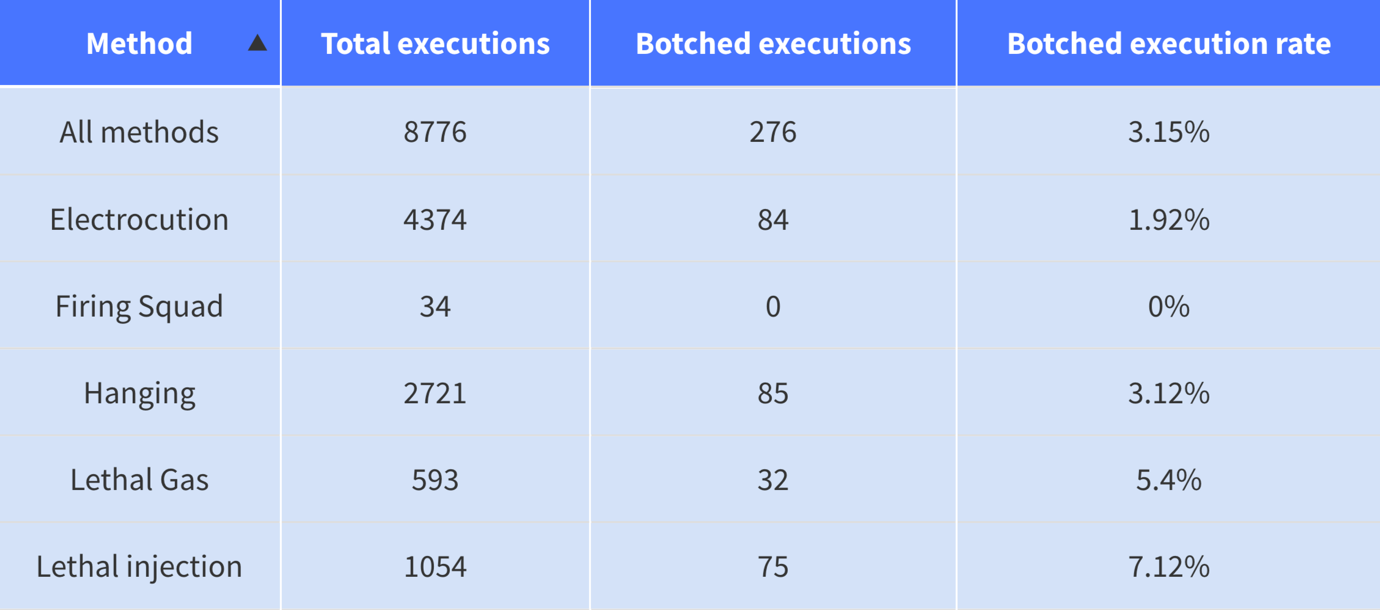
    3. Botched executions: 'Botched executions' are those that did not go as planned, resulting in unnecessary pain for the person charged with death penalty.
    4. Inequities in application: The application of the death penalty is not uniform and can be influenced by factors such as race, gender, and socioeconomic status. This raises concerns about the fairness and impartiality of the justice system.
    5. Retribution vs. rehabilitation: The death penalty is often seen as a form of retribution rather than rehabilitation. This raises ethical questions about whether the state should be seeking revenge or working towards the rehabilitation of offenders.
    6. Cost: The death penalty is often more expensive than life imprisonment. This raises ethical questions about the allocation of resources and whether society should be spending money on a form of punishment that is not proven to be more effective than alternatives.

    Overall, the ethical issues associated with the death penalty are complex and multifaceted. While some argue that it is necessary for justice to be served, others believe that it is a violation of human rights and that alternative forms of punishment should be explored.

    Important Supreme Court Judgments

    • Bachan Singh v. State of Punjab, 1980: Consider aggravating and mitigating factors of crime and the accused. Use Death Penalty only in 'rarest of rare cases'.
    • Machhi Singh v. State of Punjab, 1983: Identify the way the crime was committed, motive, the anti-social nature of the crime, the magnitude of the crime, and the personality of the victim.
    • Shatrughan Chauhan v. Union of India, 2014: Undue, inordinate and unreasonable delay in death penalty execution amounts to torture and a ground for commutation of sentence. 

    Death penalty methods and failure rates

    • The table shows the proportion of botched executions for each method. Data includes only executions in the U.S. from 1890 to 2010.
    ZWq4D12c iGP0rGv9WraJRMW6yVTpypEKhmzR0W jf wJe0DqNOvbUq9Q Lgykj98sArumpARSc0SiBDnggi47L7zFfdyHDrbNYmvApk2HvhOeJsmKrJBcWxu20t LngDQZIp5DF

    There are several alternatives to the death penalty that are used by various countries and jurisdictions around the world.

    Here are a few examples:

    • Life imprisonment without the possibility of parole: This is a sentence in which the offender is kept in prison for the rest of their life, with no chance of release. This is a common alternative to the death penalty in many countries.
    • Restorative justice: This is a process in which the offender is required to make amends for their crime, usually through community service or financial restitution to the victim. This approach focuses on repairing harm rather than punishment.
    • Rehabilitation programs: This involves providing offenders with education, job training, counseling, and other services that can help them reintegrate into society and avoid future criminal behavior.
    • Community service: This is a sentence in which the offender is required to perform a certain amount of community service as a form of punishment.
    • Fines and other monetary penalties: This involve imposing a financial penalty on the offender, which can range from a small fine to a substantial sum of money.
    • Suspended sentence: This is a sentence in which the offender is found guilty but not actually sent to prison. Instead, the sentence is "suspended," which means that the offender is released but must adhere to certain conditions, such as regular check-ins with a probation officer or avoiding further criminal activity.
    • Capital punishment moratorium: This is a temporary or indefinite suspension of the death penalty, which allows time for review and reform of the justice system.

    Overall, there are many alternatives to the death penalty that can be effective in deterring crime, protecting society, and rehabilitating offenders.

    Global Trends

    The use of the death penalty varies greatly around the world. While some countries have abolished it entirely, others continue to use it as a form of punishment for certain crimes. Here are some global practices with regard to the death penalty:

    • Abolitionist countries: As of 2021, 109 countries have completely abolished the death penalty. These countries include Canada, most of Europe, Australia, New Zealand, and many Latin American and African countries.
    • There are still 55 countries that retain the death penalty in law and/or in practice, including the United States, China, Iran, Saudi Arabia, and Vietnam.
    • Some countries that have not abolished the death penalty have imposed a moratorium on executions. This means that while the death penalty is still legal, no executions are being carried out. For example, India has not executed anyone since 2015.
    • The methods used to carry out the death penalty also vary around the world. In some countries, such as the United States, lethal injection is the most common method, while in others, such as Saudi Arabia, beheading is used.
    • The crimes that can result in the death penalty also vary by country. In some countries, such as Iran and Saudi Arabia, crimes such as drug trafficking and apostasy can result in the death penalty, while in others, such as the United States, only certain types of murder can result in the death penalty.

    The ethical implementation of the death penalty requires adherence to certain principles, such as ensuring that the justice system is free of flaws and that laws are properly enforced. To avoid any failures or miscarriages of justice, the criminal justice system must be improved.

    In addition, the judiciary must maintain a consistent approach that takes into account the restorative and rehabilitative aspects of justice in order to avoid any negative consequences that could arise from imposing the death penalty.

    Furthermore, there must be compelling justifications for the imposition of the death penalty in order to avoid excessive punishment and maintain respect for the value of life.

    Finally, the mercy petition must be treated as the final bulwark against any miscarriage of justice, with a time-bound disposal of such petitions to ensure that justice is served.

    NSA Invoked Against Amritpal and Company

    National Security Act (NSA), 1980 which is a preventive detention law as per Article 22(3) of the Indian Constitution has been invoked against Amritpal Singh and his associates for preaching radical anti-India ideals.

    Constitutional Protection on Arrests and Exceptions – Article 22

    • Article 22(1) states that every person who is arrested shall be informed about the grounds of arrest and shall not be denied the right to consult, and to be defended by, a legal practitioner of his choice.
    • Article 22(2) states that Every person who is arrested and detained in custody shall be produced before the nearest magistrate within a period of twenty-four hours of such arrest. 
    • Article 22(3) states that the above mentioned provisions provided under Article 22(1) and Article 22(2) shall not be available to any person:
    1. who for the time being is an enemy alien or 
    2. who is arrested or detained under any law providing for preventive detention. 
    • Thus, police can arrest such persons under preventive detention laws such as National Security Act without formal charge and need not present the accused before the magistrate within 24 hours. 
    • Article 22(4) further states that - No law providing for preventive detention shall authorise the detention of a person for a longer period than three months unless— An Advisory Board (constituted under the Preventive Detention Law) suggests otherwise.   
    • Article 22(5) states that grounds of arrest shall be disclosed to the person arrested under preventive detention law and also provide the person the earliest opportunity of making a representation against the order.   
    • Article 22(6) states that authority making arrest under preventive detention law can withhold disclosure of certain facts regarding grounds of arrest if the authority considers to be against public interest. 
    • Article 22(7) states that Parliament may by law prescribe the circumstances under which, and the class or classes of cases in which, a person may be detained for a period longer than three months under any law providing for preventive detention without obtaining the opinion of an Advisory Board. 
    • Parliament may also prescribe the maximum period for which any person may be detained under such preventive detention law.

    Thus, Article 22 has provided elaborate details and contours for invoking preventive detention laws against persons and accordingly the Parliament has enacted the National Security Act, 1980. 

    Grounds on which National Security Act can be invoked  

    • The Central or State Government can issue detaining order under Section 3 of NSA if is satisfied that: 
      • It is necessary to prevent any person from acting in any manner prejudicial to the defence of India, the relations of India with foreign powers, or the security of India
      • With respect to any foreigner, it is necessary to regulate his/her continued presence in India or with a view to making arrangements for his/her expulsion from India.
    • If according to the Central or State Government, it is necessary to prevent a person from acting in any manner prejudicial to the: 
      • security of the State
      • maintenance of Public order or
      • maintenance of supplies and services essential to the community
      • then central or state government can issue detention orders under NSA. 
    • The District Magistrate or Commissioner of Police can issue arrest warrant under NSA if they are satisfied that situation exists which may affect national security, public order or disrupt essential supplies.

    Constitution of Advisory Board under NSA

    • The Central Government and each State Government shall, whenever necessary, constitute one or more Advisory Boards for the purposes of this Act. 
    • Each Advisory Board shall consist of three persons who are, or have been, or are qualified to be appointed as, Judges of a High Court, and such persons shall be appointed by the appropriate Government. 
    • Among the three members, one of them shall be appointed as the Chairman by the government. 

    Procedure to be Adopted by the Advisory Board 

    • The Advisory Board shall consider the materials placed before it but can also ask for other information from the government which it thinks necessary. 
    • The Board shall hear the accused in person but without any legal representation. 
    • The Board shall submit its report to the appropriate government and in a separate part specify whether or not further detention is needed.
    • When there is a difference of opinion among the members, the opinion of the majority of such members shall be deemed to be the opinion of the Board.
    • The proceedings of the Advisory Board and its report, except that part of the report in which the opinion of the Advisory Board is specified, shall be confidential.  

     Maximum Period of Detention – NSA

    • The maximum period for which any person may be detained in pursuance of any detention order which has been confirmed shall be twelve months from the date of detention.
    • However, the central or state government may revoke or modify the detention order at any earlier time.  

    Concerns – Application of Preventive Detention Laws like NSA

    • Under preventive detention laws, there is no need to inform the accused immediately of grounds of arrest. 
    • The authorities may withhold disclosure of grounds of arrests
    • Arrested person need not be produced before Court within 24 hours as per normal norms. 
    • For cases referred to  Advisory Boards under NSA
      • there is no public hearing involved and no guaranteed oral hearing for the person detained. 
      • The accused cannot be represented through a lawyer of their choice
    • Preventive Detention laws can be used to suppress freedom of expression of journalists, political opponents, RTI activists etc. especially voicing concerns against policies or legislations of the government. 
    • At times, preventive detention laws are used to cover normal crimes as this largely reduces the legal assistance of detainees.      

    Way Forward 

    If any person is arrested under NSA, then the only recourse available lies in filing writ petitions in High Court or Supreme Court for release of such person.

    Thus, procedural fairness should be incorporated under NSA and other preventive detention laws because under the present system, the balance always tilts in favour of the government in such cases.

    Adultery and court martial proceedings

    Constitution Bench of the Supreme Court has observed that Joseph Sine Judgment (2018) which declared provisions related to adultery as unconstitutional will not impact court martial proceedings initiated against personnel serving the armed forces for adulterous conduct. Based on this observation, the Union of India has sought clarifications from the Court on the application of special legislation for armed forces made under Article 33 of the Indian Constitution which governs their conduct of service.

    Article 33 – fundamental rights

    Article 33 - Power of Parliament to modify the rights conferred by this Part in their application to Forces, etc. - Parliament may, by law, determine to what extent any of the rights conferred by this Part shall, in their application to,— the members of the Armed Forces; or the members of the Forces charged with the maintenance of public order; or persons employed in any bureau or other organisation established by the State for purposes of intelligence or counter intelligence; or person employed in, or in connection with, the telecommunication systems set up for the purposes of any Force, bureau or organisation referred to in clauses (a) to (c), be restricted or abrogated so as to ensure the proper discharge of their duties and the maintenance of discipline among them.    

    Provisions on Adultery    

    Section 497 of Indian Penal Code defines Adultery Whoever has sexual intercourse with a person who is and whom he knows or has reason to believe to be the wife of another man, without the consent or connivance of that man, such sexual intercourse not amounting to the offence of rape, is guilty of the offence of adultery, and shall be punished with imprisonment of either description for a term which may extend to five years, or with fine, or with both. In such case the wife shall not be punishable as an abettor.
    Screenshot 2023 03 13 at 3.55.50 PM
    As per Section 198 (2) of Code of Criminal Procedure, only the aggrieved husband could file the case of Adultery against another man who had sexual intercourse with his wife without his consent.       

    Recommendations of Committees on adultery    

    • 42nd Law Commission Report and Justice Malimath Committee had suggested that offence of adultery be amended to include wife liable for the offence of adultery.    
    • This will not only remove the arbitrariness but
    • would also make the law gender neutral      

    as same punishment shall be given to both the man and woman for the offence of adultery.   

    • However, Madhav Menon Committee and National Commission of Women had suggested for the removal of adultery from criminal offence and make it a social wrong.            

    constitution bench judgment -  Joseph Shine v Union of India – 2018

    • The petition challenged the constitutionality of the offence of adultery under Section 497 of the IPC read with Section 198(2) of the Criminal Procedure Code, 1973 and also pleaded to make the provision gender neutral.
    • The Supreme Court struck down Section 497 of the IPC on the grounds that it violated Articles 14, 15 and 21 of the Constitution.
    • The Court held that Section 497 pertaining to Adultery was archaic, arbitrary and paternalistic and infringed upon a woman’s autonomy, dignity, and privacy.
    • The Court held that adultery can be ground for civil issues including dissolution of marriage but it cannot be a criminal offence.     
    • Section 198(2) of the Cr.PC which allowed only a husband to bring a prosecution under Section 497 of the IPC was also struck down as unconstitutional.
    • This decision overruled the Court’s previous decisions in Yusuf Abdul Aziz vs. State of Bombay (1954 SCR 930), Sowmithri Vishnu vs. Union of India ((1985) Supp SCC 137) and Vishnu Revathi vs. Union of India ((1988) 2 SCC 72) where the constitutional validity of Section 497 was upheld.   

    questions posed before the supreme court  on  regulating the conduct and behaviour of armed force personnels

    • Department of Military Affairs under Ministry of Defence has sought clarifications from the Supreme Court on the following issues:
    • Should persons subject to Army Laws made under Article 33 being a distinct class of persons be subjected to provisions of adultery under Section 497 of IPC?  
    • Can an exception in regard to application of Section 497 of the IPC for persons subject to Army Act be made?
    • Whether the adulterous acts be allowed to be governed by the provisions of Army Act, Navy Act or Air Force Act irrespective of the 2018 Joseph Shine Judgment by treating it as an abrogation of Fundamental Rights under Article 33.
    • In view of Article 33 of the Constitution, whether the 2018 judgment would prevent the Armed Forces from proceeding against a person subject to the Army Act, who is guilty of what would in effect be an adulterous act.
    • Whether an adulterous relationship by a male or a female in the army, navy or airforce be initiated under special laws (made under Article 33) considering the requirements of discipline and proper discharge of their duty?
    • Armed Forced do not differentiate between man and woman - Government argued that unlike Section 497 of IPC, the Armed Forces do not make a difference between a man and a woman, who is subject to the Army Act, if they are guilty of an offence.
    • Reasons to restrict Fundamental Rights under Article 33 - There was a reason why the framers of the Constitution had authorised Parliament to restrict or abrogate certain FR in their application to armed forces to ensure proper discharge of duties and maintenance of discipline.  

    Supreme Court’s Observation

    • Joseph Shrine Not Concerned with Article 33 - On the issue of applicability of Joseph Shine case o Armed Forces, Supreme Court observed that Joseph Sine was not concerned with the provisions of Armed Forces Acts legislated under Article 33 of the Indian Constitution.
    • Exemptions can be provided under Article 33 - The bench further noted that as per Article 33 of the Constitution, the legislations governing armed forces can provide exemptions from the applicability of fundamental rights.
    • The Constitution Bench has reserved its judgment dated 31-01-2023 on the issue pertaining to an application filed by the Department of Military Affairs seeking clarification of the Constitution Bench judgment dated 27-09-2018 Joseph Shine v. Union of India.

    Disciplinary Proceedings Must Have Direct Nexus with Performance of Duties

    In various cases post Joseph Shine Judgment in 2018, the constitutional courts have tried to differentiate personal and public activities including cases of promiscuity or adultery.

    • Mahesh Chand Sharma versus State of Rajasthan and Others (2019) - Rajasthan High Court set aside the departmental proceedings against the petitioner serving as an inspector in Rajasthan Police for illicit relation with one woman constable and had also ‘begotten a child from illicit relations’.   
    • Moral Policing Not Allowed by Employer - No employer can be allowed to do moral policing on its employees which goes beyond the domain of his public life.
    • Personal choices and selections (to have sexual intercourse) cannot be a subject matter of departmental proceedings under the Service Conduct Rules.    
    • Maheshbhai Bhurjibhai Damor versus State of Gujarat -Gujarat High Court quashed and set aside the dismissal order of an armed police constable arising from allegations that he had developed illicit relations with a widow which amounted to misconduct
    • Allegations Must have Direct Nexus with Duties Performed – The Court held that in order to prove misconduct, allegations must have some nexus, direct or indirect, with the duties to be performed by the government servant. 
    • Affair not misconduct under Conduct Rules - alleged act was a private affair and not a result of any coercive pressure. Hence, the act of the petitioner at the most could be considered as an immoral act and cannot be considered as misconduct under the Service Rules.

    Way Forward

    As of now the Supreme Court has reserved the judgment on the application of adultery provisions as misconduct under specific legislations. However, considering the High Courts judgments post Joseph Shine judgment, it has maintained strict separation between public and private affairs and misconduct proceedings can only be initiated if the alleged act has a direct nexus with the duties to be performed by the public servant.