Context: Increasing number of states have been filing cases against the Central Government in the Supreme court under the provisions of original jurisdiction of the Supreme Court as provided for in the Indian Constitution.
AboutOriginal Jurisdiction of the Supreme Court
Article 131 of Indian Constitution provides for the original jurisdiction of Supreme Court in following cases of dispute:
(a) Between the Centre and one or more states; or
(b) Between the Centre and any state or states on one side and one or more other states on the other side; or
(c) Between two or more states.
In the above federal disputes, the Supreme Court has exclusive original jurisdiction. Exclusive means, no other court can decide such disputes and original means, the power to hear such disputes in the first instance, not by way of appeal.
Conditions for filing cases under original jurisdiction of the Supreme Court:
One, the dispute must involve a question (whether of law or fact) on which the existence or extent of a legal right depends. Thus, the questions of political nature are excluded from it.
Two, any suit brought before the Supreme Court by a private citizen against the Centre or a state cannot be entertained under this.
Further, this jurisdiction of the Supreme Court does not extend to the following:
A dispute arising out of any pre-Constitution treaty, agreement, covenant, engagement, Sanad or other similar instrument.
A dispute arising out of any treaty, agreement, etc., which specifically provides that the said jurisdiction does not extend to such a dispute.
Inter-state water disputes.
Matters referred to the Finance Commission.
Adjustment of certain expenses and pensions between the Centre and the states.
Ordinary dispute of Commercial nature between the Centre and the states.
Recovery of damages by a state against the Centre.
Note: In 1961, the first suit, under the original jurisdiction of the Supreme Court, was brought by West Bengal against the Centre. The State Government challenged the Constitutional validity of the Coal Bearing Areas (Acquisition and Development) Act, 1957, passed by the Parliament. However, the Supreme Court dismissed the suit by upholding the validity of the Act.
Context: Government had established a committee under the Chairmanship of Former President Ramnath Kovind and other legal luminaries to evaluate the need, challenges and suggest practical reforms for operationalisation of simultaneous elections at the level of the House of the People (Lok Sabha), State Legislative Assemblies and Local bodies such as Panchayats and Municipalities.
Suggestions by Ramnath Kovind Committee on Operationalisation of Simulataneous Elections
Government must develop a legally tenable mechanism to restore the cycle of simultaneous elections.
Proposed Mechanism by the Committee:
Step 1: Simultaneous elections to Lok Sabha and State Legislative Assemblies should be held.
Step 2: Elections to Municipalities and Panchayats will be synchronized with Lok Sabha and State Legislative Assemblies n such a way that elections to Municipalities and Panchayats are held within a hundred days of elections of Lok Sabha and State Legislative Assemblies.
Proposal for bring synchronisation between the House of People and State Legislative Assemblies:
President, may by notification, issued on the date of first sitting of House of the People (Lok Sabha) after a General Election. The date of this notification shall be called the Appointed date.
Tenure of all State Legislative Assemblies, constituted by elections to State Legislative Assemblies after the Appointed Date and before the expiry of the full term of Lok Sabha, shall be only for the period pending up to the subsequent General elections to the Lok Sabha. (ie Tenure of State Legislative Assemblies will be full term of the House of People).
Thereafter, all General elections to Lok Sabha and all State Legislative Assemblies shall be held simultaneously.
Proposal for enabling simultaneous elections in Constitutional Local Bodies (Panchayats & Municipalities with Lok Sabha and State Legislative Assembly): (Introduction of Article 324A) This Constitution Amendment should be introduced for enabling simultaneous elections in Panchayats and Municipalities with General elections of Lok Sabha and State Legislative Assemblies.
Solution to Hung House, No-Confidence Motion or Defection:
In the event of a hung house, no-confidence motion or any such events, fresh elections may be held to constitute the new House. However, the tenure of the newly House of People or State Legislative Assembly will be only for the unexpired term (or remaining term) of the immediately preceding full term of House of People. After the expiration of this remaining term, there will be dissolution of the House.
Similarly, where fresh elections are held for State Legislative Assemblies, then such new Legislative Assembly unless sooner dissolved, shall continue up to the end of the full term of the House of People.
These changes will require amendments Article 83 (Duration of Houses of Parliament) and Article 172 (Duration of State Legislatures). This Constitution Amendment will not need ratification by the States.
Single Electoral Roll and Single Elector's Photo Identity Card: (Amendment of Article 325) Required for enabling Single Electoral Roll and Single Elector's Photo Identity Card (EPIC), which shall be prepared by ECI in consultation with State Election Commission. This Single Electoral Roll will substitute any other electoral roll prepared by ECI under Article 325 or State Election Commission (SEC) under Article 243K and 243ZA of Indian Constitution. This amendment to the Constitution will require ratification by more than 50% of State Legislative Assemblies.
Addressing of Logistical Challenges:
For Simultaneous elections to Lok Sabha and State Legislative Assemblies: For making logistical arrangements for conduct of simultaneous elections to the House of People and State Legislative Assemblies, the ECI may estimate in advance for the procurement of equipment such as EVMs and VVPATs, deployment of polling personnel and security forces and make other arrangements.
For elections to Municipalities and Panchayats: State Election Commission in consultation with Election Commission of India may estimate in advance for procurement of equipment such as EVMs & VVPATs, deployment of polling personnel and security forces.
Context: The destruction caused by Cyclone Michaung in Tamil Nadu has resulted in Tamil Nadu Government demanding extra funds from the Central Government to meet the relief and reconstruction demands. Tamil Nadu has been demanding declaring Cyclone Michaung as a 'National Disaster'. Central Government has replied that there is no provision in the current disaster management financing framework which allows for declaration of disaster as a national disaster. Centre has agreed to send team to assess the damage in Tamil Nadu to provide excess grants to Tamil Nadu government from the NDRF. All this brought about the issue of Disaster Financing in India into spotlight.
Disaster Financing in India
The mechanism of disaster risk financing in India reflects the distribution of responsibility in respect of disaster management.
State Governments respond immediately to disasters - organizing rescue, evacuation and relief and providing people with assistance. After the disaster event, the responsibility for recovery and reconstruction also lies primarily with State Governments.
State Governments incur most of the expenditure on disaster management. These expenditures are met through SDRF. When States exhaust their SDRF resources, they can request financial assistance through the NDRF by submitting memorandums to the Union Government.
Union Government extends secondary support to states through deploying the National Disaster Response Fund and armed forces at the request of State Governments. NDRF replenishes and reinforces the State funds following a set of guidelines.
Climate change is expected to significantly increase the frequency of adverse weather events severely increasing magnitude of disasters. India has been witnessing many large-scale floods (Tamil Nadu, Kerala); Cyclones (Tamil Nadu, Andhra Pradesh); droughts and floods. This necessitates focusing on disaster management.
Funds created by Disaster Management Act, 2005
Disaster Management Act, 2005 lays down the framework for disaster financing in India. The act establishes the following funds:
National Disaster Relief Fund (NDRF): In the event of a calamity of a severe nature, where the requirement of funds for relief operations is beyond the funds available in the State’s Disaster Response Fund account, additional Central assistance is provided from National Disaster Response Fund. State Government is required to submit a memorandum indicating the sector wise damage and requirement of funds. On receipt of the memorandum from the State, an inter-Ministerial Central Team is constituted and deputed for an on-the-spot assessment of damage and requirement of funds for relief operations, as per the extant items and norms of State Disaster Response Fund and National Disaster Response Fund.
State Disaster Relief Fund (SDRF): States contribute 25% of funds of SDRF and rest is provided by Central Government. The State Disaster Response Fund shall be used only for meeting the expenditure for providing immediate relief to the victims of cyclone, drought, earthquake, fire, flood, tsunami, hailstorm, landslide, avalanche, cloud burst, pest attack, frost, and cold wave.
National Disaster Mitigation Fund (NDMF) & State Disaster Mitigation Fund (SDMF): Though provided in the Disaster Management Act, 2005, yet these funds had not been operationalised. 15th Finance Commission has recommended for the constitution of NDMF and SDMF. The Mitigation Fund would be used for local level and community-based interventions to reduce disaster risks and promote environmentally friendly settlements.
Concerns with the present disaster financing framework
Lack of focus on Mitigation: Allocations made through the SDRF and NDRF help governments meet their contingent liabilities in the face of disaster. However, these allocations do not help in reducing contingent liabilities. Mitigation refers to minimizing of adverse impact of a hazardous event by undertaking both structural and nonstructural measures.
Lack of flexibility for states: Current guidelines for providing relief from the SDRF and NDRF are determined by the Central Government. States have been demanding greater flexibility for their unique needs of certain areas, especially remote and hilly terrains.
Limited list of disasters eligible: Many State Governments have been arguing for widening the scope for inclusion of several calamities in the eligible list of disasters for funding support from the SDRF and NDRF. However, most of these calamities are State-specific or region-specific and can be difficult to quantify. For ex. Heatwaves, river and coastal erosion, fire hazards, lightning deaths are not eligible for ex gratia assistance.
Limited quantum of funds allocated to SDRF and NDRF: Current practice of allocating funds to SDRF and NDRF is based on past expenditures incurred by States and Union government on Disaster Management and Relief. The expenditure-based approach tends to favour better off states, which can allocate resources and show higher expenditures. Risk and vulnerability to disasters are currently not taken into consideration.
Inability of states to meet matching grants towards SDRF: Mandates relating to operating of disaster-related funds require the States to transfer their matching share towards the SDRF along with Union's share received by them. However, some States do not make transfers into the public account maintained by them in a timely manner. This results in inadequate funds being available with States to tackle disasters of a severe nature and they seek additional central assistance from the NDRF.
Exclusion of long-term or permanent restoration works from the ambit of NDRF/SDRF: Existing norms for disaster relief from SDRF and NDRF do not provide sufficient funds for reconstruction of housing and infrastructure, resettlement of people from floodplains, coastal and hilly areas. This force states to look after World Bank or Central Government for long term resettlement and recovery efforts.
Slow process: Current process of assessment for the determination of Union assistance through the NDRF as well as its release is slow. Often funds required for disaster relief is required immediately, especially after severe disasters.
GST regime: NDRF was financed by National Calamity Contingent Duty (NCCD). However, a substantial amount of NCCD has been subsumed under the GST. NCCD is currently being levied on very few products such as Tobacco and crude petroleum. This leaves very less fiscal space for the Union Government to finance NDRF. Thus, the central government will have to incur additional fiscal deficit for financing NDRF.
Recommendations for strengthening disaster financing in India
Focus on disaster mitigation: NDMF and SDMF should be operationalised which should amount for 20% of overall funds allocated to NDRF and SDRF.
Risk based fund allocation: Allocation to SDRF should be a combination of capacity (as reflected by expenditure), risk exposure (area and population) and hazard and vulnerability (risk index).
Separate window for long-term reconstruction: A separate Recovery and Reconstruction facility should be created with SDRF and NDRF with about 30% allocation. This will help people affected by disasters on a long-term basis.
Separate window for capacity building: Current disaster financing mechanism overlooks capacity building required to effectively respond to disasters in the States. Capacity building measures like early warning systems and emergency equipment etc. are essential for effective disaster management. Thus, a separate window for capacity building should be created in SDRF and NDRF.
Constitution of District level Disaster Response and Mitigation Funds: State Government can allocate resources to districts for preparedness and mitigation of disaster on an annual basis.
Using flex-fund component of CSS towards disaster management: States hit by severe disaster should be permitted to use more than the 25% flexi-fund component of centrally sponsored schemes to carry out post-disaster permanent restoration works.
Mainstreaming disaster insurance pool: After the liberalisation of India's insurance industry, it is essential to leverage insurance sector to substantially reduce the financial burden of disaster management by households, particularly well-to-do ones.
Context: NITI Aayog has conceived an initiative focused on developing city regions are growth hubs.
About Growth Hub Program of NITI Aayog
To leverage urbanisation for economic growth, NITI Aayog has conceived developing city-regions as growth hubs.
The program endeavors to forge a robust economic growth strategy for city-regions across India and prepare a roadmap for achieving the same.
Under the initiative, NITI Aayog will work in close collaboration with the State governments.
During the initial stage, four city regions will be taken up on a pilot basis to develop a template for devising an economic strategy. Later, 16 more cities will be taken up.
The economic strategy template will act as the model strategy for other city-regions across the country for achieving desired economic targets.
Economy growth strategy for cities: Under the program, a roadmap for developing economic growth strategy will be developed for each city region.
For developing this following activities will be taken up:
Comprehensive baseline assessment of city region's economy
SWOT analysis for understanding the strengths and challenges of the region
Identification of growth drivers, setting economic goals
Designing policy enablers
Proposing governance structure for projectization of proposed strategies
Initial focus cities: Mumbai, Surat, Vishakhapatnam have been identified.
Significance of developing economic potential of urban areas
Urban areas hold immense potential to drive economic advancement to achieve the target of making India a developed country with a GDP $35-$45 trillion economy target by 2047.
GDP of several major city, regions worldwide appears to match the GDP of entire countries. This intriguing trend reflects urban centers' growing economic prominence and vitality, highlighting their pivotal role in shaping the country's economic development.
Indian cities also hold the potential to propel unparalleled economic growth which needs to be realised. While the government is exploring multiple pathways at all levels to achieve this target, strategizing \for transforming city regions into mega economic growth hubs is crucial.
Context: Tamil Nadu government said it would move the Supreme Court over its due share of Cauvery water from Karnataka, as the neighbouring State has refused to share the water with Tamil Nadu.
About Cauvery River
The river has a total length of around 802 km, and a catchment area of 81,155 sq. km, of which 2,866 sq.km. lie in Kerala, 34,273 sq.km. in Karnataka and 44,016 sq.km. in Tamil Nadu.
Flow of Cauvery
Cauvery, the Ganga of the South, rises at Thalakaveri, in the Brahmagiri range of hills of the Western Ghats, in Karnataka.
It receives the Harangi which has been dammed North-West of Mysore.
Two other tributaries-Hemavathy and Lakshmana-theertha join the Cauvery into the Harangi reservoir.
The main river continues to flow Eastwards up to Sreerangapatnam and then changes its course South-East wards.
Then it receives Kabini, an important tributary that originates in the Wyanad district of Kerala.
Then, it joins with Suvarnavathy and takes a North-Easterly direction, passing the Eastern Ghats at Sivasamudram.
At Sivasamudram, after flowing through a very narrow gorge, it continues its East-ward journey and forms the boundary between the States of Karnataka and Tamil Nadu for about 64km.
Below Sivasamudram, it receives the Shimsha, and then Arkavathy, just before entering the territory of Tamil Nadu.
In Tamil Nadu, the river Cauvery continues to flow Eastwards up to Hogenakal Falls and takes a Southerly course and enters the Mettur reservoir.
It leaves the Eastern Ghats below Mettur and is joined by Bhavani downstream.
Cauvery takes a more Easterly course after that and is joined by Noyil, and then by Amaravathy.
Amaravathy, an important tributary of the Cauvery, has its origin in Kerala, where it is known as Pambar, and carries rich flows in Kerala.
Below Tiruchirappalli, the Cauvery splits into two branches, which are controlled by the Upper Anicut.
The Northern branch, called the Coleroon flows in a North-Easterly direction to enter the Bay of Bengal near Porto Novo.
The Southern branch, however, continues to trek under the name of Cauvery itself. It further divides into Cauvery and Vennar below the Grand Anicut.
The Cauvery branch descends into the Bay at Pompuhar, North of Tranqobar as an insignificant stream.
The Dispute between Karnataka and Tamil Nadu
The Cauvery water sharing dispute, dating back to the British Raj, remains a contentious issue between Karnataka and Tamil Nadu. Many of the districts in both states are dependent on the Cauvery for irrigation.
The Cauvery water dispute emerged in 1892 between British-ruled Madras Presidency and the princely state of Mysore over water sharing.
In 1910, the two states began conceptualising the idea of constructing reservoirs to store the river water.
The 1924 agreement presided over by the British gave Madras Presidency and the Mysore state the right to use surplus water from river Cauvery.
As per the agreement in 1924, Tamil Nadu and Puducherry would get 75% of the surplus water, while Karnataka would get 23%. The remaining would go to Kerala.
There were also restrictions on how much land could be irrigated.
Post-Independence
The challenge of water sharing escalated following the state reorganization in 1956:
Through the late 20th century, Tamil Nadu was opposed to the construction of dams on the river by Karnataka.
Karnataka contended that the 1924 agreement's 50-year term expired in 1974, freeing the state from adhering to the regulations, especially since the river originated in the state.
Between 1960 and late 1980s, Karnataka built four dams on Cauvery – Hemavati, Harangi, Kabini and Suvarnavathy.
This became a problem for Tamil Nadu as the state had become dependent on Cauvery water especially huge area of agricultural land in the delta area.
Involvement of Supreme Court (SC) and Tribunal
Tamil Nadu argued that being the lower riparian state put them in a precarious situation and approached the Supreme Court (SC).
Karnataka government’s arguments
Karnataka argued that river water sharing should follow international norms to divide the water in equal proportions.
Karnataka proposed a 47% water allocation for each state, with the remaining divided equally between Kerala and Puducherry.
Tamil Nadu government’s arguments
Tamil Nadu wanted to stick to the 1924 agreement.
In 1986, Tamil Nadu's farmers urged the SC for a tribunal to address water sharing.
In 1990, the SC directed the Centre to establish a tribunal for inter-state water distribution.
The Cauvery Water Disputes Tribunal (CWDT) assessed 1980-1990 water inflow to Tamil Nadu.
In 1991, it ordered Karnataka to provide 205 tmcft annual water and cease irrigated land expansion.
Karnataka rejected the tribunal’s award and sought an annulment in the Supreme Court.
The SC struck down the state’s ordinance attempting to nullify the award and went on to uphold the tribunal’s order.
After which Karnataka said that the state was facing drought and hence could not release water.
The 1998-formed Cauvery River Authority (CRA), which included the Prime Minister as Chairperson and the Chief Ministers from four states as members, enforced CWDT's interim order.
Cauvery Water Disputes Tribunal in 2007 gave out its final award.
CWDT directed Karnataka to release 192 tmcft annually, including 182 tmcft for Tamil Nadu with 10 tmcft for environment, at Billingundlu border.
In a distress year, allocated shares shall be proportionately reduced among Kerala, Karnataka, Tamil Nadu and Puducherry.
Constitutional provisions
Part XI of the constitution under the title Relations between the Union and the States provides for Disputes relating to Waters.
Article 262: Adjudication of disputes relating to waters of inter-State rivers or river valleys.
Parliament may by law provide for the adjudication of any dispute or complaint with respect to the use, distribution or control of the waters of, or in, any inter-State river or river valley.
Notwithstanding anything in this Constitution, Parliament may by law provide that neither the Supreme Court nor any other courtshall exercise jurisdiction in respect of any such dispute or complaint as is referred to in clause (1).
Seventh Schedule
Entry 56 of List I: Regulation and development of inter-State rivers and river valleys to the extent to which such regulation and development under the control of the Union is declared by Parliament by law to be expedient in the public interest.
Entry 17 of List II: Water, that is to say, water supplies, irrigation and canals, drainage and embankments, water storage and water power subject to the provisions of entry 56 of List I.
Provision used by Courts
Tamil Nadu filed a preliminary complaint in 2001 of Article 131, in which it stated that interim measures were not effectively regulated.
The States of Karnataka, Tamil Nadu and Kerala, disturbed by the decision of the Cauvery Water Dispute Tribunal in 2007, have applied for a special permit pursuant to Article 136. The Supreme Court accepts them.
Article 131: Original jurisdiction of the Supreme Court
Subject to the provisions of this Constitution, the Supreme Court shall, to the exclusion of any other court, have original jurisdiction in any dispute
Between the Government of India and one or more States;
Between the Government of India and any State or States on one side and one or more other States on the other;
Between two or more States
Art 136: Special leave to appeal by the Supreme Court
Notwithstanding anything in this Chapter, the Supreme Court may, in its discretion, grant special leave to appeal from any judgment, decree, determination, sentence or order in any cause or matter passed or made by any court or tribunal in the territory of India.
Nothing in clause (1) shall apply to any judgment, determination, sentence or order passed or made by any court or tribunal constituted by or under any law relating to the Armed Forces.
Inter-State River Water Disputes Act, 1956
In Pursuant to the power conferred by the Constitution under Article 262, Parliament has enacted the Inter-State Water Disputes Act, 1956. Following are Its main features:
Filing of dispute: A State Government which has a water dispute with another State Government requests the Central Government to refer the dispute to a tribunal for adjudication.
Scope for negotiations: The Central Government, if it is of the opinion that the dispute cannot be settled by negotiation, refer the dispute to a Tribunal.
Tribunal and its composition: As laid down by the act It consists of a chairman and two other members, nominated by the Chief Justice of India from among persons who, at the time of such nomination, are Judges of the Supreme Court or High Court.
Appointment of Assessor: Central government in consultation with the Tribunal can appoint assessors to advise it in the proceedings before it.
Investigation and Report: With the reference being made by the Central Government, the Tribunal investigates the matter and makes its report, embodying its decision. The decision is to be published by the centra government and is to be final and binding on the parties.
Bar on Courts: Jurisdiction of the Supreme Court and other courts, in respect of the dispute referred to the Tribunal, is barred.
Formulation of scheme: Central Government may frame a scheme, providing for all matters necessary to give effect to the decision of the Tribunal. It can provide for establishing an authority for implementing the scheme. (Section 6A)
Dissolution of Tribunal: The Central Government dissolves the Tribunal after it has forwarded its report and the Central Government is satisfied that no further reference to the Tribunal would be necessary.
The River Boards Act 1956
The River Boards Act, 1956, provides for the establishment of River Boards, for the regulation and development of inter-State rivers and river valleys.
Establishment: The Central Government can establish a Board for “advising the Government of state”when a request is received from a State Government or otherwise.
Establishment: The established board deals in relation to matters concerning the regulation or development of an inter-State river or river valley, or any specified part as notified by the Central Government.
Different Boards may be established for different inter-State rivers or river valleys.
The Board consist of the Chairman and such other members as the Central Government thinks fit to appoint.
The appointed member must have special knowledge and experience in irrigation, electrical engineering, flood control, navigation, water conservation, soil conservation, administration or finance.
Functions of the Board: As set out in the Act, they are very wide, covering conservation of the water resources of the inter-State river, schemes for irrigation and drainage, development of hydro-electric power, schemes for flood control, promotion of navigation, control of soil erosion and prevention of pollution.
All functions of the Board are advisory and not adjudicatory.
The Board is directed to consult all the Governments concerned and to secure agreement among such governments, as far as possible. (Section 14(3))
Formulation of scheme: The Board is empowered to frame schemes, obtain comments from the interested Governments and finalise a scheme. (Section 15(2)).
The schemes so framed are not mandatory to implement, they are of an advisory nature. (Section 15(5)).
Central Assistance: The Central Government can “assist the state Governments interested”, in taking such steps as may be necessary, for execution of the scheme. (Section 15(6))
Arbitration: The act provides for arbitration in the listed matters where any dispute or difference arises between two or more Government interested. (Section 22)
Context: The Kerala Assembly passed a resolution urging the Centre to rename the state as “Keralam” in the Constitution and all office records.
Arguments by Kerala Government to change the name
The name of the State is Keralam in Malayalam language.
The need to unite Kerala for the Malayalam-speaking communities has been strongly evident since the time of the national freedom struggle and even reflected in the linguistic reorganisation of the states.
Origin of the name
The earliest epigraphic record that mentions Kerala is emperor Asoka’s Rock Edict II of 257 BC. The inscription refers to the local ruler as Keralaputra (Sanskrit for “son of Kerala”).
About ‘Keralam’, it is believed to have originated from ‘Cheram’.
The origin of the term Cheram could possibly be from the root ‘cher’, which means to join. This clears the meaning in the compound word ‘Cheralam’, in which alam means region or land.
Constitutional Provisions
According to constitution of India parliament has the power to change the name of a state under Article 3.
Article 3 of the constitution
Formation of new States and alteration of areas, boundaries or names of existing States:
Parliament may by law—
Form a new State by separation of territory from any State or by uniting two or more States or parts of States or by uniting any territory to a part of any State
Increase the area of any State
Diminish the area of any State
Alter the boundaries of any State
Alter the name of any State
- Provided that no Bill for the purpose shall be introduced in either House of Parliament except on the recommendation of the President and unless, where the proposal contained in the Bill affects the area, boundaries or name of any of the States.
- Provided the Bill has been referred by the President to the Legislature of that State for expressing its views thereon within such period as may be specified in the reference or within such further period as the President may allow and the period so specified or allowed has expired.
- According to Article 4 which deals with Laws made under articles 2 and 3 to provide for the amendment of the First and the Fourth Schedules and supplemental, incidental and consequential matters provides that law made under Article 2 and 3 shall not be deemed to be an amendment of this Constitution for the purposes of article 368.
Procedure to change the name of a state
A bill with the intent to change the name of the state can be presented in Parliament or State Legislative Assembly of the concerned state for such alterations.
In Parliament, the bill cannot be presented without a recommendation from the President.
The bill should be represented to the Legislative Assembly of the state concerned to present its views on the bill within the prescribed time period. This Consultative mechanism provided helps in maintaining the spirit of federalism
The views or suggestions of the State Legislature are not binding to the President or The Parliament. After receiving the suggestions of the State Legislative Assembly or after the expiration of the limited time period the bill goes back to Parliament. Then the bill gets further deliberated upon in Parliament.
The bill, like any ordinary bill, must be passed with a simple majority.
The bill is next sent for assent to the President.
After the approval is given by the President. The Act will be enforced, and the name of the state will be changed.
Context: The Supreme Court will decide the constitutionality of the Presidential Orders that removed Jammu and Kashmir’s special constitutional status under Article 370.
Article 370
Article 370 was inserted in the twenty-first part of the constitution that proclaimed it to be Temporary, Transitional and Special Provision.
It provided for a special status to Jammu and Kashmir, which was granted to it through the Presidential Order of 1954.
According to it Jammu and Kashmir have a constitution of their own.
The Centre must take the concurrence of the state's constituent assembly before passing any legislation or an act on the state.
The boundary of the state and name cannot be altered under Article 3 of the Indian Constitution.
The President is empowered to make an order to amend or abrogate the article, but he can only do this with consent of the state's constituent assembly.
The amendment concerning Article 368 will only be applicable when it is applied by the President's order.
In Article 370(3), the President may declare Article 370 to be inoperative but for this he requires the consent of the constituent assembly of the state.
On 5 August 2019, the Government of India issued a Presidential Order superseding the 1954 order and making all the provisions of the Indian constitution applicable to Jammu and Kashmir.
The order was based on the resolution passed in both houses of India's parliament. A further order made all the clauses of Article 370 except clause 1 to be inoperative.
Issue with abrogation
State of J&K historically represented a unique relationship unlike princely states like Hyderabad, Junagarh etc. which integrated into the Union.
Article 370 cannot be revoked, as concurrence of constituent assembly was necessary according to the constitution of India.
The Governor took on the role of the ‘State government’ after keeping the State Legislative Assembly in suspended animation who lack the representation of state.
There is a fear that this will threaten the local culture of the state by increasing the inflow from the other states.
Arguments in favour of abrogation
The Constituent assembly is not a permanent body like parliament so the provision making the Constituent Assembly’s ‘recommendation’ necessary before abrogation has no application at present.
Article 370 was mentioned in the Constitution only as a “temporary” provision and not with other permanent features.
This abrogation will realise the true spirit of unity and lead to the economic benefits and development of the J&K state.
This may decrease the separatism and terrorism tendencies prevailing in the state.
Court cases
Sampat Prakash v. Jammu & Kashmir (1968)
The Supreme Court said:
Article 370 will only dissolve upon the recommendation of the Constituent Assembly under Article 370(3).
The power to issue orders includes the power to add, amend, vary or rescind them.
SBI v. Santosh Gupta (2016)
The Supreme Court overturned the J&K high court judgment, holding that Parliament had legislative competence to enact the provisions because India’s Constitution is superior to Jammu & Kashmir’s.
The court held that Article 370(1)(b) does not limit Parliament’s power because the Constitution of India is applicable to Jammu & Kashmir via the 1954 Presidential Order.
With population given a higher weightage over performance, the revenue-sharing formula has created friction between States and the Centre.
Southern states feel that horizontal distribution of net proceeds by the Centre as per formula suggested by 15th Finance Commission are “inequitable”, putting them at a disadvantage vis-a-vis Northern states.
Facts:
The Centre’s tax collections are pooled-in from States and a part of it is distributed among them, based on the Finance Commission’s (FC) formula.
The share of taxes that each state gets is decided by a formula. The largest weight in this formula is given to what is called the “income distance” parameter, which is essentially the inverse of the per capita income of a state. Thus, the lower the per capita income, the more the state gets.
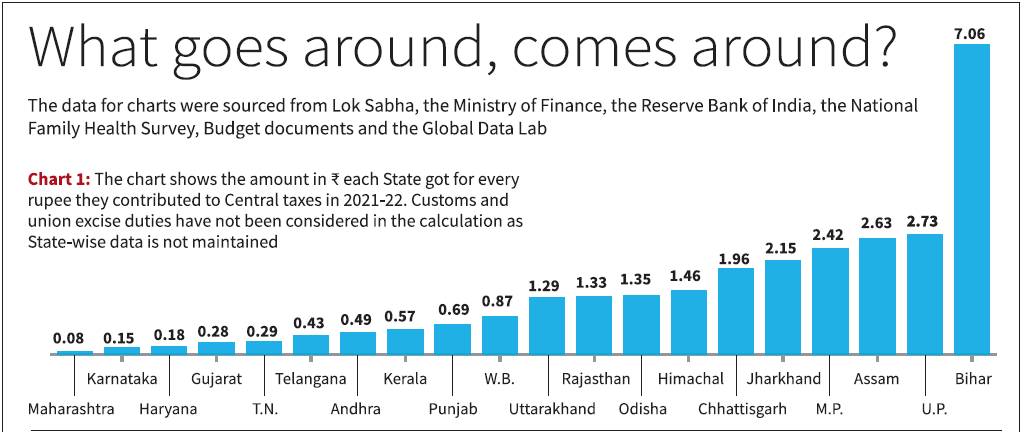
India’s poorest states, Bihar and Uttar Pradesh, therefore, have the highest share in tax devolution to states, much higher than they would get if population was the only parameter
The 15th FC formula is skewed in favour of some States, resulting in wide inter-State variations. As population is given a higher weightage, it tilts the balance in favour of some northern States.
For every one rupee that Tamil Nadu gives the Centre, it gets back 29 paise. On the other hand, Uttar Pradesh gets ₹2.73, and Bihar gets back ₹7.06.
The 15th FC had arrived at the States’ share in the divisible pool of taxes based on each State’s needs (population, area and forest and ecology), equity (per capita income difference) and performance (own tax revenue and lower fertility rate).
The weight assigned to needs was 40%, equity 45%, and 15% for performance.
This formula meant that Uttar Pradesh and Bihar got 17.9% and 10%, respectively in the XVFC. Karnataka, Kerala and Tamil Nadu got 3.65%, 1.93% and 4.08%, respectively.
Chart below shows that in successive FCs, the share of southern States has seen a consistent decline.
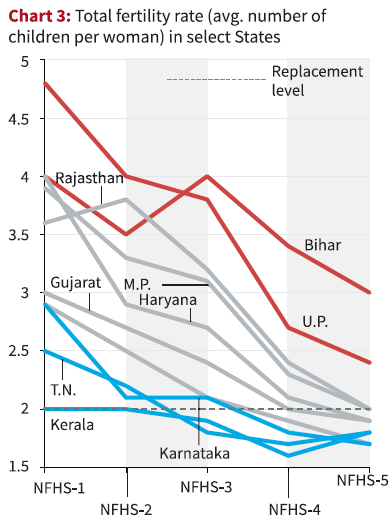
Also, the 15th FC introduced the fertility rate in the formula to reward States which had reduced the fertility levels.
While this does favour the developed States which have pushed their TFR below replacement rate as shown in the chart below, the weightage given to the component is relatively lower than equity and need
Rationale for Equitable Distribution
Active state intervention was envisaged to reduce the developmental disparities.
The mechanism employed to achieve these goals was the transfer of resources from the Centre to the states.
These transfers, which are more heavily directed to populous and poorer states, were channelled in the past through the Finance Commission and the Planning Commission.
Arguments:
In Favour: The objective is not to return the money you get from a State. Transfers enable a State to provide comparable levels of services. The basic rationale is horizontal equity. Taxes accrued to Tamil Nadu are not necessarily from the State. Yes, per capita income levels increased substantially in Karnataka, Kerala and Tamil Nadu. Now, the increase need not necessarily have to do only with the States’ efforts.
Against: The southern States have grown faster, and contribute larger revenue to the central kitty. The argument is that both Northern as well as Southern states should get equally higher amounts. Equity needs to be balanced so that it does not adversely impact efficiency of Southern states. The Centre needs to incentivise developing States to generate more tax revenue for an even more effective distribution.
Article 280 of the Indian Constitution:
Clause (1): The President shall, within two years from the commencement of this Constitution and thereafter at the expiration of every fifth year or at such earlier time as the President considers necessary, constitute a Finance Commission which shall consist of a Chairman and four other members to be appointed by the President.
Clause (2): Parliament may by law determine the qualifications which shall be requisite for appointment as members of the Commission and the manner in which they shall be selected.
Clause (3): It shall be the duty of the Commission to make recommendations to the President as to:
(a) the distribution between the Union and the States of the net proceeds of taxes which are to be, or may be, divided between them under this Chapter and the allocation between the States of the respective shares of such proceeds;
(b) the principles which should govern the grants in-aid of the revenues of the States out of the Consolidated Fund of India;
(bb) the measures needed to augment the Consolidated Fund of a State to supplement the resources of the Panchayats in the State on the basis of the recommendations made by the Finance Commission of the State;
(c) the measures needed to augment the Consolidated Fund of a State to supplement the resources of the Municipalities in the State on the basis of the recommendations made by the Finance Commission of the State;
(d) any other matter referred to the Commission by the President in the interests of sound finance.
Clause (4): The Commission shall determine their procedure and shall have such powers in the performance of their functions as Parliament may by law confer on them.
The criteria for distribution of central taxes among states for the 2021-26 period is the same as that for 2020-21.
Criteria
14th Finance Commission
15th Finance Commission
Income Distance
50
45
Population (1971 Census)
17.5
Not Considered
Population (2011 census)
10
15
Demographic Performance
Not Considered
12.5
Forest Cover
7.5
Not Considered
Forest and Ecology
Not Considered
10
Area
15
15
Tax Effort
Not considered
2.5
Total
100
100
Way Forward:
The inequalities between rich and poor states are manifest in almost every economic dimension. Incomes, assets and discretionary purchasing power are higher in the richer states. They are the locus of formal employment and of high value jobs, which is why the hunger for government jobs is so much more intense in the poorer regions of India. The overwhelming majority of foreign investment comes to the richer states. They have better healthcare, higher levels of literacy and better public services than the poorer states.
Therefore, any scheme of allocation should take into account both development needs as well as past performance, with the latter serving both to incentivize better performance and to allocate resources where they can be most effectively used.
‘Committee for Evolving a Composite Development Index of States’ in 2013 proposed a general method for allocating funds from the Centre to the states based both on a state’s development needs as well as its development performance.
The methodology developed by the Committee first allocates funds across states based on need. Need is based on a simple index of (under) development. The index proposed here is an average of the following ten sub-components: (i) monthly per capita consumption expenditure, (ii) education, (iii) health, (iv) household amenities, (v) poverty rate, (vi) female literacy, (vii) percent of SC-ST population, (viii) urbanisation rate, (viii) financial inclusion, and (x) connectivity.
The proposed allocation scheme accommodates differences in needs, even while recognizing that the truly needy should be given disproportionately more. Less developed states rank higher on the index, and would get larger allocations based on the need criteria.
Given that poor administration or weak institutions in a recipient state can fritter away allocated resources to the detriment of the population, there should be some recognition for effective governance and the efficiency of resource use. This becomes all the more necessary since the proposal to give substantially more to underdeveloped states might create a mild disincentive to develop.
In sum, 8.4% of funds will be allocated as a fixed basic allocation. Of the remaining 91.6%, we choose parameters such that 3/4th of it is allocated based on need and 1/4th based on performance.
A positive feature of this formula for allocation of funds is that the incremental reward for performance is increasing in the level of underdevelopment – this is because the reward for performance is multiplied by need.