Energy Sector

Aiming for the stars: how inverter ACs are catalysing the energy-efficiency revolution

Context: According to latest data from the Bureau of Energy Efficiency (BEE), Ministry of Power, inverter ACs accounted for less than 1 per cent of the overall room AC (RAC) market of 4.7 million units in the financial year 2015-16 (FY16). As of FY23, the share has increased to 77 per cent, while the fixed-speed RACs went down to 23 per cent.

What is Energy conservation act 2001?

  • Government of India enacted the Energy Conservation (EC) Act, 2001 to realize the benefits of energy efficiency through reduced energy consumption. 
  • The Act provides the legal framework, institutional arrangement and regulatory mechanism to embark upon an energy efficiency drive in the country. 
  • Energy efficiency institutional practices and programs in India are being guided through various voluntary and mandatory provisions of the Act. 
  • The Government of India set up Bureau of Energy Efficiency (BEE), also referred to as 'BEE' or 'Bureau' on 1st March 2002 under the provisions of the EC Act, 2001. 
  • The mission of the Bureau is to assist in developing policies and strategies with a thrust on self-regulation and market principles, within the overall framework of the EC Act, 2001 with the primary objective of reducing energy intensity of the Indian economy.

What is Standards & Labeling Program?

  • The objective of the S&L program is to help consumers make an informed choice about various energy-consuming appliances, in terms of energy savings, that would result based on each appliance’s energy efficiency performance. 
  • This scheme also helps the consumer determine the cost-saving potential of the marketed household and other equipment. 
  • The broad objective of the scheme is:
    • To reduce the end-use energy consumption of appliances without diminishing the service levels.
    • To create awareness amongst the consumers, to make an informed decision considering the cost-effectiveness & energy performance while purchasing appliances.
    • To monitor and verify energy savings that incur annually through the sale of energy-efficient appliances
  • The scheme was launched by the Hon'ble Minister of Power in May 2006 and is currently invoked for 30 appliances/equipment.
  • A star rating, ranging from 1 to 5 in the ascending order of energy efficiency is provided to products registered with the Bureau. An endorsement label is also provided for some products.

What is a label?

  • Describes energy performance (in the form of energy use, efficiency or energy cost)
  • “Labels” mainly give consumers the necessary information to make informed purchase.
    • There are two types of labels:

a) Comparative label : allow consumers to compare efficiency of all the models of a product in order to make an informed choice. It shows the relative energy use of a product compared to other models available in the market. 

b) Endorsement label : define a group of products as efficient when they meet minimum energy performance criteria specified in the respective product schedule/ regulation/statutory order.
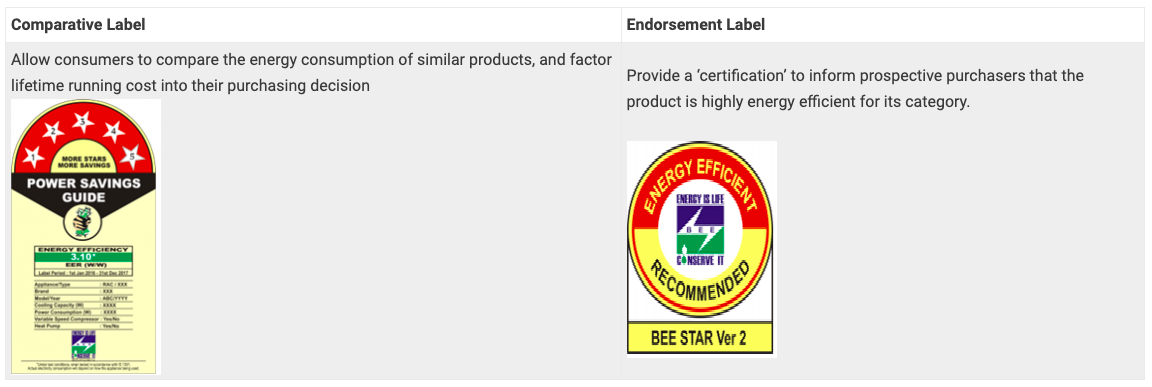
BEE power saving lebel
Mandatory appliancesVoluntary appliances
Frost free refrigeratorSide by Side/Multi Door Refrigerator 
Stationary Storage Type Electric Water HeaterSolar water heater 
Colour TelevisionComputer
Room Air Conditioner (Variable Speed)Washing machines
Tabular fluorescent lampsMicro wave oven
LED lampsHi energy Li batteries
Deep freezersChillers 
Ultra high definition televisionsTyres
Room air conditionersDomestic gas stove
Ceiling fansPedestal fan, table/walled fan
Direct cool refrigeratorDiesel generator set
Distribution transformerSubmersible Pump Set
Diesel Engine Driven Monoset Pumps for Agricultural Purposes

Pricing of Oil products in India

Context: Recently OPEC+ agreed to extend the ongoing oil production cuts into 2024 as it seeks to keep oil prices from falling in the wake of concerns about a global economic slowdown. For India, which imports more than 80% of its crude oil requirements, the combined OPEC+ announcements of supply curtailment are a cause for some concern given the potential they have in pushing up global oil prices.

Though the crude oil prices softened towards the end of FY22-23, Pump prices of petrol and diesel have remained unchanged since May 22, 2022, with the governments at the Centre and the States, and the oil marketing companies unwilling to reduce the taxes and revenues in order to insulate themselves from any rise in the cost in future. 

major petroleum products consumption

Breakup of Prices of Petrol & Diesel:

Public sector Oil Marketing Companies (OMCs) revise the retail prices of petrol and diesel in India on a daily basis, according to changes in the price of global crude oil.  The retail price charged to consumer includes the following components:

Base price set by OMCs

Several parameters like global crude prices, expected future crude prices, local taxes, Shipping costs, apart from the cost of refining are considered while fixing the rates which may be different for different OMC.

  • Freight price includes the cost of transporting to dealers across India.
  • Dealer commissions
  • Taxes and Surcharges of centre includes
  • Basic Excise Duty
  • Agriculture Infrastructure and development cess
  • Road & Infrastructure cess
  • Taxes of State governments includes Sales tax/ VAT

The prices of Petrol & Diesel vary from city to city depending upon the taxes charged by the state governments. Usually, the share of tax component in the retail price is above 40%. SO any reluctance by the centre or state governments to decrease their taxes will not result in transmission of softening of global crude oil prices to the ultimate consumer. 

Petrol & Diesel under GST?

There has been growing demand to include petrol products under GST mechanism as it may reduce the ultimate price paid by the consumer because:

  • Even if petroleum is charged at the current maximum tax slab of 28%, consumers will be paying a lesser price than they are presently paying for it.
  • GST, being a value added tax mechanism, ensures that there is no cascading effect (tax on taxation). 

However, most of the states are unwilling to this proposal as states generate a considerable amount of revenue from taxing petroleum products. Each state has its own taxation structure for petrol and diesel. Under GST, even under the 28 per cent tax slab, states will earn a lot less compared to what they currently earn from petrol and diesel sales as value-added tax (VAT). Few States are demanding that if petrol and diesel are brought under the GST, then the Central Government must compensate all the States of their deficit revenue. However, there has been no such commitment given by the centre. 

Will inclusion of Petroleum under GST solve the problem?

In the short run, lowering the prices of petrol and diesel due to GST may prove helpful but ultimately, all the consumers will have to start shifting towards renewable energy sources for sustainable growth and development and insulate Indian economy from any geo-political shocks. 

India may join offshore wind alliance

Context: India is “very actively" considering joining the Global Offshore Wind Alliance in an attempt to improve its energy transition standing, said Gauri Singh, deputy director general of the International Renewable Energy Agency (IRENA), which played a key role in forming the alliance.

What is global offshore wind alliance (GOWA)?

image 429
  • The alliance was initiated by the International Renewable Energy Agency (IRENA), Denmark and the Global Wind Energy Council.
  • It will bring together governments, the private sector, international organisations and other stakeholders to accelerate the deployment of offshore wind power.
  • It has the aim of reaching global offshore wind capacity of at least 380 GW by 2030.
  • Countries joining GOWA have agreed to work together to drive national, regional, and global ambitions and remove barriers to the deployment of offshore wind in new and existing markets. 
  • Offshore wind can be deployed at large scale, in short timeframes and at competitive cost.

What is Global Wind Energy Council (GWEC)?

  • The Global Wind Energy Council is the international trade association for the wind power industry.
  • GWEC is a member-based organisation that represents the entire wind energy sector. 
  • The members of GWEC represent over 1,500 companies, organisations and institutions in more than 80 countries, including manufacturers, developers, component suppliers, research institutes, national wind and renewables associations, electricity providers, finance and insurance companies.

GWEC India – a single advocacy and research body representing the entire value chain of India’s wind industry, from IPPs to OEMs to end-users to service-providers – will work closely with central and state governments to improve the enabling environment for sector growth, creating the conditions for inward investment in the tens of billions of dollars.

What is offshore wind energy?

Offshore wind power or offshore wind energy is the energy taken from the force of the winds out at sea, transformed into electricity and supplied into the electricity network onshore.
It is the clean and renewable energy that is produced on the high seas, where it reaches a higher and more constant speed than on land due to the absence of barriers. In order to make the most of this resource, mega-structures are installed that are seated on the seabed and equipped with the latest technical innovations.

Benefits:
1. Renewable, unlimited and non-polluting.

2. Reduces pressure on land resource.

3. Barrier free regions thus higher wind speed and efficiency

4. Visual and acoustic impact is small5. No issues of land acquisition.
6. The ease of maritime transport, which has few limitations with regard to cargo and dimensions in comparison with land transportation, has made it possible for offshore wind turbines to reach much larger unit capacities and sizes than onshore wind turbines.

India and offshore wind energy:


India is blessed with a coastline of about 7600 km surrounded by water on three sides and has good prospects of harnessing offshore wind energy. Considering this, the Government had notified the “National offshore wind energy policy” as per the Gazette Notification dated 6th October 2015. As per the policy, Ministry of New and Renewable Energy will act as the nodal Ministry for development of Offshore Wind Energy in India and work in close coordination with other government entities for Development and Use of Maritime Space within the Exclusive Economic Zone (EEZ) of the country and shall be responsible for overall monitoring of offshore wind energy development in the country. National Institute of Wind Energy (NIWE), Chennai will be the nodal agency to carryout resource assessment; surveys and studies in EEZ demarcate blocks and facilitate developers for setting up offshore wind energy farms.

Roadmap to energy justice

Context: A pragmatic and balanced strategy has helped India to keep prices of petrol, diesel and gas under check.

How has India managed control oil prices?

  • When petrol and diesel prices went up by 35-40 per cent in the US, Canada, Spain and the UK, and despite importing over 85 per cent of its crude oil requirements and 55 per cent of its natural gas requirements, prices of diesel in India have actually gone down in the last one year. 
  • India has outperformed many of its neighbouring nations in controlling oil prices.
  • Centre and many states announced massive cuts in excise duty and VAT rates, twice.
  • Oil PSUs, absorbed huge losses to ensure that the massive hikes in the prices of crude oil and natural gas in the international market were not passed on to Indian consumers.
  • Subsidised APM gas for city gas distribution sector was drastically increased even at the cost of cutting down the captive use of domestic gas by our own PSUs. 
  • Imposition of export cess on petrol, diesel and ATF and windfall tax on domestically produced petroleum products to prevent refiners and producers from profiteering at the cost of domestic consumers.
  • India has also further strengthened its ties with countries like the US (energy trade has gone up 13 times in the last four years) and Russia to ensure a reliable supply of crude oil. 

Steps towards oil exploration and refinery

  • By 2025, India wants to boost its net geographic area under exploration from 8 per cent (0.25 million sq km) to 15 per cent (0.5 million sq km) and has reduced the prohibited/no-go areas in our Exclusive Economic Zone (EEZ) by 99 per cent, releasing nearly 1 million sq km for exploration.
  • As per consulting firm Wood Mackenzie noting that India could be the licensing wildcard of 2023.
  • India is a global exporter of petroleum products and its refining capacity is the fourth largest in the world after the US, China, and Russia. Efforts are underway to further enhance this capacity to 450 MMT by 2040.

Expansion in Gas sector and alternative fuels

  • India is also accelerating its efforts to move towards a gas-based economy by increasing the share of gas from the current 6.3 per cent to 15 per cent by 2030.
  • India has connected more than 9.5 crore families with clean cooking fuel in the past nine years. 
  • PNG connections have increased from 22.28 lakh in 2014 to over 1 crore in 2023. 
  • The number of CNG stations in India has gone up from 938 in 2014 to 4,900 in 2023. 
  • Since 2014, India has increased the length of its gas pipeline network from 14,700 kms to 22,000 kms in 2023.
  • India took a giant stride in her biofuel revolution by launching E20 — 20 per cent ethanol blended gasoline — which will be rolled out in 15 cities and expanded across the country in the next two years.
  • India’s ethanol blending gasoline has grown from just 1.53 per cent in 2013-14 to 10.17 per cent in 2023, and now India is also setting up five second generation ethanol plants, which can convert agricultural waste into biofuel, further reducing pollution due to stubble burning and generating income for farmers.
  • National Green Hydrogen Mission has been launched with an outlay of Rs 19,744 crore to develop the entire green hydrogen ecosystem in the country and accelerate India’s efforts towards 4 MT of annual green hydrogen production and Rs 1 lakh crore of cumulative fossil fuel import savings by 2030. India is poised to realise its full potential to create a green hydrogen ecosystem by 2030.
  • India is targeting the installation of alternate fuel stations (EV charging/CNG/ LPG/LNG/CBG etc.) at 22,000 retail outlets by May 2024.

Unified Tariff Regime for National Gas Grid System

Context: Petroleum & Natural Gas Regulatory Board has amended PNGRB (Determination of Natural Gas Pipeline Tariff) Regulations to incorporate regulations pertaining to Unified Tariff for natural gas pipelines with a mission of 'One Nation, One Grid & One Tariff). National Gas Grid System means network of all such natural gas pipelines within India which are fully interconnected with each other (including those which are partly commissioned and so interconnected)

Salient Features of Unified Tariff Regime for Natural Gas Pipelines

  • Levelised Unified Tariff: PNGRB has notified a levelized Unified Tariff of Rs 73.93 per MMBTU additional GST tax will be Rs. 0.19/MMBTU. All entities part of National Gas Grid will get the tariff as per their entitlement while customers would pay Unified Tariff applicable for different zones. Difference between the entitlement tariffs to be earned by pipeline companies and unified tariffs paid by customers will be settled between pipeline entities by a settlement mechanism. 
  • Tariff zones for unified tariff:
    • First Tariff zone for unified tariff: Length of 300 km from the entry point on either side of national gas grid system.
    • Second Tariff zone for unified tariff: length between 300 to 1200 km on either side of the first tariff zone on national gas grid
    • Third Tariff zone for unified tariff: Remaining length of national gas grid system on either side of second tariff zone. 
UNIFIED ZONETARIFF (Rs./MMBTU on GCV basis)
Zone 139.45
Zone 274.97
Zone 399.90
  • Companies covered: National Gas Grid covers all interconnected pipeline networks owned and operated by following entities: Indian Oil Corporation, Oil & Natural Gas Corporation (ONGC), GAIL (India), Pipeline Infrastructure ltd., Gujarat State Petronet Ltd, Gujarat Gas, Reliance Gas Pipelines, GSPL India Gasnet & GSPL India Transco. All these entities will be members of Industry Committee. 
  • Settlement mechanism: The settlement mechanism will be applicable to all the entities including shippers availing transportation services through natural gas pipelines forming part of National Gas Grid System. Out of the members of the Industry Committee 5 members will be selected to form a part of Settlement Committee will decide the ratio of settlement among different entities part of National Gas Grid System. 

Significance of Unified Price for National Gas Grid System

  • Expansion of National Gas Grid: With commissioning of newer interconnected gas pipelines, the national gas grid will keep expanding for Union tariff.
  • Affordable access to natural gas in far-flung areas: This reform will specially benefit consumers located in far-flung areas by making natural gas available at competitive and affordable rates. In the current regime, additive rates are applicable for gas consumers in these areas. 
  • Transition to gas economy: India plans to raise the share of gas in the economy to about 15% by 2030 from 6.4% in 2022. The uniform price mechanism for transportation will aid in this regard. 

About Petroleum & Natural Gas Regulatory Board (PNGRB)

PNGRB is a statutory body formed under the Petroleum & Natural Gas Regulatory Board Act, 2006.

The Board is headed by a Chairperson, a Member (legal) and three other members to be appointed by Central Government.

Functions of PNGRB are:

  1. Protect interests of consumers by fostering fair trade and competition among entities.
  2. Register entities related to:
  3. Authorise entities to:
    • Lay, build, operate or expand a common carrier or contract carrier.
    • Lay, build, operate or expand city or local natural gas distribution network. (CNG networks)
  1. Declare pipelines as common carrier or contract carrier.
  2. Regulate
    • Access to common carrier or contract carrier to ensure fair trade and competition amongst entities.
    • Transportation rates for common carrier or contract carrier.
    • Access to city or local natural gas distribution network to ensure fair trade and competition.
  3. In respect of petroleum, petroleum products and natural gas:
    • Ensure adequate availability.
    • Ensure display of information about maximum retail prices
    • Monitor prices and take corrective measures to prevent restrictive trade practices by the entities.
    • Secure equitable distribution for petroleum and petroleum products
    • Provide and enforce retail service obligations for retail outlets and marketing service obligations for entities.
    • Monitor transportation rates and take corrective actions to prevent restrictive trade practices by entities.
    • Levy fees and other charges
    • Maintain a data bank of information on activities related to petroleum, petroleum products & natural gas.
    • Lay down technical standards, specifications & safety standards related to petroleum, petroleum products, natural gas, pipeline construction, operation & maintenance related to downstream petroleum and natural gas.
  4. Adjudicate and decide disputes arising amongst entities and receive complaints. 

Petroleum and Natural Gas Regulatory Board (PNGRB)

  • The Petroleum and Natural Gas Regulatory Board (PNGRB) was constituted under The Petroleum and Natural Gas Regulatory Board Act, 2006.
  • The Act provides for the establishment of Petroleum and Natural Gas Regulatory Board to protect the interests of consumers and entities engaged in specified activities relating to petroleum, petroleum products and natural gas and to promote competitive markets and for matters connected therewith or incidental thereto.
  • Further as enshrined in the act, the board has also been mandated to regulate the refining, processing, storage, transportation, distribution, marketing and sale of petroleum, petroleum products and natural gas excluding production of crude oil and natural gas so as and to ensure uninterrupted and adequate supply of petroleum, petroleum products and natural gas in all parts of the country.

Vision of PNGRB

To create a vibrant energy market with rapid and orderly growth, we aim to facilitate the flow of investments into basic infrastructure. This infrastructure supports the efficient transportation and distribution of petroleum, petroleum products, and natural gas at minimum cost.

Additionally, we are committed to a high level of protection of consumer interests. This is achieved through fair trade practices and fostering competition amongst entities. Our goal is to ensure the enhanced competitiveness of the Indian economy and achieve high customer satisfaction.

Powers regarding complaints and resolutions of disputes by the Board

  • The Board shall have jurisdiction to:
    • Adjudicate upon and decide any dispute or matter arising amongst entities or between an entity and any other person on issues relating to refining, processing, storage, transportation, distribution, marketing and sale of petroleum, petroleum products and natural gas, unless the parties have agreed for arbitration.
    • Receive any complaint from any person and conduct any inquiry and investigation connected with the activities relating to petroleum, petroleum products and natural gas on contravention of:
      • Retail service obligations;
      • Marketing service obligations;
      • Display of retail price at retail outlets;
      • Terms and conditions subject to which a pipeline has been declared as common carrier or contract carrier or access for other entities was allowed to a city or local natural gas distribution network, or authorisation has been granted to an entity for laying, building, expanding or operating a pipeline as common carrier or contract carrier or authorisation has been granted to an entity for laying, building, expanding or operating a city or local natural gas distribution network;
      • Any other provision of this Act or the rules or the regulations or orders made there under.
  • While deciding a complaint, the Board may pass such orders and issue such directions as it deems fit or refer the matter for investigation.

Functions of Board: The Board shall

  • Protect the interest of consumers by fostering fair trade and competition amongst the entities;
  • Register entities to:
    • Market notified petroleum and petroleum products and, subject to the contractual obligations of the Central Government, natural gas;
    • Establish and operate liquefied natural gas terminals;
    • Establish storage facilities for petroleum, petroleum products or natural gas exceeding such capacity as may be specified by regulations;
  • Authorise entities to: lay, build, operate or expand a common carrier or contract carrier or expand city or local natural gas distribution networks;
  • Declare pipelines as common carrier or contract carrier;
  • Regulate, by regulations:
    • Access to common carrier or contract carrier so as to ensure fair trade and competition amongst entities and for that purpose specify pipeline access code;
    • Transportation rates for common carrier or contract carrier;
    • Access to city or local natural gas distribution network so as to ensure fair trade and competition amongst entities as per pipeline access code;
  • In respect of notified petroleum, petroleum products and natural gas:
    • Ensure adequate availability;
    • Ensure display of information about the maximum retail prices fixed by the entity for consumers at retail outlets;
    • Monitor prices and take corrective measures to prevent restrictive trade practice by the entities;
    • Secure equitable distribution for petroleum and petroleum products;
    • Provide, by regulations, and enforce, retail service obligations for retail outlets and marketing service obligations for entities;
    • Monitor transportation rates and take corrective action to prevent restrictive trade practice by the entities;
  • Levy fees and other charges as determined by regulations;
  • Maintain a data bank of information on activities relating to petroleum, petroleum products and natural gas;
  • Lay down, by regulations, the technical standards and specifications including safety standards in activities relating to petroleum, petroleum products and natural gas, including the construction and operation of pipeline and infrastructure projects related to downstream petroleum and natural gas sector;
  • Perform such other functions as may be entrusted to it by the Central Government to carry out the provisions of this Act.

Power Sector in India

  • Power is among the most critical components of infrastructure, crucial for the economic growth and welfare of nations. The existence and development of adequate power infrastructure is essential for sustained growth of the Indian economy.
  • The fundamental principle of India’s power industry has been to provide universal access to affordable power in a sustainable way.
  • The Government has made significant efforts over the past few years to turn the country from one with a power shortage to one with a surplus by establishing a single national grid, fortifying the distribution network, and achieving universal household electrification.
  • India’s power sector is one of the most diversified in the world. Sources of power generation range from conventional sources such as coal, lignite, natural gas, oil, hydro and nuclear power, to viable non-conventional sources such as wind, solar, agricultural and domestic waste.
  • Electricity demand in the country has increased rapidly and is expected to rise further in the years to come. In order to meet the increasing demand for electricity in the country, massive addition to the installed generating capacity is required.

Facts Associated with Power Sector in India:

  • India was ranked 4th in wind power, 5th in solar power and 4th in renewable power installed capacity, as of 2020.
  • India is the only country among the G20 nations that is on track to achieve the targets under the Paris Agreement.
  • As of October 31, 2022, India’s installed renewable energy capacity (including hydro) stood at 165.94 GW, representing 40.6% of the overall installed power capacity.
    • Solar energy is estimated to contribute 61.62 GW, followed by 41.84 GW from wind power, 10.70 GW from biomass, 4.92 GW from small hydropower, and 46.85 GW from hydropower.
image 17
  • The peak power demand in the country stood at 210.79 GW on June 9, 2022.

Why is India at an Advantage:

  • Growing Demand:
    • India is the third-largest producer and consumer of electricity worldwide, with an installed power capacity of 408.71 GW as of October 31, 2022.
    • Growing population along with increasing electrification and per-capita usage will provide further impetus. Power consumption is estimated to reach 1,894.7 TWh in 2022.
image 18
image 19
  • Attractive Opportunities:
    • Under the Union Budget 2022-23, the government announced the issuance of sovereign green bonds, as well as conferring infrastructure status to energy storage systems, including grid-scale battery systems.
    • In the same budget, Rs. 19,500 crore (US$ 2.57 billion) was allocated for a PLI scheme to boost manufacturing of high-efficiency solar modules.
  • Policy Support:
    • 100% FDI allowed in the power sector has boosted FDI inflow in this sector.
    • Schemes such as Deen Dayal Upadhyay Gram Jyoti Yojana (DDUGJY) and Integrated Power Development Scheme (IPDS) are expected to augment electrification across the country.
  • Higher Investments:
    • As per the National Infrastructure Pipeline 2019-25, energy sector projects accounted for the highest share (24%) out of the total expected capital expenditure of Rs. 111 lakh crore (US$ 1.4 trillion).
    • Total FDI inflow in the power sector reached US$ 16.39 billion between April 2000-June 2022.

Issues Associated with Power Sector

  • Challenges in fuel supply: include unequal contractual provisions, inadequate supply, and poor transport logistics. Coal is transported over long distances through railways, but such long haulage leads to increased delivery costs, thefts and life-cycle energy consumption
  • Challenges to open access: While all states in India have notified open access, only 19 have determined all the charges (cross-subsidy charges, wheeling charges, transmission charge) on open access.
  • Poor financial health of DISCOMS: The main causes of which include unmetered consumption, low collection efficiency, and high technical losses due to insufficient capital expenditure on up-gradation of existing infrastructure. The extent of commercial losses of DISCOMS across India increases by over 50% in the absence of subsidy.
  • High Transmission & Distribution Losses: averaging about 22.3% of electricity which is very high as compared to those of the developed countries (6-11%).
  • Under-procurement of power by states - cancelling out costlier Power Purchase Agreements (PPAs) in favour of newer and cheaper agreements.
  • Coordination Issues: Multiple ministries and agencies are currently involved in managing energy-related issues which presents challenges of coordination and optimal resource utilisation, thus undermining efforts to increase energy security.

Government Policies & Initiatives

The Government of India has identified the power sector as a key sector of focus to promote sustained industrial growth. Some initiatives by the Government to boost the Indian power sector are as below:

  • In the Union Budget 2022-23, the government allocated Rs. 19,500 crore (US$ 2.57 billion) for a PLI scheme to boost manufacturing of high-efficiency solar modules.
  • As of August 24, 2022, over 36.86 crore LED bulbs, 72.18 lakh LED tube lights and 23.59 lakh energy-efficient fans have been distributed across the country, saving around 48,411 million kWh per year and around Rs. 19,332 crore (US$ 2.47 billion) in cost savings.
  • As of November 2022, over 51.62 lakh smart metres have been deployed under the National Smart Grid Mission (NSGM), with a further 61.13 lakh to be deployed.
  • Electrification in the country is increasing with support from schemes like Deen Dayal Upadhyay Gram Jyoti Yojana (DDUGJY), Ujwal DISCOM Assurance Yojana (UDAY), and Integrated Power Development Scheme (IPDS).
  • In order to meet India’s 500 GW renewable energy target and tackle the annual issue of coal demand supply mismatch, the Ministry of Power has identified 81 thermal units which will replace coal with renewable energy generation by 2026.
  • In February 2022, a parliamentary standing committee recommended the government to take steps to increase the loan limit for the renewable energy sector under priority sector lending. The current limit stands at Rs. 30 crore (U$ 3.93 million).
  • In November 2021, the government announced future plans to increase the funding under the PLI scheme for domestic solar cells and module manufacturing to Rs. 24,000 crore (US$ 3.17 billion) from the existing Rs. 4,500 crore (US$ 594.68 million) to make India an exporting nation.
  • In November 2021, Energy Efficiency Services Limited (EESL) stated that it will partner with private sector energy service companies to scale up its Building Energy Efficiency Programme (BEEP).
  • The Pradhan Mantri Sahaj Bijli Har Ghar Yojana, “Saubhagya”, was launched by the Government of India with an aim of achieving universal household electrification. As of March 2021, 2.82 crore households have been electrified under this scheme.

Road Ahead

  • In the current decade (2020-2029), the Indian electricity sector is likely to witness a major transformation with respect to demand growth, energy mix and market operations.
  • India wants to ensure that everyone has reliable access to sufficient electricity at all times, while also accelerating the clean energy transition by lowering its reliance on dirty fossil fuels and moving toward more environmentally friendly, renewable sources of energy.
  • Future investments will benefit from strong demand fundamentals, policy support and increasing government focus on infrastructure.
  • The Government of India is preparing a 'rent a roof' policy for supporting its target of generating 40 GW of power through solar rooftop projects by 2022. It also plans to set up 21 new nuclear power reactors with a total installed capacity of 15,700 MW by 2031.
  • The Central Electricity Authority (CEA) estimates India’s power requirement to grow to reach 817 GW by 2030. Also, by 2029-30, CEA estimates that the share of renewable energy generation would increase from 18% to 44%, while that of thermal energy is expected to reduce from 78% to 52%.
  • The government plans to establish a renewable energy capacity of 500 GW by 2030.

Need to expand India’s refining capacity

India is aiming to add 200 million tonnes (MT) of refining capacity, or around 4 million barrels a day, in the next 10 years to meet the growing demand for fuel. This is important for India’s energy security as India’s oil demand will double to 11.1 million barrels a day (550 MT) by 2045, according to OPEC’s World Oil Outlook. However, the achievement of target is facing challenges

Oil refining in India

Oil refining in India is a significant industry that plays a crucial role in meeting the country's energy needs. India is one of the largest consumers of petroleum products in the world and imports more than 80% of its crude oil requirements. As a result, oil refining has become an important activity in the country.

India has several oil refineries, both public and private, located in different parts of the country. These refineries process crude oil and produce a variety of petroleum products such as petrol, diesel, aviation fuel, liquefied petroleum gas (LPG), kerosene, and others. The Indian oil refining industry has been growing steadily over the years, driven by the increasing demand for petroleum products.

The largest oil refinery in India is located in Jamnagar, Gujarat, and is owned by Reliance Industries. The refinery has a capacity of 1.24 million barrels per day and is one of the largest refineries in the world. Other major refineries in India include the Indian Oil Corporation refineries in Panipat, Gujarat, and Mathura, and the Bharat Petroleum Corporation refinery in Mumbai.

The Indian government has also taken several steps to encourage investment in the oil refining sector. The government has liberalized the sector, allowing private players to enter and operate in the market. It has also set up several Special Economic Zones (SEZs) to promote oil refining and attract foreign investment.

Challenges to addition of refining capacity

  • State-run refiners, which account for 65% of the domestic business, are proving slow to act, with IOC’s Paradip the last greenfield project to be commissioned in 2016 after a long delay.
  • Indian refiners need to add 20 MT of capacity per year to meet the target, but the growth in refining capacity has stalled, expanding by only 17 MT over the past five years, compared to 21 MT in the previous five years.
  • Over the next few years, only around 50 MT of capacity may come up with state-owned refiners sitting on decisions for the past six years to build new projects, despite government backing.
  • Exports leave India with less fuel for domestic use. Earnings from oil product exports accounted for 15% of India’s gross exports by value in April-January FY23. Reliance and Nayara account for the bulk of exports with state oil companies catering to the domestic market.
  • The upcoming capacity of 50 MT may yield only around 30 MT of fuels because around 25% of the capacity from new refineries will be dedicated to petrochemicals, and another 10% used to run the refinery, according to a former chairman of a state refiner.
  • State refiners slowed capacity addition fearing an exodus to EVs, yet EV sales next fiscal will trail state targets by half, according to a Business Standard report.
  • While the current impetus on decarbonisation is expected to cast a shadow over long-term consumption growth, a significant decline in consumption of petroleum products remains unlikely.

In order to solve the challenges, following measure can be suggested.

Measures Suggested

  • Encourage private investment: The government could create a more conducive environment for private companies to invest in the oil refining sector. This could include offering tax incentives, reducing regulatory hurdles, and simplifying the approval process for new projects.
  • Streamline decision-making: The government could work to streamline the decision-making process for state-owned refiners. This could help reduce delays and ensure that new projects are approved and completed more quickly.
  • Improve efficiency: The government could work with refiners to identify opportunities to improve efficiency and increase output from existing refineries. This could help address the current shortfall in refining capacity and reduce the need for new projects.
  • Increase exports: The government could encourage refiners to increase exports of refined petroleum products. This could help generate additional revenue to fund new projects and reduce the impact of lower domestic demand.
  • Develop alternative fuels: The government could invest in research and development of alternative fuels, such as biofuels or hydrogen. This could help reduce India's dependence on fossil fuels and provide new opportunities for refiners to diversify their businesses.
  • Address the issue of petrochemicals: The government could work with refiners to address the issue of petrochemicals. This could include developing policies to incentivize investment in petrochemical production and reducing the amount of refining capacity dedicated to petrochemicals to free up more capacity for fuel production.
  • Focus on domestic demand: The government could prioritize meeting domestic demand for refined petroleum products over exports. This could help ensure that India has sufficient capacity to meet its growing energy needs and reduce dependence on imports.

Russian Crude Oil Imports by India

India imported a record 1.62 million barrels per day of Russian oil in February, up 29 per cent from January’s 1.26 million barrels a day, which was also a record.

Russian Crude Oil Imports from Russia
  • It is now higher than combined imports from traditional suppliers Iraq and Saudi Arabia.
  • The rise in Russian imports has been at the expense of Saudi Arabia and the United States. Oil import from Saudi fell 16% month-on-month and that from the U.S. declined 38%.
  • Refiners continue to snap up plentiful Russian cargoes available at a discount when compared with other grades . And this oil is converted into petrol and diesel at refineries and exported to Western markets like Europe.

Background:

  • After Russia invaded Ukraine in February 2022, many Western countries and their companies shunned purchase of Russian crude oil.
  • As mounting international pressures lowered appetite for its crude oil elsewhere, Russia began offering steep discounts to oil refiners in India and few other countries on direct sale of their crude oil.
  • India being the world’s third-biggest consumer and importer of crude oil, utilised the offer to ramp up purchase of oil at cheap prices.
  • From a market share of less than 1% in India's import basket before the start of the Russia-Ukraine conflict in February 2022, Russia's share of India's imports rose to 1.62 million barrels per day in February, taking a 35% share.

Why has India continued oil purchase from Russia?

  • Unprecedented surge in global commodity prices led to inflationary pressures. The Indian basket of crude oil prices also soared to as high as $130 per barrel.
  • India’s retail inflation (measured by Consumer Price Index or CPI) accelerated to 8-year high of 7.79% in April 2022, thus implying most of India’s inflation was imported. Rapidly growing economy of India requires affordable energy in order to improve the lives of its citizens.
  • Russia offered steep discounts in the initial phase soon after the Ukraine war began - $20-30 per barrel. Though they have narrowed significantly and stand at just $7-8 on a delivered basis. However, it is still cheaper than viable alternatives.
  • Russia has long-standing trade and strategic relationships with India, and along with offering steep price discounts is also accepting payments (through VOSTRO accounts) in local currency to keep trade flows strong.

Indian Exports:

  • While India — the world’s third-largest consumer of crude oil — depends on imports to meet over 85% of its oil requirement, the country is a net exporter of petroleum products as its refining capacity of 250 million tonnes per annum, which is higher than its domestic demand.
  • As a large refining hub that has ramped up purchases of discounted Russian oil, India now finds itself playing an increasingly prominent role in the global crude oil and refined products supply map.
  • While the European Union (EU) weans itself off refined petroleum products from Russia, Indian refiners, particularly private sector companies, are rushing in to fill the gap.
  • In the run-up to the EU’s ban on Russian petroleum products from February 5 — owing to the Ukraine invasion — India saw its refined product exports to the region rise for five straight months.

The exports touched 1.90 million tonnes in January, the highest monthly volume in the first 10 months of the current fiscal.

Petroleum Product Exports to EU
  • In the four months leading to the EU’s ban on Russian refined products, the region’s share in India’s petroleum product exports rose from 16% to almost 22%.
  • India’s petroleum product exports to EU countries rose 20.4% year-on-year in April-January to 11.6 million tonnes.

Way Forward:

  • While the West was irked at India’s rising purchases of Russian oil in the aftermath of Moscow’s invasion of Ukraine. Major Western powers like the US are comfortable with the rising supply of Indian refined products to Europe.
  • This is mainly because refiners in countries such as India are ensuring that the global oil and refined products market remains balanced and adequately supplied despite Russian oil and products being shunned by numerous countries.
  • In fact, a number of experts see higher purchases of Russian oil and rising exports of petroleum products from countries like India as critical for the success of the price caps on Russian oil and refined products which were imposed by G7 countries and their allies without causing a global supply shock.
  • This provides an opportunity for Indian refiners - particularly export-oriented private sector companies like Reliance Industries and Nayara Energy - to increase purchases of discounted Russian crude.