Context: Union Cabinet has approved the central sector scheme - National Forensic Infrastructure Enhancement Scheme with a total outlay of Rs 2254.43 crores for improving the criminal justice system in India.
About National Forensic Infrastructure Enhancement Scheme
The scheme will be operated by the Union Home Ministry.
The scheme will be a central sector scheme (100% financed by Central Government) with a total outlay of Rs 2254.3 crores.
The scheme will run from 2024-25 to 2028-29.
Components under the scheme:
Establishment of campuses of National Forensic Sciences University (NFSU) in India.
Establishment of Central Forensic Science Laboratories in India.
Enhancement of existing infrastructure of Delhi Campus of NFSU.
Rationale behind the NFIES Scheme
New Criminal laws mandates forensic investigation for offences involving punishment of 7 years or more, which is expected to create a significant increase in the workload of forensic science laboratories. Thus, the scheme will create the required infrastructure to address this increased demand for forensic science professionals and laboratories.
Currently, there is a significant shortage of trained forensic science laboratories in India. The scheme is expected to increase the number of trained forensic professionals in India.
Establishment of additional off-campuses of National Forensic Sciences University (NFSU) and new Central Forensic Science Laboratories would address shortage of trained manpower.
Aims to establish an effective and efficient criminal justice system, based on scientific and timely forensic examination of evidence.
Creation of high quality, trained forensic professionals in the timely and scientific examination of evidence for an efficient criminal justice process, leveraging advancements in technology & evolving manifestations and methods of crime.
Importance of increased reliance on forensics in criminal justice system
Securing an increased conviction rate of more than 90%.
Alleviate case load and pendency.
Prevent miscarriage of justice and correct identification of perpetrators.
Enhanced public trust in the criminal justice system
Restrains the police from employing inhuman techniques like third degree and torture.
Formulating standardised procedures and protocols for evidence collection
Helps to create integrated databases and international cooperation.
Context: The Supreme Court of India in Satender Kumar Antil vs CBI case has highlighted the growing reluctance on the part of trial judges to grant bail. This goes against the Indian judicial doctrine of "Presumption of Offence", thereby establishing a jurisprudence system where jail and not bail is becoming a rule.
Bail system in India
The Fair Trial Programme of Project 39A in its study of Yerwada and Nagpur central prisons, has given important highlights on bail system in India:
18.5% undertrials were migrants.
93.48% undertrials did not own any assets.
62.22% did not have any contact with the family.
Issues with the bail system in India
Discretionary- The power to grant bail is largely based on the Judge's discretion, which makes bail grant/denial procedure very subjective in nature.
Financial Constraints- The Supreme Court and the Law Commission (154th and 203rd report) has highlighted that bail is heavily influenced by the economic status of the accused.
Violation of Criminal Jurisprudence- Supreme Court in Siddharam case had highlighted that presumption of innocence would be effective by granting bail. But denial of bail violates this criminal jurisprudence.
Arbitrary grounds/conditions for granting bail- The judges have set conditions like high surety amount, which Supreme Court in Moti Ram case has highlighted as a human rights issue.
Non-adherence to bail guidelines- The Supreme Court has laid down several guidelines for bail hearings. But the lower Judiciary has not adhered to these guidelines. Ex: The Courts do not usually record reasons for rejecting bail.
Overburdening the Judiciary and Prisons- Over 75% of India's prisoners are undertrials which takes the overcrowding in Indian prisons to 118%. This has also led to high pendency of cases in India with over 5 crore cases pending in total.
Violation of Fundamental Rights- Denial of bail on arbitrary and discretionary ground violates the Right to Life and Personal Liberty (Article 21) of the accused.
Way Forward
New Prison manual, 2016
Setting up of legal aid clinics for undertrials.
Legal literacy classes in prison.
Constitution of Undertrial review committee.
E-Prison project to digitalize the flow of Judicial Orders on bails for instant implementation of it. Ex: SUPAC system of Supreme Court for transmitting bail orders digitally to jail authorities.
Mulla Committee: Release of undertrial prisoners on bail as per the law commission's recommendations.
Following Supreme Court's guidelines- Bail should be the rule and Jail should be an exception (Balachand case).
Enacting a separate law for bail as recommended by the Supreme Court.
Effective enforcement of safeguard against arbitrary arrests. According to The National Police Commission's Report, 60% of total arrests were uncalled for and were excessive in nature. The report also states that 42% of the expenditure in the jails was over persons who shouldn’t have been arrested in the first place.
Conclusion
Going forward, streamlining the bail procedure in India by enacting a separate law can promote human-centric model Viksit Bharat Sankalp, highlighting the inclusive development trajectory of “Sabka Saath, Sabka Vikas”.
Context: Supreme Court in case of Rajesh and Another v. State of Madhya Pradesh acquitted three persons who were alleged to have been involved in the murder and related offence on the ground of illegalities in investigation.
Argument by Court for Their Acquittal
The Court argued that a person could not be said to be in police custody till he was formally arrested, as he did not figure as an accused person in the First Information Report (FIR) and was not accused of any offence till his arrest.
The Court emphasising on seeking compliance under Section 100(4) and Section 100(5) of the Code of Criminal Procedure (CrPC) called out many irregularities in the investigation.
Police Custody
When a person is arrested by police for charges of committing a heinous crime or on suspicion, he is detained in police custody.
Judicial Custody
When a person is kept in custody by a magistrate, it is called judicial custody. Unlike police custody, here a person is kept in jail on the orders of the magistrate for a certain temporary period.
Challenges with Investigation in India
Budgetary Constraints: Dismal budget allocation by the state government affects many areas such as lack of skills, insufficient training, appropriate or insufficiency of equipment, and logistic support affecting their operational capacity.
Dual responsibility of Maintaining order and investigation are two different responsibilities of the police officers, which in turn lead to suboptimal investigation.
Excessive workload due to inadequacy of manpower and long working hours even on holidays and the absence of a shift system.
Forensic Science: Lack of technology and research in forensic results in the faulty fingerprint, footprints etc. at the scene of crime compromising the investigation.
Lack of Public Cooperation: Many times, eyewitnesses are reluctant to give statements to the police officers decreasing efficiency of investigation.
Political Interference: Investigations, particularly in cases where high-profile people are involved, get compromised due to direct or indirect political interference.
Transfer of police officers by the government during an investigation delays the investigation as new officers need to understand the case from the scratch.
During investigation, the media while disseminating news sometimes help the culprit in compromising evidence and can also help the criminals in executing plans e.g., 26/11 Mumbai attack.
Witnesses may be influenced, coerced, unduly remunerated by the culprit or others and may turn hostile halting the investigation.
Lack of coordination with other sub-system of the Criminal Justice System in crime prevention, control, and search for truth.
Uneven compliance with the recommendation of committees or court directives e.g., 17 states have taken steps to separate law and order and investigation wings.
Malimath Committees Recommendation
Establish an independent complaints authority to investigate complaints against police officers so that the process is fair and unbiased.
Set up a National Police Commission to oversee the functioning of the police and to ensure that they are working effectively and efficiently.
Improve the forensic capabilities and training of the police to help them collect and analyse evidence.
Introduce a witness protection program to ensure their safety, and their identities should be kept confidential to prevent retaliation.
Increase the use of technology in the justice system and allow the prosecution to rely on electronic evidence to prove its case.
Recommended that the investigation wing should be separate from that of the law-and-order wing.
Law Commission’s Recommendation Under Report 239
Networking of all police stations to establish a link with all the courts.
Digital videography to be installed at police stations. At the time of receiving an FIR/complaint, videography should be made compulsory.
Each Police Station should be provided with secure interrogation rooms, with simultaneous audio-visual recording facilities.
At least, all District Headquarters should be provided with mobile forensic vans which should accompany the homicide teams to the place of occurrence.
Context: Union Home Minister introduces the Bhartiya Nyaya Sanhita Bill 2023, the Bharatiya Nagarik Suraksha Sanhita Bill, 2023 and the Bharatiya Sakshya Bill, 2023 in the Lok Sabha.
Proposed Changes
Old Code
Proposed Code
Altered Provisions
Indian Penal Code, 1860
Bharatiya Nyaya Sanhita Bill, 2023
Bharatiya Nyaya Sanhita will have 356 sections instead of the earlier 511 sections. 175 sections have been changed, 8 new sections have been added and 22 sections have been repealed.
Criminal Procedure Code, 1898
Bhartiya Nagarik Suraksha Sanhita Bill, 2023
Bhartiya Nagarik Suraksha Sanhita has 533 sections.160 sections of old law have been changed, 9 new sections have been added and 9 sections have been repealed
Indian Evidence Act, 1872
Bharatiya Sakshya Bill, 2023
Bharatiya Sakshya, will now have 170 sections instead of the earlier 167.23 sections have been changed, 1 new section has been added and 5 have been repealed.
Objective
To protect all the rights given to Indian citizens by the constitution, and not to punish the subjects but give justice to citizen.
The codes were based on the ideas of Victorian morality, made during the time of the British across all the departments now they are to be align in accordance with today's time and in the interest of the Indian society.
To address the new emerging challenges in jurisprudence that were not present in the 19th century e.g., use of technology in the criminal justice system.
Proposed Provisions in the Bills:
Definition of Document: The law expands the definition of documents to include electronic or digital records, e-mails, server logs, computers, smart phones, laptops, SMS, websites, locational evidence, mails, messages on devices.
Use of technology: Provision has been made in this law to digitize the entire process from FIR to case diary, case diary to charge sheet and charge sheet to judgement.
Videography has been made compulsoryat the time of search and seizure which will be part of the case and will not implicate innocent citizens.
Without such a recording by the police no charge sheet will be valid.
Effective Forensic: Provision to set up the National Forensic Science University to promote forensic science in a bid to increase the conviction ratio.
After three years, every year 33,000 forensic science experts and scientists will be available in the country;the target has been set in the law to take the conviction ratio above 90%.
The visit of the forensic team is being made compulsory on the crime scene of crimes having provision for punishment of 7 years or more, through this, the police will have scientific evidence, after which the chances of acquittal of the culprits in the court will be very less.
Sexual Harassment: The statement of the victim has been made compulsory in the cases of sexual violence and the video recording of the statement has also been made compulsory in the cases of sexual harassment.
Status of Complaint: It will be compulsory for the Police to give the status of the complaint in 90 days and thereafter every 15 days, to the complainant.
Limited Government:No government will be able to withdraw a caseof imprisonment of 7 years or more without listening to the victim, this will protect the rights of the citizens.
Summary Trial: Scope of summary trial has been increased in petty cases, now crimes punishable up to 3 years will be included in summary trial, with this provision alone, over 40% of cases in sessions courts will end.
Defined Time Limit:
A time limit of 90 days is fixed for filing the charge sheet and depending on the situation, the court can further give permission for 90 more days, the investigation will have to be completed within 180 days and trial should begin.
Courts will now be bound to give notice of framing of charge to the accused person within 60 days, The Honorable Judge, must deliver the verdict within 30 days following the conclusion of arguments, ensuring prompt resolution instead of prolonged delays, and the order will have to be made available online, within 7 days.
Government must decide on permission within 120 days for trial against civil servant or police officer else it will be treated as deemed permission and trial will be started.
Declared offenders: A provision has been brought for attachment of property of declared offenders; a new provision of harsh punishment against inter-state gangs and organized crimes is also being added to this law.
False Promise: Sex on the pretext of false promise of marriage, employment, promotion and false identity has been made a crime.
Petty Crimes: There was no provision for snatching of mobile phone or chain from women earlier but now a provision has been made for the same.
Limit the Pardon: The death penalty can only be changed to life imprisonment, life imprisonment to a minimum of 7 years and 7 years to a minimum of 3 years.
Sedition Repealed: India is a democracy, and everyone has the right to speak, the Bill is going to repeal sedition law completely.
New Definition: Earlier there was no definition of terrorism, now crimes like armed insurgency, subversive activities, separatism, challenging the unity, sovereignty and integrity of India have been defined in this law.
Fugitive Offenders: A historic decision regarding trial in absentia has been taken, a person declared fugitive by a Sessions Court judge will be tried and sentenced in his absence.
if the fugitive has to appeal against punishment, he will have to follow Indian law.
Death penalty for gang rape of minor: The Bill allows death penalty for gang rape of women below 18 years of age.
Benefits
Special Consideration for Vulnerable: Special care under the law has been taken of women and children, it has been ensured that criminals are punished, and the police cannot misuse their powers against vulnerable sections.
Holistic Coverage of Issue: In the proposed bill on one hand, laws like sedition have been repealed, on the other hand, provision of punishment for heinous crimes like exploiting women by cheating and mob lynching have been made, provisions also made for crack down on organized crimes and terrorism.
Collaborative Effort: 18 States, 6 Union Territories, the Supreme Court, 16 High Courts, 5 Judicial Academies, 22 Law Universities, 142 Members of Parliament, around 270 MLAs and the public have given their suggestions on these new laws.
Defined Procedure: Proposed bills provide for time limits from filing of charge sheets to disposal of cases. It also provides the definition of many offences like terrorism, insurgency etc. to bring clarity in the jurisprudence.
Issues
Redressing: Many experts have criticised the bill saying that most of these bills retain the same existing provisions under new names.
Wide Power to Police: New offences added such as acts endangering sovereignty, organised crime, mob lynching, terrorism, rape by false promise to marry which may ends up giving the police unreasonably wide powers of arrests.
New Version of Sedition: The sedition law has been replaced by another in the new bill which punishes "acts endangering sovereignty, unity and integrity of India" this is really an expanded definition of sedition itself.
Missed Opportunity:
The bills overlook certain crucial aspects e.g., Marital rape has not been criminalised despite India having tough laws to deter sexual violence against women.
The bills should have also revisited the other offences to reduce the vagueness e.g., offences relating to religion and blasphemy, some of which are still very vague and ambiguous to even qualify as criminal provisions.
Ambiguous Terms: Loosely defined terminology can create ambiguity. E.g., the terminology of "modesty" employed in the code for the offence of "outraging the modesty of a woman" can have variable interpretation.
Practical Limitations: A provision that mandates a minimum sentence of seven years in prison, life imprisonment, or even the death penalty for every individual within a mob a gathering of five or more people found guilty of committing murder put a practical limit in execution of the sentences given.
Institutional challenges: The bill proposes that every crime scene must undergo forensic investigation which put a tremendous pressure on India's forensic system and create infrastructural challenges.
The Parliamentary Standing Committee in its 111th and 128th reports had stressed upon the need to reform and rationalise the criminal law of the country by introducing a comprehensive legislation in Parliament rather than bringing about piecemeal amendments in respective acts. While government should adhere to the recommendation, special attention should be given to reduce the discretion of executives, decrease the ambiguities in the words and debate and deliberation should be done to include the pressing issues marital rape, blasphemy provisions etc.
The Supreme Court on March 21 asked the Centre to provide data which may point to a more dignified, less painful and socially acceptable method of executing prisoners other than death by hanging.
A Bench of Chief Justice of India D.Y. Chandrachud and Justice P.S. Narasimha even mooted the setting up of an expert committee to relook at India's method of putting to death its criminals.
The Chief Justice said such a committee would have experts from the national law universities, professors of law, doctors and scientific persons.
The Court indicated to the Centre, represented by Attorney General R. Venkataramani, that it needed some underlying data based on which it could examine if there was a more "humane" method of execution which would render death by hanging unconstitutional.
Death penalty has been one of the most contentious issues of India’s constitutional debate. Every time a death penalty has to be executed, it leads to a fierce public debate.
Hence, we have to understand the following dimensions of this issue:
What is Death Penalty?
What is the method to be adopted while executing the death sentence in India?
Issues involved in Death penalty.
Important Supreme Court Judgments
Death penalty methods and failure rates
Alternatives to the death penalty
Global Trends
What is Death Penalty?
Capital Punishment, also known as the death penalty, is the act of the state executing an individual as punishment for a crime. It has been a part of India's judicial system since the British era and is still a legally recognized form of punishment.
While 109 countries have abolished the death penalty, 55 countries, including India, Pakistan, China, the USA, and Japan, continue to retain it for certain crimes.
Some countries do not practice the death penalty but still have provisions for it in their legal systems.
In India, under the Code of Criminal Procedure of 1898, the punishment for murder was the death penalty. Despite ongoing debates about its validity, the 35th Law Commission recommended in 1967 that the death penalty should be retained because it acts as a deterrent and creates fear among criminals.
The Constitutional validity of Death Penalty has been challenged from time to time and after the re-enactment of the Code of Civil Procedure in 1973, there have been certain changes in the concept of Death Penalty.
Under the 1973 Act, under section 354(3) special reasons have to be given for awarding the death penalty not life imprisonment.
What is the method to be adopted while executing the death sentence in India?
Art. 21 of the Constitution, which guarantees to every citizen the fundamental right to life, also expressly states, “no person shall be deprived of his life or personal liberty except according to procedure established by law." This means that under no circumstances your right to live will be taken away from you except by the due procedure established by law, that is the state can take away your life through the given process of law if it deems fit. Not all offences are punishable by death, in fact, most of the agencies do not elicit capital punishment; instead, it is only reserved for the most heinous of crimes.
Hanging
Section 354(5) of the CrPC specifies that hanging is the method of execution in the civilian court system and that it is the only method permitted in India for the execution of a civilian person.
Shooting
Another execution method used in India is shooting. A firing squad member may execute a convict who has been given the death penalty. The only organisations capable of executing the death penalty in this manner are the Army, Air Force, and Navy. According to the Army Act of 1950, the army court-martial system recognises both hanging and shooting as legitimate methods of execution.
But as all of us can understand that death penalty is a highly controversial and divisive topic. While some argue that it is a justifiable form of punishment for heinous crimes, others believe that it is ethically and morally wrong. Here are some of the main ethical issues associated with the death penalty:
Human rights violations: Many argue that the death penalty violates the basic human right to life. The state taking a person's life, even if they have committed a serious crime, is seen as a violation of their human dignity.
Possibility of wrongful convictions: There have been numerous cases where innocent people have been sentenced to death. This raises serious concerns about the reliability of the justice system and the risk of executing an innocent person.
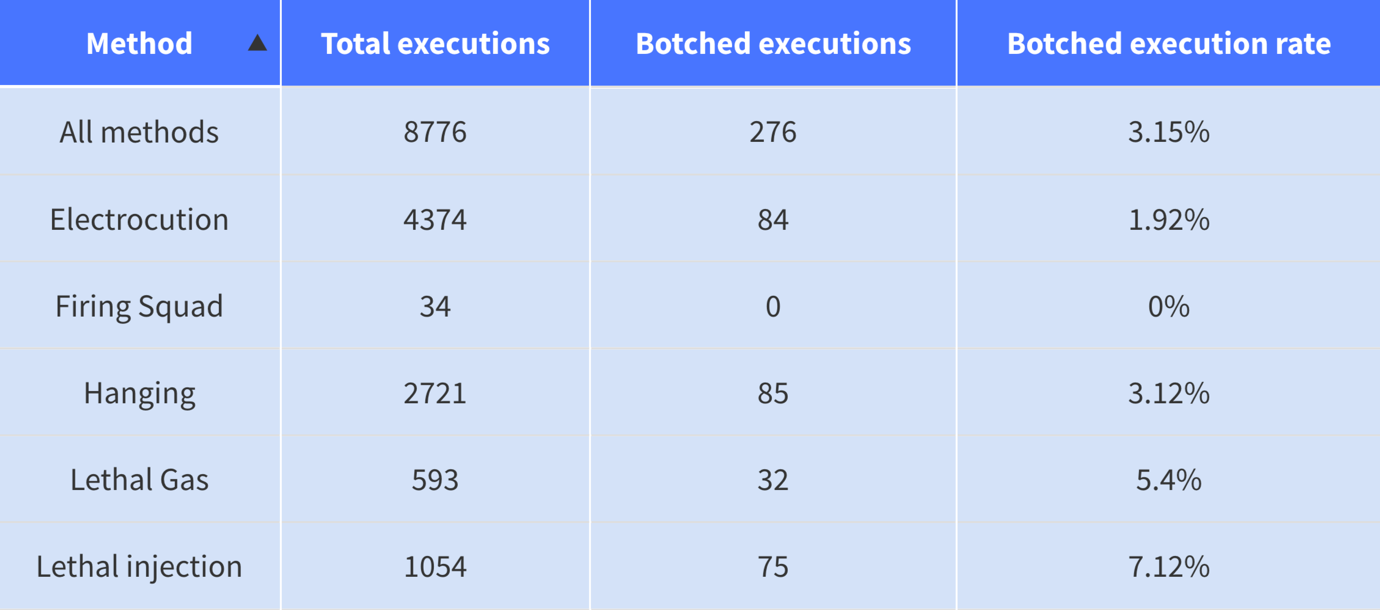
Botched executions: 'Botched executions' are those that did not go as planned, resulting in unnecessary pain for the person charged with death penalty.
Inequities in application: The application of the death penalty is not uniform and can be influenced by factors such as race, gender, and socioeconomic status. This raises concerns about the fairness and impartiality of the justice system.
Retribution vs. rehabilitation: The death penalty is often seen as a form of retribution rather than rehabilitation. This raises ethical questions about whether the state should be seeking revenge or working towards the rehabilitation of offenders.
Cost: The death penalty is often more expensive than life imprisonment. This raises ethical questions about the allocation of resources and whether society should be spending money on a form of punishment that is not proven to be more effective than alternatives.
Overall, the ethical issues associated with the death penalty are complex and multifaceted. While some argue that it is necessary for justice to be served, others believe that it is a violation of human rights and that alternative forms of punishment should be explored.
Important Supreme Court Judgments
Bachan Singh v. State of Punjab, 1980: Consider aggravating and mitigating factors of crime and the accused. Use Death Penalty only in 'rarest of rare cases'.
Machhi Singh v. State of Punjab, 1983: Identify the way the crime was committed, motive, the anti-social nature of the crime, the magnitude of the crime, and the personality of the victim.
Shatrughan Chauhan v. Union of India, 2014: Undue, inordinate and unreasonable delay in death penalty execution amounts to torture and a ground for commutation of sentence.
Death penalty methods and failure rates
The table shows the proportion of botched executions for each method. Data includes only executions in the U.S. from 1890 to 2010.
There are several alternatives to the death penalty that are used by various countries and jurisdictions around the world.
Here are a few examples:
Life imprisonment without the possibility of parole: This is a sentence in which the offender is kept in prison for the rest of their life, with no chance of release. This is a common alternative to the death penalty in many countries.
Restorative justice: This is a process in which the offender is required to make amends for their crime, usually through community service or financial restitution to the victim. This approach focuses on repairing harm rather than punishment.
Rehabilitation programs: This involves providing offenders with education, job training, counseling, and other services that can help them reintegrate into society and avoid future criminal behavior.
Community service: This is a sentence in which the offender is required to perform a certain amount of community service as a form of punishment.
Fines and other monetary penalties: This involve imposing a financial penalty on the offender, which can range from a small fine to a substantial sum of money.
Suspended sentence: This is a sentence in which the offender is found guilty but not actually sent to prison. Instead, the sentence is "suspended," which means that the offender is released but must adhere to certain conditions, such as regular check-ins with a probation officer or avoiding further criminal activity.
Capital punishment moratorium: This is a temporary or indefinite suspension of the death penalty, which allows time for review and reform of the justice system.
Overall, there are many alternatives to the death penalty that can be effective in deterring crime, protecting society, and rehabilitating offenders.
Global Trends
The use of the death penalty varies greatly around the world. While some countries have abolished it entirely, others continue to use it as a form of punishment for certain crimes. Here are some global practices with regard to the death penalty:
Abolitionist countries:As of 2021, 109 countries have completely abolished the death penalty. These countries include Canada, most of Europe, Australia, New Zealand, and many Latin American and African countries.
There are still 55 countries that retain the death penalty in law and/or in practice, including the United States, China, Iran, Saudi Arabia, and Vietnam.
Some countries that have not abolished the death penalty have imposed a moratorium on executions. This means that while the death penalty is still legal, no executions are being carried out. For example, India has not executed anyone since 2015.
The methods used to carry out the death penalty also vary around the world. In some countries, such as the United States, lethal injection is the most common method, while in others, such as Saudi Arabia, beheading is used.
The crimes that can result in the death penalty also vary by country. In some countries, such as Iran and Saudi Arabia, crimes such as drug trafficking and apostasy can result in the death penalty, while in others, such as the United States, only certain types of murder can result in the death penalty.
The ethical implementation of the death penalty requires adherence to certain principles, such as ensuring that the justice system is free of flaws and that laws are properly enforced. To avoid any failures or miscarriages of justice, the criminal justice system must be improved.
In addition, the judiciary must maintain a consistent approach that takes into account the restorative and rehabilitative aspects of justice in order to avoid any negative consequences that could arise from imposing the death penalty.
Furthermore, there must be compelling justifications for the imposition of the death penalty in order to avoid excessive punishment and maintain respect for the value of life.
Finally, the mercy petition must be treated as the final bulwark against any miscarriage of justice, with a time-bound disposal of such petitions to ensure that justice is served.