Banking & Monetary Policy

First Loan Default Guarantee (FLDG)

What is FLDG?

image 68
  • First Loan Default Guarantee (FLDG) is a lending model serviced between digital-lending fintechs and their partner banks and NBFCs.
  • Under these agreements, the fintech originates a loan and promises to compensate the partners up to a pre-decided percentage in case customers fail to repay.
  • The bank/NBFC partners lend through fintech but from their own books. 

RBI Framework

  • Regulated Entities (REs) shall ensure that the total amount of default loss guarantee (DLG) cover on any outstanding portfolio which is specified upfront shall not exceed 5% of the amount of that loan portfolio.
  • In the case of implicit guarantee arrangements, the DLG Provider shall not bear a performance risk of more than the equivalent amount of 5% of the underlying loan portfolio.
  • The RE shall invoke DLG within a maximum overdue period of 120 days, unless made good by the borrower before that.
  • In terms asset quality, recognition of individual loan assets in the portfolio as NPA and consequent provisioning shall be the responsibility of the RE as per the extant asset classification and provisioning norms irrespective of any DLG cover available at the portfolio level. The amount of DLG invoked shall not be set off against the underlying individual loans. Recovery by the RE, if any, from the loans on which DLG has been invoked and realised, can be shared with the DLG provider in terms of the contractual arrangement.
  • Any DLG arrangement shall not act as a substitute for credit appraisal requirements and robust credit underwriting standards need to be put in place irrespective of DLG cover.

Benefits

  • Expand the customer base of traditional lenders but relies on the fintech’s underwriting capabilities.
  • Enhances the deeper partnerships and collaboration between legacy institutions (Banks, regulated entities, NBFCs) and new age fintech’s - democratises access to credit and fuel growth for the unserved and underserved.
  • Strengthens credit penetration and boosts the digital lending ecosystem.
  • Promotes more transparency and discipline in the digital lending environment.
  • Widens the scope of resolution of stressed assets.

UPI transaction limit set by Indian banks

Context: Unified Payments Interface (UPI) related frauds have been on the rise. To check the number of transactions and reduce the risk of big financial frauds, leading banks including HDFC Bank, State Bank of India (SBI), Axis Bank, and ICICI Bank have implemented some restrictions on UPI transactions. These come as the National Payments Corporation of India (NPCI) has set guidelines to regulate the expanding digital payment ecosystem.

What is UPI

image 62
  • UPI is an instant real-time payment system developed by the National Payments Corporation of India (NPCI)
  • The mobile-based fast payment system is built over the Immediate Payment Service (IMPS) infrastructure.

Features:

  • The payments can be made round-the-clock and in real time.
  • It eliminates the risk of sharing bank account details by the remitter as customers are not required to enter the details such as Card no, account number, IFSC, etc.
  • UPI supports both Person-to-Person (P2P) and Person-to-Merchant (P2M) payments and it also enables a user to send or receive money.
  • It enables the use of a single mobile application for accessing different bank accounts.
  • Transactions are carried out through mobile devices with two-factor authentication using device binding and a UPI PIN as security.
  • Registration of Beneficiary is not required for transferring funds through UPI as the fund would be transferred based on using a Virtual Payment Address (VPA) created by the customer.

Daily limits for UPI

Set by NPCI

  • At present, users can make up to 20 transactions or ₹1 lakh in a single day either all at once or through the day. For certain specific categories of transactions such as the capital markets, collections (such as bills, among others), insurance, and forward inward remittances, the limit is ₹2 lakh. 
  • In December 2021, the limit for the UPI-based ASBA (Application Supported by Blocked Amount) IPO and retail direct schemes was increased to ₹5 lahks for each transaction.

Set by banks and apps

  • The transaction limits can vary between banks and may depend on factors such as the type of account, customer profile, and the bank's risk assessment policies and individual banks have established their own limits for UPI transactions like PNB’s daily limit is ₹50,000, SBI’s daily limit is 1 lakh, etc.
  • As for apps, have established their own limits for UPI transactions like Paytm and Amazon Pay UPI have set a daily limit of Rs. 1 lakh, with a total of up to 10 transactions permitted across all UPI apps and bank accounts. However, these limits can vary depending on the banks if you use their UPI application for transactions.

Rationale behind the limits on UPI transactions

  • Security and Fraud Prevention: By imposing limits, banks can reduce the potential loss in case of unauthorized transactions or account breaches. Limiting transaction amounts helps to detect suspicious activities and prevent large-scale financial fraud.
  • Customer Protection: Transaction limits serve as a safeguard for customers, ensuring that any fraudulent transactions or errors are contained within a manageable threshold. 
  • Risk Management: Limiting transaction amounts allows banks to monitor and identify unusual patterns or activities more effectively.
  • Compliance with Regulatory Guidelines: The transaction limits for different types of transactions, ensuring adherence to regulatory requirements.

Growth of UPI

  • Digital transactions: To compare the amount with May of the previous financial year (2022-23), the volume of transactions has grown by 58%, while the overall value has surged by 37%.
  • UPI Frauds: However, until February in the financial year 2022-23, the total number of reported UPI frauds had also increased by about 13% in comparison to the previous financial year to 95,402. 
  • However, this was alongside a decline in the fraud-to-sales ratio at 0.0015%. Thus, to combat the growing incidences, there is an imperative need to have safeguard infrastructure in a growing ecosystem.

RBI dividend payments to Government

Context: The Central Board of Directors of the Reserve Bank of India (RBI) recently approved the transfer of ₹87,416 crore as surplus to the Union government for the accounting year 2022-23, almost thrice the ₹30,307 crore transferred for the previous fiscal year. The RBI’s board also decided to raise the Contingency Risk Buffer to 6%, from 5.5% in the preceding year.

Source of Earnings for RBI:

  • Interest on Government securities held 
  • Interests on loans and advances made 
  • Interest earned on Liquid Adjustment Facility operations
  • Interest income from foreign currency assets held 
  • Earnings from forex swaps
  • Seigniorage 
image 321
                                              Composition of RBI’s balance sheet
LiabilitiesAssets
Capital Reserves Revaluation AccountsDeposits of Banks and Government Currency notes in circulation Foreign Currency AssetsGoldInvestments in domestic securitiesLoans & Advances
  • Capital reserves: Two important components are
  • Contingency fund: The fund is set aside by RBI for meeting unforeseen contingencies like risks arising out of monetary policy operations, exchange rate risks or systemic risks.
  • Asset development fund: This fund is set aside for investments in subsidiaries and associate institutions and to meet internal capital expenditure.

These two funds are considered as Risk provisions of the RBI and provisioned from the earnings of RBI. Such capital required to withstand risks is also known as Economic Capital. 

  • Revaluation Accounts: RBI maintains revaluation accounts to insulate its assets (Gold, foreign currency, Investments in domestic and foreign securities) from prevailing market trends. They include Currency and Gold Revaluation Account (CGRA), Investment Revaluation Account (IRA) and Foreign Exchange Forward Contracts Valuation Account (FCVA). 
  • Deposits: In its traditional role as a banker to the government, RBI usually accepts government deposits, which constitutes a liability for the central bank. The central bank also accepts deposits from other banks and other financial instituions. 
  • Currency notes in circulation is a liability of the central bank. 

How surplus is shared with Central government?  

After meeting the risk provisions and other operational expenditures (salaries etc.) from the earnings of RBI, the surplus is transferred to the central government in the form of dividends. Surplus transfer from the Reserve Bank is an important component of non-tax revenues to the central government.  However, the quantum of dividends shared with the central government depends upon the amount of money provided for risk provisioning, especially for contingency fund. 

There occurred a controversy regarding the excess capital reserves accumulated with the RBI and sharing of dividend with the central government in 2018. To sort out this controversy a committee (Bimal Jalan committee) was appointed to review the Economic Capital Framework. The Committee had prescribed a Contingency Risk Buffer in the range of 5.5% to 6.5% of its balance sheet. 

Merchant Discount Rate

Context: The Payments Council of India (PCI), an industry body representing payment fintechs in the country, has requested finance minister to restore Merchant Discount Rate (MDR) for RuPay debit cards, as payment aggregator fintechs continue to lose on revenue lines for processing payments through the card infrastructure.

Merchant Discount Rate:

  • MDR (Merchant Discount Rate) refers to a fee that a merchant is charged by their issuing bank for accepting payments from their customers via credit and debit cards. ‌It is also known as Transaction Discount Rate (TDR). While the card-issuing bank gets a share of it, the remaining amount is distributed between the payment network and point-of-sale terminal providers. 

Push for Digitalisation: 

  • The Government had mandated that large businesses (With turnover greater than ₹50 crore) provide customers with low-cost digital modes of payment and had asked banks to levy zero charges on the same.
  • The finance minister gave this initiative a further push by mandating that no MDR charges will be applicable on digital transactions via the Rupay and UPI platforms. 

Concerns of Fintechs:

  • Payment aggregator fintechs are claiming that a loss of Rs 5,500 crore from no revenue being earned on UPI and RuPay debit card transactions. To compensate for this, the body has sought an incentive of Rs 4,000 crore in its representations to the ministry.
  • Zero MDR is also seen as a hindrance in attracting more players to adopt these payment modes and invest more in the development of the tech infrastructure to handle the huge volumes of transactions.

What is LIBOR and why RBI has asked the banks to Move away from it

Context: The Reserve Bank of India has directed the banks and other financial institutions to move away from the LIBOR (London Interbank Offered Rate) and move to any Alternative Reference Rates (ARR).

What is LIBOR?

LIBOR stands for the London Interbank Offered Rate. It is a benchmark interest rate that indicates the average rate at which major banks in London are willing to borrow from each other in the interbank market. LIBOR serves as a reference rate for a wide range of financial products and transactions, including loans, derivatives, and other financial contracts.

  • The British Bankers' Association (BBA) used to administer LIBOR until 2014, after which the Intercontinental Exchange Benchmark Administration (ICE Benchmark Administration) took over the responsibility.
  • LIBOR is calculated for various currencies and different borrowing periods, ranging from overnight to one year.
  • The calculation of LIBOR involves a panel of major banks submitting their borrowing rates, which are then used to determine an average rate. These rates are supposed to reflect the rates at which banks can borrow funds in the London wholesale money market.

How Is Libor Calculated?

  • Each day, 18 international banks submit their ideas of the rates they think they would pay if they had to borrow money from another bank on the interbank lending market in London.
  • To safeguard against extreme highs or lows, the Intercontinental Exchange (ICE) Benchmark Administration strips out the four highest submissions and the four lowest submissions before calculating an average.
  • It’s important to note that Libor isn’t set on what banks actually pay to borrow funds from each other. Instead, it’s based on their submissions related to what they think they would pay. As a result, it’s possible for banks to submit lower rates and manipulate Libor fairly easily.

Libor Scandals and the 2008 Financial Crisis

  • During the crisis, banks manipulated the LIBOR rates for their own benefit. They understated or manipulated their reported rates to create an illusion of financial health and to appear more creditworthy than they actually were.
  • By manipulating LIBOR rates, banks were able to lower their borrowing costs and increase their profits. This also gave them a false sense of security and credibility in the eyes of investors and counterparties.
  • The manipulation of LIBOR distorted the true pricing of financial products, leading to mispricing and increased risk in the global financial system.
  • Many financial institutions around the world relied on LIBOR as a benchmark for pricing and valuing their financial products. The manipulation of LIBOR undermined the integrity of these markets and eroded trust among market participants.
  • The impact of the LIBOR manipulation was far-reaching. It affected trillions of dollars' worth of financial contracts globally, including loans, mortgages, and derivatives. This, in turn, had a significant impact on individuals, businesses, and the overall economy.
  • The revelation of the LIBOR manipulation sparked a wave of investigations, lawsuits, and regulatory actions against banks involved in the scandal. Several major financial institutions faced substantial fines and penalties for their involvement.
  • The 2008 financial crisis exposed the vulnerabilities and weaknesses in the LIBOR benchmark system. It highlighted the need for reform and the development of alternative, more robust benchmark rates to ensure the integrity and stability of financial markets.
  • In response to the crisis, efforts were made to transition away from LIBOR as a benchmark rate. Various alternative reference rates, such as the Secured Overnight Financing Rate (SOFR) in the United States, were introduced to replace LIBOR and mitigate the risk of manipulation.

The RBI has directed all banks in India to end all contracts with LIBOR by 31 Dec and use the Mumbai Interbank Forward Offer rate (MIFOR).

What is MIFOR?

  • MIFOR stands for Mumbai Interbank Forward Offer Rate. It is a benchmark interest rate used in India to determine the pricing of various financial instruments, particularly forward rate agreements (FRAs) and interest rate swaps (IRS).
  • MIFOR is derived from a combination of the Mumbai Interbank Offered Rate (MIBOR) and the corresponding foreign currency benchmark rate. MIBOR is the interest rate at which banks in Mumbai, India, lend to one another in the interbank market.
  • The foreign currency benchmark rate used in the calculation of MIFOR depends on the currency involved in the transaction.
  • MIFOR is commonly used in India for hedging and pricing purposes in the derivatives market. It reflects the market's expectations of future interest rates in India and provides a reference point for interest rate-related transactions.
  • It's worth noting that the information provided is accurate up until my last knowledge update in September 2021. There might have been updates or changes in the financial landscape since then, so it's always a good idea to consult up-to-date sources and experts for the most recent information.

ONDC Project

Context: Despite best efforts, the Government's Open Network for Digital Commerce could go in vain if proper supply chain management is not being developed.

What is Open Network for Digital Commerce?

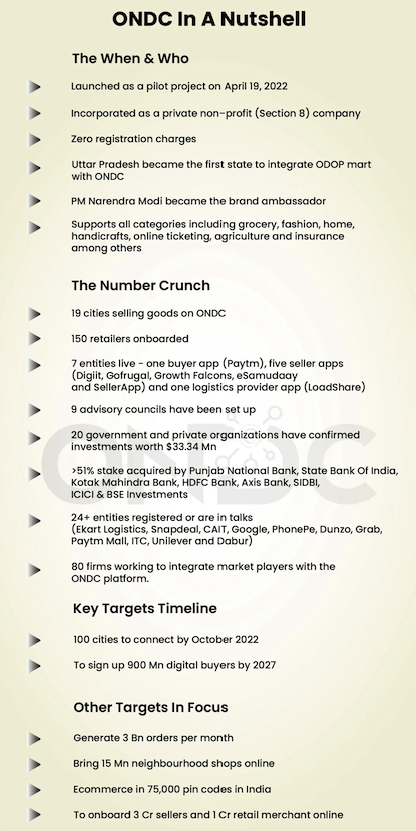
  • Open Network for Digital Commerce (ONDC) is an initiative aiming at promoting open networks for all aspects of exchange of goods and services over digital or electronic networks (like e-commerce). 
  • Sponsored by DPIIT (the Department for Promotion of Industry and Internal Trade), the non-profit programme, will bring together all stakeholders – buyers, sellers, logistics players, and digital payment providers – on one platform for convenience and growth.
  • ONDC is to be based on open-sourced methodology, using open specifications and open network protocols independent of any specific platform.
  • ONDC are to be open protocols for all aspects in the entire chain of activities in exchange of goods and services, similar to hypertext transfer protocol for information exchange over internet, simple mail transfer protocol for exchange of emails and unified payments interface for payments.
  • These open protocols would be used for establishing public digital infrastructure in the form of open registries and open network gateways to enable exchange of information between providers and consumers. 
  • Providers and consumers would be able to use any compatible application of their choice for exchange of information and carrying out transactions over ONDC.

Benefits:

  • The initiative will not only facilitate the rapid adoption of e-commerce but also boost and strengthen the growth of startups in India. By facilitating scalable and cost-effective e-commerce through the open protocol, ONDC will empower startups to grow collaboratively.
  • ONDC will take ecommerce penetration to 40-50% in the coming years, as opposed to the current 10% share within India’s overall retail market.
  • For businesses, this will help create a level playing field and further drive open commerce, similar to how the United Payments Interface (UPI) democratised the digital payments segment. 
  • Buyers, too, will benefit from easy access to a massive merchant base, great pricing, faster delivery, and enhanced customer experience.
  • ONDC will keep referral commissions capped at 3-5% at a later stage (for now, it is free), a massive reduction in costs compared to what businesses have to pay now for selling their goods online. According to a Gofrugal estimate, this is 7 to 10 times less than the usual online-selling commission rate of 23% to 28% on the cart value.
image 291

Challenge to ONDC:

  • ONDC does not have the best of the supply chain management when compared to other ecommerce giants like Amazon or Flipkart. 
  • It still depends upon the ability of the others to facilitate logistics and warehousing.
  • Number of participants is still very low (not very popular among people).

Expected Loss Approach for Provisioning

Context: Lenders have sought a one-year extension from the Reserve Bank of India (RBI) for implementation of the Expected Credit Loss (ECL)-based loan loss provisioning framework.

Provisions

A loan loss provision is an expense that is set aside for defaulted loans. Banks set aside a portion of the expected loan repayments from all loans in their portfolio to cover the losses either completely or partially.

  • In the event of a loss, instead of taking a loss in its cash flows, the bank can use loan loss reserves to cover the loss.
  • An increase in the balance of reserves is called loan loss provision. The level of loan loss provisions is determined based on the level expected to protect the safety and soundness of the bank.

What is the current approach for Provisioning?

  • Presently, banks are required to make loss provisions based on 'Incurred Loss Approach', where banks need to provide for losses that have occurred/incurred.
  • Example: Banks in India are required to make provisions of 15% of outstanding in case of secured loans and 25% of outstanding for unsecured loans, when a loan exposure is classified as NPA. This provisioning must be made after the loan has been classified as an NPA.
  • However, there have been issues of lag in identifying credit risks and the procyclical nature of incurred loss approach. This leads to significant delays and erosion of bank capital during downturns respectively.

Expected Loss Approach for Provisioning

  • In January 2023, the RBI came out with a draft guidelines proposing adoption of expected credit loss approach for credit impairment. As per the draft, banks will be given a one year period after the final guidelines are released for implementation of expected credit loss approach for loss provisioning.
  • Expected credit losses represent a probability weighted estimate of the present value of all cash shortfalls from an instrument.
  • Banks will classify financial assets (primarily loans, including irrevocable loan commitments and investments classified as held-to-maturity or available for sale) into following three categories:
  • Stage I: Includes financial assets that have not had a significant increase in credit risk since initial recognition or that have low credit risk at reporting date. 
  • Stage II: Includes financial instruments that have had a significant increase in credit risk since initial recognition (unless they have low credit risk at the reporting date) but that do not have objective evidence of impairment.
  • Stage III: Includes financial assets that have objective evidence of impairment at the reporting date. For these assets, lifetime expected credit loss is recognised and interest revenue is calculated on the net carrying amount.

Insolvency and Bankruptcy Code

Exit from business is as integral to ease of doing business as is an entry. Earlier frameworks for resolution, such as the Debt Recovery Tribunals, the Lok Adalats and even the Securitisation and Reconstruction of Financial Assets and Enforcement of Securities Interest Act (SARFAESI Act) of 2002, which sought to ease the process of resolution or liquidation failed to do the task effectively.  It was in this context that the government decided to frame and enact the Insolvency and Bankruptcy Code (IBC) of 2016. 

Objective: The IBC, which came into existence in 2016, aimed to create a single, comprehensive framework that would provide a time-bound and cost-effective process for resolving insolvency and bankruptcy. 

Institutional framework: 

image1 1

Process:

The IBC seeks to achieve the stated objectives through a well-defined process that includes various stages, including initiation of insolvency, appointment of an insolvency professional, resolution plan, and liquidation.

InitiationInsolvency Resolution ProcessLiquidation
Minimum amount of default:
- ₹ 1000 (for Individual)
- ₹ 1cr (for Companies)
In case the application is admitted by the adjudicating authority, a moratorium is declared on all the legal proceedings against the debtor until the completion of the CIRP.If either the Resolution plan is rejected by the CoC or failed to be approved by it with in 330 days, the process of liquidation kicks in automatically.
Initiators:
- Debtor
- Secured & Unsecured
creditors
- Employees
A resolution professional is appointed by the NCLT who supersede the board of directors of the debtor company and supervises its assets.The proceeds of liquidation are distributed among secured creditors, unsecured creditors, Govt dues, Preferential share holders etc. in the respective order of priority.
Adjudication Authority:
- DRT (for individuals)
- NCLT (for companies)
The Resolution Professional would help in chalking out a resolution plan and get it approved by the committee of creditors (CoC) with a majority of 66%.

Performance:

The apprehension of losing the business to the resolution applicant in the event of a successful CIRP or the eventual liquidation has instilled a sense of fear in the minds of the Corporate Debtors. This has resulted in improvement in the corporate repayment culture of the bank loans and resultant reduction in the nonperforming assets (NPAs) of the banks in the recent years despite the adverse impact of COVID-19 pandemic on the trade and economy of the country.

Successful examples:

  • In Essar Steel resolution, the creditors managed to recover 925 of ₹49,000 crore of debt outstanding.
  • In Bhushan Steel case, 64% of ₹56,022 crore outstanding was retrieved, whereas Binani Cements in whose case all of the ₹6,469 crore outstanding was recovered.

However, 

  • Out of the 4,376 cases for which the Corporate Insolvency Resolution Process (CIRP) had commenced till now, only 2,653 have been closed, with just 348 (or 13.1 per cent) of those closed being disposed after approval of a debt resolution plan.
  • If we consider the proportion of outstanding credit recovered from defaulters through the resolution process, the figure stands at 39.26% even for the minority of cases resolved through the CIRP, which is not very much higher than the 26 per cent registered for cases dealt with under the SARFAESI Act. The argument that the IBC would be a game changer is yet to be validated.

Challenges:

  • Backlog of cases in the NCLT, which has led to delays in the resolution process. The proportion of NCLT benches to the high number of cases are imbalanced.
  • Another challenge is the lack of infrastructure and trained professionals to manage the insolvency process. At present, there are less than 100 registered insolvency professionals. 
  • Due to the lack of need for minimum experience in handling and managing a company, one might question the ability of the resolution professional.
  • The time limit of 330 days to complete CRIP is proving to be very difficult. For companies having a large number of creditors, will have hindrances in the smooth functioning of the creditor’s committee. 
  • No strict liability of directors for wilfully delaying /concealing insolvency of company

To address these challenges, the government has taken several measures, including increasing the number of NCLT benches, increasing the number of insolvency professionals, and amending the IBC to address practical challenges.

Way forward:

  • The process of mediation be institutionalised and appropriately integrated in the CIRP Regulations with adequate provision to exclude the time taken in the mediation process while reckoning the completion of CIRP within the stipulated timeframe of 180, 270, or 330 days.
  •  Setting up of additional benches of NCLT and National Company Law Appellate Tribunal may be taken on priority to bring down the pendency and adhering to the stipulated timelines.

Despite certain challenges faced so far, it deserves to be recognised that the IBC has significantly contributed to consistent improvement in India’s ranking in the World Bank’s erstwhile ‘Ease of Doing Business’ over the years.  Timely changes/modifications of the existing legislation and expanding to new areas (group insolvency, pre-pack process for all assets, cross-border insolvency regime) would facilitate overall improvement in the insolvency resolution regime of the country.

Aadhaar enabled Payment System (AePS)

Context: Incidents of bank frauds, without two factor authentication, have been reported across India, with cybercriminals using silicone thumbs to operate biometric ATMs and POS devices.

What is AePS?

  • AePS, or Aadhaar enabled Payment System, is a payment system that enables customers to carry out financial transactions through Aadhaar-based authentication at Point of Sale (PoS) devices and micro ATMs. 
  • Aadhaar is a unique identification number containing demographic and biometric data issued to Indian residents. 
  • With the help of biometric authentication methods like fingerprint or iris scans, customers can use their Aadhaar number to access various banking services, including cash withdrawals, balance inquiries, fund transfers, and other banking transactions. 
  • The National Payments Corporation of India (NPCI) introduced the AePS system to promote financial inclusion and make banking services accessible to all, particularly those living in remote and rural areas.

Benefits of AePS:

  • Financial inclusion: AePS enables individuals who do not have access to traditional banking services to carry out financial transactions. This promotes financial inclusion and ensures that everyone has access to basic banking services. 
  • Streamlining Government Entitlements: Aadhaar enabled Payment System facilitate disbursements of Government entitlements like NREGA, Social Security pension, Handicapped Old Age Pension etc. of any Central or State Government bodies using Aadhaar authentication.
  • Convenience: AePS allows users to carry out financial transactions using their Aadhaar number and biometric authentication. It eliminates the need for carrying cash or a physical debit card, making transactions more convenient and hassle-free. 
  • Security: Since transactions on AePS are authenticated using biometric authentication, it is more secure than traditional banking services that rely on passwords and PINs. It ensures that transactions are safe and secure. 
  • Low-cost transactions: AePS transactions are low-cost, making it an affordable option for individuals who want to carry out financial transactions. 
  • Easy to use: AePS is easy to use and does not require any special training or knowledge. Users can carry out transactions using their Aadhaar number and biometric authentication, which is a simple and straightforward process.
  • Inter-operability: Aadhaar enabled Payment System facilitates inter-operability across banks in a safe and secured manner.
  • Reaching the unreached: The model enable banks to extend financial services to the unreached clients beyond their branch network as beneficiaries of the Business Correspondents (BCs) are mostly located at unbanked and underbanked areas.

RBI’s switch auction of G-secs stays undersubscribed on tight liquidity

Context: The Reserve Bank of India’s switch/conversion auction of government securities (G-secs) of Rs 20,000 crore remained undersubscribed. as liquidity remained tight and banks demanded higher yields.

Why this trend?

  • The overall liquidity (cash) in the system is stable at a lower level of just about Rs 50,000 crore. There is clearly a strain in the market in terms of liquidity not being evenly distributed and there are shortfalls in the liquidity of some banks. 
  • Switches and conversions have been used to defer payments due in the next couple of years, with the maturities being stretched. This reduces pressure on the market in terms of fresh borrowings being needed.
  • Liquidity (cash) demand of the banking sector was around 1.5 lakh crore, however, it was narrowed down to 80,000 crore. Lower cash with the banking sector left overnight call money rates being pushed above the benchmark level. This led to tightening of liquidity.

About Government Securities

A Government Security (G-Sec) is a tradable instrument issued by Central or State governments. It acknowledges the Government's debt obligation.

RBI As Debt Manager:

  • RBI Act mandates RBI to undertake receipts and payments of Central Government and carry out banking and management of public debt of Union.
  • State Government transactions are carried out by RBI in terms of an agreement entered by RBI and State Governments under RBI Act. As of now, such agreements exist between RBI and all State Governments except Sikkim.
  • Thus, RBI is banker and debt manager of government.
  • RBI issues both, treasury bills and bonds or dated securities on behalf of Central Government while the State Governments issue only bonds or dated securities, which are called the State Development Loans (SDLs).

Types Of Government Securities:

Short Term Government Securities(maturity less than 1 year)

  • Treasury bills: Money market instruments issued by GoI. Presently, issued in three tenors of 91 days, 182 days and 364 days.
  • Cash Management bills: Issued by GoI to meet temporary mismatches in cash flow of GoI. They are like T-bills but are issued for maturities less than 91 days.

Long Term Government Securities (Maturity more than 1 year):

  • Dated G-Secs: They are securities which carry a fixed or floating coupon (interest rate) which is paid on face value, on a half-yearly basis. Tenor ranges between 5 to 40 years.
  • Fixed Rate Bonds: These are bonds on which the coupon rate is fixed for the entire life (i.e., till maturity) of the bond. Most Government bonds in India are issued as fixed rate bonds.
  • Floating Rate Bonds: FRBs are securities which do not have a fixed coupon rate. Instead, it has a variable coupon rate which is re-set at pre-announced intervals (say, every six months or one year).

Auction Of Government Securities

G-Secs are issued through auctions conducted by RBI. Auctions are conducted on the electronic platform called the E-Kuber, the Core Banking Solution of RBI.

Members of e-KUBER: Commercial Banks, Scheduled Urban Cooperative Banks, Primary Dealers, Insurance Companies and Provident Funds, who maintain funds account (Current Account) and securities account (Subsidiary General Ledger account) with RBI.

All members of E-Kuber can place their bids in the auction through this electronic platform.

Types Of Auctions

  • Rate of interest (coupon rate) gets fixed through a market-based price discovery process.
  • Yield Based Auction: is generally conducted when a new G-Sec is issued. Investors bid in yield terms. Bids are arranged in ascending order and cut-off yield is arrived at the yield corresponding to the notified amount of the auction. The cut-off yield is then fixed as the coupon rate for the security. Successful bidders are those who have bid at or below the cut-off yield.
  • Price Based Auction: is conducted when G-Sec which has already been issued is being reissued. Bidders quote in terms of price per Rs 100 of face of the security. Bids are arranged in descending order of price offered and the successful bidders are those who have bid at or above the cut-off price.

Allocation Of Government Securities

Depending upon the method of allocation to successful bidders, auction may be conducted on Uniform Price basis or Multiple Price basis:

Uniform Price Method: All the successful bidders are required to pay for the allotted quantity of securities at the same rate, i.e., at the auction cut-off rate, irrespective of the rate quoted by them.

Multiple Price Method: Successful bidders are required to pay for the allotted quantity of securities at the respective price/yield at which they have bid.

Types Of Bidding

Competitive Bidding: In a competitive bidding, an investor bids at a specific price/yield and is allotted securities if the price/yield quoted is within the cut-off price/yield. Competitive bids are made by well-informed institutional investors such as banks, financial institutions, primary dealers, mutual funds and insurance companies. Multiple bidding is also allowed, i.e., an investor may put in multiple bids at various prices/yield levels.

Non-Competitive Bidding: To encourage wider participation and retail holding of Government

securities, retail investors are allowed participation on ‘non-competitive’ basis in select auctions of dated G-Secs and Treasury bills (5% of notified amount). Retail investor is any person including individuals, firms, companies, corporate bodies, institutions, provident funds, trusts and any other entity as prescribed by RBI.

RBI’s Retail Direct Scheme:

  • It is a comprehensive scheme which provides a one-stop solution to facilitate investment in Government Securities by individual & retail investors through an online portal. It aims to provide a safe, direct and secured platform to investors.
  • Under this scheme, retail individual investors will be able to open a Gilt Securities Account - Retail Direct Gilt (RDG) Account with RBI, using an online portal (rbiretaildirect.org.in).

Using the Retail Direct Platform, individual investors can participate in 

  • T-Bills
  • Dated G-Sec
  • State Development Loans (SDLs)
  • Sovereign Gold Bonds (SGB)

Investments can be made using following routes:

  • Primary issuance of government securities: Investors can place bid as per the non-competitive scheme for participation in primary auction of government securities and procedural guidelines for sovereign gold bond issuance.
  • Secondary market: Investors can buy and sell government securities on NDS-OM.
  • Using the RDG account, individuals can buy Government Securities in primary market (auctions) and buy/sell in secondary market.

International trade in Indian Rupee

Context: RBI Governor Shaktikanta Das said the government and the central bank are in discussion with South Asian countries to have cross-border trade in rupee. India had already made similar agreements with Sri Lanka, Russia and Mauritius and in early discussions with UAE to trade non-oil commodities in Indian rupee.

Need for trading in local currencies:

  • Reduce transaction costs: When countries import and export goods and services, they have to make payments in a foreign currency. Since the US dollar is the world’s reserve currency, most of these transactions are settled in dollars.

E.g., If an Indian buyer enters into a transaction with a seller from Germany, the Indian buyer has to first convert his rupees into US dollars. The seller will receive those dollars, which is then converted into euro. 

Here, both the parties involved have to incur the conversion expenses and bear the risk of foreign exchange rate fluctuations.

  • Geo-political shocks: Geo-political tensions often create challenges in seamless trade between the countries.

E.g., Recent Russia-Ukraine war resulted in western sanctions on Russia which created challenges for India to trade with Russia in dollars. 

  • Reduce dependency over foreign currency: Increasing use of Indian rupee for cross-border transactions will not only reduce our dependency over foreign currency but also increases the credibility of rupee in the global market adding weight to Indian economy. 
  • Insulate from external shocks: Reducing dependence on foreign currency makes India less vulnerable to external shocks like mitigating the pain of reversal of capital flows. 

Mechanism of Rupee trade settlement:

Vostro accounts are accounts a bank holds on behalf of another foreign bank. Rupee Vostro accounts keep a foreign entity's holdings in the Indian bank, in Indian rupees. Recently RBI permitted various Indian banks to open 12 special vostro accounts for trade in rupees.

A Rupee Vostro account is used to facilitate international trade transactions in Indian rupee. When an Indian importer wants to make a payment to a foreign trader in rupees, the amount will be credited to this Vostro account, and when an Indian exporter needs to be paid for supplying goods or services, this Vostro account will be deducted, and the amount will be credited to the exporter's account. 

image 170

Challenges with Internationalisation of Indian currency:

  • Unfeasible with all the countries: Countries with whom we run trade deficit may reluctant to use this rupee settlement because the vostro accounts are left with surplus amount.  
  • Hampers independent monetary policy: 
  • Internationalisation of a currency could make simultaneous pursuit of exchange rate stability and autonomous monetary policy challenging.
  • As both residents and non-residents can buy and sell domestic currency denominated financial instruments, internationalisation can limit the ability of the RBI to control domestic money supply and influence interest rates in accordance with the requirements of domestic macroeconomic conditions.

Global financial contagion: Effective internationalisation of a currency would require taking steps towards full convertibility on the capital account, which may put at the India at the risk of global financial contagion.

Rise in RBI’s Gold Reserves

Context: The Reserve Bank of India’s (RBI) gold reserves touched 794.64 metric tonnes in fiscal year 2022-23, an increase of nearly 5% over fiscal 2022, when it held 760.42 metric tonnes of gold.

How Much Gold has RBI Purchased?

  • Between the fiscal year ended June 30, 2019 (the RBI used to follow the July-June accounting year then; this was changed to April-March starting 2020-21) and fiscal 2023, the RBI’s gold reserves swelled by 228.41 tonnes.
  • As on March 31, 2023, the country’s total foreign exchange reserves stood at $578.449 billion, and gold reserves were pegged at $45.2 billion. 
  • In value terms (USD), the share of gold in the total foreign exchange reserves increased from about 7% at the end of March 2022 to about 7.81% at the end of March 2023. It was 7.06% as of end-September 2022.

Reasons for Accumulation of Gold

  • Diversification: Gold is considered a more safe, secure, and liquid asset. It also safeguards returns amid global uncertainty and a rising inflation scenario.
  • Driving factors: Negative interest rates in the past, the weakening of the dollar and growing geopolitical uncertainty.
  • Gold offers long-term store of value and is a high performing asset during the times of crisis as this year was scarred by geopolitical uncertainty and rampant inflation.

Conclusion:

  • As the Central bank buying gold remains robust, there is little to indicate that this will change in the short term.