
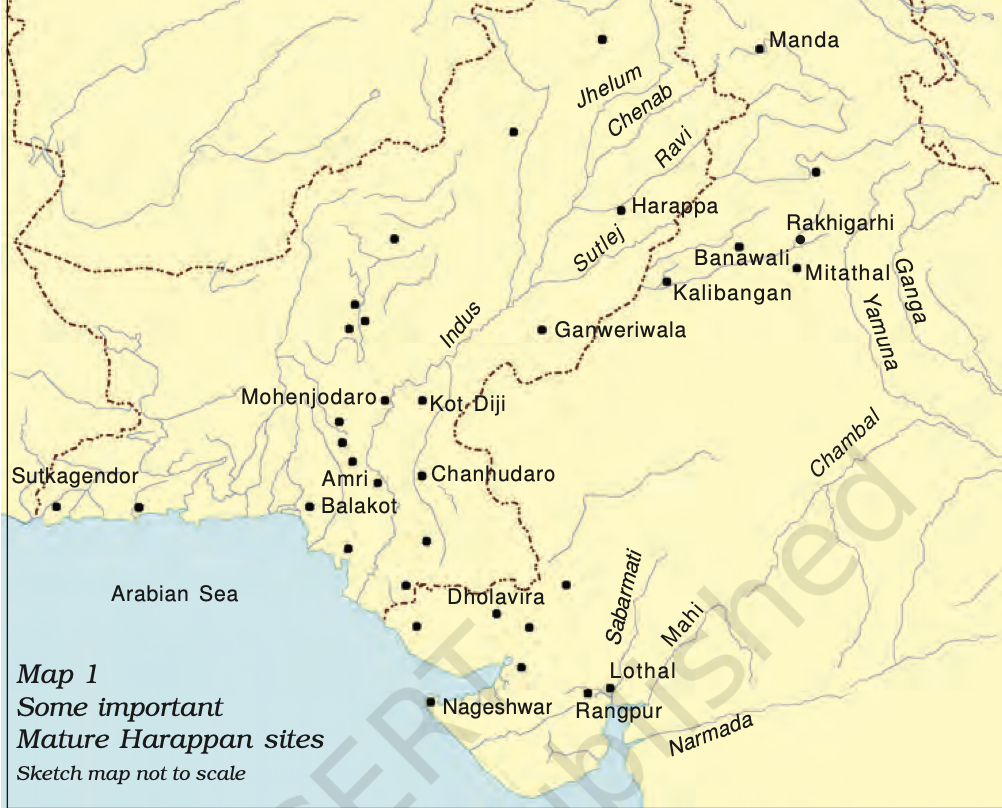
- Indus Valley Civilisation (IVC) or Harappan civilisation is known for its splendid elements on urban civilisation and rise of organised cities in Indian continents. These cities and towns were located around a particular water body such as rivers or lakes or had linkages with oceans.
- IVC was Bronze Age civilization (The mature phase lasted from 2500-1900 BCE).
- Since IVC preceded Iron Age, the Harappans were unaware of the use of iron but used copper, bronze, silver, and gold.
- Along with ancient Egypt and Mesopotamia, it was one of three early civilizations of the world.It is older than the Chalcolithic culture, which have been treated earlier, but it is far more developed than these cultures.
- It is called Harappa because this civilisation was discovered first in 1921 at the modern site of Harappa situated in the province of West Punjab of Pakistan.
- The Indus or the Harappan culture arose in the north and western part of the Indian subcontinent.
- The Harappan culture covered parts of Punjab, Sindh, Balochistan, Gujarat, Rajasthan and the fringes of western Uttar Pradesh.
- It extended from Jammu in the north to the Narmada estuary in the south, and from the Makran coast of Balochistan, in the west to Meerut in the north-east.
- Although over 250 Harappan sites are known, only six can be regarded as cities.
- Of these the two most important cities were Harappa in Punjab and Mohenjo-daro in Sindh, both forming parts of Pakistan that were linked together by the Indus.
- Chanhu-daro about 130 km south of Mohenjo-daro in Sindh
- Lothal in Gujarat' at the head of the Gulf of Cambay.
- Kalibangan in northern Rajasthan.
- Banwali is situated in Hisar district in Haryana.
Debate on Indus Valley
- Despite being named as Indus Valley Civilisation, many sites of the IVC have been found to be located in the Ghaghar-Hakra Valley. These sites are