Daily Current Affairs

May 6, 2024

Current Affairs

Eta Aquariid Meteor Shower

Context: The Eta Aquariid meteor shower, which has been active since April 15, will peak on May 5 and 6. These showers are seen in May every year, and are best visible to countries such as Indonesia and Australia in the Southern Hemisphere.

Comets:

image 14
  • Comets are frozen leftovers from the formation of our solar system, some 4.6 billion years ago.
  • Comets are composed of dust, rock and ice, and orbit around the Sun in highly elliptical orbits which can, in some cases, take hundreds of thousands of years to complete.
  • According to NASA, a total of 3,910 comets are currently known, although billions more are theorised to be orbiting the Sun beyond Neptune, in the Kuiper Belt and even more distant Oort cloud.
  • Comets come in different sizes, although most are roughly 10 km wide. However, as they come closer to the Sun, comets heat up and spew gases and dust into a glowing head that can be larger than a planet.  This material also forms a tail which stretches millions of miles.

Asteroids:

  • Asteroids are rocky remnants from the early formation of our solar system (about 4.6 billion years ago) that mainly orbit the Sun between Mars and Jupiter.
  • The asteroid belt is a nearly flat ring that contains millions of asteroids, ranging in size from less than 10 metres to 530 kms (The largest asteroid is Ceres, which is about one-quarter the size of Earth’s moon). 
image 15

Meteoroids, Meteors and Meteorites: 

  • Meteoroids are rocky fragments of asteroids, comets, moons, and planetary collisions. They are much smaller than asteroids, ranging in size from tiny grains up to a metre. In our solar system, most meteoroids come from the asteroid belt, but a few come from comets and fragments of the Moon and Mars formed by impacts.
  • Meteor is a flash of light (shooting star or falling star) seen when a meteoroid, asteroid, or comet heats up in the Earth’s atmosphere. Since most meteors are tiny (the size of a grain of sand) they completely burn up in Earth’s atmosphere. This burning also creates a brief tail. 
  • Meteorites are meteoroids that enter the Earth’s atmosphere and survive to impact the Earth’s surface. A large enough meteor can pass through the atmosphere and hit the Earth’s ground, often causing significant damage.

Eta Aquariid meteor shower:

  • The Eta Aquariid meteor shower is formed when Earth passes through the orbital plane of the famous Halley’s Comet, which takes about 76 years to orbit the Sun once.
    • Last seen in 1986, Halley’s comet is due to enter the inner solar system again in 2061.
    • Like Eta Aquariids, the Orionids meteor shower is also caused by the Halley’s Comet, and appears every October.
  • The Eta Aquariid meteor shower is known for its rapid speed. This makes for long, glowing tails which can last up to several minutes. The meteor shower consists of burning space debris moving at speeds of around 66 km per second (2.37 lakh kmph) into Earth’s atmosphere.

Southern Hemisphere: a better vantage point: 

  • The difference in meteor rates between the Northern and Southern Hemispheres during the Eta Aquarid meteor shower is primarily due to the position of this radiant point relative to each hemisphere.
  • The radiant point of the Eta Aquarids (apparent origin of the meteors) is located near the star Eta Aquarii in the Aquarius constellation (in the southern part of the sky).
    • From the Southern Hemisphere, this radiant is higher above the horizon, which means meteors appear to streak outwards in different directions and are more spread out across the sky.
    • From the Northern Hemisphere, the radiant point of the Eta Aquarids is much closer to the horizon. This positioning causes the meteors to skim the Earth's atmosphere at a shallower angle. Consequently, they may appear as "Earthgrazers," which are long, slow-moving meteors that appear to skim or graze the surface of the Earth.
  • Consequently, In the Southern Hemisphere, where the radiant is higher in the sky, observers can see more meteors per hour during the peak of the shower (around 30 to 40 meteors per hour). Conversely, in the Northern Hemisphere, with the radiant nearer to the horizon, observers typically see fewer meteors (around 10 per hour) and often in the form of Earthgrazers.
Tobacco

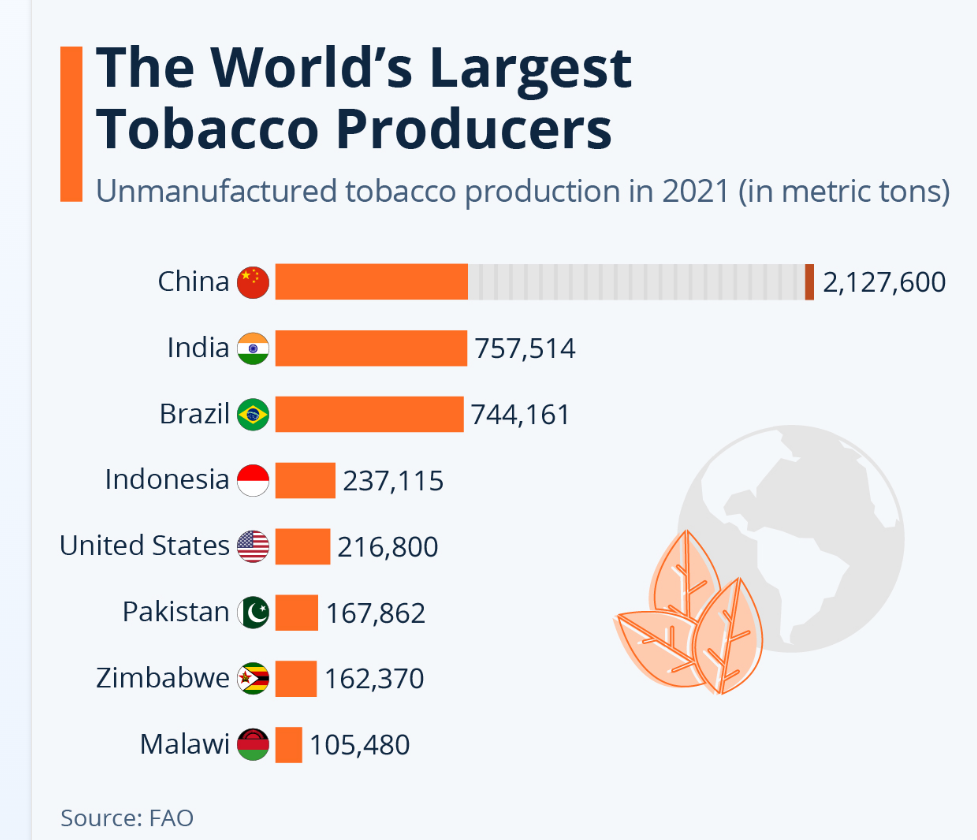
Context: With top global tobacco producers such as China, Brazil and Zimbabwe reporting issues relating to production output, the demand for Indian tobacco has increased significantly. Tobacco farmers in Andhra Pradesh and Karnataka, who reaped a good harvest in the 2023-24 season, have reported record prices for the produce.

Tobacco crop

  • Tobacco refers to several plants in the genus Nicotiana, primarily N. tabacum, which is the chief commercial crop used for various products

Etymology:

  • The English word “tobacco” originates from the Spanish word “tabaco.”
  • Its precise origin is disputed, but it likely derives from the Taíno language of the Caribbean. In Taíno, it meant either a roll of tobacco leaves or an L-shaped pipe used for sniffing tobacco smoke.

History:

  • Tobacco has been used in the Americas for centuries. Cultivation sites in Mexico date back to 1400–1000 BC.
  • Traditional use includes smoking, chewing, snuffing, and extraction of nicotine.
  • Iroquois mythology attributes tobacco’s origin to Earth Woman’s head after she died giving birth to her twin sons, Sapling and Flint.

Health Impact:

  • Tobacco use is associated with many deadly diseases, including heart, liver, and lung conditions, as well as various cancers.
  • In 2008, the World Health Organization named tobacco use as the world’s single greatest preventable cause of death.

Global Impact:

  • Tobacco kills up to half of its users who don’t quit and causes over 8 million deaths worldwide.
  • WHO provides resources to reduce tobacco demand and its health and economic consequences, including measures like pictorial health warnings, taxes, and advertising bans.

Tobacco Cultivation and Climate:

Origin: Tobacco is tropical in origin, but it is grown successfully under tropical, sub-tropical, and temperate climates.

Ideal Conditions:

  • Frost-Free Climate: Tobacco requires about 100 to 120 days of frost-free climate to mature.
  • Temperature: An average temperature of around 80°F (27°C) is ideal for tobacco growth.
  • Rainfall: A well-distributed rainfall of 88 to 125 mm per month is essential for tobacco crops.
  • Soil: Tobacco is grown in warm climates with rich, well-drained soil.

Global scenario of Tobacco

  • In India, Gujrat is the largest producer followed by Andhra Pradesh which is 41% and 22% respectively.

Tobacco Board of India

  • The Tobacco Board was constituted as a statutory body on 1st January 1976 under Section (4) of the Tobacco Board Act, 1975. 
  • The Board is headed by a chairman with its headquarters at Guntur, Andhra Pradesh and is responsible for the development of the tobacco industry. 
  • While the primary function of the Board is export promotion of all varieties of tobacco and its allied products, its functions extend to production, distribution (for domestic consumption and exports) and regulation of Flue Cured Virginia (FCV) tobacco.

Read also: World No Tobacco Day

Practically every state in India cultivates some type of tobacco, and the country ranks second in global tobacco production after China.

Oxytocin Ban

Context: The Delhi High Court has ordered the Department of Drugs Control in Delhi to check weekly and make sure that any cases of fake Oxytocin being used or held are officially recorded under Section 12 of the Prevention of Cruelty to Animals Act, 1960, and Section 18(a) of the Drugs and Cosmetics Act, 1940.

About Oxytocin: 

  • It is also known as the ‘love hormone’ or bonding hormone, is a hormone produced in the hypothalamus and secreted by the pituitary glands of mammals during sex, childbirth, lactation or social bonding.
  • It acts both as a hormone and as a brain neurotransmitter. In the brain, where it acts as a neurotransmitter, oxytocin is involved in a variety of social behaviours, bonding, and emotional responses.
  • It helps contract the uterus and induce delivery, control bleeding, and promote the release of breast milk. Its use is especially crucial to prevent new mothers from excessively bleeding after giving birth, a common cause of maternal deaths.
  • It can also be chemically manufactured and is sold by pharma companies for use during childbirth. It is administered either as an injection or a nasal solution.
  • It was banned in April 2018, saying that it was being misused on milch cattle to increase yield, which not only affects the health of the cattle but also humans who consumed the milk.
  • It is also used to increase the size of vegetables such as pumpkins, watermelons, eggplants, gourds, and cucumbers.

Swell Waves

Context: Hyderabad-based INCOIS has issued an alert to coastal States on the possibility of swell surges and rough sea conditions.

About Swell Waves:

image

High-Energy Swell Waves

All swells are created by wind blowing over the surface of the ocean. When strong winds persist over vast distances (such as during storms), they generate waves. The strength, duration, and area of the ocean that the wind affects determine the size of the waves, how far they’ll travel, and the energy they carry when they reach the shore.

Working:

  • Wind Energy: As winds blow across the ocean, they transfer energy to the water surface. This energy causes ripples to form, which eventually evolve into waves.
  • Distance and Duration: The longer the wind blows and the greater the distance it covers, the more energy is transferred to the waves. Consequently, the waves become larger and cover more distance.
  • Swells: Swells can be categorized based on their origin:
    • Groundswell: These swells originate from winds far out at sea, covering longer distances. They have longer swell periods and more energy. Groundswells often result in cleaner, organized surf conditions.
    • Windswell: Wind swell forms closer to the shore. The swell period is shorter, waves are less organized, and they arrive faster.

Issuing Authority: Hyderabad-based Indian National Centre for Ocean Information Services (INCOIS).

Recipient States: Coastal States of Goa, Maharashtra, West Bengal, Odisha, Tamil Nadu, Kerala, Lakshadweep, and Andaman & Nicobar Islands.

Alert Content:

  • INCOIS alerted coastal states about the possibility of high-energy swell waves over the weekend.
  • Urged the total suspension of operational and recreational activities at beaches and nearshore regions on Saturday and Sunday.
  • Advised fishermen and coastal populations to be cautious about potential surge waves, especially in low-lying areas.

Scientific Explanation:

  • Senior scientist T. Balakrishnan Nair explained that high-period swells originating approximately 10,000 km away from the Indian coast in the southern Atlantic Ocean on April 26 were causing high-energy swell propagation towards Indian coastal regions.
  • Expected impact: hitting the southern tip of India early Saturday, potentially causing coastal flooding in low-lying areas when combined with high tide conditions.

Safety Recommendations:

  • Small vessels cautioned against plying nearshore.
  • Recommended anchoring boats at a fair distance from each other to prevent damage.

Special Advisory for Kerala:

  • Kerala coastal communities advised to remain vigilant.
  • State put on red alert for high-energy swell waves, locally known as 'Kallakadal' (rogue sea), likely lasting until 11:30 p.m. on Sunday.
  • Potential swell waves: ranging from 0.5 meters to 1.7 meters high in low-lying areas.

Actions by Kerala State Disaster Management Authority (KSDMA):

  • Issued directions to suspend recreational activities along beaches.
  • Advised coastal residents to temporarily evacuate if necessary.
  • First instance of a red alert being issued for the State regarding the Kallakadal phenomenon, according to KSDMA member secretary Sekhar Kuriakose.

Standard Essential Patent

About Standard Essential Patent:

  • A ‘standard’ is a set of technical requirements or agreed technical descriptions which cover ideas, products or services and make sure that technologies interact and work together.
  • A Standard Essential Patent (SEP) is a patent granted for technological invention which is essential for implementation and working of a standard.
  • Patents which are essential to a standard and have been adopted by a Standard Setting Organisation (SSO) are known as SEPs.
    • SSOs are either governmental, quasi-governmental or private groups of independently governed industry associations.
    • SSOs set, develop, coordinate, interpret, and maintain standards. Industry participants can collaborate on a single technical solution because of such standards.
  • When a patent is acknowledged by the SSO and designated as a SEP, manufacturers can only produce their goods in the market after first acquiring a licence under the SEP.

SEPs and the Telecommunications Sector: 

  • SEPs are widely used in the telecommunications sector as it is a highly standardised industry primarily driven by the requirement for interoperability between communication devices.
  • Technologies such as CDMA, GSM, LTE are all industry standards in the telecom sector. Such technological standards are especially important to ensure interoperability of different brands of cellular phones manufactured by different companies.
    • For example, once GSM was adopted as a standard, all manufacturers had to ensure that the handsets that they manufactured were compatible with GSM. Otherwise there would be no demand for their phones.
  • In industries like consumer electronics, the automotive industry, and the electricity grid industry, such communication standards are also essential for the growth of the hyperconnected society. 
  • The goal of making standards accessible to everyone for public use may be defeated by the exclusive rights granted to inventors by patents. To address this issue, the majority of SSOs have established IPR policies that require SSO members to agree to licensing their SEPs under "Fair, Reasonable and Nondiscriminatory" (FRAND) terms and conditions.
    • These commitments are intended to safeguard technology implementers while making sure that Patent holders are fairly compensated for their research and development expenditures.

SEP protection in India: 

  • The Patent laws in India neither contain a special provision for SEPs nor lays down any specific criteria or terms and conditions to be complied with while licensing a patented technology. However, it does restrain a patentee (proprietor of the patent) from abusing its patent right and engaging in practices that unreasonably restrain trade. 
  • Moreover, the Indian judiciary has been framing laws through court cases for the regulation of the SEPs.
  • Through its National Telecom Policy (2012), India has aimed to increase standardisation and intellectual property creation. India’s national SSO is the Bureau of Indian Standards. 

FRAND licensing (Fair, Reasonable and Non-Discriminatory): 

  • The Judiciary and the Standard Setting Organisations have mandated licensing of the patents based on FAIR, REASONABLE and NON-DISCRIMINATORY (FRAND) principles.
  • FRAND terms encourage the adoption of the standard and mitigate any concerns about unfair competition. 
  • SEPs can be protected in India only by registering a patent in India. A SEP holder must agree to licence the SEP to willing licensees at Fair, Reasonable, and Non-Discriminatory (FRAND) rates. 

Challenges: 

  • Globally, the process of setting standards in the technology sector is largely privatised and dominated by “standard setting organisations” (SSOs) run largely by private technology companies. Countries such as India with little innovation in the telecom sector, have very little influence over how standards are set or how SEPs are licensed.
  • Theoretically, the companies which own the SEPs, gain enormously because every manufacturer of cellular phones has to licence the technological standards in question in order to survive in the market. The lack of alternatives also means that owners of SEPs can demand extortionary royalties or licensing terms from manufacturers that block competition. 
  • In theory, the SSOs are supposed to prevent such a scenario by requiring the owners of SEPs to licence their technologies at a fair, reasonable and non-discriminatory (FRAND) rate. In practice, this model of self-regulation by the technology industry has been marked with opacity. 

Way Forward: 

  • On the lines of international agreements, the Indian government needs to intervene and put in place the measures to regulate standard essential patents for greater transparency and protect the rights of Indian manufacturers. 

Australia-India trade pact working well for both nations

Context: The India-Australia Economic Cooperation and Trade Agreement (ECTA) has been beneficial for India. The exports of Indian farm products and industrial goods such as iron and steel products, showed a marked increase.  

India-Australia Economic Cooperation and Trade Agreement (ECTA):

image 12
  • Australia is an important strategic partner of India. They are also part of the four nation QUAD, Trilateral Supply Chain Initiative and the Indo-Pacific Economic Forum (IPEF).
  • The Australia-India ECTA entered into force in the year 2022.
  • It provides an institutional mechanism to encourage and improve trade between the two countries and covers almost all the tariff lines dealt by India and Australia.
  • Provisions: 
    • Preferential market access for goods: 
      • India is benefitting from preferential market access provided by Australia on 100% of its tariff lines, including all the labour-intensive sectors of export such as Gems and Jewellery, Textiles, leather, footwear, furniture, food, and agricultural products, engineering products, medical devices and Automobiles.
      • India is offering preferential access to Australia on over 70% of its tariff lines, including lines of export interest to Australia, which are primarily raw materials and intermediaries such as coal, mineral ores and wines.
    • Services: 
      • Australia has offered wide-ranging commitments in around 135 sub-sectors and Most Favoured Nation (MFN) status in 120 sub-sectors covering key areas of interest to India.
      • India has offered market access to Australia in around 103 sub-sectors and Most Favoured Nation status in 31 sub-sectors from the 11 broad service sectors such as ‘business services’, ‘communication services’, ‘construction and related engineering services.’
    • Separate Annex on Pharmaceutical products: This agreement will enable fast-track approval for patented, generic and biosimilar medicines.
    • Employment generation
      • An additional 10 lakh jobs would be created in India under ECTA.
      • Indian Yoga teachers and chefs are set to gain the annual visa quota. 
      • Over 1 lakh Indian students would benefit from a post-study work visa (for 18 months to 4 years) under the ECTA.
  • Increase in exports: 
    • Indian exports of iron and steel products were up 16 per cent at $322 million, apparel exports increased 6 per cent to $342 million and exports of jewellery increased 6 per cent to $169 million.
    • Indian exports of agriculture also increased 15 per cent.

India and Australia are now negotiating to sign a full-fledged Comprehensive Economic Cooperation Agreement (CECA). 

  • The proposed CECA is expected to cover goods (some of the remaining ones that are out of CEPA), services, digital trade, government procurement and Rules of Origin (ROO)-Product Specific Rules Schedule.
image 13

Conclusion: 

India-Australia bilateral trade, currently valued at about $30 billion per annum, has the potential of touching $100 billion over the next few years with the increased cooperation between the two sides and as India is aspiring to be at the centre of the supply chains of the future, a comprehensive partnership with Australia will assist it attaining its ambitions. 

Anti-Dumping Duty

Context: Out of the 46 anti-dumping duties levied by the finance ministry in the last three years 60 per cent targeted goods originating only in China.

What is Dumping?

  • Dumping is an unfair trade practice that occurs when goods are exported from one country to another at a price lower than the normal value in their domestic market.
  • Directorate General of Trade Remedies (DGTR) under Ministry of commerce and Industry investigates cases of anti-dumping brought forward by industry players and recommends an Anti-Dumping Duty in case of a consequential serious injury to domestic industry.
  • Central Board of Indirect taxes and Customs (CBIC) under finance ministry must accept or refuse DGTR’s ADD recommendation within three months from the date of the final hearing. The imposition of anti-dumping duties is a legitimate trade remedial measure under the WTO’s General Agreement on Trade and Tariffs 1994.
Anti-dumping duty is a tax imposed on imported goods that are believed to be sold at a price lower than their fair market value in the exporting country. This is done to protect domestic businesses in the importing country from what is considered unfair competition.  Countervailing Duties (CVDs) are tariffs levied on imported goods to offset subsidies made to producers of these goods in the exporting country. CVDs are meant to level the playing field between domestic producers of a product and foreign producers of the same product who can afford to sell it at a lower price because of the subsidy they receive from their government. 

Paving legal path to make ‘pink’ hydrogen

Context: India is in talks with large domestic companies to invest in the regulated nuclear sector, including promoting clean power through generation of pink hydrogen. 

Present Status:

  • Restricted Private Ownership: The Atomic Energy Act, 1962 restricts private companies from owning and operating nuclear power plants in India.
  • Central Government Control: The central government, currently through public sector corporations like Nuclear Power Corporation of India (NPCIL), holds the authority for activities related to nuclear energy, including its production, development, use, and disposal.
  • Amended Act (2015): The 2015 amendment to the Atomic Energy Act, allows NPCIL to form joint ventures with other public sector units to secure funding for new projects. However, this does not extend to private or foreign companies. 
  • Private Sector Participation: Currently, private companies can participate in specific areas like supplying components and reactors, but not owning or operating plants.
  • Future Considerations: Discussions are ongoing about allowing more private sector involvement, potentially through Public-Private Partnerships (PPPs). This would likely require further amendments to the Act.

Types of Hydrogen:

  • Hydrogen can be produced from a variety of resources, such as natural gas, nuclear power, biomass, and renewable power like solar and wind. 
  • Hydrogen is an invisible gas. Depending on the type of production used, different colour names are assigned to the hydrogen.
image 11

Some common types of Hydrogen

  • Grey hydrogen: Grey hydrogen is produced using fossil fuels such as natural gas or coal. Grey hydrogen accounts for roughly 95% of the hydrogen produced in the world today.
    • The two main production methods are steam methane reforming and coal gasification. Both of these processes release carbon dioxide (CO2).
    • If the carbon dioxide is released into the atmosphere, then the hydrogen produced is referred to as grey hydrogen.
  • Blue Hydrogen: Blue hydrogen is similar to grey hydrogen, except that most of the CO2 emissions are sequestered (stored in the ground) using carbon capture and storage (CCS).
    • Capturing and storing the carbon dioxide instead of releasing it into the atmosphere allows blue hydrogen to be a low-carbon fuel. 
    • Blue hydrogen is a cleaner alternative to grey hydrogen but is expensive since carbon capture technology is used.
  • Green Hydrogen: Green hydrogen is hydrogen produced using electricity from clean energy sources, such as wind and solar energy, which do not release greenhouse gases when generating electricity.
    • Green hydrogen is made when water (H2O) is split into hydrogen (H2) and oxygen (O2) via a process known as electrolysis.
  • Pink Hydrogen: Pink hydrogen is produced through electrolysis of water but using energy from nuclear power, which does not produce any carbon dioxide emissions.
    • Pink hydrogen facilities can achieve a high-capacity factor due to the steady base-load profile of nuclear power (involving both stability and density), as compared to the intermittent supply from renewable sources (solar, wind). 
  • Turquoise Hydrogen: Turquoise hydrogen is made using a process called methane pyrolysis. In this process methane is split into hydrogen and solid carbon with heating in reactors or blast furnaces.