Daily Current Affairs

November 6, 2023

Current Affairs

Ghiyas-ud-din Balban (1216-1287)

Context: The Lieutenant Governor of Delhi unveiled six renovations in Mehrauli's Archaeological Park, with one of the monuments being the restoration of the 13th-century tomb of Balban.

About Ghiyas-ud-din Balban

Introduction:

image 6
  • Ghiyas-ud-din Balban, the ninth sultan of the Mamluk dynasty of Delhi and an Ilbari Turk, reigned from 1266 AD to 1287 AD.
  • Balban's journey to power began when he was initially sold as a slave to the then-ruler Iltumish in 1232 CE, only to be later freed by him.
  • During his rule, Ghiyas achieved various conquests, including subduing the troublesome inhabitants of Mewat, reclaiming Bengal, and successfully defending against the Mongol threat, though it came at the cost of his son's life.

Early Life: 

  • Initially, he served as the Sultan's personal attendant or Khasdar and swiftly became one of the most distinguished members of the Chalissa, a group of forty Turkic nobles in Delhi.
  • During Razia Sultan's reign, he held the significant position of Amir-i-Shikar, responsible for both military and political duties. 
  • Balban played a pivotal role in the overthrow of Alaud-din Masud and the installation of Nasiruddin Mahmud as Sultan, subsequently serving as the Wazir from 1246 to 1265.
  • During Nasiruddin Mahmud's reign, he was granted the titles of Amiri-Hajib and Naib-i-Mamlakat, signifying his significant role in the administration.

Military Campaigns: 

  • Balban relied on the Turkish nobility for support but also raised a massive army of 2 lakh troops, encompassing individuals from various castes.
  • He identified four main problem areas: the vicinity of Delhi, the Ganga-Yamuna doab, trade routes, especially the one to Awadh, and rebellions in Rohilkhand.

Balban achieved several military feats:

  • He successfully lifted the Mongol siege of Uch under Masud Shah in 1246.
  • When the governor of Bengal, Tughral Khan, challenged Delhi's authority in 1275, Balban initially dispatched the governor of Awadh and later a second army, both of which failed. Balban personally led a third army, ultimately reclaiming the region and eliminating Tughral and his followers, with the assistance of his son, Nasiruddin Bughra Khan. Subsequently, Balban appointed his second son, Bughra Khan, as the governor, who declared independence after Balban's death, maintaining it for four decades. 
  • Balban's military campaign against the Meo people of Mewat stands out as a significant endeavour. These raiders had been terrorizing the residents of Delhi, even in broad daylight. To quell this threat, Balban implemented his ‘Blood and Iron’ strategy. This involved a year-long effort to subdue the Meos, during which forests were cleared to eliminate their hiding spots, leading to a substantial reduction in their numbers. To further secure the region, Balban oversaw the construction of forts in the affected areas and granted control to iqtedar holders.

Reign as Sultan:

  • During Balban's reign, his governance was marked by the establishment of an unwavering ‘Fear of the governing power,’ which he considered the fundamental basis for effective rule. 
  • To ensure unwavering loyalty to the crown, he implemented an efficient espionage system, modelled after the Umayyad Barid. This included the use of spies or barids to monitor his officials, who were placed under independent authority and answered solely to the Sultan.
  • Balban imposed severe punishments for any mishaps, even towards his nobles, and did not spare their own slaves. For instance, Malik Baqbaq, the governor of Budaun, was disciplined for ordering a slave to be beaten to death while intoxicated.
  • Balban also addressed the threat of the Mongols by reorganizing the military and restructuring the revenues of Iqtedar holders, discontinuing them for older Muqtas who could not serve as military commanders.
  • Balban was openly vocal about his concept of kingship, referring to himself as the representative of God on Earth and adopting the title 'Zillullah' or 'shadow of God.' His theory of kingship was based on the notion that a king's power emanated solely from God, making his actions beyond public scrutiny.
  • Balban maintained a notable distance from the common masses, forgoing public drinking and never appearing in court without his full regalia.
  • He introduced the Persian festival of Nowruz and enforced customs like 'Sijda' and 'Paibos' in his court to instil a sense of wonder among ordinary people.
  • Balban took a stern approach to rule, breaking up the 'Chahalgani,' a group of the forty most influential nobles in the court. He promoted junior Turkish officers to positions of equality with the members of the Chalisa Dal. 

After his Death:

  • Ghiyas ud din Balban served as Sultan from 1265 until his demise in 1287.
  • Balban's elder son, Prince Muhammad Khan, lost his life in a battle against the Mongols.
  • Balban selected his grandson, Kaikhasrau, the son of Prince Muhammad, as his designated heir.
  • However, after Balban's passing, his nobles instead nominated Qaiqubad as the new Sultan. 
  • Qaiqubad's reign lasted from 1287 to 1290, during which Bughra Khan asserted his independence in Bengal.
  • After Qaiqubad’s death, leadership was passed to his three-year-old son, Shamsuddin Kayumar. However, Shamsuddin Kayumars was later deposed by his guardian, Jalal-ud din Firoz Khalji, in 1290, marking the end of the Slave dynasty.
image 7

Tomb of Balban

  • Balban's Tomb is housed within the archaeological park, and it was originally constructed by the Sultan himself, known as the Dar-ul-Amaan or the Haven of Safety.
  • This tomb is historically significant as it represents the earliest example of Indo-Islamic architectural style in India, although its existence was only unearthed in the mid-20th century.
  • Near Balban's tomb lies the resting place of his son, Khan Shahid or Mahmud, who died in 1285 AD while battling the Mongols. Mahmud's tomb is adorned with exquisite Persian calligraphy.
  • Balban's tomb is noteworthy for being the first structure in India to feature true arches, constructed using a circular arrangement of stones.
    • This architectural innovation was novel in Indian architecture at the time. 
  • The tomb was built using rubble masonry and it also demonstrates a fusion of Hindu and Islamic art in its construction.

Russia test fires nuclear-capable ballistic missile

Context: Russia has test-launched an intercontinental ballistic missile “Bulava” capable of carrying nuclear warheads from one of its submarines. The 12-metre-long missile has a range of over 8,000 kilometres.

The launch comes just days after the Russian withdrew its ratification of the Comprehensive Test Ban Treaty in a move Russia argued was needed to bring its position in line with the United States. 

Ballistic Missiles

  • Ballistic missiles are long range rocket-propelled munitions/weapon systems that follow a parabolic trajectory to deliver a payload from its launch site to a predetermined fixed target. 
image 5

Types of Ballistic Missiles:

  • Short-range ballistic missile (SRBM): Range from 300 to 1,000 kilometres.
  • Medium-range ballistic missile (MRBM): Range from 1,000 to 3,500 kilometres.
  • Intermediate-range ballistic missile (IRBM) or long-range ballistic missile (LRBM): Range from 3,500 to 5,500 kilometres.
  • Intercontinental ballistic missile (ICBM): Range greater than 5,500 kilometres. E.g., Agni-V 
  • Ballistic missiles follow a specific ballistic parabolic trajectory whose path is determined primarily by gravity and the missile's initial velocity. However, they are not actively guided like cruise missiles throughout their entire flight.
  • Ballistic missiles travel at extremely high speeds (upto 24 Mach) during their terminal phase, making it challenging for defensive systems to track and intercept them in real-time. The rapid speed reduces the time available for a defence system to respond effectively.
  • Ballistic missiles are rocket-powered, their rocket engines use a combination of fuel and oxidizer to generate thrust. This allows the missile to continue operating in the vacuum of space.
    • Two primary components of the rocket propulsion system are the fuel and the oxidizer.
    • The fuel is typically a chemical substance that can burn and release energy, while the oxidizer is another chemical component that provides the necessary oxygen for combustion of fuel.
  • Ballistic missiles can carry conventional high explosives as well as chemical, biological, or nuclear munitions.

Comprehensive Test Ban Treaty

  • Comprehensive Nuclear-Test Ban Treaty (CTBT) bans all nuclear explosions, whether for military or peaceful purposes. 
  • Objective: To end nuclear testing and promote nuclear disarmament and non-proliferation. By prohibiting all nuclear explosions, it aims to prevent the development of new nuclear weapons and promote global security.
  • Negotiation and Adoption: The treaty was subsequently opened for signature on September 24, 1996, and it has been signed by 187 countries and ratified by 178 countries as of October 2023.
  • Entry into Force: CTBT has not entered into force as of November 2023. CTBT requires that all 44 “nuclear capable” states (also known as “Annex II” states) ratify the treaty before it may enter into force. Eight Annex II states have yet to ratify the CTBT.
    • Countries that have signed but not ratified CTBT: United States, China, Egypt, Iran, and Israel. 
    • Those that have neither signed nor ratified: India, Pakistan and North Korea.
  • Comprehensive Nuclear-Test-Ban Treaty Organization was established to oversee the implementation and verification of the CTBT. It is headquartered in Vienna, Austria, and is responsible for managing the International Monitoring System (IMS) and the International Data Centre (IDC) to detect and analyse nuclear test events.

InvITs (Infrastructure Investment Trust)

Context: According to Sebi data, Rs 18,658 crore was collected through these emerging investment vehicles in the April-September period of 2023-24. This comprises Rs 12,753 crore through InvITs and the remaining Rs 5,905 crore via REITs.

What are InvITs?

Infrastructure Investment Trusts (‘InvITs’) are pooled investment vehicles similar to mutual funds which were introduced to make investment in infrastructure assets accessible to private and retail investors. InvITs invest in long-term infrastructure projects such as roads, gas pipelines, transmission lines, renewable assets, etc. They are regulated by SEBI. 

Design and Features of InvITs:

The InvITs designed as a tiered structure with a sponsor setting up the InvIT which in turn invests into the eligible infrastructure projects either directly or via special purpose vehicles (SPVs).

Design and Features of InvITs

Who can Invest? 

  • The minimum subscription limit for InvITs is 1 lakh. Hence apart from institutional investors like Banks, Insurance companies, pension funds and sovereign wealth funds, Retail investors also can invest in InviTs. The investors receive units for their investment, hence they are also referred as Unit holders.
  • Some part of the investment is used by the InvIT as loan while other portion is used as capital. Hence, the unit holders receive returns in the form of Dividend and Interest. Both the dividend and interest are taxed.
  • If the investor receives profit upon selling his units, Capital gains tax is imposed on any such gain. 

Low Risk:

  • As per the SEBI regulations, InvITs must invest at least 80% of their assets in projects that are completed and revenue-generating. This lowers the risk for investors as this reduces the typical risk associated with the infrastructure sector i.e. delay in completion, due to lack of regulatory approvals, poor project management etc.
  • InvITs and REITs are recognised as borrowers under the Securitisation and Reconstruction of Financial Assets and Enforcement of Securities Interest (SARFAESI) Act. This enables the investors, especially banks, to initiate action against the trustees of InvITs in case of any default.

Surveillance in India

Context: Over a dozen Opposition leaders and journalists in India received email alerts from Apple informing them that their devices may be targeted by “state-sponsored attackers”.

Surveillance means close observation of a person or group, especially the one who is under suspicion or the act or observing or the condition of being observed. 

With the growing technological developments surveillance technologies have also been introduced such as internet surveillance, CCTV surveillance, telephone, and e-mail id surveillance, artificial intelligence, facial recognition, integrated database systems, social media analytics, etc.

Types of Surveillance 

Surveillance can be categorized in various ways, primarily based on the actor conducting the surveillance and the individuals affected by it. Here are different types of surveillance based on these factors:

Based on the Actor

Surveillance by State: This involves government agencies, law enforcement, or other state entities monitoring individuals or groups for various purposes, including national security, law enforcement, and public safety.

Surveillance by a Private Actor: Private entities, such as corporations, businesses, or individuals, may conduct surveillance for various reasons, including commercial interests, security, or personal reasons.

Based on the Affected Person

Mass Surveillance: In mass surveillance, a large population or a broad group of individuals is subject to monitoring, often without specific targeting. This can involve the collection of data on a wide scale, such as integrated data systems, social media analytics, etc., the monitoring of internet communications or the use of public surveillance cameras.

Targeted Surveillance: Targeted surveillance is focused on specific individuals, groups, or entities. It involves monitoring and data collection with a specific objective, often in cases where there is a perceived threat or suspicion.

Lateral Surveillance: Lateral surveillance occurs when individuals monitor or surveil others within their social or peer groups. It can involve citizens watching or reporting on each other's behaviour, often facilitated by social media or community networks. E.g., During Covid this surveillance was used to report infected persons.

Mechanism Used by State for Surveillance in India

National Intelligence Grid (NATGRID)

NATGRID allows investigation and law enforcement agencies to access real-time information from data stored within agencies like the Income Tax Department, banks, insurance companies, the Indian Railways, and other offices. There are a total of 21 categories of data that NATGRID has access to.  

Central Monitoring System (CMS) 

Where the NATGRID has access to real-time data, CMS is a centralized telephone interception provisioning system. And it’s exactly what it sounds like. It can bypass the middleman the telecom companies to directly monitor text messages, social media posts and phone calls.  

Network Traffic Analysis (NETRA)

NETRA is the third leg of India’s security infrastructure. While the CMS is tapping into your phone’s network, NETRA is watching everything you do online, not just on social media.

It can monitor any text-based messages containing direct messages on Facebook, within your personal emails or online blogs. Using filters and keywords, it can identify words even in encrypted messages.

Automated Facial Recognition System (AFRS)

Delhi Police have used AFRS, a large database containing videos and photos of people's faces. A new face can be identified by matching a photo of a person with this database, and their identity can be ascertained.

Crime and Criminal Tracking Network System (CCTNS) 

CCTNS aims at collecting, storing, analysing, transferring, sharing of data between various police stations and with State Headquarters and police organisations.

Law Governing State-Surveillance in India

In India, there are no specific laws governing surveillance, although there are many acts and rules passed by legislature which governs surveillance indirectly.

  • Section 69 Information Technology (IT) Amendment Act, 2008 gives power to the government to intercept, monitor or decrypt any data or information stored on any computer resources for the reason of public safety, public order etc.
  • The Indian Telegraph Act (ITA), 1885 had also given power to the central or state government to intercept any message if it is against public safety.

Need for Surveillance by State

  • To monitor and protect borders against illegal crossings, smuggling, and other illicit activities.
  • It plays a crucial role in gathering intelligence about foreign governments, organisations, and individuals to protect national interests and security.
  • It helps in identifying and preventing cyberattacks on critical infrastructure and sensitive information.
  • It helps in identifying and preventing terrorist activities, organised crimes and gathering intelligence on potential threats.
  • It assists law enforcement agencies in investigating and solving crimes, including theft, fraud, cybercrime, and other illegal activities.
  • It helps in monitoring and preventing activities related to insurgency, Left wing extremism and other threats to national security.

Incidents

In October 2012, The Hindu a newspaper, released a report stating that over 10,000 phone calls and 1000 email Ids are under the scanner.  

In 2012, Rajya Sabha was informed that the government has now acquired technology to monitor or block content on the internet and has also started surveillance on Facebook and twitter walls.  

In 2019, WhatsApp confirmed that some of its users were targeted with spyware in India. 

In 2023, Many opposition leaders, journalists and other received an email alert from Apple informing them about snooping in their devices by state sponsored attackers. 

Concerns with the State-Surveillance 

  • Privacy Rights: The Indian Constitution guarantees the fundamental right to privacy under Article 21, but the use of surveillance technologies like use of Pegasus, facial recognition, and CCTV cameras can compromise citizens' privacy.
  • Lack of oversight mechanism: The IT Act and ITA grant government surveillance powers without independent legislative oversight, potentially enabling unchecked surveillance by concentrating power within the executive.
  • Lack of Accountability: The lack of accountability in surveillance activities, especially when it comes to government agencies and law enforcement. 
  • Lack of Transparency: The government has implemented various surveillance programs, such as the CMS, NETRA and NATGRID facing criticism for their lack of transparency and potential for abuse.
  • Potential for Political Misuse: Surveillance can be misused for monitoring political opponents, activists, and journalists. This can have a chilling effect on freedom of expression and dissent.
  • Misuse of Biometric Data: The system which collects and stores biometric data on millions of Indian citizens, has raised concerns about the security of this data and the potential for misuse. 
  • Facial Recognition Technology: The use of facial recognition technology by law enforcement agencies and private entities has raised concerns about its accuracy and potential for misuse, including tracking citizens without their consent.
  • Lack of Consent: Sometimes, people aren't sufficiently informed about the extent of surveillance they're under, leading to a lack of informed consent for data collection and monitoring.
  • Unintended consequences: Storing vast amounts of sensitive personal data in surveillance databases poses cybersecurity risks leading to data breaches, identity theft and related risks.
  • Risk of Social Profiling: Surveillance technologies can be used for social profiling which potentially can be used to change electoral behaviour, and stereotyping based on personal data.

Way forward

  • An overhaul of surveillance laws is necessary to prevent the indiscriminate monitoring of people and entities by the state.
  • Oversight and accountability mechanisms should be embedded in the legal mechanism provided for surveillance.
  • Balancing the use of technology with the advantages it offers in terms of surveillance and the rights of citizens is crucial.
  • A joint parliamentary committee can be formed to find the best legal practices in the world and find a legislative mechanism suitable for India.
  • Legislation should be changed to address the emerging threats the existing legislations in India are from an era before spyware such as Pegasus and, thus, do not respond effectively to the modern-day surveillance industry.
  • A Select Committee on surveillance can be formed in Parliament where the government submits specific reports about surveillance, explaining the need for such action.

Global Practices with regards to State Surveillance 

United States of America (USA) 

USA has a very strict policy on surveillance. In USA, 

  • The Attorney General shall report to the House of Permanent Select Committee on Intelligence and Senate Select Committee. 
  • The CJI can form a panel for surveillance to grant, modify or deny the application regarding surveillance.
  • Any federal officer can file such an application for electronic surveillance.  

United Kingdom (UK) 

  • In the UK, Regulation of Investigatory Powers Act, 2000 governs the provisions for surveillance and investigation by governmental bodies. 
  • Under this act and guidelines, the surveillance and investigation can be done in case of terrorism, crime, public safety, or emergency services.
  • Surveillance includes full electronic surveillance such as intercepting communication on cell phones or emails or letters, GPS locations of targets and access to electronic data encrypted or password protected.  

Fill vacancies in CIC SICs, top court tells Centre, States

Context: The Supreme Court has directed the Centre and State governments to take immediate steps to fill up vacancies in CIC and SICs before the commissions become “defunct” and render the citizen’s right to know a dead letter.

About RTI Act 2005

  • The RTI Act provides for setting up of the practical regime of Right to Information for citizens to secure the right to access to information held by or under the control of public authorities.
  • RTI act was brought with an intent to foster transparency and accountability in the functioning of public authority.
  • Every citizen has the right to information subject to the provisions of RTI act.
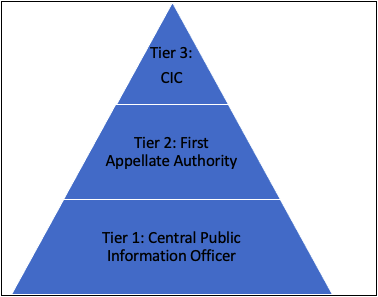
  • Organizational structure is as follows:
  • Tier 1: The Public information officer is responsible for providing information to an RTI applicant within 30 days of receipt of request.
  • Tier 2: It is designated as First Appellate Authority, the applicant who does not receive the required information or is aggrieved by the decision of CPIO can file an appeal within 30 days.
  • Tier 3: At third tier, Central Information Commissioner has been appointed as the apex body under RTI Act 2005. If the applicant is not satisfied or does not receive any order from First Appellate Authority, he/she can file Second appeal within 90 days.

WXWL12UDo05RAUK1pLMFVPiQDRGCoCErxUEL0YuufsrTKbxnTmtTa jTJ5VNVeatIS TypVLpUzAkyLyZvQ51D2Qu8bYQqSwsYBtBgfA5zNoDsjDJWG8mwYInlRu5yt fQiKiuoP1f5

Benefits of RTI Act

  • Accountability: Empowers Citizens to hold government accountable for non- performance of their duties by providing citizens access to government files and records.
  • Participative Decision Making: Allows citizens to participate in decision making process and shape public opinion through access to important information.
  • Accessible to marginalized: Helps marginalized and vulnerable sections in demanding their basic rights and access to important government services and welfare schemes.
  • Proactive governance: Discloses steps taken by governments in times of crisis – e.g.: food, medicines, healthcare facilities provided during pandemic or disasters, steps taken during COVID, natural disasters.
  • Empowers citizens: Citizens and NGOs in the past have used information to file writ petitions in Courts against instances of misgovernance, non- implementation of various rules or laws or even schemes, lack of access to government services etc.
  • Clean Governance: Expose extent of criminalization of politics and helped in de-criminalizing Indian politics through important SC judgments.
  • Exposes corruption and scandals:  Adarsh Housing Society Case, 2G case, Commonwealth Games Case etc.
  • Universalized regime of rights: RTI Act has ensured application of Article 19 of Universal Declaration of Human Rights.
  • Bridges the gap between information seeker and information provider.

Issues arising in the functioning of RTI Act

  • Amendment in 2019: Amendment in 2019 have considerably diluted the powers of CIC/SICs with respect to appointment, tenure, and service conditions. (Earlier CICs conditions of service were similar to the Election Commissioners).
  • Pendency: There is a pendency of more than 19,000 complaints with CIC as per the recent data, which account for average waiting period of 2 years for disposal of cases.
  • Vacancy: Vacancy of seats against the sanctioned strength of 10 (CIC), at state level, 25% of the posts of information commissioners are vacant.
  • Recruitment of retired bureaucrats: Commissions have become parking lot of retired bureaucrats considered as close to ruling party. Since most bureaucrats are accultured in secrecy, they tend to favour non-disclosure of information.
  • Low disposal rates and opaque functioning: SICs have been accused of low disposal rates in the appeal matters.
  • Defunct offices: The offices of SIC Jharkhand, Tripura and Telangana have been defunct of over three years.
  • Lack of digital infrastructure: Only 11 information commissions out of 29 provide e-filing facility for RTI applications or appeals, but only five are functional. 
  • No imposition of penalties: A study on penalties imposed found that the commissions didn’t impose penalties in 95% of the cases where penalties were potentially imposable.
  • Improper file management: Ineffective record management system particularly in state field offices/departments.
  • Conflict of interest of PIOs: PIO is a functionary of the office from which the information is sought. This often prevents him to divulge critical information affecting his colleagues.
  • Conflict with OSA: Legislations such as OSA restrict the free flow of information.
  • Suo moto disclosure: Reluctance of authorities, especially at state level for Suo moto disclosure, maintenance of records which is duly catalogued and accessible.
  • Intimidation and threat by the person in power and by political parties

Suggestions:

  • Open data regime: Government should follow Open data policy and proactive disclosure to increase transparency at maximum possible instances.
  • Capacity building: through continuous training and issuance of guidelines to CPIOs to dispose of information at the first stage itself.
  • E-courts and video conferencing: for early hearing of second appeals/complaints.
  • Digitization of records: electronic receipt of cases to enhance efficient delivery of information.
  • Social audits can be carried out with respect to the functioning of CIC/SICs.
  • Public Spirited individuals as Information Commissioners: The need is for the commission to have public spirited individuals as information commissioners.